 NihontoWatchNihontoWatch
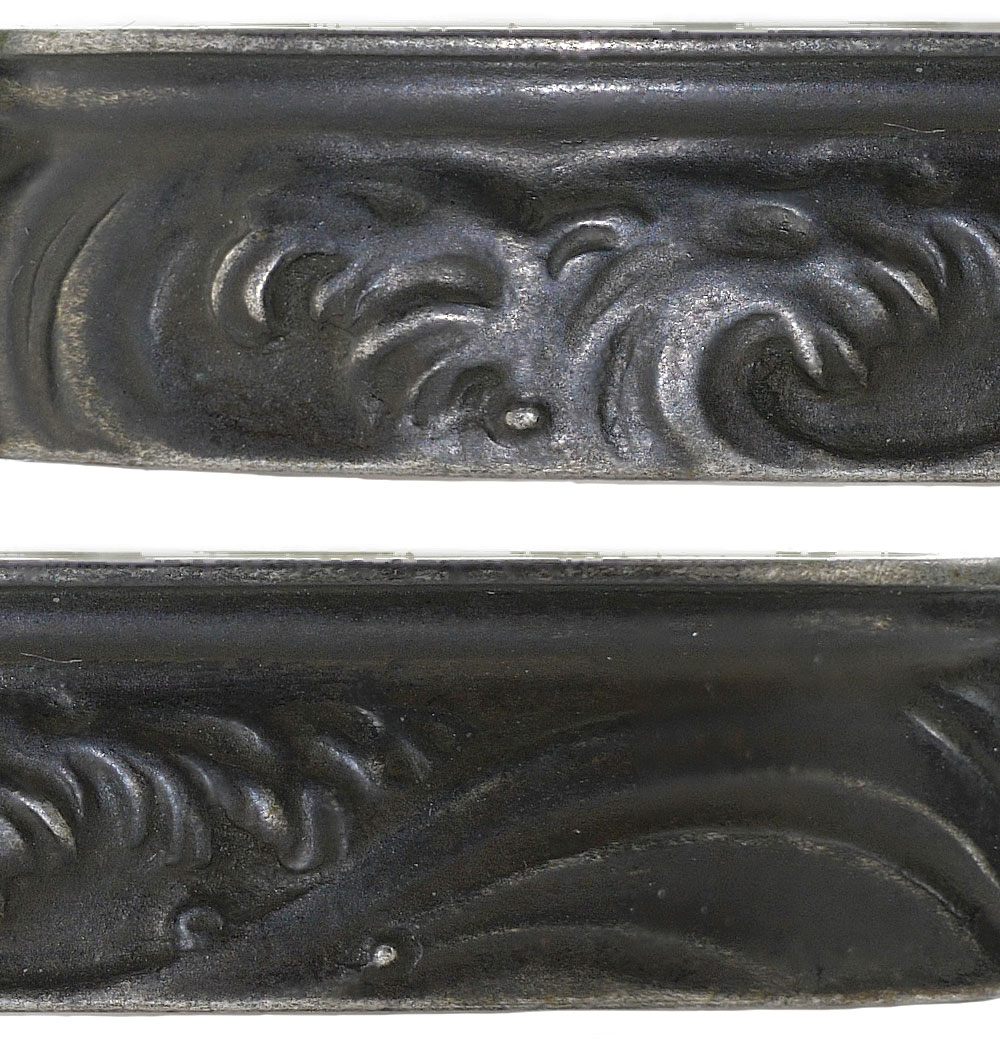
I believe it is not good to introduce kodogu based solely on imagery, but please understand that for this work, I am aware of potential criticism as the description tends to focus on imagery. The maker of this work is Nobuyoshi. He was a pupil of Iwama Masayoshi, and also studied under Iwama Nobuyuki, who later became the adopted son of Masayoshi. He took the characters "Nobu" and "Yoshi" from his two teachers respectively to name himself Nobuyoshi. His works are often in shibuichi or shakudo, and he excelled at nikubori on migaki-ji, though there also seem to be works in shishiaibori and katakiri hira-zogan. Masayoshi and Nobuyuki are quite famous kinko. Nobuyoshi, having received instruction from those two, also seems to have earned high praise, and he is indeed skilled. Let us glimpse that technique through this work. The jigane is shibuichi, and it is a somewhat small-sized fuchigashira. Both the fuchi and kashira have a low koshi, and at first glance, the shape makes one think it might be a Higo fuchigashira. The taihai of the tsukuri is thick-walled, which is likely the nikuoki related to the hori I will mention later. Looking at the fuchi from the side, the side where the tsuka fits (the lower side) is constricted, and a ko-beri is provided. Looking closely at this ko-beri, it is double-layered. This treatment is skillful. This tsukurikomi work is also applied to the kashira, and both show magnificent workmanship. I called it workmanship, but this is hori, and like the carving of the gates, it is delicate and polite. And as for the crucial carving of the mon... while the kanteisho describes it as sukidashibori, I feel it might be better to call it takabori. Well, regarding the issue of terminology in this area, either is fine. In this carving, there is almost no difference in height on the kashira. On the fuchi, the main side gives an image of somewhat effective contrast, but both are works that overall attempt expression through the shadows of shallow irregularities, where the edges of the height differences melt into the hirachi like a gradation. One is surprised by the skill that can express so much with only a very slight difference in height. The theme is hatou and murakumo. Perhaps he imagined a tsuka shape sandwiched between the fuchigashira, representing a way of life or thoughts existing between the sea and the sky. The composition of the theme also utilizes the margins of yohaku, and could be taken as implying expanding possibilities. However, this composition might be a Japanese-style wabi-sabi method. By the way, for this carving, there is no uchidashi from the back. It is formed purely by carving alone. In a sense, it can be said to be a quite luxurious and well-tailored construction. How do you find this texture? It is as if one is looking at a landscape shrouded in mist. It seems Nobuyoshi indeed possesses the skill to be highly evaluated. Ah, I almost forgot... a kao is carved along with the mei, but this kao is not under the mei or on the opposite side, but is carved alone directly beneath the nakago-hitsukan. Does he always carve the kao in this location when carving fuchigashira? At present, our shop has no other works by him, so we cannot compare. If anyone can provide information regarding similar examples, I would be grateful if you could let me know.
Offered by Asahi Token

Iwama Nobuyoshi is a name with Jūyō-designated work, and we couldn’t find current papers for this piece. Treat the name as unproven until papers say otherwise. It mentions papers that aren’t in our records yet; only current NBTHK or NTHK shinsa papers would settle the name. — Hoshi Ask me first
32 on the market

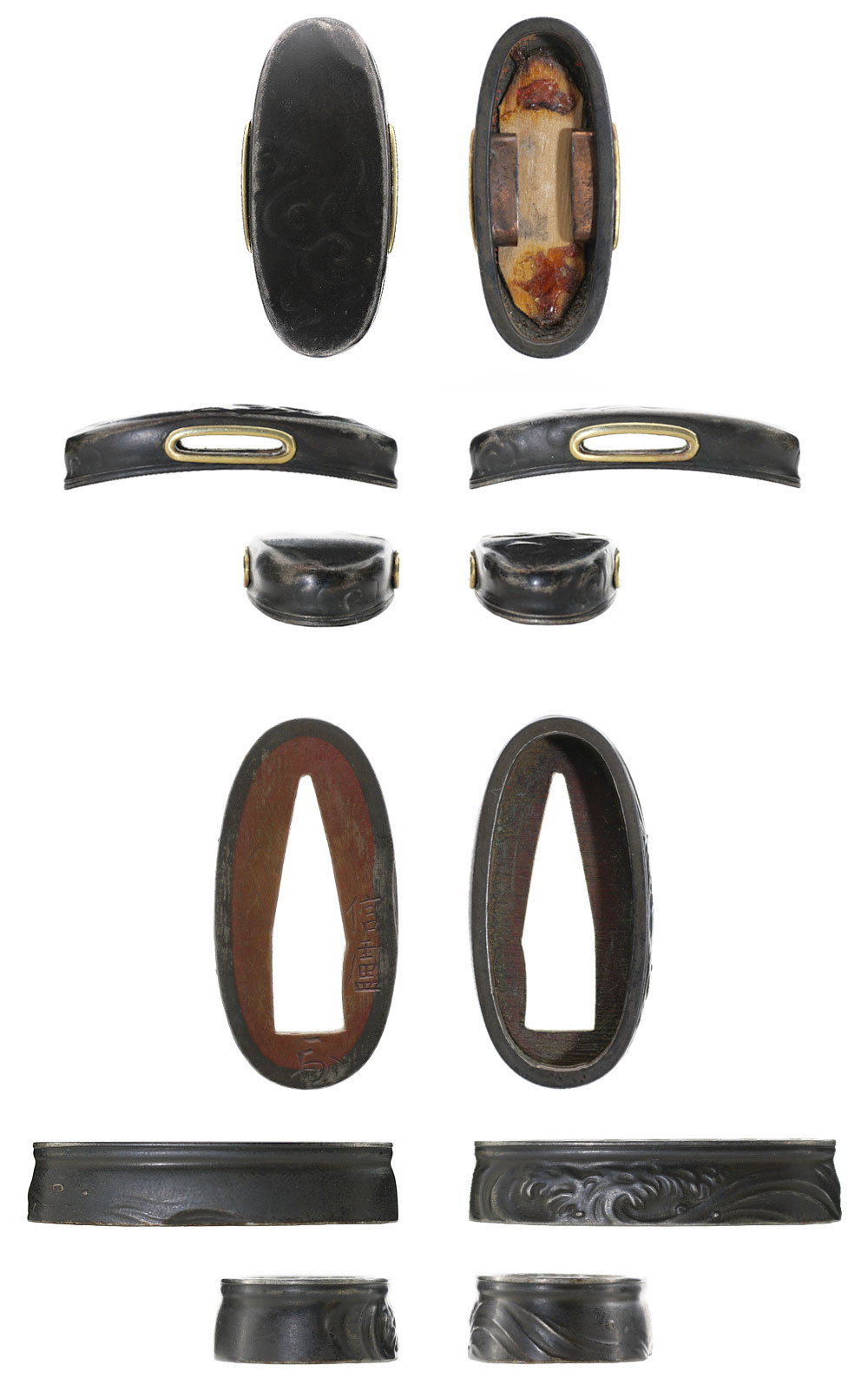
Edo
Signed
As written by the shop
Machine translation from the shop's Japanese · may contain errors ·
Machibori · Musashi · around 1670
1 piece on the market now
Where Nobuyoshi stands among comparable artisans: across all of nihontō, and within tradition, era, and period. The tiers (Foremost · Leading · Major · Notable) weigh official designations from the NBTHK and Japan's Agency for Cultural Affairs, together with historical honors of lasting repute such as the Sansaku and Meibutsu-chō.
Select a lens to see how it's measured.
Machibori · Edo
32 pieces on the market now
The Hamano school of machibori carving was established in mid-Edo Edo by Hamano Masazui (浜野政隨), commonly known as Tarōbei, an exceptionally gifted pupil of Nara Toshihisa. As the Edo Kinkō Meifu states of him that he "thunders through the world," Masazui won widespread renown as one of the "Four Guardian Kings of Nara" (Nara Shitennō). Training many disciples and employing numerous art names—including Otsuryūken, Aji-zumi, Kankei, Rifūdō, Yūkotei, Shūhōsai, Hankei-shi, and Isshunan—he formed what came to be known as the Hamano school, establishing one of the principal lineages of machibori artistry and founding an independent house. " Works are rendered by means of yōbori (sculptural carving) upon varied grounds—gold-and-silver imo-tsugi-ji, solid gold (kinmuku)—with details frequently treated in the in'yō-kon mode, suggesting the early Gotō masters as models.
The carving is executed with "ample, well-judged volume (nikudori)" and "exceptionally full, weighty presence," while applied metal (okigane) in silver and shakudō with shakudō iroe tightens pictorial fields and imparts additional movement. Later Hamano artists such as Katsurano Akafumi maintained this technical versatility, favoring polychrome inlay applied to high-relief compositions. " The NBTHK repeatedly notes that works "clearly demonstrate the high level of technique," "amply demonstrate advanced technical mastery," and possess "a composed dignity"—attestations to the school's sustained excellence across generations and its enduring place within the broader machibori tradition. Learn more →
| Smith | Era | Designated |
|---|---|---|
| Shozui政随 | — | 17 |
| Sekibun赤文 | 1670 | 8 |
| Noriyuki矩随 | — | 4 |
| Naotoshi直寿 | — | 0 |
| Naoharu直春 | — | 0 |
We could not find an authenticity certificate on the seller’s listing. Japanese swords and fittings are normally papered by the NBTHK (or the NTHK). Without one, the attribution is the seller’s own assessment and has not been independently verified — treat it with caution and ask the dealer about certification before buying.
Returns are accepted within 7 days of the item's arrival, provided its condition has not changed since the time of sale. Once the return is confirmed, the payment is promptly refunded to your designated account.
¥200,000