 NihontoWatchNihontoWatch
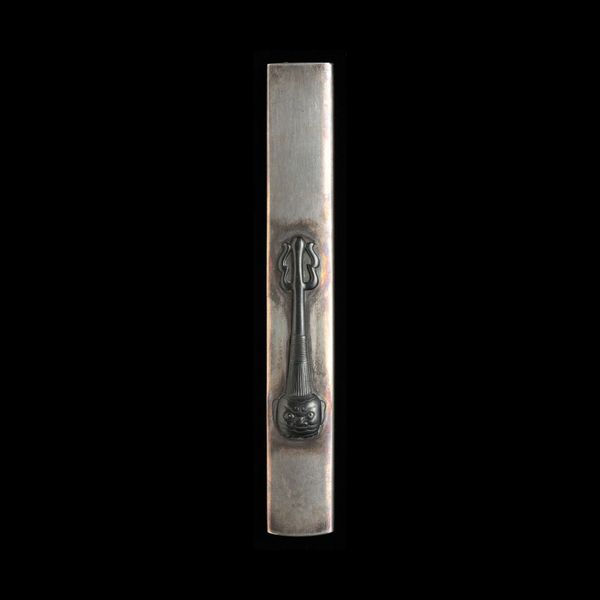
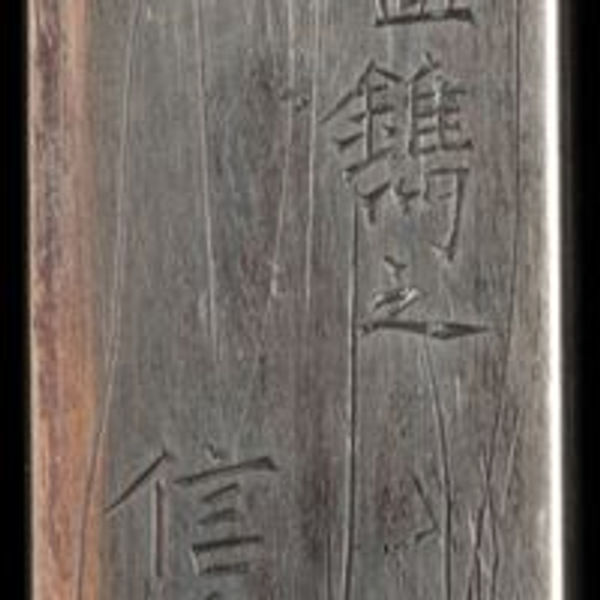
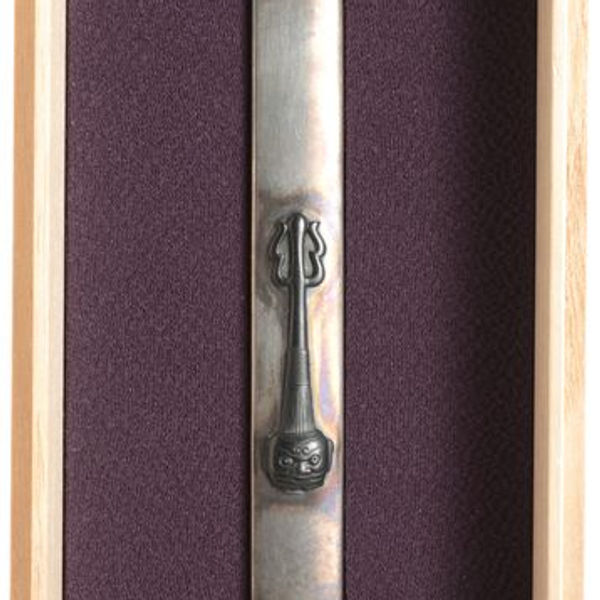
何だろう、これは。誰もがチラッと思うのではないか。「ハクション大魔王の魔法の壺みたい。」小柄の裏面には「拠古図鐫之 (古図に拠りて之を鐫る)」とある。では、古図とは?江戸時代中期以降に高まった好古の潮流。学者や好事家は出土品や伝世品の古鈴にも関心を寄せ、収集し記録を取り、互いに模写しあった。駅鈴、古鈴に関する書籍も刊行されており、松平定信が編纂させた『集古十種』にも鹿島正統寺蔵の古鈴として鬼面を表した特徴のある鈴が所載されている。これは三鈷鐃(さんこにょう)という密教の法具。本作とよく似ている。銀磨地の地板は時を経て黒味を帯びた落ち着きのある色合いとなり、際端を絞った立体的な赤銅地高彫の存在感を際立たせている。一度見たら忘れないユニークな作である。享保三年(1803年)生まれの岩間信盧は、どこでこの図を見たのだろう。想像するのも楽しい。信盧は遠山直隨と浜野本家に学んだ岩間政盧の門人。後に法橋と法眼の位に叙された。
NihontoWatchOffered by Choshuya
This piece has sold
Get an email when a new Iwama Nobuyoshi piece hits the market.

Iwama Nobuyoshi
Edo
Musashi
Signed
Hozon (NBTHK)
As written by the shop
Machibori · Musashi · around 1670
1 piece on the market now
Where Nobuyoshi stands among comparable artisans: across all of nihontō, and within tradition, era, and period. The tiers (Foremost · Leading · Major · Notable) weigh official designations from the NBTHK and Japan's Agency for Cultural Affairs, together with historical honors of lasting repute such as the Sansaku and Meibutsu-chō.
Select a lens to see how it's measured.
Machibori · Edo
32 pieces on the market now
The Hamano school of machibori carving was established in mid-Edo Edo by Hamano Masazui (浜野政隨), commonly known as Tarōbei, an exceptionally gifted pupil of Nara Toshihisa. As the Edo Kinkō Meifu states of him that he "thunders through the world," Masazui won widespread renown as one of the "Four Guardian Kings of Nara" (Nara Shitennō). Training many disciples and employing numerous art names—including Otsuryūken, Aji-zumi, Kankei, Rifūdō, Yūkotei, Shūhōsai, Hankei-shi, and Isshunan—he formed what came to be known as the Hamano school, establishing one of the principal lineages of machibori artistry and founding an independent house. " Works are rendered by means of yōbori (sculptural carving) upon varied grounds—gold-and-silver imo-tsugi-ji, solid gold (kinmuku)—with details frequently treated in the in'yō-kon mode, suggesting the early Gotō masters as models.
The carving is executed with "ample, well-judged volume (nikudori)" and "exceptionally full, weighty presence," while applied metal (okigane) in silver and shakudō with shakudō iroe tightens pictorial fields and imparts additional movement. Later Hamano artists such as Katsurano Akafumi maintained this technical versatility, favoring polychrome inlay applied to high-relief compositions. " The NBTHK repeatedly notes that works "clearly demonstrate the high level of technique," "amply demonstrate advanced technical mastery," and possess "a composed dignity"—attestations to the school's sustained excellence across generations and its enduring place within the broader machibori tradition. Learn more →
| Smith | Era | Designated |
|---|---|---|
| Shozui政随 | — | 17 |
| Sekibun赤文 | 1670 | 8 |
| Noriyuki矩随 | — | 4 |
| Naotoshi直寿 | — | 0 |
| Naoharu直春 | — | 0 |
Certifies a genuine fitting worth preserving: a correct signature, or, if unsigned, an identifiable era and school, with recognized artistic and craft value.
The NBTHK (Nihon Bijutsu Tōken Hozon Kyōkai, the Society for the Preservation of Japanese Art Swords) is a public-interest incorporated foundation founded in 1948 and supervised by Japan’s Agency for Cultural Affairs (Bunkachō); it is based at the Japanese Sword Museum in Tokyo. Its expert panels physically examine each submitted work (shinsa) and issue a certificate (kanteishō) ranking it by artistic and historical merit. NBTHK papers are the most widely recognized standard of authentication for Japanese swords and fittings.
NBTHK official siteIf, due to our fault, the item differs significantly from its proper condition, the item may be returned. Cooling-off is within one week of the item's arrival.