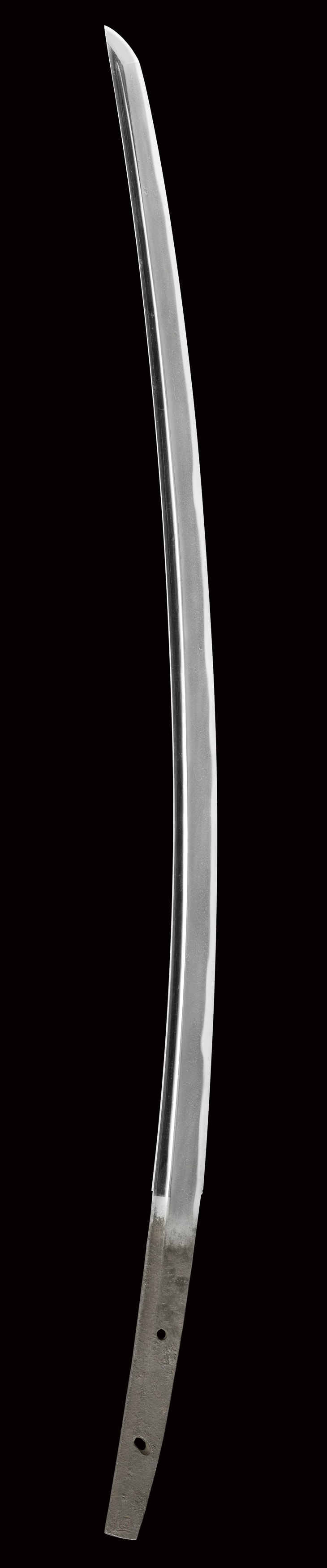
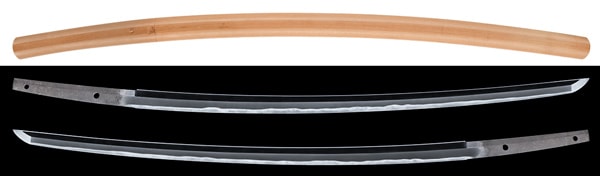
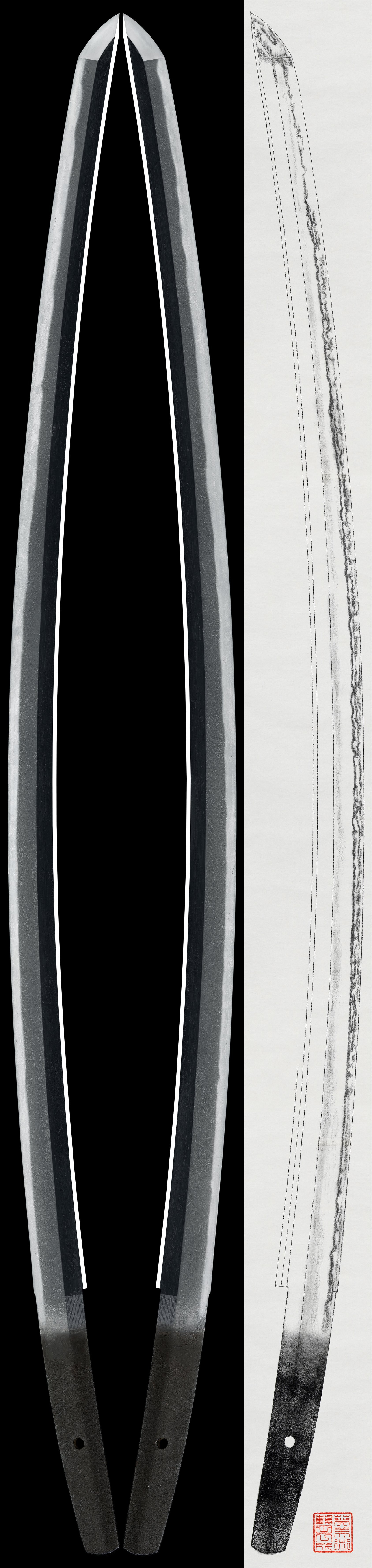
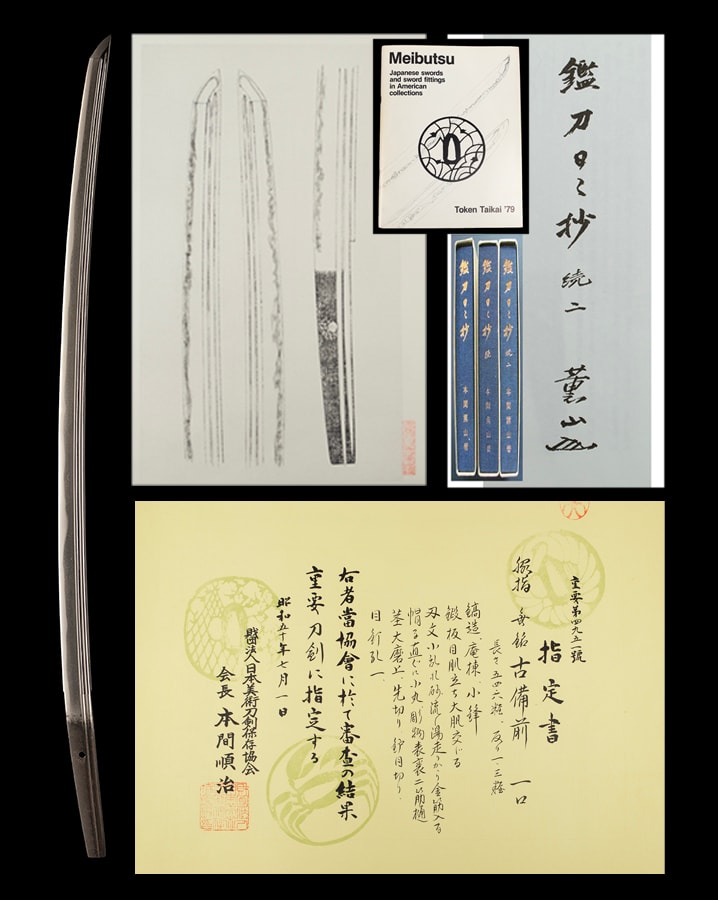
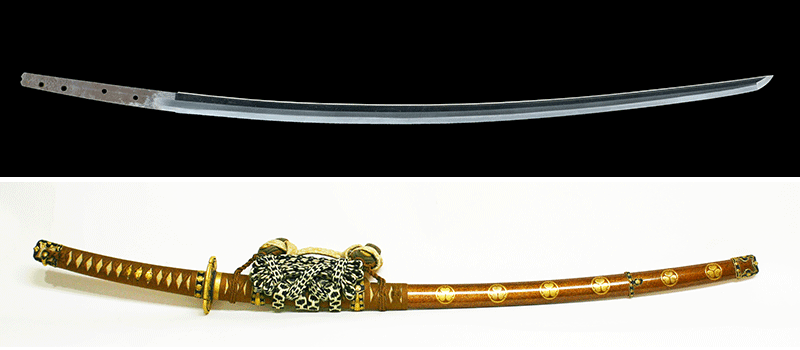
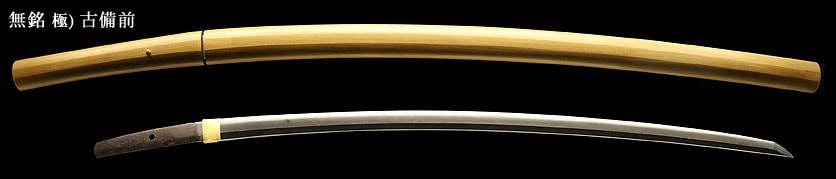
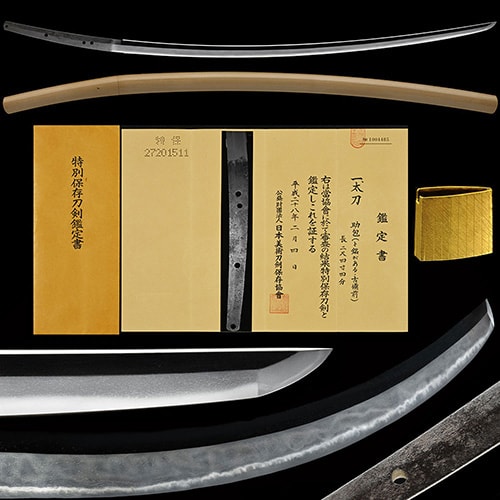
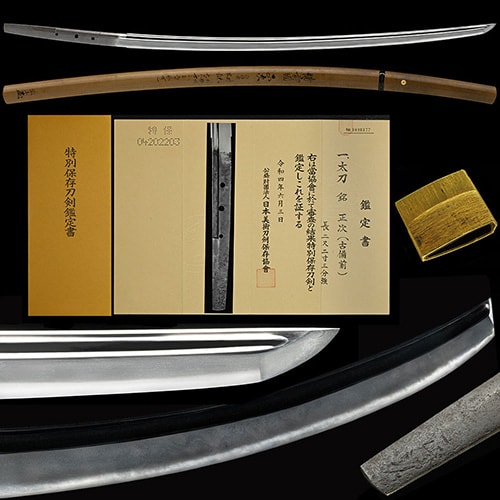
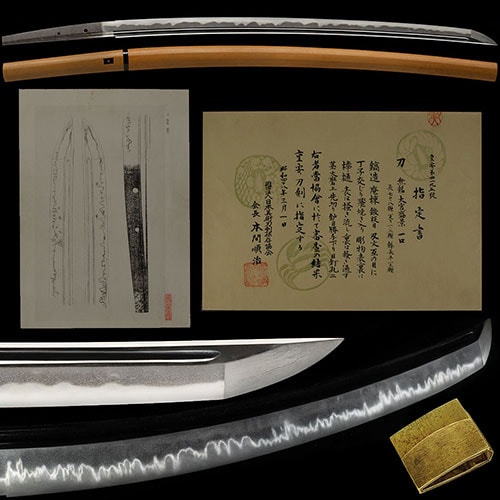
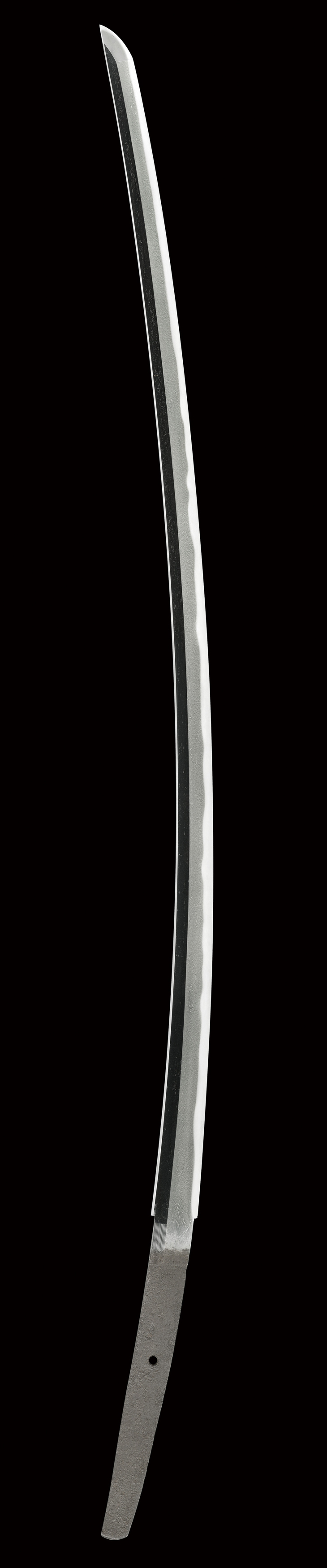
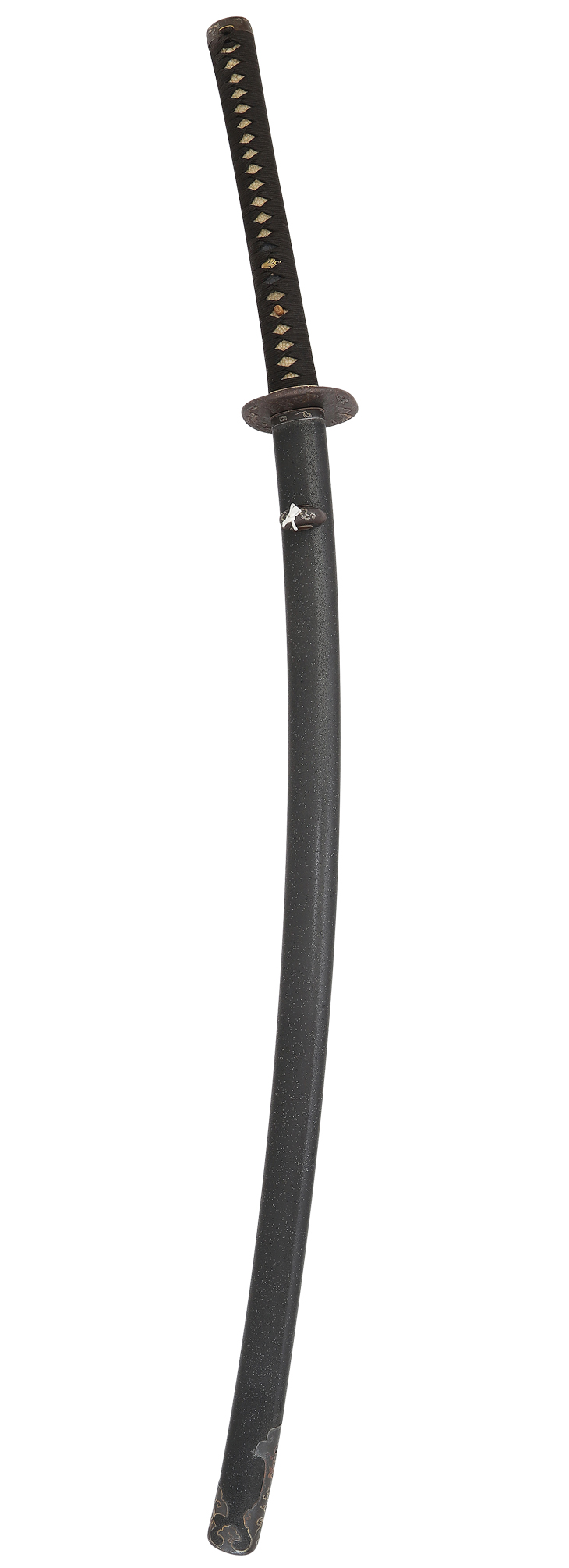
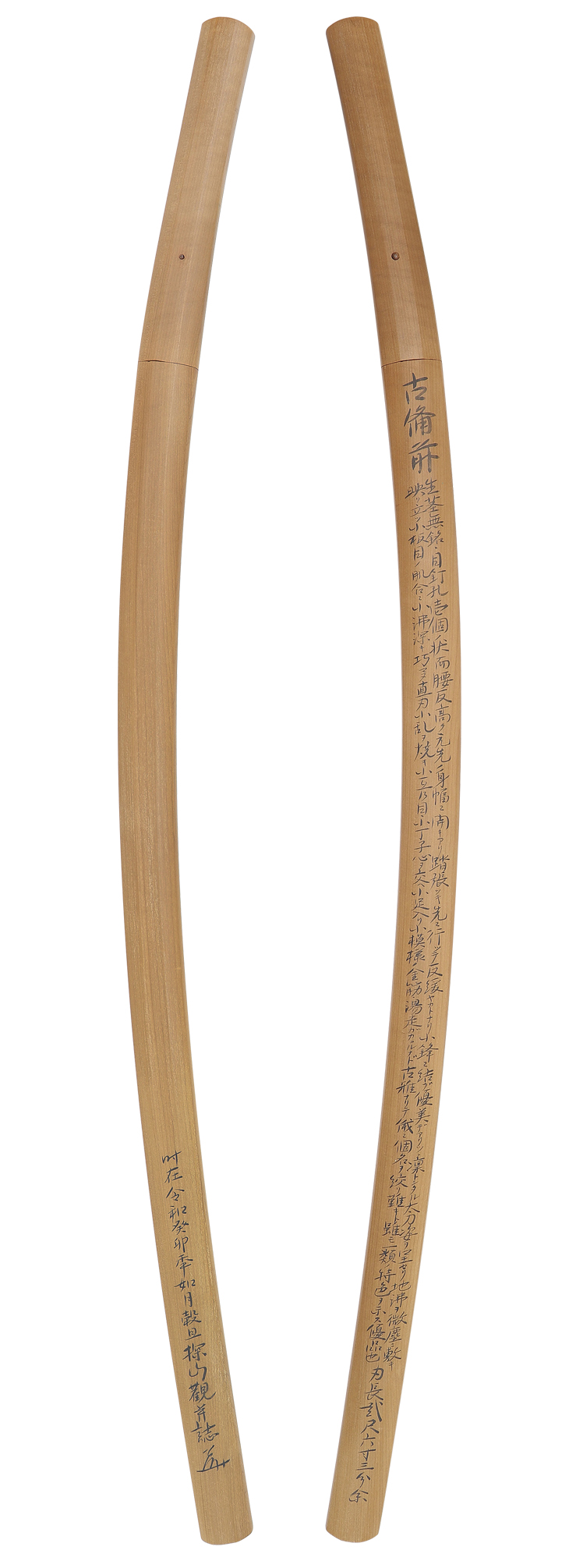
This is an ubu tachi attributed to the Ko-Bizen school, dating from the late Heian to early Kamakura period. It features a nagasa of 79.8cm, a deep koshi-zori, and a well-forged jitetsu with ji-nie and utsuri. The blade comes with a koshirae from the late Edo period and a Tokubetsu Hozon Token certificate.
 NihontoWatch
mumei · Kobizen · Koto · nagasa 79.8cm · sori 3.1cm
Bizen-den · Bizen
4 pieces on the market now
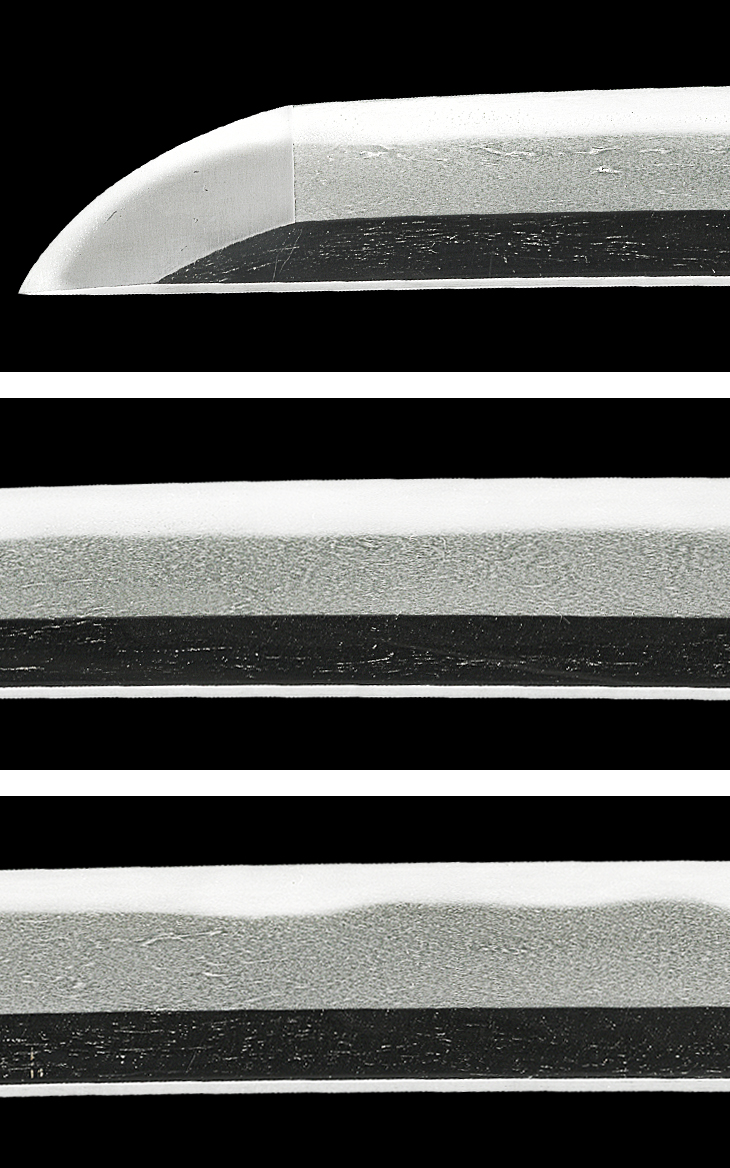
Ko-Bizen (古備前) is the oldest stratum of the Bizen tradition, the work of the smiths who forged in Bizen province from the late Heian period, around the Eien era, into the early and middle Kamakura. The published sources trace the line to a founding Tomonari and to Masatsune, the two counted from old as the twin pillars (sōheki) of the group, and they are careful to read each of the great names as a name-line rather than a single man: surviving tachi signed Tomonari carry Katei-era dates of the early Kamakura, the Masatsune name is transmitted across three generations or more, and the Kanehira and Sukehira signatures fall into distinct chisel hands. Beside the pillars stand the three Bizen Sanpei, Kanehira, Sukehira and Takahira, and a wider field of hands, Nobufusa, Naritaka, Yukihide, Sukekane, Yoshikane and the smiths of the Masatsune house such as Tsunemitsu, Toshitsune and Tochika. From this root, before the school's great flowering at Fukuoka, the whole Bizen tradition descends. Several of these names recur in the early Ichimonji line of the same province, so that the appraisal of any one of them begins by separating the archaic Ko-Bizen hand from its later namesake. The shared vocabulary is consistent enough that the school is read as a single manner held across many hands. The sugata is the slender tachi of the age: shinogi-zukuri with iori-mune, high koshizori with pronounced funbari, the curvature settling toward a small ko-kissaki. The forging is an itame mixed with mokume, the grain often standing a little (hada-dachi), with ji-nie adhering, chikei woven through, and over it the speckled jifu-utsuri or a midare-utsuri of old Bizen steel.
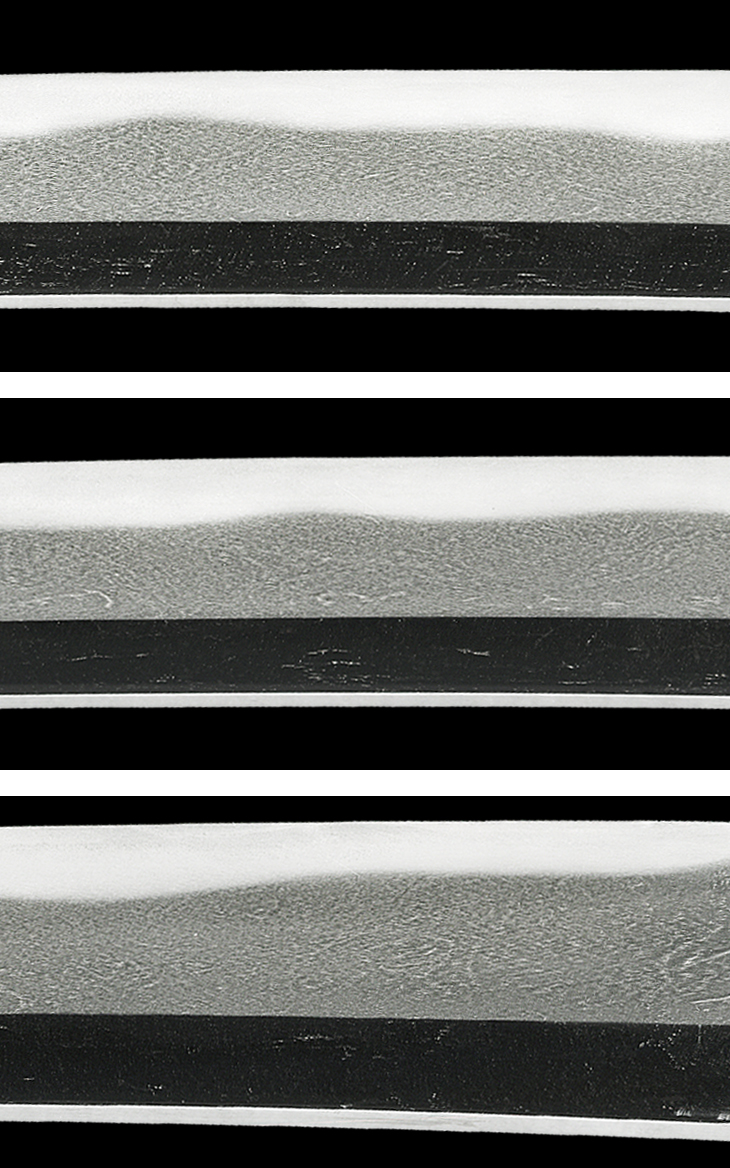
The temper is the quietest reading of Bizen: a suguha tone undulating shallowly into ko-midare, into which ko-chōji and ko-gunome enter, ko-nie adhering thickly, ashi and yō working in the ha, and kinsuji and sunagashi running through; the bōshi runs straight to a calm ko-maru, at times to yakizume with hakikake, and a yakiotoshi dropped above the machi is an archaic touch met across the group. Within that norm the early masters keep their individuality. The sources separate Tomonari and Masatsune by saying the first is marked by the excellence of his sugata and the second by the excellence of his kitae; Yoshikane is known by a hada that stands more than his fellows and a nioiguchi that sinks; Yukihide leans his midare in the reverse (saka) direction; Naritaka crowds the edge with uchinoke and a doubled nijūba; and Kageyasu sets angular gunome and chōji further forward than the pillars, the manner the earliest Ichimonji would inherit. A collector seeks Ko-Bizen as the source of the Bizen line, and the kantei turns on restraint rather than display. Against the later Fukuoka Ichimonji, whose flamboyant ō-chōji stand under a brilliant midare-utsuri, Ko-Bizen keeps its ko-midare quiet and its nie archaic; against the Osafune line of Nagamitsu, which is nioi-based and utsuri-bearing, the Ko-Bizen edge is nie-deki, a distinction the published record makes the whole ground for separating Junkei from the man he was long mistaken for. The standing of the best members is fixed by the weight of designation behind their names: Tomonari, Masatsune, Kanehira and Nobufusa are graded Sai-jo saku by Fujishiro, and the school's summit is the Ō-Kanehira, the broadest and most powerful tachi old Bizen produced, a National Treasure long held as the patrimony of the Ikeda house and now in the Tokyo National Museum. The signature works carry provenance through the first houses of the realm, the Imperial Household, the Tokugawa shogunal family, and the Ikeda, Maeda, Date, Shimazu and Satake daimyo, with the Nobufusa tachi given by Ieyasu to Sakai Tadatsugu and the Naritaka blade transmitted as the wearing sword of Nasu no Yoichi. Because so much of the corpus is held as heritage and the signed early hands are scarce, a signed Ko-Bizen tachi reaching open hands is among the rarer encounters the field affords, a document of how the Bizen tradition began. Learn more →
| Smith | Era | Designated |
|---|---|---|
| Tomonari友成 | 987-989 | 33 |
| Masatsune正恒 | 987-989 | 66 |
| Kanehira包平 | 1151-1200 | 28 |
| Kageyasu景安 | 1222-1224 | 27 |
| Yoshikane吉包 | 1150-1220 | 46 |
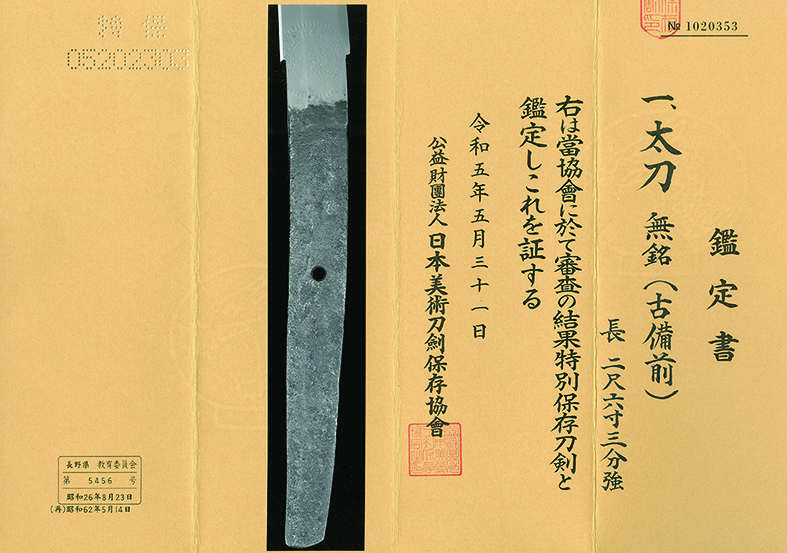
A Hozon-certified blade judged to show notably superior workmanship and a better state of preservation. The bar is higher: re-tempered blades and most unsigned Muromachi/Edo works are excluded.
The NBTHK (Nihon Bijutsu Tōken Hozon Kyōkai, the Society for the Preservation of Japanese Art Swords) is a public-interest incorporated foundation founded in 1948 and supervised by Japan’s Agency for Cultural Affairs (Bunkachō); it is based at the Japanese Sword Museum in Tokyo. Its expert panels physically examine each submitted work (shinsa) and issue a certificate (kanteishō) ranking it by artistic and historical merit. NBTHK papers are the most widely recognized standard of authentication for Japanese swords and fittings.
NBTHK official siteFor one-of-a-kind items such as swords, sword fittings, and antiques, please contact us about a return within 3 days of the item's arrival and ship it back within 8 days. Refunds are issued the same day the returned item arrives.

This is an ubu tachi attributed to the Ko-Bizen school, dating from the late Heian to early Kamakura period. It features a nagasa of 79.8cm, a deep koshi-zori, and a well-forged jitetsu with ji-nie and utsuri. The blade comes with a koshirae from the late Edo period and a Tokubetsu Hozon Token certificate.
NihontoWatchmumei · Kobizen · Koto · nagasa 79.8cm · sori 3.1cm
Bizen-den · Bizen
4 pieces on the market now
Ko-Bizen (古備前) is the oldest stratum of the Bizen tradition, the work of the smiths who forged in Bizen province from the late Heian period, around the Eien era, into the early and middle Kamakura. The published sources trace the line to a founding Tomonari and to Masatsune, the two counted from old as the twin pillars (sōheki) of the group, and they are careful to read each of the great names as a name-line rather than a single man: surviving tachi signed Tomonari carry Katei-era dates of the early Kamakura, the Masatsune name is transmitted across three generations or more, and the Kanehira and Sukehira signatures fall into distinct chisel hands. Beside the pillars stand the three Bizen Sanpei, Kanehira, Sukehira and Takahira, and a wider field of hands, Nobufusa, Naritaka, Yukihide, Sukekane, Yoshikane and the smiths of the Masatsune house such as Tsunemitsu, Toshitsune and Tochika. From this root, before the school's great flowering at Fukuoka, the whole Bizen tradition descends. Several of these names recur in the early Ichimonji line of the same province, so that the appraisal of any one of them begins by separating the archaic Ko-Bizen hand from its later namesake. The shared vocabulary is consistent enough that the school is read as a single manner held across many hands. The sugata is the slender tachi of the age: shinogi-zukuri with iori-mune, high koshizori with pronounced funbari, the curvature settling toward a small ko-kissaki. The forging is an itame mixed with mokume, the grain often standing a little (hada-dachi), with ji-nie adhering, chikei woven through, and over it the speckled jifu-utsuri or a midare-utsuri of old Bizen steel.
The temper is the quietest reading of Bizen: a suguha tone undulating shallowly into ko-midare, into which ko-chōji and ko-gunome enter, ko-nie adhering thickly, ashi and yō working in the ha, and kinsuji and sunagashi running through; the bōshi runs straight to a calm ko-maru, at times to yakizume with hakikake, and a yakiotoshi dropped above the machi is an archaic touch met across the group. Within that norm the early masters keep their individuality. The sources separate Tomonari and Masatsune by saying the first is marked by the excellence of his sugata and the second by the excellence of his kitae; Yoshikane is known by a hada that stands more than his fellows and a nioiguchi that sinks; Yukihide leans his midare in the reverse (saka) direction; Naritaka crowds the edge with uchinoke and a doubled nijūba; and Kageyasu sets angular gunome and chōji further forward than the pillars, the manner the earliest Ichimonji would inherit. A collector seeks Ko-Bizen as the source of the Bizen line, and the kantei turns on restraint rather than display. Against the later Fukuoka Ichimonji, whose flamboyant ō-chōji stand under a brilliant midare-utsuri, Ko-Bizen keeps its ko-midare quiet and its nie archaic; against the Osafune line of Nagamitsu, which is nioi-based and utsuri-bearing, the Ko-Bizen edge is nie-deki, a distinction the published record makes the whole ground for separating Junkei from the man he was long mistaken for. The standing of the best members is fixed by the weight of designation behind their names: Tomonari, Masatsune, Kanehira and Nobufusa are graded Sai-jo saku by Fujishiro, and the school's summit is the Ō-Kanehira, the broadest and most powerful tachi old Bizen produced, a National Treasure long held as the patrimony of the Ikeda house and now in the Tokyo National Museum. The signature works carry provenance through the first houses of the realm, the Imperial Household, the Tokugawa shogunal family, and the Ikeda, Maeda, Date, Shimazu and Satake daimyo, with the Nobufusa tachi given by Ieyasu to Sakai Tadatsugu and the Naritaka blade transmitted as the wearing sword of Nasu no Yoichi. Because so much of the corpus is held as heritage and the signed early hands are scarce, a signed Ko-Bizen tachi reaching open hands is among the rarer encounters the field affords, a document of how the Bizen tradition began. Learn more →
| Smith | Era | Designated |
|---|---|---|
| Tomonari友成 | 987-989 | 33 |
| Masatsune正恒 | 987-989 | 66 |
| Kanehira包平 | 1151-1200 | 28 |
| Kageyasu景安 | 1222-1224 | 27 |
| Yoshikane吉包 | 1150-1220 | 46 |
A Hozon-certified blade judged to show notably superior workmanship and a better state of preservation. The bar is higher: re-tempered blades and most unsigned Muromachi/Edo works are excluded.
The NBTHK (Nihon Bijutsu Tōken Hozon Kyōkai, the Society for the Preservation of Japanese Art Swords) is a public-interest incorporated foundation founded in 1948 and supervised by Japan’s Agency for Cultural Affairs (Bunkachō); it is based at the Japanese Sword Museum in Tokyo. Its expert panels physically examine each submitted work (shinsa) and issue a certificate (kanteishō) ranking it by artistic and historical merit. NBTHK papers are the most widely recognized standard of authentication for Japanese swords and fittings.
NBTHK official siteFor one-of-a-kind items such as swords, sword fittings, and antiques, please contact us about a return within 3 days of the item's arrival and ship it back within 8 days. Refunds are issued the same day the returned item arrives.