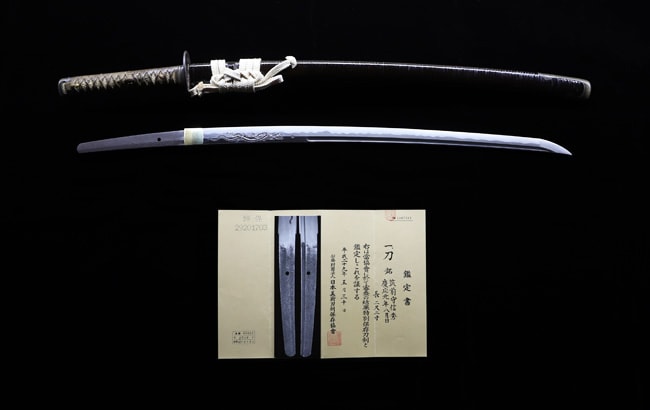

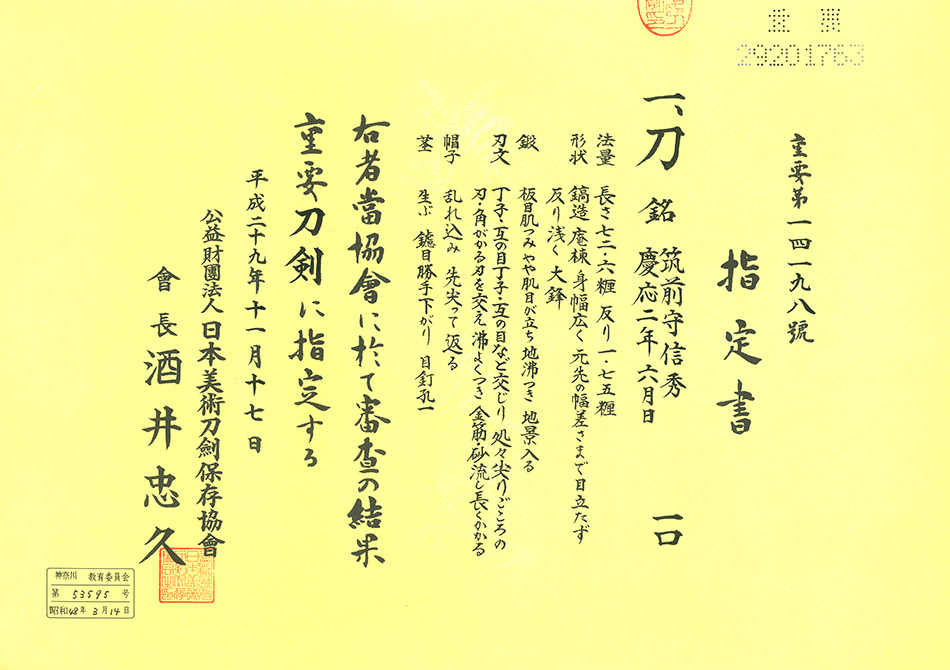
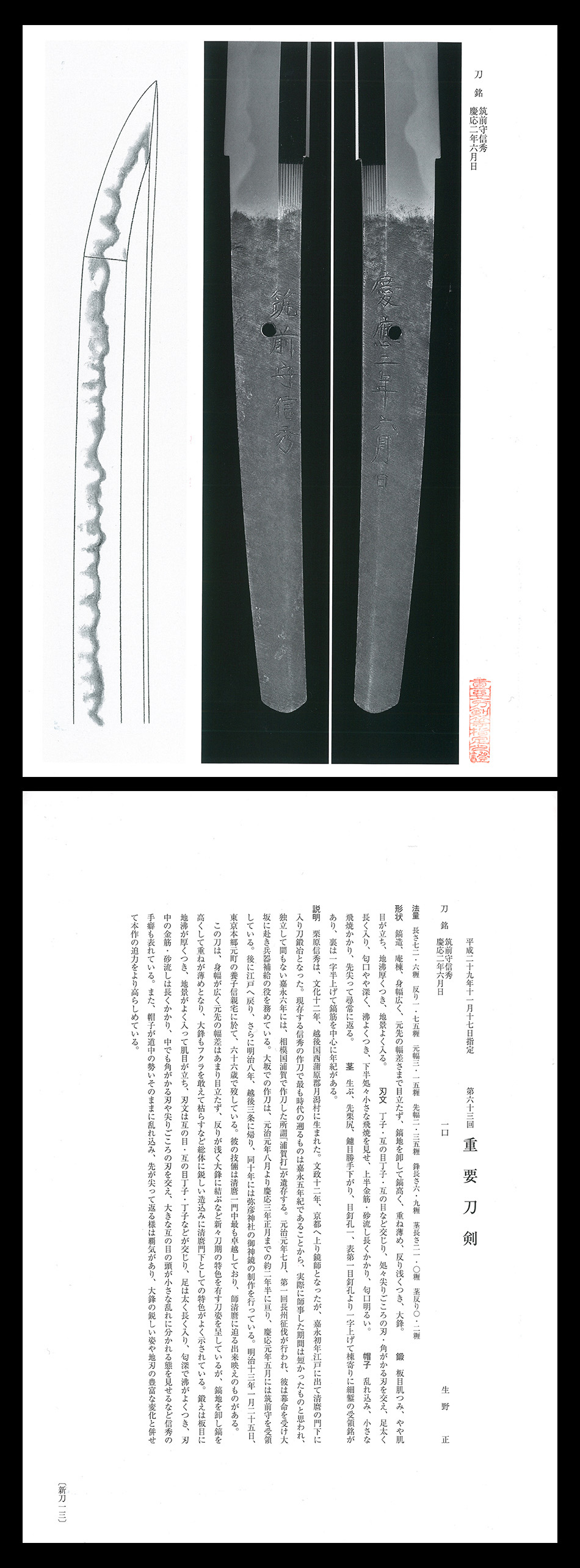
-, 63rd Session — Designated November 17, 2017
, : no Kami Nobuhide (筑前守信秀)
by Ikuno Tadashi (生野正)
Measurements 72.6 cm, 1.75 cm, 3.15 cm, 2.35 cm, 6.9 cm, 20.0 cm, 0.2 cm
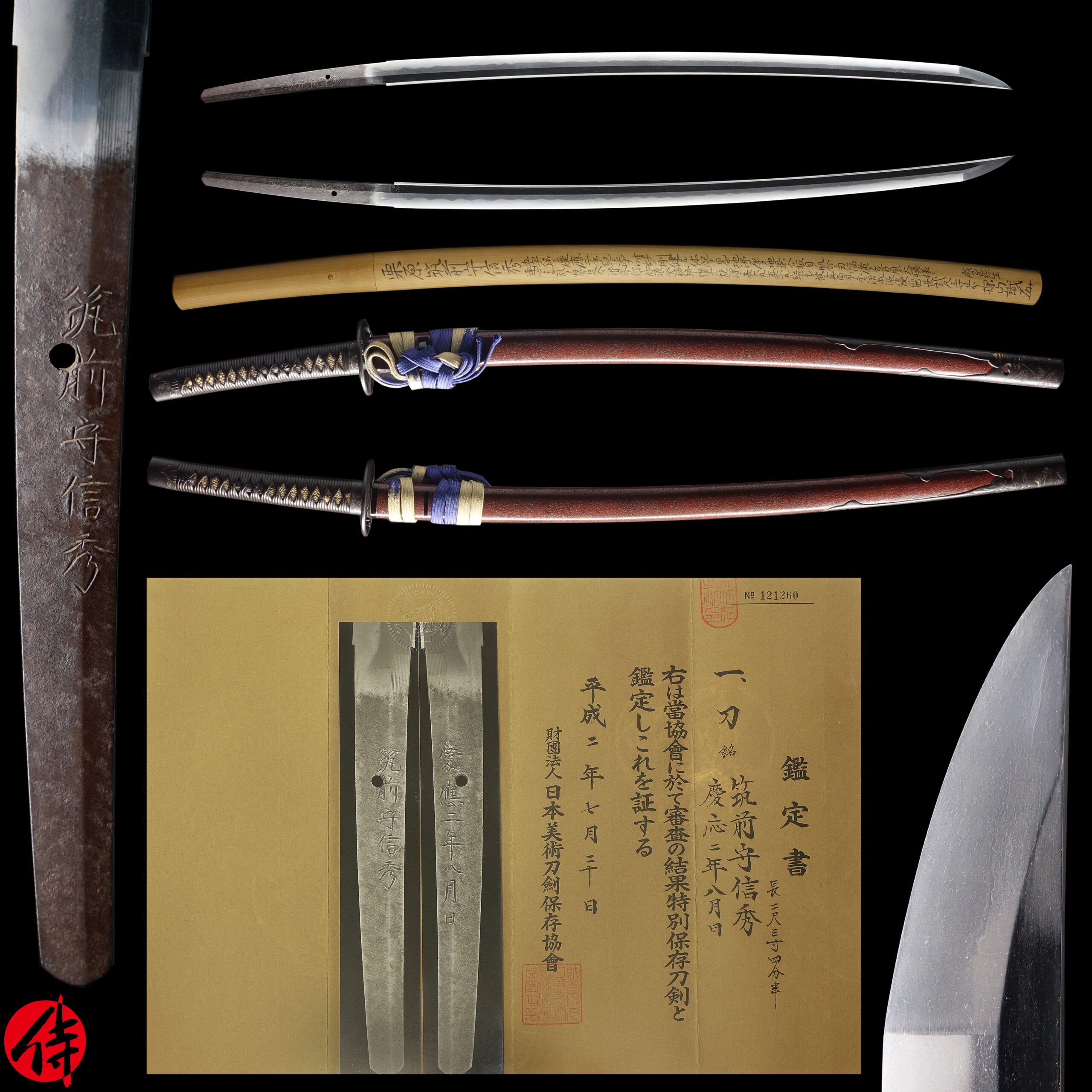
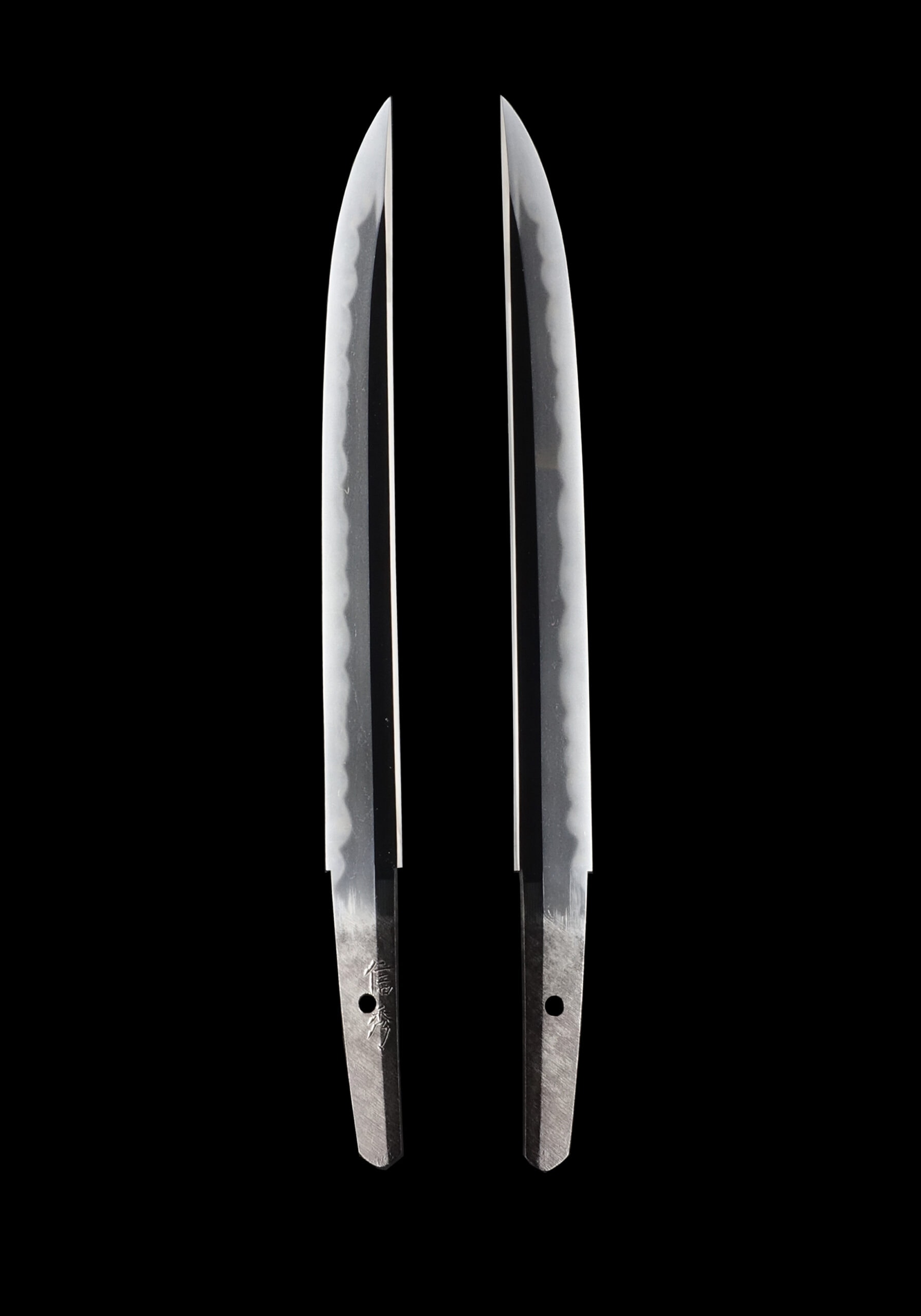
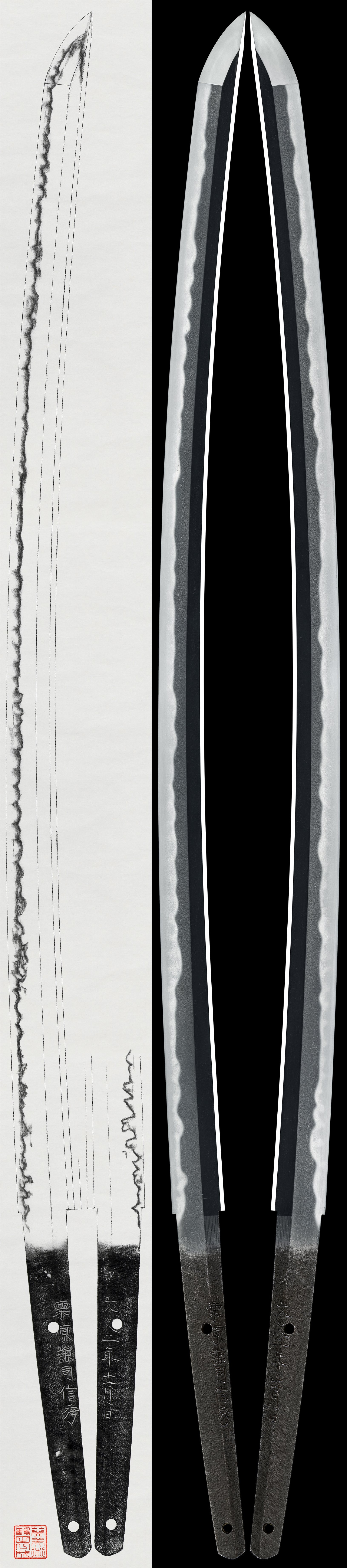
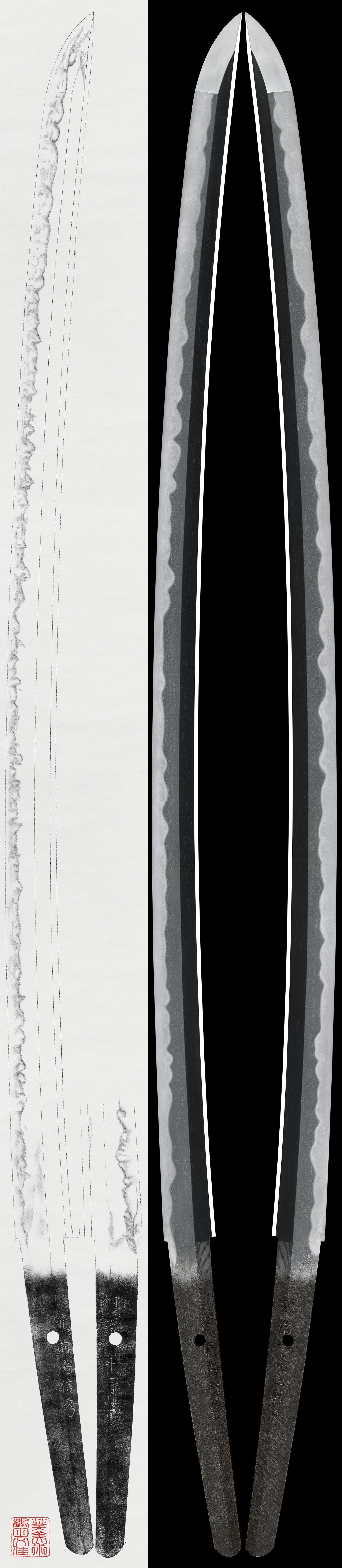
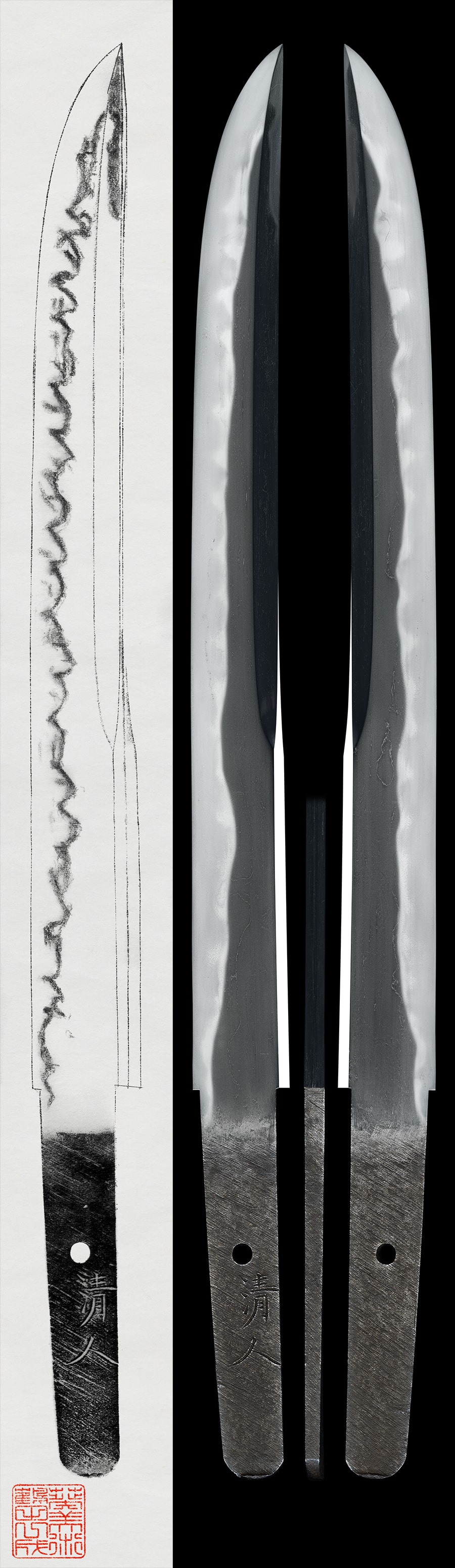
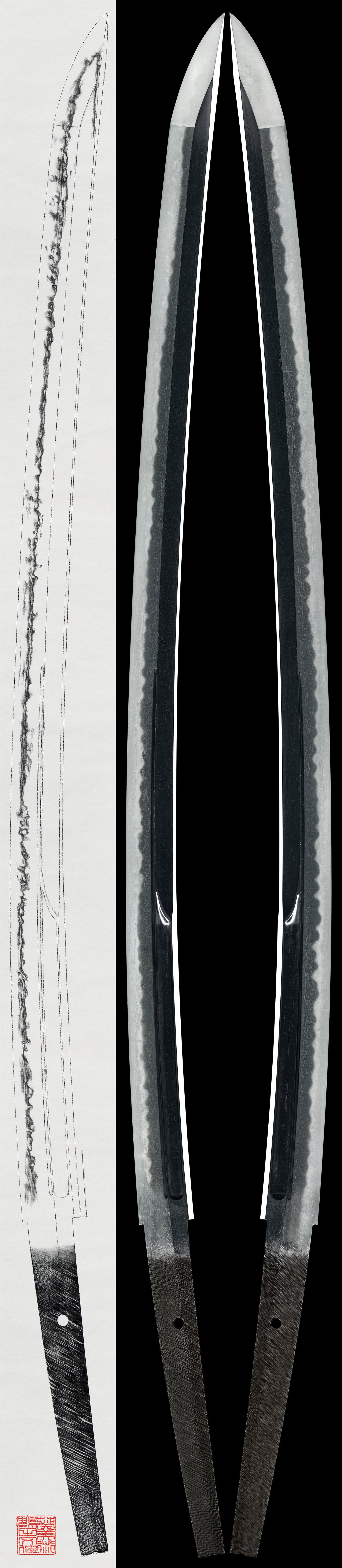
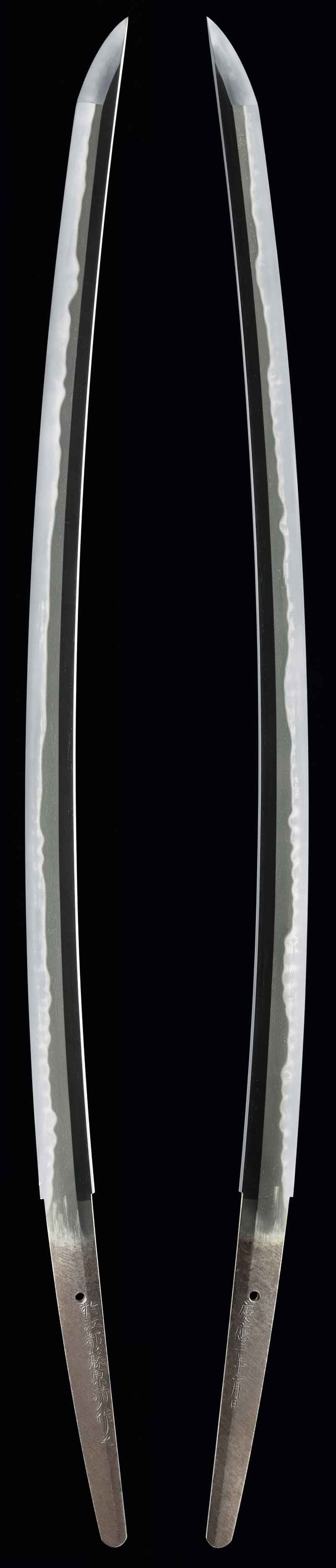
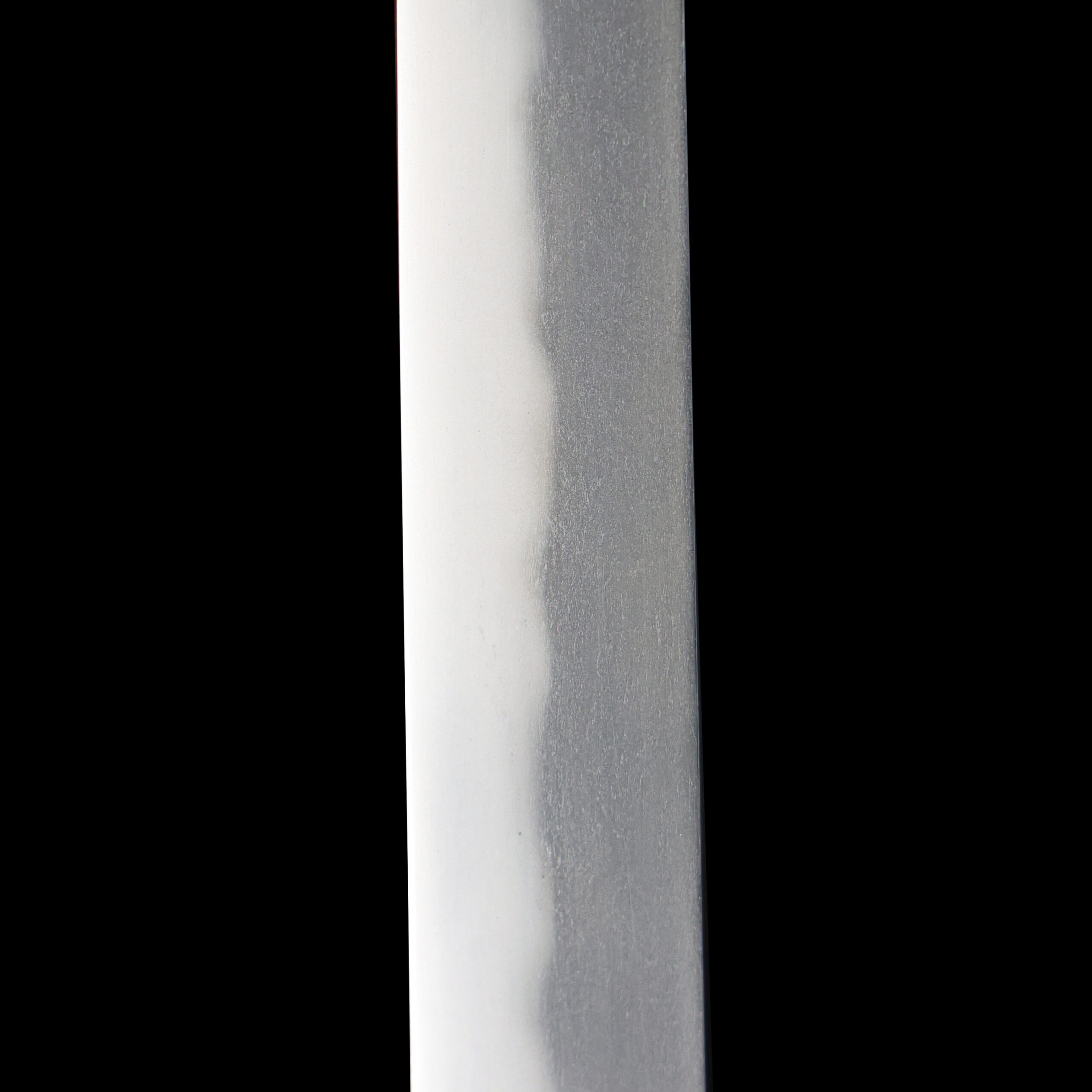
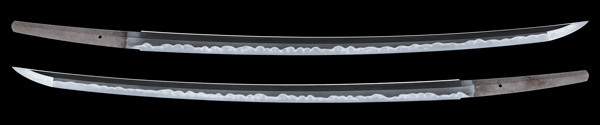
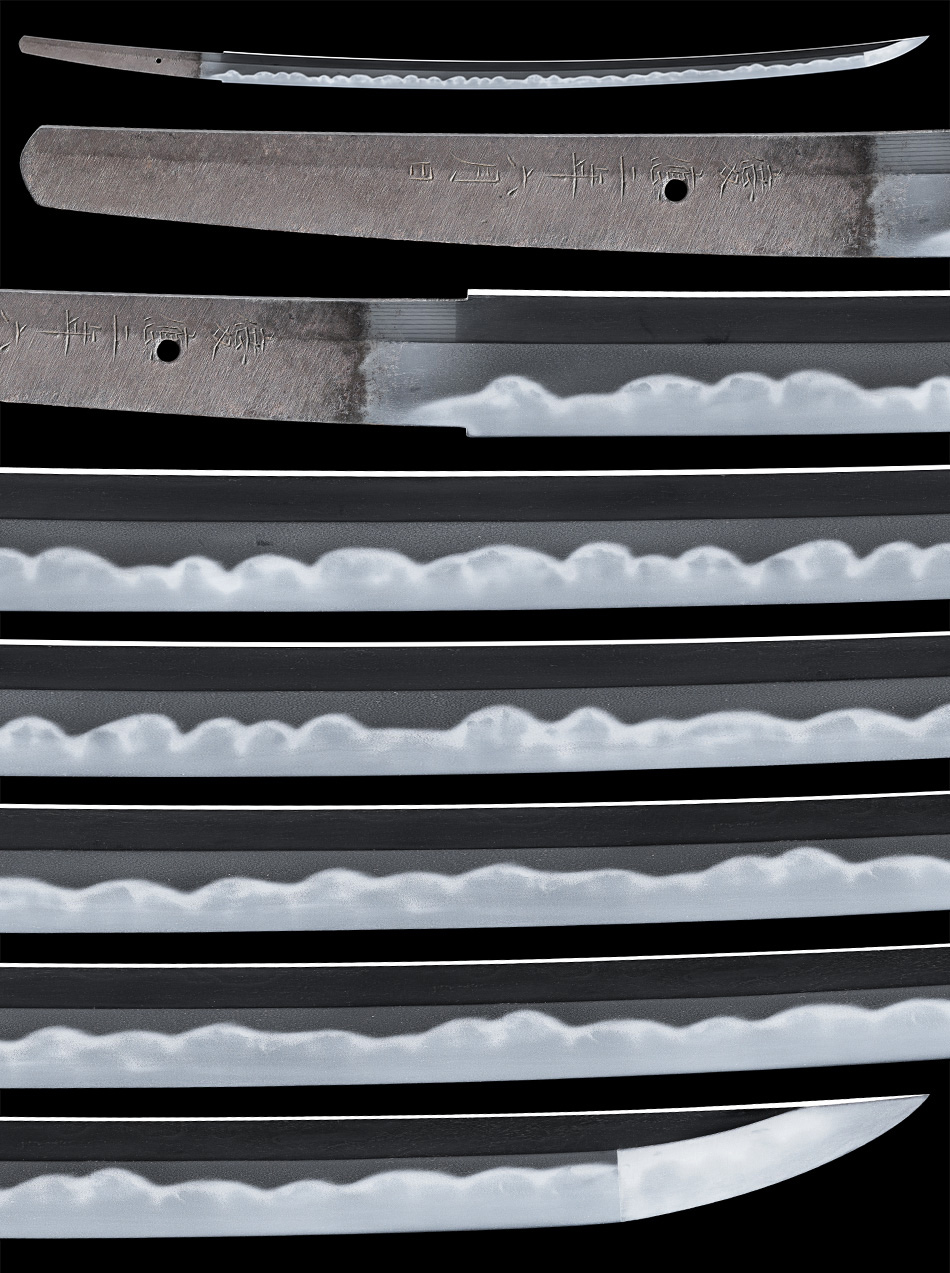
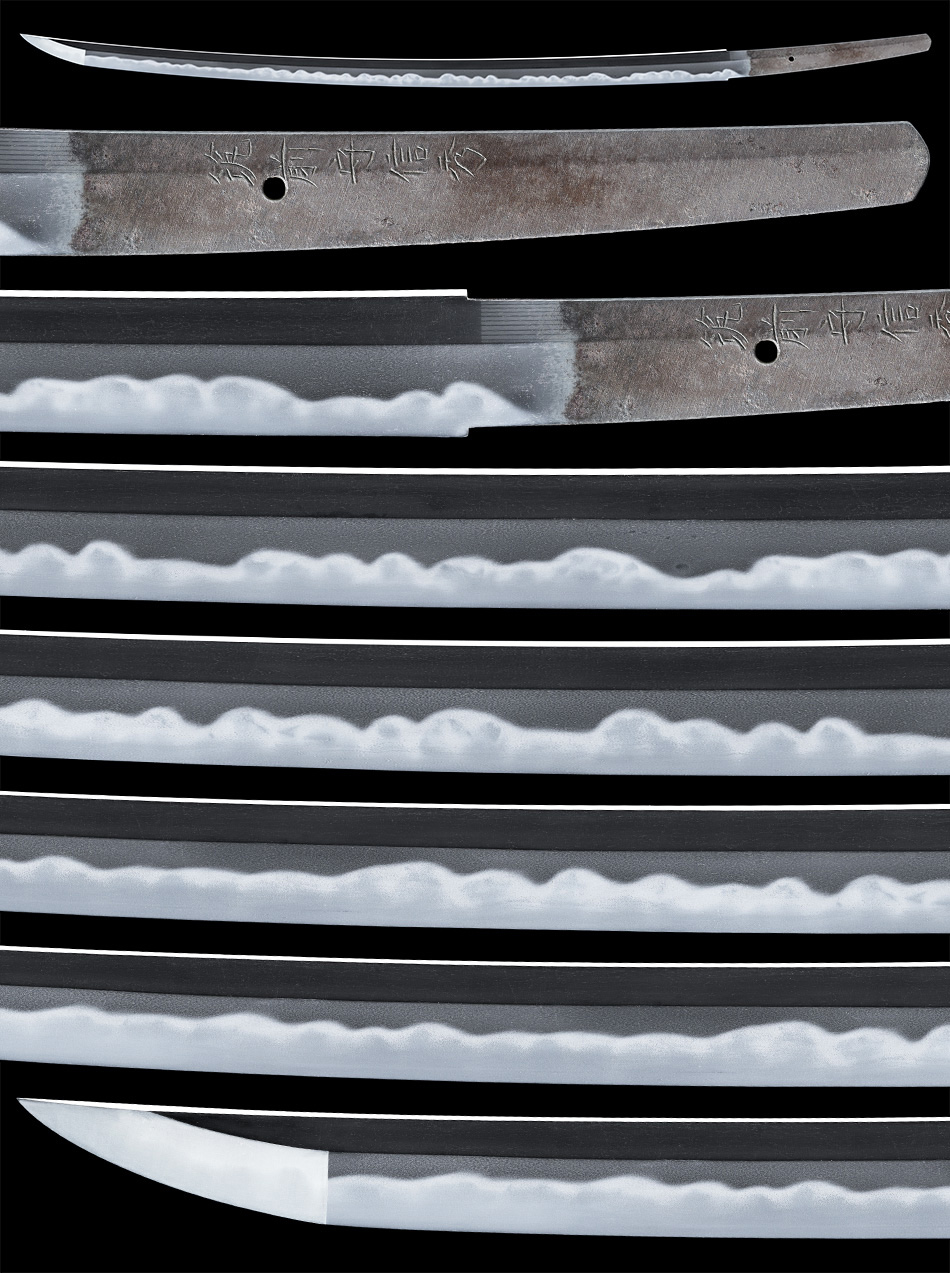
Description Keijo: , ; wide with little difference between base and tip widths; the is noticeably planed down and the stands high; rather thin ; shallow ; . : Dense with somewhat standing grain; thickly applied ; appears well. : A mixed pattern of , , and -; in places it includes pointed tendencies and angular (square-shouldered) elements; thick, long enter; the is somewhat deep; adheres well; in the lower half small appear here and there; in the upper half and run long; the is bright. : , with small ; the point becomes sharp and turns back in a standard manner. : None. : ; ; ; one ; on the , a fine-chisel (hosotagane) - is placed one character above the first and toward the ; on the , the date is set about one-and-a-half characters above, centered on the ridge line.
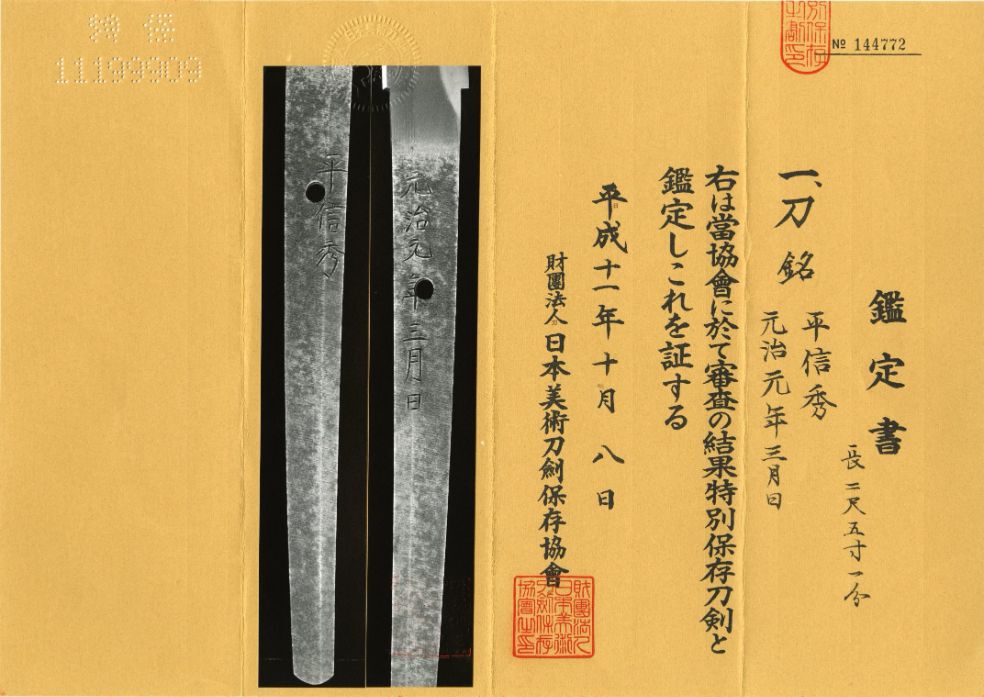
Artisan Kurihara Nobuhide (栗原信秀), titled no Kami
Era Dated Keio 2 (1866), sixth month (June) — late period ()
Explanation Kurihara Nobuhide was born in Bunka 12 (1815) in Tsukigata Village, Nishikanbara District, Echigo Province. In Bunsei 12 (1829) he went up to Kyoto and became a mirror-maker, but in the early Ka’ei era (1848–1854) he moved to , entered the school of Kiyomaro, and became a swordsmith. Since the earliest surviving dated work by Nobuhide is dated Ka’ei 5 (1852), it is thought that the period during which he actually studied under his master was short. By Ka’ei 6 (1853), shortly after establishing himself independently, examples of his so-called “Uraga-forged” (Uraga-uchi) work made at Uraga in Province are extant.
In the seventh month of Genji 1 (1864), during the First Chōshū Expedition, he went to Osaka under bakufu orders and served in a role connected with the supply of weapons. His swordmaking activity in Osaka spans roughly two and a half years, from the eighth month of Genji 1 through the first month of Keio 3 (1867). In the fifth month of Keio 1 (1865) he received the court title no Kami. Afterward he returned to , and later, in Meiji 8 (1875), he went back to in Echigo; in Meiji 10 (1877) he produced a sacred mirror for Yahiko Shrine. He died at age sixty-six on Meiji 13 (1880), first month, twenty-fifth day, at the residence of his adopted son Nobuchika in Hongō-Motomachi, Tokyo.
Among the Kiyomaro group, Nobuhide’s technical ability is regarded as the most outstanding, and there are works whose quality comes close to that of the master Kiyomaro himself. This exhibits the characteristic silhouette: broad with little taper from base to tip, shallow , and an . At the time, its overall construction is sharply executed: the is intentionally lowered, the is made high, the is rather thin, and even the of the large point is deliberately restrained—features that clearly express his identity as a Kiyomaro disciple.
The forging shows with thick ; is well formed and the grain stands out. The temper mixes , -, and ; the are thick and long; the is deep and the well developed. Long-running and appear within the hardened area. Especially notable are the inclusion of angular and pointed tendencies, and a manner in which the heads of large divide into small irregularities—features that reveal Nobuhide’s characteristic habits of hand. Moreover, the continues with the momentum as the mid-blade, turning into a vigorous and returning with a sharpened point. Together with the keenly formed large and the abundant variety in both and , these points heighten the commanding power of this work.