Muromachi turned sword making into an industry: the uchigatana rose with massed infantry warfare, Osafune and Seki produced bundle swords beside custom orders, and the Ming trade carried Japanese blades abroad by the tens of thousands.
 NihontoWatchNihontoWatch
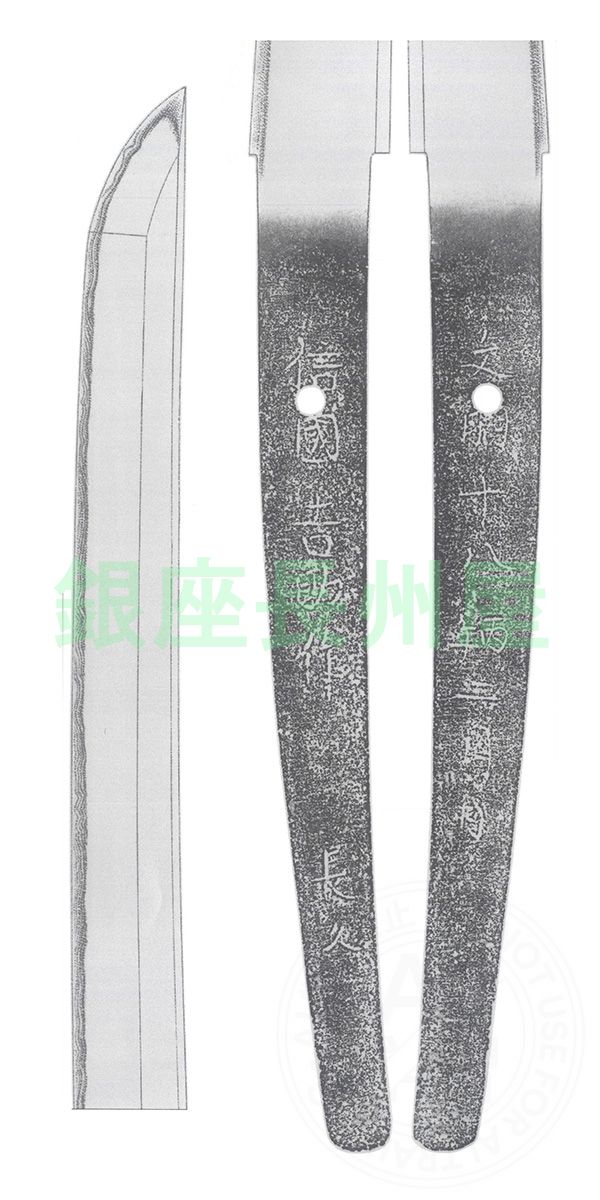
信國吉助(よしすけ)は室町中期の豊前の刀工で、遠祖は京の信國。同派が豊前に来住したのは南北朝末から室町初期で、隣国の長門大内氏や豊後大友氏等と渡り合った安心院(あじむ)氏(宇佐八幡の大宮司)に仕え、吉包、吉貞、吉政等の吉を通名とする優工が鎚を振るった(注1)。 この刀は茎先から腰元までが平造、その二寸半程上の棟際の肉が削ぎ落されて鎬造とされた特異な造り込み。 これが元来からの造り込みであることは、矢を払った際に生じたのであろう楔形の打ち込み傷が刀身中央部の鎬筋上にあって明らか。 戦国時代を経ながらも身幅が充分に残され、手元の棟の重ねが厚く、山城系の特長でもある深い輪反り格好とされている点も見どころ。 九州特有のねっとりとした温潤味のある小板目鍛えの地鉄は、微かに柾肌を交えて詰み、地沸が微塵に付き、春霞のような映りに筋状の地景が働いて揺らぐような景色を呈する。 細直刃の刃文は、淡雪のような純白の沸が厚く付いて刃縁が茫洋とし、湯走りが働いて処々二重刃となり、よく沸えた刃中には細かな金線と砂流しが蠢くように掛かる。帽子は浅く乱れ込み、金線を伴い掃き掛けて小丸に返る。平造とされた茎に飄々とした鑚使いで刻された銘字は吉助自身の手になるもので、吉は𠮷となる特色が顕著。 「長久」の文字、干支を伴う文明十八年紀(注2)も貴重この上ない資料となっている。宇佐信國の優質を伝える稀有の一刀である。 注1...久野繁樹「豊前信国の初祖について」(『刀剣美術』九〇号)に詳しい。 注2...『日本刀銘鑑』には長享二年、延徳四年、明応二年五年が載せられている。本作の文明十八年紀は同作中最古の年紀で資料的な価値が高い。
NihontoWatchOffered by Choshuya









Yamashiro-den · Buzen · around 1444-1449
Tōken Taikan top 76%
Yamashiro-den · Yamashiro
20 pieces on the market now
Few Kyoto houses bridged two traditions as deliberately as Nobukuni (信国), the Yamashiro-den lineage whose work runs from the Nanbokucho period through Muromachi and on, in a western branch, into the shinto age. The first generation, the smith the NBTHK counts as shodai, is the master of the Enbun, Koan and Joji years; the older registers placed a founding Nobukuni back in the Kenmu era, but the published sources set that legend aside, since no work survives so early and the style of the oldest dated blades connects directly with that of Sadamune. Two inheritances meet in him. By blood he belongs to the Ryokai line, recorded as son or grandson of Ryo Hisanobu and therefore of Rai descent; by training he is said to have studied under Soshu Sadamune, counted among the Sadamune Santetsu, the three brilliant pupils. The name then passed on: a change-of-generation Nobukuni with Eitoku, Shitoku and Meitoku dates stands at the close of Nanbokucho, and in early Muromachi come the so-called Oei Nobukuni, Saemon-no-jo and Shikibu-no-jo, conventionally the third generation. The published commentary keeps these hands apart and notes that several smiths of the same signature appear within the Nanbokucho period alone. Through Muromachi the line moved to Buzen and then Chikuzen, where it served the Kuroda house of Fukuoka as retained smiths and flourished as the Chikuzen Nobukuni group of Yoshisada, Yoshimasa, Yoshitsugu, Yoshikane and Shigekane. A single steel underlies the whole school. The jigane is an itame mixed with mokume that flows toward the ha and stands into masame, with thick ji-nie and chikei entering frequently; on the finer-forged pieces a streak-like nie-utsuri rises, and that masame-tinged surface is read as the visible token of the Ryokai pedigree.
Over it the temper divides into the manners the sources name together: a suguha expressing the Kyoto tradition, refined in ko-nie with fine hotsure and a niju-ba tendency, carried on tanto and ko-wakizashi; and a ko-notare mixed with gunome inheriting the Sadamune style, laid thick in nie, with kinsuji, sunagashi, hotsure and conspicuous yubashiri, on the most flamboyant pieces stringing into a two-tiered ha. From the late Nanbokucho succession into the Oei generation a third range enters, a gunome-led midare whose tell is paired gunome linked across the valleys by a low ko-notare into a yahazu, arrow-notch, profile, with muneyaki, tobiyaki and niju-ba on the liveliest blades. Above all stands the carving the sources call the house art, the horimono of bonji, kurikara, suken, gomabashi, sanko-ken and the invocation of Hachiman Daibosatsu, often layered one over another in kasanebori; few smiths of the age are so consistently identified by what they carved. The Chikuzen branch carried the masame-leaning itame forward and added a choji-midare with midare-utsuri, Yoshikane reaching toward Soshu-den with deep nioi and thick nie, Shigekane ranked highest in skill within his group and noted as a copyist of meibutsu who emulated Fudo Kuniyuki at the Hama Palace. To kantei Nobukuni is to read the Kyoto traces that part him from Sadamune: the nie-utsuri, the niju-ba, and the hada that drifts into masame along the ha. Within the long succession the shodai remains the touchstone, his dated work the standard against which unsigned blades and generation questions are resolved, the reversed left-form kuni marking the Oei Saemon-no-jo, the yahazu the daigawari hand. The best members rank Jo-jo saku under Fujishiro, and the carving reputation is the constant thread, distinguishing these blades from the plainer utilitarian grooving of contemporary Bizen. Provenance runs through the great houses: the Kuroda wakizashi once carried by Kuroda Nagamasa, a Hongan-ji meibutsu held to have been cherished by Rennyo Shonin, the signed Arao Nobukuni descended in the Asano of Geishu, pieces in the Sanada, Tosa Yamauchi and Tamura families, and a tachi bestowed on the Owari Tokugawa. Examples rest today in the Tokugawa Art Museum, the Kyoto National Museum, shrines such as Atsuta and Ise, and long-held private collections, with the Chikuzen smiths' shogunal-command pieces preserving the historical episodes that produced them. Learn more →
| Smith | Era | Designated |
|---|---|---|
| Nobukuni信國 | 1356-1368 | 70 |
| Nobukuni信國 | 1383-1392 | 33 |
| Nobukuni信國 | 1394-1428 | 44 |
| Yoshikane吉包 | 1661-1686 | 6 |
| Masanobu正信 | 1356-1361 | 4 |
The Muromachi period (1392 to 1573)
Muromachi turned sword making into an industry: the uchigatana rose with massed infantry warfare, Osafune and Seki produced bundle swords beside custom orders, and the Ming trade carried Japanese blades abroad by the tens of thousands.
A Hozon-certified blade judged to show notably superior workmanship and a better state of preservation. The bar is higher: re-tempered blades and most unsigned Muromachi/Edo works are excluded.
The NBTHK (Nihon Bijutsu Tōken Hozon Kyōkai, the Society for the Preservation of Japanese Art Swords) is a public-interest incorporated foundation founded in 1948 and supervised by Japan’s Agency for Cultural Affairs (Bunkachō); it is based at the Japanese Sword Museum in Tokyo. Its expert panels physically examine each submitted work (shinsa) and issue a certificate (kanteishō) ranking it by artistic and historical merit. NBTHK papers are the most widely recognized standard of authentication for Japanese swords and fittings.
NBTHK official siteIf, due to our fault, the item differs significantly from its proper condition, the item may be returned. Cooling-off is within one week of the item's arrival.