NihontoWatch MonNihontoWatchBETA
MarketEncyclopedia
NihontoWatch Mon

NihontoWatchBETA

Market
Encyclopedia
Overview·Kantei·Designations·Blade Forms·Signatures·Lineage·School
OverviewKanteiDesignationsBlade FormsSignaturesLineageSchool
  1. Schools
  2. Nobukuni
  3. Masanobu

Nobukuni Masanobu

正信

Jūyō
Vol. 21, No. 104 · Tantō

Nobukuni Masanobu

正信

4 ranked works

ProvinceEchigoEraEnbun (1356–1361)PeriodNanbokuchōSchoolNobukuniTraditionYamashiro-denGeneration1stTeacherNobukuniFujishiroJo sakuToko Taikan500(top 26%)TypeSwordsmithCodeMAS696
4Jūyō Tōken

Overview

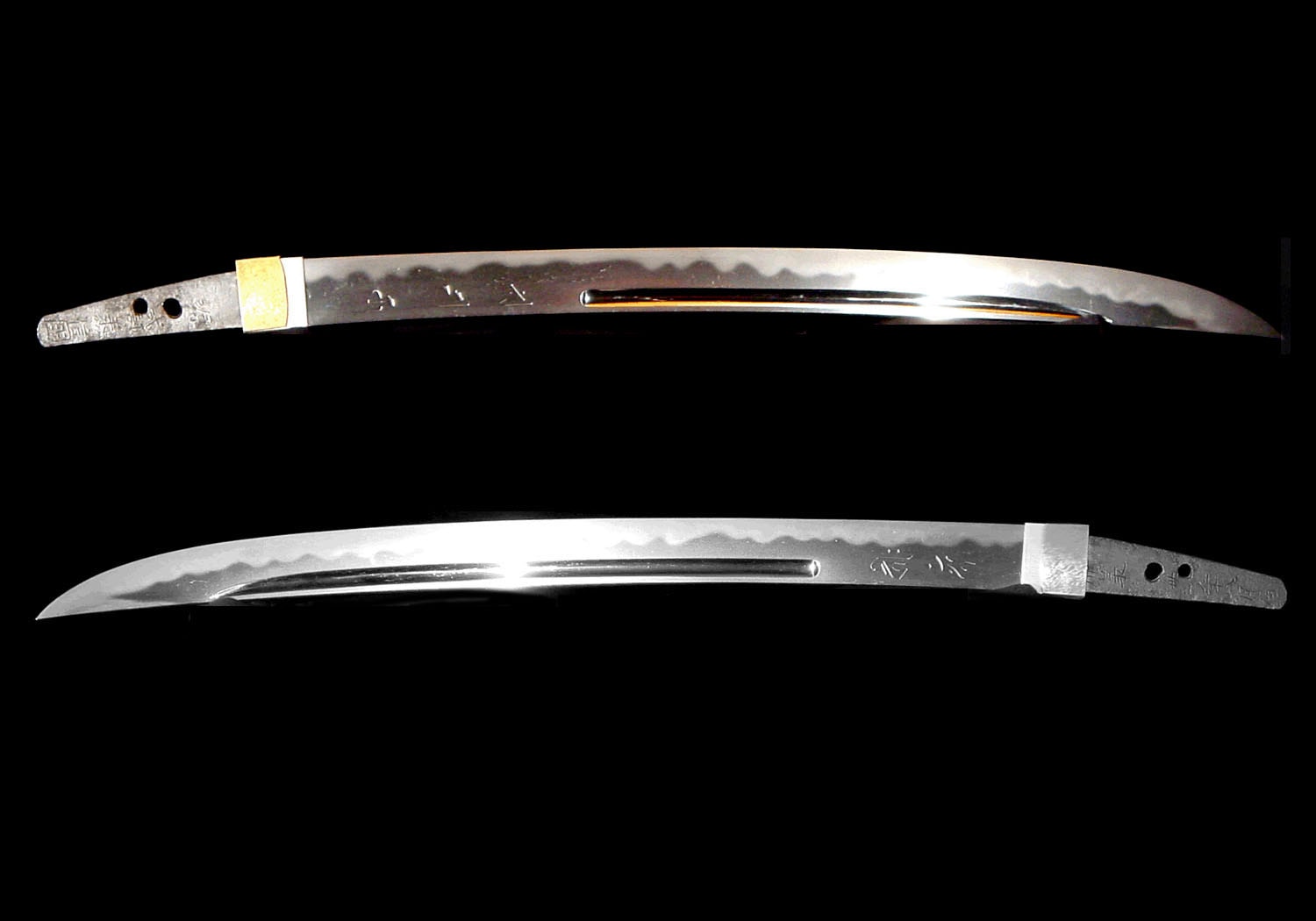
A of the eleventh session, signed only with the two characters Masanobu and assigned in the published record to the Yamamura group of Echigo, opens onto one of the more thinly recorded provincial offshoots of the manner. Yamamura Masanobu was a smith of that group, which took its name from the Yamamura district near Takada in Echigo, the holding of a powerful local warrior house. The commonly held account, set down in the published sources, is that the family invited the line from Kyoto, the second or the third generation by varying tellings, into Echigo and learned its methods, and what most convinces of the tradition is that the surviving work so closely resembles 's own. Of this hand only a small number of pieces survive, bearing signatures such as Yamamura-ju , Masanobu and Yasunobu, and the name Masanobu was not one man's alone but is recorded in the sword-reference compendia for several smiths from the period into the early . His whole designated record is , and of the signed survivors the published sources judge there may be no more than two, observing of the eleventh-session blade that the extant signed works of this hand are probably limited to these two pieces alone (同作の現存する有銘作は恐らくこの二口のみではなかろうか).

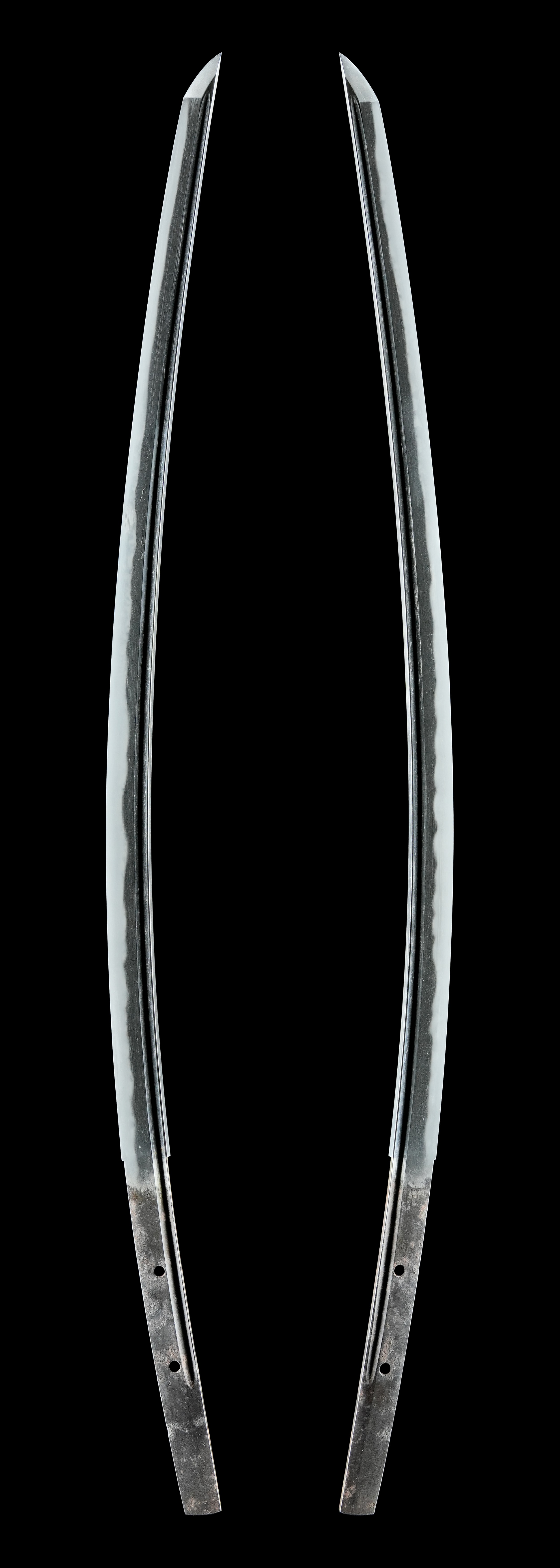
The constant by which his hand is known is the . It is an interwoven with a flowing that tends to stand, thick gathering on it and entering well, and it is on this steel that a faint or a whitish cast appears. On the signed eleventh-session the flows and stands with and a whitish surface; on the broad blade of the thirty-first session the is tight, mixing a flowing tendency toward the edge, the thick and the fine. The published sources rest the attribution on exactly this , finding in the blade of the fifty-ninth session a and that clearly express the characteristic manner of the Yamamura group, which drew on the lineage of (信国の流れを汲む山村派の特色をよく現わしている), and praising the forging that interweaves while relying upon . It is the standing flowing steel, not a single temper pattern, that carries the back to him.

Over that the divides into two registers the texts draw expressly along the signature status of the blade. On the signed two-character pieces the temper is a or a mixed with , small entering and adhering, the work quiet and bearing a Kyoto flavor; the twenty-first-session is read as a piece carrying that Kyoto cast (京風を帯びたものであり), excellent in both and and moreover a rare thing, and the published sources call it for that reason a rarity (地刃の出来が優れており、且つ珍品である). On the blades attributed to him the temper grows more active: a base or a -toned pattern mixed with and , in places turning boxy, the edge fraying into , deep forming in the with well-working , running, and slight and seen, the bright. Across both registers the runs or shallow into , at times with an tendency, the on the signed blade turning back somewhat long.

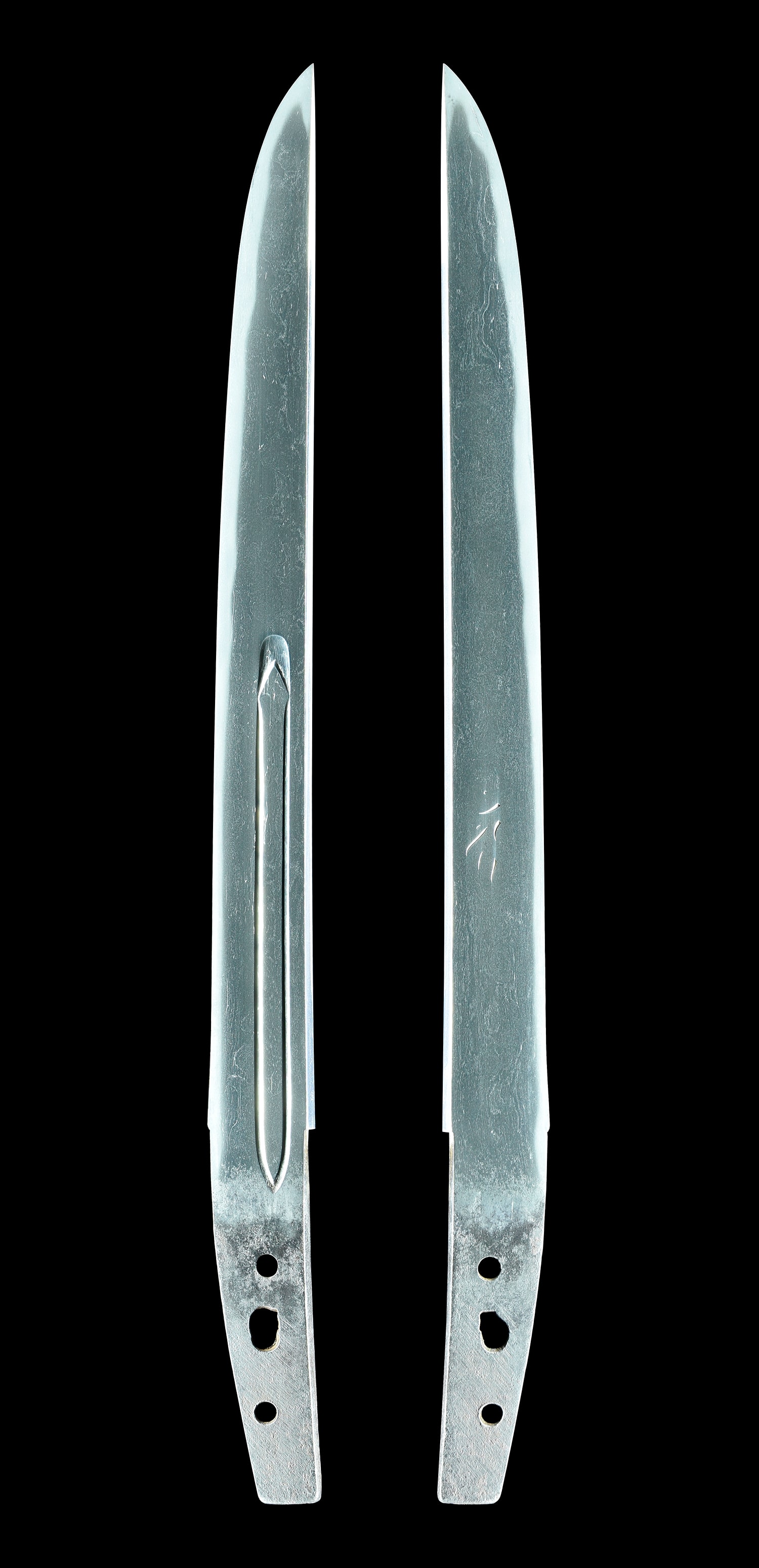
The confirm the school as surely as the steel. On the thirty-first-session a Gyo-style is cut on the with a run off on the , and the published sources note that the carving too is of the manner and skillfully done (倶利迦羅の彫物も信国流で巧みである). The eleventh-session blade carries a finished kaki-nagashi on the and paired cut through on the , the groove there altered, the text notes, from an original or . These are not incidental ornaments but a continuation of the Yamashiro repertoire carried north, the iconography of the parent school worked by a provincial hand. The signatures themselves are a bare niji-, the two characters Masanobu cut at the center of an , on the twenty-first-session blade running into and crossing the .

What distinguishes Masanobu within his small body of work is the way the Kyoto inheritance and the northern setting meet in one hand. The signed blades keep the calm and the Kyoto flavor of the line he is said to have studied under, while the attributed pieces show the showier side of the manner, the breaking into with abundant and the gathering small with a bright . His bright, frayed and his standing -rich steel are what set the group apart and tie it back to its source, and on the strongest of the blades the published sources find a work that ranks higher in both workmanship and presumed period within the Yamamura group (山村派の中でも作位・年代共に上がるものであり), so that the attribution to Yamamura Masanobu is readily accepted (山村正信の極めが首肯され) and the date set to the era. The group founded no long-running independent tradition; its importance lies in carrying the Yamashiro- idiom into Echigo, and Masanobu is the name by which that transmission is best known.

Fujishiro grades him Jo , and the Toko Taikan values his work at the middle of its range. Four designated works stand on the official record, all of them and all of them , two cut with the two-character Masanobu signature and two attributed as Yamamura Masanobu. His record carries no National Treasure, no Important Cultural Property and no , so the question of patrimony held permanently beyond the market does not arise, and no house or museum is recorded as having held these blades. What a collector may realistically encounter is one of this small, even group of , signed or attributed, appearing only from time to time and a notable occasion when one does, for the signed pieces in particular the published sources count among the rarest survivals of the hand. A verified two-character Masanobu is, on the texts' own reckoning of perhaps two such blades, among the scarcer things a student of the provincial schools could meet, and the four designated works together give an exact measure of the level the published sources credit to the Yamamura group that carried the manner into Echigo.

Kantei

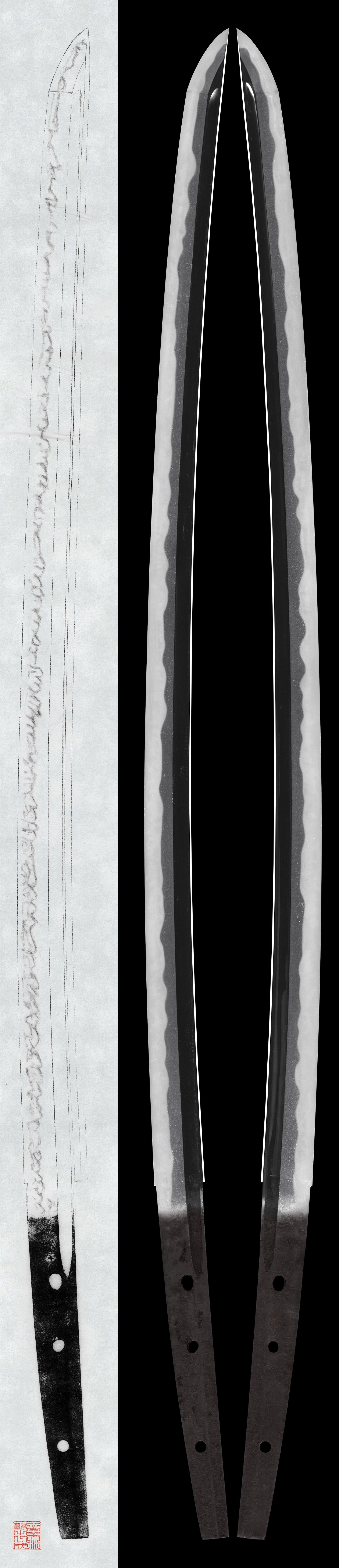
One provincial Nobukuni-derived hand, surviving entirely in tanto, that the texts read in two registers tied to the work's signature status. The signed two-character Masanobu blades carry a calmer suguha or suguha-cho with a Kyoto flavor, ko-itame with a flowing tendency, ko-ashi and ko-nie, the boshi ko-maru. The mumei blades attributed to him carry a more active suguha-to-notare mixed with gunome and kuichigai-ba, the ji an itame standing into nagare-hada with thick ji-nie and chikei, deep nie in the ha with kinsuji, sunagashi, yubashiri and a bright nioiguchi, the boshi ko-maru or o-maru-gokoro. Across both the carving, a kurikara or paired gomabashi, is in the Nobukuni manner, and the whole expresses the Yamamura school drawing on the Nobukuni line.

Yamamura Masanobu was a swordsmith of the Yamamura group in Echigo, a warrior house that held the Yamamura district near Takada and, by the commonly held tradition, invited the Kyoto line to Echigo and learned its methods. The published sources place him in the period, with surviving work running into the early (Oei), and record that the name was used by several smiths across those generations rather than by one man. His whole surviving record is , with or , and the texts judge only a handful of signed pieces to exist, perhaps no more than two two-character Masanobu blades. His is an mixed with a flowing that tends to stand, carrying thick and well-entered , at times a faint or a whitish cast. The divides into two registers the texts draw expressly: a calmer or with a Kyoto flavor on the signed blades, and a more active -to-notare mixed with and , with deep , , and a bright , on the pieces attributed to him. Across both the runs into or , and the carving, a or paired , is cut in the manner.

Diagnostic discriminators

100% of his works

the two signed tanto are suguha or suguha-cho with a Kyoto flavor; the two mumei tanto run to suguha-and-notare with gunome, kuichigai-ba and abundant nie

75% of his works

Observation by phase

The signed register, calm suguha with a Kyoto flavor

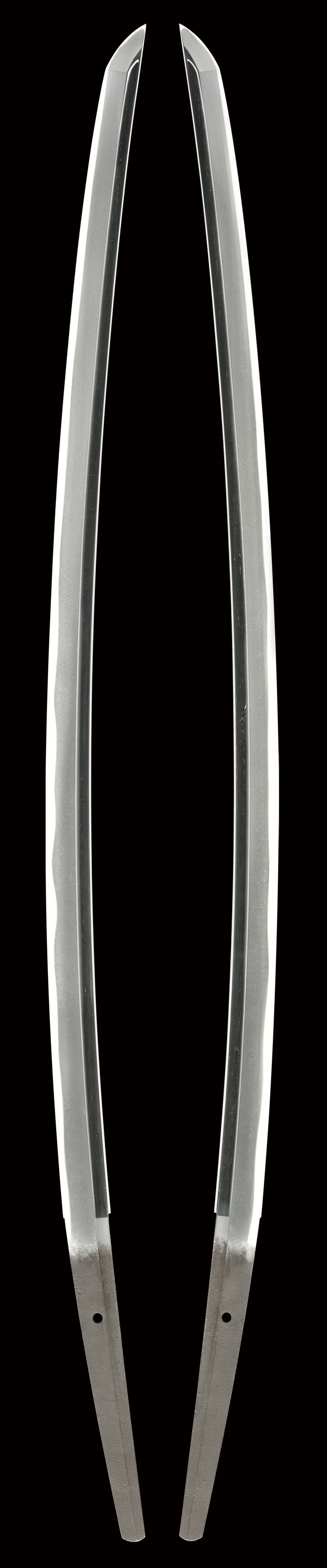
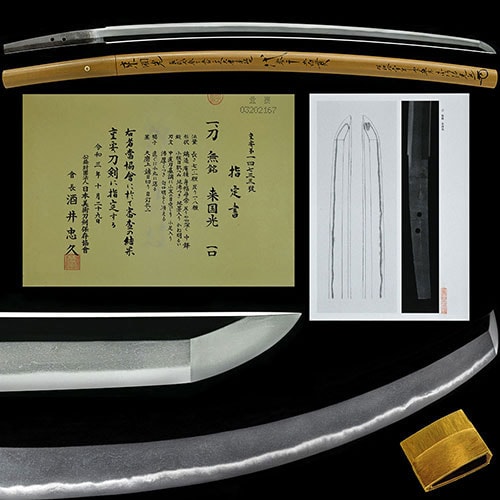
the two-character signed Masanobu blades: the Juyo 11 tanto, whose explanation notes that signed survivors of this hand probably number only two, and the Juyo 21 tanto, a suguha work bearing a Kyoto flavor

The register of the two-character Masanobu blades, which the published sources judge to be perhaps only two in number. The is a mixed with a flowing , with some mixed grain, adhering and at times a faint or a whitish cast. The is a or mixed with and , small entering, running and forming, the or into with a somewhat long . The texts call this work a piece bearing a Kyoto flavor, dated no later than the period, the and excellent and the blade itself a rarity, and it is this Kyoto-derived calm that ties the Yamamura group to the line they are said to have studied under.

Sugata 姿
Jigane 地鉄
Hamon 刃文
Bōshi 帽子

The mumei register, active suguha-to-notare with abundant nie

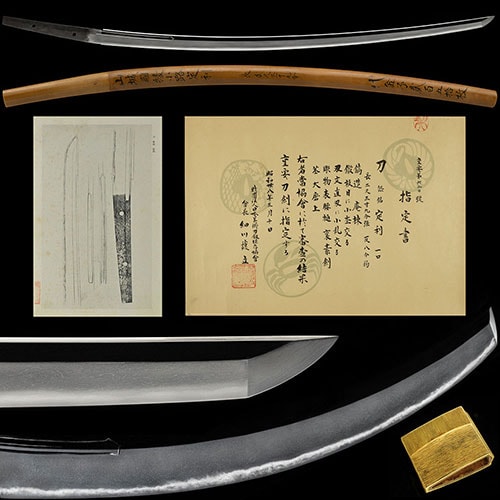
the mumei den-Yamamura-Masanobu blades: the Juyo 31 tanto with kuichigai-ba, deep nie and a Gyo kurikara, and the Juyo 59 tanto with a notare-toned ha, bright nioiguchi and chikei-rich forging that the texts rank high in the school

The register of the blades attributed to him , which carry more visible activity than the signed pieces. The is an mixed with tending to stand, thick accumulating and entering well. The is a base or a -toned pattern mixed with and , in places becoming boxy, the edge fraying into , deep forming with well-working , running and slight and seen, the bright. The turns back in or with an tendency, entering shallowly. The carving is a or a , cut in the manner, and the published sources call the forging that interweaves while relying on notably well done, ranking the best of these pieces high in workmanship within the Yamamura group.

Jigane 地鉄
Hamon 刃文
Bōshi 帽子
Scholarship

His place is fixed in the published sources: the Yamamura were a powerful local family who held Yamamura near Takada in Echigo, and the tradition that they summoned the Nobukuni line from Kyoto is supported above all by the close resemblance of the surviving work to Nobukuni.

The name was not a single maker's: the sword-reference compendia record several smiths using Masanobu within the Yamamura group from the Nanbokucho period into the early Muromachi, so the corpus spans more than one generation.

The kantei to Yamamura Masanobu rests on the ji and ha together expressing the Nobukuni-derived manner of the group, the itame standing into nagare with thick ji-nie and chikei, the suguha fraying with bright nioiguchi, and the kurikara cut in the Nobukuni style.

Designations

Kokuhō—
Jūyō Bunkazai—
Jūyō Bijutsuhin—
Gyobutsu—
Tokubetsu Jūyō—
Jūyō Tōken4

Elite Standing

0.02 across 4 designated works

Top 28% among smiths

Blade Forms

Distribution across 4 ranked works

Signatures

Signature types across 4 ranked works

Currently Available

Lineage

TeacherNobukuni
Masanobu
Students (2)
  1. 1.Nobushige信重
  2. 2.Yasuyuki安幸

Nobukuni School

Other artisans of the Nobukuni school

  1. 1.Nobukuni信國1 for sale69designated
  2. 2.Nobukuni信國2 for sale33designated
  3. 3.Nobukuni信國1 for sale44designated
  4. 4.Yoshikane吉包2 for sale7designated
  5. 5.Shigekane重包1 for sale4designated
  6. 6.Shigekuni重國1designated
  7. 7.Nobukuni信國1 for sale2designated
  8. 8.Nobukuni信國2designated
  9. 9.Nobusada信貞2designated
  10. 10.Yoshimasa吉政2 for sale2designated
  11. 11.Masakane正包1designated