NihontoWatch MonNihontoWatchBETA
MarketEncyclopedia
NihontoWatch Mon

NihontoWatchBETA

Market
Encyclopedia
Overview·Kantei·Designations·Provenance·Blade Forms·Signatures·Lineage·School
OverviewKanteiDesignationsProvenanceBlade FormsSignaturesLineageSchool
  1. Schools
  2. Nobukuni
  3. Nobukuni

Nobukuni

信國

Tokujū
Vol. 7, No. 7 · Wakizashi

Nobukuni

信國

69 ranked works

ProvinceYamashiroEraEnbun (1356–1361)PeriodNanbokuchōSchoolNobukuniTraditionYamashiro-denGeneration2ndTeacherSadamuneFujishiroJo-jo sakuToko Taikan1,000(top 8%)TypeSwordsmithCodeNOB300
4Jūyō Bunkazai
5Jūyō Bijutsuhin
1Gyobutsu
7Tokubetsu Jūyō52Jūyō Tōken

Overview

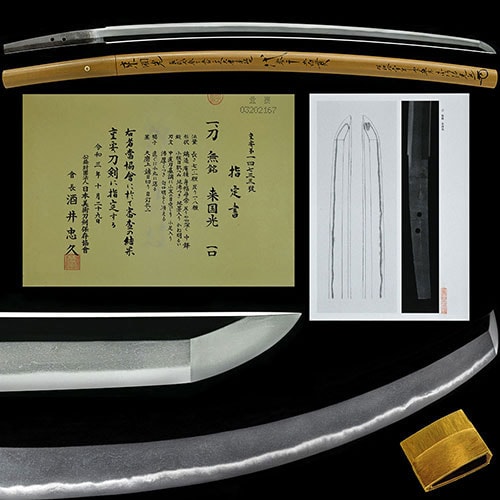
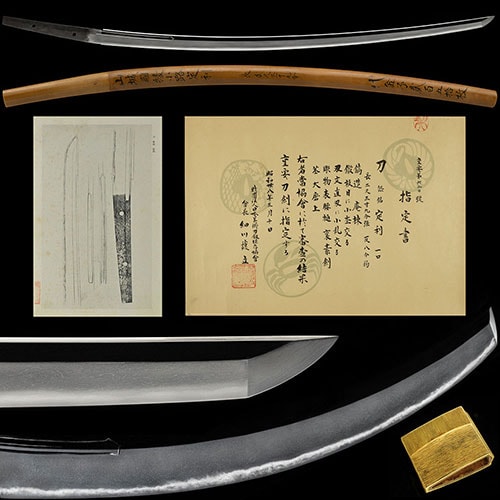
A dated Enbun 3 (1358), a of Koan 1 (1361), and further dated pieces reaching Joji 5 and 5 (1372) frame the working life of of Yamashiro, the Kyoto master whom the counts as the first generation of his name. The old registers placed a founding back in the Kenmu era, but the published sources set that legend aside: no work dated to Kenmu or its vicinity survives, no extant blade can be appraised so early, and the style of the oldest dated works connects directly with that of Sadamune, so that "the prevailing view today regards the Enbun and Joji smith as the first generation" (通説). Two lines meet in him. By blood he belongs to the Ryokai school, recorded in the transmitted genealogies as the son or grandson of Ryo Hisanobu, himself Ryokai's son, and therefore of descent; by training he is the pupil of Sadamune, counted among the Sadamune (貞宗三哲), the three brilliant pupils. The published sources rank him a representative smith of the period.

His style, the writes in a standing formula, "is in broad outline of two kinds: the one , the other a whose main tone is a Sadamune-style " (二様). What binds the two manners is the steel itself. Whether the is straight or irregular, the flows conspicuously toward the and takes on , and the published record reads this trait, with the of the Enbun 3 and Koan 1 dated works, as what makes the Ryokai pedigree credible. On a of the tenth session the judges write that "above all, the that inclines to and flows near the edge suggests his connection to the Ryokai line." The is mixed with , thick, entering incessantly; on many pieces a rises toward the , and niju-ba appears along the .

The principal manner of the surviving work is the Sadamune style. Over the flowing the temper runs in a mixed with and , and enter, and the lies thick and bright. and work constantly through the , fray the , and spill above the temper; on the more flamboyant pieces the string intermittently along the until, as the published sources write of the Kuroda , they produce "the appearance of a kind of two-tiered " (二段刃状). The runs or into with . A signed from the Tosa Yamauchi family is praised as workmanship that thoroughly vindicates the Sadamune-pupil tradition, "yet compared with Sadamune the stand out somewhat, and exactly there the look of shows itself." To this manner belongs the carving the published sources call his house art (御家芸とも言うべき彫物): , , , and , frequently layered one over another, on one judged "skillfully layered in the manner of Daishinbo."

The second manner is the of his ancestry (来派の伝統である直刃). His earliest dated works carry it, and a signed is praised for "a dignified that strictly preserves the tradition of Kyoto work." These blades show a , at times a , in , the tight or deep, the finely frayed with , and a niju-ba tendency appearing, and slight near the ; beneath lies the flowing, masa-tinged with . Most of the corpus consists of , and of the build the published sources name the Enbun-Joji type (延文・貞治型): wide in the , , thin in the , shallow in the . The long blades are nearly all , wide with little taper, the extended or reaching , at times with a deep wheel-like . One is recorded as his kawari-, "a construction that at first sight could be confused with Yamato work." His signature is a two-character cut centrally below the , the dated pieces adding the nengo on the ; of his designated works twenty-eight are signed against forty unsigned, one shortened preserves the original as a , and the gold-inlaid attributions added later by the are appraisals, not signatures.

The name outlived him. At the very end of stands a change-of-generation with dates of Eitoku, Shitoku and Meitoku, and in early the so-called Oei , smiths bearing the titles Saemon-no-jo and Shikibu-no-jo; every generation favored the and the , and from late into Oei a -led entered the school's range beside them. The line continued through and later moved to Buzen and then , where it flourished into the age. Within that long succession the remains the touchstone: the published sources resolve unsigned blades and generation questions by holding a piece against his dated work, and the Bijutsuhin record preserves Honma Junji's caution over one whose character departs from the forms usual in the first and second generations. His own blades are told from Sadamune's by the Kyoto traces they carry: the , the niju-ba, and the that drifts into along the .

Fujishiro grades him Jo-jo , and sixty-nine designated works stand on the official record: four Important Cultural Properties, seven and fifty-two . The provenance attached to his blades runs through the great houses. The Kuroda , with the gold-inlaid possession mark of Kuroda no Kami and a cutting attestation, is said to have been the personal sword of Kuroda Nagamasa, presented to the shogunal house, granted to the Hotta, and passed at last to the Akita Satake; a small is a Hongan- "traditionally said to have been especially cherished by Rennyo Shonin"; the signed called Arao (号荒尾信国) descended in the Asano family of Geishu with a Koon of Manji 1 (1658); other pieces were transmitted in the Sanada of Matsushiro, the Tosa Yamauchi and the Tamura, and a was bestowed by the shogunal house upon the Owari Tokugawa in Koka 2 (1845). Of recorded whereabouts today, examples rest in the Tokugawa Art Museum and the Kyoto National Museum among other public and long-private collections. The four Important Cultural Properties are patrimony, preserved beyond the market; the fifty-nine blades in the and tiers are for the greater part held closely, and a signed of the comes to the market only rarely, a notable occasion when it does.

Kantei

one generation, one prime period (Enbun to Oan), carried in two manners the NBTHK itself names: the Sadamune-style notare-midare and the Rai-traditional suguha; both ride a jigane that flows masa-gokoro along the ha (the lineage proof) with nie-utsuri rising; the corpus splits into a sunnobi hira-zukuri wakizashi and tanto register of the Enbun-Joji build and an o-suriage mumei long-blade register; horimono throughout; two-character mei

, the as the reckons him, is the Kyoto master of the Enbun and Joji eras (1356 to about 1372 by his dated work). By blood he stands in the Ryokai line, recorded as son or grandson of Ryo Hisanobu and thus of descent; by training he is the pupil of Sadamune, counted among the Sadamune . His output runs in two manners the texts name expressly, a Sadamune-style -laden with and a -traditional , and in either manner the flows masa-gokoro along the , the trait the reads as proof of his Ryokai blood. , , , and layered relief, is his house art. Signed works carry a two-character .

Diagnostic discriminators

22% of his works · 5.3× vs Sadamune

31% of his works · 4.2× vs Sadamune

25% of his works · 3.0× vs Sadamune

33% of his works · 5.9× vs Hiromitsu

Observation by phase

The Sadamune manner, nie-laden ko-notare with gunome

The principal manner of the surviving work. The is mixing , flowing toward the into , thick, entering incessantly, with rising on many pieces; the temper is a base mixing and , and entering, thick and bright, and working constantly, at the and above, on the finest pieces strung along the into a quasi two-tier effect; the runs or into with . The texts call this his - made manifest and note that, held against Sadamune, his stand out a little more.

Sugata 姿
Jigane 地鉄
Hamon 刃文
Bōshi 帽子
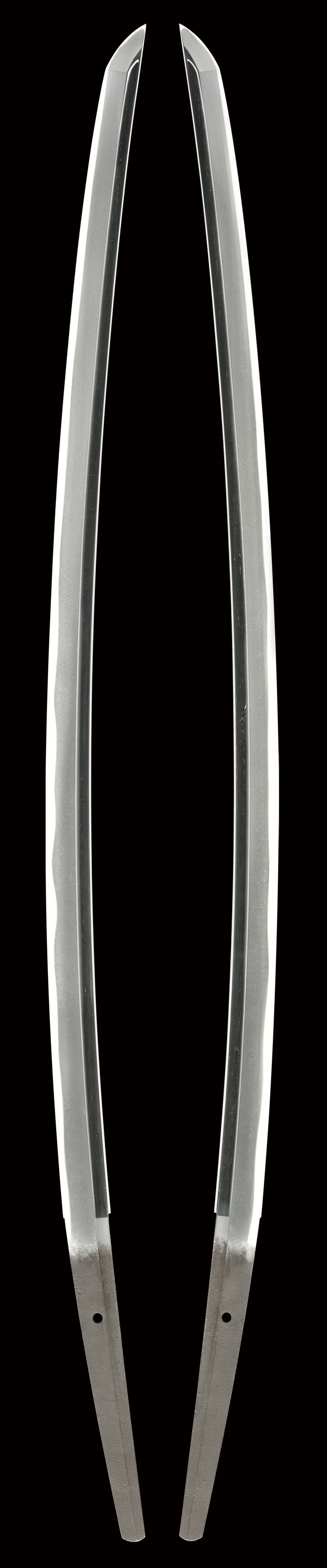
O-suriage mumei long-blade register— the katana and tachi (21 of 72 texts), nearly all o-suriage mumei: wide mihaba with little taper, the kissaki extended or o-kissaki, at times a deep wheel-like sori, the Nanbokucho build; signed long blades are few
Sunnobi hira-zukuri wakizashi and tanto register— the hira-zukuri mitsu-mune pieces (51 of 72 texts): wide mihaba, sunnobi, thin kasane, shallow sori, the Enbun-Joji build by name; most ubu-nakago, and the signed pieces carry the two-character mei below the mekugi-ana, the dated ones a nengo on the ura

The Rai-traditional suguha manner

the manner of his earliest dated work: the Enbun 3 (1358) tanto and the Koan 1 (1361) wakizashi are suguha, the very works on which the NBTHK rests his Ryokai pedigree; 22 of 72 texts describe suguha, six of them hoso-suguha

The second manner the texts name: a or in the Kyoto tradition, tight or deep with , the finely , and a niju-ba tendency appearing, slight at the , the into . The flowing, masa-tinged with lies beneath, so the elegance rides on visibly -fed steel; the texts call these works high in tone, the dignified side of the smith.

Jigane 地鉄
Hamon 刃文
Bōshi 帽子
Scholarship

The generation question is settled in the texts themselves: the old registers call the shodai a Kenmu-era man, but no extant work or credible style reaches that far back, and since the oldest dated pieces, Enbun and Joji, connect directly to Sadamune, today's consensus makes the Enbun-Joji smith the first generation.

His pedigree is given as Ryo Hisanobu's son or grandson, Hisanobu being Ryokai's son, and the NBTHK accepts the record because the blades themselves show it, the suguha of the dated works and the kitae that flows whatever the hamon.

The succession map the texts draw: a change-of-generation Nobukuni at the very end of Nanbokucho with Eitoku, Shitoku and Meitoku dates, then in early Muromachi the Oei Nobukuni bearing the titles Saemon-no-jo and Shikibu-no-jo; every generation favors notare and suguha, and from late Nanbokucho into Oei a gunome-led midare is added to the school's range.

The signed corpus is two-character: the mei sits below the mekugi-ana at the center, the dated pieces add a nengo on the ura, and one text notes plainly that his signed works are few.

Designations

Kokuhō—
Jūyō Bunkazai4
Jūyō Bijutsuhin5
Gyobutsu1
Tokubetsu Jūyō7
Jūyō Tōken52

Elite Standing

0.56 across 69 designated works

Top 5% among smiths

Provenance

28 documented provenances across certified works by Nobukuni

Provenance Standing

13 works held in elite collections across 28 documented provenances

Top 7% among smiths

Raw score: 2.80 / 10

Blade Forms

Distribution across 69 ranked works

Signatures

Signature types across 69 ranked works

Currently Available

Lineage

TeacherSadamune
Nobukuni
Students (5)
  1. 1.Nobukuni信國2 for sale33designated
  2. 2.Masanobu正信
  3. 3.Nobukuni信國
  4. 4.Nobukuni信國
  5. 5.Nobukuni信國

Nobukuni School

Other artisans of the Nobukuni school

  1. 1.Nobukuni信國2 for sale33designated
  2. 2.Nobukuni信國1 for sale44designated
  3. 3.Yoshikane吉包2 for sale7designated
  4. 4.Shigekane重包1 for sale4designated
  5. 5.Masanobu正信4designated
  6. 6.Masakane正包1designated
  7. 7.Nobukuni信國1 for sale2designated
  8. 8.Yoshimasa吉政2 for sale2designated
  9. 9.Shigekuni重國1designated
  10. 10.Nobukuni信國2designated
  11. 11.Nobusada信貞2designated