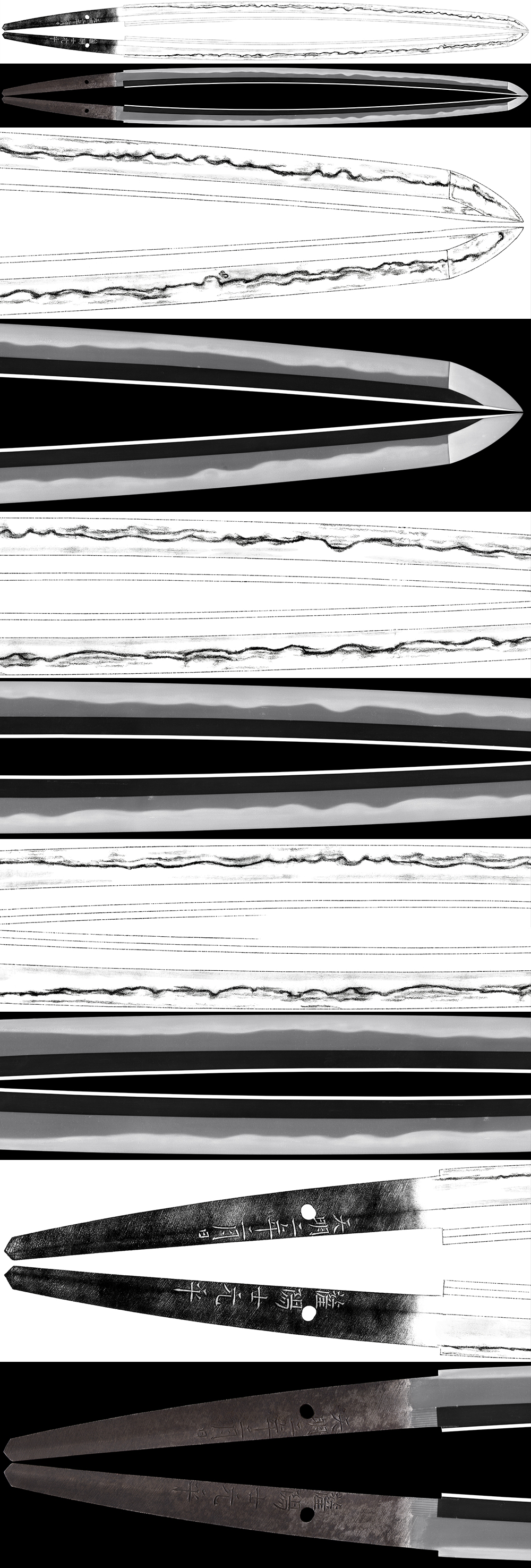
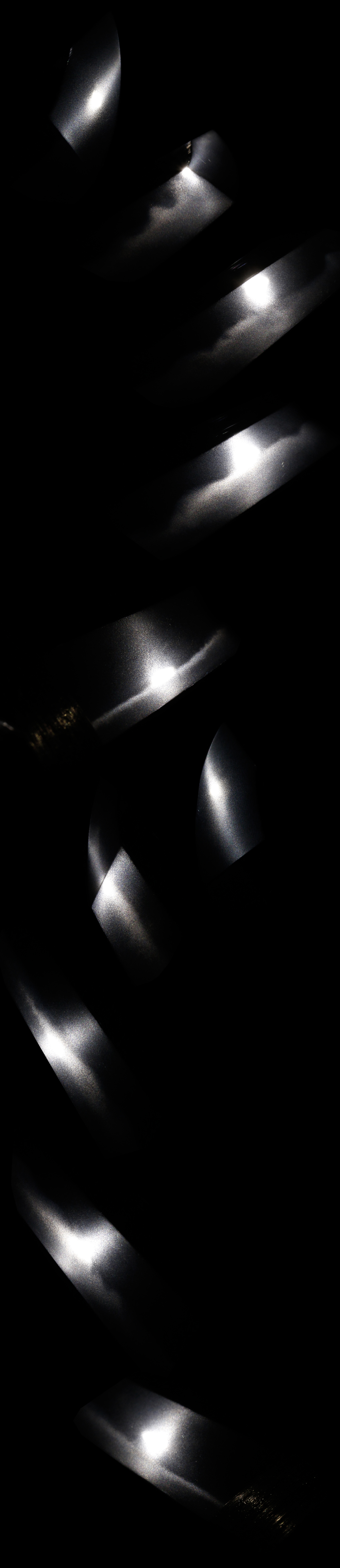
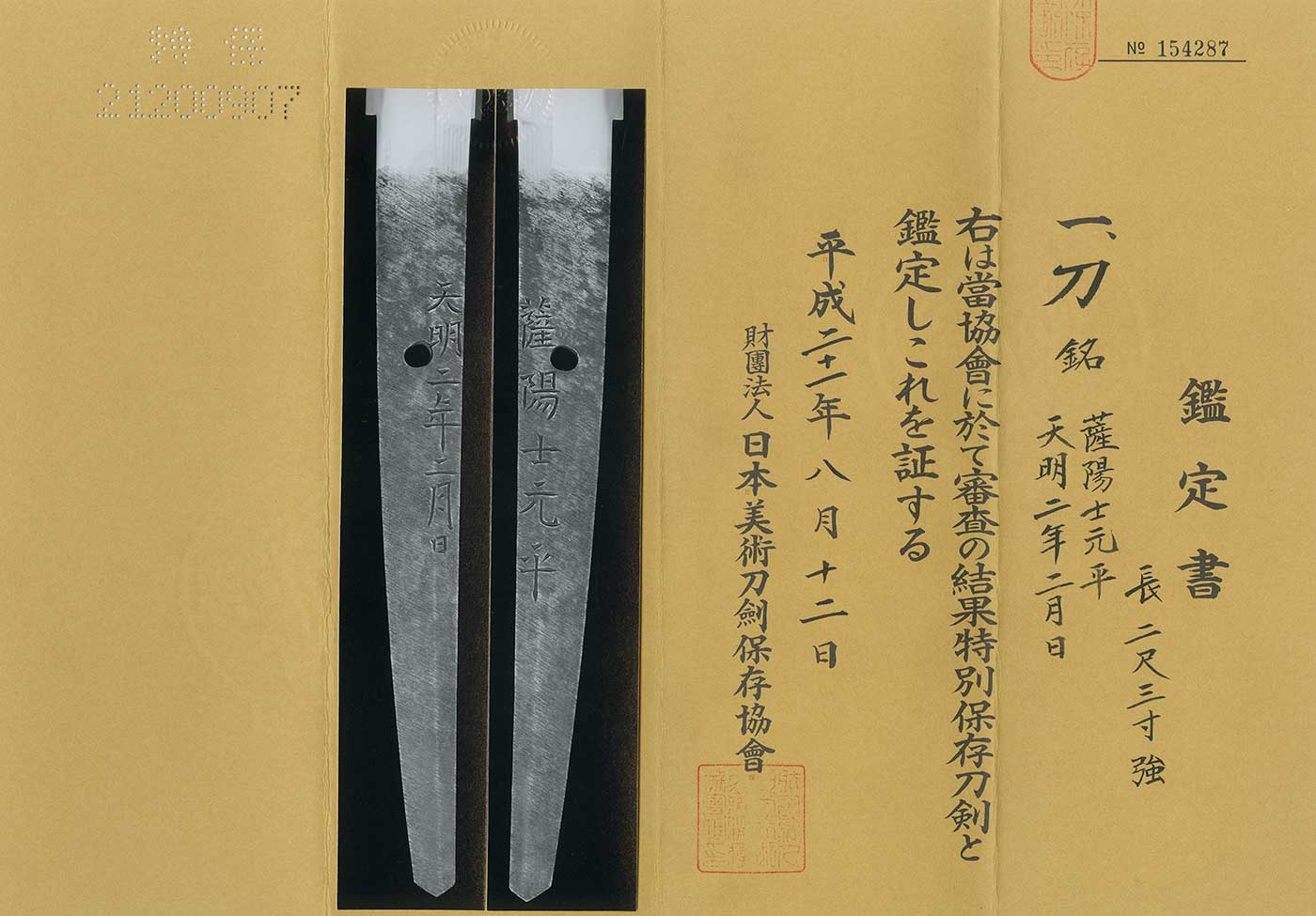
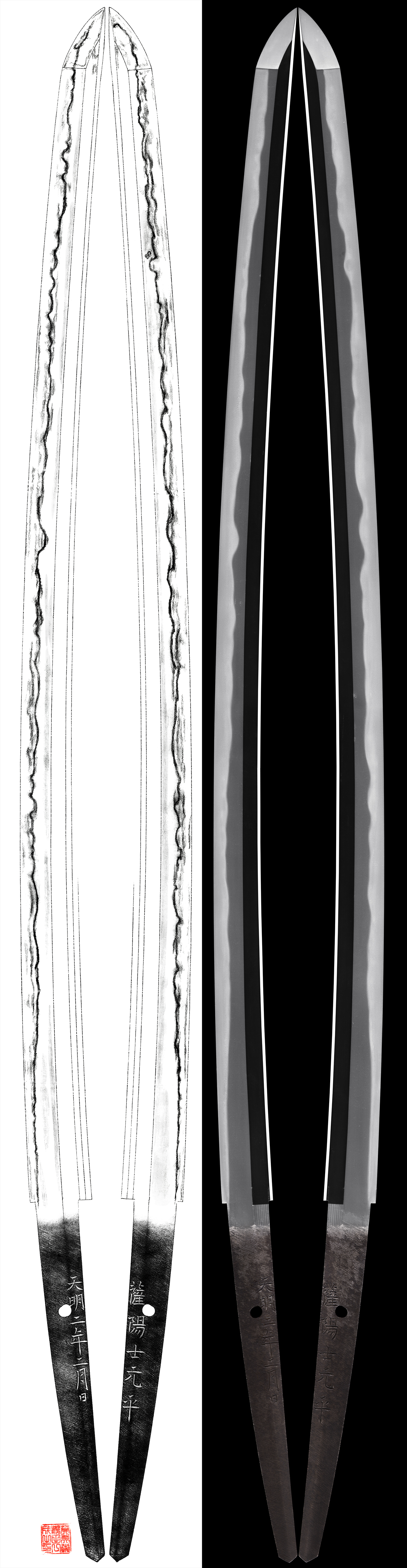
This Katana is signed by Satsuyoshi Motohira and dated to February 1782 (Tenmei 2 nen). It is a Jyojyo saku ranked blade from Satsuma province, known for its excellent swordsmiths under the Shimazu family. The blade features a well-grained Itame Hada and an active Nie Deki Hamon with Notare and Gunome Midare, accompanied by Sunagashi and Kinsuji.
mei · Tenmei (1781-1789) · nagasa 69.84cm · sori 1.36cm


Oku (Satsuma), shinshinto · Satsuma · around 1778-1789
Fujishiro Jo-jo saku · Tōken Taikan top 17%
13 pieces on the market now
Oku Motohira, common name Oku Kozaemon, was the eldest son and heir of Oku Motonao, born in Enkyo 1 (1744). He learned forging from his father and earned early a reputation for surpassing his teacher, his work appearing from the Meiwa era and rising sharply in volume from about An'ei 8 to 9. The published sources place him by a single recurring pairing that has held ever since: with Hoki no Kami Masayuki he is acclaimed as one of the soheki, the twin pillars of Satsuma shinshinto[[c:1]], eleven years Masayuki's junior. His signature itself maps his career. In his An'ei and early Tenmei years he cut Satsuyoshi Motohira; from Tenmei 5 he cut Satsuhan-shin Oku Motohira; and after receiving the title Yamato no Kami in Kansei 1 (1789) he most often cut the long Oku Yamato no Kami Taira Ason Motohira[[c:2]]. He worked into extreme old age, with a dated and age-inscribed piece from the very year of his death, Bunsei 9 (1826), at eighty-three.
His characteristic hand is a broad, imposing katana the sources name his favored Soshu-den. The body is wide in mihaba with ample hiraniku and an extended chu-kissaki, and the temper is a shallow notare-toned gunome-midare into which he sets pointed togariba, at times opened at the base, sometimes widening to o-gunome. The nioi is deep and the nie thick and strong with ara-nie mixed, and through the ha run frequent sunagashi and long kinsuji, the streaming Satsuma nie-lines the published sources name imozuru, the yam-vine, recording on one katana that the kinsuji enter thick to show "vine-like nie-lines" (「芋蔓状の沸筋」). The pointed teeth and the running vine are the spine of his recognition, a Soshu-den read in coarse nie rather than in clove-flower.
The jigane is the constant beneath. It is a well-forged itame, often a tightly packed ko-itame with mixed nagare, carrying thick ji-nie and chikei, on his finest pieces bright and clear. Over it the boshi runs in midare-komi or straight, turning back in ko-maru, the point swept with hakikake and on his most vigorous work flaring to a flame-like kaen cast. There is one feature the published sources single out as a kantei point on the tang itself: the nakago is almost always ubu, narrowed toward the tip in a funagata-like manner to a sword-shaped kengyo point, a form they note did not change throughout his life, the long signature cut boldly with a thick chisel and frequently carrying his age.
His record divides cleanly by period. The earlier work, dated through the An'ei years and into early Tenmei, is read as a calmer manner before the full Soshu hand emerges: a shallow notare-toned temper, at times a wide suguha undulating into gentle notare, deep in nioi with well-attached nie and a bright clear nioiguchi. The sources give it a name, reading one Tenmei 5 piece as a Shinkai-like shallow notare of his earlier phase and a Tenmei 2 piece, among his early works, as a Shinkai manner of the Osaka shinto tradition. The forging beneath, the tight ji-nie itame, is already the steel he carries into his prime, so the early suguha is the same hand held quieter rather than a separate school. He also forged often with his younger brothers Mototake and Motoyasu, who signed independently only rarely and whose skill the sources hold below his; joint signatures of two or three of the brothers survive and are themselves called precious, the workmanship on them no different from his sole-signed blades.
What sets him within his province is exactly the pairing the judges name and the manner they return to. He is read first against his elder townsman Masayuki, the two held together as the twin pillars of Satsuma shinshinto, and the published sources keep returning to the same description of him: his swords are generally, in their words, "broad in body and imposing" (「身幅が広く, 堂々とした」)[[c:3]], excelling in gunome-midare with much coarse nie in a flamboyant style, and he is the smith they say "excelled in the Soshu-den" (「相州伝を得意」). His bright deep-nioi gunome with pointed togariba, his running imozuru and his flaring kaen boshi are the grounded traits that set him apart, not a borrowed comparison. He stands at the head of the Oku line, the hand by which a Satsuma shinshinto blade of his descent is read.
For the collector he is one of the great names of late Satsuma, and Fujishiro grades him Jo-jo saku. He has no National Treasures and no Important Cultural Properties; his record on the modern designation tiers runs through the Juyo rank, where twenty-six of his works are held, almost all ubu and signed across a working life from An'ei to his death year, with one carrying the provenance of the Matsue Matsudaira family. Most designated blades, including those in private hands, are held rather than traded, and a fine signed Motohira of his characteristic Soshu-den comes to market only from time to time and with patience, a substantial thing for a collector to encounter when it does. His work is, comparatively, among the more findable of the first-rank shinshinto masters, more so than the locked heritage of the older traditions, but a dated, age-inscribed katana in his full vigorous manner remains a landmark acquisition, a document of how the Satsuma school reached its late summit.
Where Motohira stands among comparable artisans: across all of nihontō, and within tradition, era, and period. The tiers (Foremost · Leading · Major · Notable) weigh official designations from the NBTHK and Japan's Agency for Cultural Affairs, together with historical honors of lasting repute such as the Sansaku and Meibutsu-chō.
Select a lens to see how it's measured.
Years he was demonstrably active, proven by signed-and-dated blades
Yamato-den · Satsuma
37 pieces on the market now
The Satsuma school gathered the smiths of southern Kyushu under the patronage of the Shimazu, the daimyo house of Satsuma and Osumi, and the published sources read its history in two distinct flowerings rather than one continuous line. Its shinto fountainhead is Izu no Kami Masafusa, a son of the Mino smith Ujifusa who moved to Kagoshima and carried a strongly nie-laden hand into the province; the NBTHK names him the origin of Satsuma forging. Learn more →
| Smith | Era | Designated |
|---|---|---|
| Yasuyo安代 | 1716-1736 | 20 |
| Motohira元平 | 1778-1789 | 38 |
| Masayuki正幸 | 1772-1817 | 27 |
| Masakiyo正清 | 1714-1736 | 25 |
| Masayoshi正良 | 1764-1786 | 10 |
A Hozon-certified blade judged to show notably superior workmanship and a better state of preservation. The bar is higher: re-tempered blades and most unsigned Muromachi/Edo works are excluded.
The NBTHK (Nihon Bijutsu Tōken Hozon Kyōkai, the Society for the Preservation of Japanese Art Swords) is a public-interest incorporated foundation founded in 1948 and supervised by Japan’s Agency for Cultural Affairs (Bunkachō); it is based at the Japanese Sword Museum in Tokyo. Its expert panels physically examine each submitted work (shinsa) and issue a certificate (kanteishō) ranking it by artistic and historical merit. NBTHK papers are the most widely recognized standard of authentication for Japanese swords and fittings.
NBTHK official siteIf you wish to return an item, please notify us within 3 days of receipt. After this period we cannot accept cancellations. Please ship the return to us within 5 business days. Cancellation is conditional on the item being kept in the same condition as at the time of sale, so please handle it with care.

This Katana is signed by Satsuyoshi Motohira and dated to February 1782 (Tenmei 2 nen). It is a Jyojyo saku ranked blade from Satsuma province, known for its excellent swordsmiths under the Shimazu family. The blade features a well-grained Itame Hada and an active Nie Deki Hamon with Notare and Gunome Midare, accompanied by Sunagashi and Kinsuji.
mei · Tenmei (1781-1789) · nagasa 69.84cm · sori 1.36cm


Oku (Satsuma), shinshinto · Satsuma · around 1778-1789
Fujishiro Jo-jo saku · Tōken Taikan top 17%
13 pieces on the market now
Oku Motohira, common name Oku Kozaemon, was the eldest son and heir of Oku Motonao, born in Enkyo 1 (1744). He learned forging from his father and earned early a reputation for surpassing his teacher, his work appearing from the Meiwa era and rising sharply in volume from about An'ei 8 to 9. The published sources place him by a single recurring pairing that has held ever since: with Hoki no Kami Masayuki he is acclaimed as one of the soheki, the twin pillars of Satsuma shinshinto[[c:1]], eleven years Masayuki's junior. His signature itself maps his career. In his An'ei and early Tenmei years he cut Satsuyoshi Motohira; from Tenmei 5 he cut Satsuhan-shin Oku Motohira; and after receiving the title Yamato no Kami in Kansei 1 (1789) he most often cut the long Oku Yamato no Kami Taira Ason Motohira[[c:2]]. He worked into extreme old age, with a dated and age-inscribed piece from the very year of his death, Bunsei 9 (1826), at eighty-three.
His characteristic hand is a broad, imposing katana the sources name his favored Soshu-den. The body is wide in mihaba with ample hiraniku and an extended chu-kissaki, and the temper is a shallow notare-toned gunome-midare into which he sets pointed togariba, at times opened at the base, sometimes widening to o-gunome. The nioi is deep and the nie thick and strong with ara-nie mixed, and through the ha run frequent sunagashi and long kinsuji, the streaming Satsuma nie-lines the published sources name imozuru, the yam-vine, recording on one katana that the kinsuji enter thick to show "vine-like nie-lines" (「芋蔓状の沸筋」). The pointed teeth and the running vine are the spine of his recognition, a Soshu-den read in coarse nie rather than in clove-flower.
The jigane is the constant beneath. It is a well-forged itame, often a tightly packed ko-itame with mixed nagare, carrying thick ji-nie and chikei, on his finest pieces bright and clear. Over it the boshi runs in midare-komi or straight, turning back in ko-maru, the point swept with hakikake and on his most vigorous work flaring to a flame-like kaen cast. There is one feature the published sources single out as a kantei point on the tang itself: the nakago is almost always ubu, narrowed toward the tip in a funagata-like manner to a sword-shaped kengyo point, a form they note did not change throughout his life, the long signature cut boldly with a thick chisel and frequently carrying his age.
His record divides cleanly by period. The earlier work, dated through the An'ei years and into early Tenmei, is read as a calmer manner before the full Soshu hand emerges: a shallow notare-toned temper, at times a wide suguha undulating into gentle notare, deep in nioi with well-attached nie and a bright clear nioiguchi. The sources give it a name, reading one Tenmei 5 piece as a Shinkai-like shallow notare of his earlier phase and a Tenmei 2 piece, among his early works, as a Shinkai manner of the Osaka shinto tradition. The forging beneath, the tight ji-nie itame, is already the steel he carries into his prime, so the early suguha is the same hand held quieter rather than a separate school. He also forged often with his younger brothers Mototake and Motoyasu, who signed independently only rarely and whose skill the sources hold below his; joint signatures of two or three of the brothers survive and are themselves called precious, the workmanship on them no different from his sole-signed blades.
What sets him within his province is exactly the pairing the judges name and the manner they return to. He is read first against his elder townsman Masayuki, the two held together as the twin pillars of Satsuma shinshinto, and the published sources keep returning to the same description of him: his swords are generally, in their words, "broad in body and imposing" (「身幅が広く, 堂々とした」)[[c:3]], excelling in gunome-midare with much coarse nie in a flamboyant style, and he is the smith they say "excelled in the Soshu-den" (「相州伝を得意」). His bright deep-nioi gunome with pointed togariba, his running imozuru and his flaring kaen boshi are the grounded traits that set him apart, not a borrowed comparison. He stands at the head of the Oku line, the hand by which a Satsuma shinshinto blade of his descent is read.
For the collector he is one of the great names of late Satsuma, and Fujishiro grades him Jo-jo saku. He has no National Treasures and no Important Cultural Properties; his record on the modern designation tiers runs through the Juyo rank, where twenty-six of his works are held, almost all ubu and signed across a working life from An'ei to his death year, with one carrying the provenance of the Matsue Matsudaira family. Most designated blades, including those in private hands, are held rather than traded, and a fine signed Motohira of his characteristic Soshu-den comes to market only from time to time and with patience, a substantial thing for a collector to encounter when it does. His work is, comparatively, among the more findable of the first-rank shinshinto masters, more so than the locked heritage of the older traditions, but a dated, age-inscribed katana in his full vigorous manner remains a landmark acquisition, a document of how the Satsuma school reached its late summit.
Where Motohira stands among comparable artisans: across all of nihontō, and within tradition, era, and period. The tiers (Foremost · Leading · Major · Notable) weigh official designations from the NBTHK and Japan's Agency for Cultural Affairs, together with historical honors of lasting repute such as the Sansaku and Meibutsu-chō.
Select a lens to see how it's measured.
Years he was demonstrably active, proven by signed-and-dated blades
Yamato-den · Satsuma
37 pieces on the market now
The Satsuma school gathered the smiths of southern Kyushu under the patronage of the Shimazu, the daimyo house of Satsuma and Osumi, and the published sources read its history in two distinct flowerings rather than one continuous line. Its shinto fountainhead is Izu no Kami Masafusa, a son of the Mino smith Ujifusa who moved to Kagoshima and carried a strongly nie-laden hand into the province; the NBTHK names him the origin of Satsuma forging. Learn more →
| Smith | Era | Designated |
|---|---|---|
| Yasuyo安代 | 1716-1736 | 20 |
| Motohira元平 | 1778-1789 | 38 |
| Masayuki正幸 | 1772-1817 | 27 |
| Masakiyo正清 | 1714-1736 | 25 |
| Masayoshi正良 | 1764-1786 | 10 |
A Hozon-certified blade judged to show notably superior workmanship and a better state of preservation. The bar is higher: re-tempered blades and most unsigned Muromachi/Edo works are excluded.
The NBTHK (Nihon Bijutsu Tōken Hozon Kyōkai, the Society for the Preservation of Japanese Art Swords) is a public-interest incorporated foundation founded in 1948 and supervised by Japan’s Agency for Cultural Affairs (Bunkachō); it is based at the Japanese Sword Museum in Tokyo. Its expert panels physically examine each submitted work (shinsa) and issue a certificate (kanteishō) ranking it by artistic and historical merit. NBTHK papers are the most widely recognized standard of authentication for Japanese swords and fittings.
NBTHK official siteIf you wish to return an item, please notify us within 3 days of receipt. After this period we cannot accept cancellations. Please ship the return to us within 5 business days. Cancellation is conditional on the item being kept in the same condition as at the time of sale, so please handle it with care.