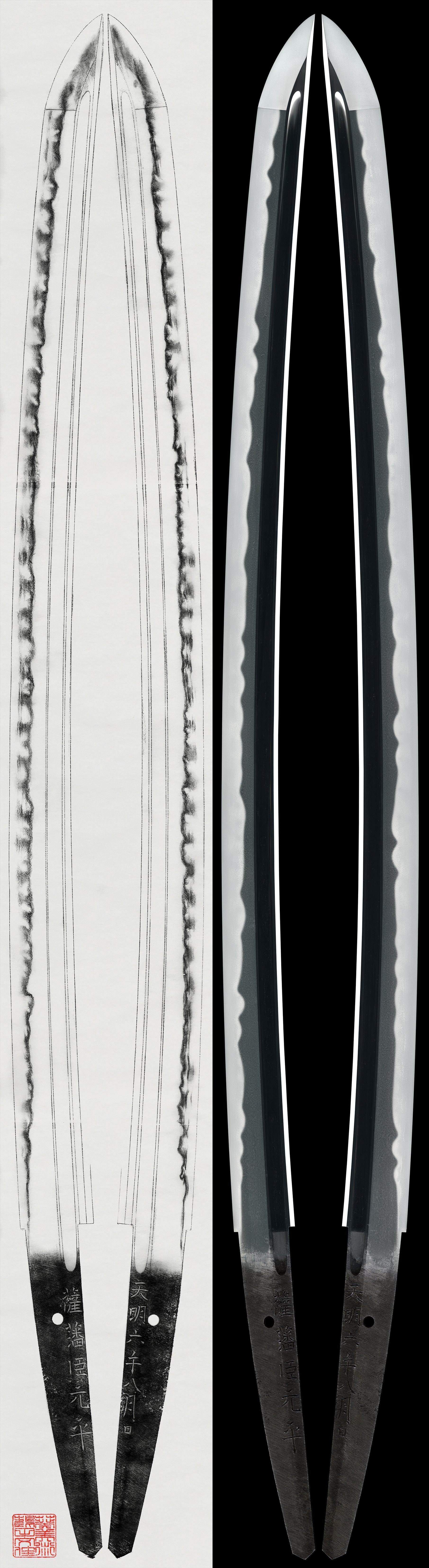
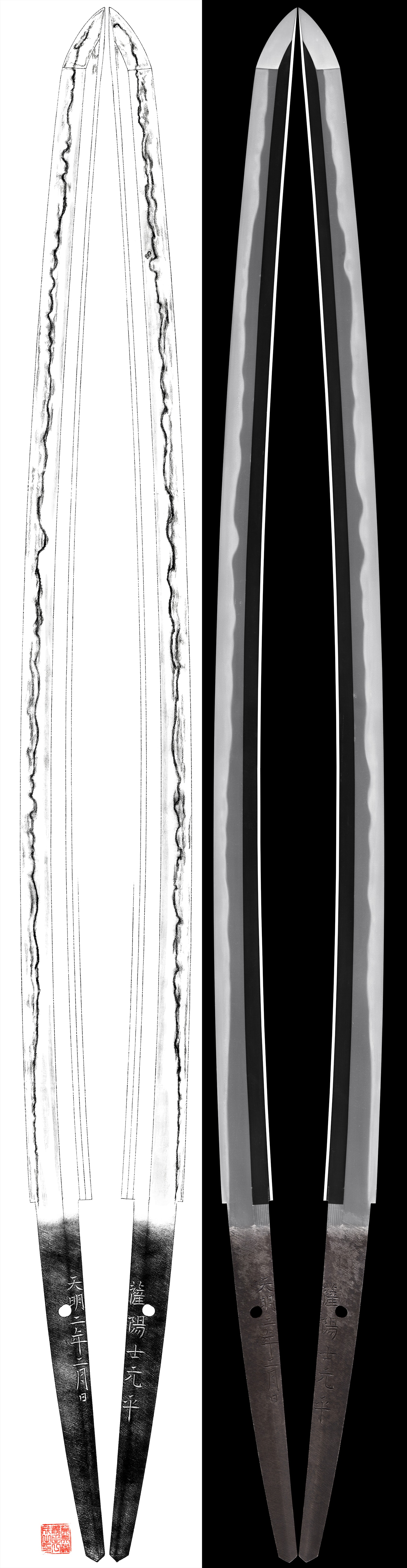
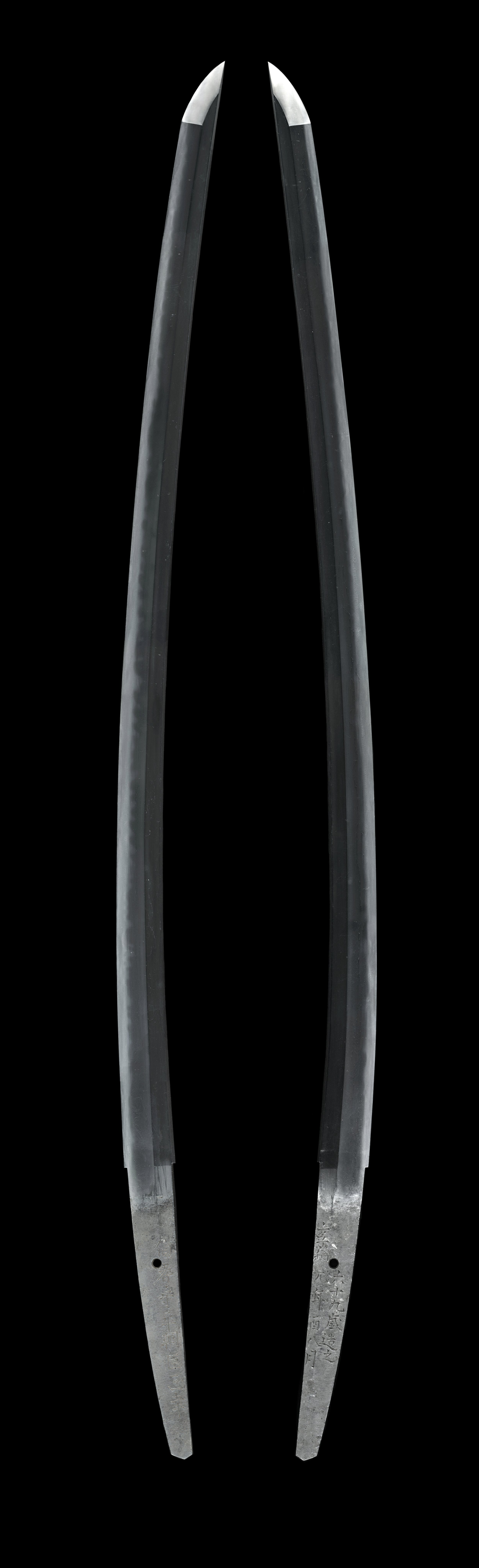
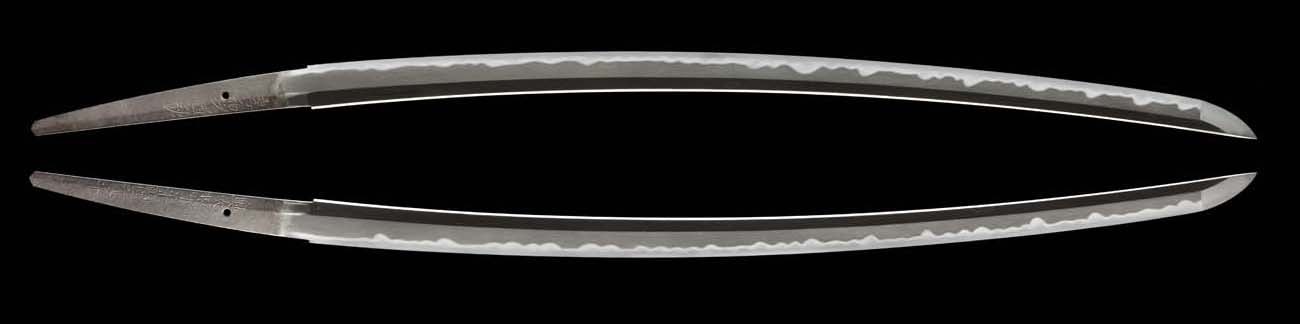
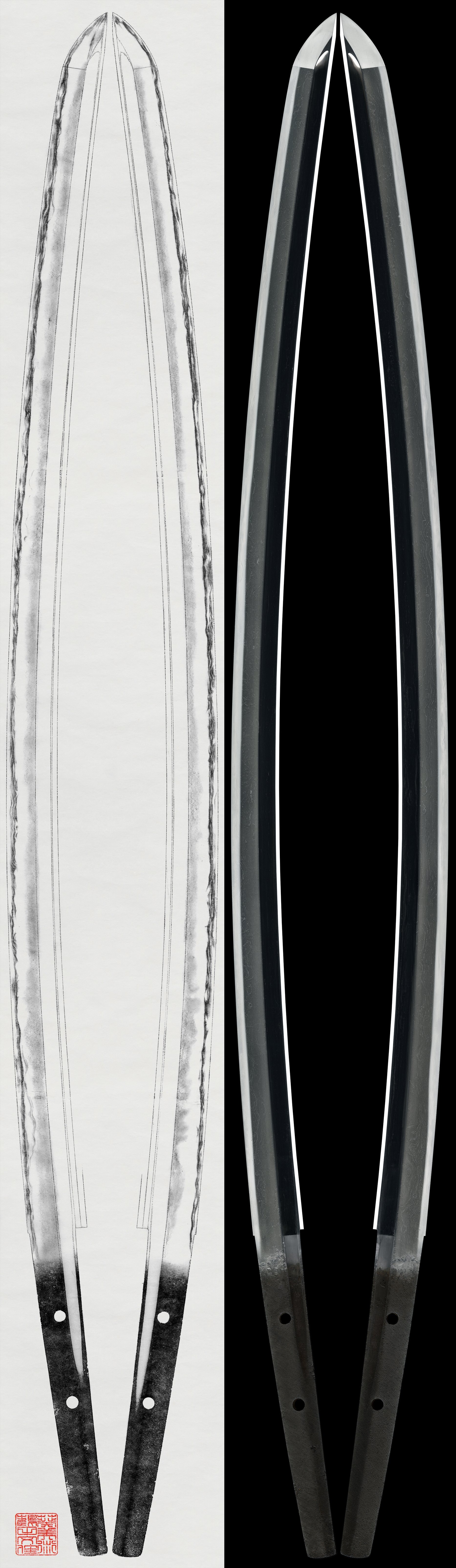
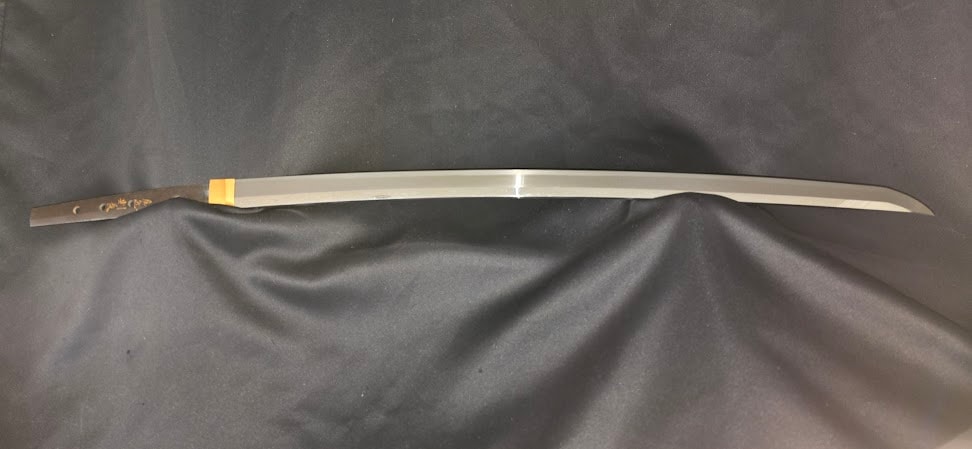
The blades on record under the name Masayoshi of Satsuma carry a family succession rather than a single hand. The published sources read the name as the Ijichi house of Satsuma domain smiths, and the record is led by the third generation, born in Kyoho 18, who succeeded to the name Masayoshi, received the title Hoki no Kami in Kansei 1 at the time as Oku Motohira, and on that occasion ceded the Masayoshi name to his heir and signed Masayuki thereafter, dying at eighty-six in Bunsei 1. The earliest hand the record reaches is the first generation, named in one text as Uehara Juzaemon, a warrior of the Izumi district at the northern edge of the province where it meets , a strategic post manned by the domain's hardiest samurai, recorded there as the grandfather of the later Hoki no Kami. Across the generations the published commentary holds a single judgment in view: among Satsuma smiths he stands, with Oku Yamato no Kami Motohira, as one of the two foremost masters, and he was held to have surpassed his teacher Masachika and his own forebears, a smith the sources call simply a master who outstripped his teacher.
His is a robust - hand, and its most constant tell lies in the activity of the and the . Over every blade in the corpus the temper carries , and over most of it and short as well, the long streaming lines running together within a deep and an abundant, thick . The itself is the second mark: it adheres heavily and conspicuously mixes coarse across most of the record, the bright, agitated steel that sets the Satsuma manner apart from the calmer of the contemporary revival or of Osaka work. The temper on which this activity rides is a notare base into which , small and a pointed tendency are mixed, the entering well, the published sources naming this carrying and pointed teeth as his habitual hand. It is not a regular and not a ; the pointed elements riding on a notare base are what the commentary repeatedly calls typical of him.
The is the third discriminator, and it must be read from this smith's own work rather than from any school formula. His is an that stands and opens, mixed with and flowing , often with a tendency toward raised grain, over which the forms thickly and enter frequently; in the finest pieces the published sources note an unusual -like vari-gane, a dark figure in the steel that lends a distinctive texture, the phrase 「地景風の変り金」 recurring in the commentary. This is a stout, active , not the fine clear of the Yamashiro or Osaka traditions, and it is the the commentary describes as belonging to Satsuma. The answers the . The defining formula the published sources cut is 「乱れ込み、先尖りごころに掃きかける」, the point running in as a , gathering a pointed and finishing in ; on the most vigorous blades the sweep gathers into a flame-like form, and a few examples close instead in a quieter or an -leaning return. The under all of this is the one the sources call habitually his, broad in width, thick in , long and stoutly built, the point extended into a or, on his greatest work, an .
Within this one manner the corpus draws two periods and a signature change that date the blades closely. The first generation's single well-represented blade, from the Kyowa years, already shows the line's idiom formed, a carrying and a pointed tendency, vigorous with , and prominent , and , the running in as a with a rounded tip and a long return, called a representative example of a maker whose work is scarce. The third generation's prime fills the rest of the record, and the sources read it as - after the manner of , one Tenmei 5 blade called outright a work in the 「志津風の作域」 and judged a success, another, from his earlier Meiwa and An'ei years, said to take its models from the older Go and from Inoue Shinkai of Osaka. The inscriptions track this chronology: he signed both and , the surname Taira entering the signature from the Tenmei years so that a Sasshu-ju Taira Masayoshi blade falls after that line, and as a rule he did not cut the character for day into his dates, one An'ei 6 abbreviating so far as to give only the year, a thing the commentary marks as extremely rare.
What sets him apart is best drawn from his own grounded traits rather than by contrast. The deep, coarse , the streaming and within a , and the standing Satsuma with its are the features that identify his hand, and the of , pointed and swept in , at times flame-like, completes the picture. The sources place him at the head of his school's late and fullest flowering, the renown of the pupil outshining the master attached to his name, written 「出藍の誉が高く」; he learned in the school of Masachika and stood at the close beside Oku Yamato no Kami Motohira, the two smiths the commentary names together whenever it weighs the masters of Satsuma , the formula 「薩摩新々刀鍛冶の中では奥大和守元平と共に双璧である」 recurring almost word for word across the record. The Jigen-ryu temper of the province, the bold construction and the weight in the hand, the sources say he carried further than most, so that his most imposing blades are exceptional even among Satsuma work.
Fujishiro grades him Jo-, and the blades on record are all ; there are no National Treasures or Important Cultural Properties among them, and the published record preserves no provenance or institutional holder for them. They are the steady mark of a domain master whose work is uncommon rather than unobtainable, held in private hands and surfacing from time to time rather than locked away as patrimony. The longest and most powerful of them, an of Tenmei 5 measuring over eighty-six centimeters, the sources call a life's major work and a 「畢生の大作にして白眉」, a preeminent piece without near parallel for its length, vigor and weight in the hand, the stronger than usual and the grandeur of the coarse- exceptional. A blade by Hoki no Kami Masayuki comes to the serious collector only from time to time and at the upper end of the Satsuma field, a landmark of the late tradition when one appears, the deep- streaming on its standing Satsuma unmistakable for the hand that made it.