Power sat in Kamakura, but taste was still made in Kyōto. The Awataguchi school’s pear-skin steel became a byword for perfection, and the Rai line supplied dignified tachi to the court, senior warriors, and the great temples alike.
 NihontoWatchNihontoWatchNihontoWatch
Offered by Choshuya
Awataguchi Kunimitsu is a name with Jūyō-designated work, and we couldn’t find current papers for this piece. Treat the name as unproven until papers say otherwise. The dealer itself presents the attribution with some reserve, which is honest; please still treat it as unproven. — Hoshi Ask me first
2 on the market









Yamashiro-den · Yamashiro · around 1249-1256
Fujishiro Jo-jo saku · Tōken Taikan top 1%
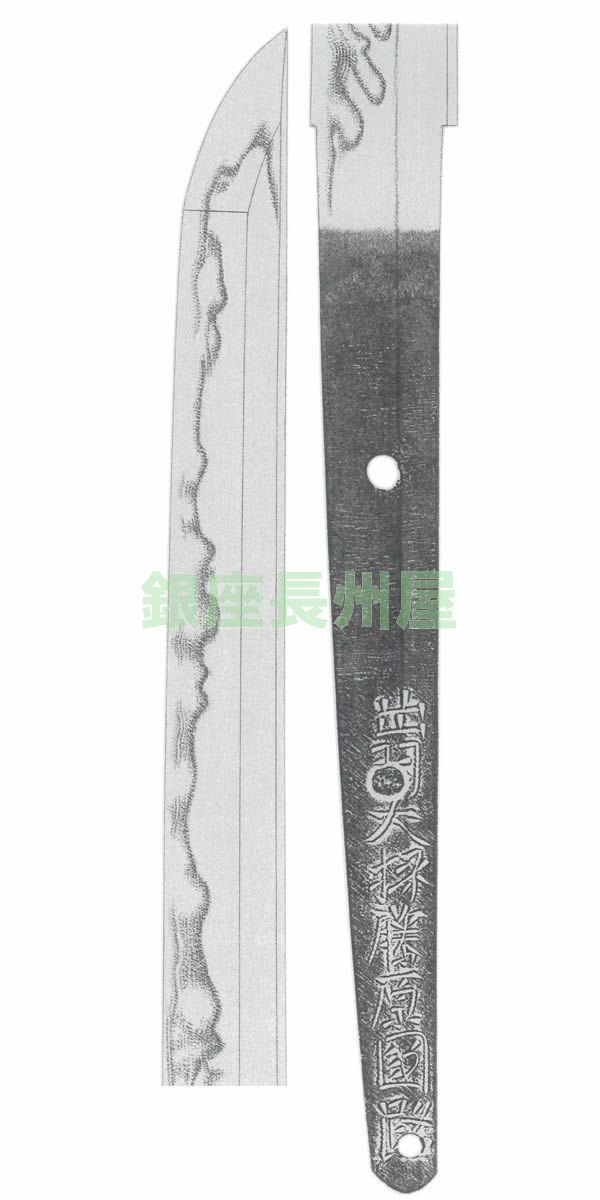
A small hira-zukuri tanto designated Juyo in 2003 fixes Awataguchi Kunimitsu in time. On the omote of its ubu tang the date Koan 11 (1288) is cut with a rather thick chisel, on the ura the fifth month, first day, and beneath it the two-character name Kunimitsu. The published sources identify him as the son of Norikuni and the younger brother of Kuniyoshi, a smith of the Awataguchi school of Yamashiro in the late Kamakura period. Secure examples of his work are exceedingly rare. Beyond this tanto they know only a few, among them two tachi designated Important Cultural Properties and a ken whose inscription includes the title Saemon no Jo. Of the dated blade they write that its ji and ha fully display the virtues of Awataguchi work[[c:1]], and that "above all, the documentary value of the Koan 11 date is beyond measure"[[c:2]]. Because the name is cut on the sashi-ura, they add, the tanto may have been made as a metezashi, worn at the right side.
The published sources describe his manner in a few consistent words. On an o-suriage katana designated in 1970 they write that he "signed in two characters, Kunimitsu, his jigane fine, excelling at suguha and highly skilled"[[c:3]]. On a katana designated in 2019 they put it more fully: his work is marked by a jigane that is "tightly forged, with ji-nie attaching in fine particles, beautiful, and he excelled at a calm suguha"[[c:4]].
The jigane is ko-itame, tightly forged, with fine ji-nie and chikei. On the 2019 katana the ji-nie attaches in fine particles, chikei enter well and a faint nie-utsuri rises. On the dated tanto the ko-itame is mixed with flowing grain and masame, the ji-nie attaches well with fine chikei, and the colour of the steel is called exceptionally bright and clear. The 1970 katana is forged in an itame that flows overall, with ji-nie attaching well.
The temper is a hoso-suguha. On the 2019 katana a few ko-ashi enter, nie attaches well, hotsure appear in places in the upper half, a slight nijuba-like effect runs on the ura and kinsuji enter here and there, the nioiguchi bright and clear. The 1970 katana mixes hotsure and kuichigai-ba into its hoso-suguha, the nioiguchi tending to tightness, with ko-nie and some slightly coarse nie and kinsuji. On the tanto the suguha undulates shallowly, mixed on the ura with small gunome, the nioi deep and the ko-nie thick. The boshi runs straight to a ko-maru on all three, turning back rather short on the 2019 katana and somewhat long on the tanto.
The shapes vary with the form. The 2019 katana is of standard width, tapering clearly, with a shallow koshizori and a chu-kissaki, and bo-hi carved kaki-nagashi on both faces. The 1970 katana, o-suriage and shallow in curvature, has a compact chu-kissaki inclining to ikubi. The tanto is slender, thin and small, with uchizori, and keeps traces of a suken on the omote and of what are taken for goma-bashi on the ura. Its two-character signature, the published sources note, shares points with that of the Important Cultural Property tachi. Of the 2019 katana, whose tang carries a red-lacquer attribution, they single out the well-refined jigane and call the blade, with its gentle form and bright, orderly suguha, "an excellent example of this smith's attribution, possessed of a dignified and elevated character"[[c:5]].
Five designated works on record carry his name. Two are Important Cultural Properties, both signed Kunimitsu, shinogi-zukuri with a maru-mune, forged in ko-itame and tempered in hoso-suguha: a tachi of 73.3 cm at Yoroji in Gifu, which the published sources name as his best-known representative work, and a tachi of 80.3 cm at the Kurokawa Institute of Ancient Cultures in Hyogo. They are heritage held by a temple and a research institute. The other three are Juyo blades: the dated tanto and the two katana. He has no National Treasures. Fujishiro ranks him Jo-jo saku. A Juyo blade by Kunimitsu reaches the market only rarely, and a signed one, given how few survive, is among the scarcest things a collector of Awataguchi work could encounter.
Where Kunimitsu stands among comparable artisans: across all of nihontō, and within tradition, era, and period. The tiers (Foremost · Leading · Major · Notable) weigh official designations from the NBTHK and Japan's Agency for Cultural Affairs, together with historical honors of lasting repute such as the Sansaku and Meibutsu-chō.
Select a lens to see how it's measured.
Yamashiro-den · Yamashiro
2 pieces on the market now
The steel is the first thing one learns to read in Awataguchi work: a ko-itame kneaded so tight that the surface takes on the pear-skin sheen the texts name nashiji-hada, the ji-nie dusted over it fine and even, slender chikei threading through, the whole carrying a moist luster (潤い) and a clarity that recurs in notice after notice. This is the steel of the early Yamashiro tradition at its summit. The forge stood at the foot of the Awataguchi slope in Kyoto, on the highway running toward Omi, and a community of smiths already worked there by the early Kamakura period; the tale collection Uji Shui Monogatari attests their presence, so this is a house with a documented place in the literature of its own century. The school is conventionally founded on the six brothers, Kunitomo the eldest, then Hisakuni, Kuniyasu, Kunikiyo, Arikuni and Kunitsuna, sons of the founder Kunika (also given as Kuniie). Kunitomo, Hisakuni and Kuniyasu were summoned as goban-kaji to forge on rotation at the cloistered court of the Retired Emperor Go-Toba, and Hisakuni is even transmitted as a teacher to the sovereign; that imperial patronage is the reason a slender tachi with so quiet a temper carries the authority it does. What binds the house across four generations is restraint married to refinement. Over the nashiji-hada the brothers set a calm suguha leaning into a shallow notare, mixed with ko-midare, ko-gunome and ko-choji, the nioiguchi tight and bright, ko-ashi and yo entering, kinsuji and sunagashi running within the ha; the boshi turns in a refined ko-maru that very often sweeps with hakikake. This is the opposite pole from the clove-flower flamboyance of contemporary Bizen, an edge whose interest lies in the activity within rather than the height of the pattern. Within that shared vocabulary the members are told apart by habit. Kunitomo and Kuniyasu hold to the compressed ko-midare of the founding generation, their nioiguchi clouding into urumi; Kuniyasu's linked ko-gunome picks him out alone within the school.
Kunitsuna is the divergence, a robust o-itame standing prominently over thick ji-nie, with conspicuously strong ha-nie that leans toward the Sagami manner about to be born. The later course runs through Norikuni, the bridge generation, into the tanto age of Kuniyoshi and Yoshimitsu, where the temper settles into bright suguha in fine ko-nie. Kuniyoshi's tell is the nijuba, the doubled (at times trebled) line along the ha; Yoshimitsu's is the linear kuisagari dropping of nie into the ji beneath the boshi, his suguha a narrow hoso-suguha under a bright nioiguchi. For the collector the school divides into work that can be studied and work that can be owned. Its summit, Toshiro Yoshimitsu, crowns the close of the line; paired with Shintogo Kunimitsu of Sagami as a master of the tanto and a virtuoso of suguha, and ranked in the Edo period with Masamune and Go among the Three Great Works under Heaven, he is a smith met in the great collections rather than possessed, his signed tanto the standard against which every attribution is measured. His teacher Kuniyoshi, whose nashiji-hada the texts name outright, is by Awataguchi measure not wholly beyond reach, his o-suriage mumei katana anchored on the doubled line. The house also seeded the eastern tradition: Kunitsuna's transmitted descent runs on to Shintogo Kunimitsu, the de facto founder of Soshu, whose own refined nashiji steel passes for Awataguchi until the chikei and kinsuji betray it, and from whose quiet nie-laden suguha Yukimitsu, Masamune and Norishige drew the nie-midare of the mature tradition. The refined nie-suguha the brothers fixed was likewise the wellspring the Rai masters drew from, the two hands sitting so close in the eye that gold-inlaid Rai attributions appear on blades grouped with Hisakuni. To kantei an Awataguchi blade is to read the pear-skin steel first, then the quiet nie-laden suguha, then the swept boshi, and to know which brother or pupil the habits name; to acquire one, of any generation, is among the scarcest encounters early Yamashiro affords. Learn more →
| Smith | Era | Designated |
|---|---|---|
| Yoshimitsu吉光 | 1259-1260 | 49 |
| Kuniyoshi國吉 | 1275-1278 | 50 |
| Hisakuni久國 | 1190-1199 | 21 |
| Kunitsuna國綱 | 1240-1264 | 14 |
| Kuniyasu國安 | 1199-1201 | 23 |
Yamashiro in the Kamakura period
Power sat in Kamakura, but taste was still made in Kyōto. The Awataguchi school’s pear-skin steel became a byword for perfection, and the Rai line supplied dignified tachi to the court, senior warriors, and the great temples alike.
We could not find an authenticity certificate on the seller’s listing. Japanese swords and fittings are normally papered by the NBTHK (or the NTHK). Without one, the attribution is the seller’s own assessment and has not been independently verified — treat it with caution and ask the dealer about certification before buying.
If, due to our fault, the item differs significantly from its proper condition, the item may be returned. Cooling-off is within one week of the item's arrival.
¥1,500,000