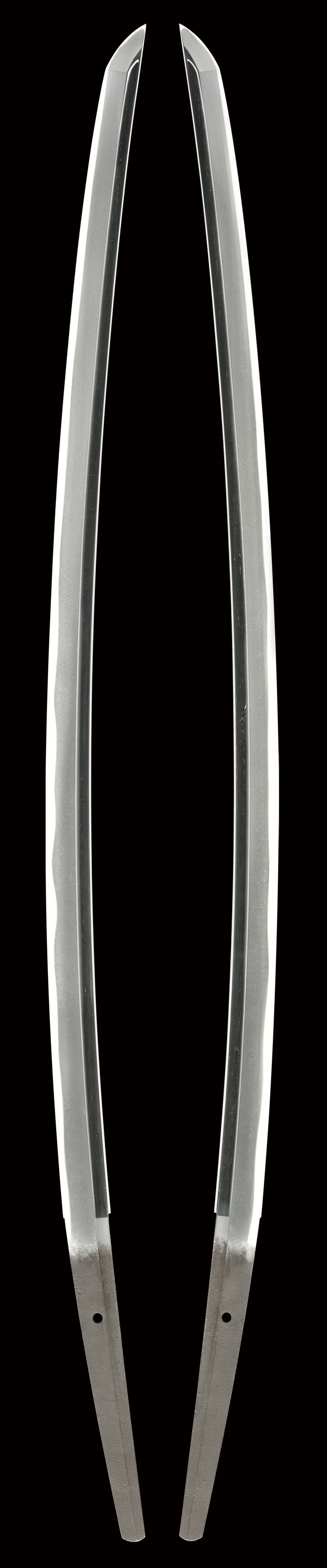
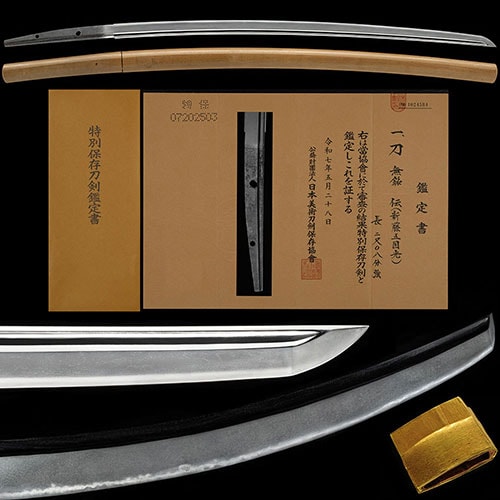
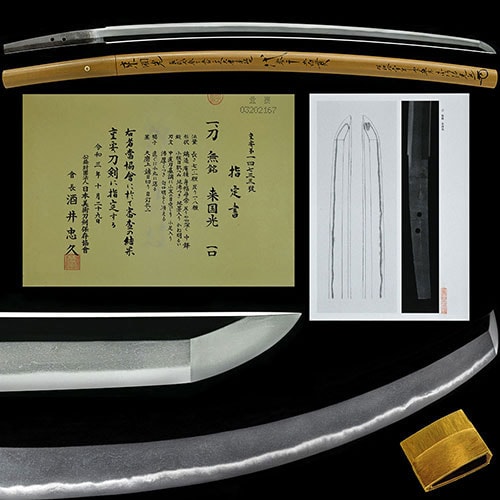
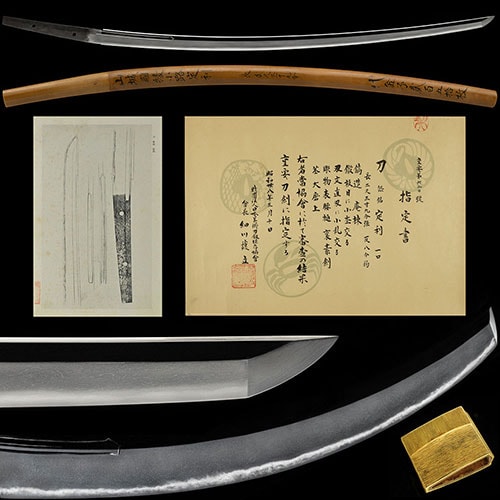
Toshiro Yoshimitsu of in Yamashiro, active in the mid to late period, is introduced by the published sources with one recurring sentence: he is the smith who crowns the close of the school, and he stands together with Kunimitsu of as "a master of the and a virtuoso of ". The notices record that in the period he was celebrated with Masamune and Go as the Three Great Works under Heaven (天下三作), and that among the three he was "placed foremost and most highly treasured". His teacher is held to be Kuniyoshi, and the published record anchors the filiation in the work itself: the varied forms of his correspond entirely to shapes found in Kuniyoshi, and the connection, the writes, is readily accepted. Fujishiro grades him Sai-jo .
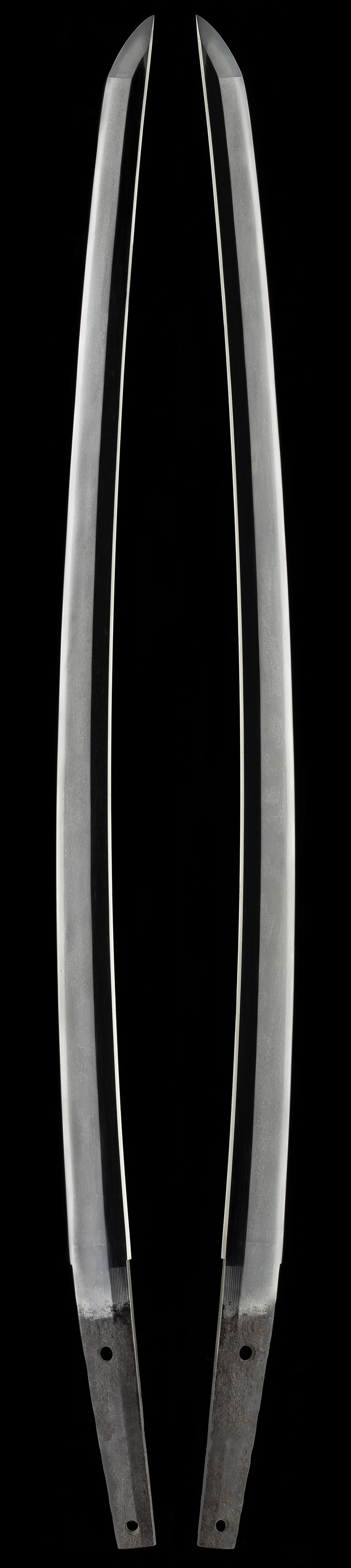
The forms of his are remarkably varied: blades broad and somewhat compact, slender yet elongated, broad and long, and of standard proportions, nearly all with . Within that variety the hand is constant. His celebrated temper is , often a narrow , laid in fine bright under a bright, clear . Small are aligned in the lower half toward the , and the tempered width narrows around the . enter, delicate and work through the edge, and at times the line carries a effect. The turns back in a calm , and beneath it on the the notices repeatedly mark a linear dropping of into the , the so-called of , a habitual trait of his hand.
Beneath the temper lies the at its full refinement, and the published sources recognize two forging modes in it. One is a so tightly packed that it is called (梨子地肌), the pear-skin surface; the other an of somewhat larger pattern in which the stands a little. In both, fine adheres thickly and evenly, fine enter, and a rises in the . The steel itself, notice after notice, carries a moist luster (潤い) and is conspicuously clear.
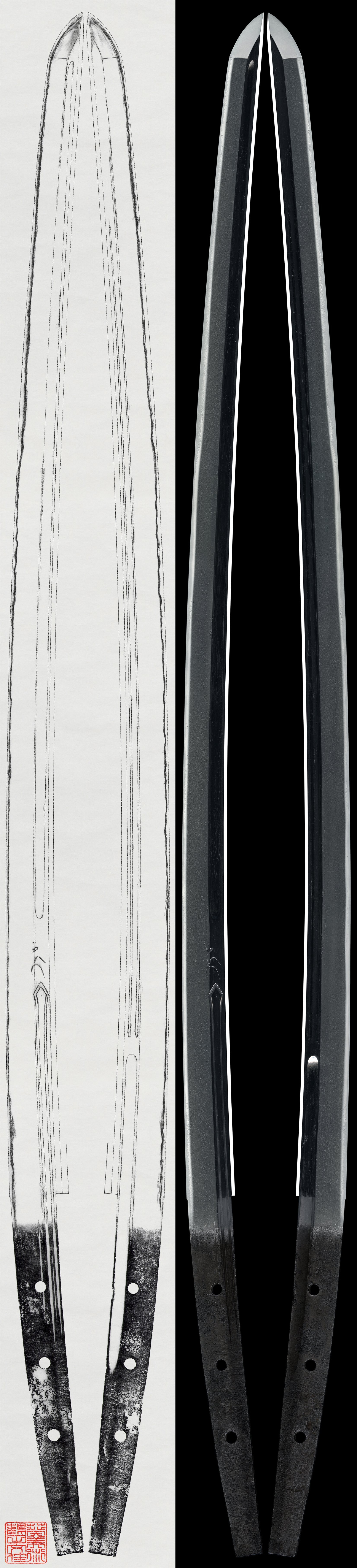
Nearly everything he made is a . The published record long held that his only surviving work outside that form was the Ichigo Hitofuri (一期一振藤四郎), the once in the collection of Toyotomi Hideyoshi and since retempered; in recent years a signed became known, regarded as an early form of the , formerly of the Naruse family of Inuyama and published in the Kozan . Its signature placement agrees exactly, the sources record, with the tang of the Ichigo Hitofuri as drawn in the Kotoku sword albums. He signed his work: forty-five pieces of record carry a against four without, the standard form a large two-character cut below the of an . The calligraphy is itself an object of scholarship. The published sources value the fluent brushwork of his as "unrivaled through the history of sword inscriptions".
The comparative judgments in the published sources are concrete. Of a small with narrow and exceptionally thick , they write that such a construction is hardly to be seen in the school, that it belongs to the varied shapes of , and that compared with works "the of and is a degree thicker, and felt more strongly". Toward his teacher Kuniyoshi the relation is continuity: the slender, elongated silhouette of certain pieces is the manner seen in the teacher's work. Within his own school, the notices add, his individuality can be grasped clearly through the near the base, the narrowing toward the , and the dropping of beneath the . His signed are in turn the standard against which every Yoshimitsu attribution is measured.
Seventy-one of his works stand on record. Four are National Treasures and nine are Important Cultural Properties, patrimony preserved in museums, shrines and long-held collections; beneath them stand seven and fourteen , twenty-one blades in those tiers. The Kyoho -cho lists sixteen of his blades headed by the Hirano Toshiro (平野藤四郎), and with its fire-lost and supplementary sections the count reaches thirty-eight. The blades that survive carry their histories openly. The Nabeshima Toshiro (鍋島藤四郎) passed from Nabeshima Naoshige through the Ikeda to Tokugawa Tsunayoshi, and was thereafter handed to each shogunal heir at his coming of age; the Asakura Toshiro (朝倉藤四郎) is named for Asakura Yoshikage of ; one was given by the shogun Iemitsu at the birth of his son Tsunashige and later worn by the sixth shogun Ienobu; another was received by Kyogoku Takatsugu from Tokugawa Ieyasu in Keicho 5. In all, thirty-nine blades carry recorded provenance, running through the Ashikaga shoguns, the Imperial Family, Matsunaga Hisahide, Toyotomi Hideyoshi, Tokugawa Ieyasu, the Owari and Kishu Tokugawa, the Maeda, the Kuroda and the Asano. The National Treasure and Important Cultural Property examples stand permanently outside the market, and of recorded whereabouts twenty-two works rest with institutions, among them the Tokugawa Art Museum, the Tokyo National Museum, the Kyoto National Museum, Atsuta Jingu, the Maeda Ikutokukai and the Sano Art Museum, against eleven in private hands. A Yoshimitsu coming into the open is among the rarest events in the field; for most collectors he is a smith to be studied in the great collections rather than possessed.