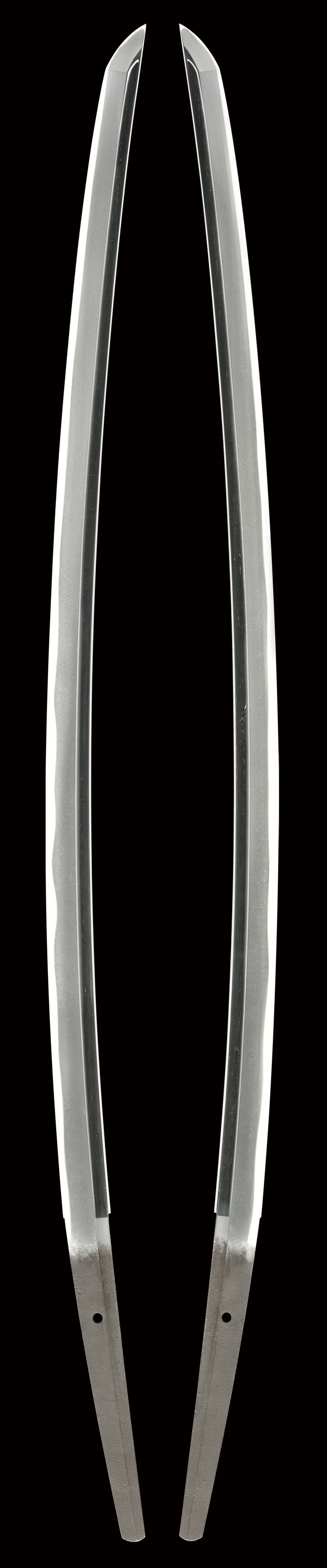
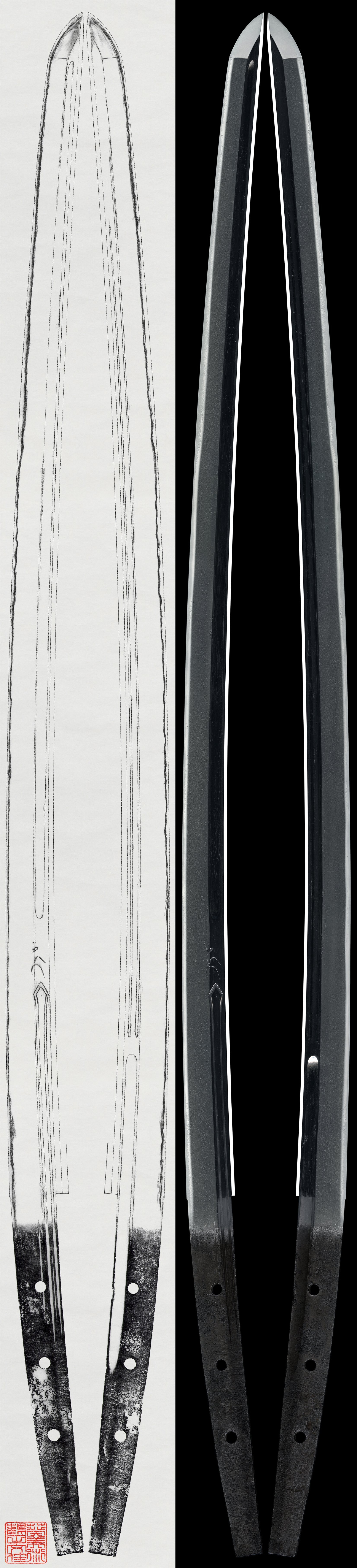
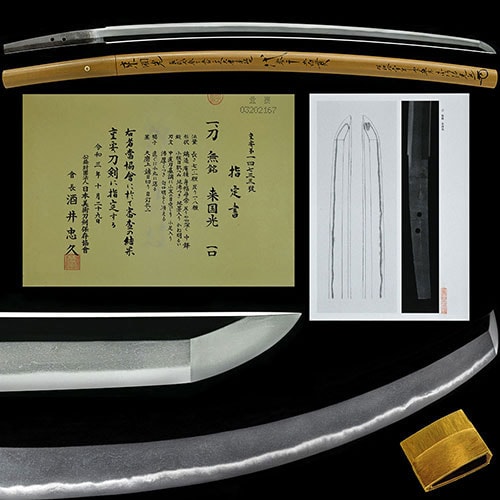
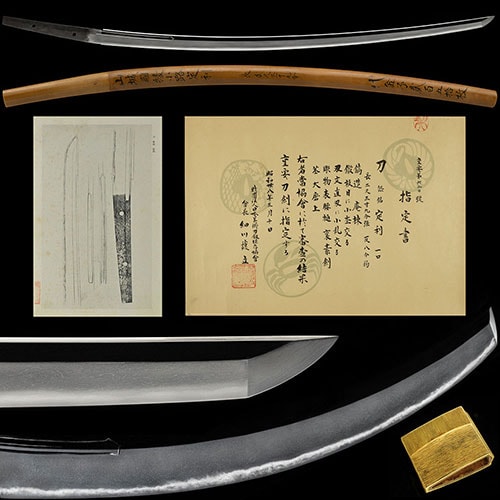
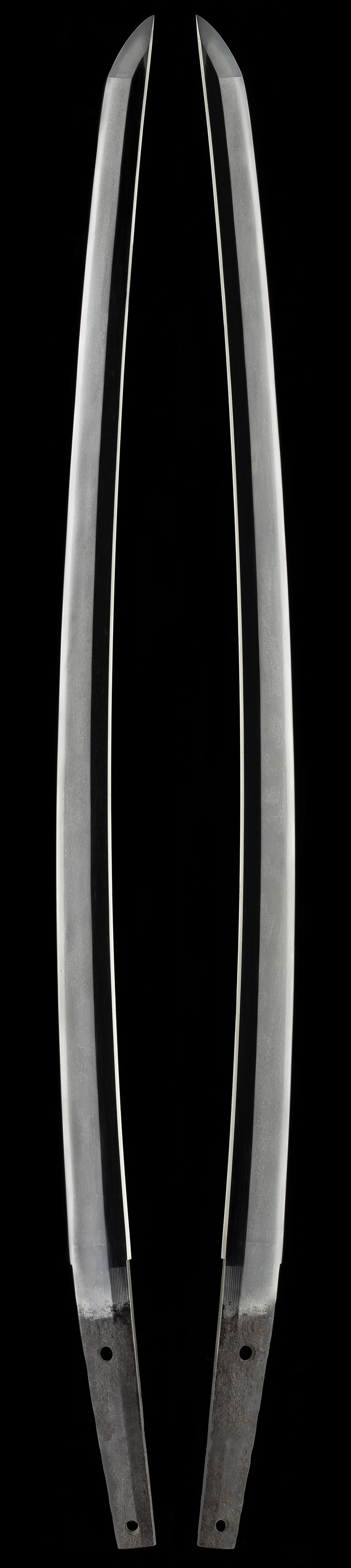
Hisakuni worked at the foot of the slope in Yamashiro in the early period, and he is the second of the six brothers, the smith who used the personal name Tojiro (藤次郎). The published record sets the family out plainly: the founder is given as Kunika, and his sons were the six brothers Kunitomo, Hisakuni, Kuniyasu, Kunikiyo (国清), Arikuni (有国) and Kunitsuna (国綱). That a community of smiths already stood at is attested in the early- tale collection Uji Shui Monogatari, so this is a forge with a documented place in the literature of its own century, not a later reconstruction.
Hisakuni's standing inside that famous house is the first thing to recognise. The 14th entry calls his manner the most refined and dignified within work, and the 42nd entry ranks him foremost of the lineage in both technique and refinement of spirit. He is repeatedly named among the bangaji whom the Retired Emperor Go-Toba (後鳥羽院) summoned to forge on rotation at the cloistered court, and one record goes further and transmits him as a teacher to the sovereign (帝王の師). The history is not decoration here. It is the reason a slender with so quiet a temper carries the authority it does.
Recognise his hand by the pure Yamashiro register. Over a tightly packed , finely worked and dense with , he tempers a quiet that leans into a shallow , with small and a little mixed in, and entering, the tight and bright, and and running in the . The is a calm , and very often it sweeps with ; one records it exactly as a straight tip that brushes into a -like finish, and the swept tip recurs across his and his . The forging itself draws a recurring word from the appraisers, the so-called tataki- look of a thoroughly consolidated , and the steel praised of old as blue in colour with a white edge.
Among the brothers the connoisseurs single him out for . The 24th entry calls him the smith whose and carry most strongly, sometimes with a slightly coarse mixed in, while the 22nd names him outright the most skilful forger of the six, its tight and deep, faintly recalling his younger brother Kuniyasu. His show the clarity in miniature: the wide, slightly curved -Bijutsuhin is flagged as an unusual shape for , and the Honma note attached to it draws the very line that separates this house from its successors, the occasional eccentric proportion among being a point of distinction from the school.
His place in the wider road of Yamashiro steel runs through that contrast with . The refined - he and his brothers fixed at is the wellspring the masters drew from, and through them the eastern smiths after; one of the grouped with him even carries a gold-inlaid attribution to Kunitsugu, a reminder of how closely the early Yamashiro and later hands sit in the eye. Signed work survives in the smallest numbers, a few and , most of them the bold two-character cut now with a thick chisel and now with a finer one, with the rare long Tojiro Hisakuni signature confirmed against the old sword books Kotoku Toezu and Kozan (光山押形). The blades carry the names of the great houses: the Kishu Tokugawa and the Date (伊達家), the Matsudaira of Saijo and the Akimoto, with one authenticated by a Kotsune dated Enpo 9.
For the collector the arithmetic is severe. A National Treasure and a small group of Important Cultural Properties stand to his name, several of them held in institutions, the Tokyo National Museum and Nikko Toshogu and Itsukushima Jinja among the recorded holders, where they can never trade. Only a handful sit in the and tiers, and those are spoken for by old provenance. A Hisakuni in private hands is therefore among the rarest things a student of the early sword can hope to meet, and when one appears it is the quiet, dignified, -laden of the imperial forge, not the spectacle of a later age, that the buyer is acquiring.