The Higo Dotanuki school was a group of swordsmiths representing Kyushu who were active from the late Muromachi period through the Momoyama period; they are known for being employed by Kato Kiyomasa and forging many robust swords suited for actual combat. The lineage includes smiths such as Nobuyoshi, Masakuni, Kozuke no Suke, Matahachi, Hyobu, Samasuke, Genzaemon, Uemon, and Katakuni. Their style is characterized by a wide mihaba, thick kasane, and a grand, sturdy tsukuri with rich hiraniku, and they particularly excelled at o-miyari of over 2 shaku. In addition to shinogi-zukuri katana, they also produced many large-sized naginata, while hira-zukuri wakizashi and yari under 1 shaku are relatively rare.
Dotanuki Ideta is a swordsmith omitted from the meikan records. The place name Ideta remains in present-day Ideta, Kikuchi City, Kumamoto Prefecture; in ancient times, it corresponded to Ideta Village, Kikuchi District, Higo Province, and belonged to the same Kikuchi District as Hiekata, which is considered the birthplace of the Dotanuki school.
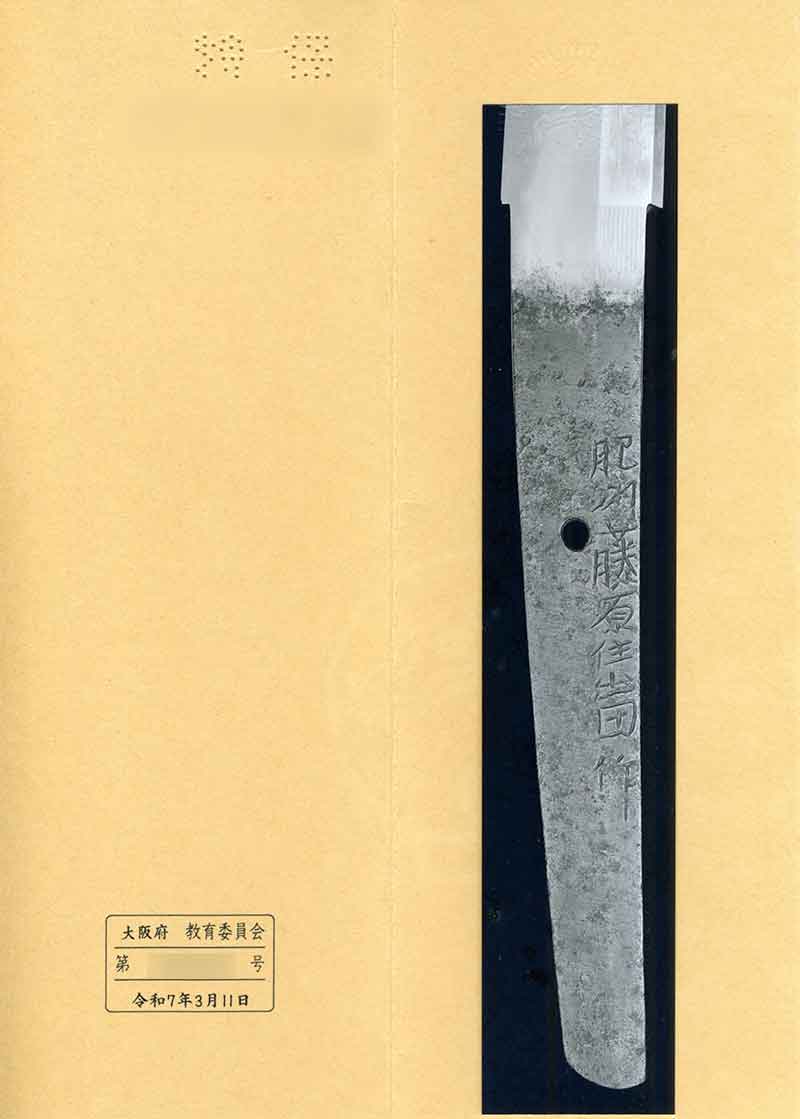
Among the Dotanuki school, smiths from the relatively early period such as Kiyokuni have examples signed "Hishu Ju Fujiwara [Name]"; although the word order differs, this work by Ideta is signed "Hishu Fujiwara Ju Ideta Saku," showing commonality in the composition of the meibun using "Hishu," "Fujiwara," and "Ju." From this, it is inferred that Ideta was a swordsmith of the Tensho era, which corresponds to the relatively early period of the Dotanuki school.
Furthermore, regarding the meibun of this work, it is thought that where it should originally have been cut as "Hishu Ju Fujiwara Ideta Saku," it was mistakenly cut as "Hishu Fujiwara Ju Ideta Saku" with "Ju Fujiwara" becoming "Fujiwara Ju," suggesting the possibility that he was unaccustomed to the format of meibun. Such errors in meibun are occasionally seen in examples from the Muromachi period, and one feels a sense of charm, perhaps reflecting the broad-mindedness of that era.
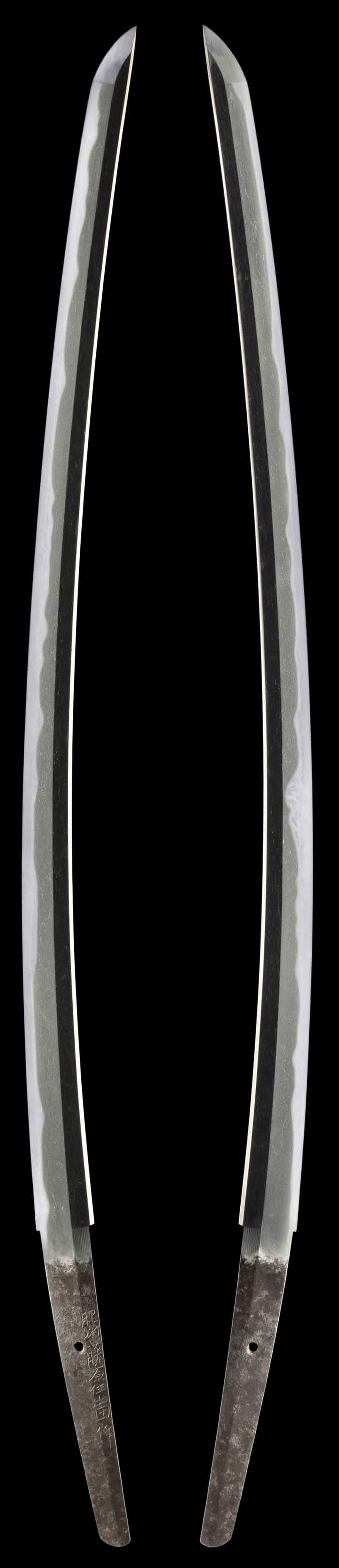
This work presents a grand sugata, feeling heavy in the hand, with an exceptionally wide mihaba, thick kasane, some difference between the moto and saki width, a high saki-sori, and a chu-kissaki that tends to be extended. The jigane shows a strong kitae with itame mixed with mokume, becoming somewhat o-hada and tending to be hada-dachi, with jinie appearing minutely and thickly, chikei entering, and the steel color taking on a blackish tint. The hamon is based on suguha with shallow notare, mixed with gunome, ko-gunome, and shimaba, with active ashi and yo, thick jinie, tobiyaki appearing in places, the habuchi generally showing nie-hotsure, fine kinsuji and sunagashi, and active muneyaki; it is an excellent work that well expresses the characteristics of the Dotanuki school.
Sayagaki by Tanobe Tanzan Sensei
"Hishu Ju Fujiwara Ideta Saku. There is an eight-character mei; perhaps the 'Fujiwara Ju' in the meibun is an error for 'Ju Fujiwara.' It presents a wide and heavy, robust taihai, with a jigane of hada-dachi itame, and a hamon based on suguha with shallow notare, mixed with gunome, tobiyaki, and shimaba. It is heavily covered in nie with sunagashi, the boshi is nie-kuzure becoming kaen-fu, and it further shows muneyaki; it displays a bold and free style and is a typical excellent work of the Dotanuki school. Additionally, works by this smith are rare and thus precious.
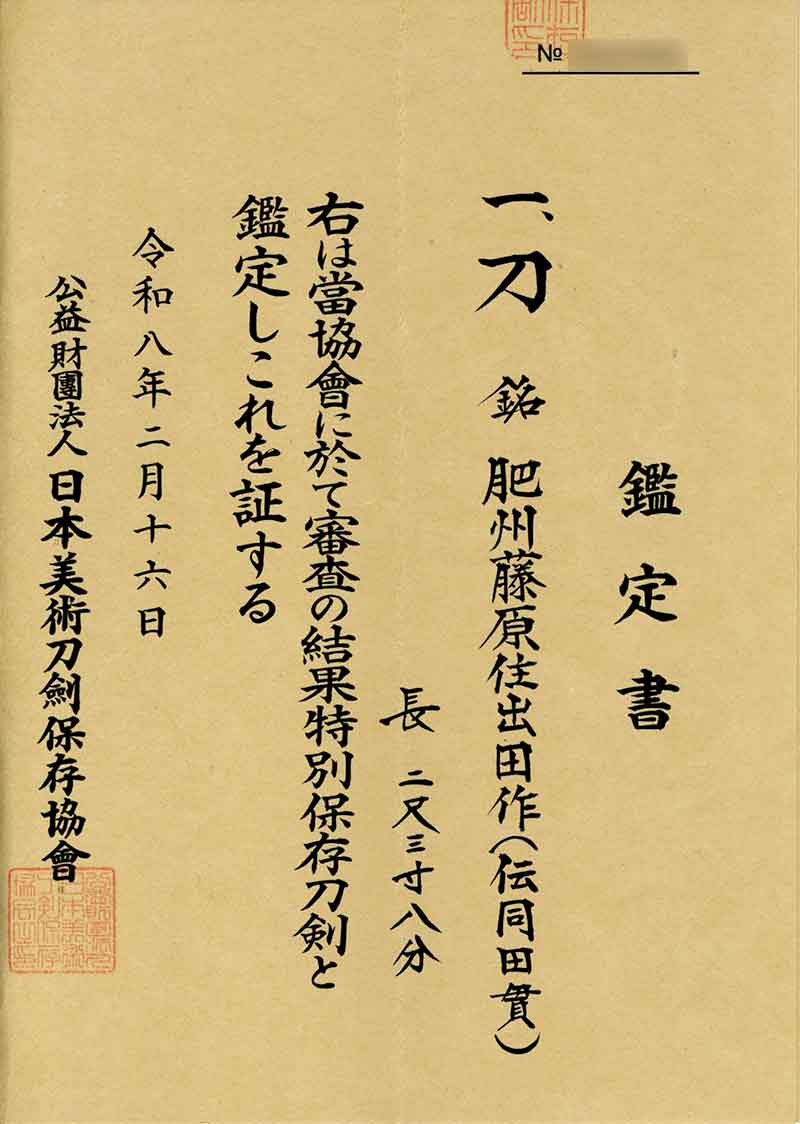
Nagasa 2 shaku 3 sun 8 bu. Written by Tanzan in the month of October, the year of Kinoto-Mi (seal)"
Due to the old polish, fine hike and scratches are visible.
Machine translation from the shop's Japanese · may contain errors ·
The Higo Dotanuki school was a group of swordsmiths representing Kyushu who were active from the late Muromachi period through the Momoyama period; they are known for being employed by Kato Kiyomasa and forging many robust swords suited for actual combat. The lineage includes smiths such as Nobuyoshi, Masakuni, Kozuke no Suke, Matahachi, Hyobu, Samasuke, Genzaemon, Uemon, and Katakuni. Their style is characterized by a wide mihaba, thick kasane, and a grand, sturdy tsukuri with rich hiraniku, and they particularly excelled at o-miyari of over 2 shaku. In addition to shinogi-zukuri katana, they also produced many large-sized naginata, while hira-zukuri wakizashi and yari under 1 shaku are relatively rare.
Dotanuki Ideta is a swordsmith omitted from the meikan records. The place name Ideta remains in present-day Ideta, Kikuchi City, Kumamoto Prefecture; in ancient times, it corresponded to Ideta Village, Kikuchi District, Higo Province, and belonged to the same Kikuchi District as Hiekata, which is considered the birthplace of the Dotanuki school.
Among the Dotanuki school, smiths from the relatively early period such as Kiyokuni have examples signed "Hishu Ju Fujiwara [Name]"; although the word order differs, this work by Ideta is signed "Hishu Fujiwara Ju Ideta Saku," showing commonality in the composition of the meibun using "Hishu," "Fujiwara," and "Ju." From this, it is inferred that Ideta was a swordsmith of the Tensho era, which corresponds to the relatively early period of the Dotanuki school.
Furthermore, regarding the meibun of this work, it is thought that where it should originally have been cut as "Hishu Ju Fujiwara Ideta Saku," it was mistakenly cut as "Hishu Fujiwara Ju Ideta Saku" with "Ju Fujiwara" becoming "Fujiwara Ju," suggesting the possibility that he was unaccustomed to the format of meibun. Such errors in meibun are occasionally seen in examples from the Muromachi period, and one feels a sense of charm, perhaps reflecting the broad-mindedness of that era.
This work presents a grand sugata, feeling heavy in the hand, with an exceptionally wide mihaba, thick kasane, some difference between the moto and saki width, a high saki-sori, and a chu-kissaki that tends to be extended. The jigane shows a strong kitae with itame mixed with mokume, becoming somewhat o-hada and tending to be hada-dachi, with jinie appearing minutely and thickly, chikei entering, and the steel color taking on a blackish tint. The hamon is based on suguha with shallow notare, mixed with gunome, ko-gunome, and shimaba, with active ashi and yo, thick jinie, tobiyaki appearing in places, the habuchi generally showing nie-hotsure, fine kinsuji and sunagashi, and active muneyaki; it is an excellent work that well expresses the characteristics of the Dotanuki school.
Sayagaki by Tanobe Tanzan Sensei
"Hishu Ju Fujiwara Ideta Saku. There is an eight-character mei; perhaps the 'Fujiwara Ju' in the meibun is an error for 'Ju Fujiwara.' It presents a wide and heavy, robust taihai, with a jigane of hada-dachi itame, and a hamon based on suguha with shallow notare, mixed with gunome, tobiyaki, and shimaba. It is heavily covered in nie with sunagashi, the boshi is nie-kuzure becoming kaen-fu, and it further shows muneyaki; it displays a bold and free style and is a typical excellent work of the Dotanuki school. Additionally, works by this smith are rare and thus precious.
Nagasa 2 shaku 3 sun 8 bu. Written by Tanzan in the month of October, the year of Kinoto-Mi (seal)"
Due to the old polish, fine hike and scratches are visible.
About the school
Dotanuki
同田貫
Bizen-den · Higo
10 pieces on the market now
›
The Dōtanuki (同田貫) line took shape in Kikuchi District of Higo Province toward the close of the Muromachi period and carried its activity forward into the shintō era, spanning the Momoyama transition into early Edo. The setsumei of the group's own blades name several of its hands: Ueno no Suke, whose dated work runs from Tenshō through Keichō and who is therefore described as a maker active across the divide between old and new traditions; Fujiwara Masakuni, treated as a leading smith of the school; Masahiro, whose naginata the register notes is absent from the meikan and so supplements that omission; and Matahachi. The accounts further list Samanosuke, Hyōbu, Matahachizaemon, and Kunikatsu among the line's signing smiths. The group is repeatedly framed as a representative Kyūshū lineage of the period, working in the domain that would become the ground of Higo's later military culture. The shared vocabulary of the setsumei is plain and consistent. The sugata is described as sturdy and uncompromising, bukotsu, with wide mihaba, thick kasane, and ample hiraniku, and little difference between base and tip width; on swords the sakizori can be pronounced and the chū-kissaki extended, while the spears and large naginata show flaring, full heads. The kitae is itame, often with nagare and mokume mixed in and a tendency toward hada-dachi, with ji-nie adhering and chikei at times visible.
The hamon moves between two registers: a notare base mixed with ko-gunome, ko-chōji, and ko-togariba, and a quieter suguha with ko-ashi and yō; across both the nioiguchi tends to be tight, nie gathers densely, and sunagashi, kinsuji, tobiyaki, and muneyaki recur. The hand is recognized by this combination of robust unrefined build and a midareba whose tight nioiguchi and clustered nie read as rustic rather than ornamental. The register notes a shizumi-gokoro, a subdued tendency in both ji and ha, that lends a restrained austerity. " The setsumei return again and again to cutting power: the sharpness of these blades is highly praised, and they are recorded as practical weapons carried into use. Provenance survives in mounted form, including a naginata by Masakuni accompanied by a black lacquer mounting with gold maki-e judged contemporary with the blade, and a Matahachi naginata with its black-lacquered pole mounting. Within the line, individual works are singled out as superior examples that convey the school's character, the Ueno no Suke katana of Keichō 16 being read as exceptionally fine among its peers. The register places Dōtanuki as a Higo lineage whose unadorned strength and cutting reputation hold a recognized standing in the shintō-period record. Learn more →
Three unifiers ended the century of war, and the sword became an instrument of the new order: the 1588 sword hunt made it the warrior’s badge, famous blades passed between houses like treaties, and appraisal ever after divides the craft here, kotō from shintō.
A Hozon-certified blade judged to show notably superior workmanship and a better state of preservation. The bar is higher: re-tempered blades and most unsigned Muromachi/Edo works are excluded.
About the NBTHK›
The NBTHK (Nihon Bijutsu Tōken Hozon Kyōkai, the Society for the Preservation of Japanese Art Swords) is a public-interest incorporated foundation founded in 1948 and supervised by Japan’s Agency for Cultural Affairs (Bunkachō); it is based at the Japanese Sword Museum in Tokyo. Its expert panels physically examine each submitted work (shinsa) and issue a certificate (kanteishō) ranking it by artistic and historical merit. NBTHK papers are the most widely recognized standard of authentication for Japanese swords and fittings.
Please exercise cooling-off within 8 days of the item's arrival.
(1) We cannot accept items that have been altered or worked on in any way (e.g. test cutting, polishing or other work, display at viewing meetings, photography, taking oshigata rubbings, use for appreciation, copying of books).
(2) Return shipping is at the customer's expense.
(3) Costs other than the item price (bank transfer fees, cash-on-delivery fees, installment fees, etc.) cannot be refunded.
(4) For cash-on-delivery and similar payments, the refund is made after the payment has reached us.
(5) We cannot accept a return when a trade-in item is involved.
(6) Items delivered overseas cannot be returned or refunded (because of the time involved and, for swords, the surrender of the registration certificate and other circumstances).



 NihontoWatch