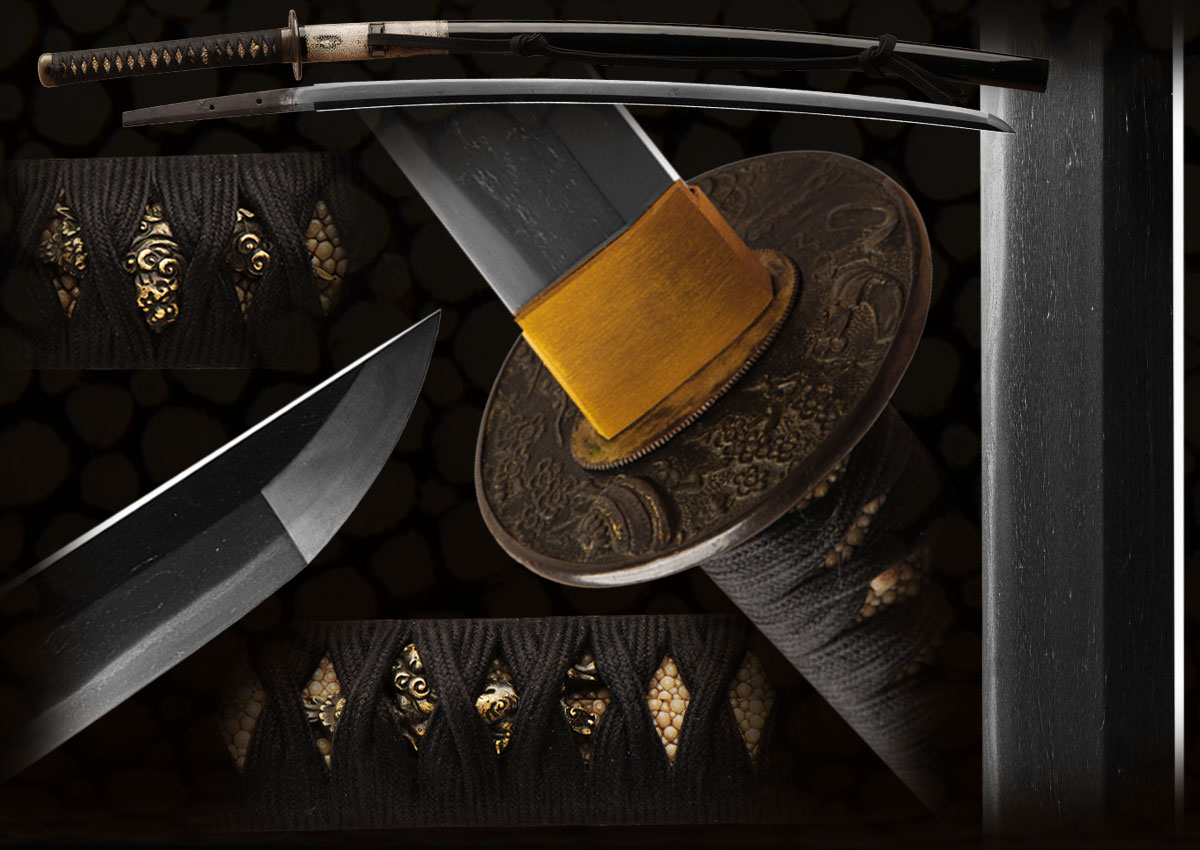
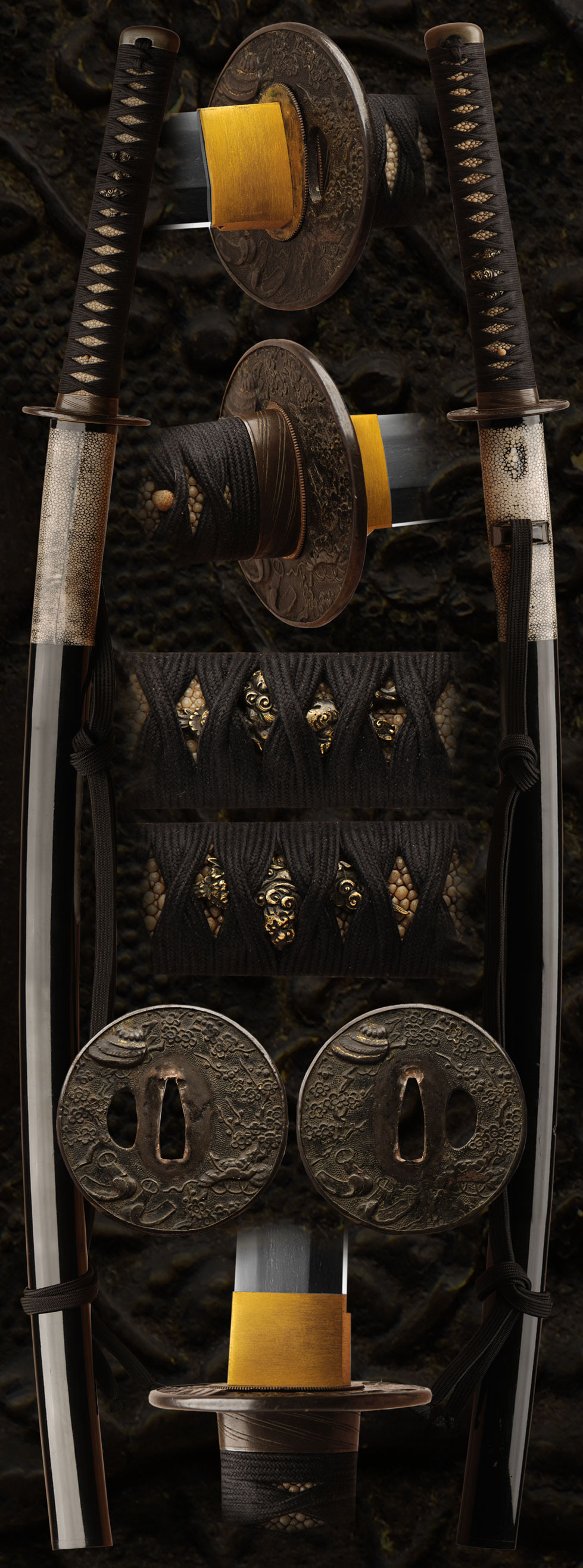
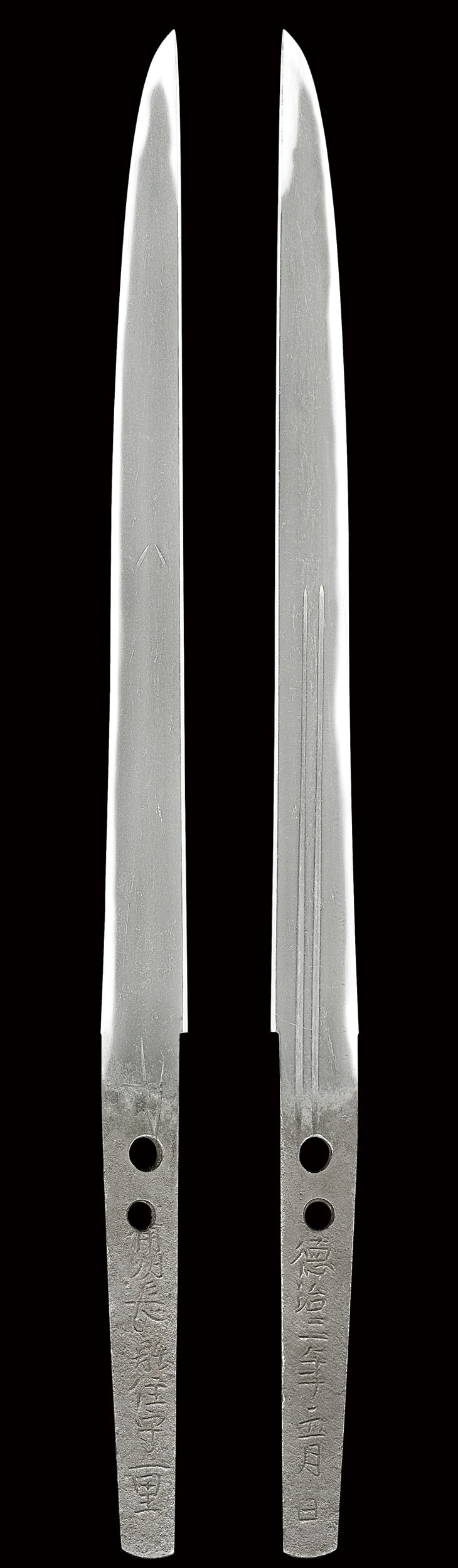
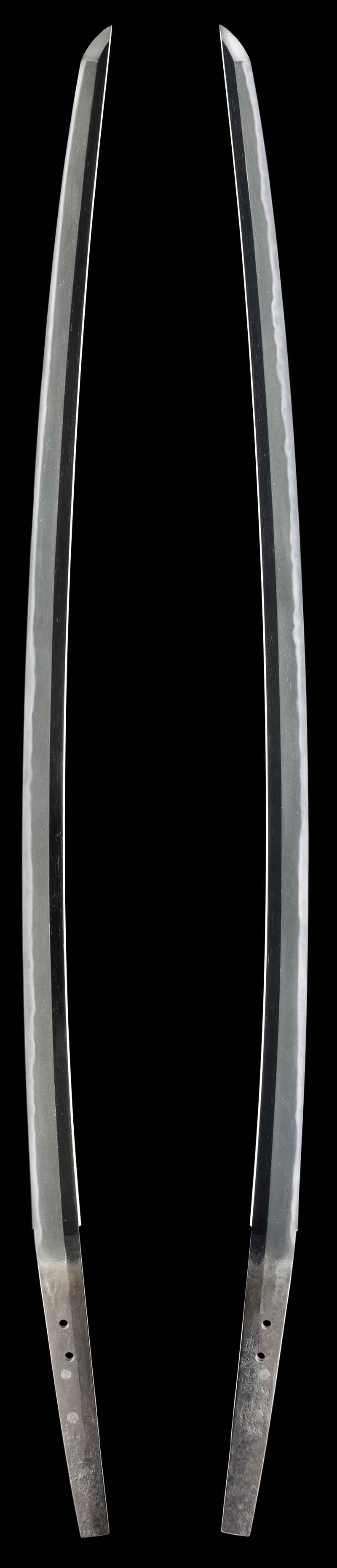
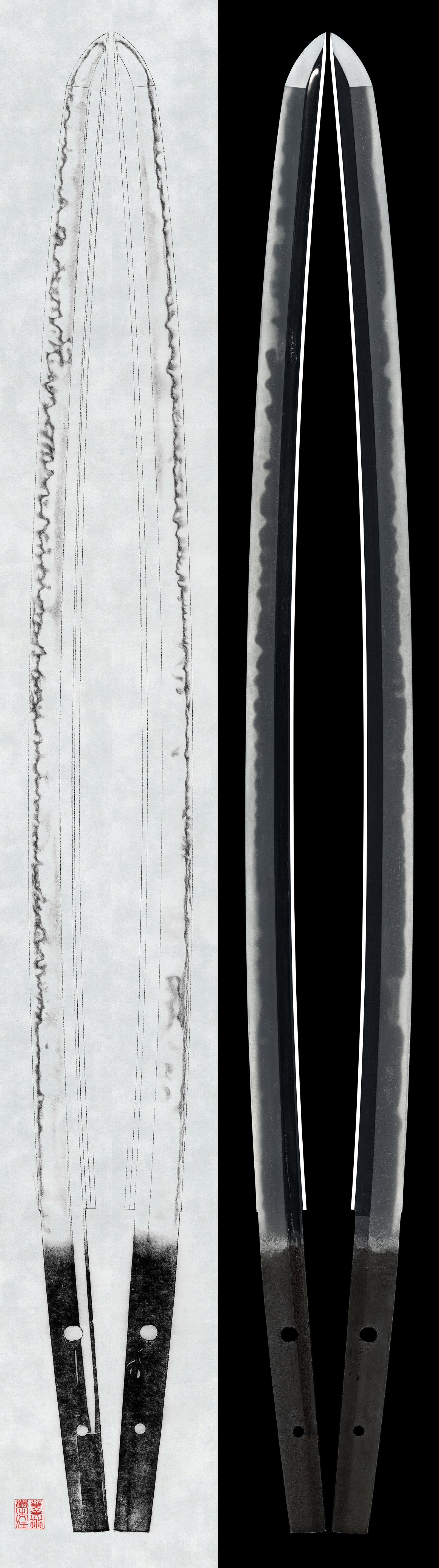
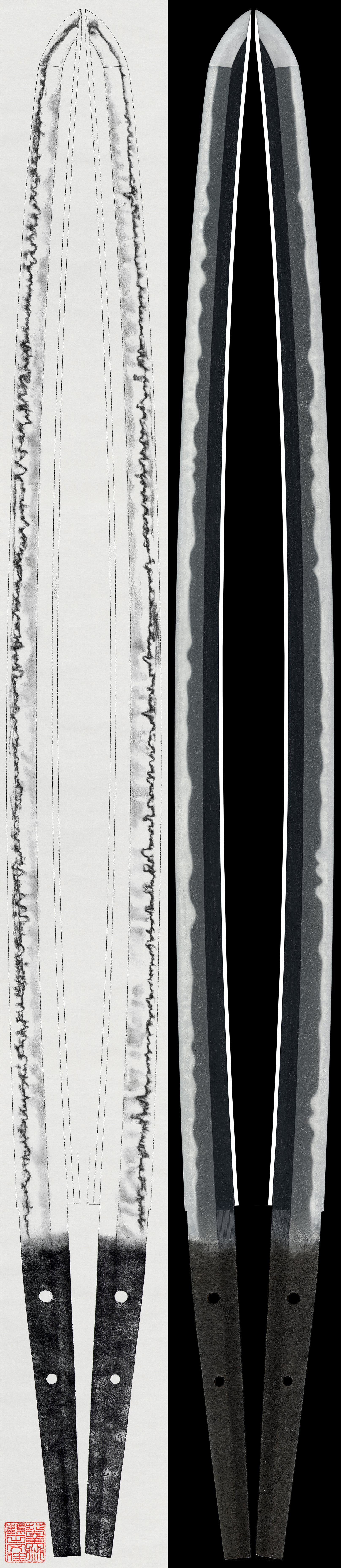
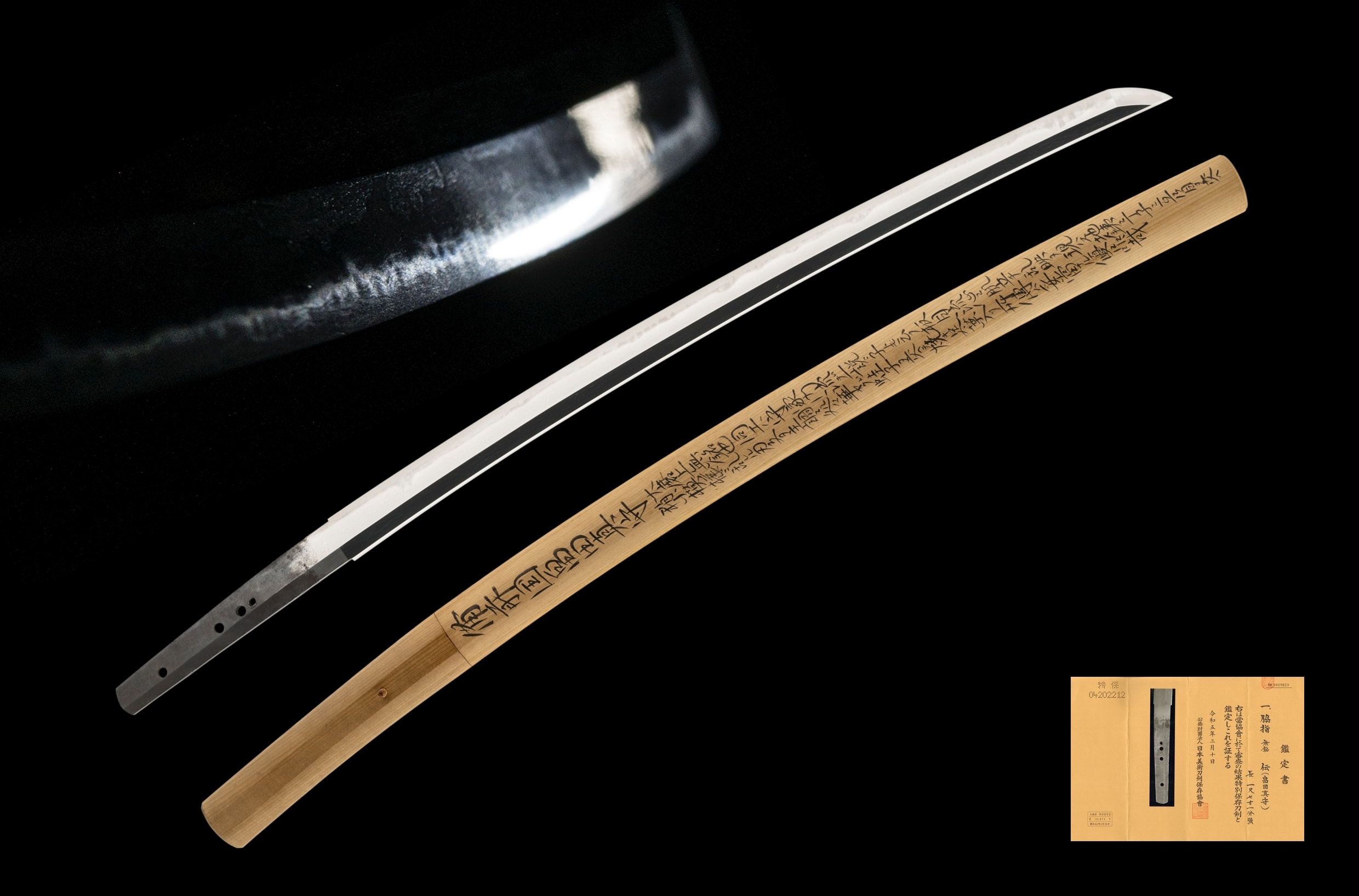
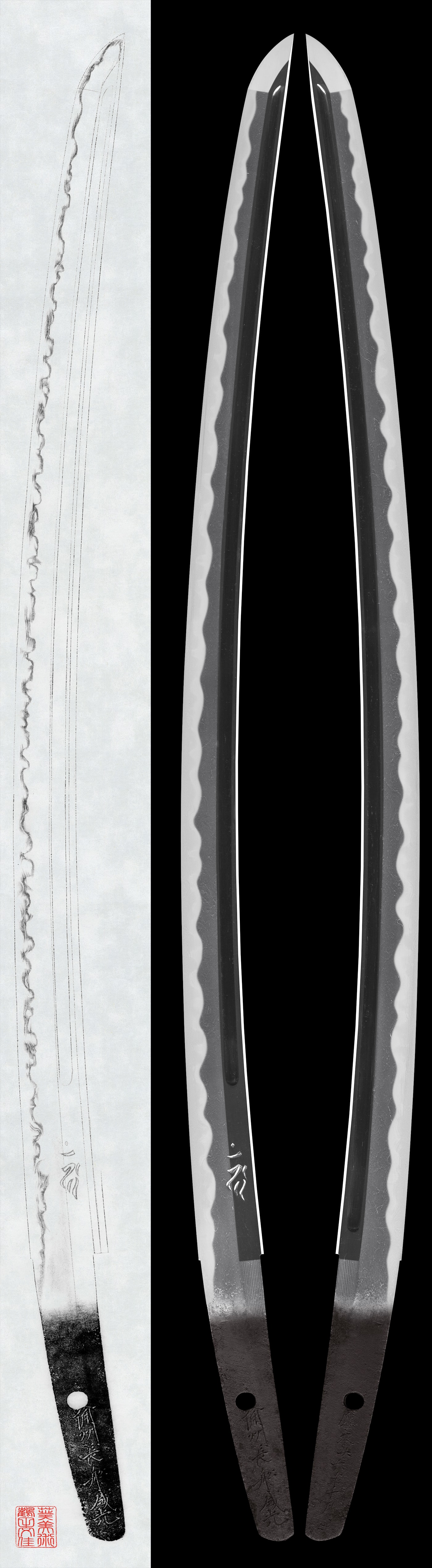
This is a long Koto katana with a Hoso-suguha hamon. The blade is suriage with remnants of an old signature. It has a nice polish and a set of koshirae, with a Shi-Shi theme menuki.


Bizen-den · Bizen · around 1275-1316
Fujishiro Jo-jo saku · Tōken Taikan top 11%
Morishige is traditionally transmitted as a swordsmith of the Hatakeda line within the Bizen Osafune school. According to the meikan (smith directories), he is recorded as a son of the second-generation Moriie and as the father of Motoshige, with extant dated works bearing era names spanning from Einin and Kagen through Showa, Bunpo, and Gen'o — all corresponding to the closing phase of the Kamakura period. Distinguishing a first and second generation Morishige is considered somewhat forced; in broad terms he should be regarded as a swordsmith of the late Kamakura period. Smiths using the same name succeeded the founder, and they continued working through the Muromachi period under what reference works identify as the Omiya group, so called because the founder is said to have moved from Omiya in Yamashiro. In all cases, however, their signatures state "Bishu Osafune-ju" (resident of Osafune in Bizen Province), making it clear that their place of work remained Osafune. The Muromachi-period generations are recorded from Oan (1368–1375) through to the end of the Muromachi period, with dated examples surviving from the Oei and Bunmei eras.
The Kamakura-period works characteristically display itame-hada — at times a dense ko-itame mixed with mokume — with midare-utsuri standing out vividly in the ji. The hamon is typically a suguha-cho basis mixed with gunome, into which ko-ashi and saka-ashi enter; the nioiguchi tends toward tightness (shimari-gokoro), and ko-nie adheres throughout. Some works exhibit kataochi-gunome reminiscent of Kagemitsu, revealing a pronounced Osafune character rather than a distinctly Hatakeda manner. Indeed, the presence of midare-utsuri in the forging and the suguha-cho composition with intermingled gunome share aspects in common with the style of the Nagamitsu group, suggesting that by this period the Hatakeda school had for the most part become assimilated into the Osafune tradition. Compared with Moriie, the workmanship tends to be subdued (sabishii), with a pronounced ko-nie tendency. The Muromachi-period generations, by contrast, are characterized by a more flamboyant, large-patterned midareba, featuring koshi-biraki gunome mixed with choji, accompanied by tobiyaki, kinsuji, and sunagashi — works that at a glance can be mistaken for Oei-Bizen in their showy manner.
Extant signed works by Morishige are exceedingly few, and it has not been possible to exhaustively examine the full range of his workmanship across all generations. Those examples that survive, however, provide valuable source material for understanding the breadth of his working range and the historical relationship between the Hatakeda and Osafune lineages. Several bear date inscriptions that serve as important reference points for the study of this smith. The overall workmanship — from the clarity of the kane-iro to the well-applied ji-nie and tight nioiguchi — demonstrates sound technical accomplishment, and the best examples are noted for being kenzen (well-preserved) in both ji and ha.
Where Morishige stands among comparable artisans: across all of nihontō, and within tradition, era, and period. The tiers (Foremost · Leading · Major · Notable) weigh official designations from the NBTHK and Japan's Agency for Cultural Affairs, together with historical honors of lasting repute such as the Sansaku and Meibutsu-chō.
Select a lens to see how it's measured.
Years he was demonstrably active, proven by signed-and-dated blades
Bizen-den · Bizen
7 pieces on the market now
The Hatakeda school (畠田) takes its name from a hamlet in Bizen lying hard against Osafune village, and from that address its founder, Moriie, is called Hatakeda Moriie. The published sources place his line across the great middle decades of Kamakura, the earliest dated work a tachi of Bun'ei 9 (1272), with the name running on through the Nanbokucho years. Learn more →
| Smith | Era | Designated |
|---|---|---|
| Moriie守家 | 1259-1260 | 33 |
| Moriie守家 | 1232-1233 | 27 |
| Sanemori眞守 | 1277-1293 | 57 |
| Mitsumori光守 | 1278-1288 | 13 |
| Moriie守家 | 1280-1299 | 14 |
We could not find an authenticity certificate on the seller’s listing. Japanese swords and fittings are normally papered by the NBTHK (or the NTHK). Without one, the attribution is the seller’s own assessment and has not been independently verified — treat it with caution and ask the dealer about certification before buying.
We offer a 48 hour inspection period for all Antique items shipped within the United States only. If the item is not to your satisfaction, we will gladly refund your money less any shipping and handling fees. All sales are final after the 48 hour inspection period. Please note that all discounted items are a final sale and not returnable.
This is a long Koto katana with a Hoso-suguha hamon. The blade is suriage with remnants of an old signature. It has a nice polish and a set of koshirae, with a Shi-Shi theme menuki.


Bizen-den · Bizen · around 1275-1316
Fujishiro Jo-jo saku · Tōken Taikan top 11%
Morishige is traditionally transmitted as a swordsmith of the Hatakeda line within the Bizen Osafune school. According to the meikan (smith directories), he is recorded as a son of the second-generation Moriie and as the father of Motoshige, with extant dated works bearing era names spanning from Einin and Kagen through Showa, Bunpo, and Gen'o — all corresponding to the closing phase of the Kamakura period. Distinguishing a first and second generation Morishige is considered somewhat forced; in broad terms he should be regarded as a swordsmith of the late Kamakura period. Smiths using the same name succeeded the founder, and they continued working through the Muromachi period under what reference works identify as the Omiya group, so called because the founder is said to have moved from Omiya in Yamashiro. In all cases, however, their signatures state "Bishu Osafune-ju" (resident of Osafune in Bizen Province), making it clear that their place of work remained Osafune. The Muromachi-period generations are recorded from Oan (1368–1375) through to the end of the Muromachi period, with dated examples surviving from the Oei and Bunmei eras.
The Kamakura-period works characteristically display itame-hada — at times a dense ko-itame mixed with mokume — with midare-utsuri standing out vividly in the ji. The hamon is typically a suguha-cho basis mixed with gunome, into which ko-ashi and saka-ashi enter; the nioiguchi tends toward tightness (shimari-gokoro), and ko-nie adheres throughout. Some works exhibit kataochi-gunome reminiscent of Kagemitsu, revealing a pronounced Osafune character rather than a distinctly Hatakeda manner. Indeed, the presence of midare-utsuri in the forging and the suguha-cho composition with intermingled gunome share aspects in common with the style of the Nagamitsu group, suggesting that by this period the Hatakeda school had for the most part become assimilated into the Osafune tradition. Compared with Moriie, the workmanship tends to be subdued (sabishii), with a pronounced ko-nie tendency. The Muromachi-period generations, by contrast, are characterized by a more flamboyant, large-patterned midareba, featuring koshi-biraki gunome mixed with choji, accompanied by tobiyaki, kinsuji, and sunagashi — works that at a glance can be mistaken for Oei-Bizen in their showy manner.
Extant signed works by Morishige are exceedingly few, and it has not been possible to exhaustively examine the full range of his workmanship across all generations. Those examples that survive, however, provide valuable source material for understanding the breadth of his working range and the historical relationship between the Hatakeda and Osafune lineages. Several bear date inscriptions that serve as important reference points for the study of this smith. The overall workmanship — from the clarity of the kane-iro to the well-applied ji-nie and tight nioiguchi — demonstrates sound technical accomplishment, and the best examples are noted for being kenzen (well-preserved) in both ji and ha.
Where Morishige stands among comparable artisans: across all of nihontō, and within tradition, era, and period. The tiers (Foremost · Leading · Major · Notable) weigh official designations from the NBTHK and Japan's Agency for Cultural Affairs, together with historical honors of lasting repute such as the Sansaku and Meibutsu-chō.
Select a lens to see how it's measured.
Years he was demonstrably active, proven by signed-and-dated blades
Bizen-den · Bizen
7 pieces on the market now
The Hatakeda school (畠田) takes its name from a hamlet in Bizen lying hard against Osafune village, and from that address its founder, Moriie, is called Hatakeda Moriie. The published sources place his line across the great middle decades of Kamakura, the earliest dated work a tachi of Bun'ei 9 (1272), with the name running on through the Nanbokucho years. Learn more →
| Smith | Era | Designated |
|---|---|---|
| Moriie守家 | 1259-1260 | 33 |
| Moriie守家 | 1232-1233 | 27 |
| Sanemori眞守 | 1277-1293 | 57 |
| Mitsumori光守 | 1278-1288 | 13 |
| Moriie守家 | 1280-1299 | 14 |
We could not find an authenticity certificate on the seller’s listing. Japanese swords and fittings are normally papered by the NBTHK (or the NTHK). Without one, the attribution is the seller’s own assessment and has not been independently verified — treat it with caution and ask the dealer about certification before buying.
We offer a 48 hour inspection period for all Antique items shipped within the United States only. If the item is not to your satisfaction, we will gladly refund your money less any shipping and handling fees. All sales are final after the 48 hour inspection period. Please note that all discounted items are a final sale and not returnable.