 NihontoWatchNihontoWatch
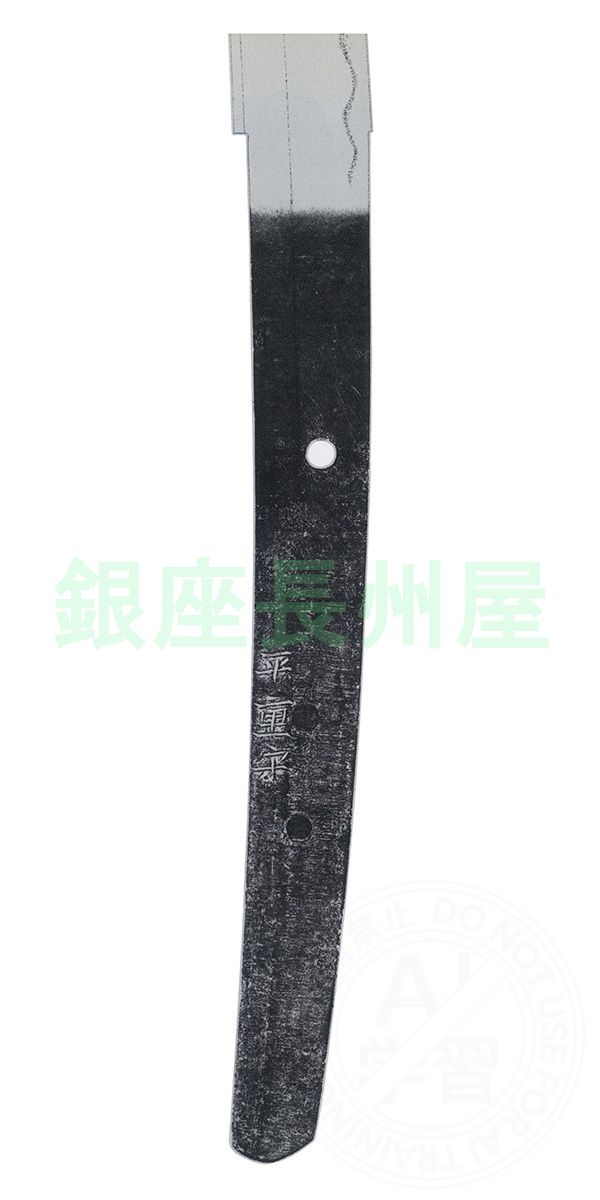
<audio controls preload="auto"> <source src="clocktowerbell.mp3" type="audio/mpeg" /> </audio> Moto-haba (Width at Ha-machi) : Approx. 2.85cm Saki-haba (Width at Kissaki) : Approx. 1.73cm 元来は馬上から打ち降ろすに適した二尺五寸を越える太刀。江戸時代には大小揃いとされたのであろう三寸ほど磨り上げ、打刀として扱い易い寸法に仕立て直されている。地鉄はねっとりと詰んだ板目肌で、全面に乱れ映りが顕著に現われ、肌目と感応し合って霧の流れるような景色を生み出している。刃文は、室町初期の備前物にも紛れるような腰開き互の目に尖刃を交え、帽子は乱れ込んで先尖ってわずかに返る。高低変化に富んだ焼刃は匂口澄んで明るく、匂の満ちた刃中には小足が入り、物打辺りに葉が浮かび、地に突き入る尖刃は映りと感応し合い備前古作を想わせる出来となっている。 戦国時代以前の九州北部を掌握していた大友氏に抱えられ、いわば武器製作の最先端に当たっていた高田鍛冶は、専ら平姓を切り添えたことから、江戸時代の同国の鍛冶と区別して平高田と呼び慣わしている。重守は天文五年の年紀作を遺している守重の一族であろう。同派の作は同時代の備前物に比して一際古風な地鉄鍛えに特徴がある。細鑚になる銘も質朴で味わい深い。
NihontoWatchOffered by Choshuya
This piece has sold
30 on the market
Get an email when new Takada School work hits the market.









Bizen-den · Bungo
30 pieces on the market now
In Bungo Province on Kyushu, the early Kamakura masters Sadahide and Yukihira appeared and then, for a span, distinguished makers ceased; the setsumei repeatedly mark this gap before the line that became the Takada school took hold. The school was founded in the Nanbokuchō period by Tomoyuki, who arose at Takada Manor (Takada-shō) and signed in the long form "Hōshū Takada-shō Fujiwara Tomoyuki," with dated work surviving from the Shōhei (1349) and Jōji eras into the 1360s. Beside him the registers place Tokiyuki, said to be his son or disciple, and Masayuki, thought to belong to a separate line, whose Kentoku 2 (1371) tantō carries Southern Court dating and a Kurikara relief following the example of Yukihira. From these Nanbokuchō roots the lineage ran continuously through Muromachi and on into the shintō era. The naming itself tracks the periods: Nanbokuchō smiths prefixed Fujiwara; from Muromachi they signed Taira and shared the characters 盛・守・鎮・統, so the group is broadly called Taira-Takada (Heike or Hira-Takada); late in the line they returned to Fujiwara, and that stream, carried into the Edo period, is distinguished as Fujiwara-Takada. Named Muromachi hands in the setsumei include Taira Naomori (a ken dated Ōnin 3, 1469), Taira Nagamori, Takada Tatemori (Meiō 10, 1501), Taira Shizunori, and Fujiwara Shinkiyo. Across the blades a consistent vocabulary recurs. The jihada is itame mixed with mokume, frequently tending toward standing grain (hada-dachi) and, in the early work, drifting toward masame or nagare; ji-nie and chikei appear, the steel often carries a darkish kanagu tone with patches of jifu, and a whitish shirake-utsuri (sometimes a faint midare-utsuri) stands out conspicuously.
The temper runs from suguha and chū-suguha mixed with ko-gunome up to gunome-midare, with nie adhering and ashi and yō entering; kinsuji and sunagashi run through, and in fuller-tempered work tobiyaki, muneyaki and hitatsura develop (as in Nagamori's Eishō wakizashi). Founder-period Tomoyuki work is recognized by angular gunome spaced at wide intervals, an overall subdued (shizumi) impression, strong shirake with jifu, and a manner the setsumei liken to Sue-Sa and the Samonji group; the school as a whole shows Bizen-leaning utsuri, Yamato-tinged masame and nagare, and at its summit, in Shizunori, work judged to take Rai Kuniyuki as its model. Branch and period read off the signature prefix and the shape: deep curvature with an arched, upturned profile through mid-Muromachi, then broader blades with shallower sori and an extended chū-kissaki in the later phase. " Among the smiths the setsumei single out Nagamori as the most accomplished of the Heike-Takada, a suguha specialist with notably good jigane and skilled horimono, his name carried across several generations and dated freely in the Eishō and Daiei eras; one of his blades was bestowed by Shimazu Tsugutoyo of Kagoshima on the retainer Honda Chikaaki, and Tatemori is rated near him. The line reached into early shintō through Kunifusa, a disciple of Shizumasa of Takada who moved to Uwajima in Iyo, served Date Hidemune, and worked in a Horikawa manner. Provenance runs through the descriptions: Masayuki's tantō was transmitted in the Shōnai Sakai family with a Hon'ami Kōchū origami of Kyōhō 6 and recorded in the Kōzan oshigata and Umetada Meikan, and Nagamori's tachi survives with a maki-e and raden scabbard. The cutting-oriented robustness of the work, weighty in hand with thick kasane and a sturdy build, reflects the taste of an age of warfare, and these blades served as practical arms across Kyushu. The setsumei are candid that Takada has drawn a generally low evaluation in the field, and several of the registered pieces are framed expressly as answering that judgment, restoring the standing of a long lineage on the strength of its best surviving work. Learn more →
| Smith | Era | Designated |
|---|---|---|
| Tomoyuki友行 | 1350-1367 | 15 |
| Kunifusa國房 | 1615-1624 | 5 |
| Akiyuki鑑行 | 1532-1555 | 0 |
| Kagenari景也 | 1661-1673 | 0 |
| Chikayuki及行 | 1661-1673 | 0 |
Certifies a genuine blade worth preserving: a signature confirmed correct, or, if unsigned, an era, province, and school that the NBTHK can reliably identify.
The NBTHK (Nihon Bijutsu Tōken Hozon Kyōkai, the Society for the Preservation of Japanese Art Swords) is a public-interest incorporated foundation founded in 1948 and supervised by Japan’s Agency for Cultural Affairs (Bunkachō); it is based at the Japanese Sword Museum in Tokyo. Its expert panels physically examine each submitted work (shinsa) and issue a certificate (kanteishō) ranking it by artistic and historical merit. NBTHK papers are the most widely recognized standard of authentication for Japanese swords and fittings.
NBTHK official siteIf, due to our fault, the item differs significantly from its proper condition, the item may be returned. Cooling-off is within one week of the item's arrival.