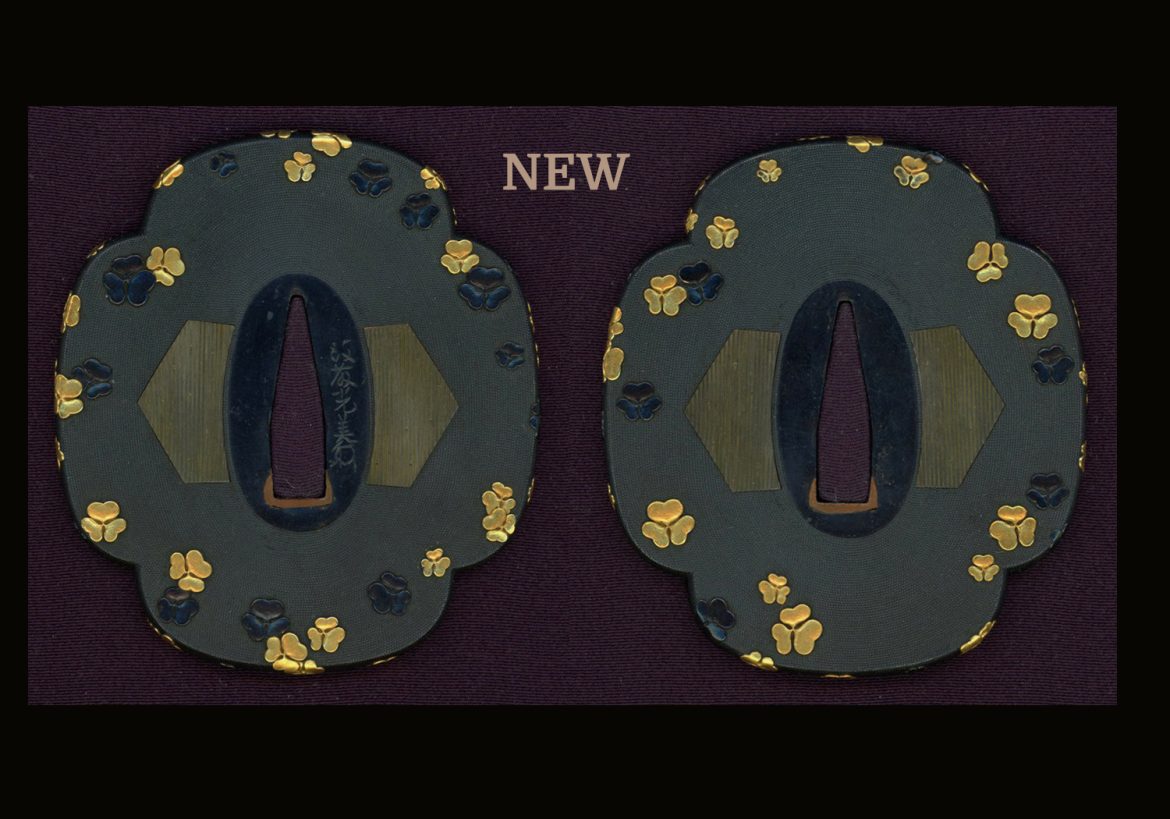
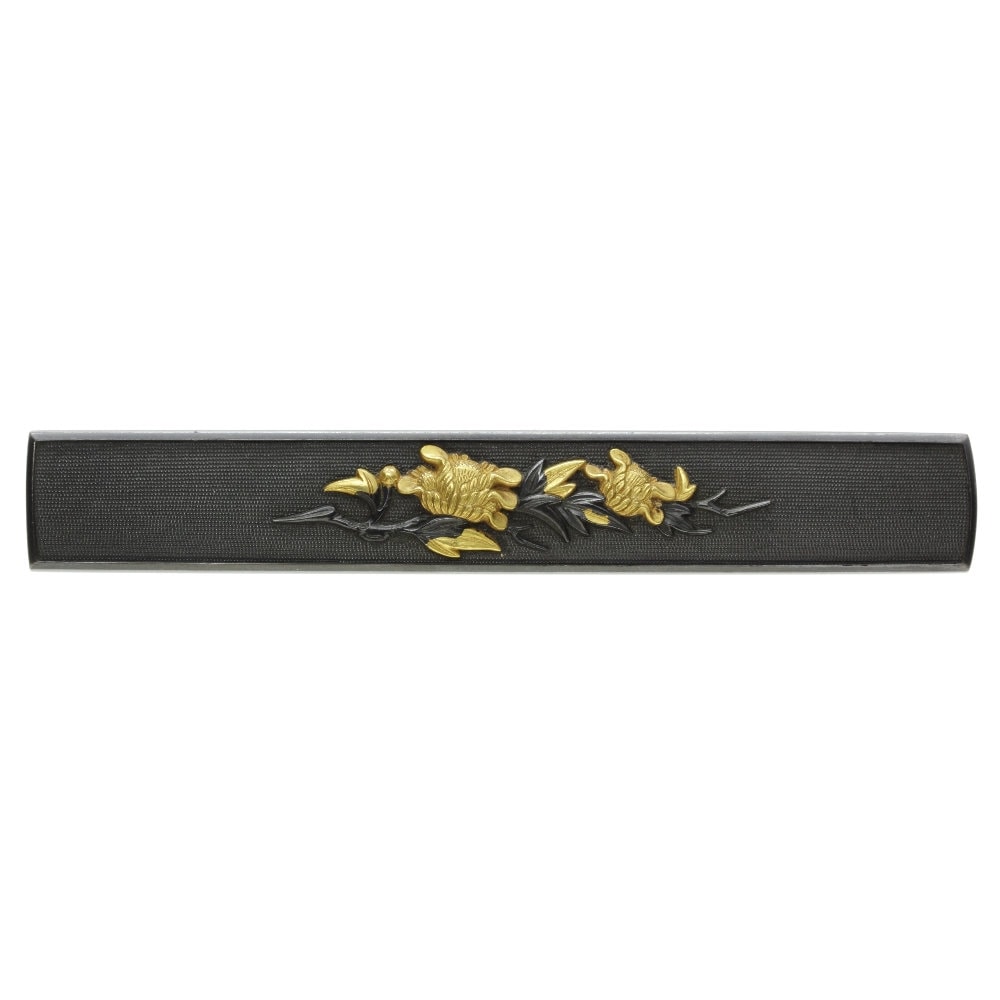
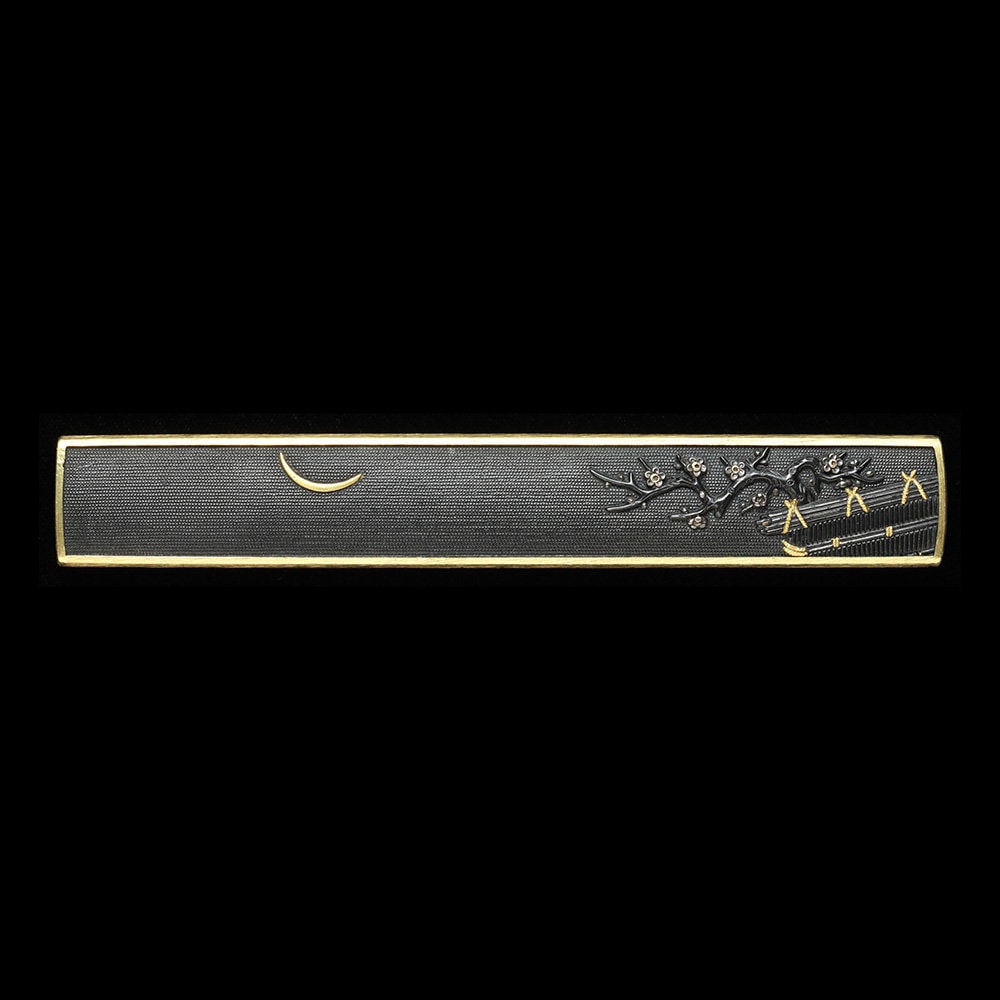
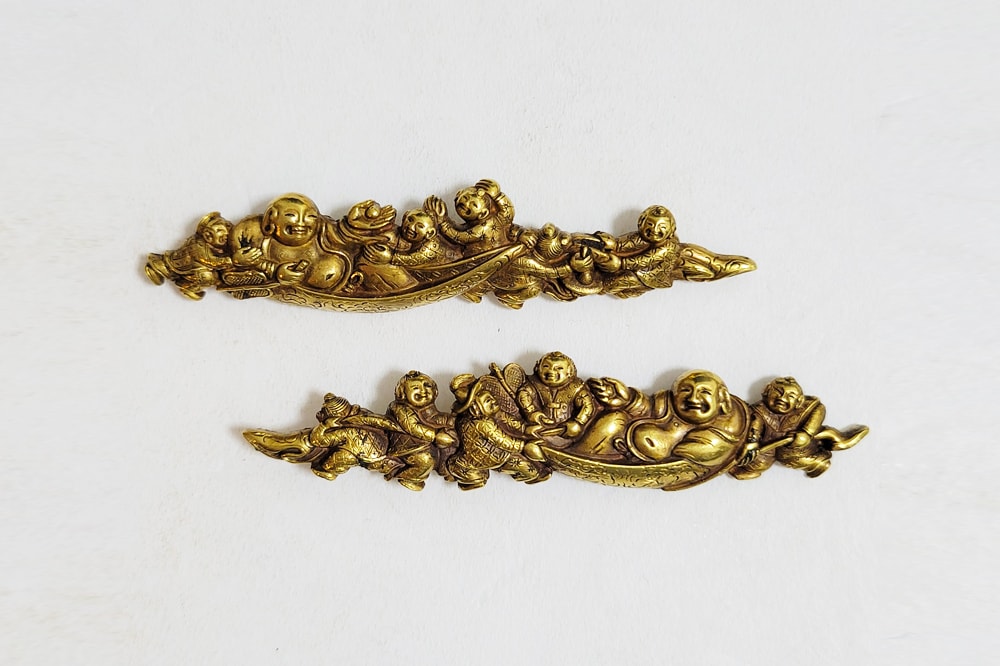
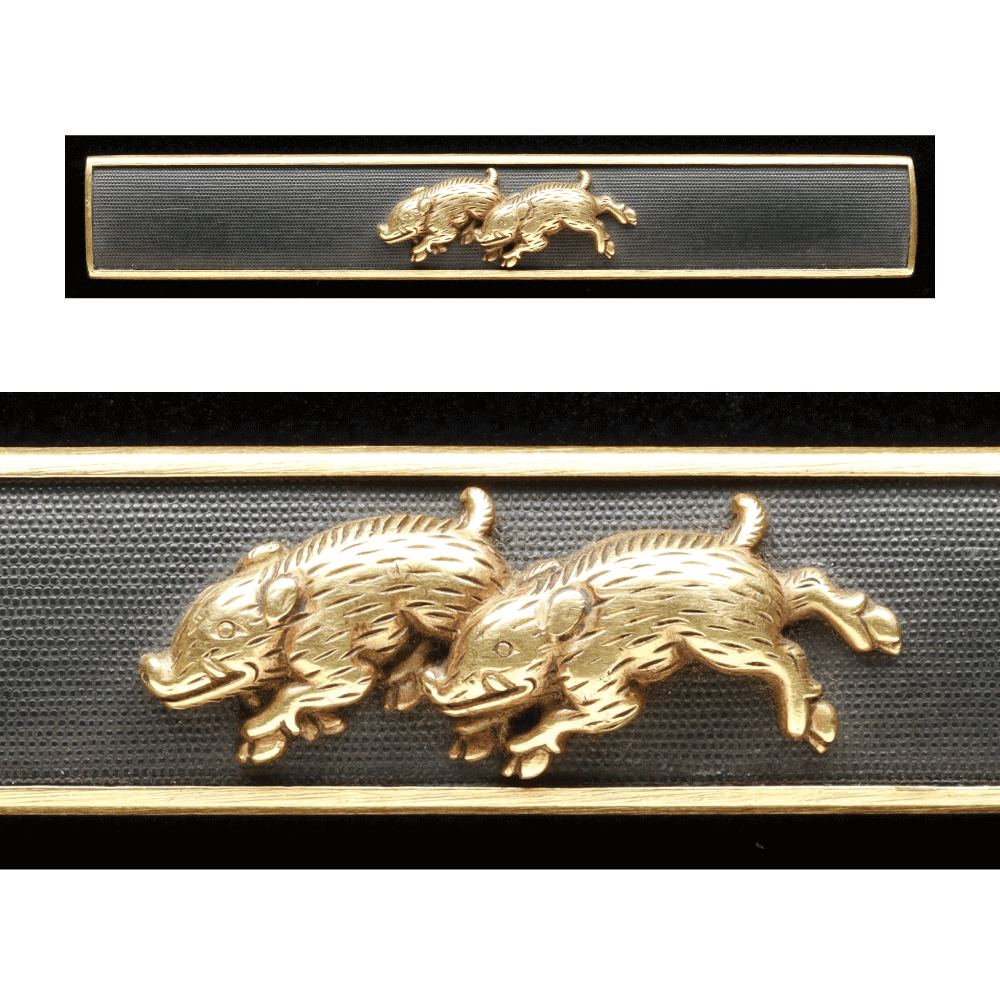
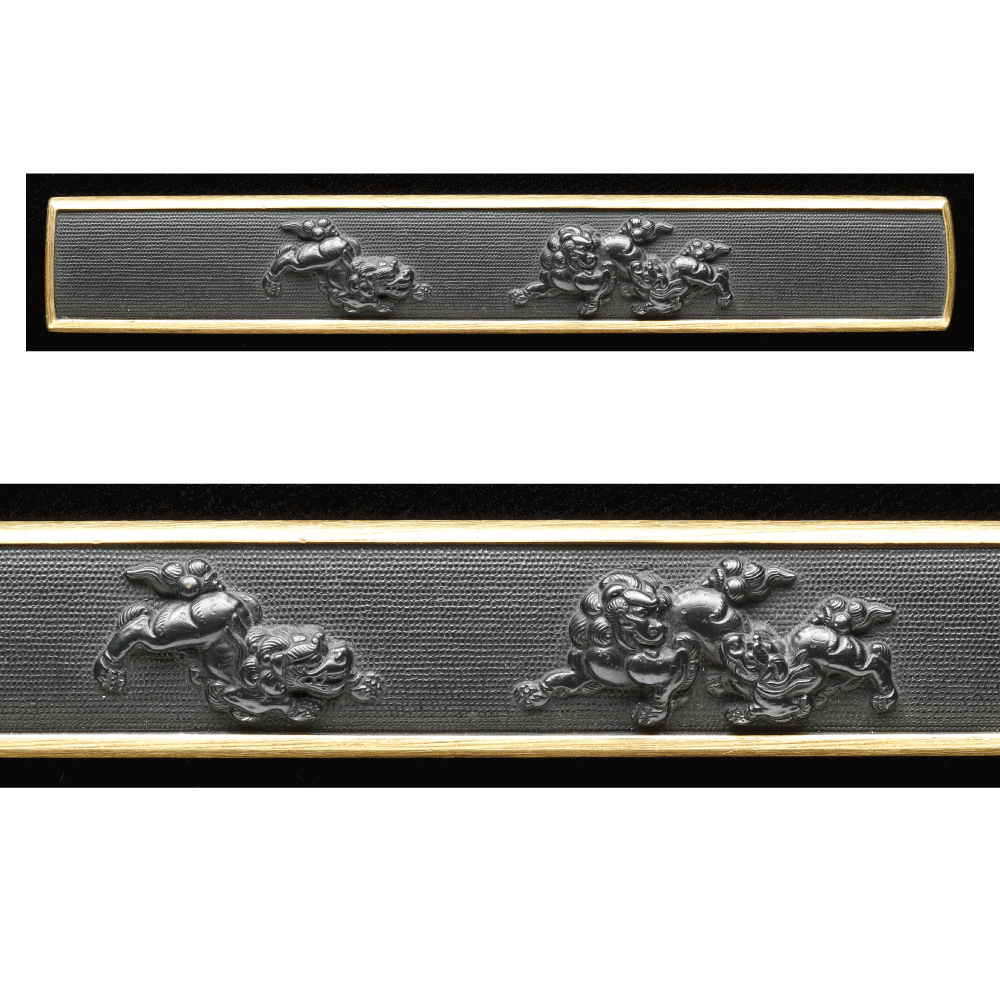
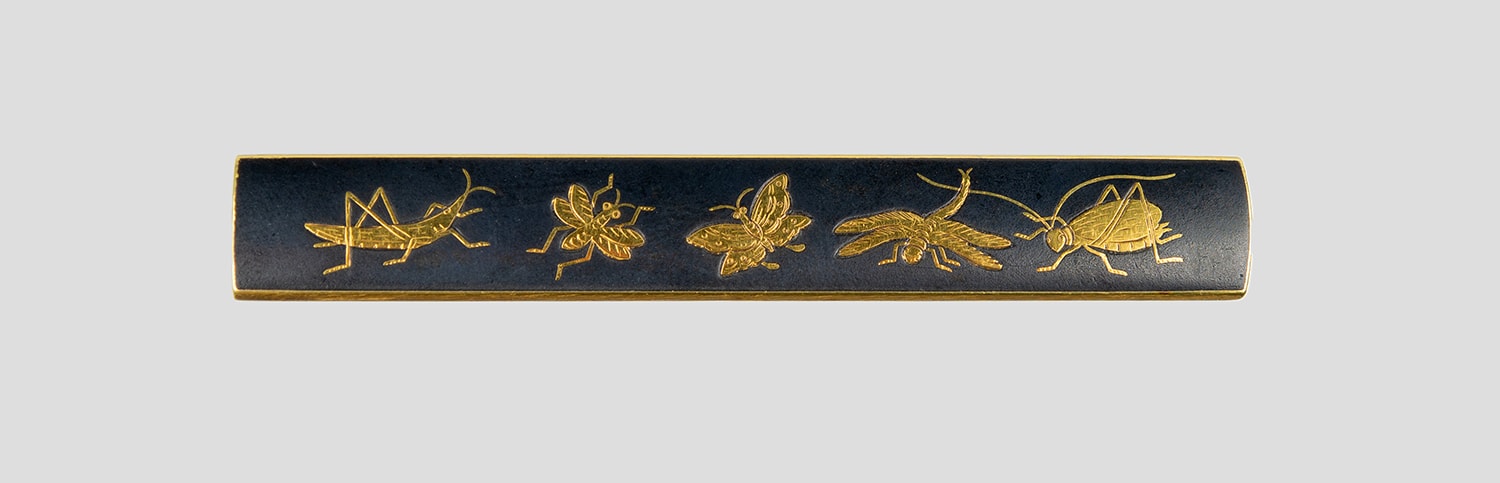
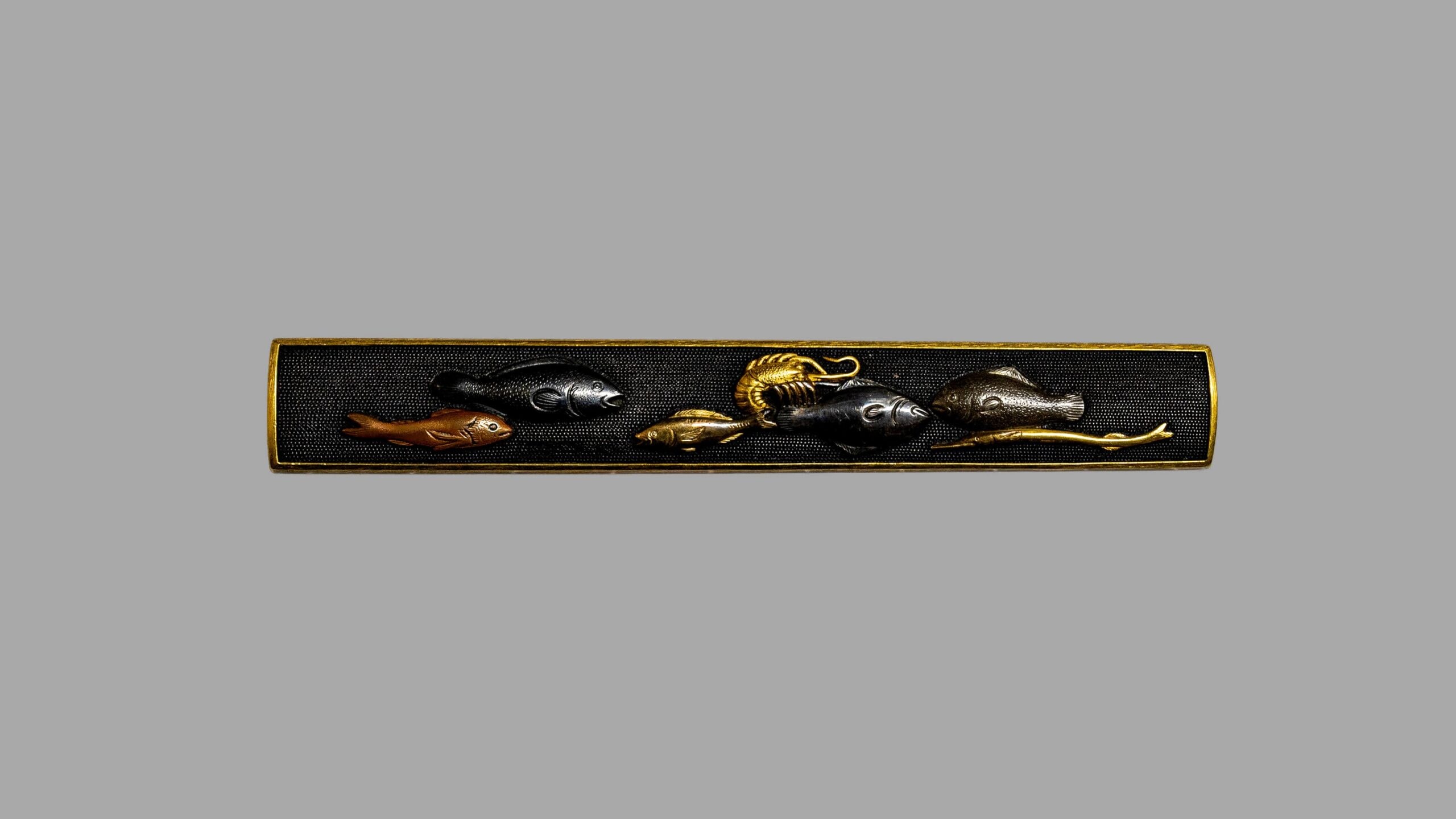
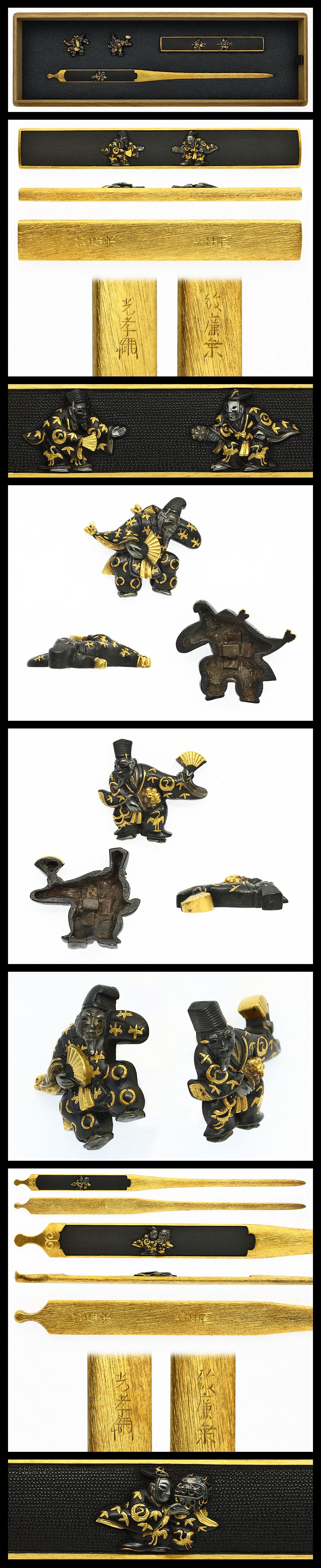
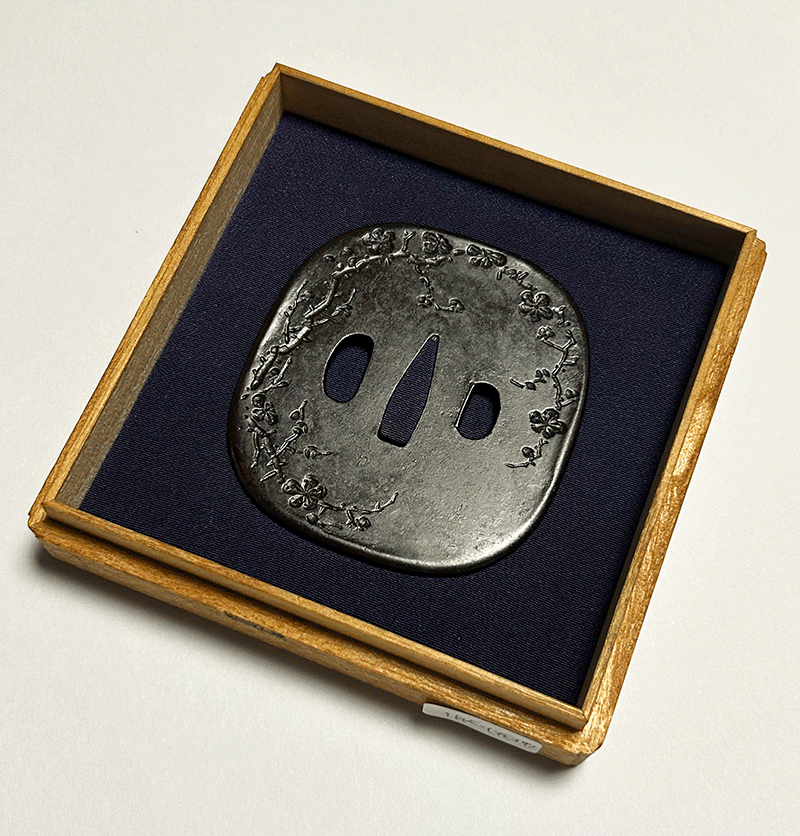
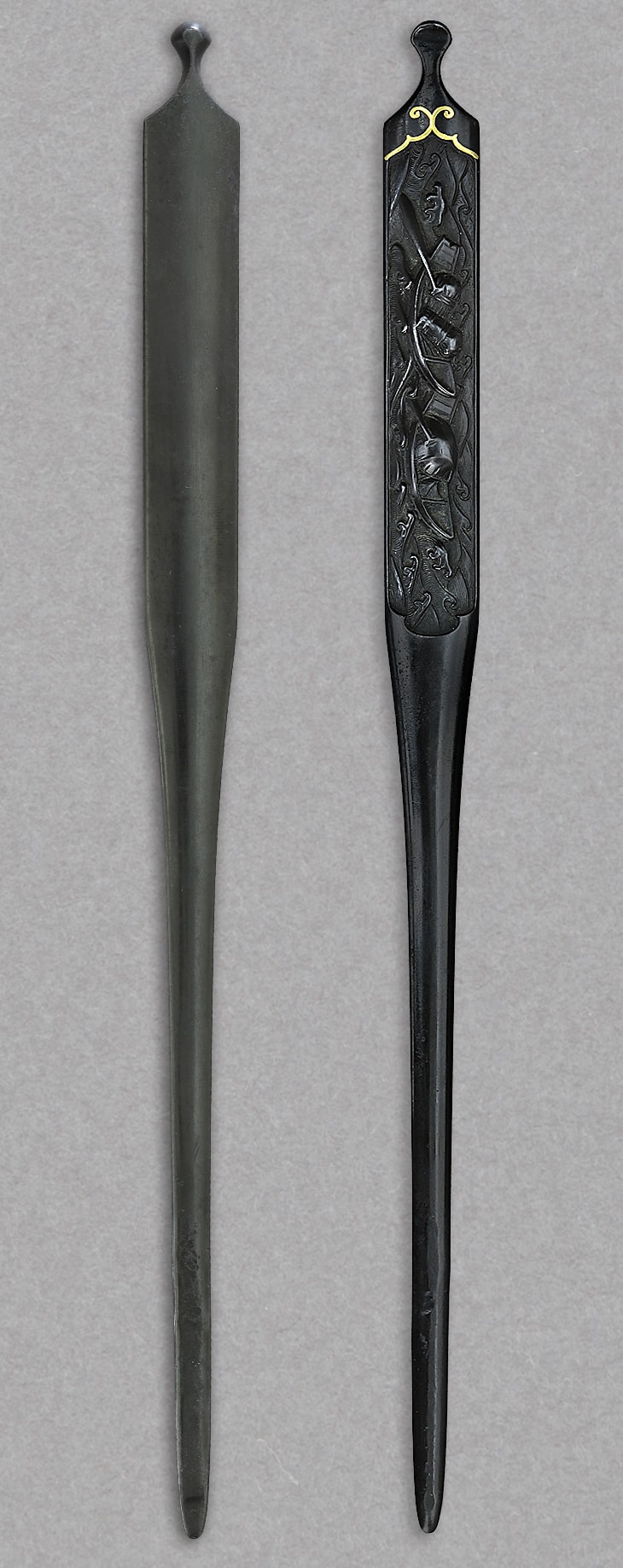
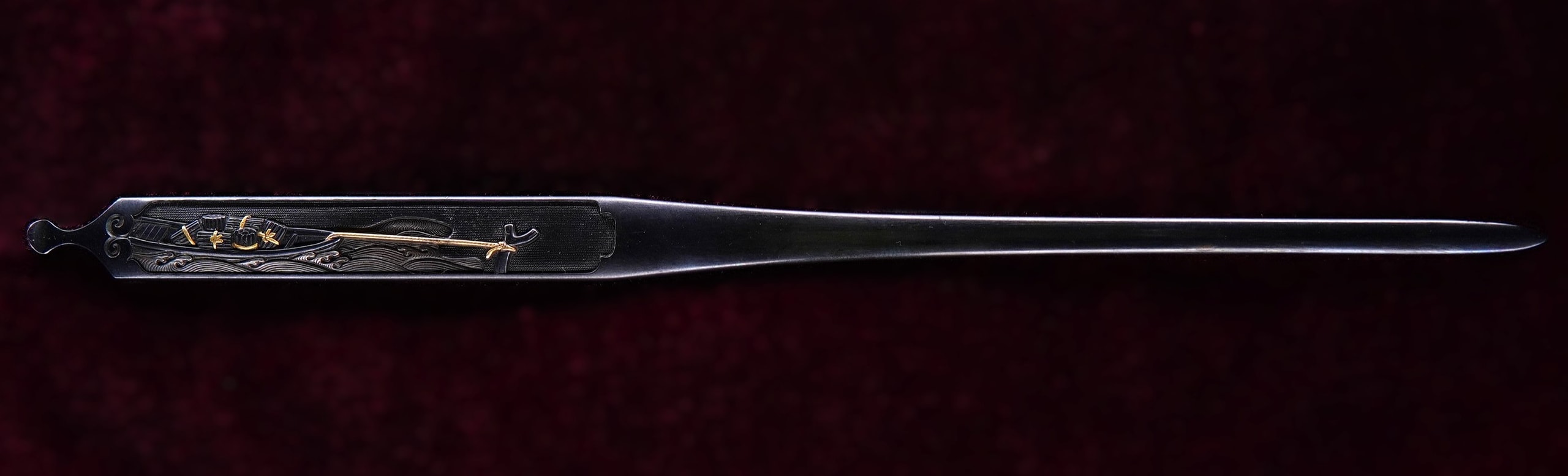
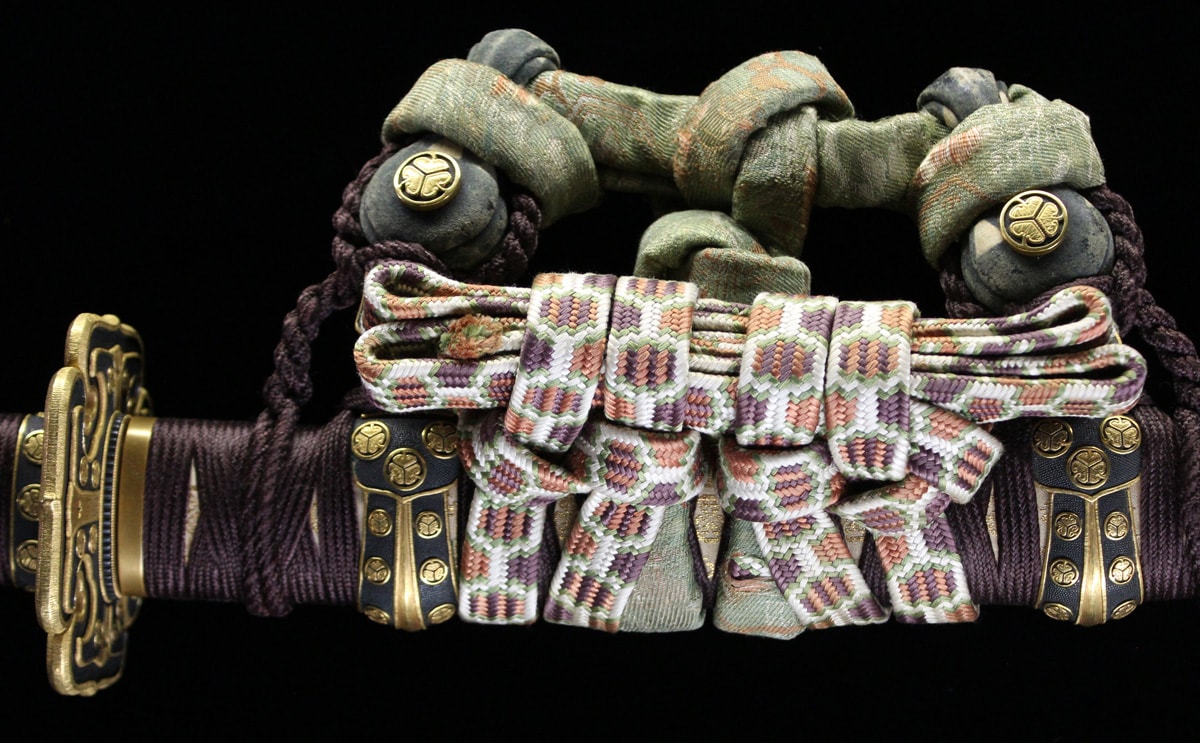
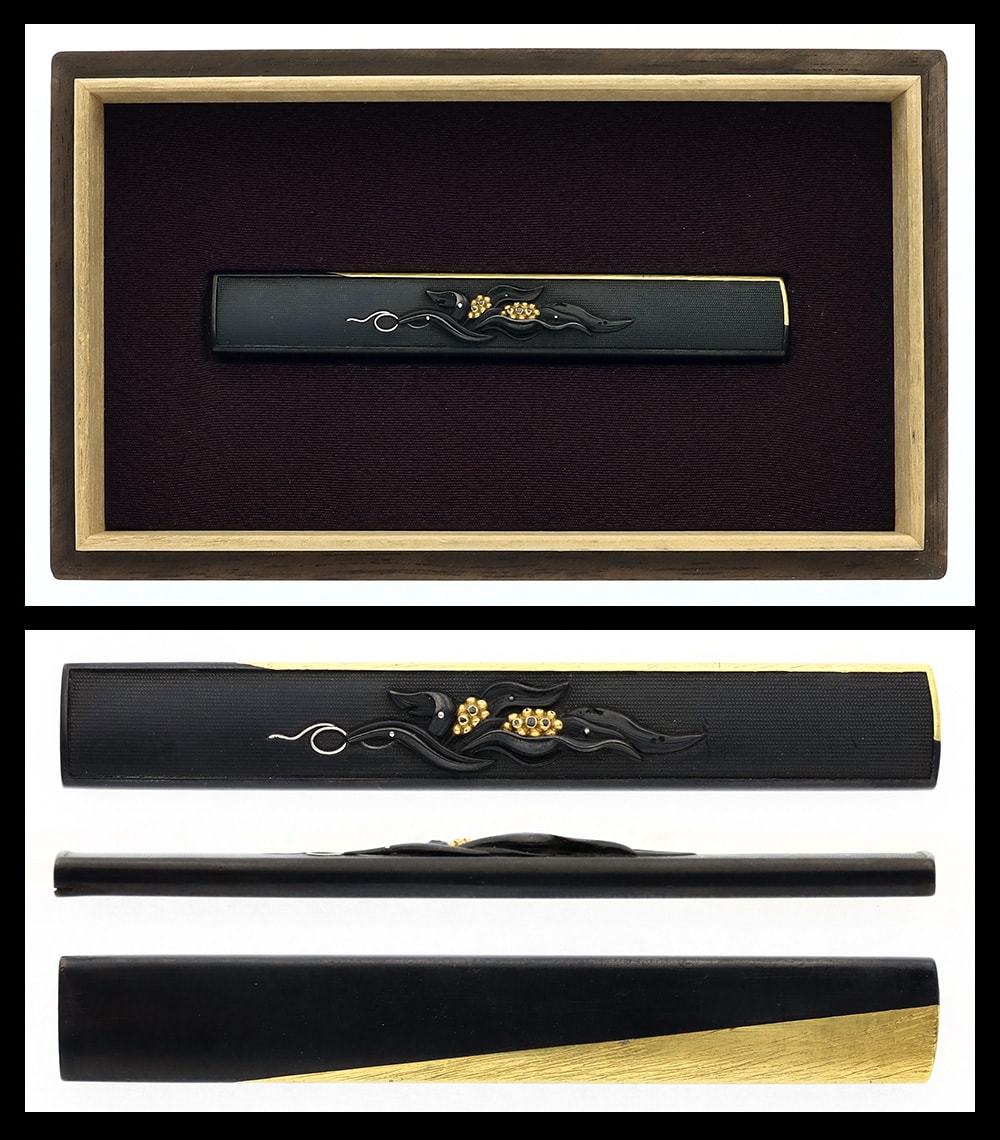
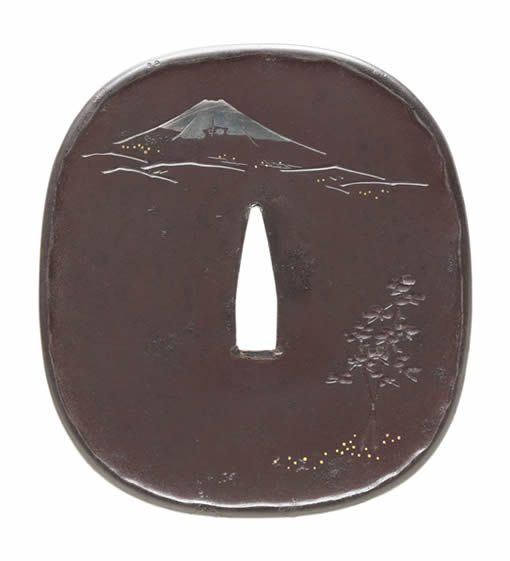
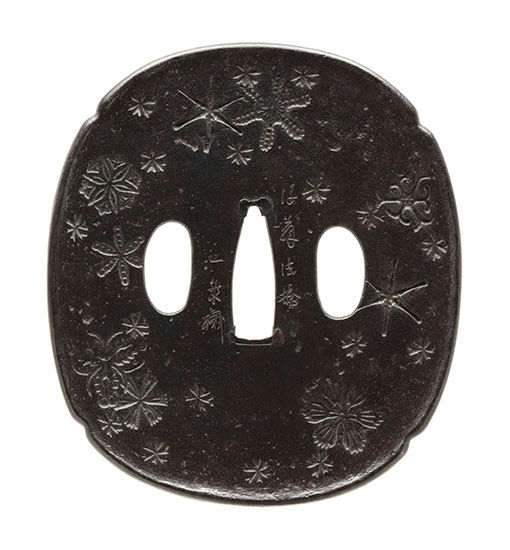
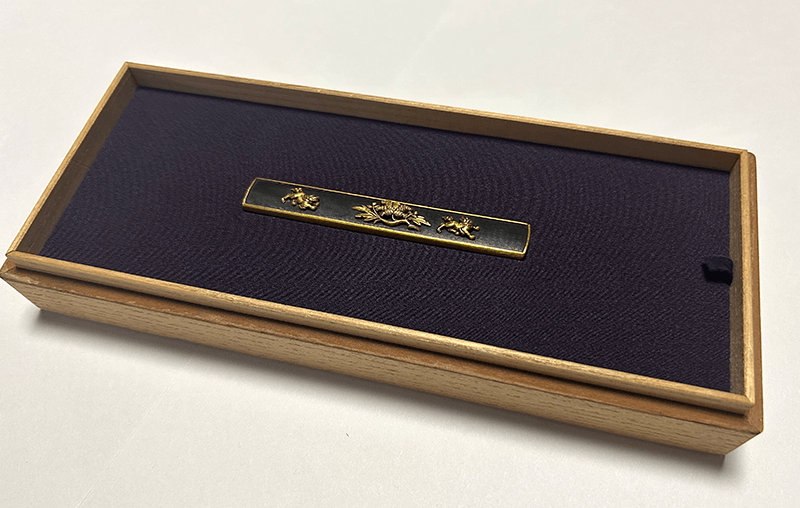
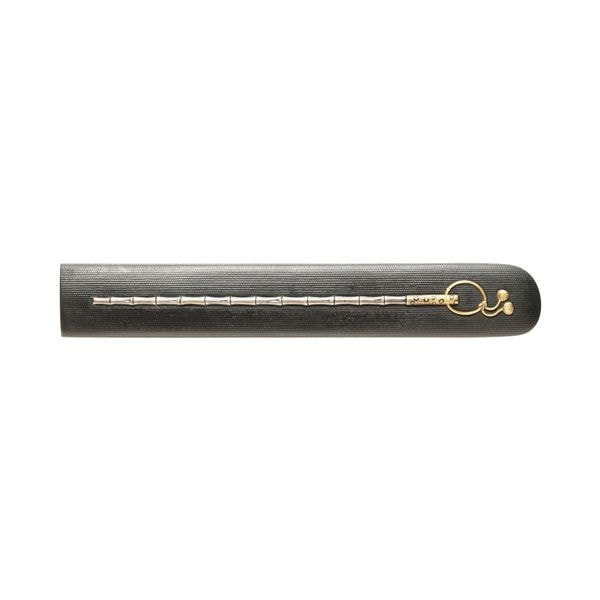
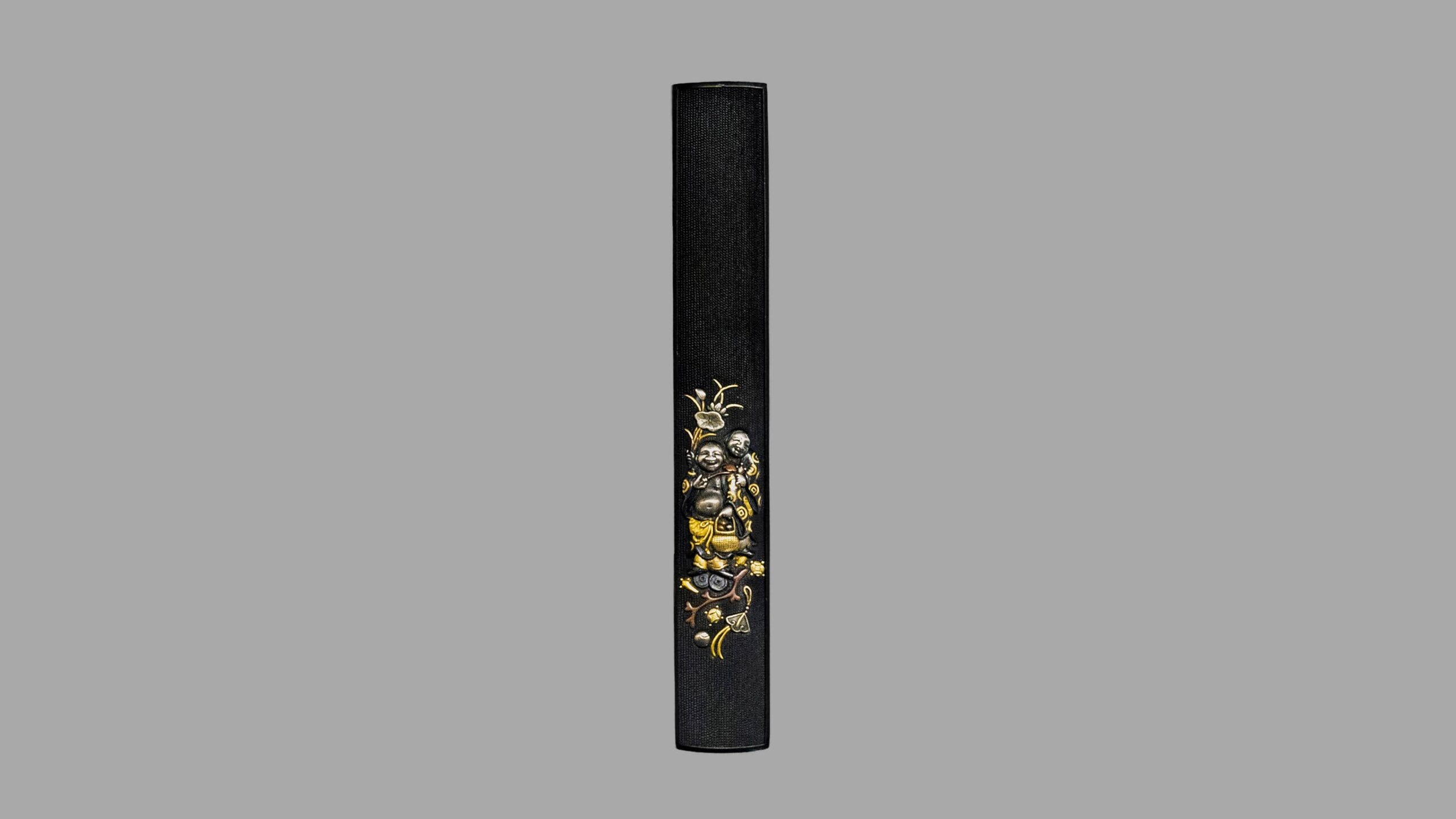
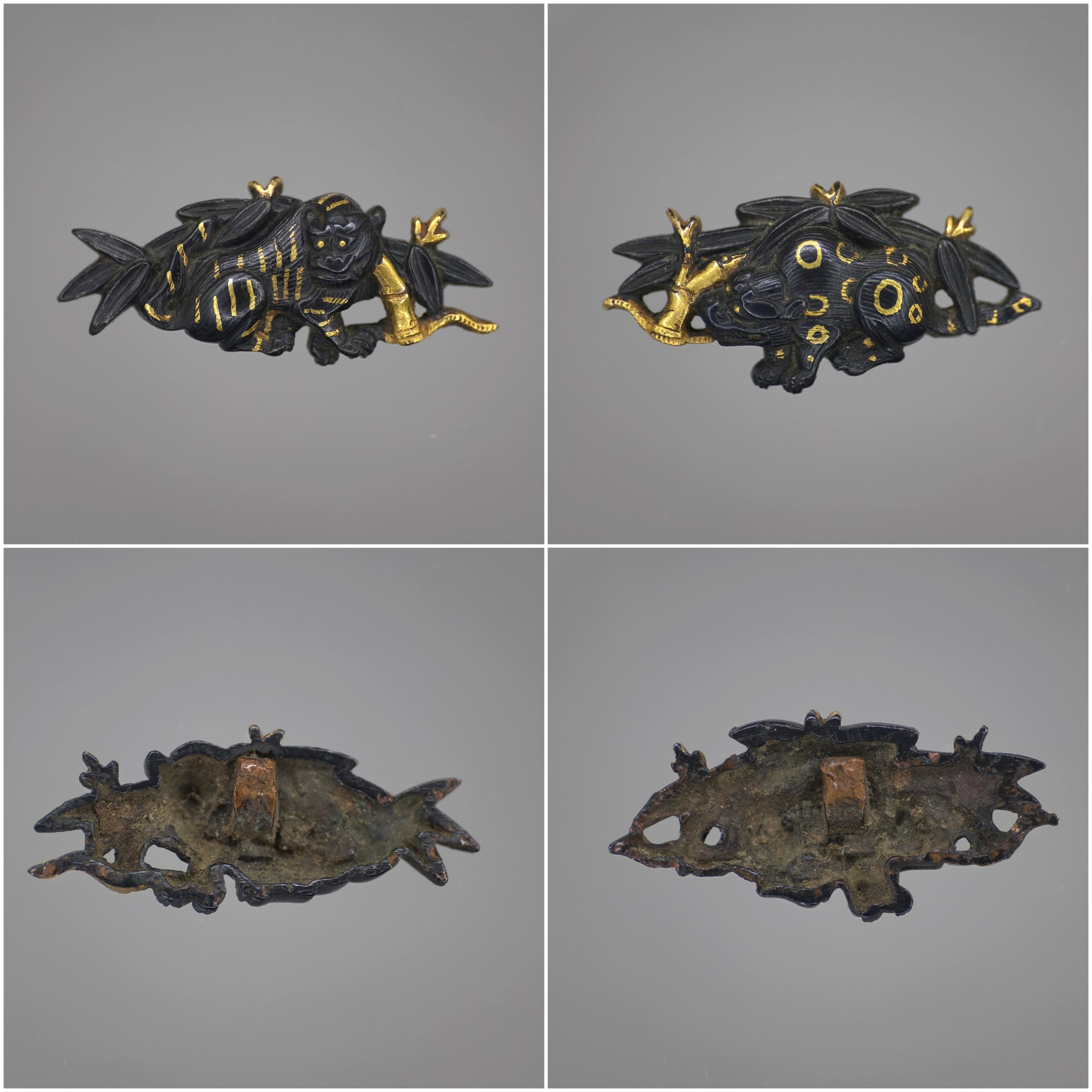
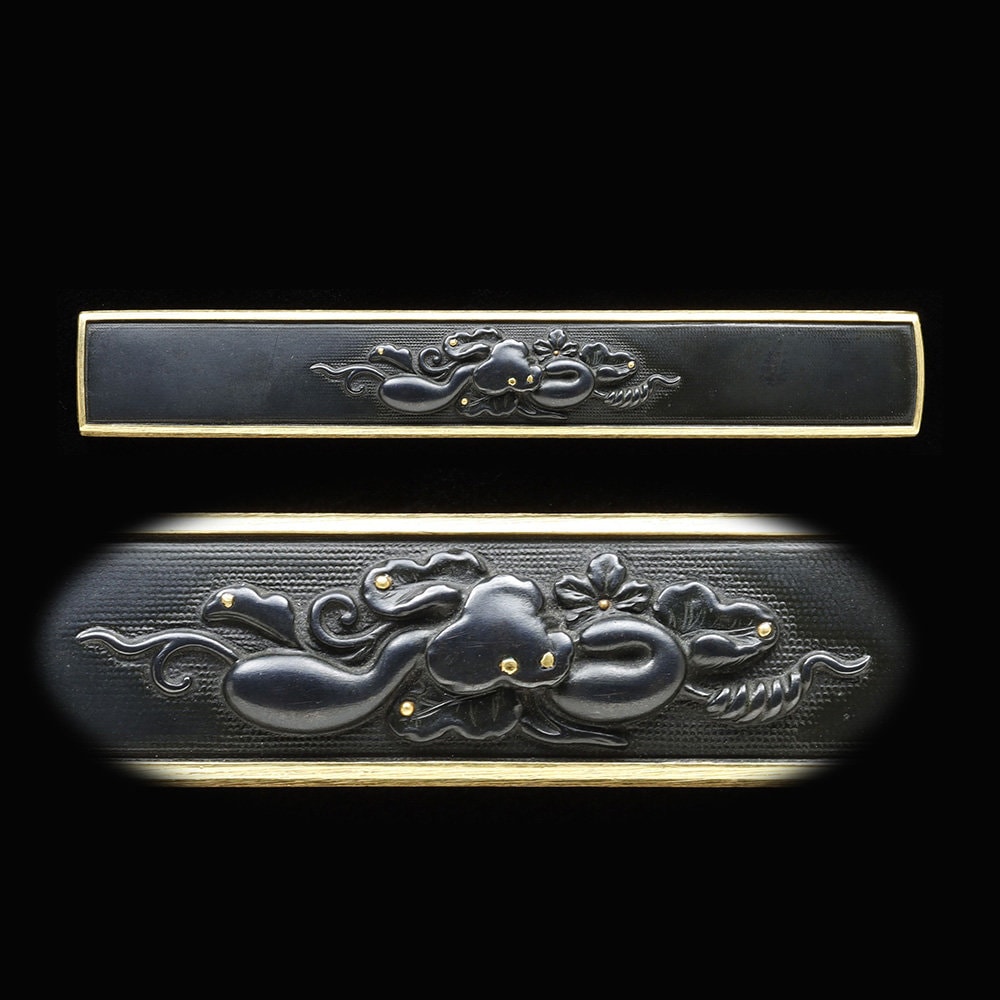
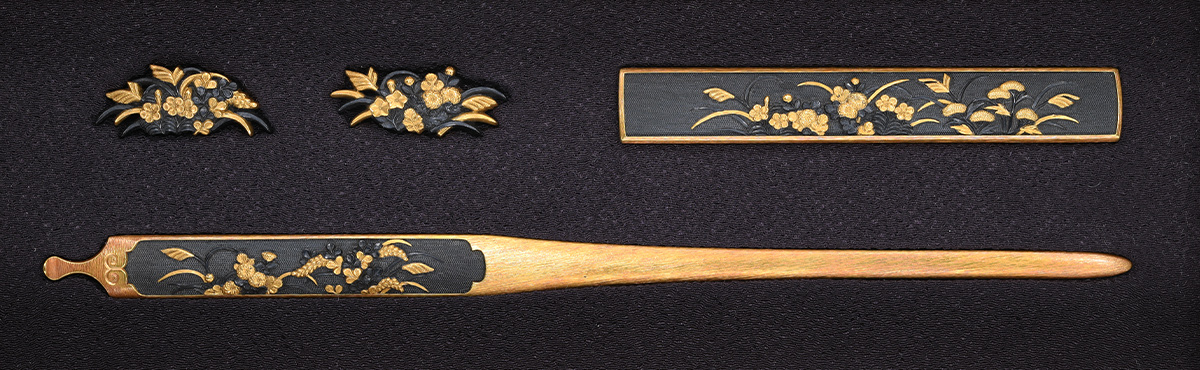
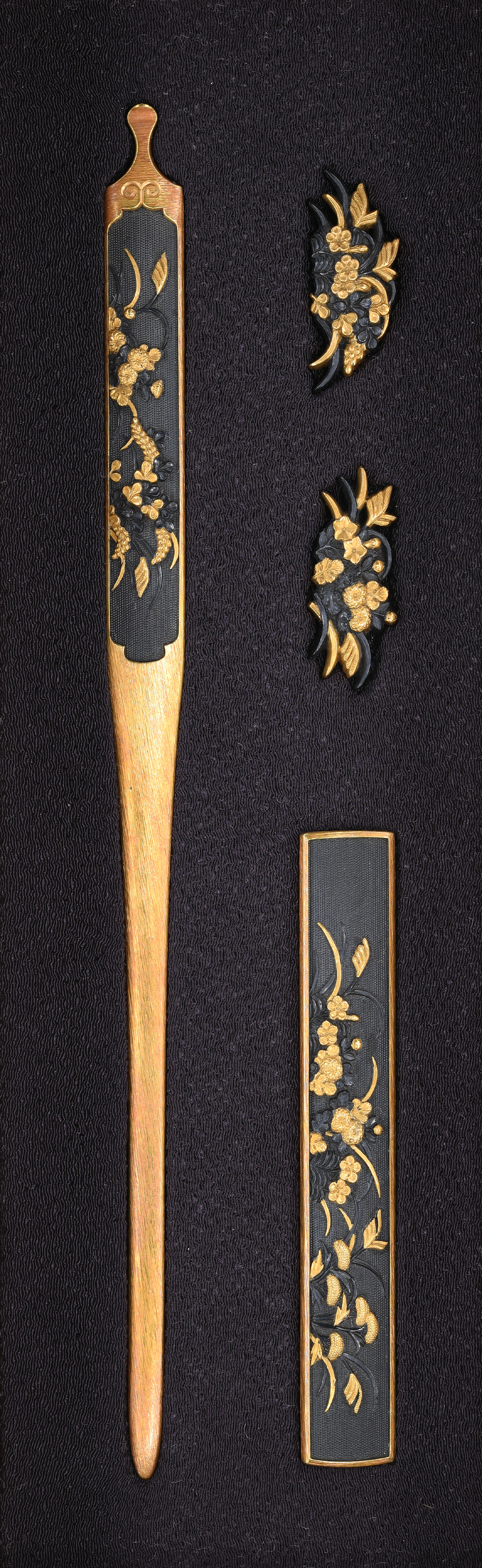
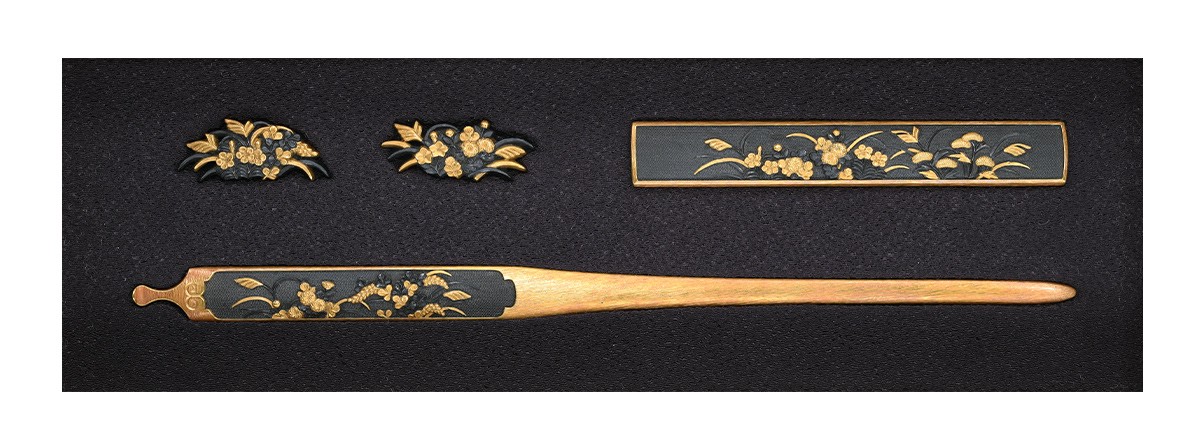
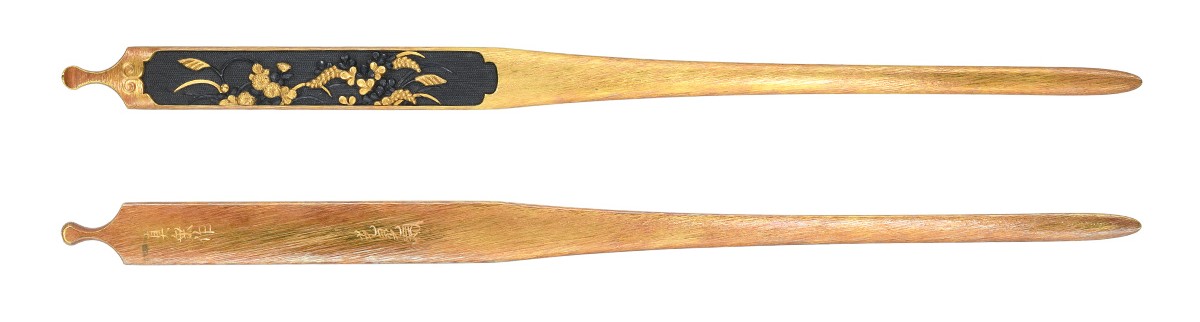
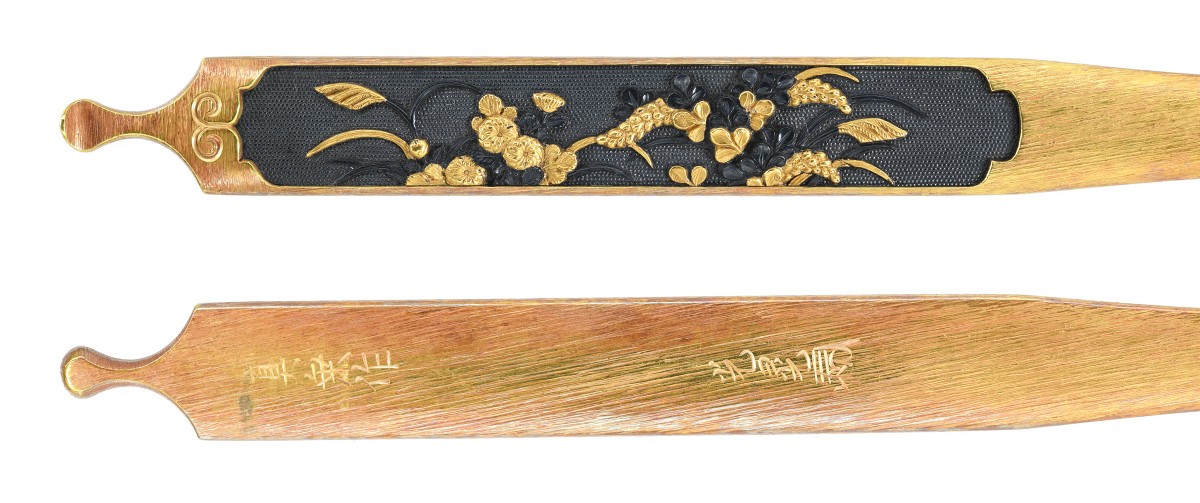
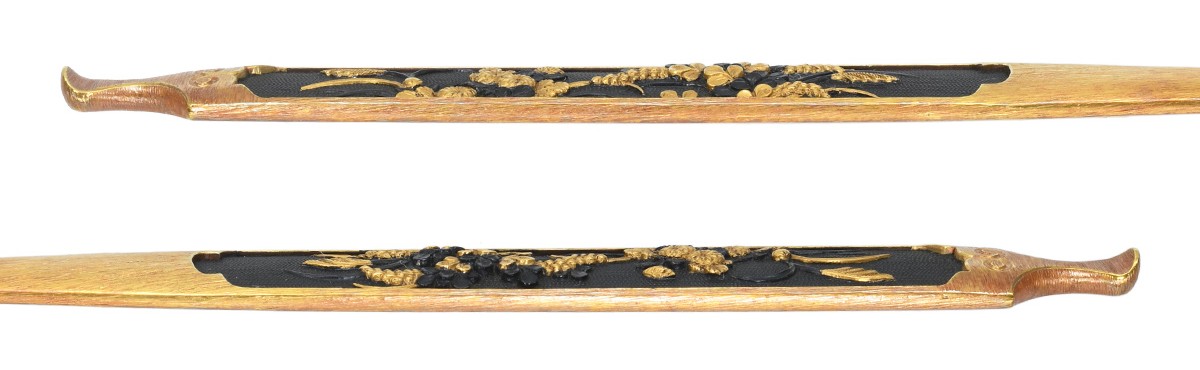
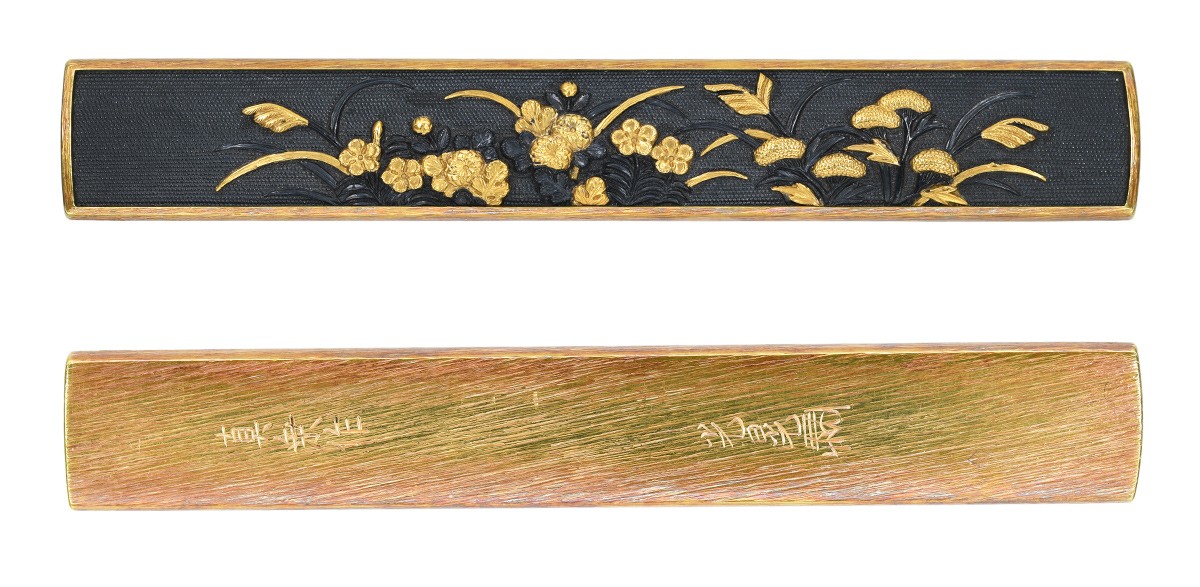
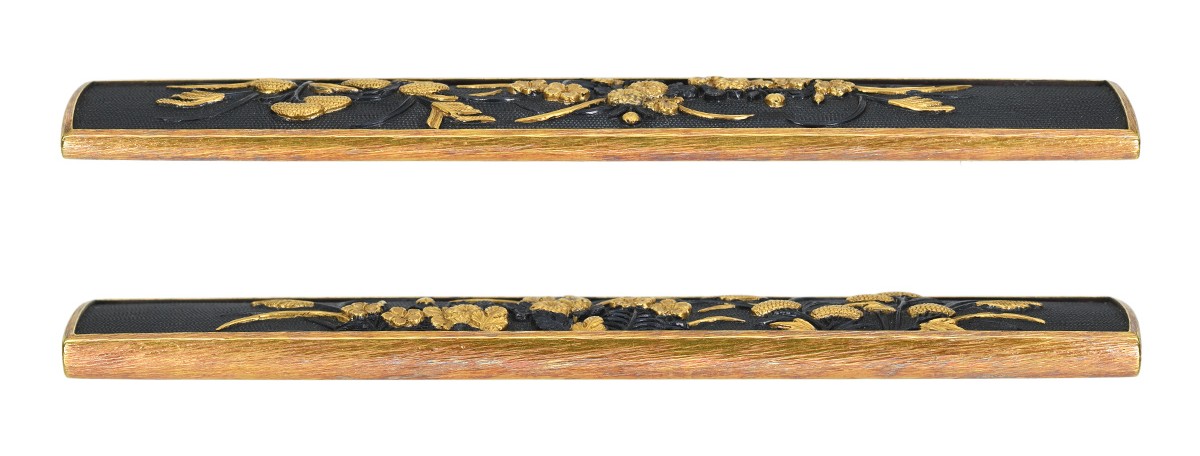
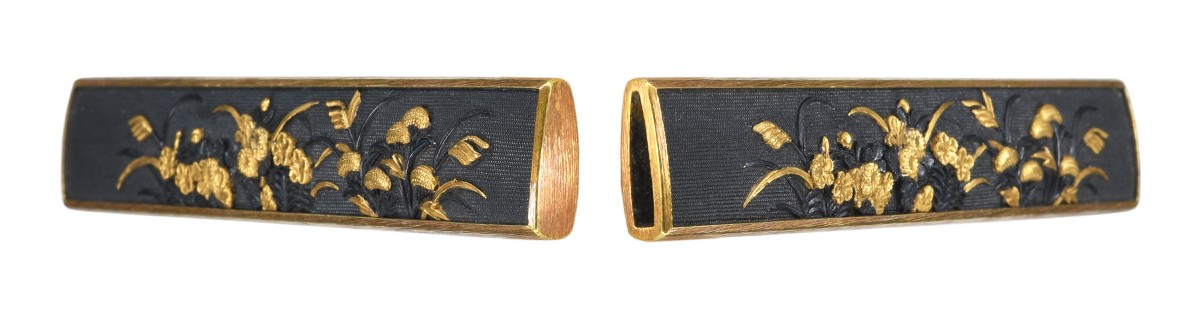
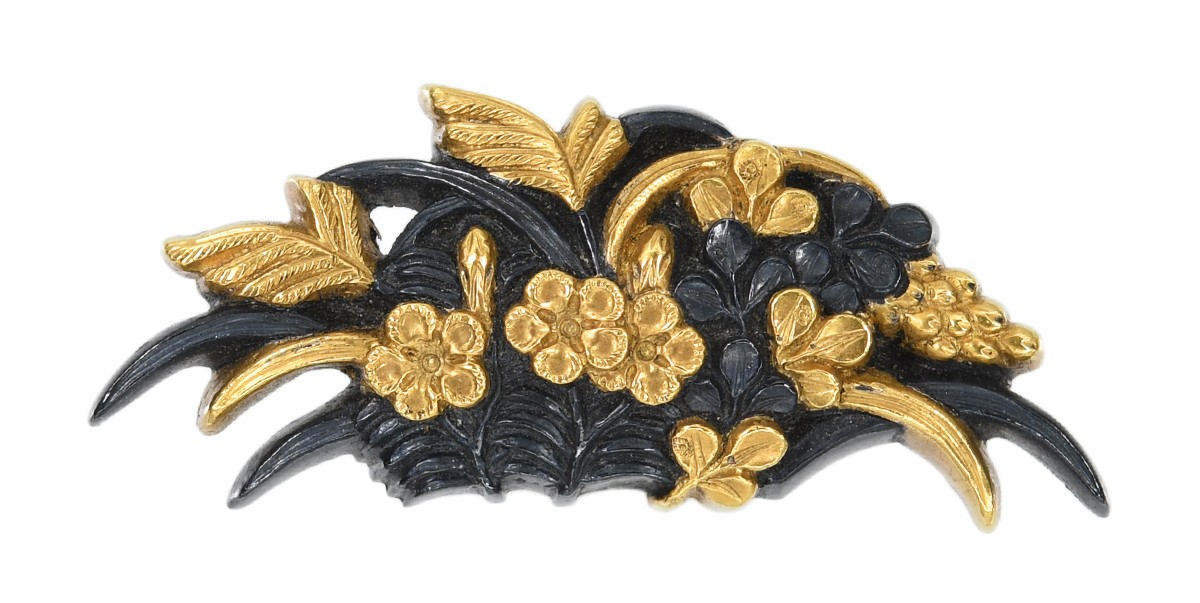
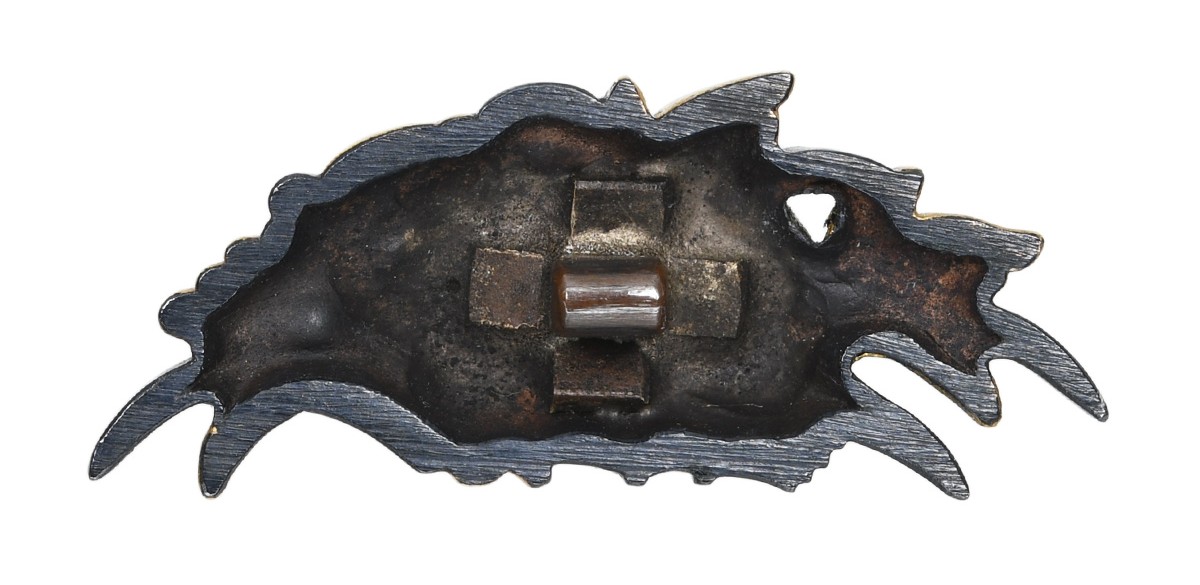
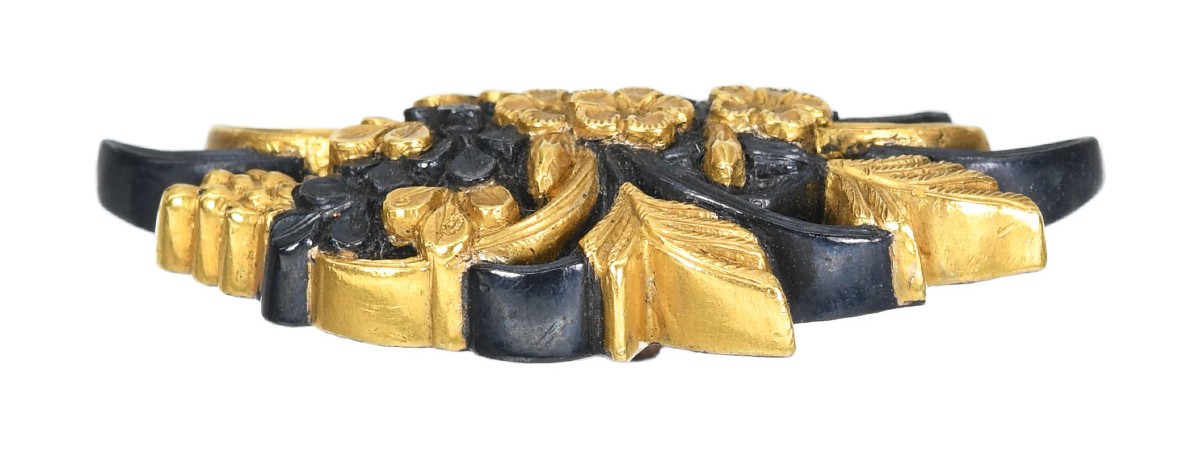
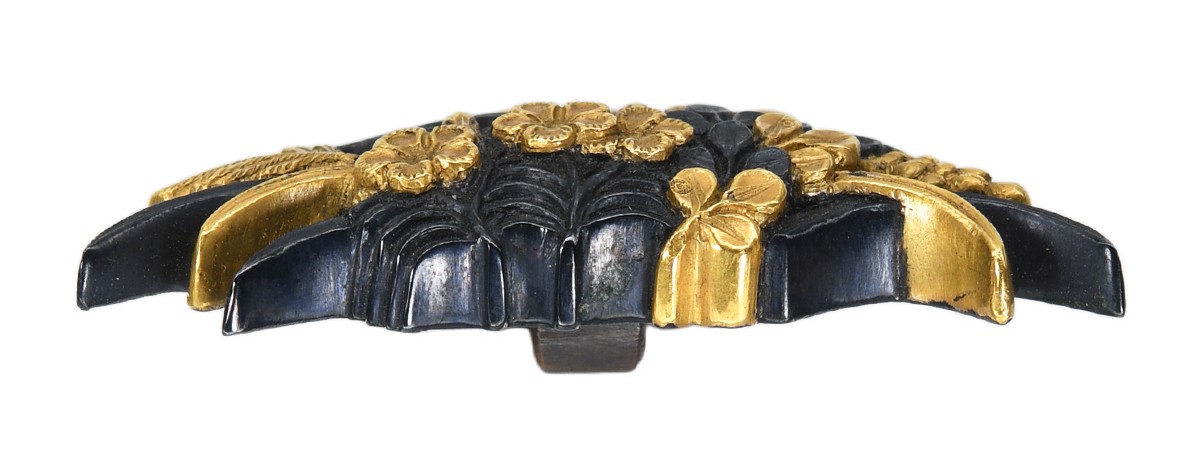
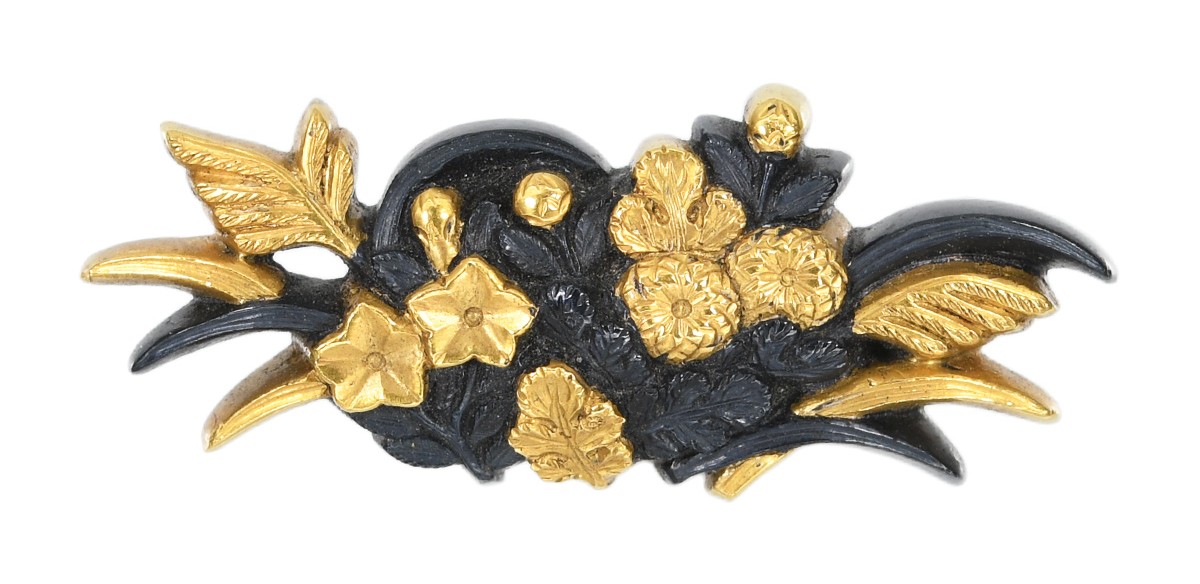
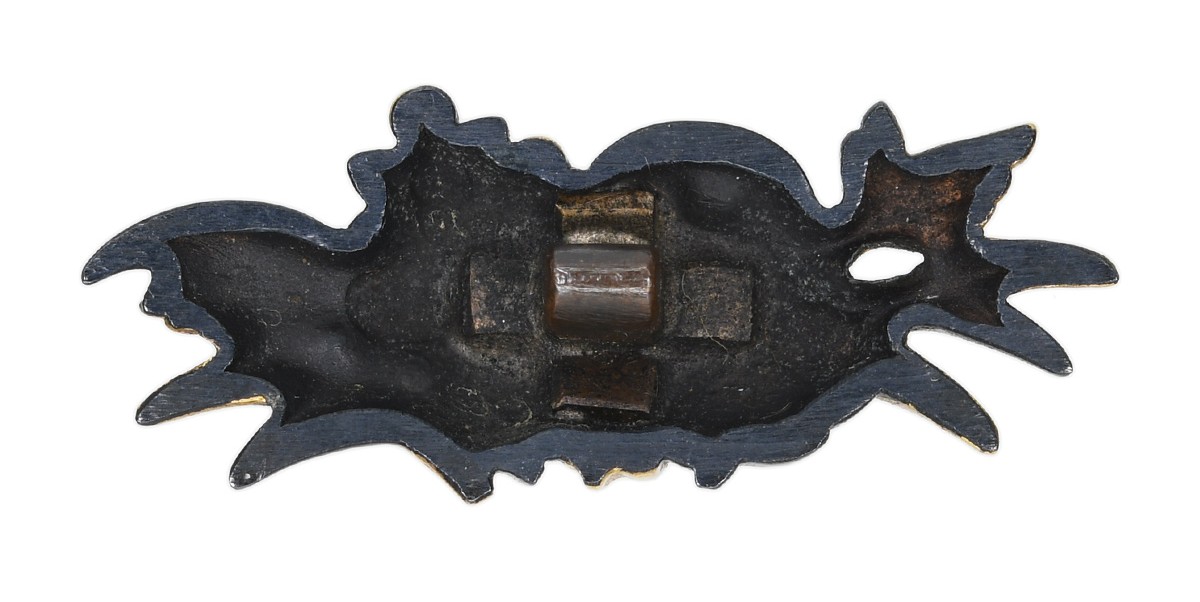
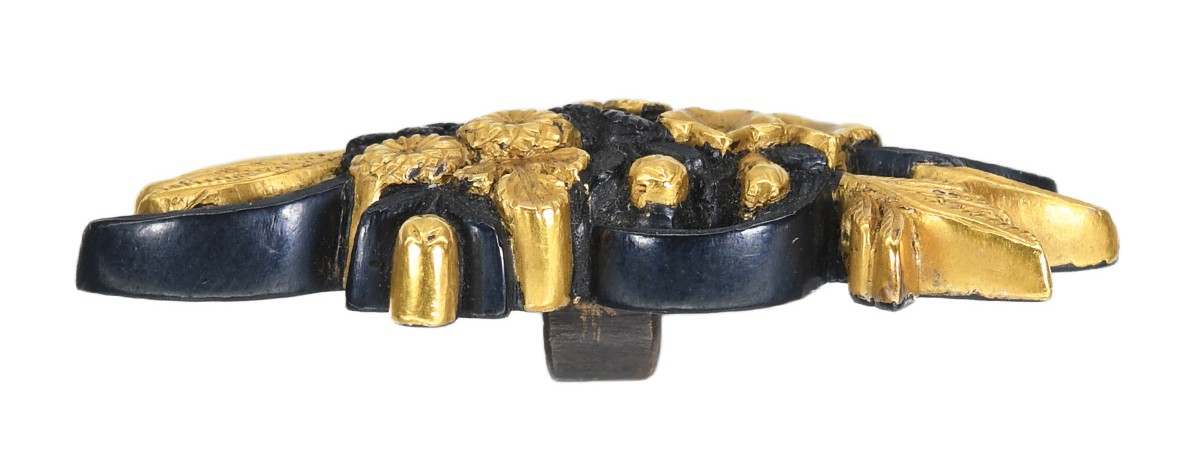
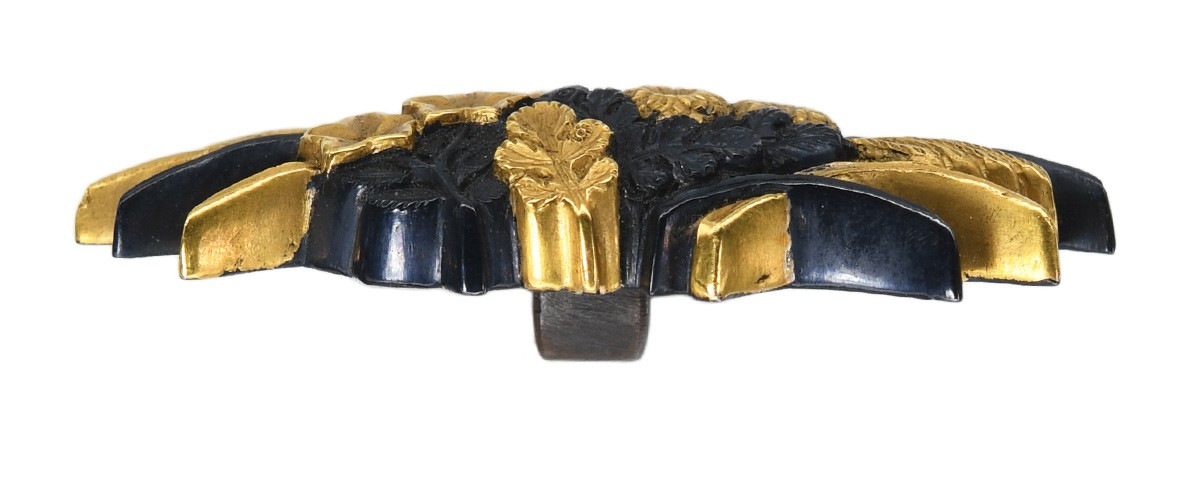
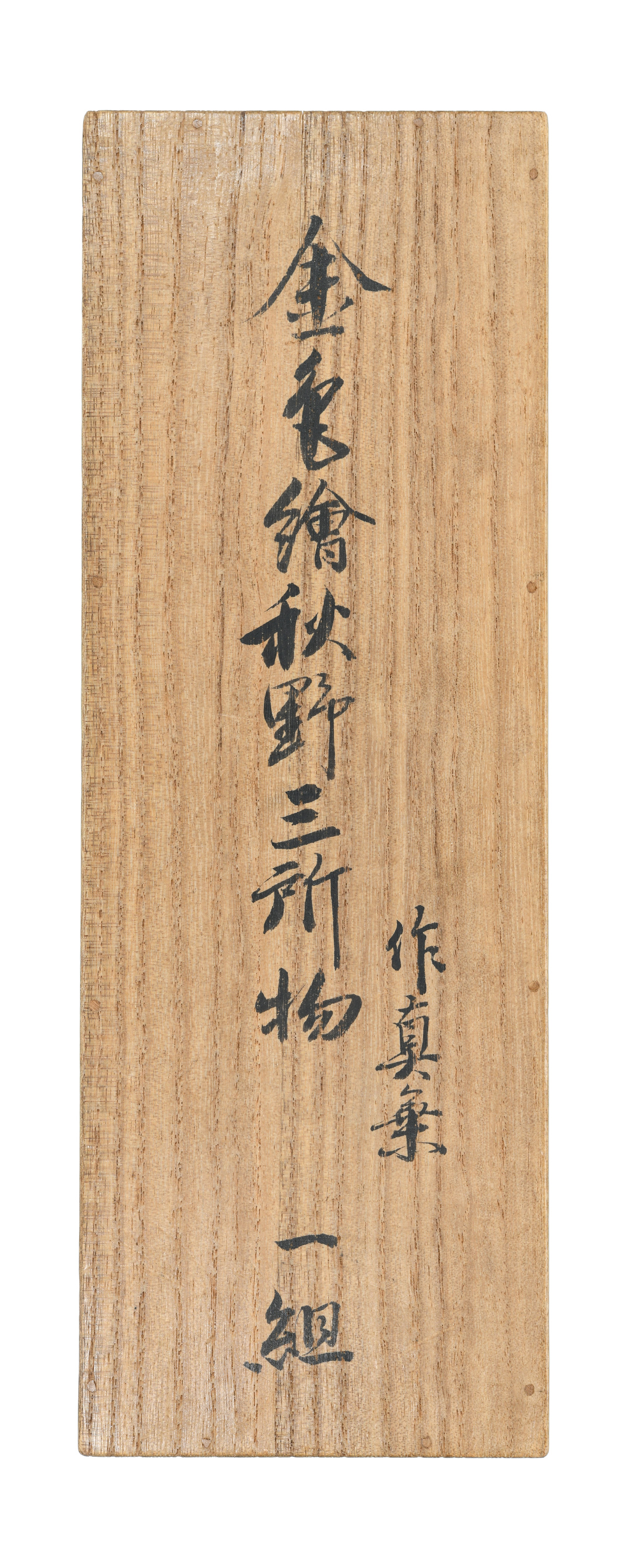
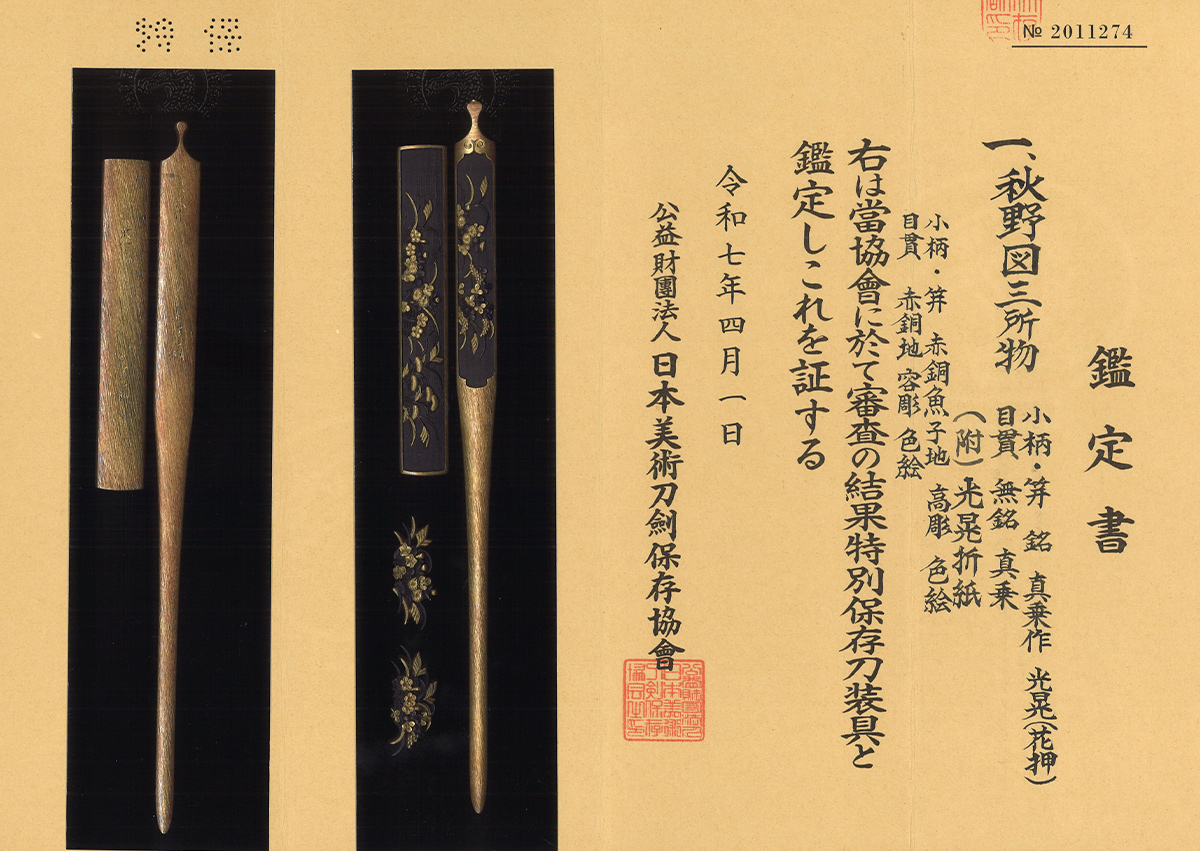
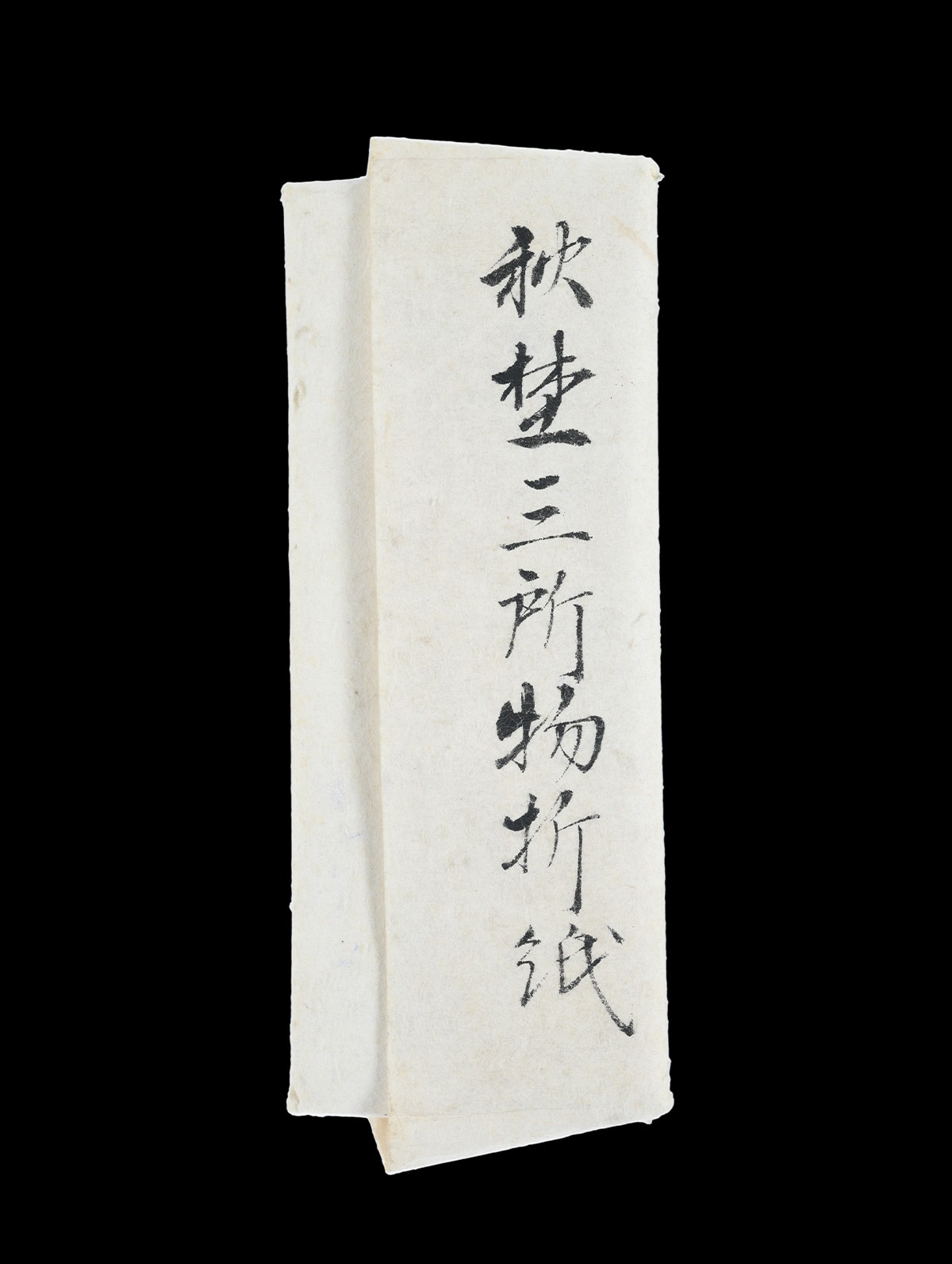
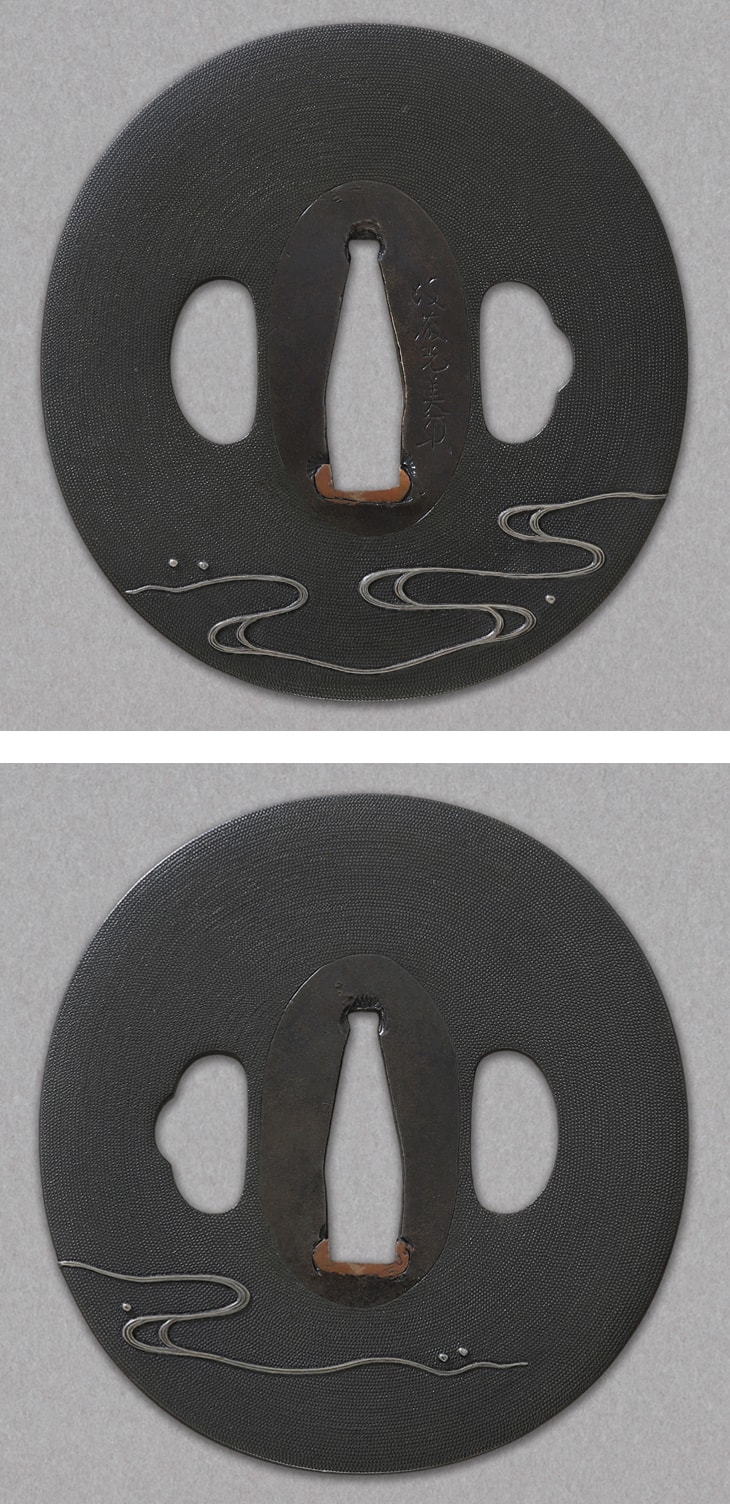
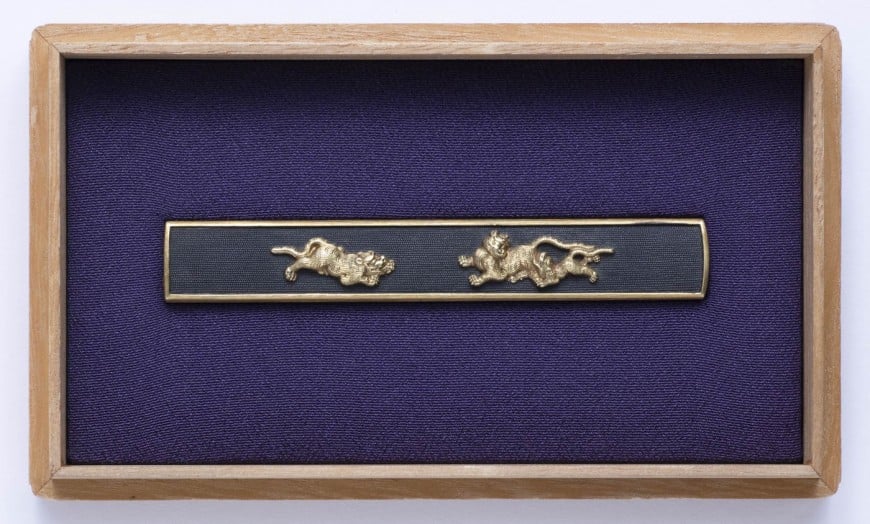
This is a set of tosogu, including a kozuka, kogai, and menuki, crafted by Shinjo Mitsuaki. The set features an Akino-zu (autumn field design) and is made of shakudo nanako-ji with high relief carving and iroe (color inlay). It comes with an NBTHK Tokubetsu Hozon Tosogu certificate.
Certificate reading — 無銘(真乗)
 NihontoWatch
mei · Edo
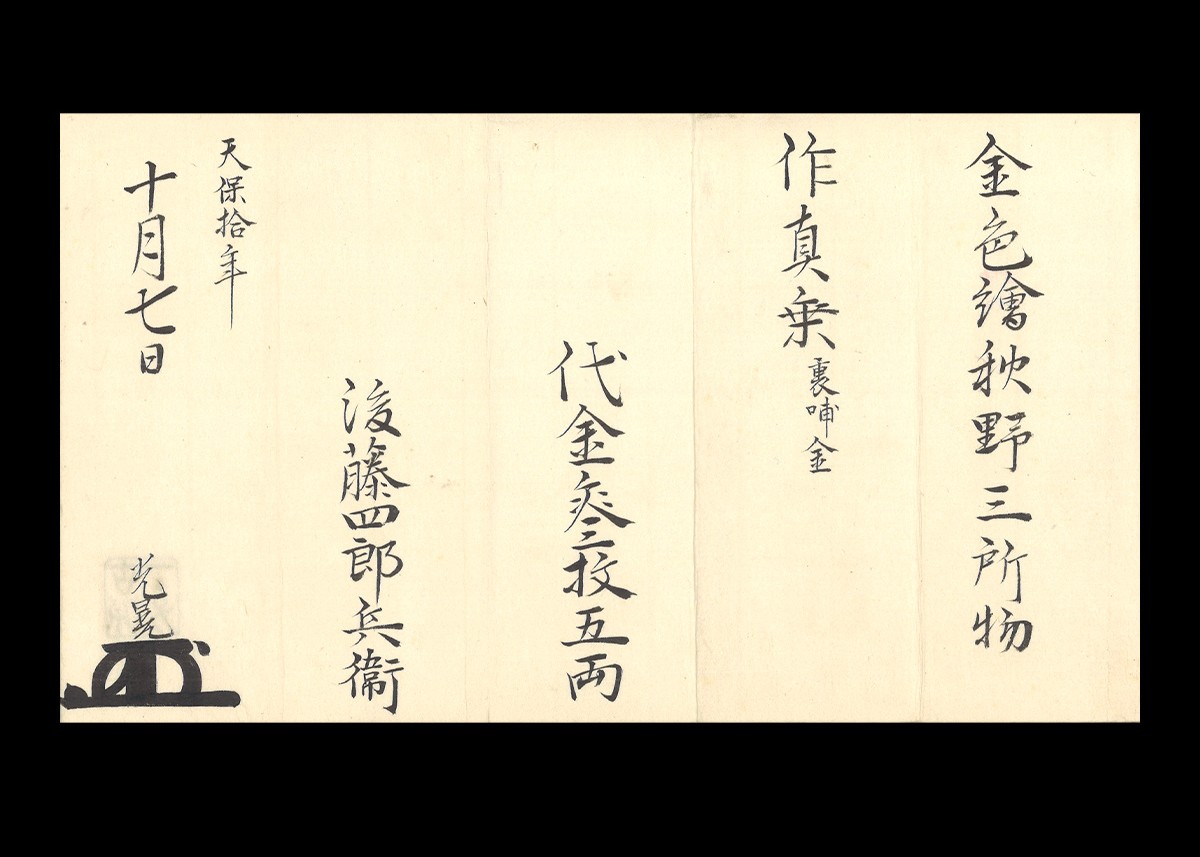
Goto Shinjo
Edo
Signed
Tokuho (NBTHK)
Iebori · Yamashiro · around 1780-1843
5 pieces on the market now
Goto Mitsuyoshi, fifteenth head of the mainline Goto family, bore the art name Shinjo. He was the eldest son and heir of the fourteenth master, Goto Mitsumori (Keijo), and was born in An'ei 9 (1780). His childhood name was Kameichi and his common name Gennojo. In Kyowa 4 (corresponding to Bunka 1, 1804), upon the death of Mitsumori at the age of sixty-four, Gennojo changed his name to Shirobei Mitsuyoshi and succeeded as the fifteenth-generation head of the main line. He thus inherited the stewardship of a house that had served the Oda, Toyotomi, and Tokugawa rulers across three centuries, continuing its unbroken tradition of metalwork at the highest echelon of the art.
Mitsuyoshi worked squarely within the traditional Goto manner -- takabori (high-relief carving) with iroe (polychrome metal inlay) on a shakudo nanako-ji ground -- yet brought to it a pronounced lyrical sensibility and assured command of composition. His subjects encompass sweeping landscape programmes such as Mt. Fuji and the Tokai seacoast, rendered across complete soroi-kanagu suites, as well as intimate seasonal themes of autumn grasses with the moon rabbit. A solid-gold kozuka depicting a seashore scene demonstrates his capacity for chisel work of pronounced modulation and rhythm, rendering form and recession using gold alone with truly delicate precision. Notably, he extended the Goto idiom beyond sword fittings by producing signed inro and netsuke in shibuichi, an uncommon material choice for the house, conceived as coordinated ensembles reminiscent of a warrior's formal attire.
The NBTHK evaluations acknowledge that Mitsuyoshi is sometimes regarded as slightly inferior in technical ability when compared among successive generations of the Goto family, yet consistently affirm the excellence of individual works. His finest pieces are praised as masterworks in which sumptuousness is balanced by an air of clarity and freshness, and in which the opposing states of stillness and movement are set in contrast. His authenticated kiwame inscriptions on works by earlier masters such as Eijo (sixth generation) further attest to his institutional authority as the final pre-modern guardian of the mainline Goto tradition.
Where Goto Shinjo stands among comparable artisans: across all of nihontō, and within tradition, era, and period. The tiers (Foremost · Leading · Major · Notable) weigh official designations from the NBTHK and Japan's Agency for Cultural Affairs, together with historical honors of lasting repute such as the Sansaku and Meibutsu-chō.
Select a lens to see how it's measured.
Iebori · Yamashiro
Phase: Goto Main Line後藤宗家· 1573–1900
323 pieces on the market now
| Smith | Era | Designated |
|---|---|---|
| Goto Joshin後藤乗真 | 1512-1562 | 68 |
| Goto Yujo後藤祐乗 | 1440-1512 | 41 |
| Goto Kenjo後藤顕乗 | 1586-1663 | 46 |
| Goto Sojo後藤宗乗 | 1461-1538 | 55 |
| Goto Eijo後藤栄乗 | 1577-1617 | 35 |
A Hozon-certified blade judged to show notably superior workmanship and a better state of preservation. The bar is higher: re-tempered blades and most unsigned Muromachi/Edo works are excluded.
The NBTHK (Nihon Bijutsu Tōken Hozon Kyōkai, the Society for the Preservation of Japanese Art Swords) is a public-interest incorporated foundation founded in 1948 and supervised by Japan’s Agency for Cultural Affairs (Bunkachō); it is based at the Japanese Sword Museum in Tokyo. Its expert panels physically examine each submitted work (shinsa) and issue a certificate (kanteishō) ranking it by artistic and historical merit. NBTHK papers are the most widely recognized standard of authentication for Japanese swords and fittings.
NBTHK official siteNo cooling-off period or returns; refund only if the purchased sword is proven fake, capped at purchase price (excludes commission sales, accessories, auction items).
¥1,500,000
This is a set of tosogu, including a kozuka, kogai, and menuki, crafted by Shinjo Mitsuaki. The set features an Akino-zu (autumn field design) and is made of shakudo nanako-ji with high relief carving and iroe (color inlay). It comes with an NBTHK Tokubetsu Hozon Tosogu certificate.
Certificate reading — 無銘(真乗)
NihontoWatchmei · Edo
Goto Shinjo
Edo
Signed
Tokuho (NBTHK)
Iebori · Yamashiro · around 1780-1843
5 pieces on the market now
Goto Mitsuyoshi, fifteenth head of the mainline Goto family, bore the art name Shinjo. He was the eldest son and heir of the fourteenth master, Goto Mitsumori (Keijo), and was born in An'ei 9 (1780). His childhood name was Kameichi and his common name Gennojo. In Kyowa 4 (corresponding to Bunka 1, 1804), upon the death of Mitsumori at the age of sixty-four, Gennojo changed his name to Shirobei Mitsuyoshi and succeeded as the fifteenth-generation head of the main line. He thus inherited the stewardship of a house that had served the Oda, Toyotomi, and Tokugawa rulers across three centuries, continuing its unbroken tradition of metalwork at the highest echelon of the art.
Mitsuyoshi worked squarely within the traditional Goto manner -- takabori (high-relief carving) with iroe (polychrome metal inlay) on a shakudo nanako-ji ground -- yet brought to it a pronounced lyrical sensibility and assured command of composition. His subjects encompass sweeping landscape programmes such as Mt. Fuji and the Tokai seacoast, rendered across complete soroi-kanagu suites, as well as intimate seasonal themes of autumn grasses with the moon rabbit. A solid-gold kozuka depicting a seashore scene demonstrates his capacity for chisel work of pronounced modulation and rhythm, rendering form and recession using gold alone with truly delicate precision. Notably, he extended the Goto idiom beyond sword fittings by producing signed inro and netsuke in shibuichi, an uncommon material choice for the house, conceived as coordinated ensembles reminiscent of a warrior's formal attire.
The NBTHK evaluations acknowledge that Mitsuyoshi is sometimes regarded as slightly inferior in technical ability when compared among successive generations of the Goto family, yet consistently affirm the excellence of individual works. His finest pieces are praised as masterworks in which sumptuousness is balanced by an air of clarity and freshness, and in which the opposing states of stillness and movement are set in contrast. His authenticated kiwame inscriptions on works by earlier masters such as Eijo (sixth generation) further attest to his institutional authority as the final pre-modern guardian of the mainline Goto tradition.
Where Goto Shinjo stands among comparable artisans: across all of nihontō, and within tradition, era, and period. The tiers (Foremost · Leading · Major · Notable) weigh official designations from the NBTHK and Japan's Agency for Cultural Affairs, together with historical honors of lasting repute such as the Sansaku and Meibutsu-chō.
Select a lens to see how it's measured.
Iebori · Yamashiro
Phase: Goto Main Line後藤宗家· 1573–1900
323 pieces on the market now
| Smith | Era | Designated |
|---|---|---|
| Goto Joshin後藤乗真 | 1512-1562 | 68 |
| Goto Yujo後藤祐乗 | 1440-1512 | 41 |
| Goto Kenjo後藤顕乗 | 1586-1663 | 46 |
| Goto Sojo後藤宗乗 | 1461-1538 | 55 |
| Goto Eijo後藤栄乗 | 1577-1617 | 35 |
A Hozon-certified blade judged to show notably superior workmanship and a better state of preservation. The bar is higher: re-tempered blades and most unsigned Muromachi/Edo works are excluded.
The NBTHK (Nihon Bijutsu Tōken Hozon Kyōkai, the Society for the Preservation of Japanese Art Swords) is a public-interest incorporated foundation founded in 1948 and supervised by Japan’s Agency for Cultural Affairs (Bunkachō); it is based at the Japanese Sword Museum in Tokyo. Its expert panels physically examine each submitted work (shinsa) and issue a certificate (kanteishō) ranking it by artistic and historical merit. NBTHK papers are the most widely recognized standard of authentication for Japanese swords and fittings.
NBTHK official siteNo cooling-off period or returns; refund only if the purchased sword is proven fake, capped at purchase price (excludes commission sales, accessories, auction items).
¥1,500,000
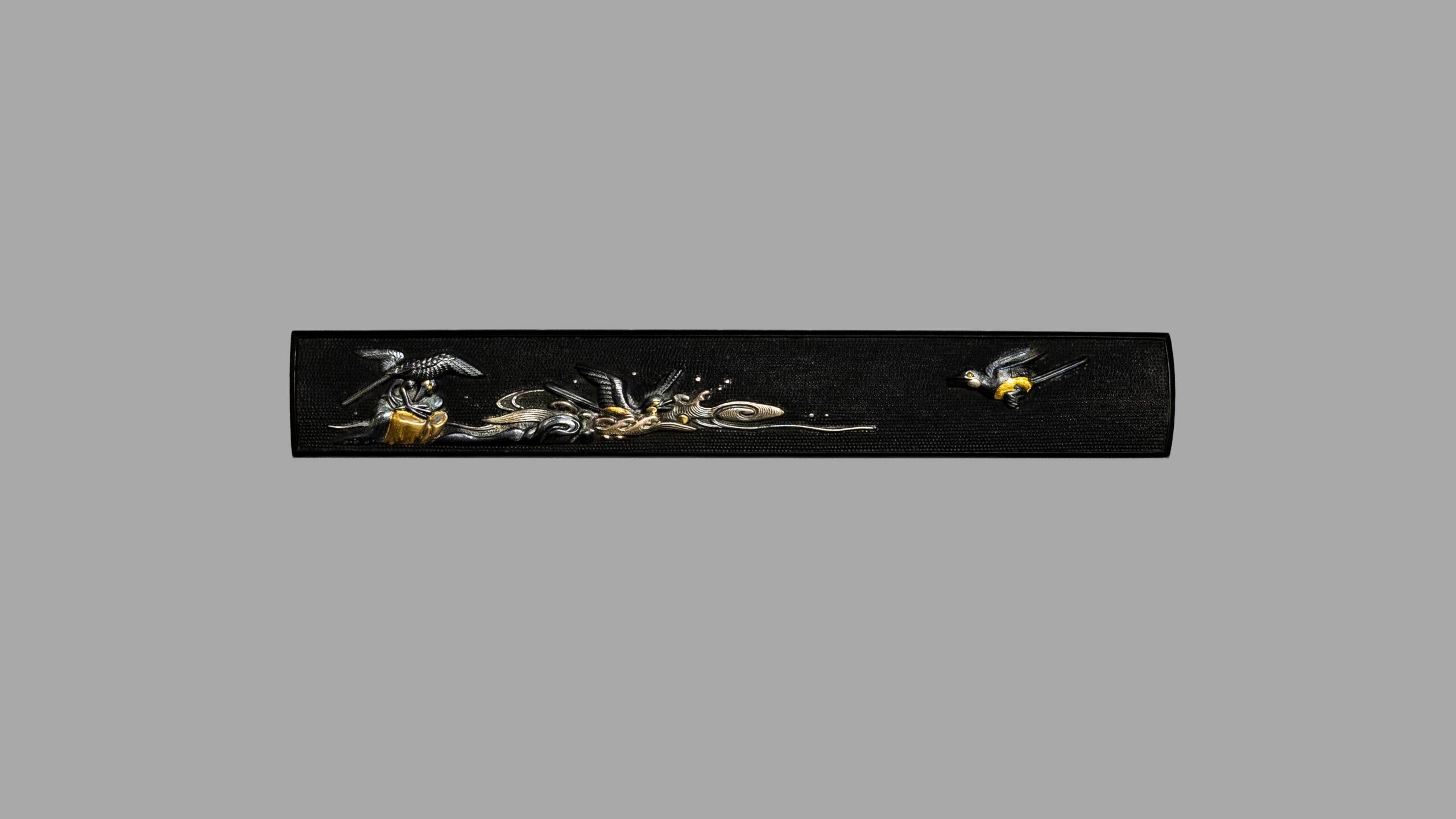
![Kozuka - Hozon - by Goto Shinjo - Pine Tree and Crane Design, Signed Goto Mitsuyoshi (Kao) [15th Generation]](/_next/image?url=https%3A%2F%2Fitbhfhyptogxcjbjfzwx.supabase.co%2Fstorage%2Fv1%2Fobject%2Fpublic%2Flisting-images%2Fchoshuya%2FL366016%2F00.jpg&w=2560&q=90)