 NihontoWatchNihontoWatch
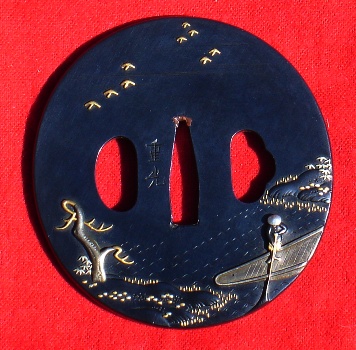
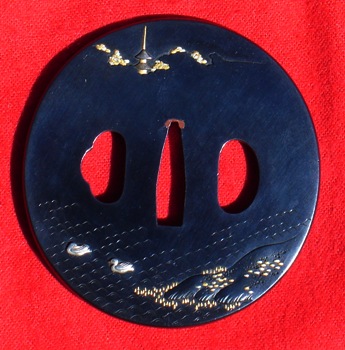
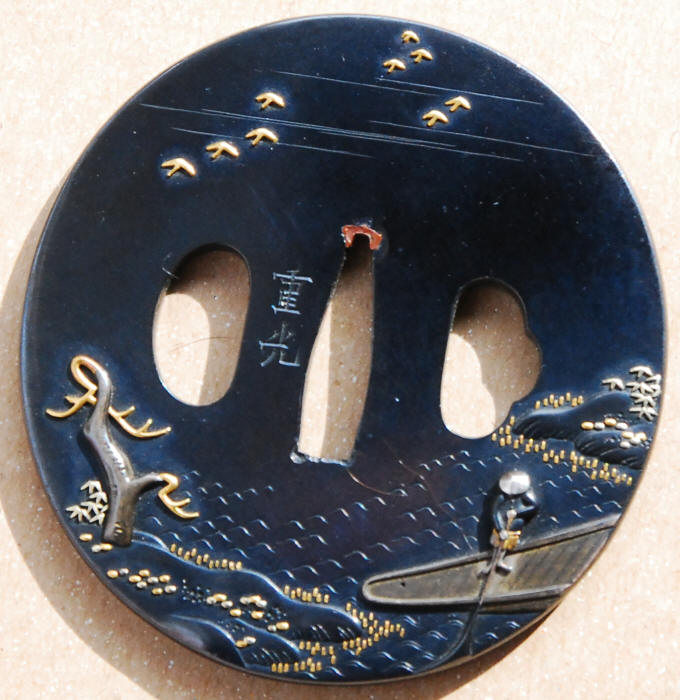
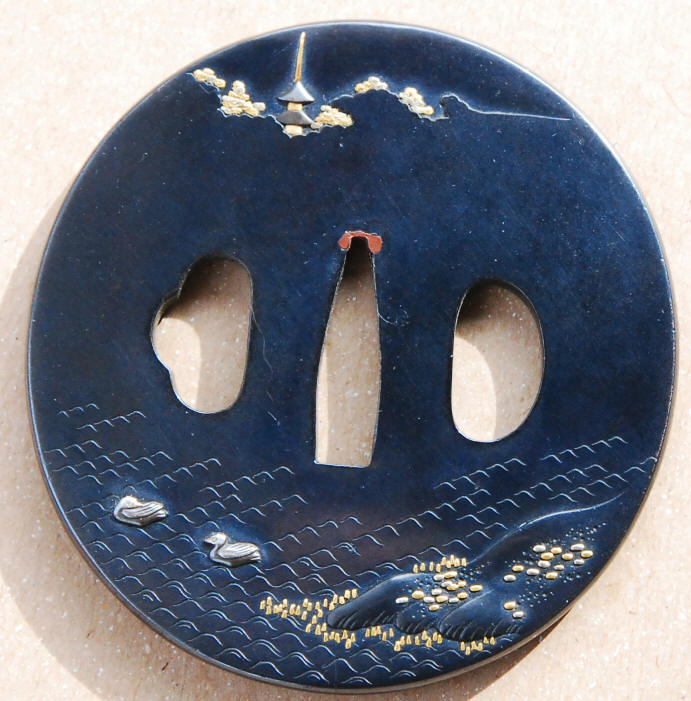
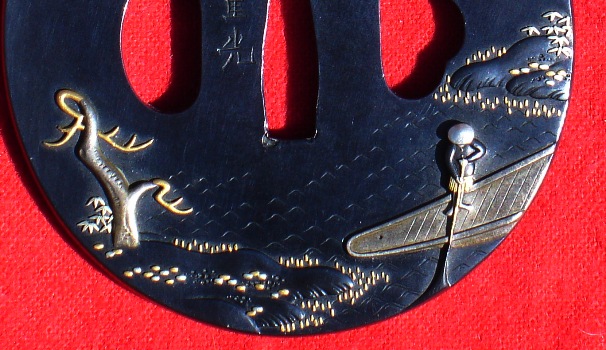
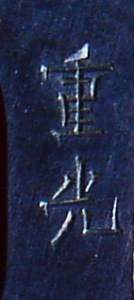
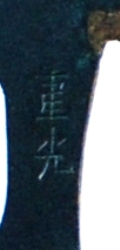
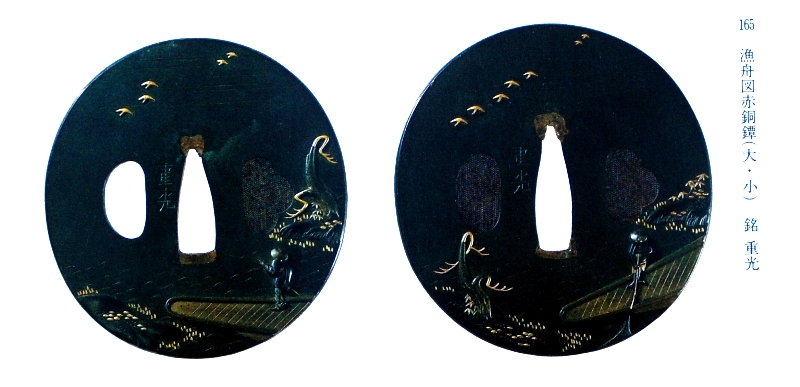
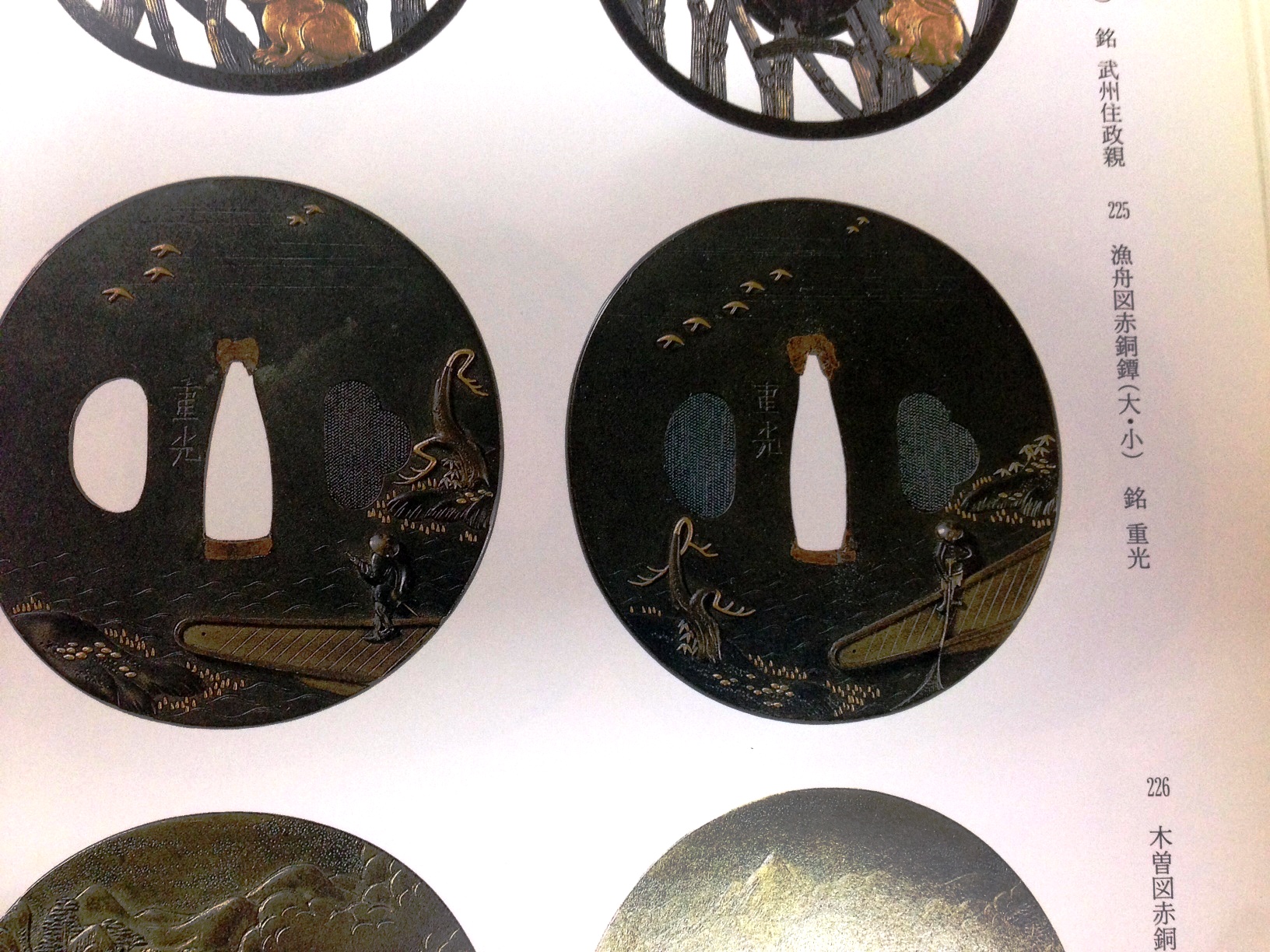
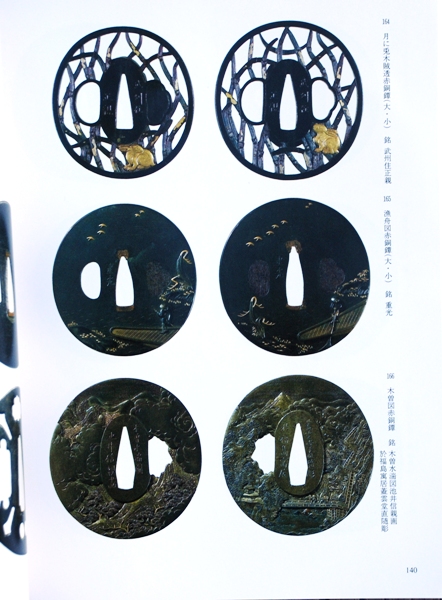
Part of an order for the Kiku Daimyo, an excellent shakudo tsuba signed, Shigemitsu with an atypical kanji. 7.55 cm x 7.24 cm x 1.51 mm. Wonderfully deep, rich, blue-black shakudo with gold, silver, shibuichi, and shakudo takazogan, and stylized waves in keibori. The gold inlay is solid, not a wash over a copper inlay, and the shakudo has a very high gold content. The normal gold percentage for good shakudo is 4% to 6%, and this would be on the high side of that. See an See an iron example TS0373. Shigemitsu was a samurai who worked for the Matsudaira Daimyo. He was a student of the second generation Yokoya Soyo. (Haynes, H 8953.0). Usually his pieces are not signed, however Robert Haynes opined that since this is such an expensive piece, and the gold could only be procured through the Daimyo, that this was probably a special order for the Daimyo, and so he elected to sign this tsuba. He confirmed that he thought that this was probably the work of Kato Shigemitsu, explaining that the design is pure Nara school, and the Kato came out of Nara. However, he added in a letter, "There were so many Shigemitsu that I can't be absolutely sure". Interestingly, this artistic rendering of "Shige", is not in any dictionaries. I had hunted in both Nelson and Koop and Inada, and poured through Tosogu Meiji Taikei, and The Index of Japanese Sword Fittings and Associated Artists, then asked help from Robert Haynes and Harry Watson. Harry Watson wrote: "I have looked through the Kinko Jiten, Kodogu Meiji Daijiten, a 15,00 kanji dictionary, and two dictionaries of seal characters, and cannot get any closer than Shigemitsu". Never submitted to shinsa. This was apparently part or a larger order, as I saw another example at a Japanese online auction, and here is a catalog reference showing a dai-sho of the same theme, but slightly different design. Boxed Shigemitsu With An Atypical Shige Kanji. Left, the above tsuba. Right, From the Tokugawa catalog below.
NihontoWatchOffered by Nihonto US
We couldn’t find current papers for this piece. Ask the dealer whether it has been, or can be, submitted to shinsa. — Hoshi
2 on the market

Machibori
2 pieces on the market now
Machibori · Edo
80 pieces on the market now
The Nara school of kinko (metalwork) emerged in the mid-Edo period as one of the most celebrated independent traditions of sword-fitting craftsmanship, its masters working outside the patronage structures that governed the Goto house. The school coalesced around the figure of Nara Toshihisa (1667--1736), also known as Tahee, who as head master during its creative zenith defined the mature idiom of the lineage. Though the school's origins are often traced through the successive generations of the Nara family beginning with Toshiharu, its lasting fame rests upon the Nara sansaku — the Three Masters of Nara: Toshihisa, Tsuchiya Yasuchika, and Sugiura Joi. " Joi (1701--1761), trained under Juei in the lineage of Toshiharu, rose to become the third pillar of this triumvirate. Together, and joined by masters of allied lineages such as Hayashi Shigemitsu of the Higo kinko tradition, the Nara school and its circle represent the highest achievement of independent metalwork in the Edo period. The collective technical vocabulary of the Nara school encompasses an extraordinary breadth of materials and methods. Its masters worked in iron, shakudo, shibuichi, brass (shinchu), refined copper (suaka), and oborogin, treating surfaces as polished grounds (migaki-ji), hammered textures (tsuchime-ji), and stone-grain finishes (ishime-ji) — the latter developed by Toshihisa into a distinctive personal manner. The school's carving methods span the full spectrum: sukidashi-bori modeled relief, takabori high relief, the thread-fine line work of kebori, and the single-stroke katakiribori incision. " Yet individual specialties distinguish the masters within this shared vocabulary.
Toshihisa's art finds its fullest expression in sukidashi takabori — relief carving in which figures are raised with subtly graduated heights to produce an illusion of spatial depth — executed against his richly textured ishime-ji grounds. Joi developed nikuaibori, a modulated relief technique of unrivaled refinement, producing entire compositions through chisel work alone on polished oborogin grounds, dispensing with inlay and colored-metal accents. Yasuchika's range is perhaps the broadest, encompassing the distinctive daigaku-gata iron tsuba conceived for his patron and kozuka that "draw forth a small universe" within a confined surface, while his late works signed with the art name Tou achieve an austere, detached realm the NBTHK terms kotan. The legacy of the Nara school rests on the singular ability of its masters to transcend decorative function and achieve genuine artistic expression within the confines of sword fittings. Toshihisa, as the senior figure among the sansaku, established the standard of dignified, powerfully carved relief against richly textured grounds, and his figural subjects — gamecocks, tigers, Bishamonten — consistently achieve what NBTHK scholarship identifies as the philosophical duality of do (movement) and sei (stillness) within a single composition. " Joi, working primarily in the intimate format of the kozuka, achieved expressive authority through the sheer subtlety of his nikuaibori chisel work — his celebrated lion-and-cub compositions existing in closely related versions across multiple designations and published in the canonical reference Tagane no Hana. That the school also attracted masters of allied provincial traditions — Hayashi Shigemitsu of Higo, whose iron tsuba display the characteristic murasaki-sabi patina and "somewhat gentler feeling" that distinguishes the second generation from the founder Matahichi — attests to its gravitational influence on Edo-period metalwork as a whole. Across the school's production, the NBTHK's evaluative language converges on a consistent theme: compositional intelligence, technical command across the full range of materials and carving methods, and an expressive depth that elevates the finest works from accomplished craft to art of the highest order. Learn more →
| Smith | Era | Designated |
|---|---|---|
| Yasuchika安親 | — | 87 |
| Toshinaga利寿 | — | 30 |
| Joi乗意 | — | 12 |
| Minzan谺珉山 | — | 1 |
| Toshiyoshi利善 | — | 0 |
We could not find an authenticity certificate on the seller’s listing. Japanese swords and fittings are normally papered by the NBTHK (or the NTHK). Without one, the attribution is the seller’s own assessment and has not been independently verified — treat it with caution and ask the dealer about certification before buying.
Three day, no penalty, inspection on every item. Returns must be in the same condition as shipped. Actual costs will be charged on returned items. No restocking fee. If you did not like the item is a good enough reason for return.
$4,500