NihontoWatch Mon

NihontoWatch

Market
Encyclopedia
Kantei
NihontoWatch Mon

NihontoWatch

Market
Encyclopedia
Kantei

Description

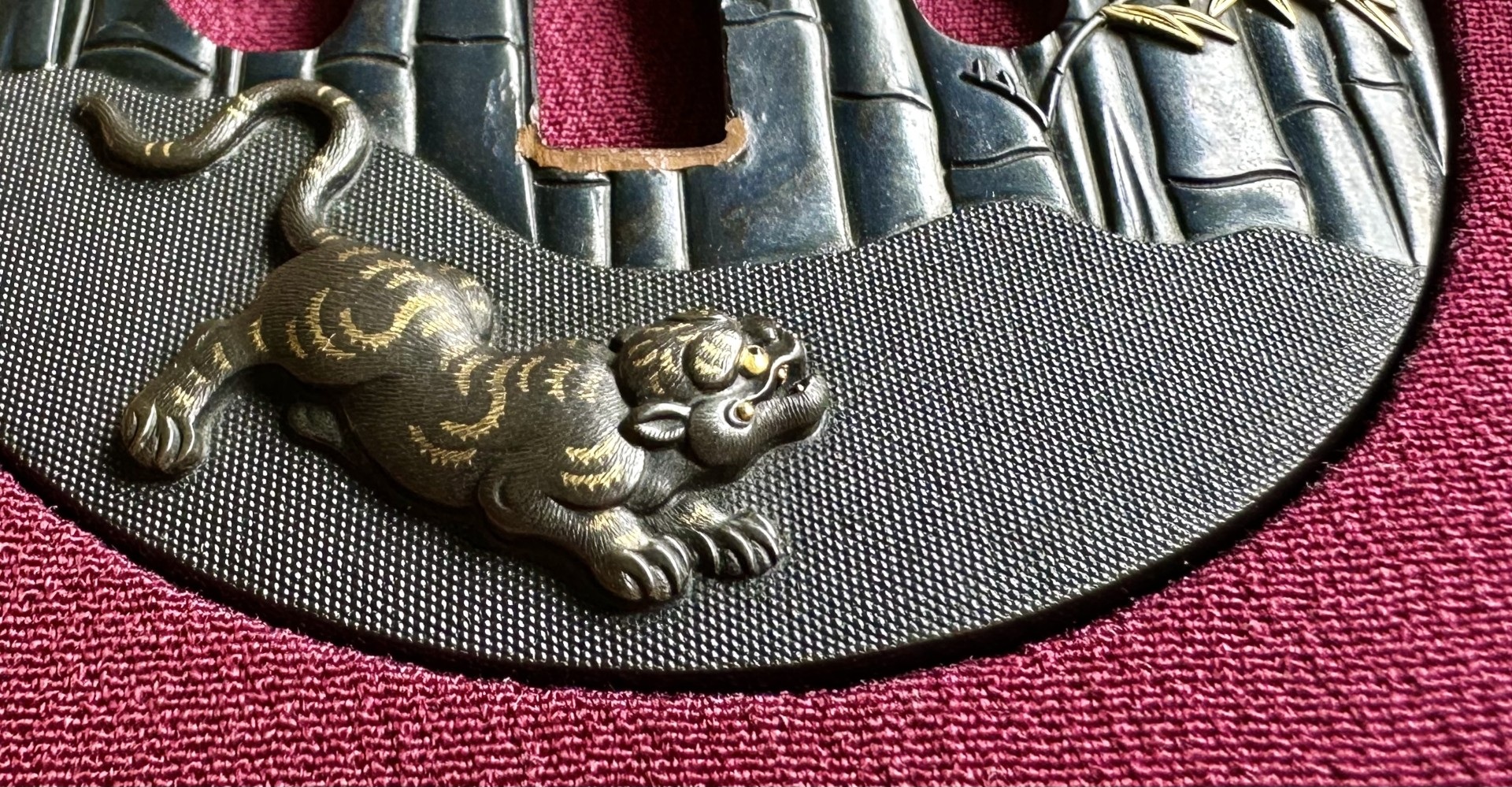
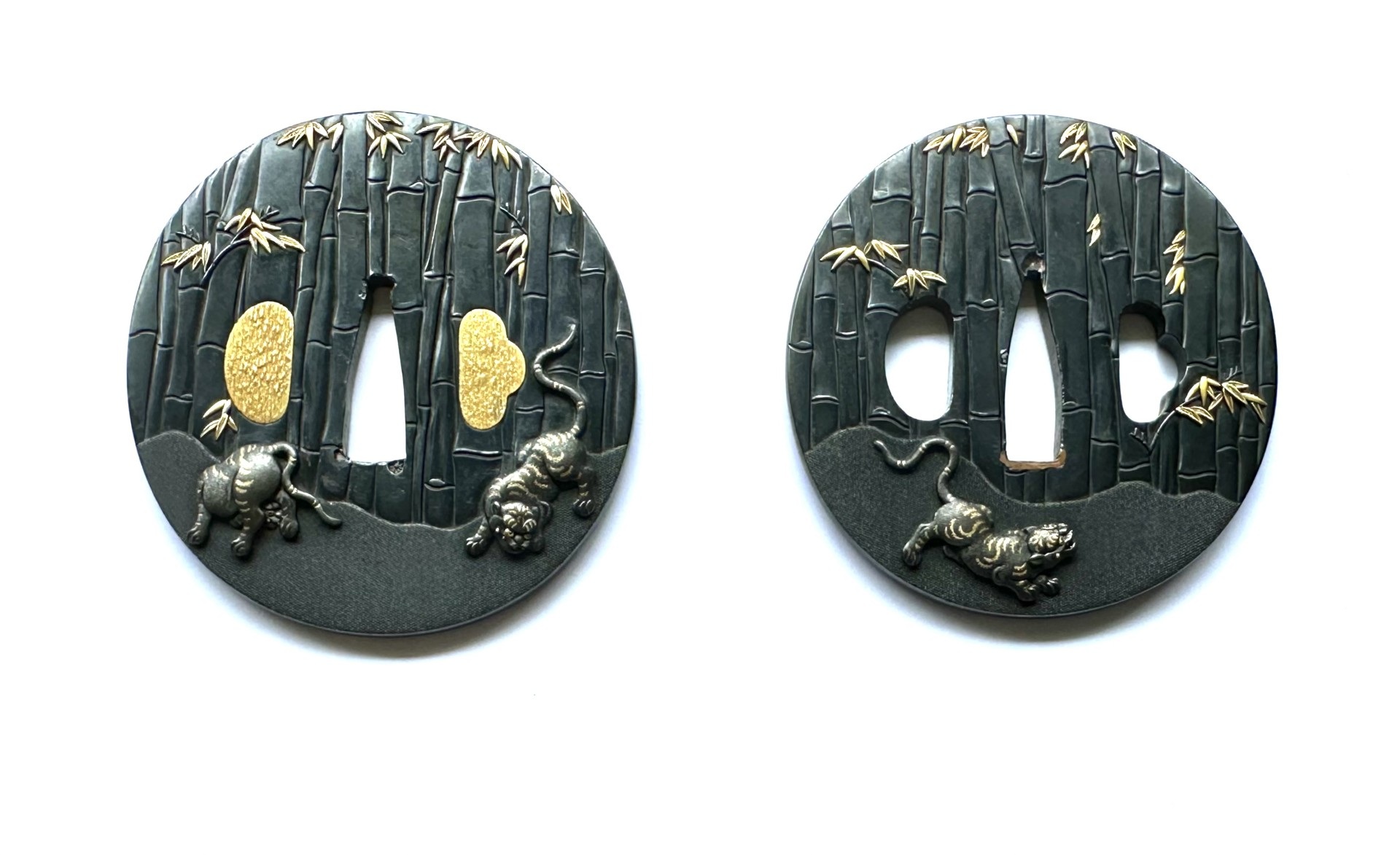
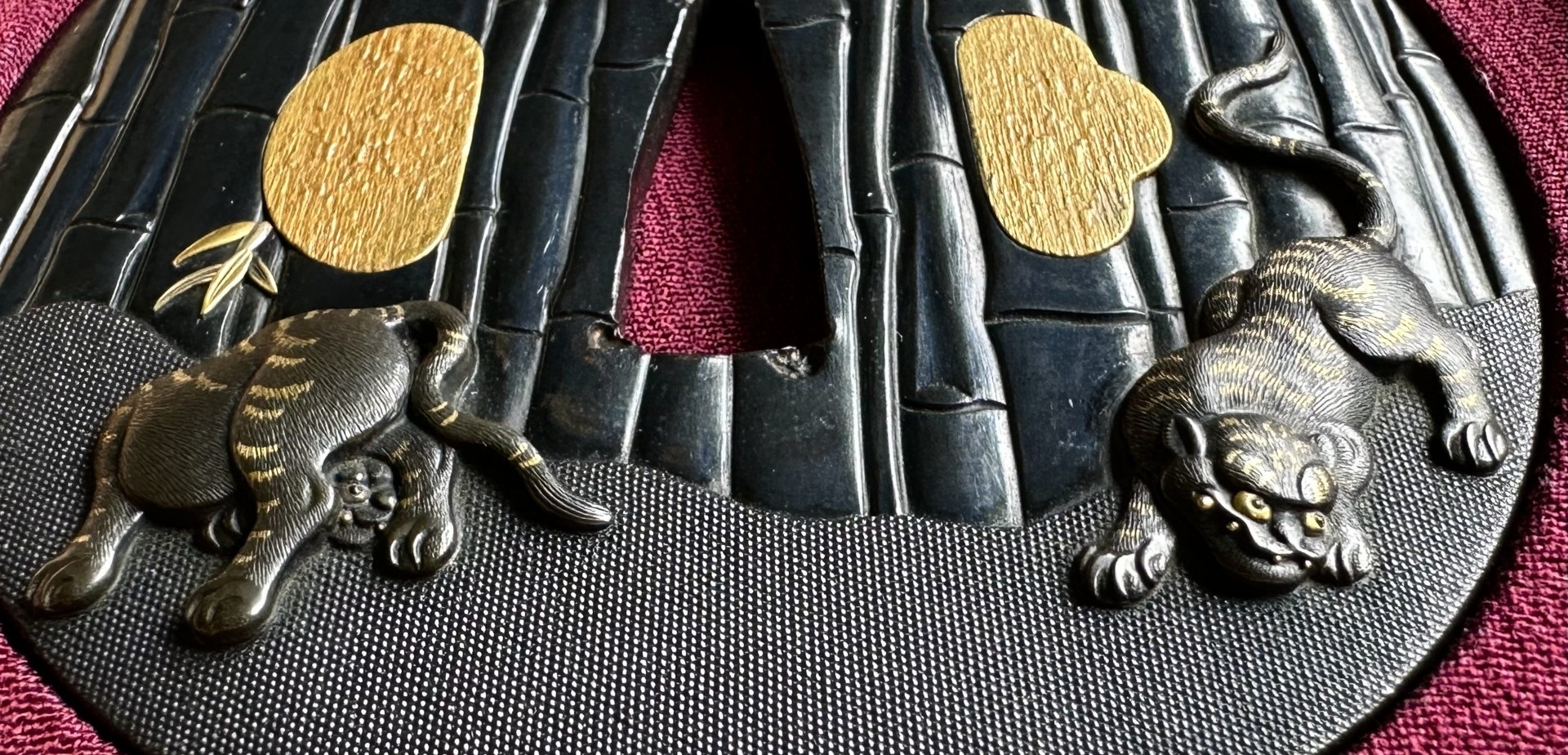
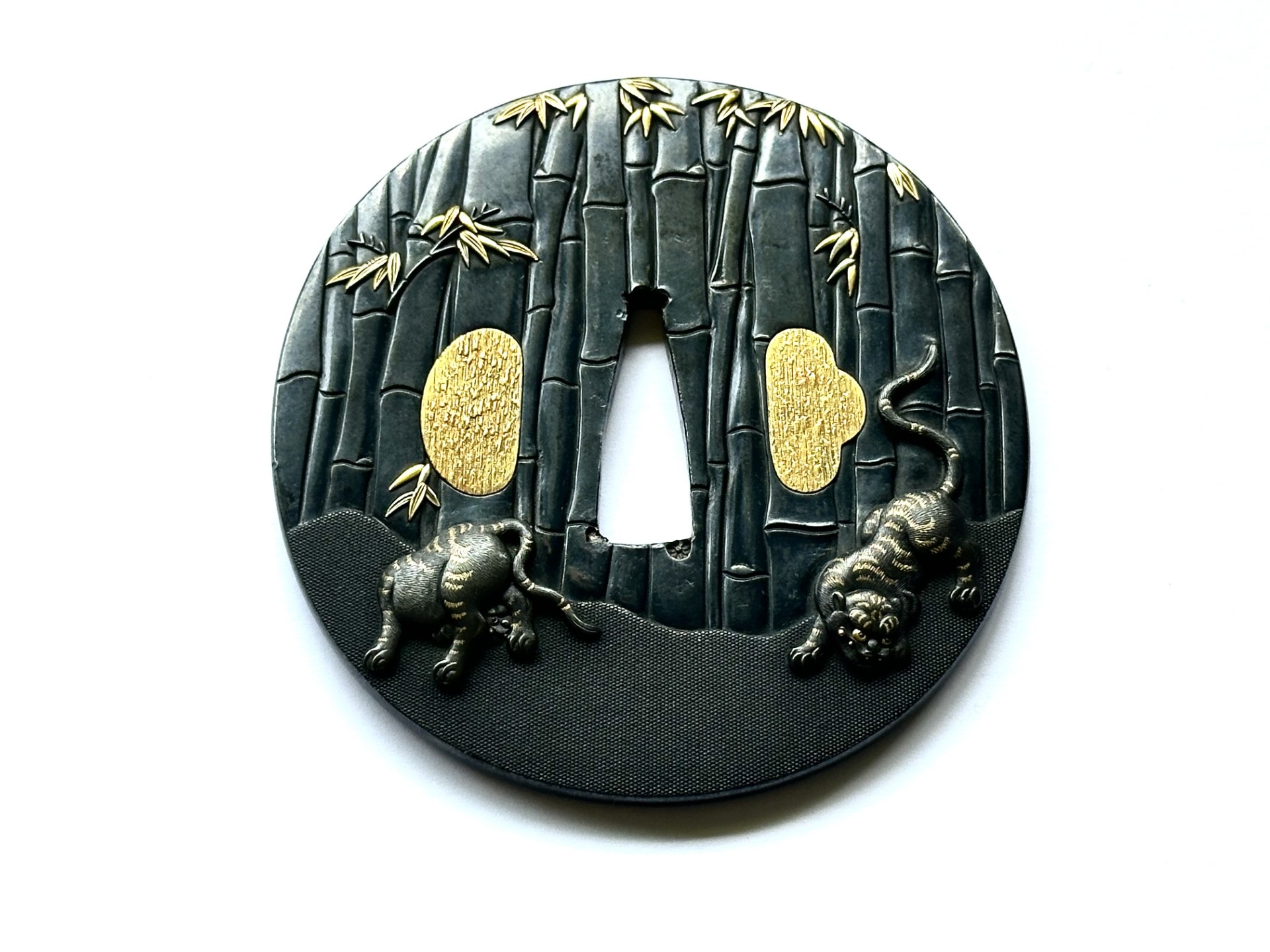
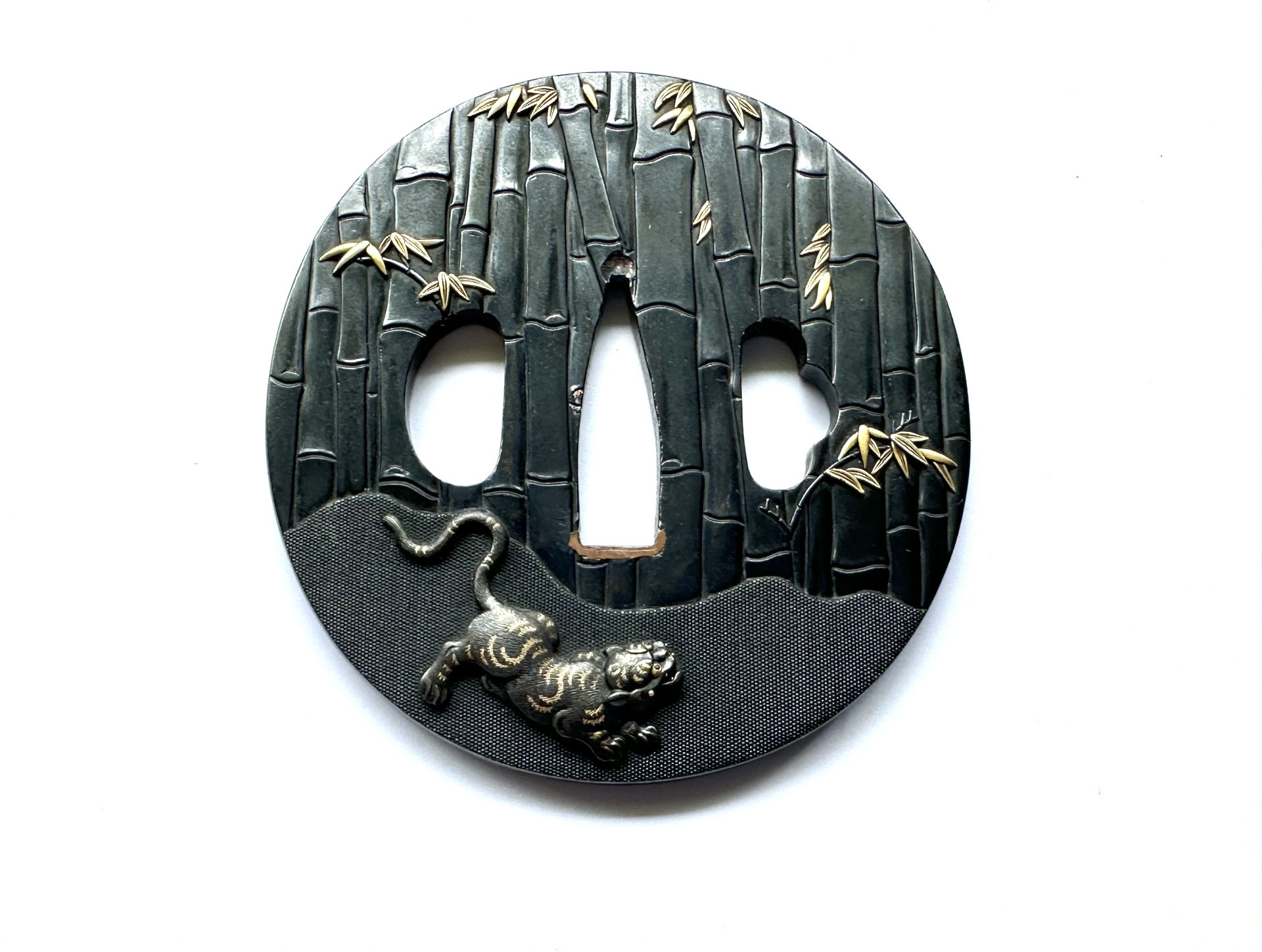
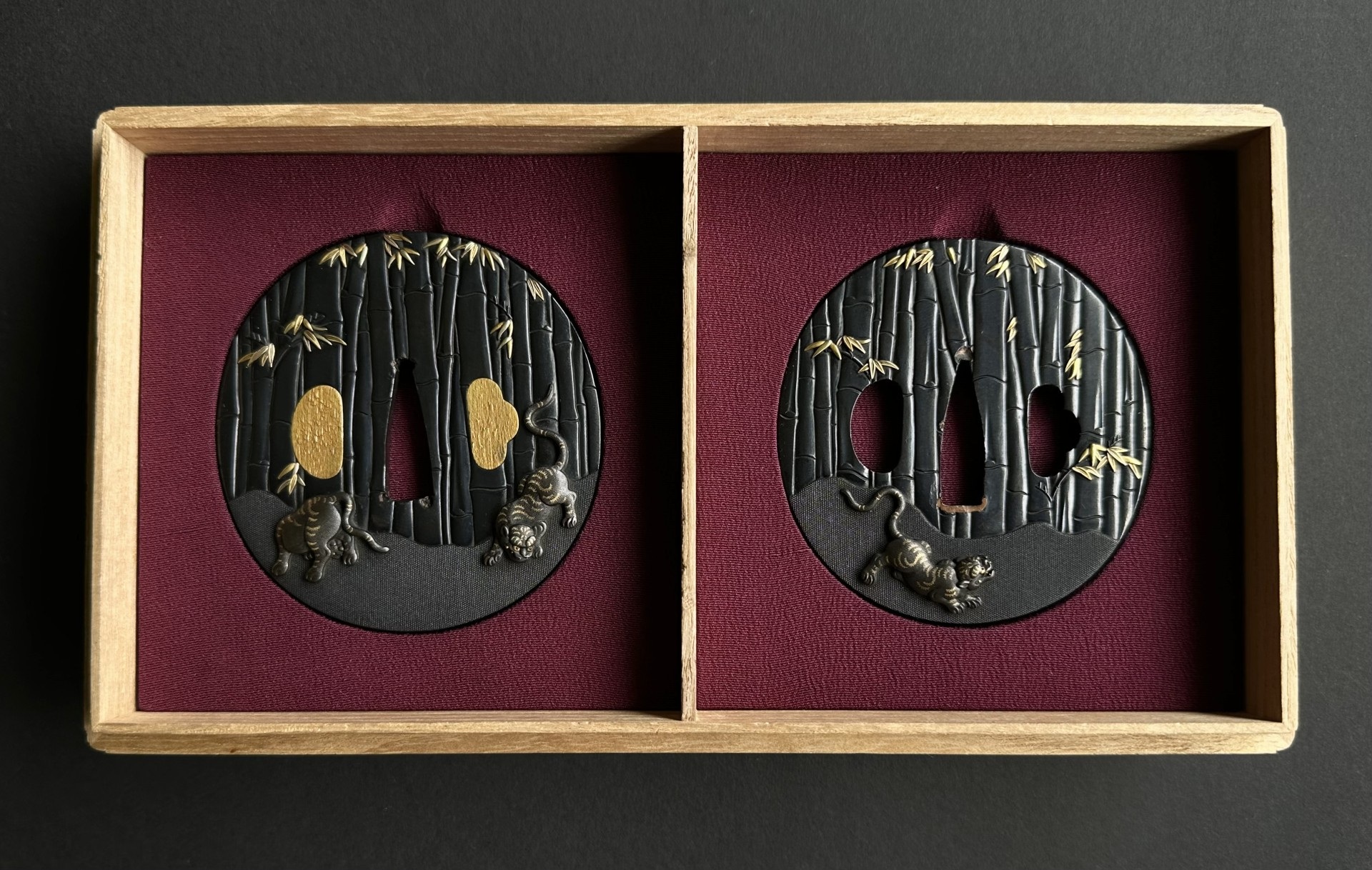
This is an extremely rare set of Daisho Tsuba by Iwamoto Konju, a chosen student of the famous Edo Master Iwamoto Konkan. Certified as Juyo Tosogu by the NBTHK, these tsuba depict tigers in a bamboo grove, symbolizing strength, courage, and resilience. The intricate carvings and use of various inlay techniques showcase the artist's exceptional skill and attention to detail.

NBTHK Setsumei

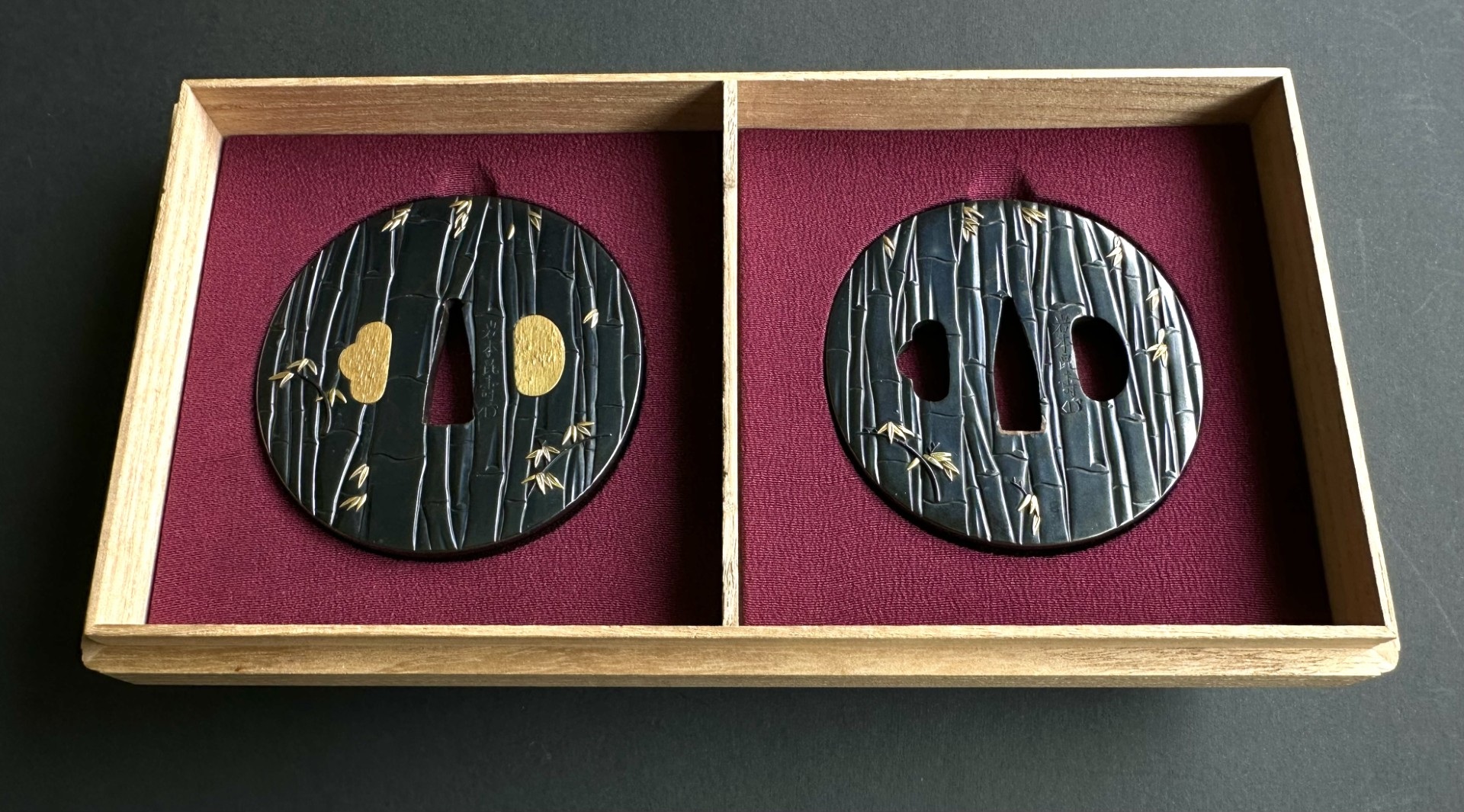
Jūyō-Tōsōgu, 51st Session — Designated October 13, 2005 Daishō tsuba, mei: Iwamoto Konju (岩本昆寿) Measurements - Dai (large): height 7.45 cm; width 7.12 cm; rim thickness 0.36 cm - Shō (small): height 7.14 cm; width 6.79 cm; rim thickness 0.36 cm Description Form: tate-maru-gata (vertical oval) Material: shakudō; migaki-ji with areas of nanako-ji Construction: — Design: tiger in a bamboo grove (take ni tora zu) Decoration: sukidashi-bori, sukishita-bori, and suemon in combination; zōgan and polychrome inlay (iroe) in gold, silver, and shibuichi Rim: kaku-mimi, ko-niku Hitsu-ana: two openings; on the dai both are fitted with gold plugs Signature: “Iwamoto Konju” with kaō Artisan Iwamoto Konju. He lived at Kōjimachi in Edo and was active as a pupil of the renowned master Konkan. His manner resembles Konkan’s: the chisel lines are taut and controlled, and his approach to iroe frequently employs inlay-based methods. Era Mid-Edo period. Explanation This is a daishō pair of tsuba depicting a tiger in a bamboo grove, executed on a shakudō ground through the combined use of sukidashi-bori, sukishita-bori, and suemon. The bamboo grove continues from the front to the reverse; on the reverse, bamboo is arranged densely, without leaving gaps. By rendering the central stalk thick while depicting those to left and right more slender, the artist creates spatial recession and convincingly conveys the depth of a luxuriant, thickly grown bamboo thicket. The carefully controlled chiselwork fully demonstrates the maker’s high technical level. In both design conception and carving execution, the piece shows a notably high degree of completion, and stands as an excellent work among Konju’s productions.

NihontoWatch MonNihontoWatch
MarketEncyclopediaKantei
Fittings›Machibori›Yokoya›Iwamoto›Konju›Iwamoto Konju Juyo Daisho Tsuba Masterpiece
tsubaJūyō
Iwamoto Konju

Iwamoto Konju Juyo Daisho Tsuba Masterpiece

mei · Edo

Price on request
Visit seller website →
Iwamoto Konju — 1 of 9
Iwamoto Konju — 2 of 9
Iwamoto Konju — 3 of 9
Iwamoto Konju — 4 of 9
Iwamoto Konju — 5 of 9
Iwamoto Konju — 6 of 9
Iwamoto Konju — 7 of 9
Iwamoto Konju — 8 of 9
Iwamoto Konju — 9 of 9
1 / 9
1 / 9
Iwamoto Konju — 1 of 9Iwamoto Konju — 2 of 9Iwamoto Konju — 3 of 9Iwamoto Konju — 4 of 9Iwamoto Konju — 5 of 9Iwamoto Konju — 6 of 9Iwamoto Konju — 7 of 9Iwamoto Konju — 8 of 9Iwamoto Konju — 9 of 9
Measurements & details
Maker

Iwamoto Konju

Era

Edo

Signature

Signed

Papers

Jūyō #51 (NBTHK)

Description

This is an extremely rare set of Daisho Tsuba by Iwamoto Konju, a chosen student of the famous Edo Master Iwamoto Konkan. Certified as Juyo Tosogu by the NBTHK, these tsuba depict tigers in a bamboo grove, symbolizing strength, courage, and resilience. The intricate carvings and use of various inlay techniques showcase the artist's exceptional skill and attention to detail.

NBTHK Zufu Commentary

Juyo #51

AI translation — may contain errors

-Tōsōgu, 51st Session — Designated October 13, 2005

, : Iwamoto Konju (岩本昆寿)

Measurements

  • Dai (large): height 7.45 cm; width 7.12 cm; rim thickness 0.36 cm
  • Shō (small): height 7.14 cm; width 6.79 cm; rim thickness 0.36 cm

Description Form: (vertical oval) Material: ; with areas of Construction: — Design: tiger in a bamboo grove (take ni tora zu) Decoration: , sukishita-bori, and in combination; and polychrome inlay () in gold, silver, and Rim: , : two openings; on the dai both are fitted with gold plugs Signature: “Iwamoto Konju” with

Artisan Iwamoto Konju. He lived at Kōjimachi in and was active as a pupil of the renowned master Konkan. His manner resembles Konkan’s: the chisel lines are taut and controlled, and his approach to frequently employs inlay-based methods.

Era Mid- period.

Explanation This is a pair of depicting a tiger in a bamboo grove, executed on a ground through the combined use of , sukishita-bori, and . The bamboo grove continues from the front to the reverse; on the reverse, bamboo is arranged densely, without leaving gaps. By rendering the central stalk thick while depicting those to left and right more slender, the artist creates spatial recession and convincingly conveys the depth of a luxuriant, thickly grown bamboo thicket.

The carefully controlled chiselwork fully demonstrates the maker’s high technical level. In both design conception and carving execution, the piece shows a notably high degree of completion, and stands as an excellent work among Konju’s productions.

About the maker

Konju

昆寿

Machibori · Musashi · around 1670

1 piece on the market now

›

Historical importance

Where Konju stands among comparable artisans: across all of nihontō, and within tradition, era, and period. The tiers (Foremost · Leading · Major · Notable) weigh official designations from the NBTHK and Japan's Agency for Cultural Affairs, together with historical honors of lasting repute such as the Sansaku and Meibutsu-chō.

随一
Foremost
屈指
Leading
有数
Major
著名
Notable

Select a lens to see how it's measured.

Designation record
2 designated works
Jūyō
2
1 work by Konju on the market→
Konju — full profileMachibori school
About the school

Iwamoto

岩本

Machibori · Edo

11 pieces on the market now

›

The Iwamoto school was a house of Edo machibori (町彫) metalworkers, founded in the early eighteenth century by Iwamoto Chūbei, a pupil of the Yokoya school, and continuing through eight generations of headmasters. As the NBTHK setsumei state repeatedly, "the Iwamoto line was originally of the Yokoya tradition," and the school's history turns on a succession crisis within that lineage: when the fifth-generation master Ryōkan died young, his junior fellow-disciple succeeded as sixth head of the Iwamoto house. This was Iwamoto Konkan, born in Edo in Enkyō 1 (1744), whose original family name was Asai and who first used the name Ryō (also read Ryōun) before changing it to Konkan. " He also signed with the art names Shunshōdō (春曙堂) and Hakuhōtei (白峯亭). The line continued through Iwamoto Kanri, common name Kijūrō, who first studied under Konkan, was later adopted by him, and succeeded as seventh head; the school's orbit also included the pupil Konju, who lived at Kōjimachi in Edo. The school's collective style rests on this synthesis of Yokoya sculptural discipline and Nara-school carving methods. Its preferred vocabulary is shakudō (赤銅) with nanako-ji (魚子地) ground, worked in takabori (高彫) high relief with suemon-zōgan (据紋象嵌) and polychrome iroe (色絵) in gold, silver, shibuichi (四分一), and suaka (素銅) copper; but the setsumei attest an unusually broad range of grounds — shibuichi and iron in polished migaki-ji (磨地), chirimen-ishime-ji[[c:1]], brass ishime-ji, and gold — together with sukidashi-bori (鋤出彫), sukishita-bori, relief-carved openwork, fine kebori (毛彫), and inlaid aogai (青貝) mother-of-pearl, set even into the eyes of fish.

The distinctive triangular chisel (sankaku-tagane 三角鏨) recurs as a house hallmark, as does a masterful command of negative space and calculated composition, with obverse and reverse conceived in deliberate contrast. Favored subjects are drawn from nature observed with startling fidelity: the uo-zukushi (魚尽) arrays of fish "rendered with such precision that one feels each individual species could be identified," each scale and backbone carved line by line; herons among reeds; pheasants under a hazy moon; carp gliding through waterweed; alongside shishi, orchids, chrysanthemums, dragons, landscape narratives such as cormorant fishing and the Chōfu Tamagawa, and even Buddhist imagery of Dainichi Nyorai and Niō. The setsumei judge Konkan to have "ranked among the foremost artists of the naturalistic, sketch-from-life approach," while a fully matched aoi-crest mounting shows the school equally capable of orthodox, formal commissioned work. The Iwamoto school's place in the tosogu canon rests above all on Konkan, counted among the leading Edo metalworkers and habitually praised in the setsumei with the phrase "Edomae no iki" — the quintessential stylishness of Edo; his fame is further reflected in the extensive forgery of his signature. Works transmitted in the Tsugaru and Sakai daimyō families attest the esteem his oeuvre commanded. The tradition did not end with him: Kanri "followed his teacher's manner closely and, after Konkan, produced a number of powerful works," while Konju's carving, "taut and controlled" in the master's likeness, carried the inlay-centered iroe methods forward. Wide-ranging in subject and prolific in output, the school stands as one of the defining expressions of late-Edo machibori art — a lineage in which the strengths of the Yokoya and Nara traditions were fused into a single, unmistakably urbane style. Learn more →

3 recorded smiths57 designated works
Leading smiths
SmithEraDesignated
Konkan昆寛—51
Kanri寛利16703
Masakatsu政克 (Masamoto—0
Soei宗栄—0
Ikkan一寛—0
Explore the Iwamoto school →
NBTHK Certificate
Jūyō Tōsōgu重要刀装具
Important Fitting
›

Exceptional craft of very high artistic value, judged to rank with a nationally recognized Important Art Object (Jūyō Bijutsuhin).

About the NBTHK›

The NBTHK (Nihon Bijutsu Tōken Hozon Kyōkai, the Society for the Preservation of Japanese Art Swords) is a public-interest incorporated foundation founded in 1948 and supervised by Japan’s Agency for Cultural Affairs (Bunkachō); it is based at the Japanese Sword Museum in Tokyo. Its expert panels physically examine each submitted work (shinsa) and issue a certificate (kanteishō) ranking it by artistic and historical merit. NBTHK papers are the most widely recognized standard of authentication for Japanese swords and fittings.

NBTHK official site→
Seller
C
Connoisseur Arms
🇳🇿Ships from New Zealand
›
✓Verified dealerconnoisseurarms.com
✓Ships worldwide✓English supportWire transfer
Return policy

Purchases are final and items cannot be returned unless otherwise stated.

View all of Connoisseur Arms’s listings→View this item on the dealer’s site→

Previously sold by Iwamoto Konju

Choshuya
Tokuho
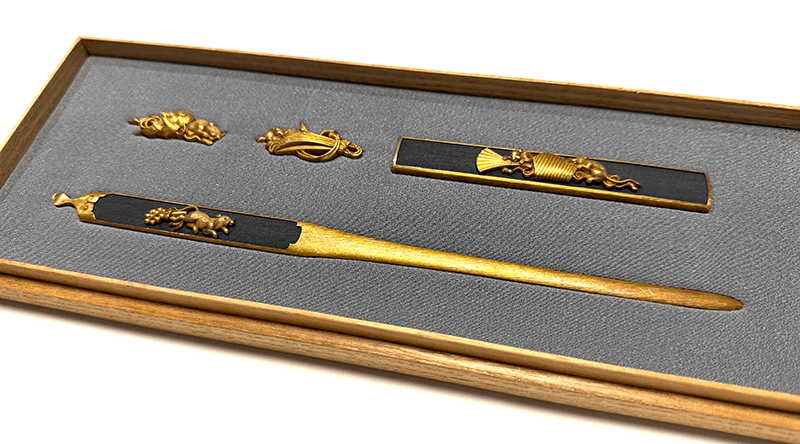
Kozuka - Tokuho - by Iwamoto Konju - Hawk and Monkey Design Futatokoro: Kozuka and Kogai Signed Iwamoto Konju with KakihanKozuka - Tokuho - by Iwamoto Konju - Hawk and Monkey Design Futatokoro: Kozuka and Kogai Signed Iwamoto Konju with Kakihan
Sold

Kozuka

ByIwamoto Konju
SOLD
Choshuya
Hozon
Fuchi-Kashira - Hozon - by Iwamoto Konju - Fuchigashira: Takasago Design, Signed Konju with KaoFuchi-Kashira - Hozon - by Iwamoto Konju - Fuchigashira: Takasago Design, Signed Konju with Kao
Sold

Fuchi-Kashira

ByIwamoto Konju
SOLD
Choshuya
Tokuho
Kozuka - Tokuho - by Iwamoto Konju - Futatokoro (Kozuka and Kogai): Fierce Bird Catching Monkey Design, Signed Iwamoto Konkan with KaoKozuka - Tokuho - by Iwamoto Konju - Futatokoro (Kozuka and Kogai): Fierce Bird Catching Monkey Design, Signed Iwamoto Konkan with Kao
Sold

Kozuka

ByIwamoto Konju
SOLD

More from the Iwamoto school

View all →
Aoi Art
Jūyō
Fuchi-Kashira - Jūyō - by Iwamoto Konkan - Fuchikashira: Iwamoto KonkanFuchi-Kashira - Jūyō - by Iwamoto Konkan - Fuchikashira: Iwamoto Konkan

Fuchi-Kashira

ByIwamoto Konkan
¥2,500,000
Tetsugendo
Tokuho
Menuki - Tokuho - by Iwamoto Kanri - Signed Iwamoto Kanri - NBTHK Tokubetsu Hozon (1700s)Menuki - Tokuho - by Iwamoto Kanri - Signed Iwamoto Kanri - NBTHK Tokubetsu Hozon (1700s)

Menuki

ByIwamoto Kanri
¥2,500
Ginza Seikodo
Tokuho
Kozuka - Tokuho - by Iwamoto Konkan - Iwamoto Konkan (kao) - Pot Hanger MotifKozuka - Tokuho - by Iwamoto Konkan - Iwamoto Konkan (kao) - Pot Hanger Motif

Kozuka

ByIwamoto Konkan
¥1,500,000
Soryu
Tokuho
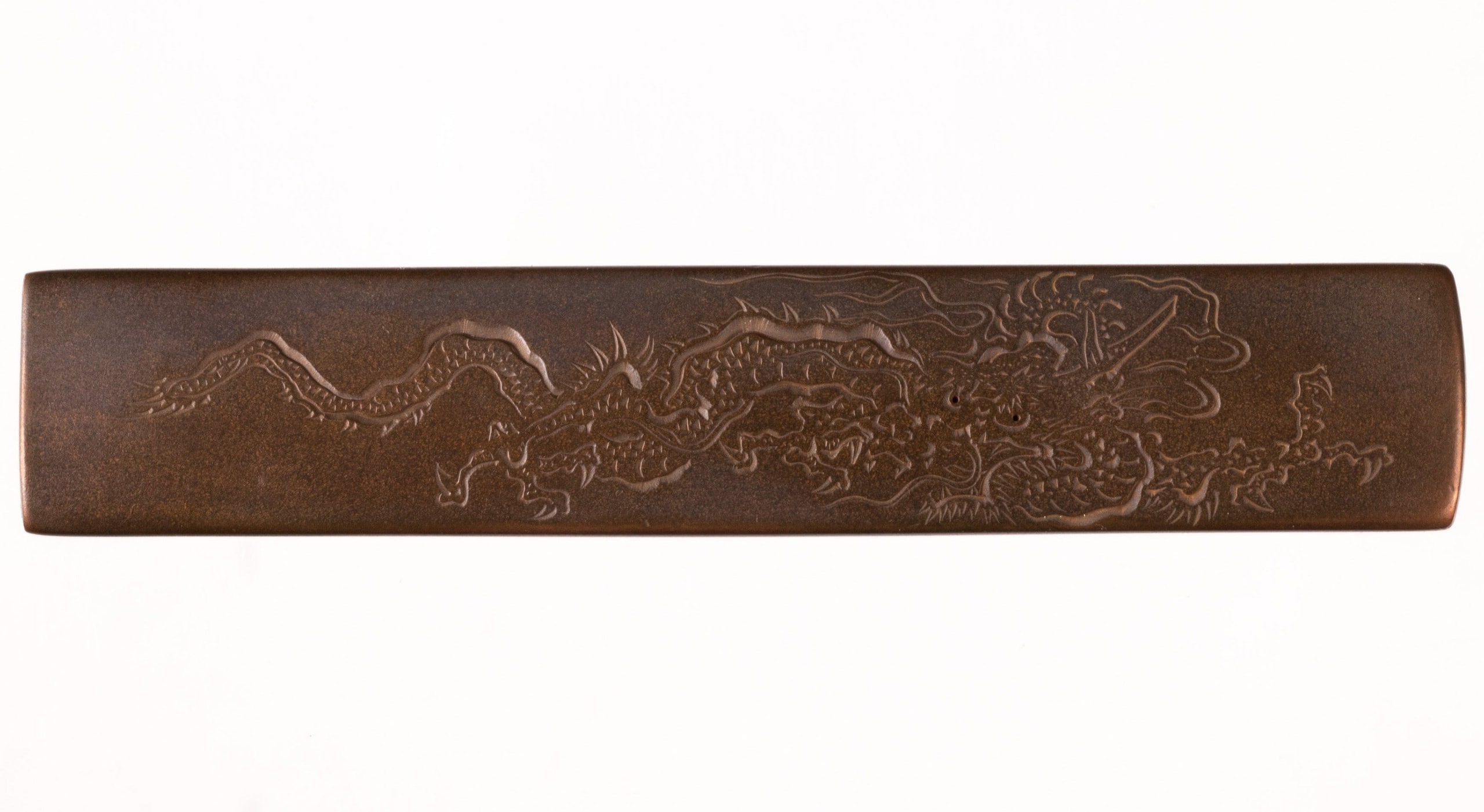
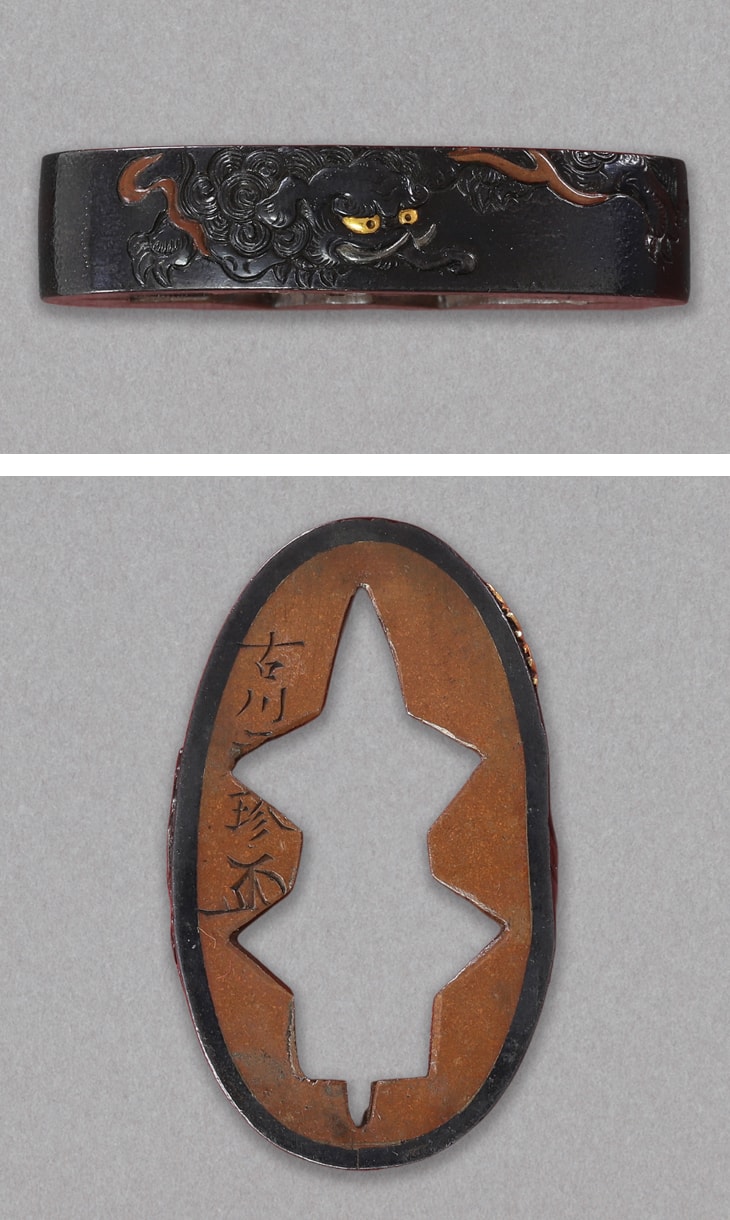
Kozuka - Tokuho - by Iwamoto School - Iwamoto Masashige - Dragon ThemeKozuka - Tokuho - by Iwamoto School - Iwamoto Masashige - Dragon Theme

Kozuka

ByIwamoto School
¥1,300
Connoisseur Arms
Hozon
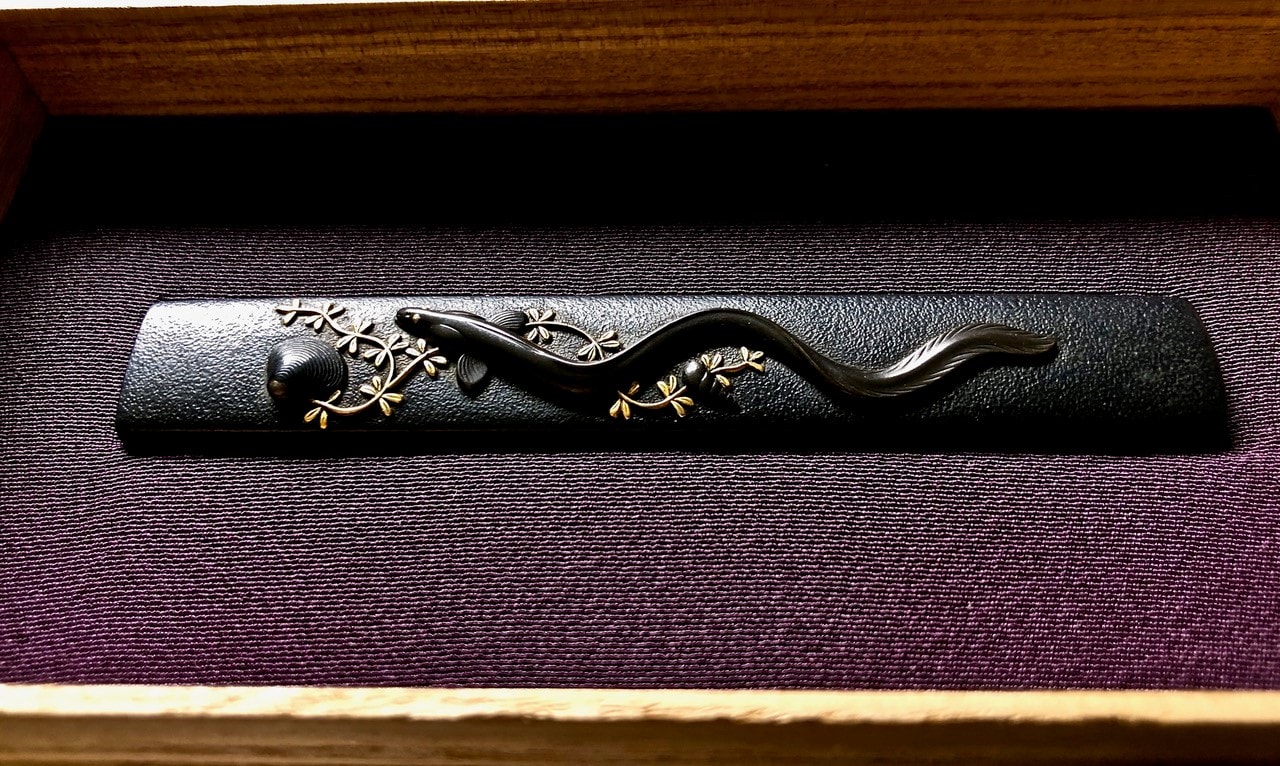
Kozuka - Hozon - by Iwamoto School - Kozuka with Eel Design by Iwamoto SchoolKozuka - Hozon - by Iwamoto School - Kozuka with Eel Design by Iwamoto School

Kozuka

ByIwamoto School
Ask
Toushin
Fuchi-Kashira - by Iwamoto Ikkan - Fuchi-Kashira: Ikkan (Kaou)Fuchi-Kashira - by Iwamoto Ikkan - Fuchi-Kashira: Ikkan (Kaou)

Fuchi-Kashira

ByIwamoto Ikkan
¥22,000
Toushin
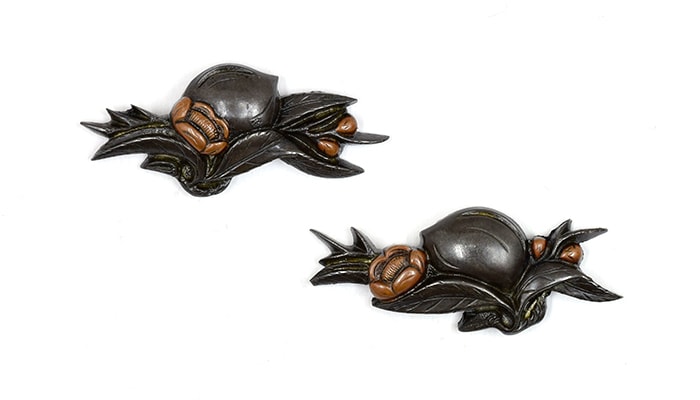
Menuki - by Iwamoto School - Peach Design Menuki by IwamotoMenuki - by Iwamoto School - Peach Design Menuki by Iwamoto

Menuki

ByIwamoto School
¥49,500
Nihonto Australia
Tsuba - by Iwamoto Kanri - Iwamoto Kanri Dragon Tsuba with NTHK CertificateTsuba - by Iwamoto Kanri - Iwamoto Kanri Dragon Tsuba with NTHK Certificate

Tsuba

ByIwamoto Kanri
Ask

More from the Yokoya school

View all →
Nihontocraft
Jūyō
Fuchi-Kashira - Jūyō - by Omori Teruhide - Omori Eishu (Teruhide)Fuchi-Kashira - Jūyō - by Omori Teruhide - Omori Eishu (Teruhide)

Fuchi-Kashira

ByOmori Teruhide
¥55,000
Ginza Seikodo
Tokuho
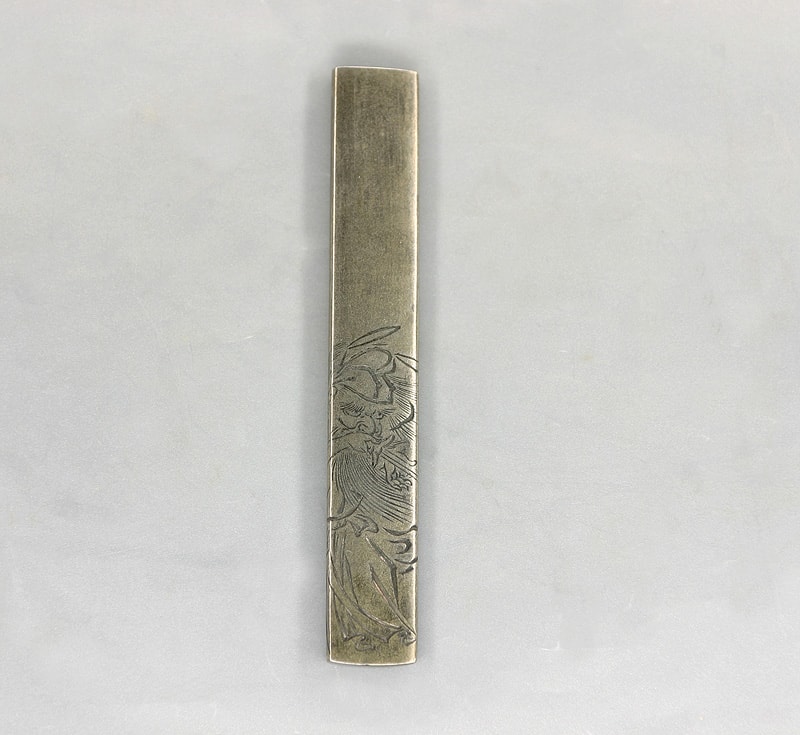
Kozuka - Tokuho - by Yokoya Somin - Somin - Depiction of Shoki (Zhong Kui)Kozuka - Tokuho - by Yokoya Somin - Somin - Depiction of Shoki (Zhong Kui)

Kozuka

ByYokoya Somin
¥1,500,000
Yamasiroya
Hozon
Fuchi-Kashira - Hozon - by Kikuoka Mitsumasa - Fuchi-Kashira: Unryu Zu, Signed RinsendoFuchi-Kashira - Hozon - by Kikuoka Mitsumasa - Fuchi-Kashira: Unryu Zu, Signed Rinsendo

Fuchi-Kashira

ByKikuoka Mitsumasa
¥140,000
Wakeidou
Hozon
Fuchi-Kashira - Hozon - by Omori Hidetoshi - Fuchi-Kashira: Hidetoshi (Kao) - Sunrise Sailboat DesignFuchi-Kashira - Hozon - by Omori Hidetoshi - Fuchi-Kashira: Hidetoshi (Kao) - Sunrise Sailboat Design

Fuchi-Kashira

ByOmori Hidetoshi
¥450,000
Nihontocraft
Jūyō
Mitokoromono - Jūyō - by Ishiguro Koretsune - Ishiguro Koretsune: The 28th Juyo TosoguMitokoromono - Jūyō - by Ishiguro Koretsune - Ishiguro Koretsune: The 28th Juyo Tosogu

Mitokoromono

ByIshiguro Koretsune
¥56,000
Choshuya
Tokuho
Kozuka - Tokuho - by Kikuoka Mitsumasa - Crawling Dragon Design, Signed Kikuoka Mitsumasa (with Kao)Kozuka - Tokuho - by Kikuoka Mitsumasa - Crawling Dragon Design, Signed Kikuoka Mitsumasa (with Kao)

Kozuka

ByKikuoka Mitsumasa
¥400,000
Ginza Seikodo
Jūyō
Menuki - Jūyō - by Omori Chizuka Hisanori - Split Tanzaku Signature Hisanori (kao) Hen and Chicks MotifMenuki - Jūyō - by Omori Chizuka Hisanori - Split Tanzaku Signature Hisanori (kao) Hen and Chicks Motif

Menuki

ByOmori Chizuka Hisanori
Ask
World Seiyudo
Hozon
Tsuba - Hozon - by Yanagawa Haruaki - Haruaki-hogan Kobumboku-zu-TsubaTsuba - Hozon - by Yanagawa Haruaki - Haruaki-hogan Kobumboku-zu-Tsuba

Tsuba

ByYanagawa Haruaki
¥2,500,000

More from the Machibori tradition

View all →
Wakeidou
Tokuho
Tsuba - Tokuho - by Otsuki Tokuoki - TokuokiTsuba - Tokuho - by Otsuki Tokuoki - Tokuoki

Tsuba

ByOtsuki Tokuoki
¥700,000
Connoisseur Arms
Jūyō
Tsuba - Jūyō - by Hamano Sekibun - Masterpiece Tsuba by Yurakusai SekibunTsuba - Jūyō - by Hamano Sekibun - Masterpiece Tsuba by Yurakusai Sekibun

Tsuba

ByHamano Sekibun
Ask
Samurai Nippon
Tokuho
Tsuba - Tokuho - by Hamano School - Kashorin ZuTsuba - Tokuho - by Hamano School - Kashorin Zu

Tsuba

ByHamano School
¥820,000
Touken Matsumoto
Hozon
Fuchi-Kashira - Hozon - by Nara Munetoshi - Fuchi Kashira: Waterside Village SceneFuchi-Kashira - Hozon - by Nara Munetoshi - Fuchi Kashira: Waterside Village Scene

Fuchi-Kashira

ByNara Munetoshi
¥75,000
Aoi Art
Tokubetsu Kichō
Tsuba - Tokubetsu Kichō - by Nara School - Unsigned (Ko-Nara) - Kinko Sennin DesignTsuba - Tokubetsu Kichō - by Nara School - Unsigned (Ko-Nara) - Kinko Sennin Design

Tsuba

ByNara School
Starting Bid¥350,000
Nihonto Art
Tokuho
Tsuba - Tokuho - by Mito School - Edo Mito Unsigned Willow and Waterfowl - NBTHK Tokubetsu HozonTsuba - Tokuho - by Mito School - Edo Mito Unsigned Willow and Waterfowl - NBTHK Tokubetsu Hozon

Tsuba

ByMito School
¥2,250
Samurai Nippon
Tokubetsu Kichō
Kozuka - Tokubetsu Kichō - by Otsuki Mitsuhiro - Wave and Plover DesignKozuka - Tokubetsu Kichō - by Otsuki Mitsuhiro - Wave and Plover Design

Kozuka

ByOtsuki Mitsuhiro
¥85,000
Choshuya
Tokuho
Kozuka - Tokuho - by Hamano Sekibun - Kozuka with Hagoromo Design, Signed Yurakusai Sekibun (with Kao)Kozuka - Tokuho - by Hamano Sekibun - Kozuka with Hagoromo Design, Signed Yurakusai Sekibun (with Kao)

Kozuka

ByHamano Sekibun
Ask

Swords

  • Katana
  • Wakizashi
  • Tantō
  • Tachi
  • Naginata
  • Yari

Fittings

  • Tsuba
  • Fuchi-Kashira
  • Kozuka
  • Menuki

Armor

  • Kabuto
  • Samurai Armor

By Certification

  • Tokujū
  • Jūyō
  • Tokuho
  • Hozon

Resources

  • Dealer Directory
  • Artist Directory
  • The Daily Kantei
  • Glossary
  • Browse All
Nihontowatch© 2026
TermsPrivacyCookiesAbout

Description

This is an extremely rare set of Daisho Tsuba by Iwamoto Konju, a chosen student of the famous Edo Master Iwamoto Konkan. Certified as Juyo Tosogu by the NBTHK, these tsuba depict tigers in a bamboo grove, symbolizing strength, courage, and resilience. The intricate carvings and use of various inlay techniques showcase the artist's exceptional skill and attention to detail.

NBTHK Setsumei

Jūyō-Tōsōgu, 51st Session — Designated October 13, 2005 Daishō tsuba, mei: Iwamoto Konju (岩本昆寿) Measurements - Dai (large): height 7.45 cm; width 7.12 cm; rim thickness 0.36 cm - Shō (small): height 7.14 cm; width 6.79 cm; rim thickness 0.36 cm Description Form: tate-maru-gata (vertical oval) Material: shakudō; migaki-ji with areas of nanako-ji Construction: — Design: tiger in a bamboo grove (take ni tora zu) Decoration: sukidashi-bori, sukishita-bori, and suemon in combination; zōgan and polychrome inlay (iroe) in gold, silver, and shibuichi Rim: kaku-mimi, ko-niku Hitsu-ana: two openings; on the dai both are fitted with gold plugs Signature: “Iwamoto Konju” with kaō Artisan Iwamoto Konju. He lived at Kōjimachi in Edo and was active as a pupil of the renowned master Konkan. His manner resembles Konkan’s: the chisel lines are taut and controlled, and his approach to iroe frequently employs inlay-based methods. Era Mid-Edo period. Explanation This is a daishō pair of tsuba depicting a tiger in a bamboo grove, executed on a shakudō ground through the combined use of sukidashi-bori, sukishita-bori, and suemon. The bamboo grove continues from the front to the reverse; on the reverse, bamboo is arranged densely, without leaving gaps. By rendering the central stalk thick while depicting those to left and right more slender, the artist creates spatial recession and convincingly conveys the depth of a luxuriant, thickly grown bamboo thicket. The carefully controlled chiselwork fully demonstrates the maker’s high technical level. In both design conception and carving execution, the piece shows a notably high degree of completion, and stands as an excellent work among Konju’s productions.

NihontoWatch MonNihontoWatch
MarketEncyclopediaKantei
Fittings›Machibori›Yokoya›Iwamoto›Konju›Iwamoto Konju Juyo Daisho Tsuba Masterpiece
tsubaJūyō
Iwamoto Konju

Iwamoto Konju Juyo Daisho Tsuba Masterpiece

mei · Edo

Price on request
Visit seller website →
Iwamoto Konju — 1 of 9
Iwamoto Konju — 2 of 9
Iwamoto Konju — 3 of 9
Iwamoto Konju — 4 of 9
Iwamoto Konju — 5 of 9
Iwamoto Konju — 6 of 9
Iwamoto Konju — 7 of 9
Iwamoto Konju — 8 of 9
Iwamoto Konju — 9 of 9
1 / 9
1 / 9
Iwamoto Konju — 1 of 9Iwamoto Konju — 2 of 9Iwamoto Konju — 3 of 9Iwamoto Konju — 4 of 9Iwamoto Konju — 5 of 9Iwamoto Konju — 6 of 9Iwamoto Konju — 7 of 9Iwamoto Konju — 8 of 9Iwamoto Konju — 9 of 9
Measurements & details
Maker

Iwamoto Konju

Era

Edo

Signature

Signed

Papers

Jūyō #51 (NBTHK)

Description

This is an extremely rare set of Daisho Tsuba by Iwamoto Konju, a chosen student of the famous Edo Master Iwamoto Konkan. Certified as Juyo Tosogu by the NBTHK, these tsuba depict tigers in a bamboo grove, symbolizing strength, courage, and resilience. The intricate carvings and use of various inlay techniques showcase the artist's exceptional skill and attention to detail.

NBTHK Zufu Commentary

Juyo #51

AI translation — may contain errors

-Tōsōgu, 51st Session — Designated October 13, 2005

, : Iwamoto Konju (岩本昆寿)

Measurements

  • Dai (large): height 7.45 cm; width 7.12 cm; rim thickness 0.36 cm
  • Shō (small): height 7.14 cm; width 6.79 cm; rim thickness 0.36 cm

Description Form: (vertical oval) Material: ; with areas of Construction: — Design: tiger in a bamboo grove (take ni tora zu) Decoration: , sukishita-bori, and in combination; and polychrome inlay () in gold, silver, and Rim: , : two openings; on the dai both are fitted with gold plugs Signature: “Iwamoto Konju” with

Artisan Iwamoto Konju. He lived at Kōjimachi in and was active as a pupil of the renowned master Konkan. His manner resembles Konkan’s: the chisel lines are taut and controlled, and his approach to frequently employs inlay-based methods.

Era Mid- period.

Explanation This is a pair of depicting a tiger in a bamboo grove, executed on a ground through the combined use of , sukishita-bori, and . The bamboo grove continues from the front to the reverse; on the reverse, bamboo is arranged densely, without leaving gaps. By rendering the central stalk thick while depicting those to left and right more slender, the artist creates spatial recession and convincingly conveys the depth of a luxuriant, thickly grown bamboo thicket.

The carefully controlled chiselwork fully demonstrates the maker’s high technical level. In both design conception and carving execution, the piece shows a notably high degree of completion, and stands as an excellent work among Konju’s productions.

About the maker

Konju

昆寿

Machibori · Musashi · around 1670

1 piece on the market now

›

Historical importance

Where Konju stands among comparable artisans: across all of nihontō, and within tradition, era, and period. The tiers (Foremost · Leading · Major · Notable) weigh official designations from the NBTHK and Japan's Agency for Cultural Affairs, together with historical honors of lasting repute such as the Sansaku and Meibutsu-chō.

随一
Foremost
屈指
Leading
有数
Major
著名
Notable

Select a lens to see how it's measured.

Designation record
2 designated works
Jūyō
2
1 work by Konju on the market→
Konju — full profileMachibori school
About the school

Iwamoto

岩本

Machibori · Edo

11 pieces on the market now

›

The Iwamoto school was a house of Edo machibori (町彫) metalworkers, founded in the early eighteenth century by Iwamoto Chūbei, a pupil of the Yokoya school, and continuing through eight generations of headmasters. As the NBTHK setsumei state repeatedly, "the Iwamoto line was originally of the Yokoya tradition," and the school's history turns on a succession crisis within that lineage: when the fifth-generation master Ryōkan died young, his junior fellow-disciple succeeded as sixth head of the Iwamoto house. This was Iwamoto Konkan, born in Edo in Enkyō 1 (1744), whose original family name was Asai and who first used the name Ryō (also read Ryōun) before changing it to Konkan. " He also signed with the art names Shunshōdō (春曙堂) and Hakuhōtei (白峯亭). The line continued through Iwamoto Kanri, common name Kijūrō, who first studied under Konkan, was later adopted by him, and succeeded as seventh head; the school's orbit also included the pupil Konju, who lived at Kōjimachi in Edo. The school's collective style rests on this synthesis of Yokoya sculptural discipline and Nara-school carving methods. Its preferred vocabulary is shakudō (赤銅) with nanako-ji (魚子地) ground, worked in takabori (高彫) high relief with suemon-zōgan (据紋象嵌) and polychrome iroe (色絵) in gold, silver, shibuichi (四分一), and suaka (素銅) copper; but the setsumei attest an unusually broad range of grounds — shibuichi and iron in polished migaki-ji (磨地), chirimen-ishime-ji[[c:1]], brass ishime-ji, and gold — together with sukidashi-bori (鋤出彫), sukishita-bori, relief-carved openwork, fine kebori (毛彫), and inlaid aogai (青貝) mother-of-pearl, set even into the eyes of fish.

The distinctive triangular chisel (sankaku-tagane 三角鏨) recurs as a house hallmark, as does a masterful command of negative space and calculated composition, with obverse and reverse conceived in deliberate contrast. Favored subjects are drawn from nature observed with startling fidelity: the uo-zukushi (魚尽) arrays of fish "rendered with such precision that one feels each individual species could be identified," each scale and backbone carved line by line; herons among reeds; pheasants under a hazy moon; carp gliding through waterweed; alongside shishi, orchids, chrysanthemums, dragons, landscape narratives such as cormorant fishing and the Chōfu Tamagawa, and even Buddhist imagery of Dainichi Nyorai and Niō. The setsumei judge Konkan to have "ranked among the foremost artists of the naturalistic, sketch-from-life approach," while a fully matched aoi-crest mounting shows the school equally capable of orthodox, formal commissioned work. The Iwamoto school's place in the tosogu canon rests above all on Konkan, counted among the leading Edo metalworkers and habitually praised in the setsumei with the phrase "Edomae no iki" — the quintessential stylishness of Edo; his fame is further reflected in the extensive forgery of his signature. Works transmitted in the Tsugaru and Sakai daimyō families attest the esteem his oeuvre commanded. The tradition did not end with him: Kanri "followed his teacher's manner closely and, after Konkan, produced a number of powerful works," while Konju's carving, "taut and controlled" in the master's likeness, carried the inlay-centered iroe methods forward. Wide-ranging in subject and prolific in output, the school stands as one of the defining expressions of late-Edo machibori art — a lineage in which the strengths of the Yokoya and Nara traditions were fused into a single, unmistakably urbane style. Learn more →
3 recorded smiths57 designated works
Leading smiths
SmithEraDesignated
Konkan昆寛—51
Kanri寛利16703
Masakatsu政克 (Masamoto—0
Soei宗栄—0
Ikkan一寛—0
Explore the Iwamoto school →
NBTHK Certificate
Jūyō Tōsōgu重要刀装具
Important Fitting
›

Exceptional craft of very high artistic value, judged to rank with a nationally recognized Important Art Object (Jūyō Bijutsuhin).

About the NBTHK›

The NBTHK (Nihon Bijutsu Tōken Hozon Kyōkai, the Society for the Preservation of Japanese Art Swords) is a public-interest incorporated foundation founded in 1948 and supervised by Japan’s Agency for Cultural Affairs (Bunkachō); it is based at the Japanese Sword Museum in Tokyo. Its expert panels physically examine each submitted work (shinsa) and issue a certificate (kanteishō) ranking it by artistic and historical merit. NBTHK papers are the most widely recognized standard of authentication for Japanese swords and fittings.

NBTHK official site→
Seller
C
Connoisseur Arms
🇳🇿Ships from New Zealand
›
✓Verified dealerconnoisseurarms.com
✓Ships worldwide✓English supportWire transfer
Return policy

Purchases are final and items cannot be returned unless otherwise stated.

View all of Connoisseur Arms’s listings→View this item on the dealer’s site→

Previously sold by Iwamoto Konju

Choshuya
Tokuho
Kozuka - Tokuho - by Iwamoto Konju - Hawk and Monkey Design Futatokoro: Kozuka and Kogai Signed Iwamoto Konju with KakihanKozuka - Tokuho - by Iwamoto Konju - Hawk and Monkey Design Futatokoro: Kozuka and Kogai Signed Iwamoto Konju with Kakihan
Sold

Kozuka

ByIwamoto Konju
SOLD
Choshuya
Hozon
Fuchi-Kashira - Hozon - by Iwamoto Konju - Fuchigashira: Takasago Design, Signed Konju with KaoFuchi-Kashira - Hozon - by Iwamoto Konju - Fuchigashira: Takasago Design, Signed Konju with Kao
Sold

Fuchi-Kashira

ByIwamoto Konju
SOLD
Choshuya
Tokuho
Kozuka - Tokuho - by Iwamoto Konju - Futatokoro (Kozuka and Kogai): Fierce Bird Catching Monkey Design, Signed Iwamoto Konkan with KaoKozuka - Tokuho - by Iwamoto Konju - Futatokoro (Kozuka and Kogai): Fierce Bird Catching Monkey Design, Signed Iwamoto Konkan with Kao
Sold

Kozuka

ByIwamoto Konju
SOLD

More from the Iwamoto school

View all →
Aoi Art
Jūyō
Fuchi-Kashira - Jūyō - by Iwamoto Konkan - Fuchikashira: Iwamoto KonkanFuchi-Kashira - Jūyō - by Iwamoto Konkan - Fuchikashira: Iwamoto Konkan

Fuchi-Kashira

ByIwamoto Konkan
¥2,500,000
Tetsugendo
Tokuho
Menuki - Tokuho - by Iwamoto Kanri - Signed Iwamoto Kanri - NBTHK Tokubetsu Hozon (1700s)Menuki - Tokuho - by Iwamoto Kanri - Signed Iwamoto Kanri - NBTHK Tokubetsu Hozon (1700s)

Menuki

ByIwamoto Kanri
¥2,500
Ginza Seikodo
Tokuho
Kozuka - Tokuho - by Iwamoto Konkan - Iwamoto Konkan (kao) - Pot Hanger MotifKozuka - Tokuho - by Iwamoto Konkan - Iwamoto Konkan (kao) - Pot Hanger Motif

Kozuka

ByIwamoto Konkan
¥1,500,000
Soryu
Tokuho
Kozuka - Tokuho - by Iwamoto School - Iwamoto Masashige - Dragon ThemeKozuka - Tokuho - by Iwamoto School - Iwamoto Masashige - Dragon Theme

Kozuka

ByIwamoto School
¥1,300
Connoisseur Arms
Hozon
Kozuka - Hozon - by Iwamoto School - Kozuka with Eel Design by Iwamoto SchoolKozuka - Hozon - by Iwamoto School - Kozuka with Eel Design by Iwamoto School

Kozuka

ByIwamoto School
Ask
Toushin
Fuchi-Kashira - by Iwamoto Ikkan - Fuchi-Kashira: Ikkan (Kaou)Fuchi-Kashira - by Iwamoto Ikkan - Fuchi-Kashira: Ikkan (Kaou)

Fuchi-Kashira

ByIwamoto Ikkan
¥22,000
Toushin
Menuki - by Iwamoto School - Peach Design Menuki by IwamotoMenuki - by Iwamoto School - Peach Design Menuki by Iwamoto

Menuki

ByIwamoto School
¥49,500
Nihonto Australia
Tsuba - by Iwamoto Kanri - Iwamoto Kanri Dragon Tsuba with NTHK CertificateTsuba - by Iwamoto Kanri - Iwamoto Kanri Dragon Tsuba with NTHK Certificate

Tsuba

ByIwamoto Kanri
Ask

More from the Yokoya school

View all →
Nihontocraft
Jūyō
Fuchi-Kashira - Jūyō - by Omori Teruhide - Omori Eishu (Teruhide)Fuchi-Kashira - Jūyō - by Omori Teruhide - Omori Eishu (Teruhide)

Fuchi-Kashira

ByOmori Teruhide
¥55,000
Ginza Seikodo
Tokuho
Kozuka - Tokuho - by Yokoya Somin - Somin - Depiction of Shoki (Zhong Kui)Kozuka - Tokuho - by Yokoya Somin - Somin - Depiction of Shoki (Zhong Kui)

Kozuka

ByYokoya Somin
¥1,500,000
Yamasiroya
Hozon
Fuchi-Kashira - Hozon - by Kikuoka Mitsumasa - Fuchi-Kashira: Unryu Zu, Signed RinsendoFuchi-Kashira - Hozon - by Kikuoka Mitsumasa - Fuchi-Kashira: Unryu Zu, Signed Rinsendo

Fuchi-Kashira

ByKikuoka Mitsumasa
¥140,000
Wakeidou
Hozon
Fuchi-Kashira - Hozon - by Omori Hidetoshi - Fuchi-Kashira: Hidetoshi (Kao) - Sunrise Sailboat DesignFuchi-Kashira - Hozon - by Omori Hidetoshi - Fuchi-Kashira: Hidetoshi (Kao) - Sunrise Sailboat Design

Fuchi-Kashira

ByOmori Hidetoshi
¥450,000
Nihontocraft
Jūyō
Mitokoromono - Jūyō - by Ishiguro Koretsune - Ishiguro Koretsune: The 28th Juyo TosoguMitokoromono - Jūyō - by Ishiguro Koretsune - Ishiguro Koretsune: The 28th Juyo Tosogu

Mitokoromono

ByIshiguro Koretsune
¥56,000
Choshuya
Tokuho
Kozuka - Tokuho - by Kikuoka Mitsumasa - Crawling Dragon Design, Signed Kikuoka Mitsumasa (with Kao)Kozuka - Tokuho - by Kikuoka Mitsumasa - Crawling Dragon Design, Signed Kikuoka Mitsumasa (with Kao)

Kozuka

ByKikuoka Mitsumasa
¥400,000
Ginza Seikodo
Jūyō
Menuki - Jūyō - by Omori Chizuka Hisanori - Split Tanzaku Signature Hisanori (kao) Hen and Chicks MotifMenuki - Jūyō - by Omori Chizuka Hisanori - Split Tanzaku Signature Hisanori (kao) Hen and Chicks Motif

Menuki

ByOmori Chizuka Hisanori
Ask
World Seiyudo
Hozon
Tsuba - Hozon - by Yanagawa Haruaki - Haruaki-hogan Kobumboku-zu-TsubaTsuba - Hozon - by Yanagawa Haruaki - Haruaki-hogan Kobumboku-zu-Tsuba

Tsuba

ByYanagawa Haruaki
¥2,500,000

More from the Machibori tradition

View all →
Wakeidou
Tokuho
Tsuba - Tokuho - by Otsuki Tokuoki - TokuokiTsuba - Tokuho - by Otsuki Tokuoki - Tokuoki

Tsuba

ByOtsuki Tokuoki
¥700,000
Connoisseur Arms
Jūyō
Tsuba - Jūyō - by Hamano Sekibun - Masterpiece Tsuba by Yurakusai SekibunTsuba - Jūyō - by Hamano Sekibun - Masterpiece Tsuba by Yurakusai Sekibun

Tsuba

ByHamano Sekibun
Ask
Samurai Nippon
Tokuho
Tsuba - Tokuho - by Hamano School - Kashorin ZuTsuba - Tokuho - by Hamano School - Kashorin Zu

Tsuba

ByHamano School
¥820,000
Touken Matsumoto
Hozon
Fuchi-Kashira - Hozon - by Nara Munetoshi - Fuchi Kashira: Waterside Village SceneFuchi-Kashira - Hozon - by Nara Munetoshi - Fuchi Kashira: Waterside Village Scene

Fuchi-Kashira

ByNara Munetoshi
¥75,000
Aoi Art
Tokubetsu Kichō
Tsuba - Tokubetsu Kichō - by Nara School - Unsigned (Ko-Nara) - Kinko Sennin DesignTsuba - Tokubetsu Kichō - by Nara School - Unsigned (Ko-Nara) - Kinko Sennin Design

Tsuba

ByNara School
Starting Bid¥350,000
Nihonto Art
Tokuho
Tsuba - Tokuho - by Mito School - Edo Mito Unsigned Willow and Waterfowl - NBTHK Tokubetsu HozonTsuba - Tokuho - by Mito School - Edo Mito Unsigned Willow and Waterfowl - NBTHK Tokubetsu Hozon

Tsuba

ByMito School
¥2,250
Samurai Nippon
Tokubetsu Kichō
Kozuka - Tokubetsu Kichō - by Otsuki Mitsuhiro - Wave and Plover DesignKozuka - Tokubetsu Kichō - by Otsuki Mitsuhiro - Wave and Plover Design

Kozuka

ByOtsuki Mitsuhiro
¥85,000
Choshuya
Tokuho
Kozuka - Tokuho - by Hamano Sekibun - Kozuka with Hagoromo Design, Signed Yurakusai Sekibun (with Kao)Kozuka - Tokuho - by Hamano Sekibun - Kozuka with Hagoromo Design, Signed Yurakusai Sekibun (with Kao)

Kozuka

ByHamano Sekibun
Ask

Swords

  • Katana
  • Wakizashi
  • Tantō
  • Tachi
  • Naginata
  • Yari

Fittings

  • Tsuba
  • Fuchi-Kashira
  • Kozuka
  • Menuki

Armor

  • Kabuto
  • Samurai Armor

By Certification

  • Tokujū
  • Jūyō
  • Tokuho
  • Hozon

Resources

  • Dealer Directory
  • Artist Directory
  • The Daily Kantei
  • Glossary
  • Browse All
Nihontowatch© 2026
TermsPrivacyCookiesAbout
NihontoWatch Mon

NihontoWatch

Market
Encyclopedia
Kantei
NihontoWatch Mon

NihontoWatch

Market
Encyclopedia
Kantei