 NihontoWatchNihontoWatch
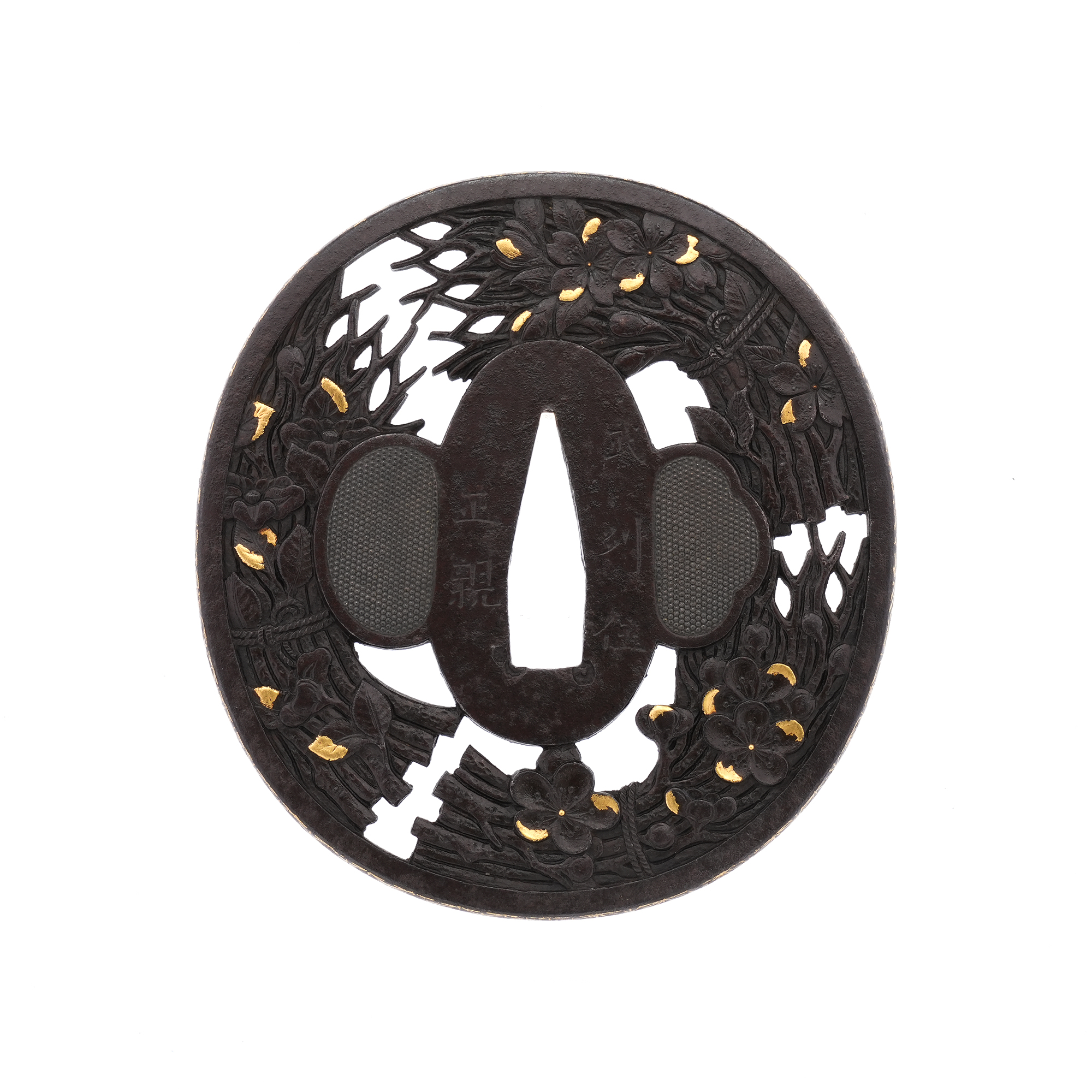
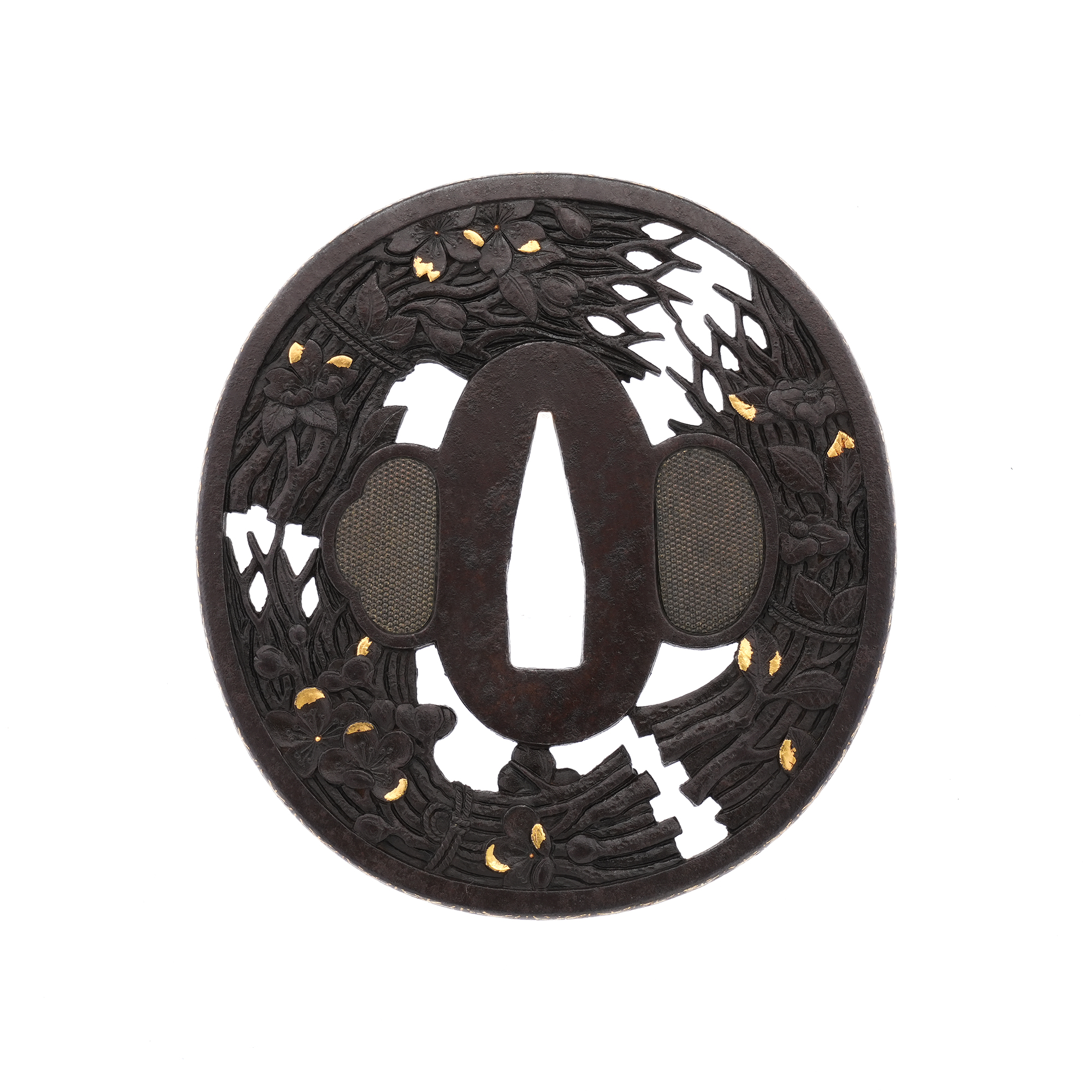
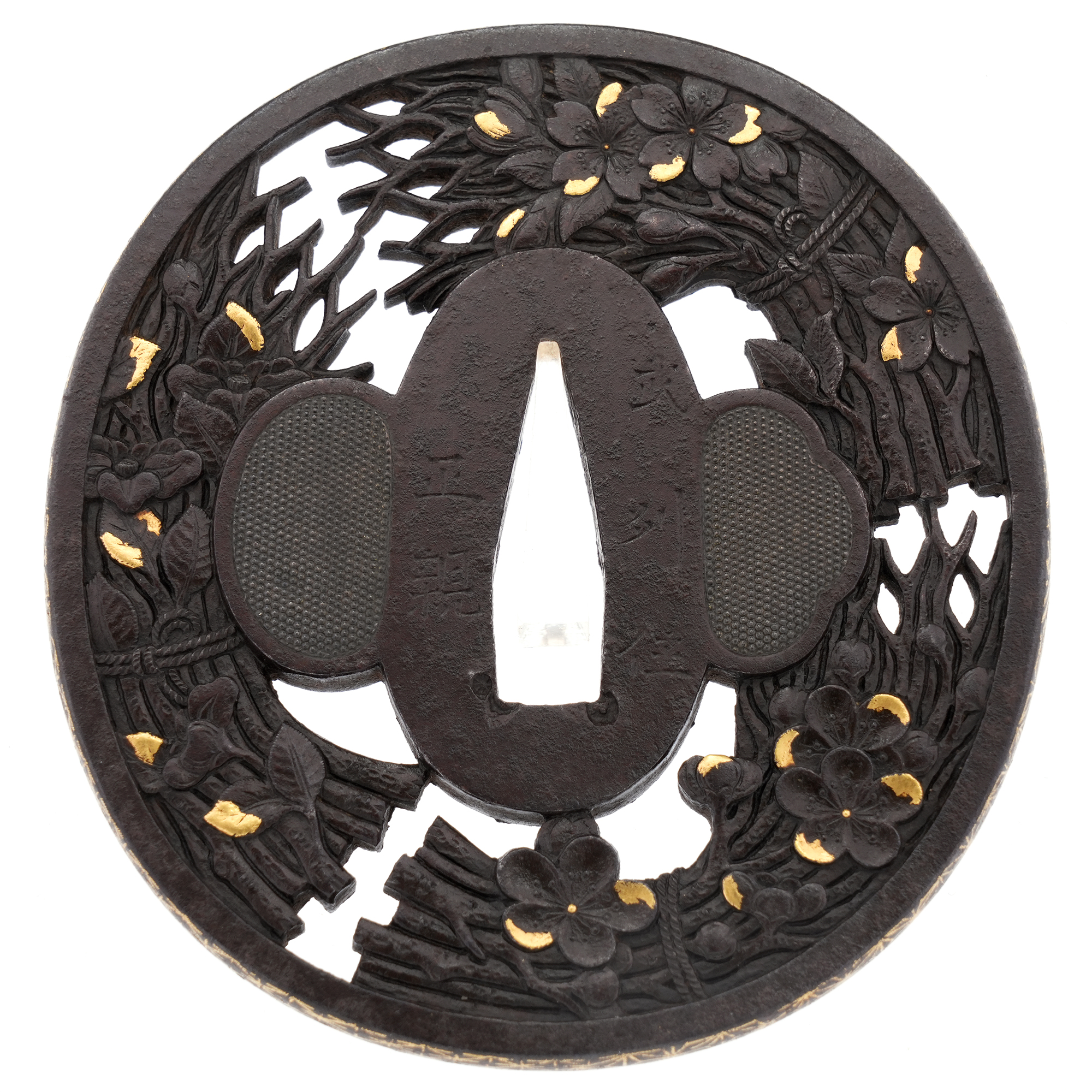
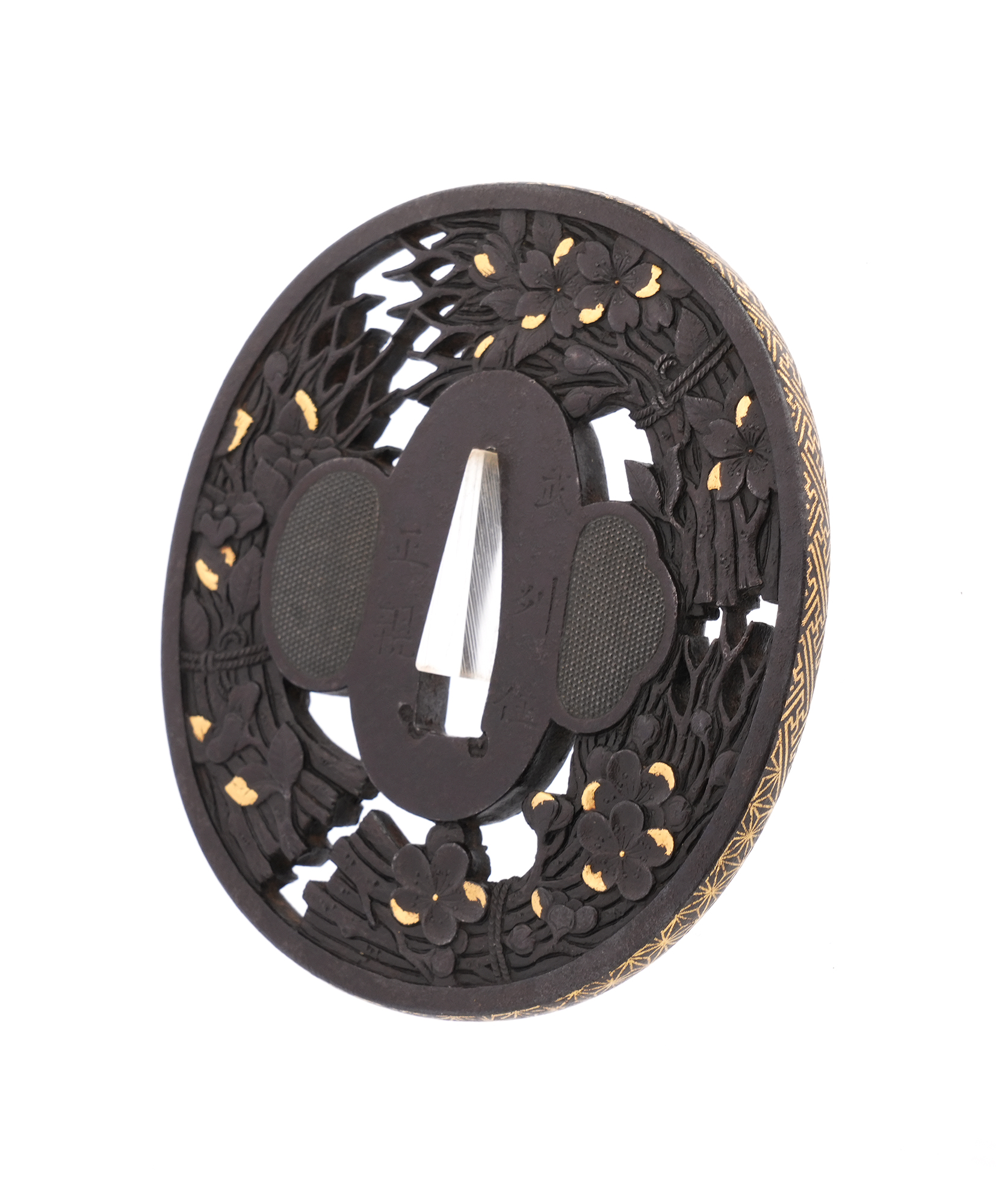
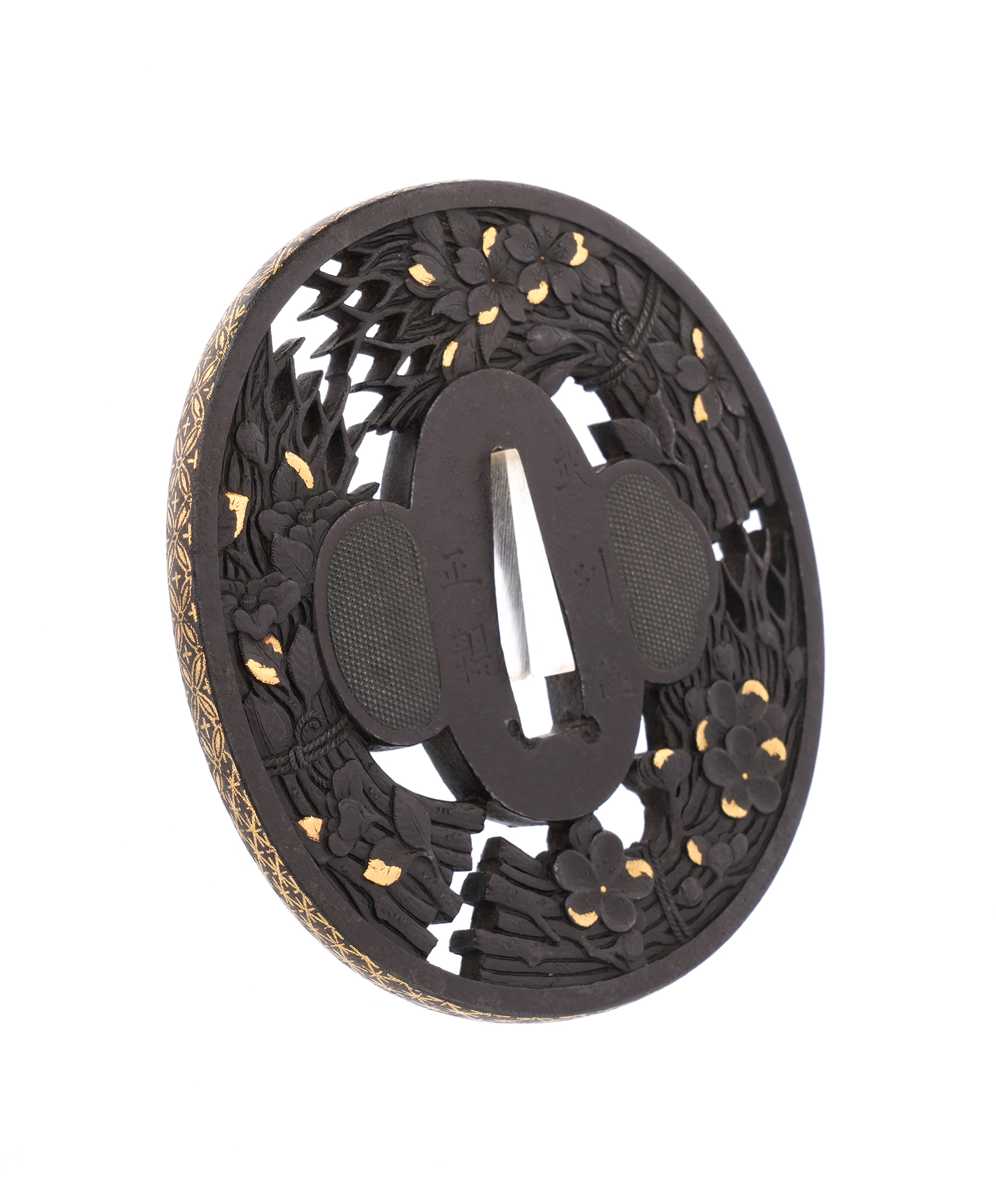
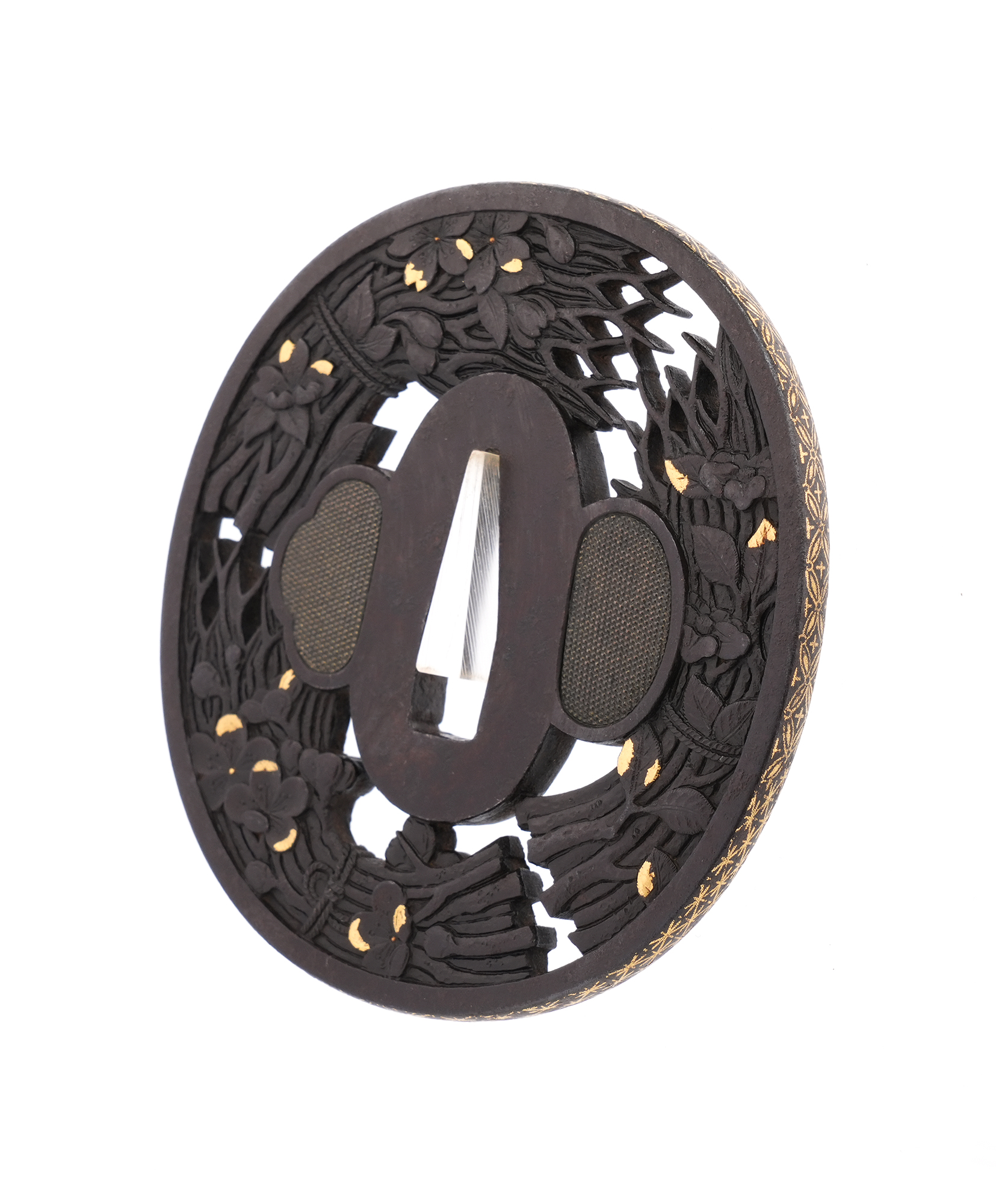
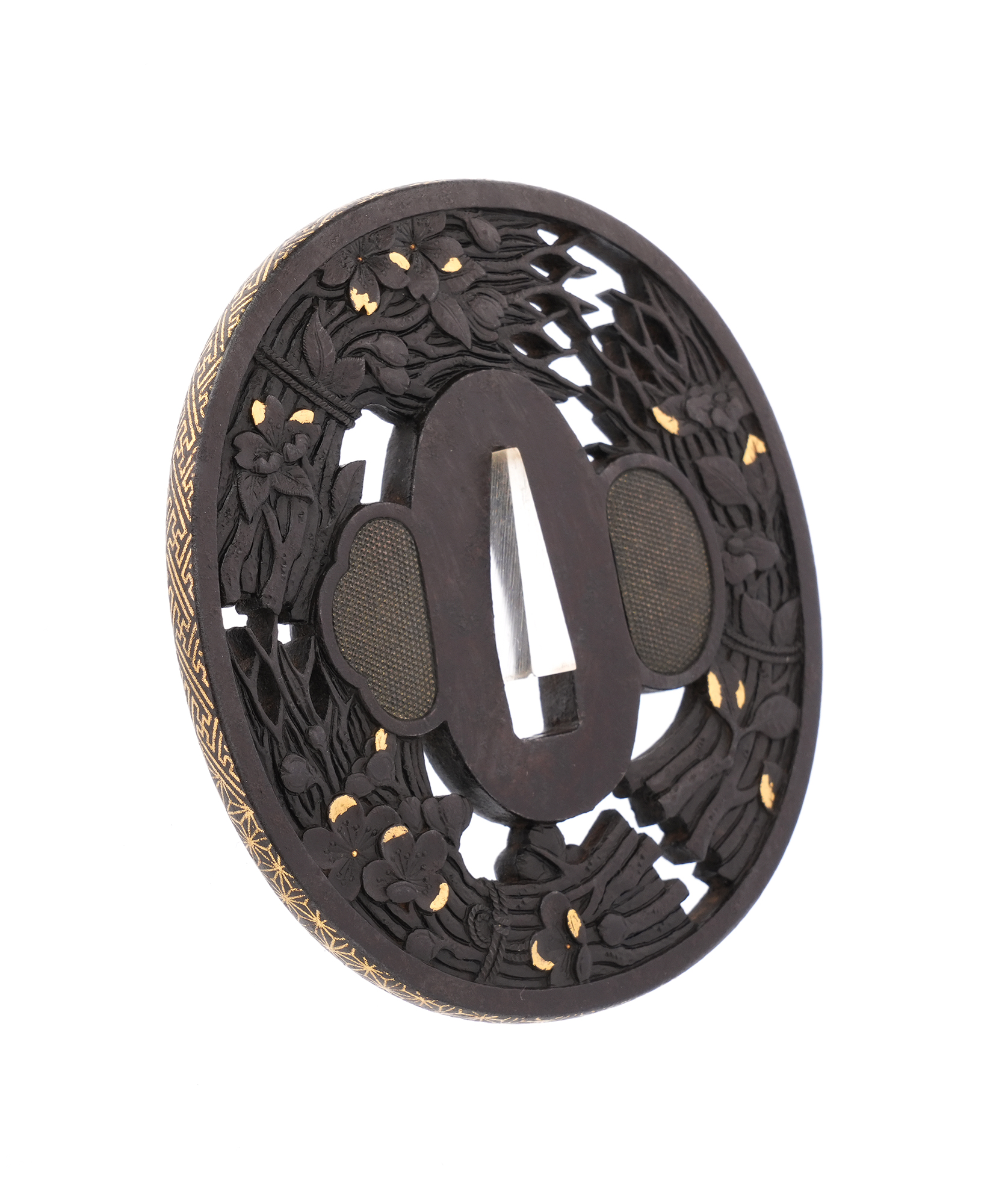
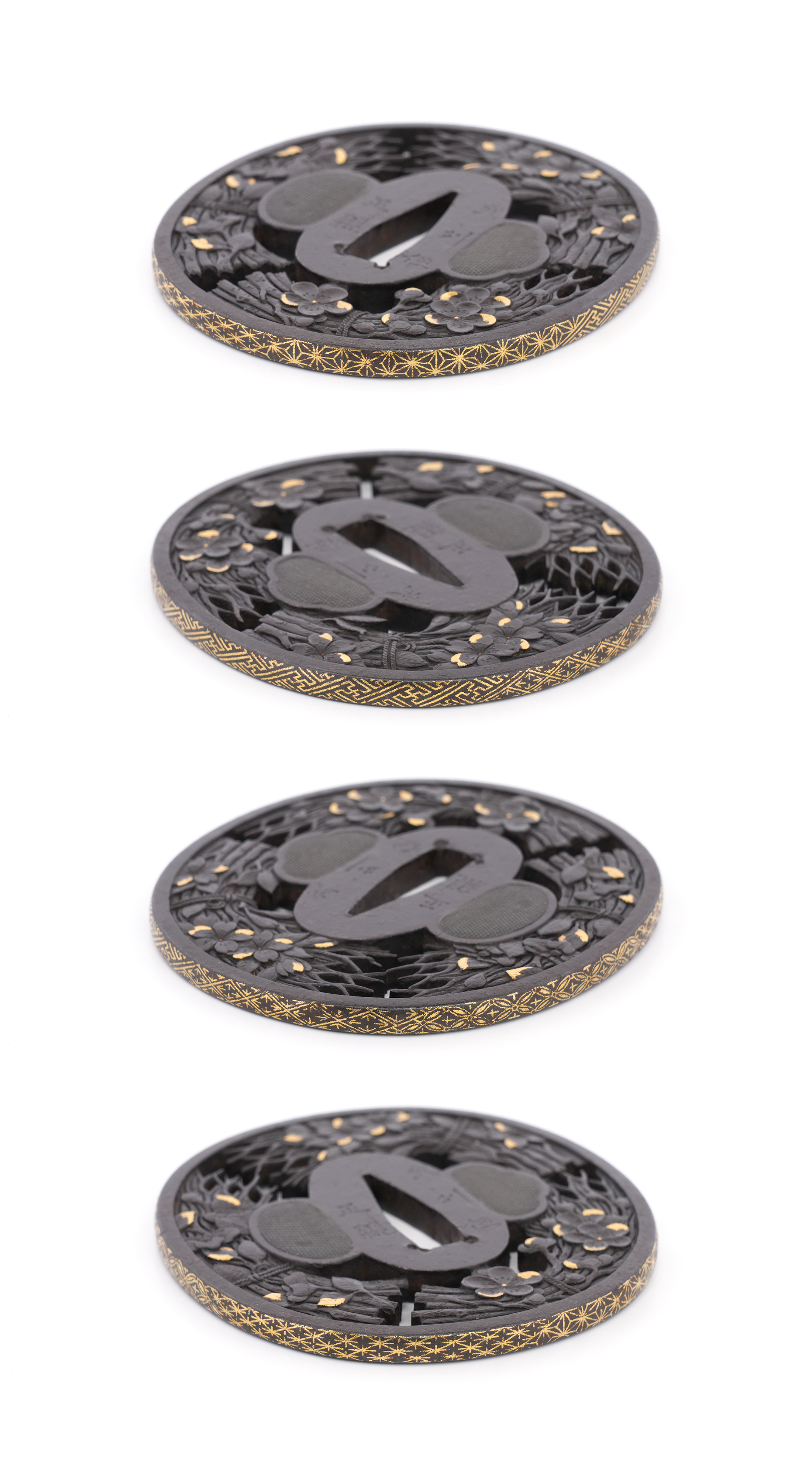
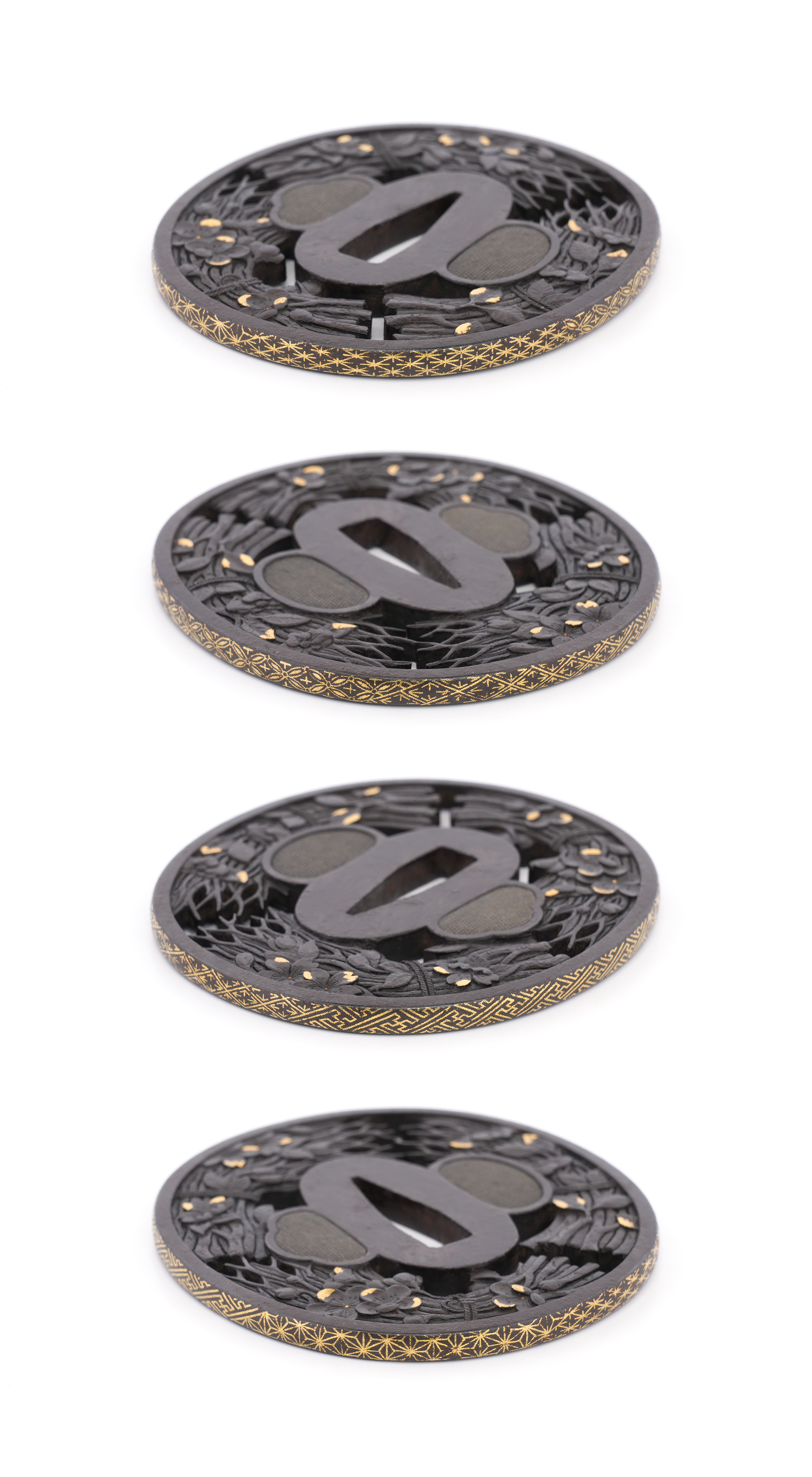
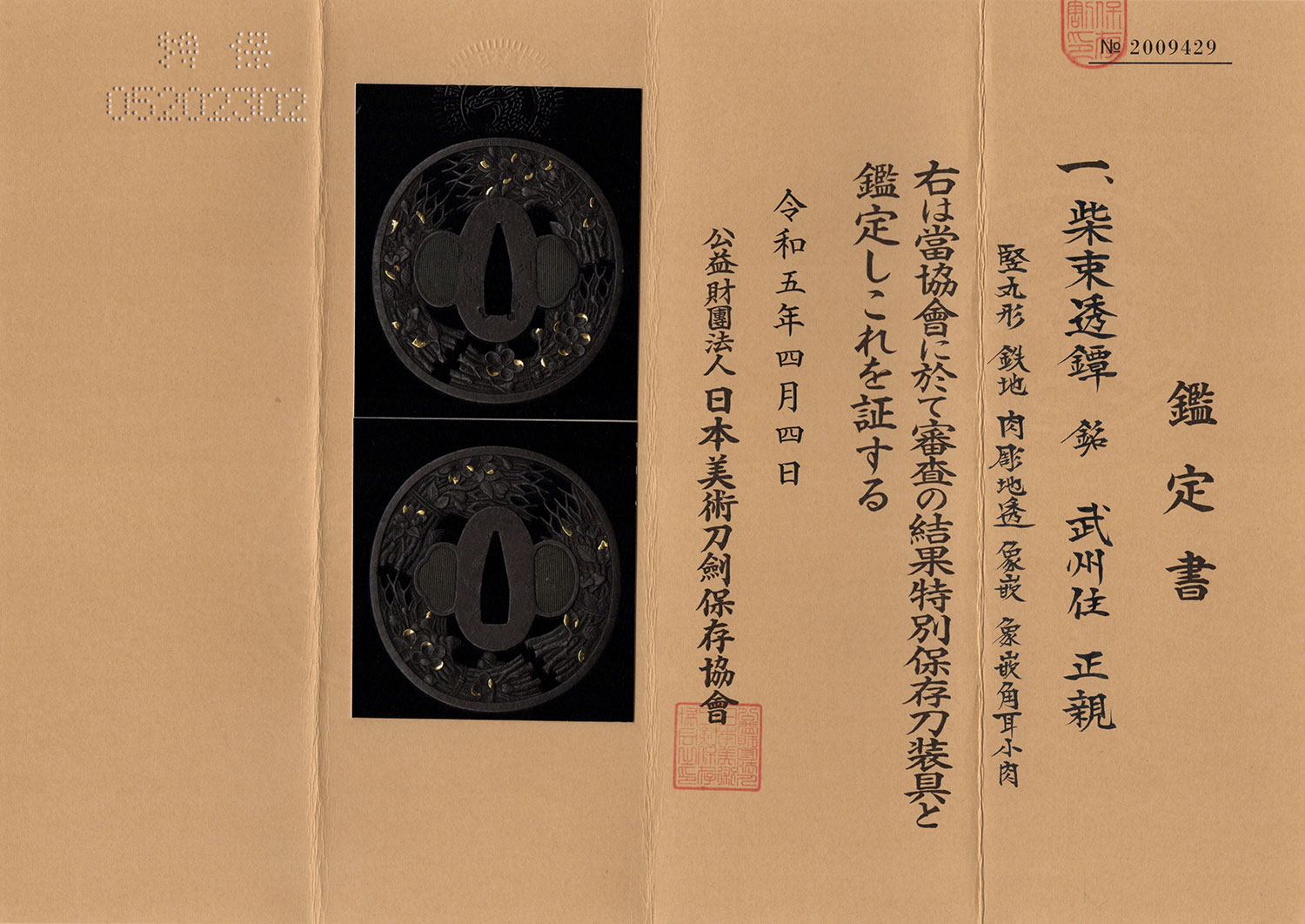
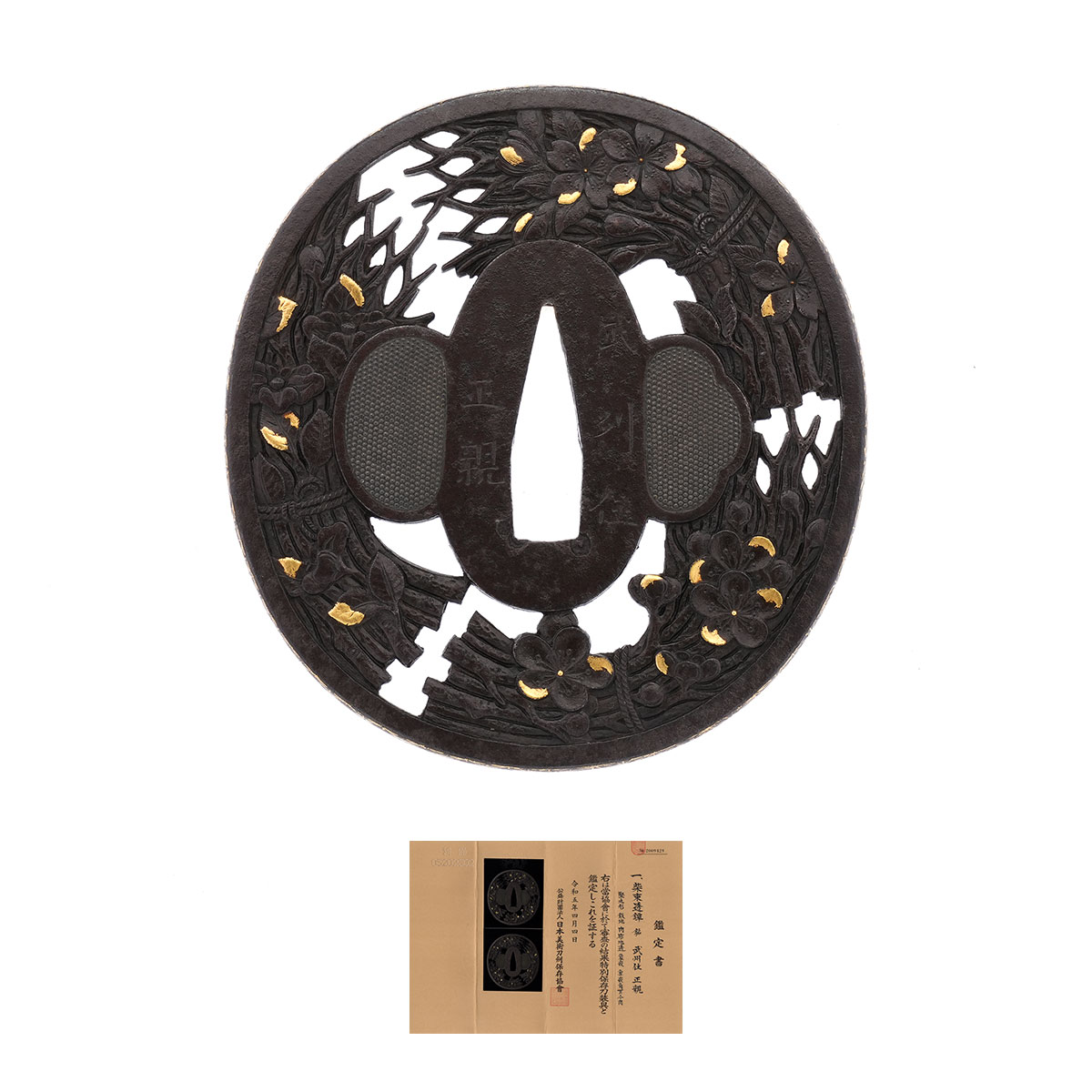
Masachika was a tsubako of the Bushu Ito school who used the surname Kitani, active in Edo during the latter half of the 18th century, and specialized in works with skillfully carved sukashi in tetsu-ji. His works are held in museums both in Japan and abroad, and the precise sukashibori and moderate use of gold seen in this piece reveal the reliable skill and refined design sense associated with the Ito school. Shibataba are bundles of thin brushwood tied tightly together, and because each individual stick is thin but gains strength when bundled, they have been favored as a design evoking unity and prosperity. In this work, cherry blossoms are scattered over shibataba arranged to form a circle, harmonizing the brilliance of spring with the strength preferred by the samurai class within a single composition. On a tate-maru gata tetsu-ji, nikubori ji-sukashi is applied, carving each of the many overlapping sticks of brushwood, the binding ropes, branches, leaves, and cherry blossoms in three dimensions; by opening large and small sukashi gaps between the complex patterns, a light sense of space and depth is given to the heavy tetsu-ji. While the arrangement of the shibataba and cherry blossoms varies between the omote and ura, they are unified in a consistent composition, and the overlapping sukashibori and shadows shift richly whenever the angle is changed. The ryo-hitsu ana contain shakudo umegane with fine nanako-ji, and by scattering kin zogan on the cherry petals and buds, bright light is added to the blackish-brown tetsu-ji. Furthermore, geometric patterns such as asanoha, sayagata, and shippo-mon are applied in kin zogan around the mimi, creating a meticulous finish that withstands appreciation not only from the front but also from the sides. The volume of the precisely bundled brushwood, the lovely cherry blossoms, the clear shadows created by the sukashi, and the brilliance of the gold placed throughout resonate in a well-balanced manner, making this an excellent piece where the carving technique and decorativeness characteristic of the Bushu Ito school can be fully enjoyed; as a reliable example of Masachika's work accompanied by a Tokubetsu Hozon Tosogu Kanteisho, it is a piece worthy of being a centerpiece for appreciation.
NihontoWatchOffered by Toushin

Machine translation of the shop's Japanese ·
Machine translation from the shop's Japanese · may contain errors ·
Iron-tsuba · Musashi
3 pieces on the market now
Iron-tsuba · Musashi
55 pieces on the market now
The Ito school (伊藤派) was a prolific kinkō lineage based in Kanda, Edo, in Musashi province. The line was established by Masanaga (正長, d. 1727), who received appointment as official tsuba maker (kōgi o-kakae tsubashi) to the Tokugawa Shogunate following an audience with Shogun Ienobu in 1710. Successive heads bore the character 正 (Masa-) in their art names, producing ten recorded generations from the Genroku era through the Meiji period. The second-generation master Masatsune (正恒) developed ito-sukashi (糸透かし), the school's signature technique of extremely fine saw-cut openwork. The tenth and final head, Itō Katsumi (伊藤勝見, 1829--1910), originally named Masataka (正隆), entered the school of Tanaka Seiju (田中清寿) at twelve, was adopted into his master's household at seventeen, and received the rank of Hōkyō (法橋) while still young, together with the art name Tōryūsai (東竜斎). After parting ways with Seiju, Katsumi studied maki-e under Shibata Zeshin (柴田是真), and in Man'en 1 (1860) was adopted into the Itō Masahiro family, becoming the tenth-generation head. This dual formation -- kinkō discipline under the Tanaka lineage and lacquer refinement under Zeshin -- profoundly shaped the school's late output.
The Ito school's collective style is characterised by mastery of zōgan (象嵌, inlay) and iroe (色絵, polychrome metalwork) deployed with what the setsumei repeatedly describe as precision and accuracy. Works are executed on plates of iron, shibuichi (四分一), oboro-gin (朧銀), or shakudō (赤銅), frequently with nanako-ji (魚子地) grounds. The technical repertoire encompasses takabori (高彫, high relief), sukidashi takabori (鋤出高彫), katakiribori (片切彫), fine kebori (毛彫, hairline engraving), suemon-zōgan (据文象嵌), and nunome-zōgan (布目象嵌), often combined within a single composition. Masatsune's work employs shippō (七宝, cloisonné enamel) on iron plate, as seen in a unified uchigatana koshirae signed "Bushū-jū Masatsune" whose tsuba, fuchi-kashira, kurikata, and kaerizuno are coordinated as a single aesthetic programme[[c:1]] with raden (螺鈿, mother-of-pearl) and gold uchikomi (打込) work. Katsumi's mature output favours figural and narrative subjects: the Frog Battle after the celebrated Chōjū-giga scrolls attributed to Toba Sōjō, Gama Sennin with his toad beneath a willow, and Daisē Fudō Myōō realised with emphatic devotional presence. "[[c:6]] The Ito school occupies a distinctive place in the tsuba canon as a Musashi-based lineage that sustained high-level production across the entire Edo period. Its works were widely disseminated through the sankin-kōtai system, as samurai from all provinces acquired Ito tsuba during their attendance in Edo. "[[c:7]] That his tsuba depicting the Chōjū-giga Frog Battle is described as a "forceful work from his later years"[[c:5]] whose "composition, which successfully preserves the spirit of the original painting, is outstanding" confirms the school's enduring capacity to unite pictorial invention with metalworking virtuosity. Learn more →
| Smith | Era | Designated |
|---|---|---|
| Katsumi勝見 | — | 4 |
| Sadatsune貞恒 | — | 0 |
| Masayoshi正備 | — | 0 |
| Masatsune正常 | — | 0 |
| Masakane正金 | — | 0 |
A Hozon-certified fitting of notably superior craftsmanship and condition, often with signature or workmanship of high reference value.
The NBTHK (Nihon Bijutsu Tōken Hozon Kyōkai, the Society for the Preservation of Japanese Art Swords) is a public-interest incorporated foundation founded in 1948 and supervised by Japan’s Agency for Cultural Affairs (Bunkachō); it is based at the Japanese Sword Museum in Tokyo. Its expert panels physically examine each submitted work (shinsa) and issue a certificate (kanteishō) ranking it by artistic and historical merit. NBTHK papers are the most widely recognized standard of authentication for Japanese swords and fittings.
NBTHK official siteAs a rule we do not accept returns, except when we have sent a different item from the one ordered or when there is a significant discrepancy between the description and the item. If you wish to return an item, please contact us within 3 days of its arrival and then send it back.
¥770,000