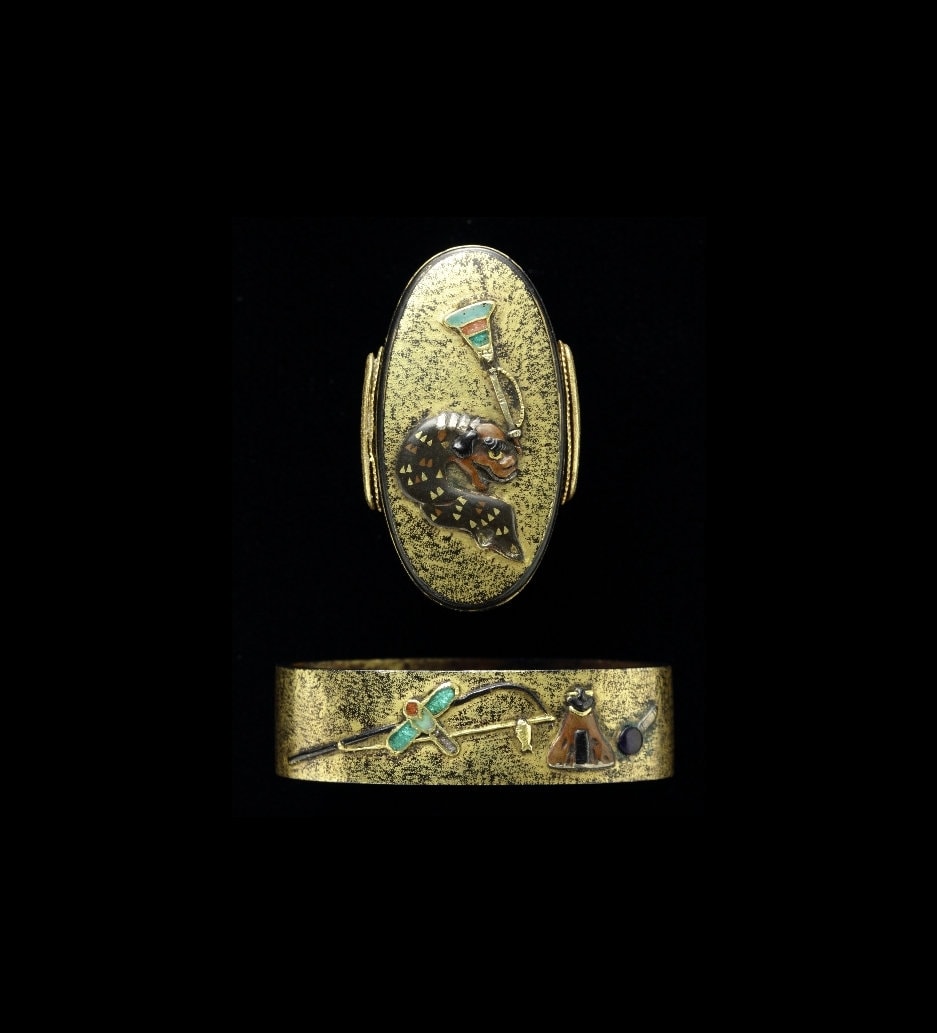
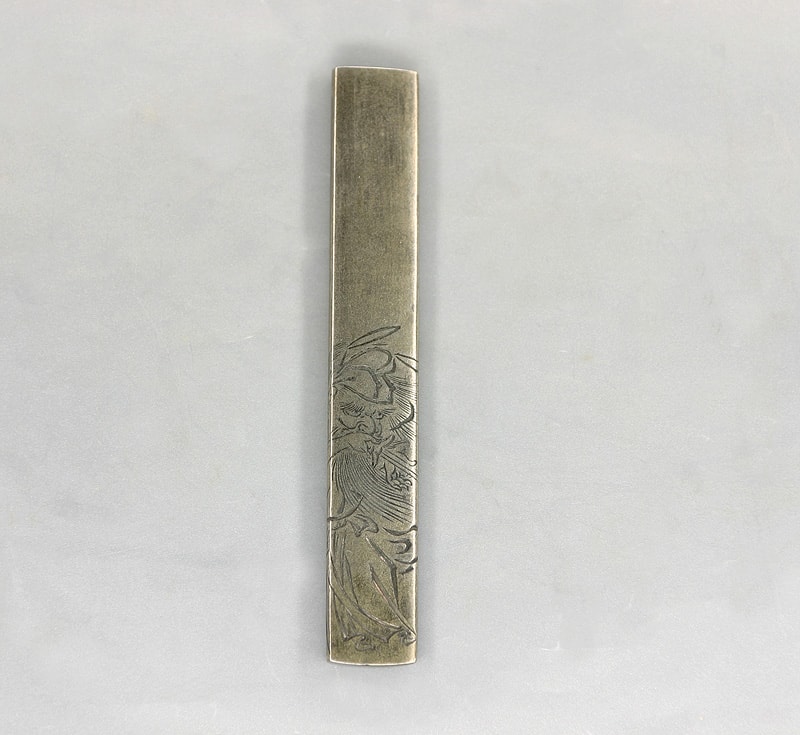
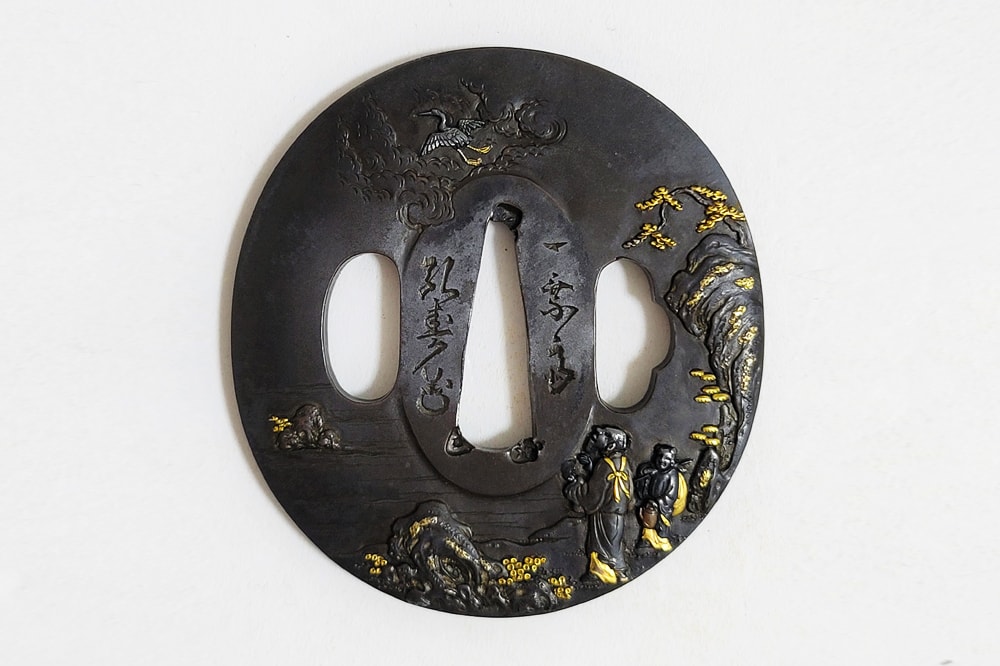
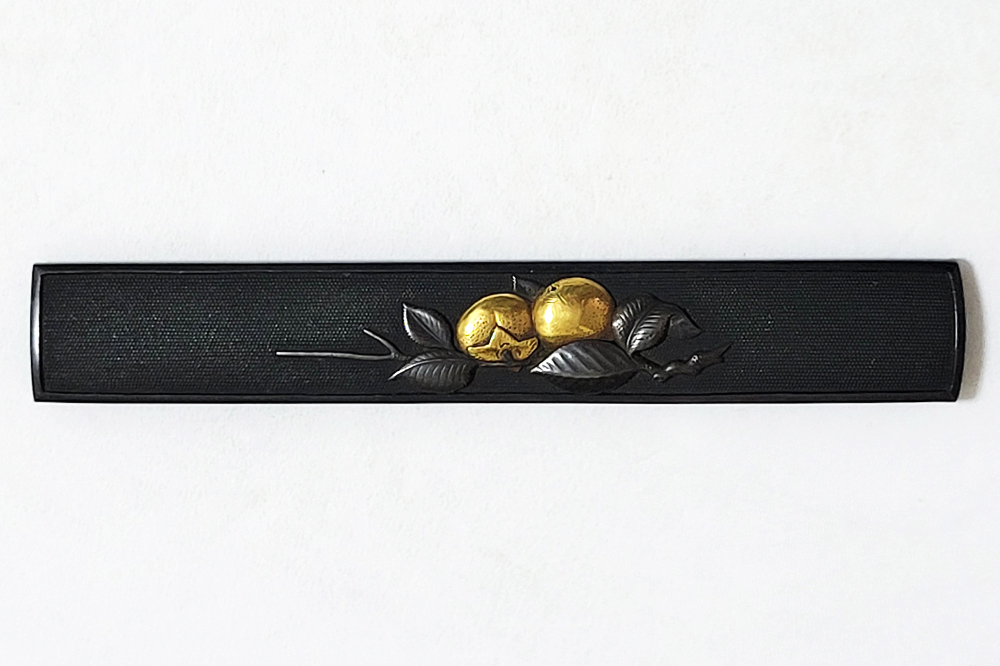
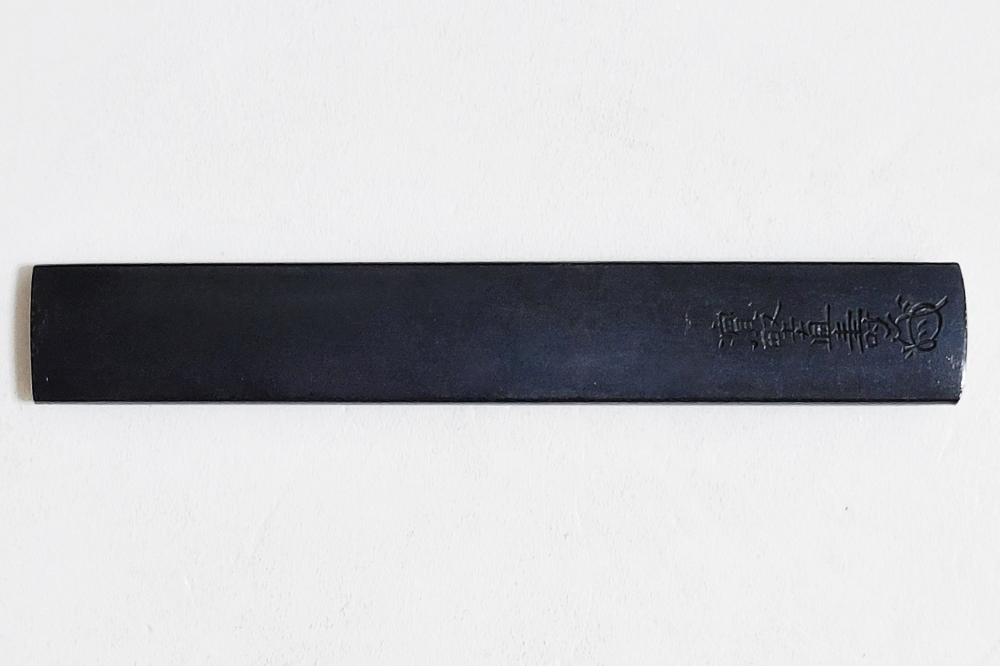
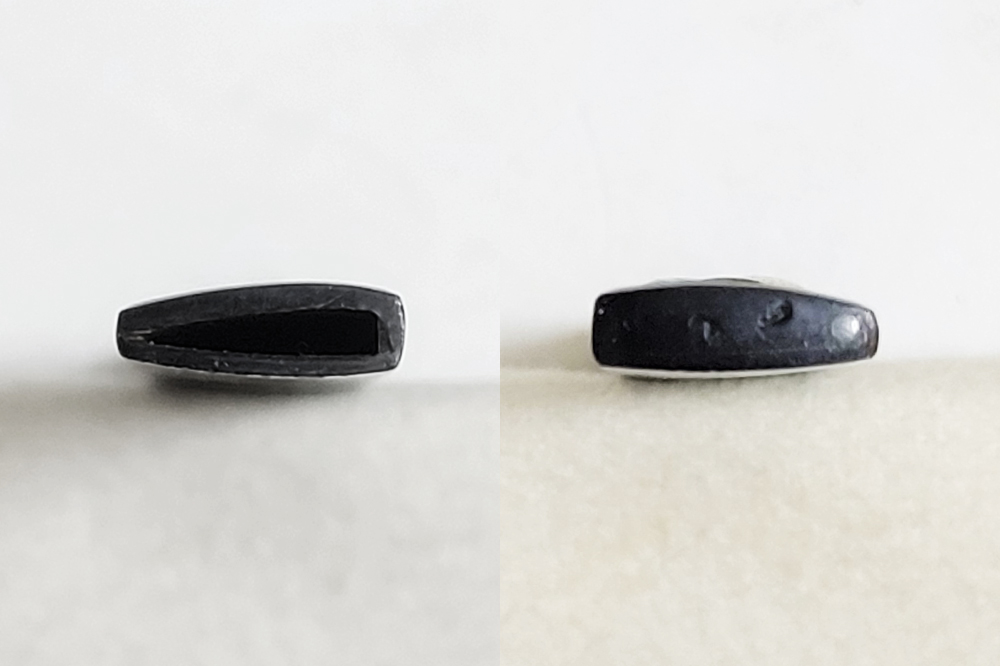
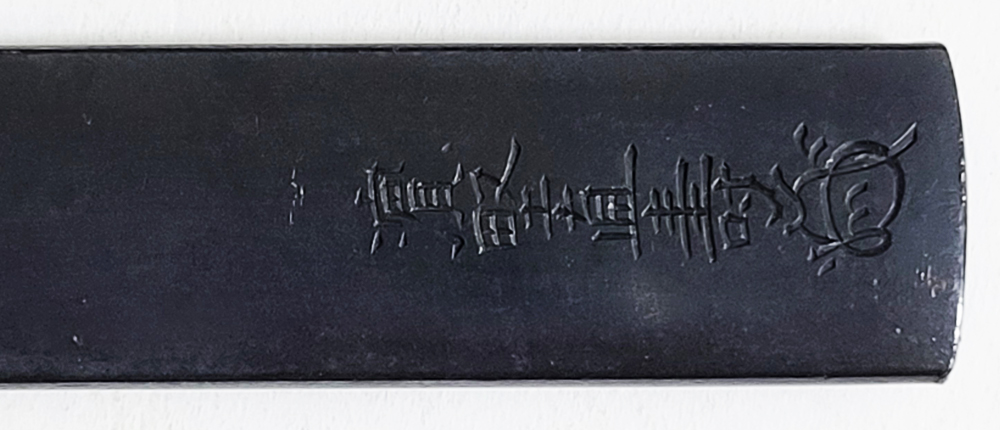
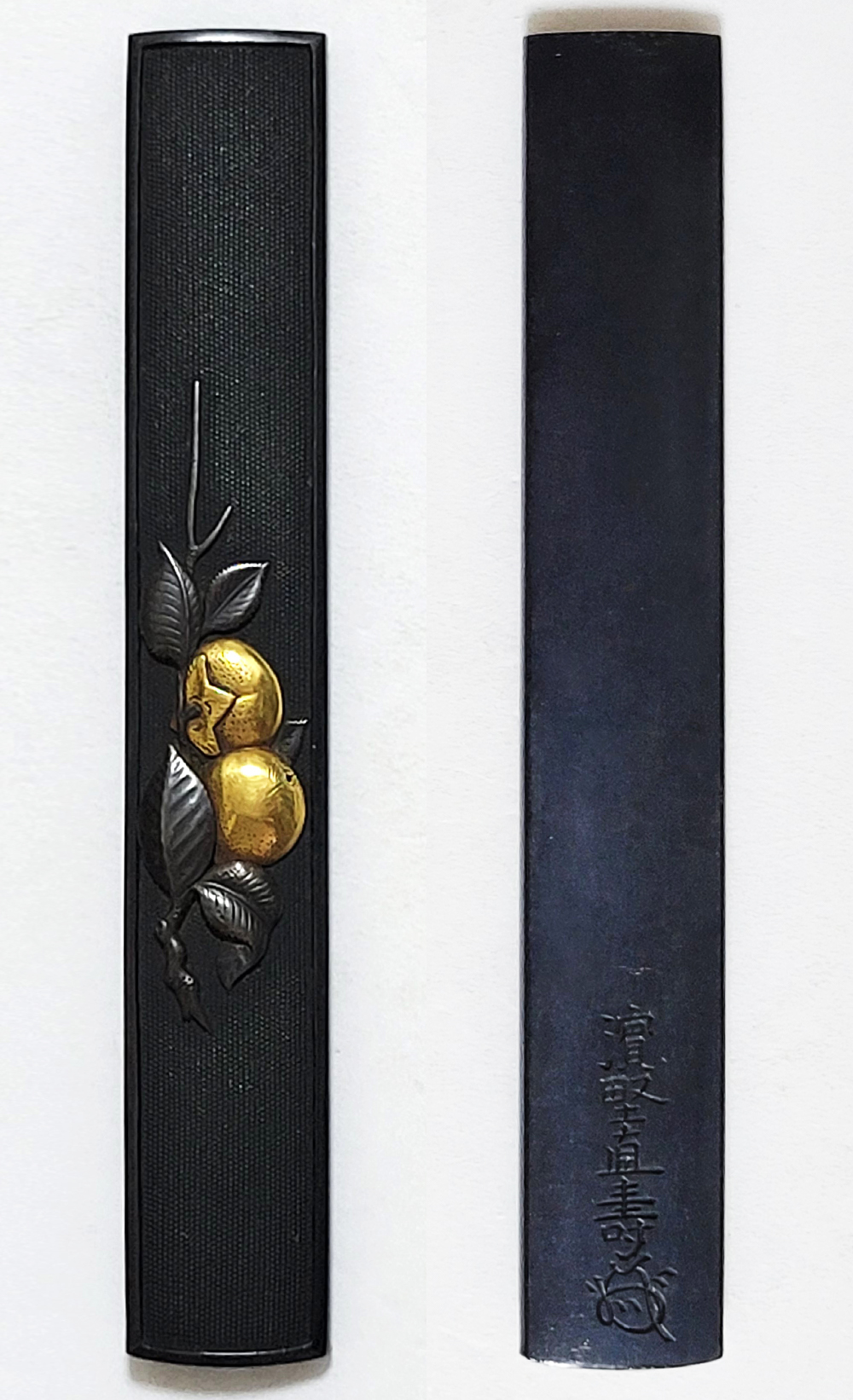
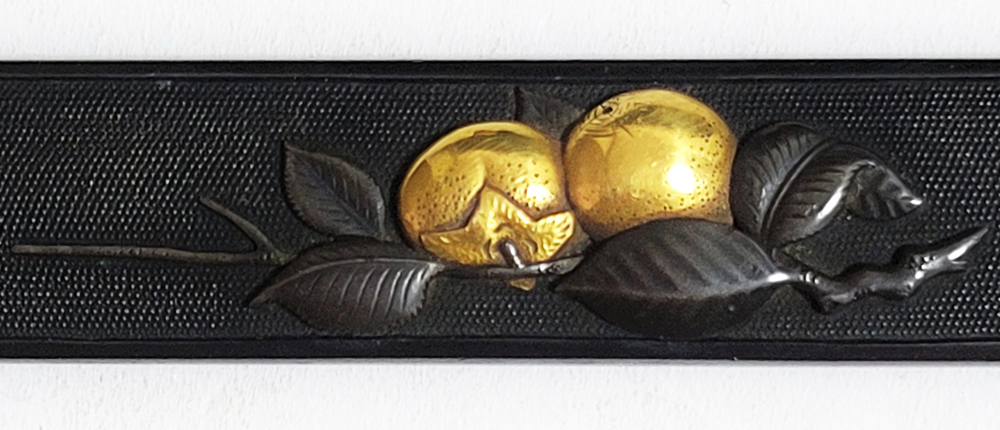
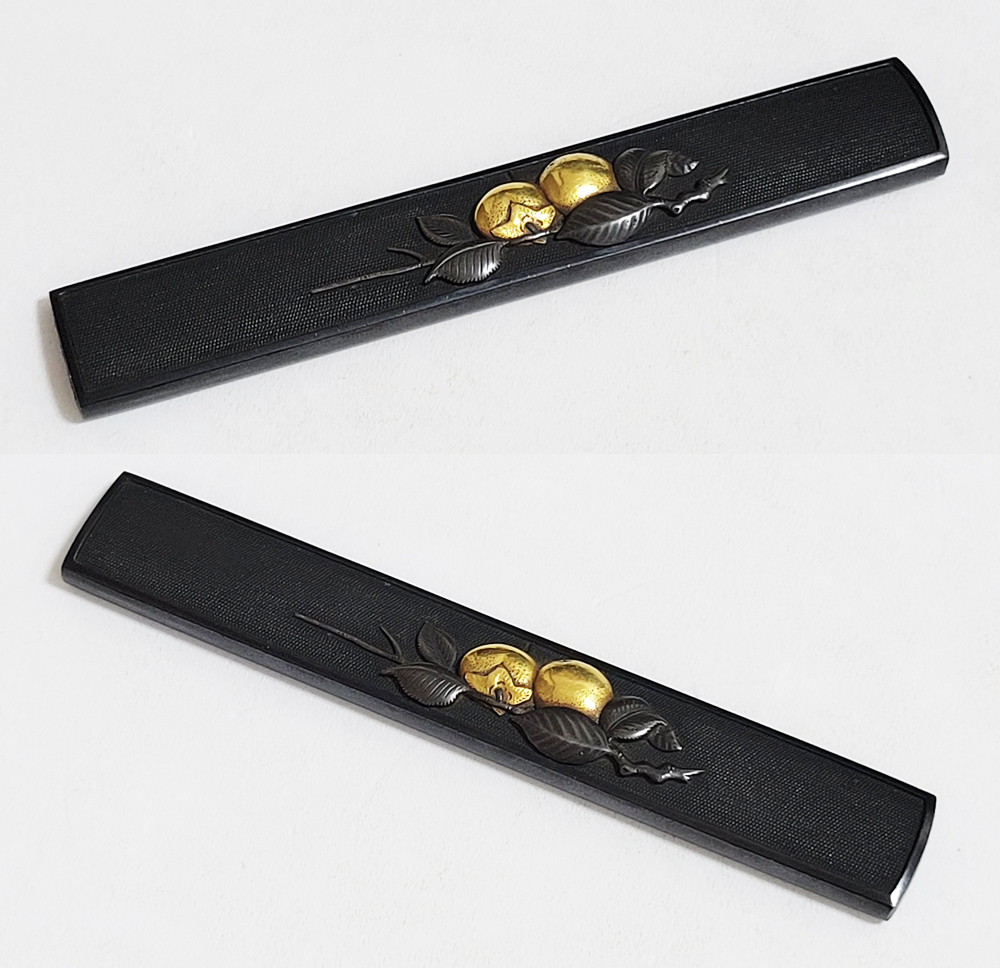
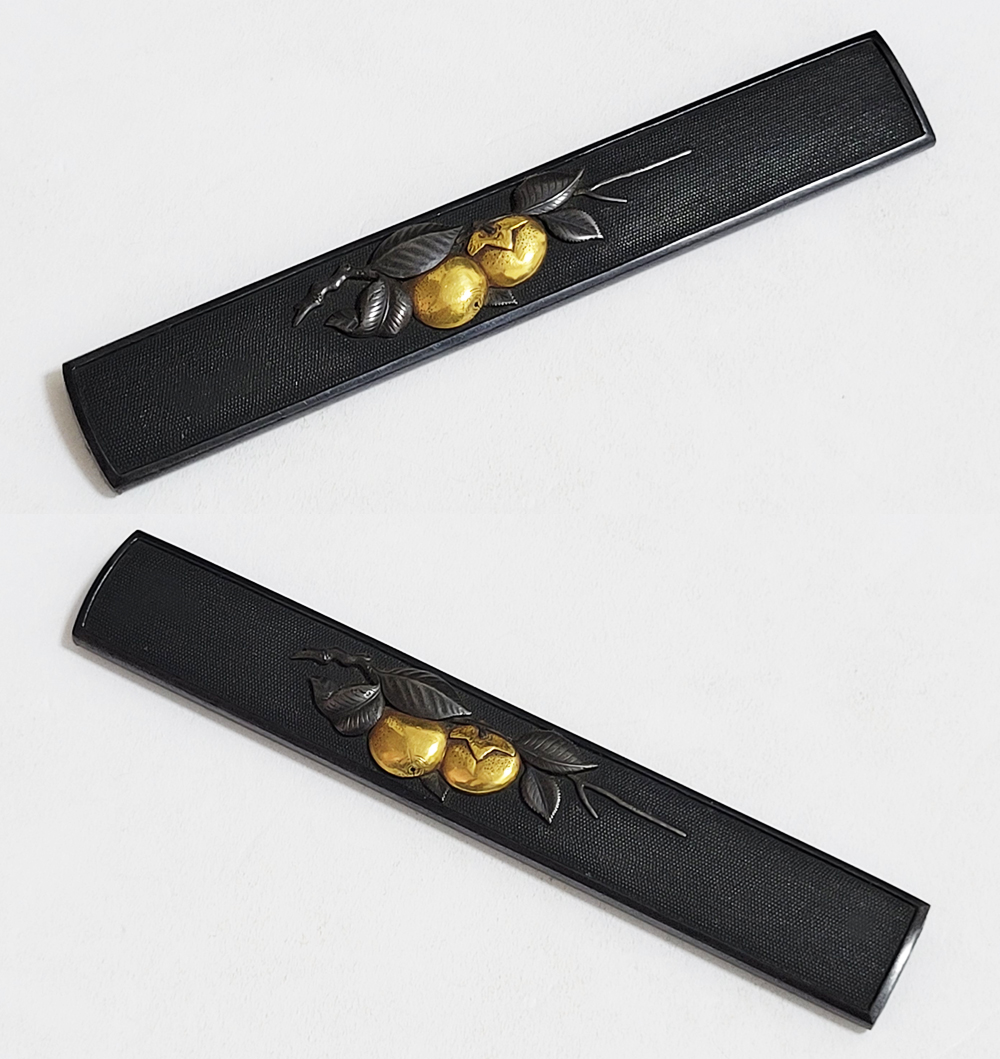
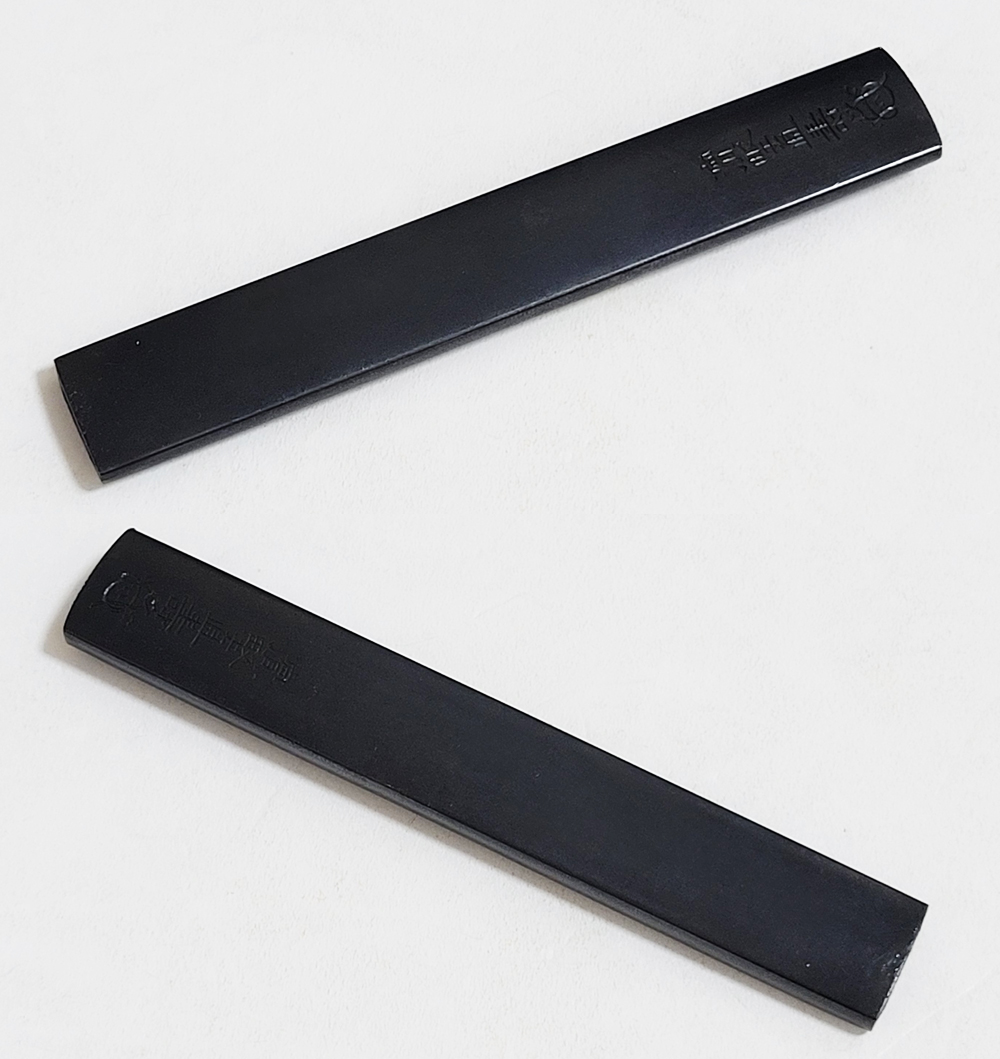
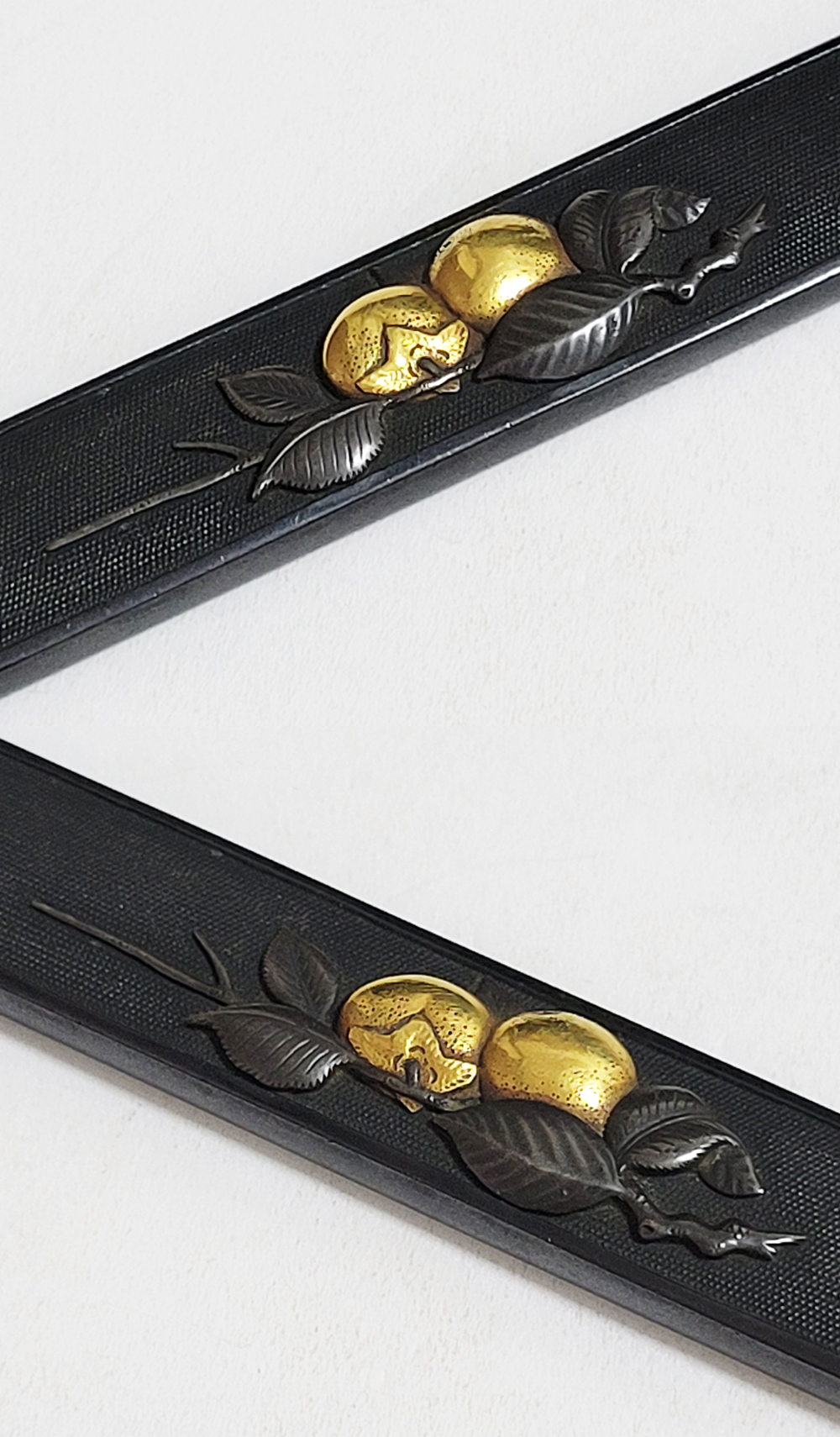
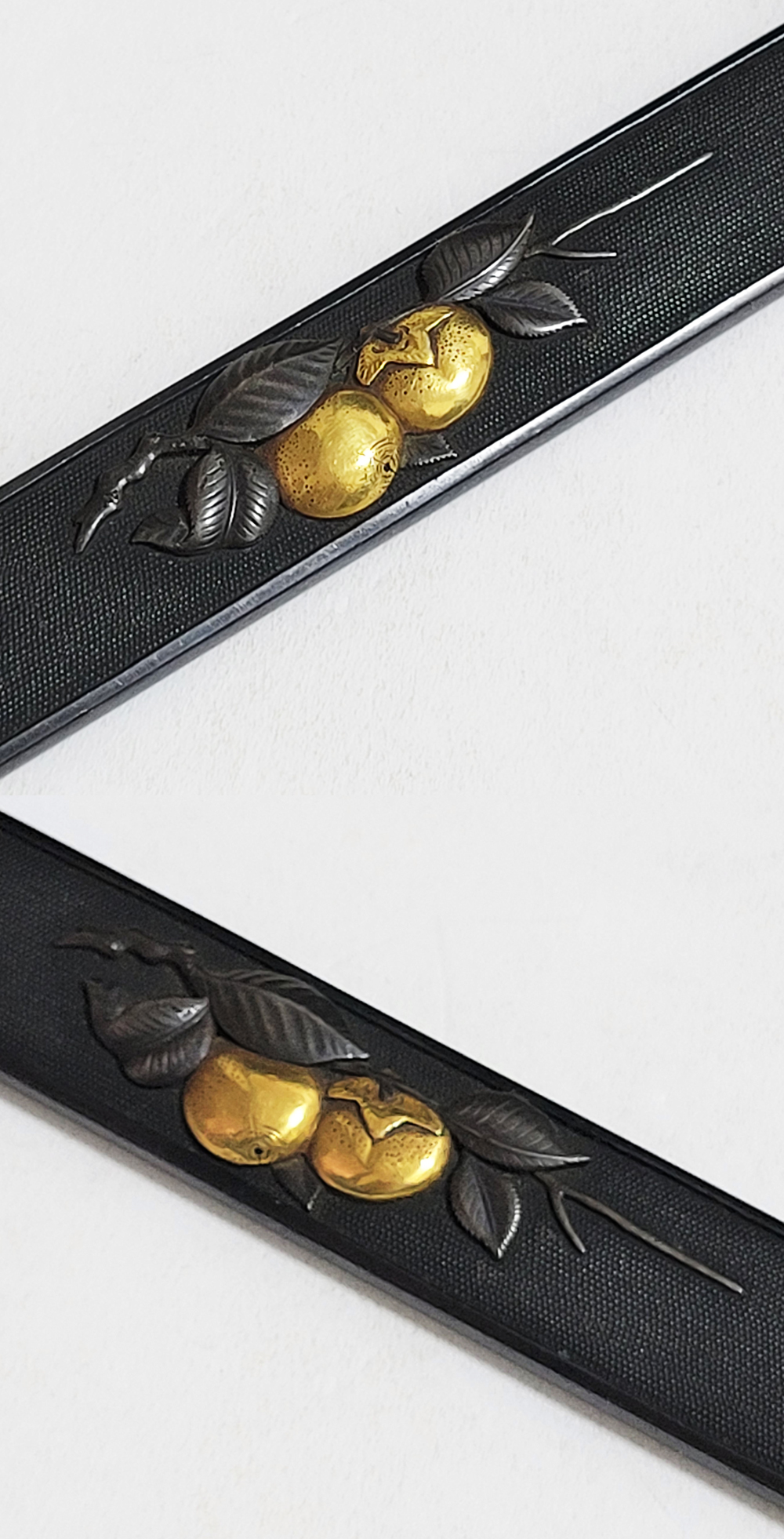
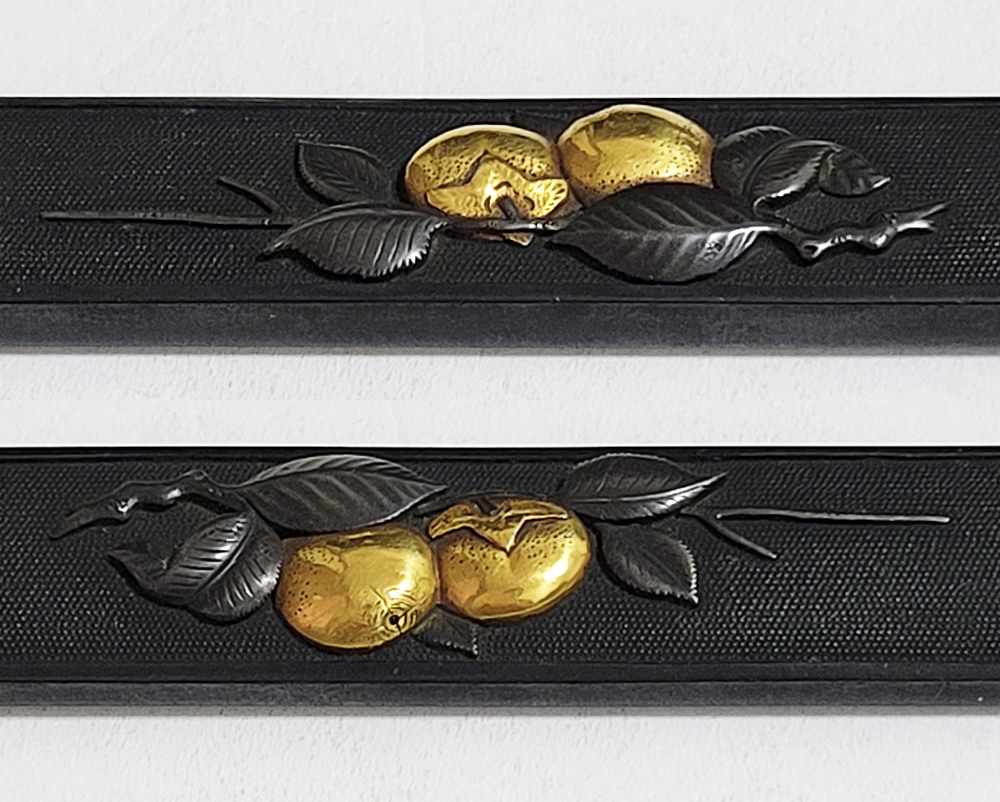
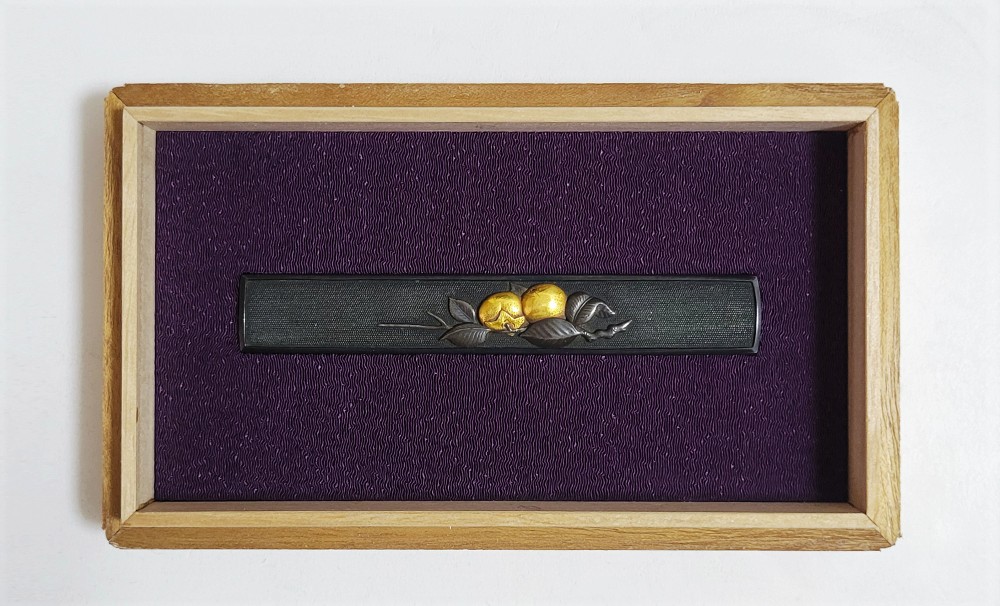
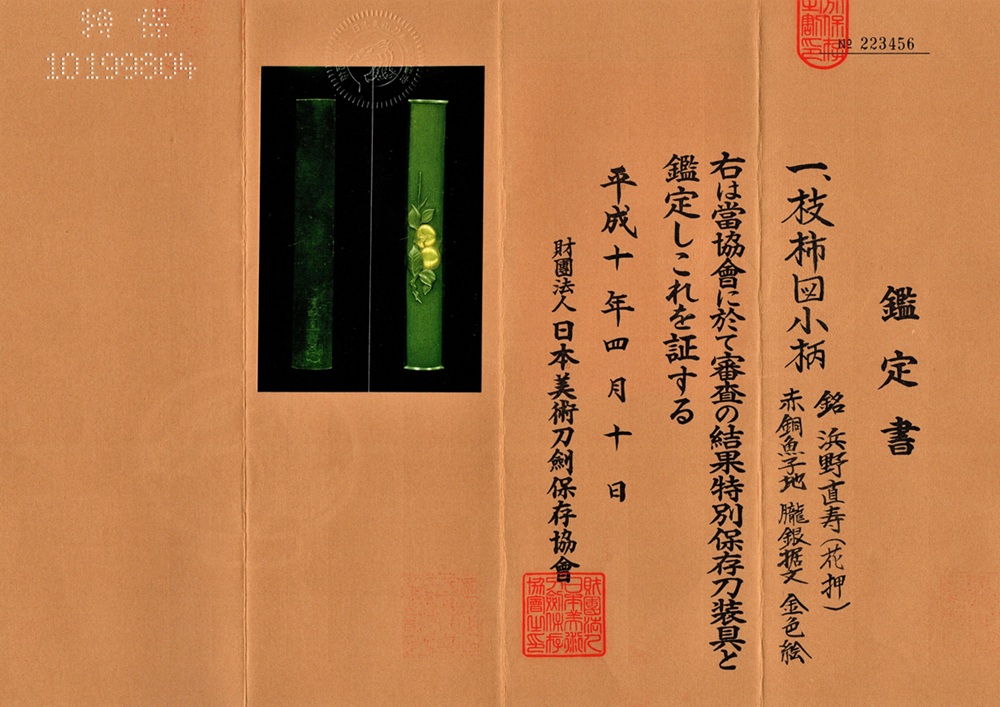
This kozuka features an intricate shakudo nanako ground, with two persimmons on a branch rendered in high-relief suemon and skillfully accented with gold iroe. The composition, with the thick branch base near the tsuba side and extending towards the kojiri side, follows the typical arrangement for plant motifs on kozuka. A unique aspect is the depiction of the two persimmons, which are shown growing upwards instead of their natural downward orientation. This intriguing detail, combined with the precise carving and beautiful gold accents, suggests a deliberate artistic choice by the maker, Hamano Naotoshi, rather than an error.
 NihontoWatch
mei · Hamano · Edo
Hamano Naotoshi
Edo
Musashi
Signed
Tokuho (NBTHK)
Machibori · Musashi
1 piece on the market now
Machibori · Edo
32 pieces on the market now
The Hamano school of machibori carving was established in mid-Edo Edo by Hamano Masazui (浜野政隨), commonly known as Tarōbei, an exceptionally gifted pupil of Nara Toshihisa. As the Edo Kinkō Meifu states of him that he "thunders through the world," Masazui won widespread renown as one of the "Four Guardian Kings of Nara" (Nara Shitennō). Training many disciples and employing numerous art names—including Otsuryūken, Aji-zumi, Kankei, Rifūdō, Yūkotei, Shūhōsai, Hankei-shi, and Isshunan—he formed what came to be known as the Hamano school, establishing one of the principal lineages of machibori artistry and founding an independent house. " Works are rendered by means of yōbori (sculptural carving) upon varied grounds—gold-and-silver imo-tsugi-ji, solid gold (kinmuku)—with details frequently treated in the in'yō-kon mode, suggesting the early Gotō masters as models.
The carving is executed with "ample, well-judged volume (nikudori)" and "exceptionally full, weighty presence," while applied metal (okigane) in silver and shakudō with shakudō iroe tightens pictorial fields and imparts additional movement. Later Hamano artists such as Katsurano Akafumi maintained this technical versatility, favoring polychrome inlay applied to high-relief compositions. " The NBTHK repeatedly notes that works "clearly demonstrate the high level of technique," "amply demonstrate advanced technical mastery," and possess "a composed dignity"—attestations to the school's sustained excellence across generations and its enduring place within the broader machibori tradition. Learn more →
| Smith | Era | Designated |
|---|---|---|
| Shozui政随 | — | 17 |
| Sekibun赤文 | 1670 | 8 |
| Noriyuki矩随 | — | 4 |
| Naotoshi直寿 | — | 0 |
| Masayoshi政盧 | — | 0 |
A Hozon-certified fitting of notably superior craftsmanship and condition, often with signature or workmanship of high reference value.
The NBTHK (Nihon Bijutsu Tōken Hozon Kyōkai, the Society for the Preservation of Japanese Art Swords) is a public-interest incorporated foundation founded in 1948 and supervised by Japan’s Agency for Cultural Affairs (Bunkachō); it is based at the Japanese Sword Museum in Tokyo. Its expert panels physically examine each submitted work (shinsa) and issue a certificate (kanteishō) ranking it by artistic and historical merit. NBTHK papers are the most widely recognized standard of authentication for Japanese swords and fittings.
NBTHK official siteDomestic: items may be returned within 7 days in original condition for a full refund (buyer covers transport). Overseas orders: no-refunds, no-returns.
¥200,000
This kozuka features an intricate shakudo nanako ground, with two persimmons on a branch rendered in high-relief suemon and skillfully accented with gold iroe. The composition, with the thick branch base near the tsuba side and extending towards the kojiri side, follows the typical arrangement for plant motifs on kozuka. A unique aspect is the depiction of the two persimmons, which are shown growing upwards instead of their natural downward orientation. This intriguing detail, combined with the precise carving and beautiful gold accents, suggests a deliberate artistic choice by the maker, Hamano Naotoshi, rather than an error.
NihontoWatchmei · Hamano · Edo
Hamano Naotoshi
Edo
Musashi
Signed
Tokuho (NBTHK)
Machibori · Musashi
1 piece on the market now
Machibori · Edo
32 pieces on the market now
The Hamano school of machibori carving was established in mid-Edo Edo by Hamano Masazui (浜野政隨), commonly known as Tarōbei, an exceptionally gifted pupil of Nara Toshihisa. As the Edo Kinkō Meifu states of him that he "thunders through the world," Masazui won widespread renown as one of the "Four Guardian Kings of Nara" (Nara Shitennō). Training many disciples and employing numerous art names—including Otsuryūken, Aji-zumi, Kankei, Rifūdō, Yūkotei, Shūhōsai, Hankei-shi, and Isshunan—he formed what came to be known as the Hamano school, establishing one of the principal lineages of machibori artistry and founding an independent house. " Works are rendered by means of yōbori (sculptural carving) upon varied grounds—gold-and-silver imo-tsugi-ji, solid gold (kinmuku)—with details frequently treated in the in'yō-kon mode, suggesting the early Gotō masters as models.
The carving is executed with "ample, well-judged volume (nikudori)" and "exceptionally full, weighty presence," while applied metal (okigane) in silver and shakudō with shakudō iroe tightens pictorial fields and imparts additional movement. Later Hamano artists such as Katsurano Akafumi maintained this technical versatility, favoring polychrome inlay applied to high-relief compositions. " The NBTHK repeatedly notes that works "clearly demonstrate the high level of technique," "amply demonstrate advanced technical mastery," and possess "a composed dignity"—attestations to the school's sustained excellence across generations and its enduring place within the broader machibori tradition. Learn more →
| Smith | Era | Designated |
|---|---|---|
| Shozui政随 | — | 17 |
| Sekibun赤文 | 1670 | 8 |
| Noriyuki矩随 | — | 4 |
| Naotoshi直寿 | — | 0 |
| Masayoshi政盧 | — | 0 |
A Hozon-certified fitting of notably superior craftsmanship and condition, often with signature or workmanship of high reference value.
The NBTHK (Nihon Bijutsu Tōken Hozon Kyōkai, the Society for the Preservation of Japanese Art Swords) is a public-interest incorporated foundation founded in 1948 and supervised by Japan’s Agency for Cultural Affairs (Bunkachō); it is based at the Japanese Sword Museum in Tokyo. Its expert panels physically examine each submitted work (shinsa) and issue a certificate (kanteishō) ranking it by artistic and historical merit. NBTHK papers are the most widely recognized standard of authentication for Japanese swords and fittings.
NBTHK official siteDomestic: items may be returned within 7 days in original condition for a full refund (buyer covers transport). Overseas orders: no-refunds, no-returns.
¥200,000