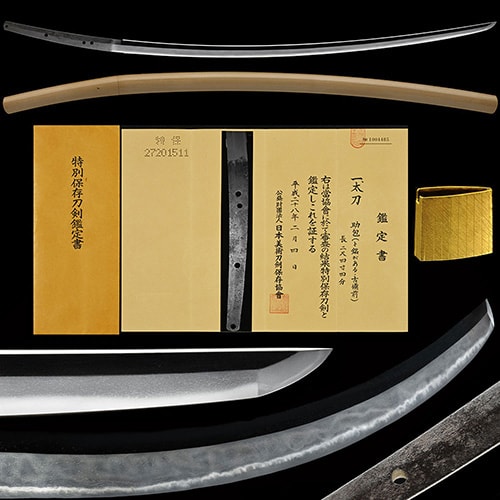
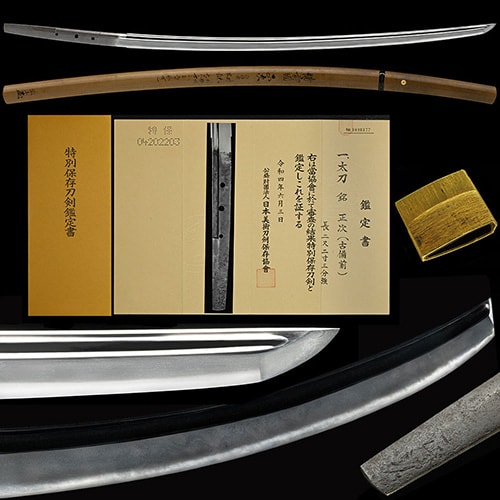
Yasutsuna (安綱) is renowned as a master smith of Hōki Province at the close of the Heian period, represented above all by the celebrated Dōjigiri. Older views placed his activity as early as the beginning of the Heian period, around Daidō (806-810), but this dating is now considered mistaken; modern scholarship assigns him to the late Heian era. A separate figure reading "Yasue" (安家) of the Ko-Bizen group is distinguished from the Hōki Yasutsuna, though both names employ overlapping characters. Within the Ko-Bizen lineage, the smith Yasutsuna is considered among the earlier, more archaic examples.
Yasutsuna's forging characteristically shows o-itame (large itame grain) that stands conspicuously, with ji-nie and the presence of chikei. The hamon is a ko-midare mixed with ko-choji, executed in nie with ashi and yo entering well. Fine kinsuji appears, and a tendency toward nijuba is observed, with sunagashi running through and becoming intertwined with the surface grain. The NBTHK describes the overall manner as unmistakably archaic (koko), conveying a "Yamato spirit" (Yamato-gokoro). In the Ko-Bizen-attributed work, the jigane shows little conspicuous utsuri, while in other examples the archaic elegance of the midare-ba and the kijimomo-gata (pheasant-thigh) tang profile together convey an old-fashioned character.
A noteworthy point in appraising Yasutsuna's signature, as the scholar Honma observed, is that the character tsuna (綱) stands out as conspicuously large in comparison to Yasu (安). Surviving works include both ubu signed tachi of outstanding form and shortened unsigned blades transmitted through such distinguished collections as the Maeda family. The breadth and antiquity of Yasutsuna's production firmly establish him as a foundational figure in the earliest stratum of Japanese sword-making.