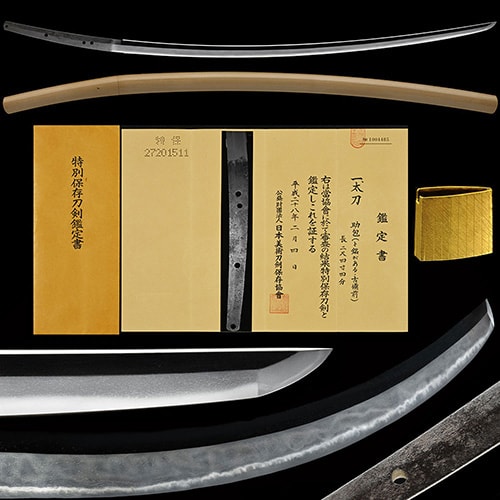
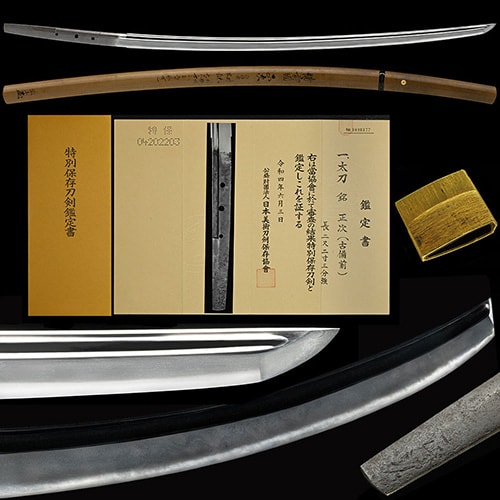
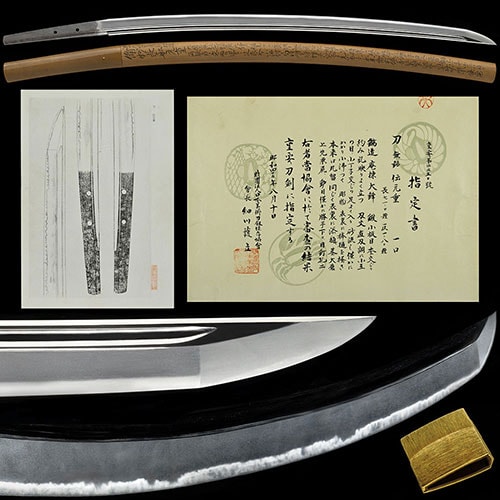
Tsunemitsu is transmitted as either the son or a student of Masatsune, the progenitor of the Ko-Bizen school, and is thus situated at the very origin of the Bizen swordmaking tradition. His working period is placed in the late Heian to early Kamakura era, a time when the Ko-Bizen group was defining the classical tachi form that would dominate Japanese swordcraft for centuries. Extant signed works by Tsunemitsu are exceedingly rare, lending particular scholarly value to each authenticated example.
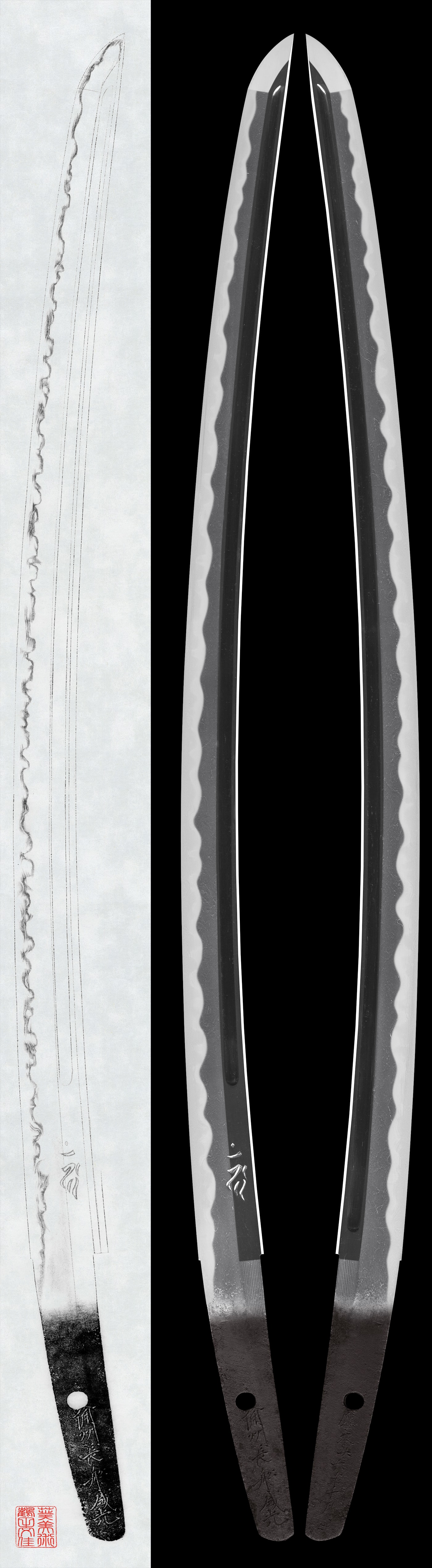
The Juyo setsumei consistently describe a forging style rooted in ko-itame-hada mixed with mokume, at times becoming o-hada with nagare-hada interwoven -- a grain structure that conveys what the examiners characterize as an archaic, or koga, quality. Ji-nie adheres across the surface, and midare-utsuri stands out prominently, a hallmark of the early Bizen tradition. The hamon is typically a shallow notare-based pattern into which ko-choji, ko-gunome, and ko-midare are combined; the nioiguchi tends toward tightness, with fine ko-nie adhering thickly in the habuchi. One setsumei singles out the tachi in Juyo 7 as "likely the finest example among Tsunemitsu's works," noting that despite a hagire at the monouchi, both form and workmanship are of superior quality. His blades characteristically display pronounced koshizori with funbari and a ko-kissaki or chu-kissaki, preserving the elegant proportions of the period.
As a smith of the Masatsune lineage working at the threshold of the Kamakura period, Tsunemitsu's surviving blades offer a direct window into the formative phase of Ko-Bizen craft. The restrained yet technically accomplished character of his work, together with the extreme scarcity of signed examples, ensures that each blade bearing his mei occupies a place of enduring importance in the study of early Bizen swordmaking.