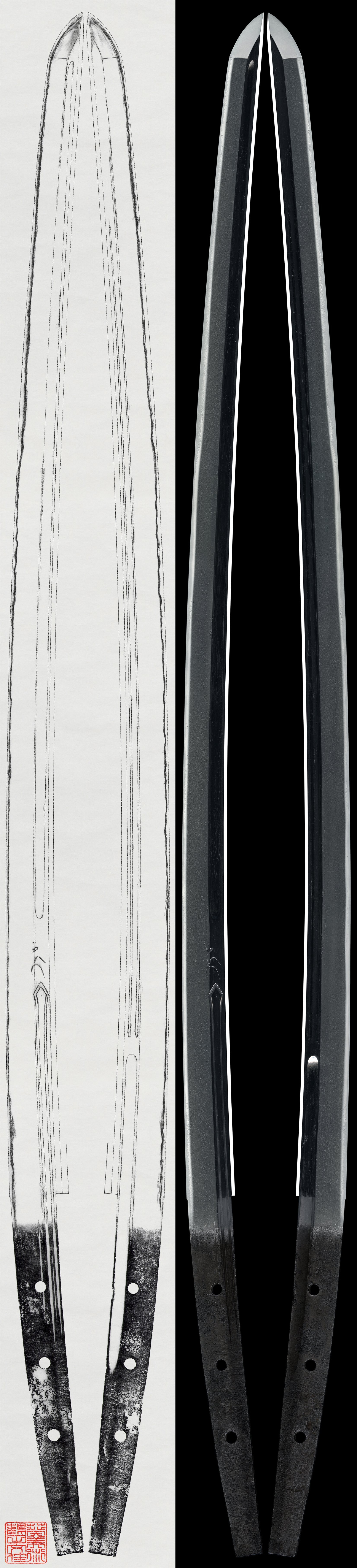
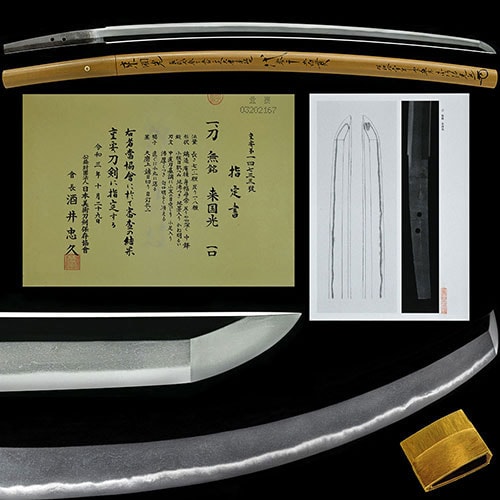
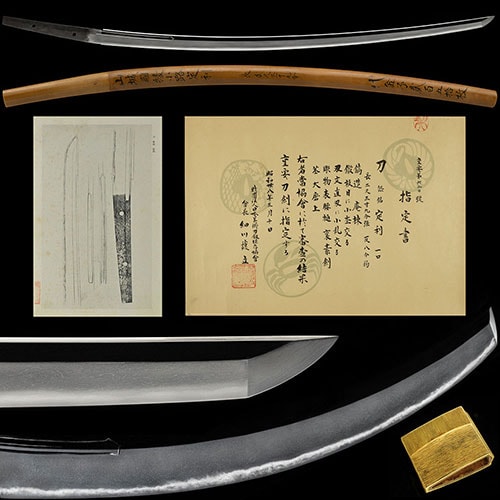
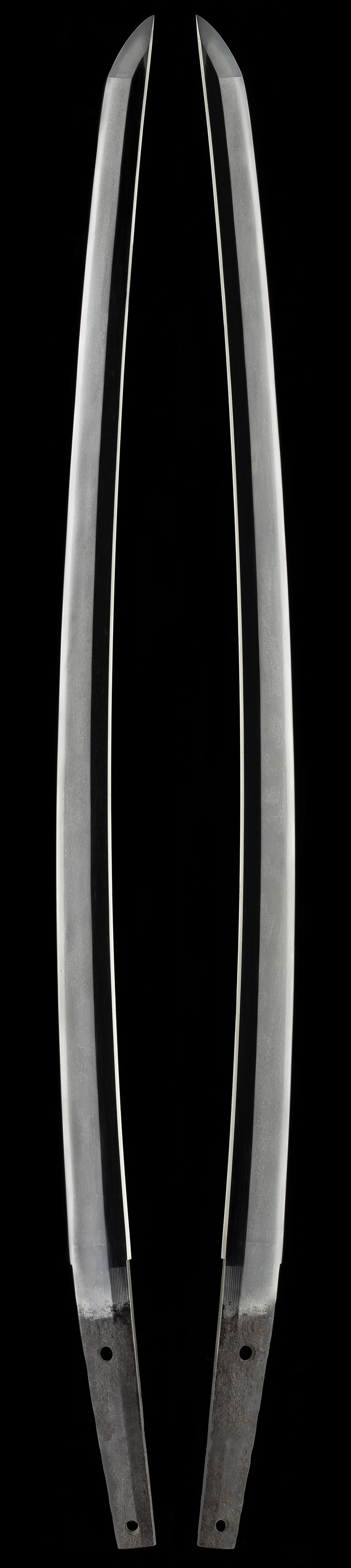
Kunikiyo was the fourth of the six brother-masters of the early school in Yamashiro, working in the opening years of the period. The published sources set him in that celebrated company: a son of Kuniie, his elder brothers Kunitomo, Hisakuni and Kuniyasu and his younger brothers Arikuni and Kunitsuna, the six of whom all served as appointed swordsmiths to the Retired Emperor Go-Toba. Of his own work very little survives in signature. One entry states plainly that 'extant signed pieces are few, numbering only two', so his name is carried today chiefly by a small group of , mumeikatana judged to him, alongside the rare signed tachi.
His hand is the bright, quiet manner of early Awataguchi. The jigane is a closely forged ko-itame, in places running a little or mixed with larger grain, carrying abundant ji-nie and, on the finest blade, frequent chikei; the published sources call the steel notably bright, with a faint midare-utsuri standing in places. Over that jigane he sets not the flamboyant chōji of Bizen but a suguha-toned ko-midare, shallowly notare and worked with ko-chōji, ko-gunome and gunome, ashi entering, the nioiguchi deep and bright, nie well adhered, with fine sunagashi and kinsuji running through. The bōshi goes straight to a ko-maru or ō-maru and returns.
Within that suguha-based edge the judges single out one piece of scenery: patches of yubashiri toward the monouchi that gather into a nijūba-like double line, a feature the published commentary notes on more than one of the ō-suriage blades. It is a restrained tell, in keeping with a smith whose whole character is calm rather than showy.
The published sources read Kunikiyo closest to his brother Kuniyasu. On the signed tachi transmitted in the Unshū Matsudaira house, the commentary finds the temper 'on the whole resembling Kuniyasu'2; on one of the ō-suriagekatana the tightly packed intervals of the midare and an urumi tendency of the nioiguchi are held to share 'a thread of affinity with Kuniyasu'3. It is exactly this affinity, set on the characteristic bright Awataguchiko-itame, that carries the attribution where the signature is gone, and the sources affirm such blades as work that 'at a glance can be appraised as Awataguchi of the early Kamakura'4. He stands within the early Awataguchi mainstream, before the school's later flowering, the quiet suguha-toned ko-midare and the uruminioiguchi the marks of the family hand.
For the collector Kunikiyo is a rare early Awataguchi name, graded sai-jō saku by the Fujishiro appraisers. He has no National Treasures; his record runs through one work designated Important Cultural Property, the Aoyama-family signed tachi, together with the prewar Juyo Bijutsuhin signed tachi from the Unshū Matsudaira house, and a small group of ō-suriagemumeikatana reaching the Jūyō and Tokubetsu Jūyō tiers, only five works carrying an official designation in all. The Tokubetsu Jūyōkatana descended through the Sakai house of Himeji, and the published sources call it a superior blade whose 'glittering nie within the temper is especially magnificent'5; among recorded whereabouts a blade is held by the Fukuyama Art Museum, and his provenance runs through old daimyō and imperial collections. With so few works on record and most of them long held, a signed Kunikiyo comes to light only rarely, and a privately held example of either his signed tachi or his attributed katana is among the more notable things a collector of early Yamashiro could hope to encounter.
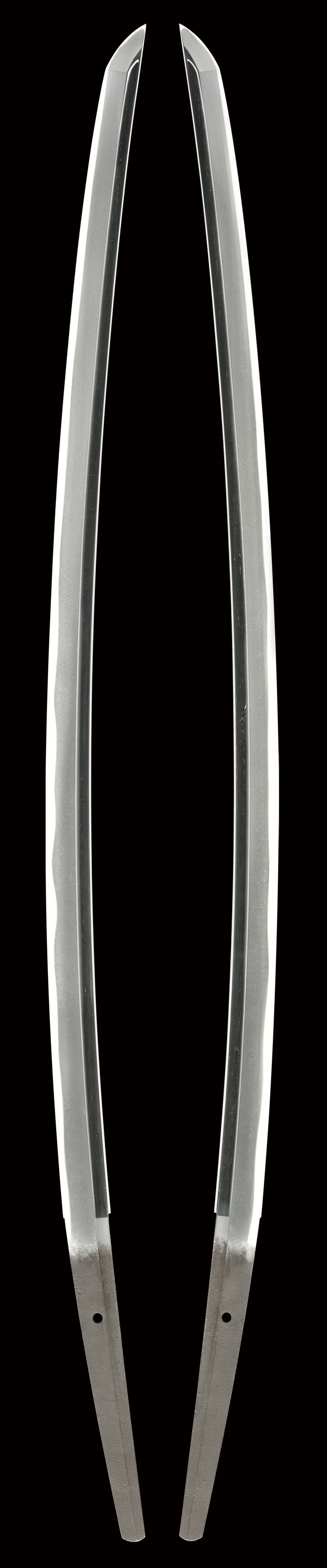
Kantei
one Awataguchi hand in two registers of record: the rare signed tachi, a dignified suguha-toned ko-midare over a fine ko-itame that the sources liken to Kuniyasu, and the o-suriage mumei katana judged to him as mainstream early-Kamakura Awataguchi work, the bright suguha-base temper with its nijuba-like yubashiri the constant across both
Kunikiyo is an early-KamakuraAwataguchi smith of Yamashiro, the fourth of the six brother-masters of the early Awataguchi school, son of Kuniie and brother to Kunitomo, Hisakuni and Kuniyasu, with Arikuni and Kunitsuna his juniors; the published sources record that the six served together as appointed swordsmiths to Retired Emperor Go-Toba. Signed work by him is exceedingly scarce, numbering only about two blades, so his record stands on a small group of o-suriagemumeikatana judged to him together with one signed tachi. His hand is the bright Awataguchi manner: a well-packed ko-itame, at times running a little, with abundant ji-nie and a steel the sources call notably bright, over which he sets a suguha-toned ko-midare mixing in ko-choji, ko-gunome and gunome, ashi entering, the nioiguchi deep and bright with nie well adhered, fine sunagashi and kinsuji running, and yubashiri that give a nijuba-like effect. The boshi runs straight to a ko-maru or o-maru with a return. The published sources repeatedly read him close to his brother Kuniyasu, in the tight intervals of the midare and an urumi tendency of the nioiguchi.
Diagnostic discriminators
直刃調suguha-cho3
小乱れko-midare3
二重刃nijuba1
unique vs his own signed tachi (plain suguha-midare)
Observation by phase
The signed tachi (resembling Kuniyasu)
His record holds only a very small number of signed pieces, and the published sources note that even among these the manner of the signature is not uniform. The signed tachi is dignified and refined in bearing. The ground is a closely knit fine ko-itame with abundant ji-nie, beautifully present and bright. Over it the temper is a slightly wide suguha-toned ko-midare, gunome predominating and covered with nie, into which the older accounts read a general resemblance to his brother Kuniyasu. The sources name the Aoyama-family tachi, an Important Cultural Property, and this Jubi tachi from the Unshu Matsudaira house as the recognized signed examples, observing that their signatures differ yet their workmanship is alike in carrying the dignified, high-class Awataguchisugata.
Jigane 地鉄
小板目ko-itame1地沸ji-nie1
Hamon 刃文
直刃調suguha-cho1小乱れko-midare1互の目gunome1沸nie1
The o-suriage mumei katana (mainstream Awataguchi attribution)
The body of his record is the o-suriage, mumeikatana judged to him. These are slender, with a deep koshizori carried high and a chu-kissaki, the elegant early-Kamakuratachi form reduced by shortening. The ground is a well-packed ko-itame, in places mixed with larger grain or running a little, with thick ji-nie, frequent chikei on the finest piece, the steel bright, and at times a faint midare-utsuri. Over it the temper is a suguha-base shallowly notare and overall a ko-midare, mixing in ko-choji, ko-gunome and gunome, ashi entering, the nioi deep and the ko-nie thickly applied, fine sunagashi and kinsuji running, the nioiguchi bright and clear, with yubashiri laid on toward the monouchi that give a nijuba-like effect. The boshi runs straight to a ko-maru or in an o-maru manner, with a return; a bo-hi is carved on both sides, carried through on the omote and run off on the ura. The published sources affirm these as Awataguchi work of the early Kamakura, the characteristic bright ko-itame ground and the urumi tendency of the nioiguchi sharing a thread with Kuniyasu, so the attribution to Kunikiyo is accepted.
The published sources record that extant signed Kunikiyo are exceedingly few, numbering only about two blades, and that even between the recognized signed tachi the manner of the signature differs; in workmanship, however, all such pieces are appraisable as essentially Awataguchi work, generally calling Kuniyasu to mind, so that on the o-suriage mumei katana the bright tightly-forged ko-itame and the urumi tendency of the nioiguchi carry the attribution to Kunikiyo.3
Master smiths summoned by Retired Emperor Go-Toba (後鳥羽上皇) to serve monthly rotations forging swords at the imperial court, ca. Jōgen–Jōkyū (1208–1221). A cross-school honor: each smith retains his own school (Awataguchi, Fukuoka Ichimonji, Ko-Aoe, etc.). The linked school NS-Gobankaji holds only Go-Toba's own Kiku gyōsaku blades.
Where Kunikiyo stands among comparable artisans: across all of nihontō, and within tradition, era, and period. The tiers (Foremost · Leading · Major · Notable) weigh official designations from the NBTHK and Japan's Agency for Cultural Affairs, together with historical honors of lasting repute such as the Sansaku and Meibutsu-chō.
随一
Foremost
屈指
Leading
All nihontōYamashiroKotōEarly Kamakura
有数
Major
著名
Notable
Select a lens to see how it's measured.
Designations
Kokuhō—
Jūyō Bunkazai1
Jūyō Bijutsuhin1
Gyobutsu—
Tokubetsu Jūyō1
Jūyō Tōken1
Elite Standing
0.11 across 4 designated works
Top 17% among smiths
Provenance
5 documented provenances across certified works by Kunikiyo
Imperial—
▸Shogunal1
Premier Daimyō—
▸Major Daimyō1
▸Other Daimyō3
Zaibatsu—
Institutions—
Named Collectors—
Provenance Standing
2 works held in elite collections across 5 documented provenances