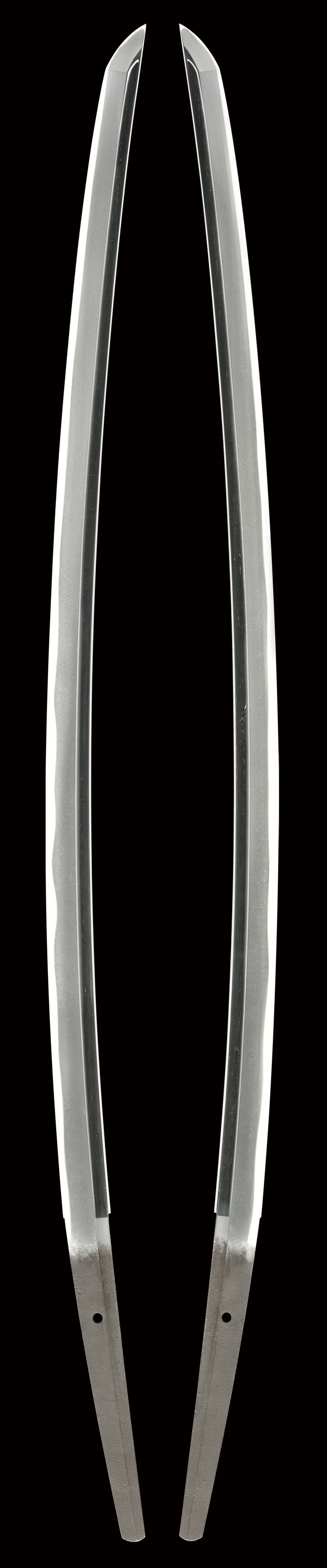
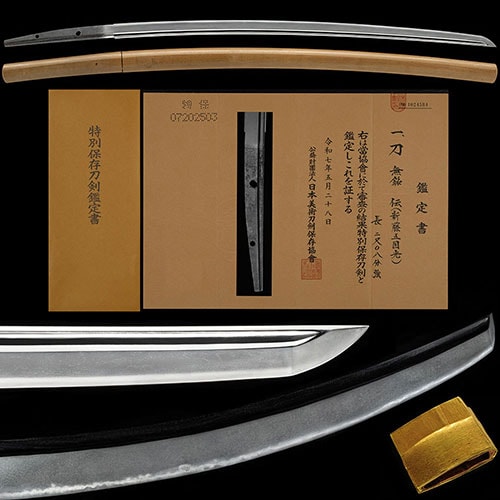
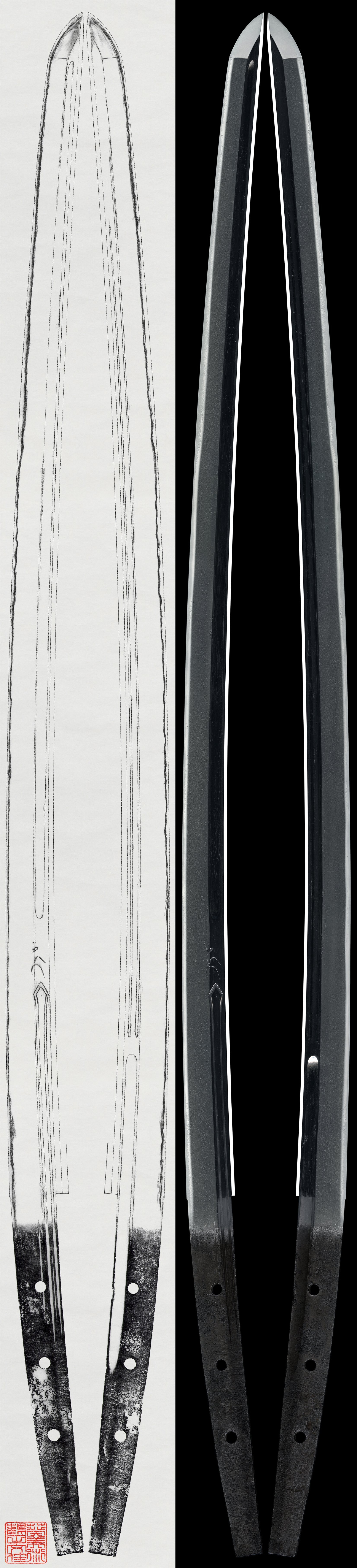
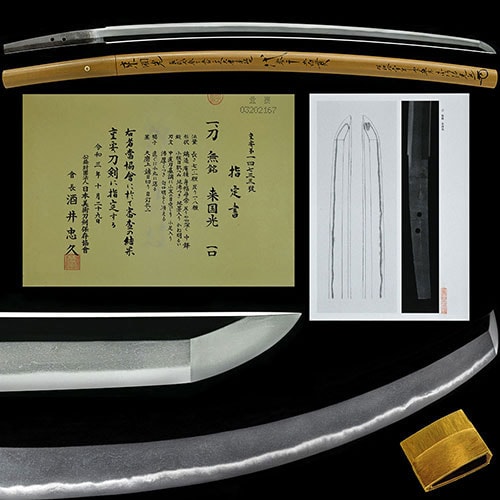
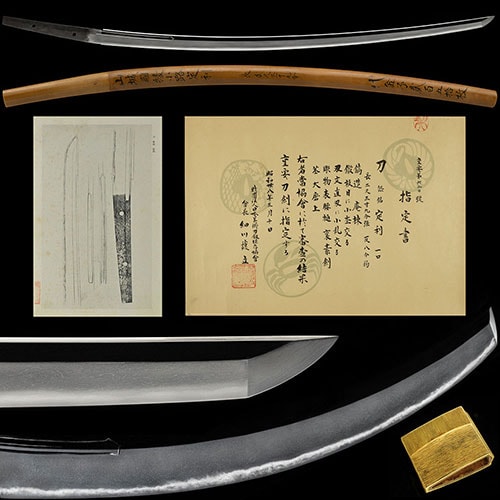
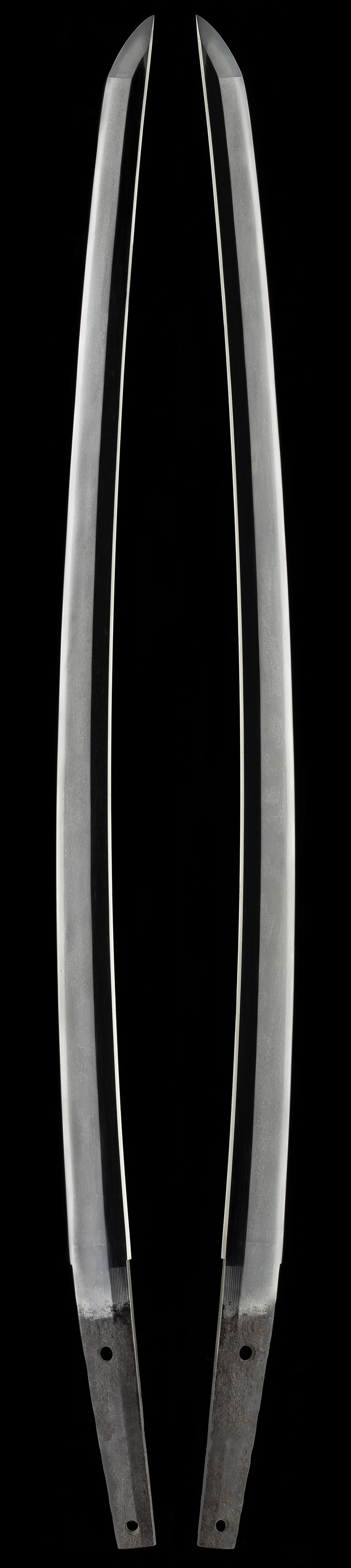
The record of Norikuni centers on a slender signed that preserves its original tang, with an old scabbard whose document of provenance states that Kitabatake Akiie received the sword from Emperor Go-Daigo; it passed in 1998 and rose to in 2000. Norikuni, called Toma no Jo, was the son of Kunitomo, the eldest of the six brothers, and the father of Sahyoe no Jo Kuniyoshi; his dates are given as around Katei (1235 to 1238), the bridge generation between the age of his father and uncles and the age of Kuniyoshi and Yoshimitsu. A prewar designation record adds the tradition that he served as a on Oki, the island of the exiled Retired Emperor Go-Toba. On one point the published sources never vary: surviving works with secure signatures, and alike, are very few.
His , the greater part of what survives, are with , of standard width, with . The is a tightly knit , the dust-fine and thick, with fine woven through. Over it he tempers a calm in , deep in , taking in or a shallow with small . Fine and run within the , and the turns back in a refined , at times lightly swept. On the and he cuts , often paired with a ; the grooves are spaced narrowly and set close to the , a placement the published sources call "a habit common to the craftsmen of the school". The Kuroda that bears his rather large two-character signature is judged sound in , and form alike, "one of the foremost works of this smith".
The steel itself carries the school's name. Of the unsigned of session 46 the published sources write that the is extremely tightly knit, the minute giving "a moist, pear-skin surface", with standing and the steel clear. The signed shows instead an mixed with , somewhat large in texture yet thoroughly worked and warm, displaying, as the sources put it, the celebrated virtues of ; over it a faint rises.
The published sources divide his manner by form. Among the there are works in a -based temper mixing , but for the "a calm, graceful is general". The signed register is the rarer one: a slender blade of high with , closing in a small point, the temper dropped in a slight just above the . Its activity gathers from the middle down through the lower half, in with and , while the upper reaches run a calm and the ends nearly straight with a tendency. The thin, short on its is what the old texts call the wasure-bi (忘れ樋), the forgotten groove often met on . The is of two characters, and the form of the character is noted as close to his son Kuniyoshi's, a point of attention in appraising his signatures. appraisals run the length of the record: an of Koon dated 1639 on the Matsudaira , an of Kochu dated 1713, and a thought to be the hand of Tadaaki, the nineteenth master; these are attributions by later appraisers, not signatures. So too the on which the late smith Ishido Unju Korekazu cut an inscription recording that he had shortened a work of Norikuni, a document the judges call greatly treasured as source material.
Within the family his place is fixed by two observations that run in opposite directions. His manner is common to Kuniyoshi and Yoshimitsu, but the published sources state that his is comparatively stronger; of the they write likewise that "the within the is strong". Yet that strength never disorders the line. His does not break into minutely complex small patterning, and the judges make this restraint itself the thread of appraisal, writing of the unsigned of session 46 that the way the does not become so intricately disordered in small patterns "is what connects it to the signed works of this smith". The hand of the school belonged to his uncle Kuniyasu; Norikuni's own appears only on his , and only in the lower half. The Kuroda of session 20, -toned yet shallowly undulant with mixed in, is singled out as the exception, good material for knowing the breadth of his work.
Fifteen designated works stand on record. Of his rare signed , three were designated , Important Cultural Properties, and one of these has since been elevated to , a National Treasure; with them stand three , six and three prewar Bijutsuhin. The Toko Taikan values him at 3,000 against a ceiling of 3,500, the figure of a master of the first rank. The National Treasure and the Important Cultural Properties are patrimony, preserved beyond any market; among the recorded holders of his work are Atsuta Jingu and the Kyoto National Museum. The provenance roll is of the order. The signed carries the old legend of Emperor Go-Daigo and Kitabatake Akiie; the Kuroda house of held the signed whose is scattered with the family's -tomoe crest; the Matsudaira lords of Iyo Saijo kept the with its 1639 ; Mori Motomichi held both prewar Jubi ; the Ikeda family appears as well. For the private collector the arithmetic is severe: nine blades stand in the and tiers, and most have rested long in the hands. A work of Norikuni reaching the open market is a rare event, and a signed example would be among the rarest encounters the field affords.