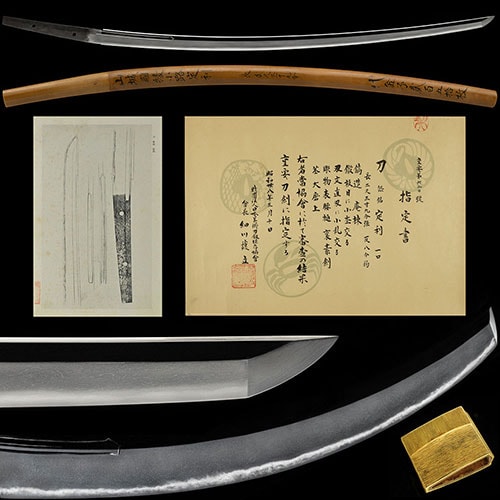
Kunitomo is a smith of the early period and, by the published account, the senior figure of his house. lay on the highway running from Kyoto toward Omi, where smiths had long resided, and from that quarter Kunitomo is transmitted as the eldest of the six brothers who founded the school's reputation: the published sources record that "Kunitomo was the eldest of the six brothers of the famed signed smiths, and is said to have styled himself Tobayashi Saemon". His younger brothers were Hisakuni, Kuniyasu, Kunikiyo, Arikuni and Kunitsuna, and together with Hisakuni and Kuniyasu he was summoned as a , a smith in monthly attendance, to the cloister of the retired sovereign Go-Toba (Go-Toba In). The swordbooks place him around the Joukyu era, and he stands among the first hands to carry the refined Yamashiro manner that the school would raise to its height.
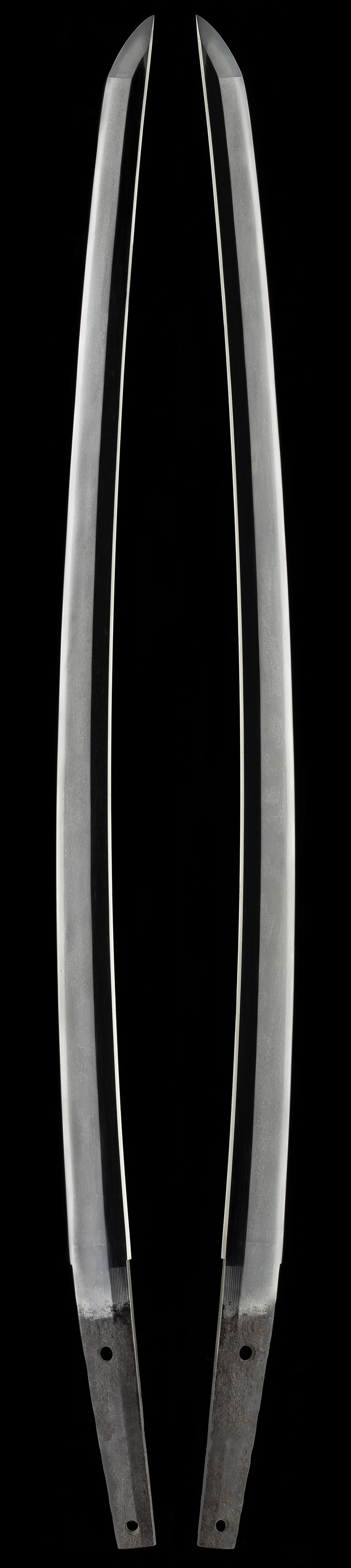
The characteristic hand is read first in the temper. Over the body of his signed Kunitomo sets a mixed only with , the calm, restrained line of early , into which enter and ; the lies deep with , and run through it, and here and there the line softens into . This is the opposite pole from the clove-flower flamboyance of contemporary , a quiet edge whose interest is carried in the activity within rather than in the height of the pattern. is the constant note, appearing on every blade of his on record, the bright lightning line that marks his deep-, temper.
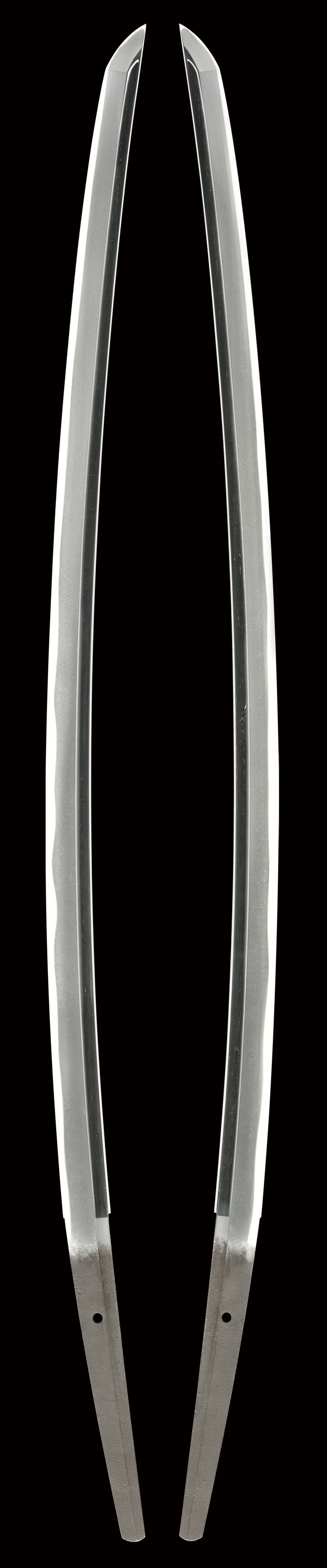
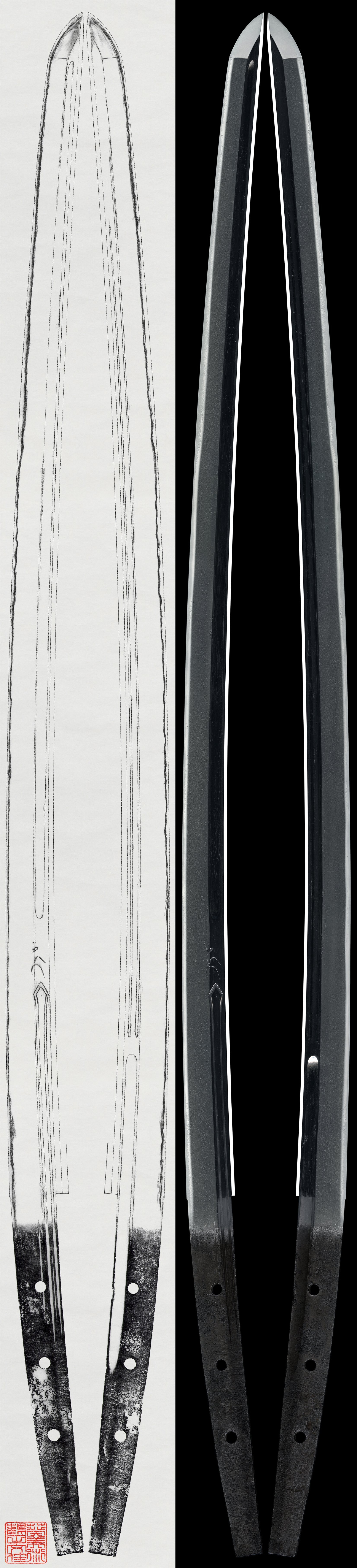
The is the school's signature and the surer half of the recognition. He forges a tightly packed that takes on a -like refinement, in places mixing flowing grain and patches of larger , with fine well adhered and the steel clear and bright; on the the close shows entering the . Over so refined a base the reads with particular clarity. The answers the quiet temper, running straight to a , or straight to a -like point with at the tip, and on the signed prime a is carved on the .
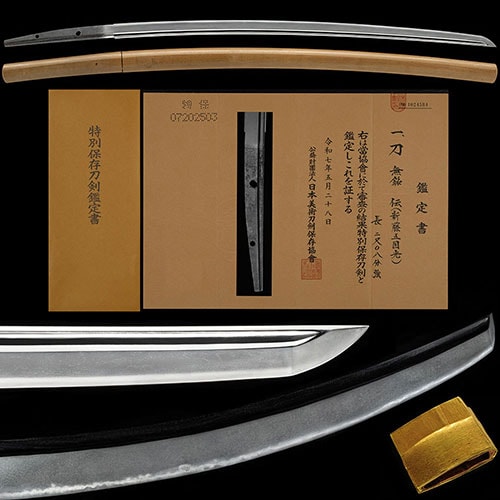
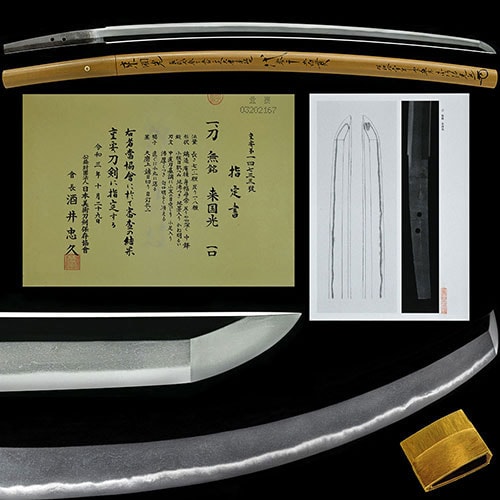
His record divides cleanly into two faces. The first is the , two-character signed , the signature finely cut on the toward the , slender with high , marked and a small , the elegant shape of the period preserved in its original tang. The second is the appraised as his work, slender and dignified in the register, its forging the finely worked and its temper the base with and mixed in. Securely signed examples are the heart of the scholarship around him: the published sources state plainly that "extant works securely bearing his signature are exceedingly few", counting little more than the preserved at Atsuta Jingu and the pieces designated in modern times.
What sets Kunitomo apart is exactly what the judges name. He is held apart from the showier schools by the restraint of his and the refinement of his -like , the quiet, precise Yamashiro hand rather than the decorative one. Within his own house he stands at the head of the brothers, beside Hisakuni and Kuniyasu, and his manner is of a piece with the calm, exacting workmanship the line would carry to its summit. The yardstick the published sources reach for is the Atsuta : of his finest signed piece they judge that "in overall workmanship as well as in the manner of the signature it is extremely close to the example at Atsuta Jingu", and they call it a work in which "the merits and elevated dignity of the early school are superbly displayed".
For the collector Kunitomo is a rare early name held very largely out of reach. The Toko Taikan places him high among rated smiths. He has no National Treasures; his record runs through an Important Cultural Property, two pieces at the rank, and a prewar Bijutsuhin, and the published commentary calls one of the signed "valuable as one of the few signed works". The surest of his signed pieces, the Atsuta Jingu , is an Important Cultural Property and remains as patrimony; the Bijutsuhin signed is held by the Kurokawa Institute of Ancient Cultures, and the signed pieces otherwise pass through long-held private hands of recorded whereabouts. With only a couple of blades in the and tiers and securely signed works numbering only a handful in all, a signed Kunitomo comes to market only very seldom, and a privately held example is among the rarest things an early- collector could encounter, a document of how the school began.