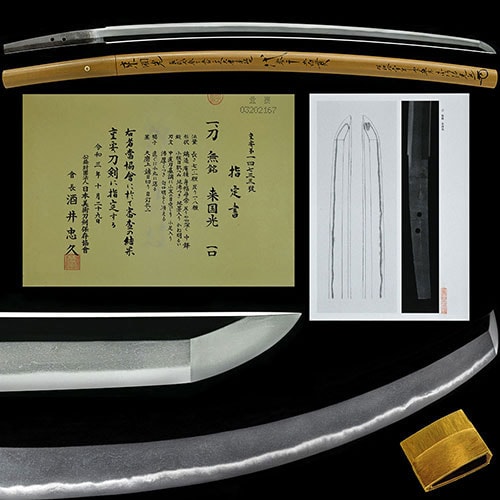
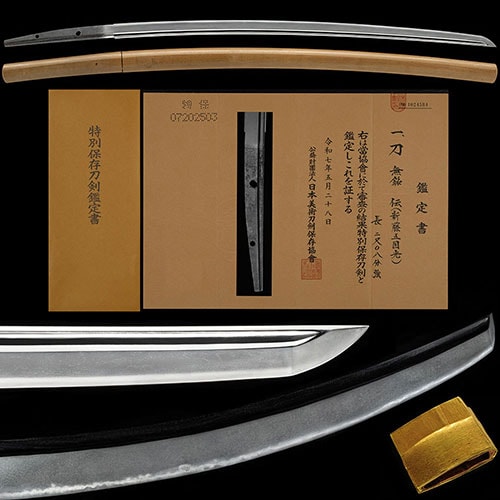
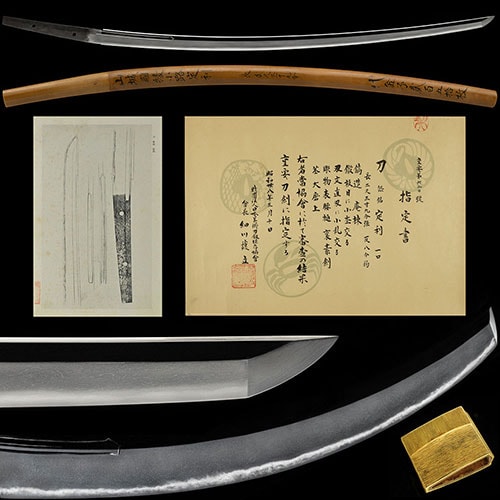
Of the works that survive under the name of Kunihide, almost all that carry a genuine signature are spears. The published sources count only two such signed and have seen no securely signed , so that the smith is known in the main through greatly shortened, unsigned later appraised to him. He stands among the rarest of the hands of Yamashiro, transmitted as the son or disciple of Kunitsugu, said to have taken the appellation Hikotaro (来彦太郎), and placed by the reference works around the Jowa era (貞和) of the period. The picture is complicated by a second smith of the name whom the assign to the close of around the Shitoku era (至徳), and by a -period Kunihide of the line; clarifying his manner and dividing the first generation from the second are named in the published record as questions for future study. He is, in short, a documented but lightly attested late- master, recognized more by the company he keeps than by his own surviving signatures.
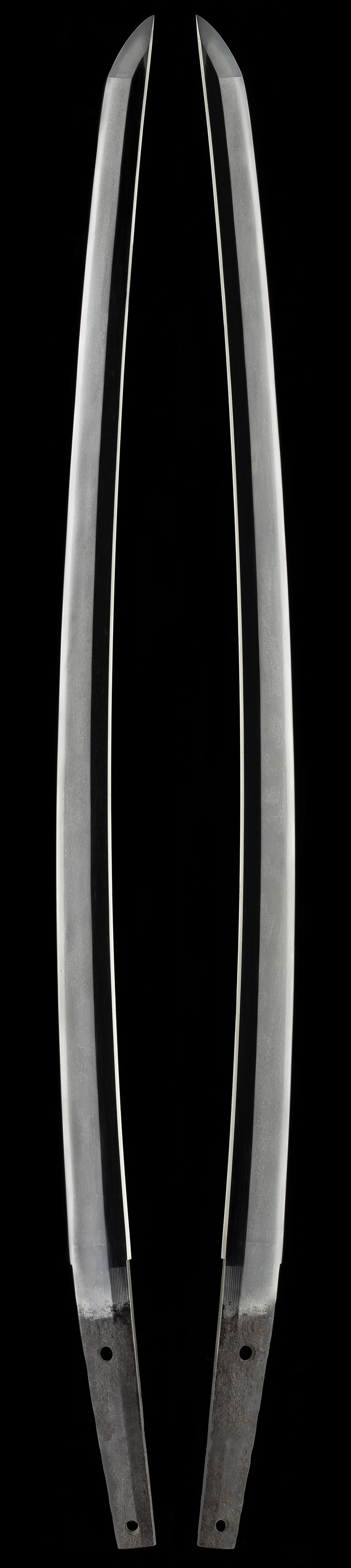
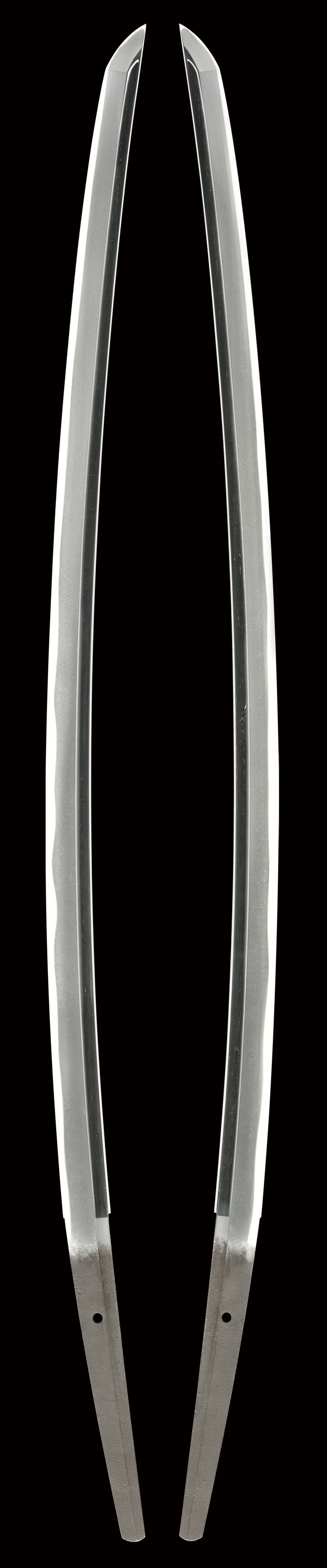
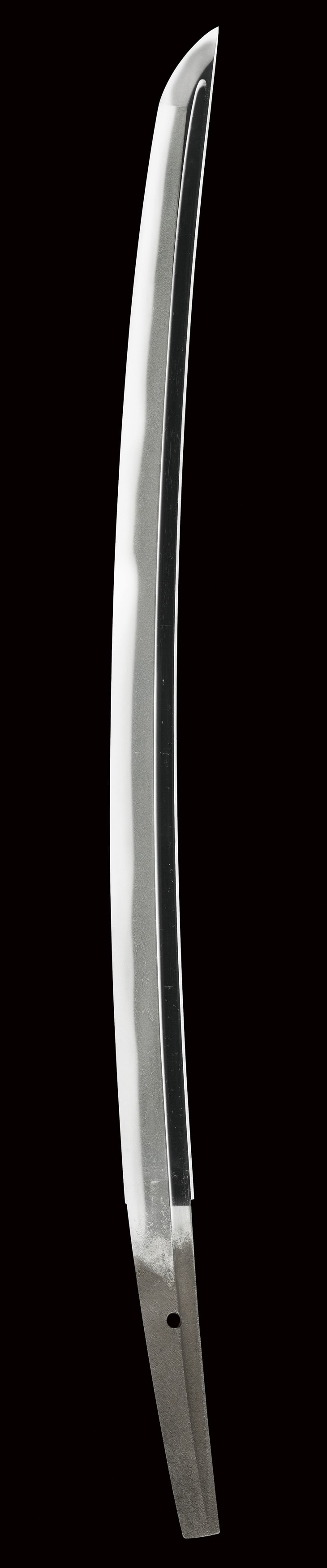
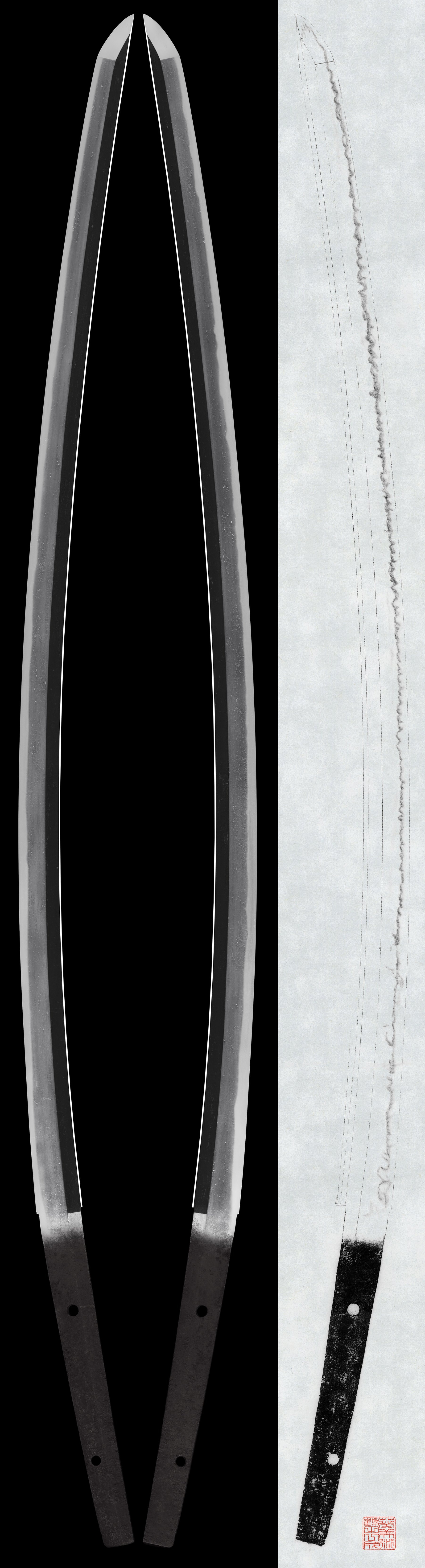
His characteristic hand departs from the plain . Over the temper line he keeps a base, but breaks it: enter, with and, on the broader , and the occasional (尖り刃), the in places tightening into a complex small pattern. Long, thick reach into the , are mixed in, the runs deep and the attaches thick, sometimes coarsening to a rough -kobore, with and throughout and, along the of the largest blades, (打のけ) and small (湯走り). The stays bright and clear, and the runs straight into a , brushed with (掃きかけ) and turning back only slightly. It is a hand that holds the brightness and the steel while carrying more disturbance in the edge than the school's quiet straight temper, and that added is what most distinguishes his from an ordinary blade.
The is the inheritance kept intact. He forges an , on the finest blades a , that tends to flow and on occasion to stand a little (肌立ち), with mixed in; over it the adheres thickly in fine particles and the (地景) enter, fine and frequent. On the signed spears the leans further toward and and carries a (沸映り), a faint reflection standing in the steel. This is the Kyoto of the school carried into the wide, extended body, and on the unsigned it is precisely the combination of that refined, -laden with the bright, busier that the judges read as before narrowing the attribution to Kunihide. The work is sound in both and , and the published sources call the strongest of these blades a particularly superior example among those appraised to him.
His surviving record divides cleanly into two kinds of object. The first is the signed , (平三角) in section with a conspicuously long kerakubi in the manner, a broad groove cut on the flat, and a large three-character signature on the tang. On these the -leaning carries the , the breaks into with along the , and the is bright; the published sources stress that genuine signed work runs almost entirely to these spears and that, with so few extant, the signature itself is the prize, observing that a is in any case scarce, that 「南北朝期の槍はごく少ない」 and that works by this maker are themselves rare. The second kind is the greatly shortened unsigned , wide in the body with a carried long, sometimes an , the period plain in the shape; these make up the larger part of the designated record. The one signed stands apart from both: it bears a finely chiseled two-character signature, Kunihide, set toward the , which as the published sources note carries 「一般の来物のように「来」の字を冠していない」, and on the strength of its wide, extended form it is appraised to the Kunihide rather than to the homonym.
Within the school he is placed just below his master, and the distinction is drawn with unusual precision. A wide unsigned of his calls Kunitsugu to mind at first sight, the working range so close that the resemblance is the starting point of the appraisal; but on close examination it is judged that 「一見、来国次を想わせるものがあるが、総体に格調の点で聡かそれに譲るところがあり」, and on that small remove in dignity (格調) the blade settles to Kunihide of the lineage. His own affirmed traits carry the contrast: the base broken by (互の目) and (丁子), the bright , the and the -laden are what set his apart, not any single missing feature, and the traditional attribution is found convincing on those positive terms. Reading the other way, because his securely signed work is almost all and no certain signed survives, a plain straight temper can in turn be mistaken for his, which is why the wide and the added matter so much to the judgment.
For a collector the arithmetic is stark and is best stated plainly. The whole of his designated record on the official rolls amounts to seven blades, all at the level of , with none yet raised to the tier and none on the higher rolls of designated cultural property; he is rare rather than canonical, a connoisseur's name rather than a museum's. None of the seven carries a recorded line of provenance, so there is no roll to recite, and the genuine signed survivals, the two , are documentary anchors more than things likely to circulate. What a patient collector might realistically encounter is one of the shortened unsigned appraised to him, and even those come forward only rarely, a attribution of real interest when one does. The published sources, noting that 「在銘の現存するものが少なく」 and that the division of the generations remains unsettled, make the point themselves: this is a master glimpsed at the edge of the record, his hand surer than his biography, and an example bearing his name is among the quieter rewards of attention to the late Yamashiro tradition.