NihontoWatch MonNihontoWatchBETA
MarketEncyclopedia
NihontoWatch Mon

NihontoWatchBETA

Market
Encyclopedia
Overview·Kantei·Designations·Blade Forms·Signatures·Lineage·School
OverviewKanteiDesignationsBlade FormsSignaturesLineageSchool
  1. Schools
  2. Rai
  3. Tomokuni

Rai Tomokuni

倫國

Jūyō
Vol. 19, No. 21 · Wakizashi

Rai Tomokuni

倫國

5 ranked works

ProvinceYamashiroErac. 1334–1370PeriodNanbokuchōSchoolRaiTraditionYamashiro-denGeneration1stTeacherKunitoshiFujishiroJo sakuToko Taikan750(top 15%)TypeSwordsmithCodeTOM432
5Jūyō Tōken

Overview

Tomokuni is handed down as the son of Kunitoshi and, on one account, the younger brother of Kunizane, which sets him within the second great generation of the Yamashiro school and makes him a near kinsman of Kunimitsu. He is a minor master of that house, and the chief fact of his record is its scarcity. The published sources report no under his name, only a handful of short and small , and even those are few, so that almost the whole of his designated body is carried to him by old appraisal. From what survives the sources read two Tomokuni, an earlier hand in the circle of Kunitoshi and a second working in the period to whom most existing blades are assigned, and they ask whether that second smith is the Tomokuni recorded under the Bunna era of the old sword registers, leaving the question open to further study. He is thus less a documented individual than a name read off a small group of late blades, and the interest of those blades lies in how they part from the rest of the school.

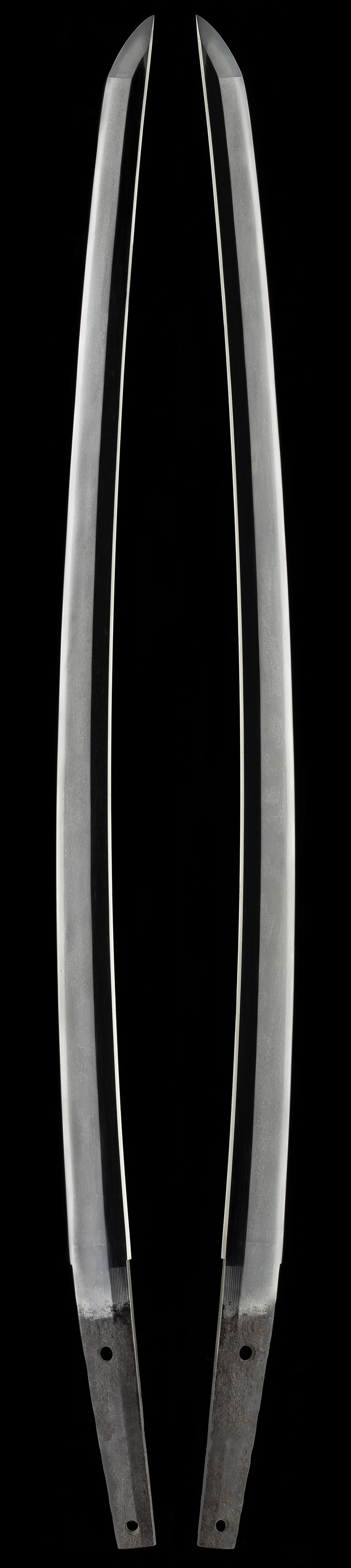
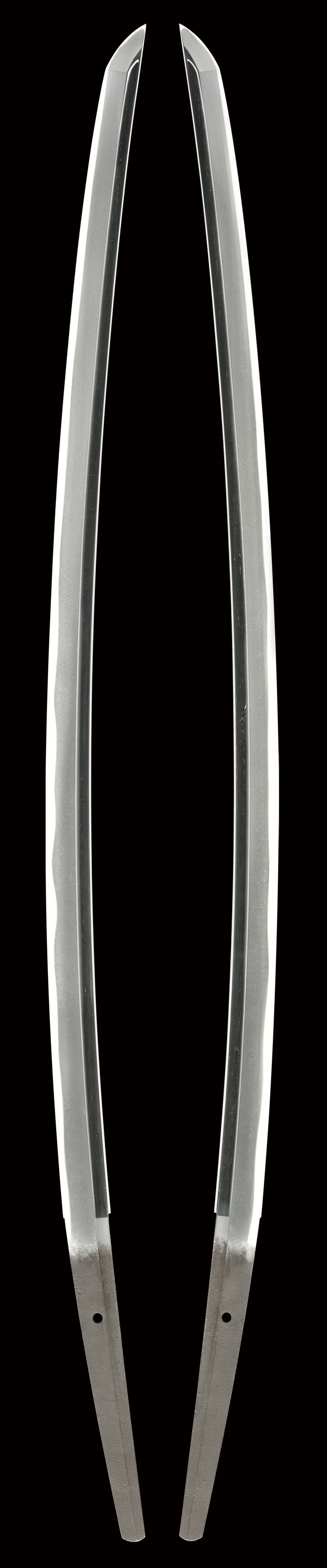
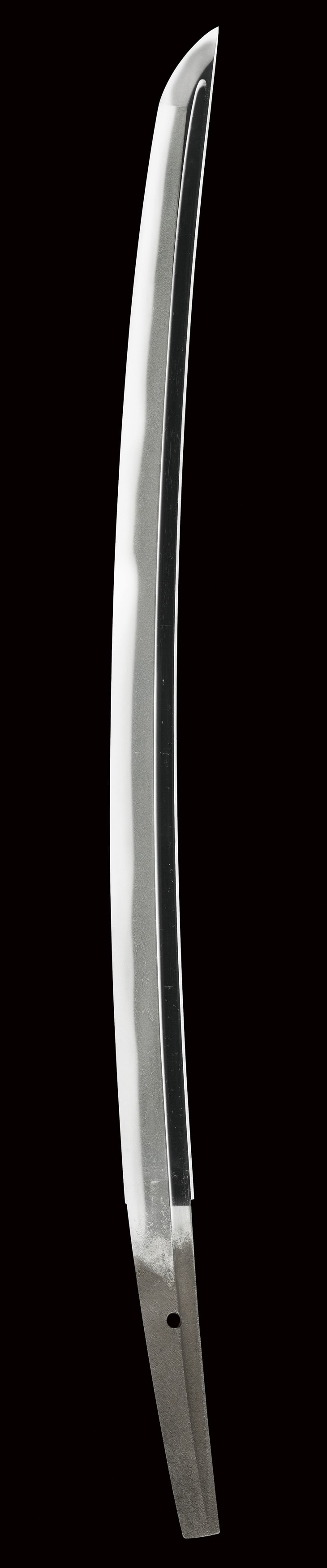
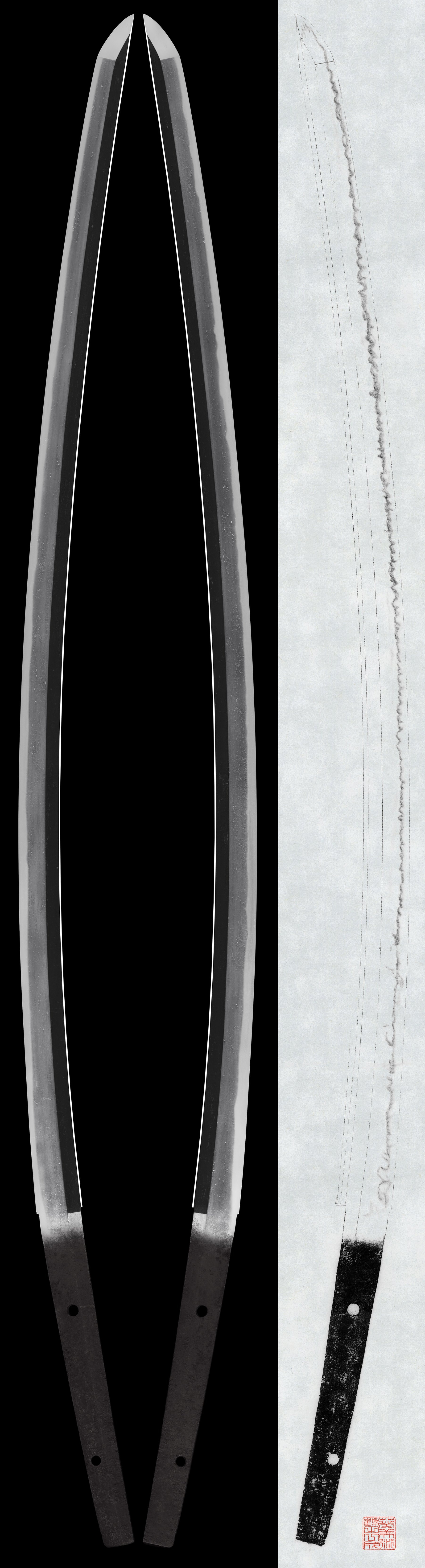
That parting is stated plainly. The published sources say his work differs somewhat from Kunitoshi (来国俊とはやや作風を異にして), the broad, the a standing stronger than is usual among the school's makers, and the temper a -toned in place of the calm that is the hallmark. Every one of his blades carries that notare base mixed with , here and there small , deep in with the well applied, and into the run and , and , with drifting and detached , and burning along the back. The is bright. The shape fixes the period at a glance, a wide, thin, of shallow that the texts read at once as work, with the one piece cut down to a . His is a worked, -laden set on a , and that combination, more than any single feature, is what a Tomokuni blade looks like.

The beneath the temper is what keeps the name. The is an , on the finest a closely packed, with adhering well and on one blade thick, entering and a faint standing on two of them. The steel neither whitens nor sinks as a northern would; it holds the clear, -covered surface of Yamashiro work, and the published sources read the school in it directly. The answers the disturbed , running in as a or, on the broadest blade, sweeping straight with and pointing faintly before a long return, while the small turns close the quieter pieces. The keep the school habit, with and a , and , twin grooves and a cut on these small blades. On each blade the judgment closes in the terms, that the shape shows the period and the and show the school, so that on one the sources find the school's traits present and the Tomokuni attribution sound (来一派の特色があり、来倫国の所伝はよい).

The rarity of his signed work is the spine of the scholarship. Because so little is signed, the published sources build the second-generation reading on style rather than on inscriptions, and the argument turns on the departures that mark his hand. On one they observe that the wide , the unusually strong for the school, and the -toned carry a strain that connects to (一脈信国に通じるものがある), and reason from exactly this difference that a distinct second generation may stand behind the name, perhaps the Bunna-era Tomokuni of the registers. The form keeps to the small end of the range. The two signed pieces and four among the blades are short and , never the the older masters are known by, and the one signed example wears a rather than a chiselled signature. He is, in short, a smith reconstructed by appraisal, the most exactly knowable thing about him being the manner itself.

That manner places him at the school's edge, where the line opens toward the -influenced styles of the day, and his brother stands at the edge. On the broadest blade the published sources turn to Kunizane, handed down as Kunitoshi's pupil or as his son and Tomokuni's elder brother, and note that some of Kunizane's signed work takes on a cast and comes near to Hasebe (皆焼風をおびて長谷部に近似した出来口のもの). Tomokuni's own departure runs the direction without going so far, his stronger and his reaching toward while the holds him to Kyoto. What sets him apart within his own house is therefore positive and grounded in his blades: a that stands where the school's lies flat, a where the school keeps , and a activity of , , and richer than the quiet temper. It is by these, not by any borrowed resemblance, that a wide blade is returned to Tomokuni rather than read past him.

Almost the whole of his record is attributed to him by old appraisal, and his connoisseurship standing reflects a sound but modest hand, rated Jo- with a Toko Taikan valuation in the middle range. A small group of his blades has reached the rank, and beyond them a scatter of works survives only in the research record, two of them held by the Tokyo National Museum and the Kurokawa Research Institute while the rest stay in private hands, with no provenance preserved among them. The published sources single out the best of the pieces for the soundness of both and , calling the broadest an elegantly finished sword without flaw in or (地刃共に破綻のない上品にまとまった優刀である). A Tomokuni is not a National Treasure held forever beyond reach, but neither is it a sword that comes readily to market. The surviving body is small, most of it is held rather than traded, and a signed example is rarer still, so that a private blade by this name is among the less common things a collector of the school could expect to encounter, met with patience rather than sought to order. For a student of how the Yamashiro line bent toward the new manner without leaving its own behind, his few wide, -laden blades are the place where that turn can actually be seen.

Kantei

a rare Rai master read in one Nanbokuchō manner against the school ground: the characteristic Tomokuni hand of a wide, sun-nobi hira-zukuri shape with a ko-notare-and-gunome midareba in deep nioi and abundant nie, kinsuji, sunagashi, tobiyaki and muneyaki; under it the Rai-school ground of itame with ji-nie, faint nie-utsuri and chikei that the attribution turns on; and the lineage-edge note the sources raise themselves, a kitae standing stronger than usual for Rai and a notare midare that connects toward Nobukuni and, through his brother Kunizane, toward Hasebe.

Tomokuni is a minor master of the Yamashiro school, handed down as the son of Kunitoshi and the younger brother of Kunizane, and so a near kinsman of Kunimitsu. His signed work is rare in the extreme. The published sources record no under his name, only a handful of short and small , and even those are few, so that almost the whole of his designated body is attributed to him by old appraisal. From these the sources read two Tomokuni: a first generation in the circle of Kunitoshi, and a second active in the period to whom most surviving work is assigned, a smith the texts tentatively connect to the Bunna-era Tomokuni of the old sword records. What sets his work apart from the rest of the school is plainly stated. He departs somewhat from Kunitoshi, the published sources say, the broad, the a that stands stronger than is usual for the school, and the temper a notare-based rather than the school's quiet , a manner in which the texts find a strain that connects to . Over a wide, thin, body of unmistakable shape he forges an with , faint and , and tempers a mixed with in deep and abundant , the carrying , , , and , the bright. The ground holds the school traits the appraisal turns on, and the published sources judge his old attribution sound.

Diagnostic discriminators

unique vs the Rai school baseline (quiet suguha / ko-midare)

unique vs the Rai school baseline (tightly packed ko-itame, calm surface)

Observation by phase

The characteristic Tomokuni hand (Nanbokuchō notare-midare)

The published sources draw the second-generation Tomokuni apart from the rest of the school in the breath that they attribute his blades. He departs somewhat from Kunitoshi, they say: the is broad, the a that stands stronger than is usual among the school's makers, and the a -toned rather than the school's quiet . The shape is the tell that fixes the period, a wide, thin, of shallow that the texts read at once as work, with the one piece reshaped to . Over it the temper is a mixed with , here and there small , deep in with well applied, the carrying and , , , and drifting and , with burning along the back and a bright . The answers the disturbed , running in as a or, on the broadest blade, sweeping straight with and pointing faintly before a long return. The published sources find in this notare-based a strain that connects to , and reason from it that a distinct second generation may indeed stand behind the name.

Sugata 姿
Jigane 地鉄
Hamon 刃文
Bōshi 帽子

The Rai-school ground (what the attribution turns on)

What holds a wide, -laden blade to the name is the ground beneath the temper. The published sources return to it on every one of his blades: the and show the school's traits, they say, and on this footing the old Tomokuni attribution is judged sound. The is an , on the finest a closely packed, adhering well and on one piece thick, with entering and a faint standing on two of them. The steel does not whiten or sink as a northern would. It keeps the clear, -covered surface of Yamashiro work, and the appraisal reads the school in it directly. The carry the school habit as well, with , and , a , twin grooves and a cut on these small blades. The published sources frame the whole judgment in the terms each time: the shape shows the period, the and show the school, and the handed-down attribution to Tomokuni is well borne out.

Jigane 地鉄
Hamon 刃文

The lineage edge (Nobukuni, and through Kunizane toward Hasebe)

The third aspect is not a separate manner but the reasoning the published sources build on the first two. Because Tomokuni's stands stronger than the school's and his temper runs to a , the texts place him at the lineage's edge, where the manner opens toward the -influenced styles of the day. On one the published sources state it directly: the wide , the ground unusually strong for the school, and the -toned carry a strain that connects to , and it is from this difference that they argue for a distinct second generation, tentatively the Bunna-era Tomokuni of the sword records. The body of work draws in his brother. On the blade signed in the broadest hand the published sources turn to Kunizane, handed down as Kunitoshi's pupil or as his son and Tomokuni's elder brother, and note that some of Kunizane's signed work takes on a cast and resembles Hasebe. Tomokuni stands beside that kinsman at the edge of the school, the place where late work and the new flamboyance meet, and his old attribution is read against exactly this family setting.

Jigane 地鉄
Hamon 刃文
Scholarship

The published sources define Tomokuni as a smith of the Yamashiro Rai school handed down as the son of Rai Kunitoshi, the younger brother of Rai Kunizane, and a kinsman of Rai Kunimitsu, whose reliably signed work is rare in the extreme, only a few short tanto and small wakizashi and no tachi. They read two generations of the name, an earlier Tomokuni in the circle of Kunitoshi and a Nanbokuchō second generation to whom most surviving work is assigned, and ask whether that second hand is the Bunna-era Tomokuni recorded in the old sword registers, leaving the question to further study.

Designations

Kokuhō—
Jūyō Bunkazai—
Jūyō Bijutsuhin—
Gyobutsu—
Tokubetsu Jūyō—
Jūyō Tōken5

Elite Standing

0.03 across 5 designated works

Top 25% among smiths

Blade Forms

Distribution across 5 ranked works

Signatures

Signature types across 5 ranked works

Currently Available

Lineage

TeacherKunitoshi
Tomokuni
Students (2)
  1. 1.Kunizane國眞1 for sale26designated
  2. 2.Kunimune國宗1designated

Rai School

Other artisans of the Rai school

  1. 1.Kuniyuki國行1 for sale125designated
  2. 2.Kunitoshi國俊84designated
  3. 3.Kunitoshi國俊5 for sale208designated
  4. 4.Kunimitsu國光4 for sale269designated
  5. 5.Kunitsugu國次2 for sale65designated
  6. 6.Mitsukane光包15designated
  7. 7.Kunizane國眞1 for sale26designated
  8. 8.Kunihide國秀7designated
  9. 9.Kunimune國宗1designated
  10. 10.Kunisue國末1designated
  11. 11.Mitsushige光重2designated
  12. 12.Kunitake國武1designated