Edo was the sword’s age of connoisseurship: the Hon’ami appraisers, the shogunal register of famous blades of 1719, and a thriving literature turned the sword into an object of study even as it ceased to be drawn in war.
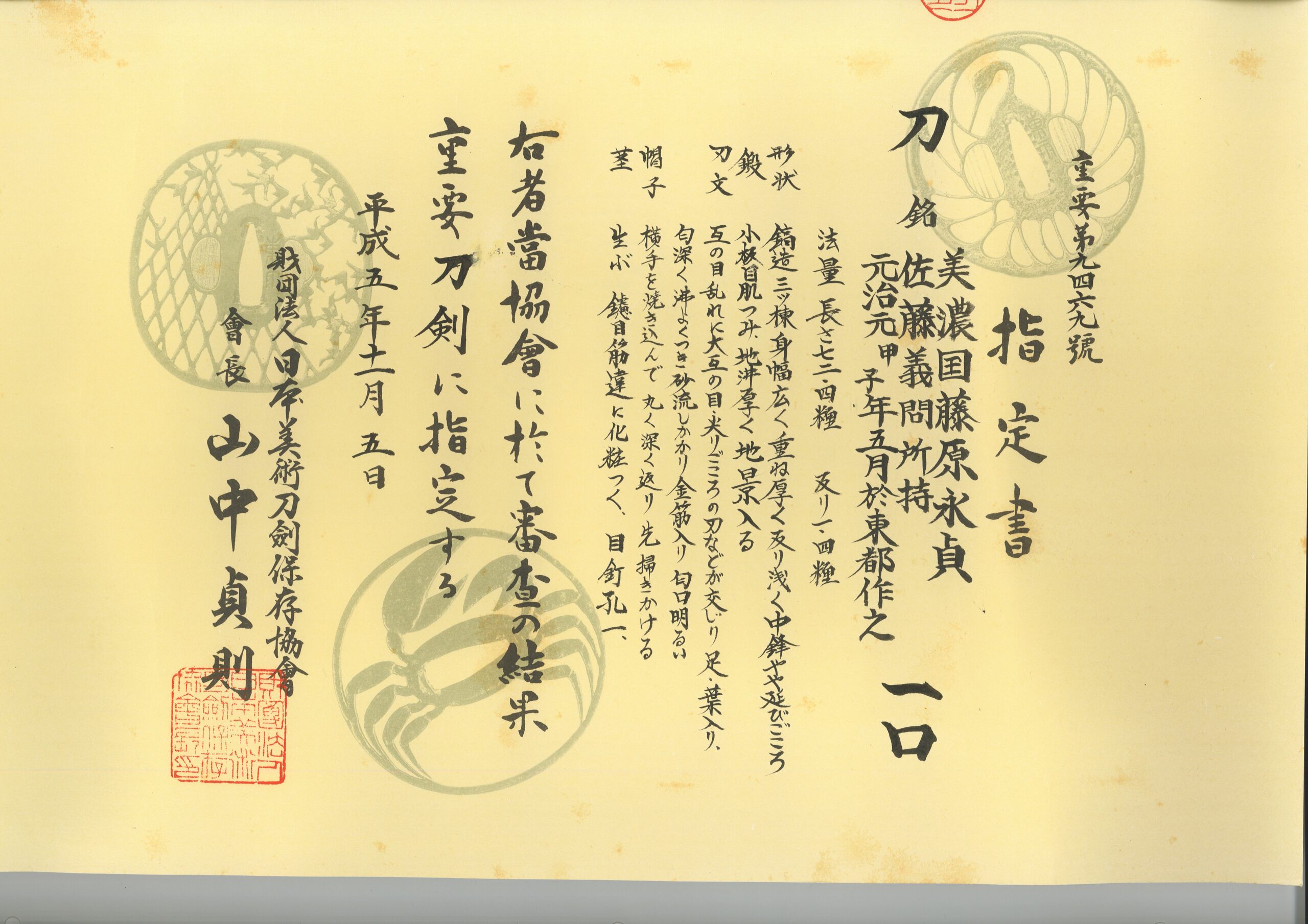
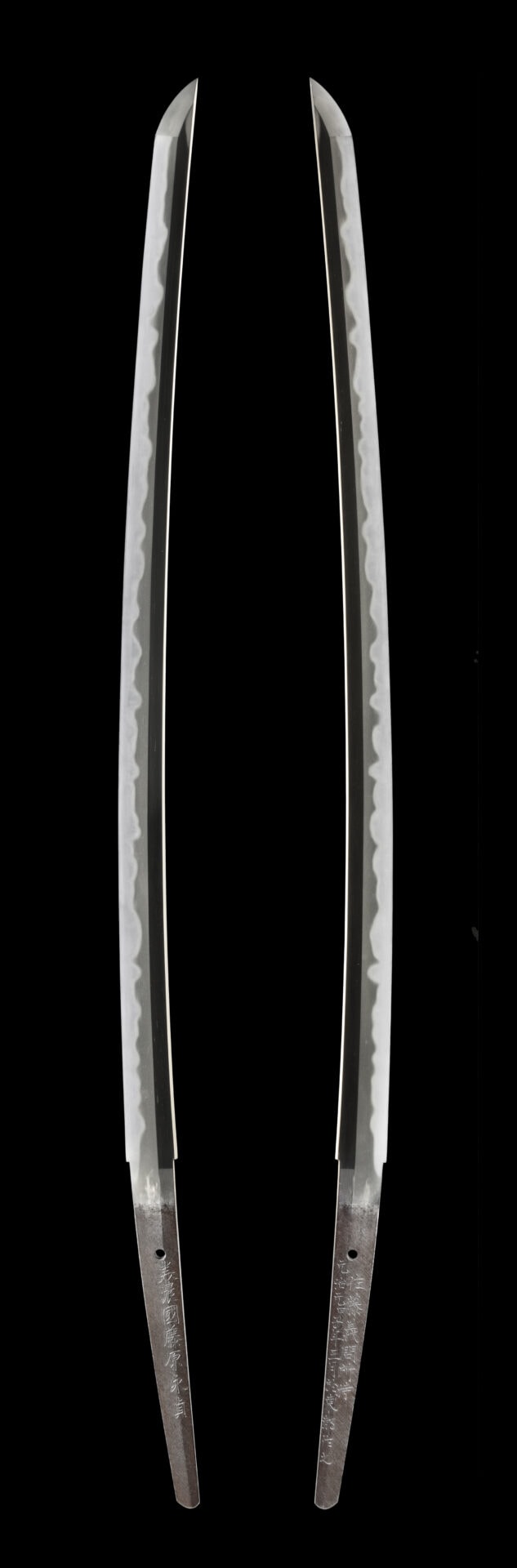
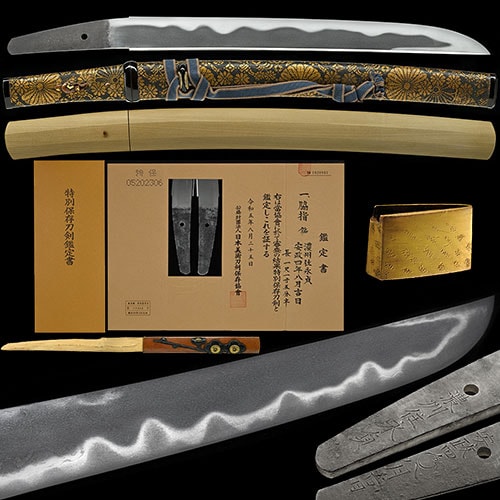
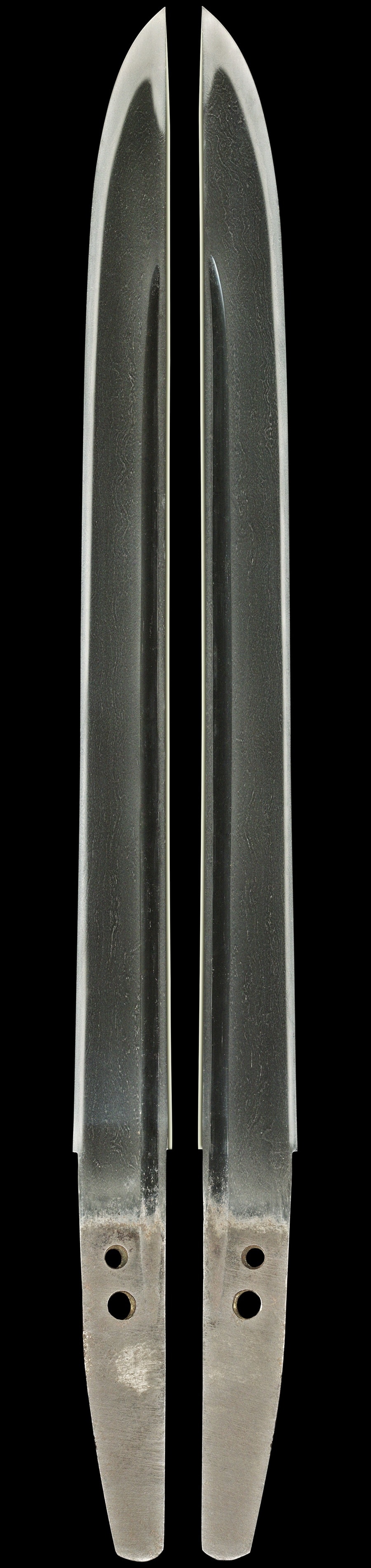
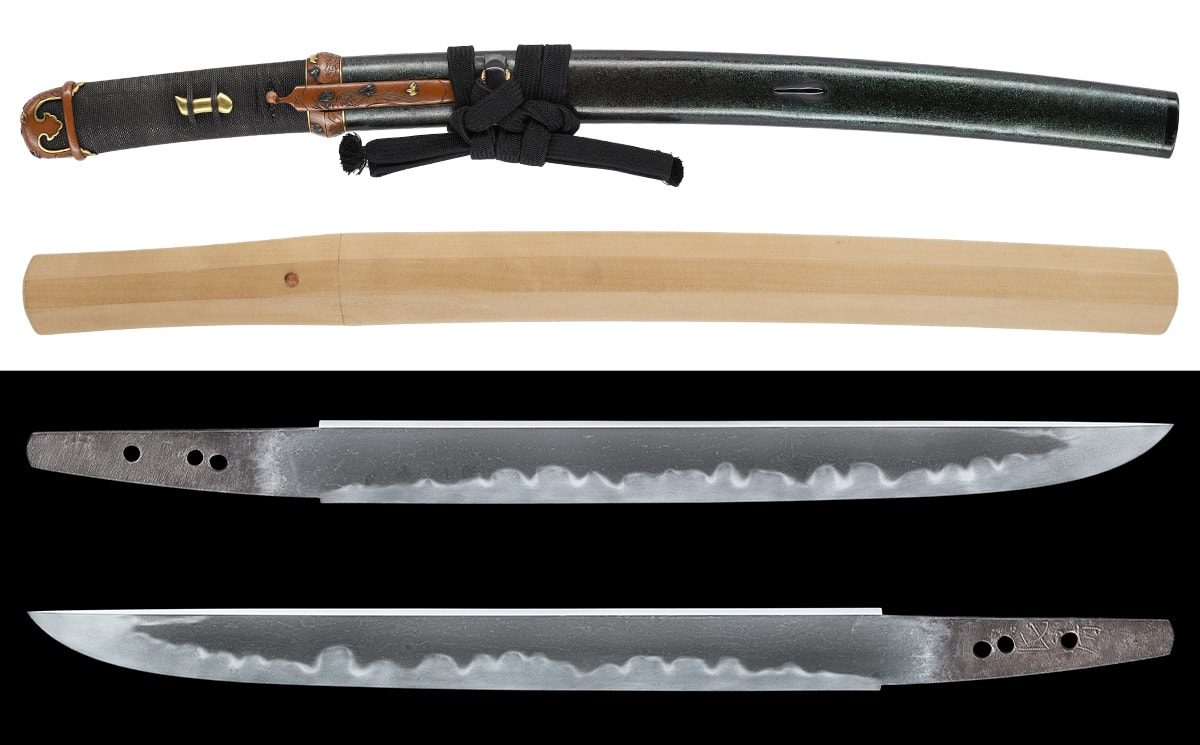
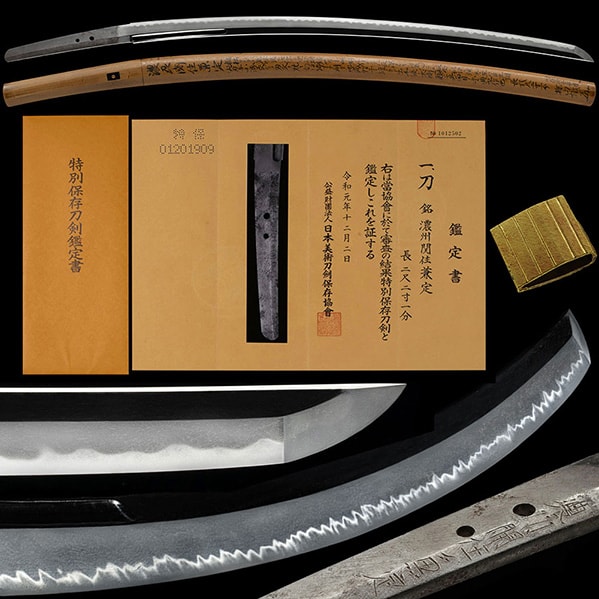
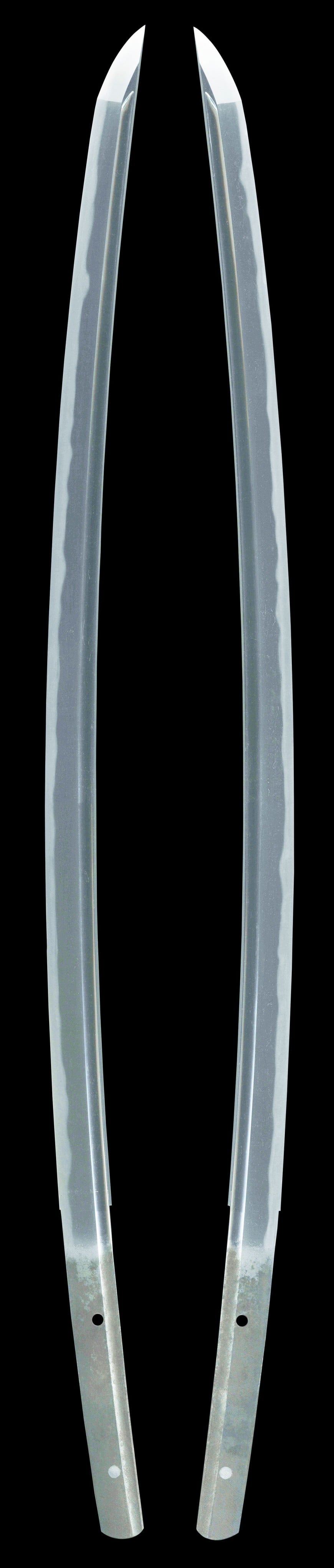
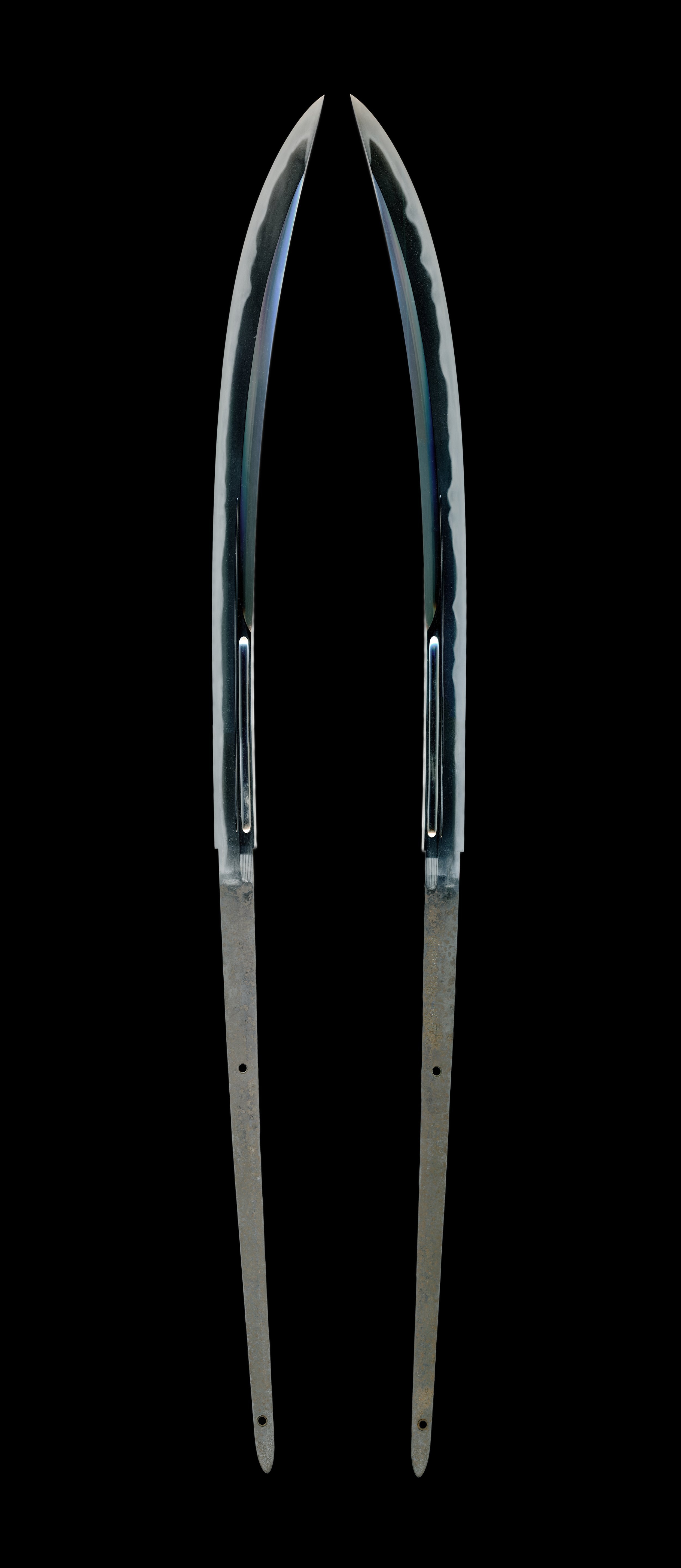
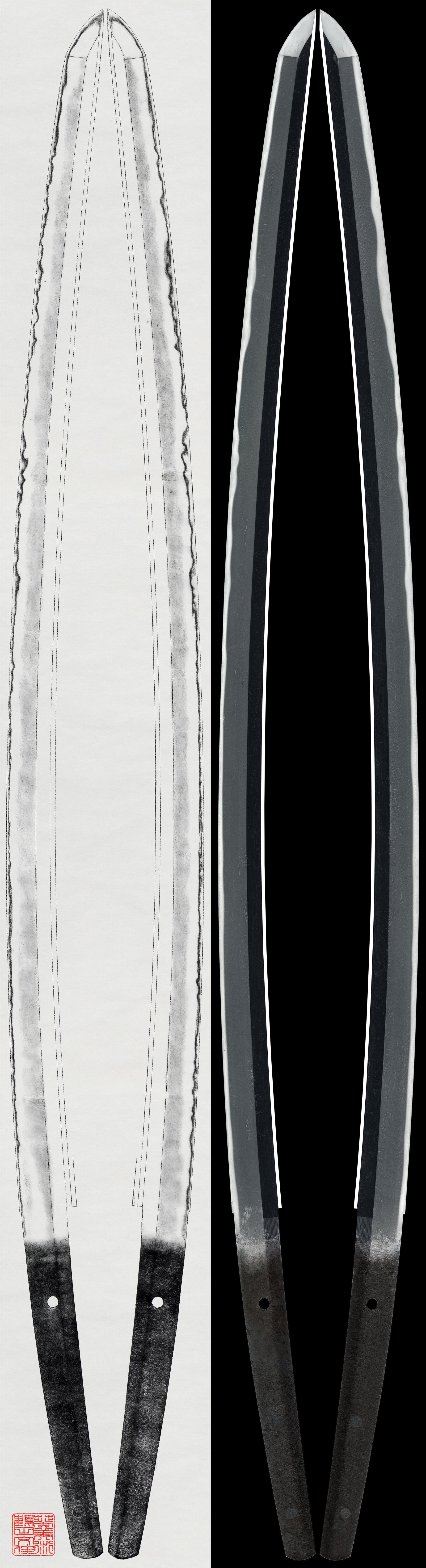
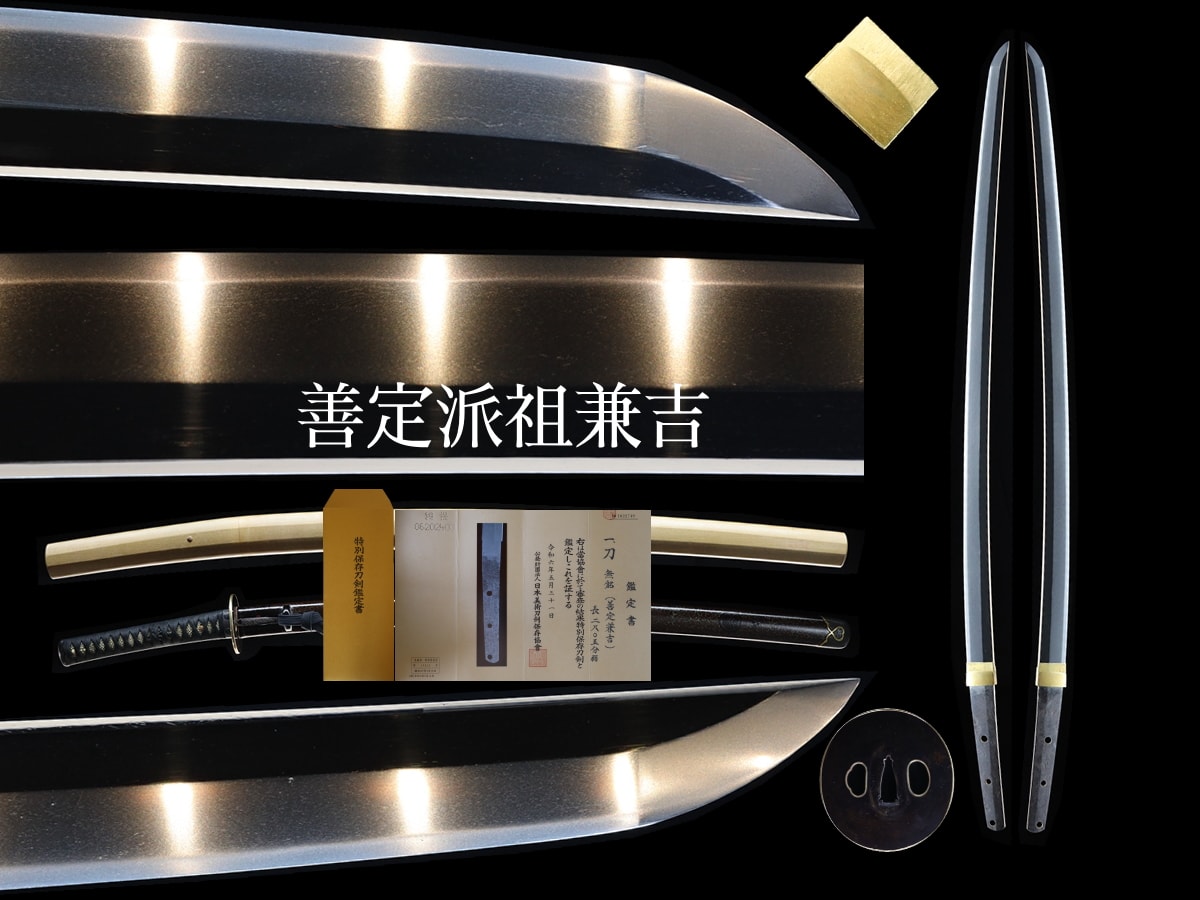
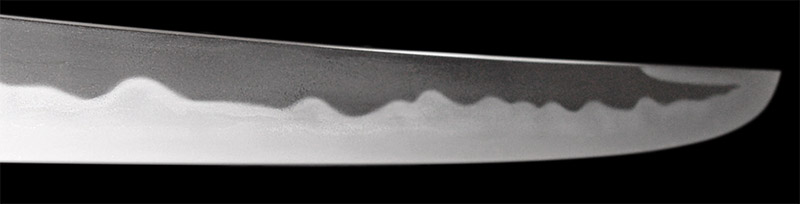
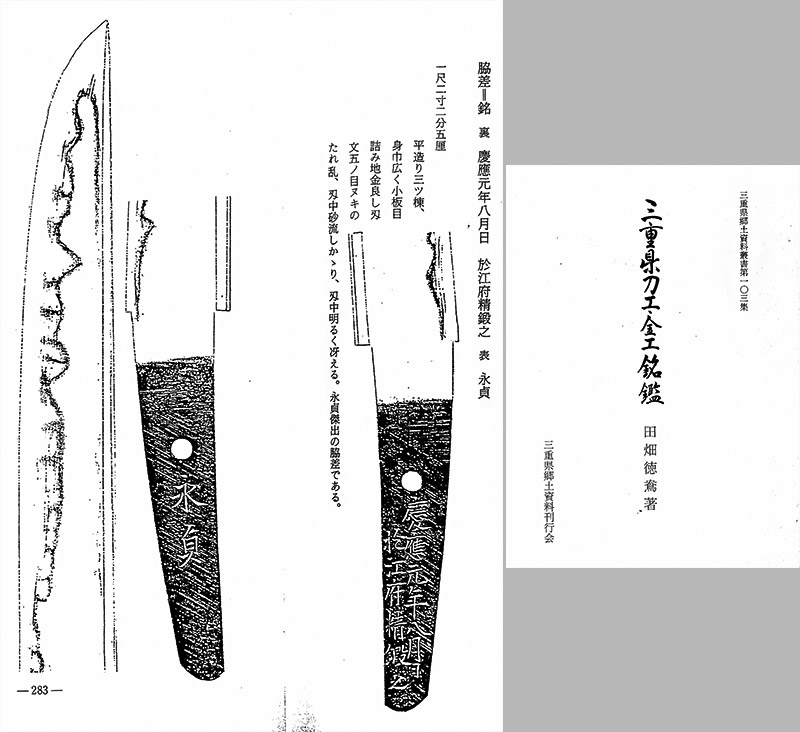
This is a wakizashi made by Nagasada from Mino province during the late Edo period (1865). The blade features a choji midare hamon and a ko-itame jigane. It comes with a Tokubetsu Hozon certificate from the NBTHK and is recorded in the Mie-ken toko, kinko meikan.
 NihontoWatch
mei · Koka (1844-1848) · nagasa 37.4cm · sori 0.5cm


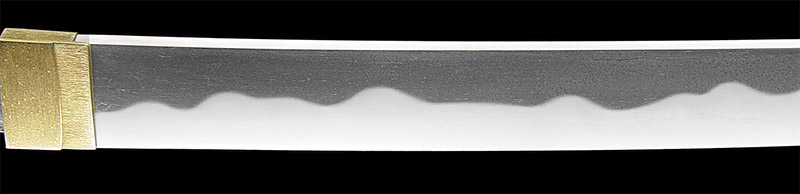
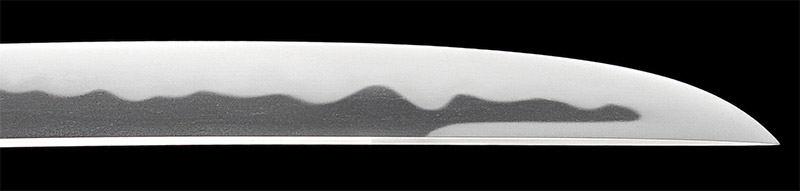
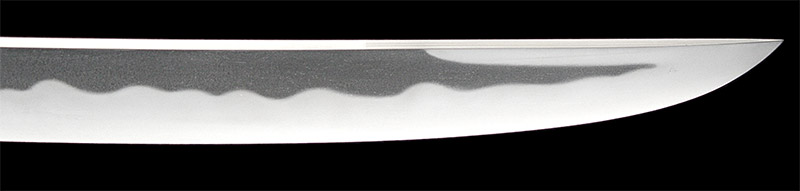
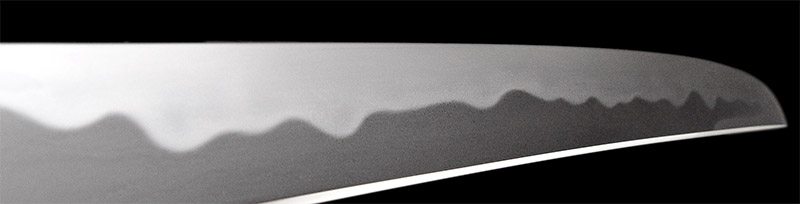

Seki (Mino), shinshinto · Mino · around 1862-1866
6 pieces on the market now
Nagasada signed himself Okatsuyama-roku Fujiwara Nagasada and gave his personal name as Matsui Jiichiro. He was born in Bunka 6, the year 1809, in Fuwa District of Mino Province, the son of Matsui Naosaburo, and the published record traces a working life that moved across three provinces: for a time he served the Tokugawa house of Kishu as an official smith, around Man'en 1 he forged at Tamaru in Ise, and from about Bunkyu 2 he settled at Aoyama in Edo, where he made swords until his death in Meiji 2 at the age of sixty. The place-name Okatsuyama that recurs in his signatures refers to a locality north of Omotesa in his native district, the place from which he took his swordsmith's name. His dated blades fall within the closing years of the Edo period, a katana of Keio 1 finely forged at Edo among them, and they place him squarely in the shinshinto revival rather than in the Sue-Seki of the old Mino tradition from which his school name descends.
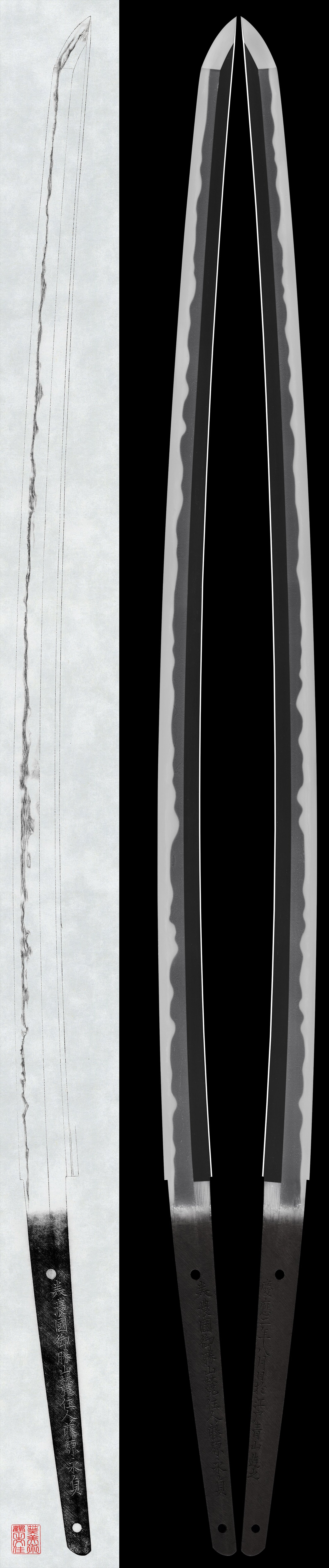
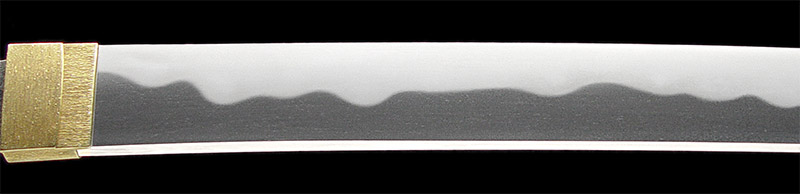
His characteristic hand is a bold, broad-bladed katana built to the heroic proportions the late-Edo smiths favoured: a wide mihaba carrying little taper from base to tip, a thick kasane, a shallow sori, and an extended chu-kissaki, the whole given a stout and magnificent bearing. Set over this construction is a flamboyant gunome-midare into which large gunome, round-headed gunome, small gunome and occasionally pointed elements are mixed. The published sources describe the pattern as華やかに乱れ, a brilliantly animated midare, with ashi and yo entering vigorously, the nioi deep and the nie adhering well and evenly, some of it coarser; over and through the temper run frequent sunagashi, kinsuji and long nie-suji, and the nioiguchi is bright. One feature is so constant across his recorded work that the judges single it out: the mitsu-mune back, a three-surface ridge that one of the published commentaries names as この工の見どころ, the point of interest particular to this smith[[c:1]].
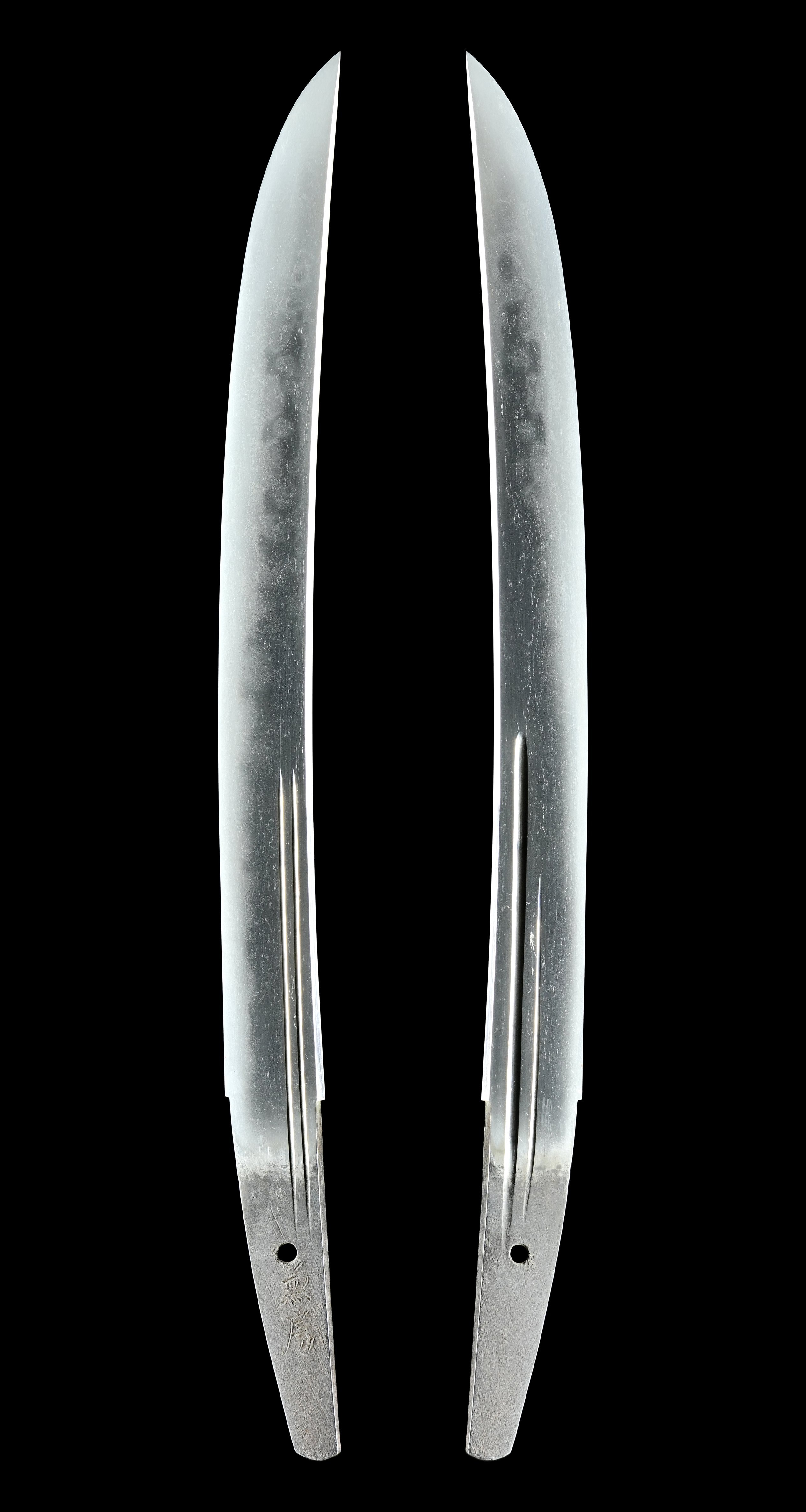
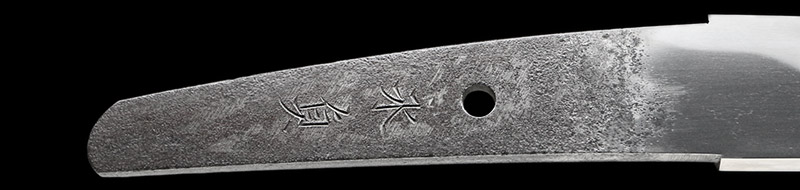
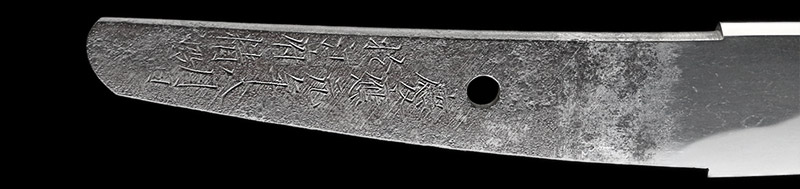
The jigane beneath that temper is a close itame, drawn tight and at times mixed with ko-itame and mokume, over which the ji-nie lies thick and fine chikei enter; on the longest of the recorded blades the grain stands a little open toward the koshimoto, but the prevailing impression is of a dense, well-forged jigane. There is no utsuri here, as there would be in a Bizen or Yamashiro ji; the brightness of his work comes instead from the depth of the nioi and the evenness of the nie. The boshi answers the temper below it, running straight or with a shallow notare and turning back in ko-maru, the very tip swept into hakikake, and on occasion tempered deeply through the yokote with a returning kaeri; one blade shows tobiyaki and muneyaki where the hardening spills onto the back near the monouchi. The nakago is ubu on every example, finished with a ha-agari kurijiri and o-sujikai file marks dressed with kesho, and carries the long signature that gives his full style and, on the reverse, the date and the place of forging.
The corpus that survives in the designated record is uniform in manner, all of it signed katana of his Edo maturity, so that his work is read less through phases than through one perfected idiom seen at full strength. Within it the judges draw a register of intensity: the most brilliant pieces, those they call出色 and華やかな, press the large and round-headed gunome and the deep nie to their flamboyant extreme, while quieter examples hold the same elements in a tighter midare. The horimono on two of the blades, the characters Hachiman Daibosatsu cut on one omote and gomabashi on a ura, belong to the same votive and martial taste that runs through bakumatsu work. The governing question the published sources return to is not of date or generation but of resemblance, for his manner sits so close to one famous neighbour that the eye must be told how to part them.
That neighbour is the Kiyomaro school. Repeatedly the commentaries state that his bold sugata, his nie-deep gunome-midare and his profuse kinsuji and sunagashi could be mistaken at a glance for Kiyomaro's line, 清麿一門に見紛う in the recurring phrase[[c:2]]. The distinction the judges then draw is exact, and it is the heart of his kantei. Within the ha one does not find the choji-tinged elements or the angular gunome that the Kiyomaro group habitually shows, 丁子がかった刃や角ばる互の目などは見られず[[c:3]]; in their place the large gunome and the round-headed gunome stand out, occasional pointed teeth enter, and the boshi turns back with a rounded tip rather than running pointed. By those features, together with the frequent mitsu-mune, the published sources separate his hand from the lineage it most resembles. He stands, then, as an independent bakumatsu master who carried the Kiyomaro manner without belonging to it, a Mino-born smith working the revival idiom for the Kishu Tokugawa and then in Edo.
Nagasada is an uncommon name on the designated record. Five of his katana are held at Juyo Token, all of them signed, and none has been raised to a higher designation; provenance is recorded for one, which passed through the hands of Sato Yoshitoi. These are the blades a private collector might realistically hope to encounter, and they reach the market only from time to time and with patience, a designated katana of his appearing as a notable event rather than a regular offering. The judges' own summations give the measure of why they are sought: of the Keio 1 katana made for Nishibori Mitsunori, the published record says the workmanship in both ji and ha is exceptionally fine and the piece may be termed 代表作と称すべき, a representative work of the smith[[c:4]]; of another it notes that the deep nioi, the evenly adhering nie and the bright nioiguchi are especially worthy of remark; and of the most robust it observes that the large-scale bearing and the flamboyant temper together convey a powerful presence. A signed katana by Nagasada offers, in a single late hand, the heroic shinshinto sugata and the nie-laden Kiyomaro-school manner held just short of Kiyomaro himself.
Where Nagasada stands among comparable artisans: across all of nihontō, and within tradition, era, and period. The tiers (Foremost · Leading · Major · Notable) weigh official designations from the NBTHK and Japan's Agency for Cultural Affairs, together with historical honors of lasting repute such as the Sansaku and Meibutsu-chō.
Select a lens to see how it's measured.
Years he was demonstrably active, proven by signed-and-dated blades
Mino-den · Mino
164 pieces on the market now
Seki (関), in Mino Province, grew from two roots set down in the Nanbokuchō period and rose to become the great center of mass sword production in the late medieval age. The published sources trace the wellspring of Mino swordmaking to Kinju (whose name the commentary also reads Kaneshige), counted since antiquity among the Masamune Jittetsu, the ten disciples of Sōshū Masamune, and to Kaneuji of the Shizu line; the Kokon Meizukushi records Kinju as a native of Tsuruga in Echizen who "crossed over to Seki and resided there," carrying the Sōshū-den manner east. Beneath that Sagami inheritance lay a Yamato foundation, legible in the Tegai descent of the Seki Zensada line through Kaneyoshi, so that the Mino-den the Seki workshops forged stands as a fusion of Yamato grain and Sōshū activity in nie. From this Nanbokuchō founding the name multiplied across the Muromachi period into Sue-Seki, the last and largest body of the tradition; its representative masters at the close of the old-sword age were Magoroku Kanemoto, famed for the sanbonsugi, and Izumi no Kami Kanesada, the smith called Nosada, while the Kanefusa, Ujifusa and Daidō hands worked beside them and the move of Wakasa no Kami Ujifusa to Kiyosu carried the Mino body to the threshold of Owari shintō. A common Mino vocabulary binds the Seki body, however widely its members range. The forging is an itame that stands and runs to masame, often mixed with mokume and nagare, over which rises the cool whitish shirake-utsuri of Mino steel rather than the bright midare-utsuri of Bizen; this pale, standing jigane is the constant tell the judges read first, present alike on Kinju's Nanbokuchō katana, Kaneyoshi's Ōei tachi and Nosada's late-Muromachi blades. Over it the smiths temper gunome into which the pointed togariba of Mino enters, with ko-nie clinging to a tight nioiguchi, ashi and yō, and sunagashi streaming through; the bōshi answers in midare-komi turning to a pointed or jizō-cast ko-maru swept with hakikake. From this shared grammar the individual hands diverge.
Kanemoto fixed the regular three-cedar sanbonsugi of pointed teeth; Kanefusa devised the rounded-head, constricted-waist "Kanefusa midare"; Kinju and the early founders held a calmer, rounder gunome away from the restless Shizu line, their work laid with thicker ji-nie and dry, standing grain. The late masters carried the manner to a higher finish: Nosada wove togariba among rounder forms for a broader temper than Kanemoto's one-sided file, and turned at times to a slender Rai-styled suguha with a hidden gunome; Kaneyoshi held instead to a cool ito-suguha, the disciplined Yamato face of late Seki, lightly broken with ko-gunome. A collector seeks Seki because it is the connoisseur's ground for reading Mino-den across a vast body of signed and attributed work. The kantei runs through the jigane first: the standing, masame-leaning itame and the whitish shirake separate a Seki blade from Bizen and Yamashiro, after which the pointed togariba, the dry nie, and the pointed or jizō bōshi confirm the province; the discriminations the judges draw, Kinju held apart from Shizu by his rounder gunome, Nosada parted from Kanemoto by his breadth, give the eye its anchors. Within the school the standing of the best members is settled: Magoroku Kanemoto for the sanbonsugi, Nosada whom the swordbooks call simply "an excellent master" and the most accomplished of the several Kanesada hands, and the early Kinju as a rare and precious founding name, his record running through the Jūyō tier with the signed pieces few and the long blades attributed den. Signature works carry real provenance: a Kinju tantō presented to the Tokugawa shogunal house in 1679, a Nosada katana borne by a chief retainer of the Kii Tokugawa and a tachi forged for the father of Takeda Shingen, a Kaneyoshi tachi transmitted in the Chikuzen Kuroda family. Beyond connoisseurship, Seki's blades earned a battlefield reputation for cutting; the full hiraniku and stout build of the Sue-Seki katana, made to sever, set the wazamono standing that made Mino the working sword of its age. Learn more →
| Smith | Era | Designated |
|---|---|---|
| Kinju金重 | 1340-1346 | 45 |
| Kaneyuki金行 | 1350-1352 | 10 |
| Kanenori兼法 | 1579-1615 | 7 |
| Kanekore兼之 | 1504-1555 | 7 |
| Nagasada永貞 | 1862-1866 | 5 |
The Edo period (1615 to 1868)
Edo was the sword’s age of connoisseurship: the Hon’ami appraisers, the shogunal register of famous blades of 1719, and a thriving literature turned the sword into an object of study even as it ceased to be drawn in war.
A Hozon-certified blade judged to show notably superior workmanship and a better state of preservation. The bar is higher: re-tempered blades and most unsigned Muromachi/Edo works are excluded.
The NBTHK (Nihon Bijutsu Tōken Hozon Kyōkai, the Society for the Preservation of Japanese Art Swords) is a public-interest incorporated foundation founded in 1948 and supervised by Japan’s Agency for Cultural Affairs (Bunkachō); it is based at the Japanese Sword Museum in Tokyo. Its expert panels physically examine each submitted work (shinsa) and issue a certificate (kanteishō) ranking it by artistic and historical merit. NBTHK papers are the most widely recognized standard of authentication for Japanese swords and fittings.
NBTHK official siteIf the item is not to your liking, please feel free to return it for any reason. Return shipping is the customer's responsibility. After the item arrives and we confirm it is in the same condition as at the time of sale, we transfer the refund to your designated account the same day. Purchases made at the store are outside the scope of cooling-off.
This is a wakizashi made by Nagasada from Mino province during the late Edo period (1865). The blade features a choji midare hamon and a ko-itame jigane. It comes with a Tokubetsu Hozon certificate from the NBTHK and is recorded in the Mie-ken toko, kinko meikan.
NihontoWatchmei · Koka (1844-1848) · nagasa 37.4cm · sori 0.5cm
Seki (Mino), shinshinto · Mino · around 1862-1866
6 pieces on the market now
Nagasada signed himself Okatsuyama-roku Fujiwara Nagasada and gave his personal name as Matsui Jiichiro. He was born in Bunka 6, the year 1809, in Fuwa District of Mino Province, the son of Matsui Naosaburo, and the published record traces a working life that moved across three provinces: for a time he served the Tokugawa house of Kishu as an official smith, around Man'en 1 he forged at Tamaru in Ise, and from about Bunkyu 2 he settled at Aoyama in Edo, where he made swords until his death in Meiji 2 at the age of sixty. The place-name Okatsuyama that recurs in his signatures refers to a locality north of Omotesa in his native district, the place from which he took his swordsmith's name. His dated blades fall within the closing years of the Edo period, a katana of Keio 1 finely forged at Edo among them, and they place him squarely in the shinshinto revival rather than in the Sue-Seki of the old Mino tradition from which his school name descends.
His characteristic hand is a bold, broad-bladed katana built to the heroic proportions the late-Edo smiths favoured: a wide mihaba carrying little taper from base to tip, a thick kasane, a shallow sori, and an extended chu-kissaki, the whole given a stout and magnificent bearing. Set over this construction is a flamboyant gunome-midare into which large gunome, round-headed gunome, small gunome and occasionally pointed elements are mixed. The published sources describe the pattern as華やかに乱れ, a brilliantly animated midare, with ashi and yo entering vigorously, the nioi deep and the nie adhering well and evenly, some of it coarser; over and through the temper run frequent sunagashi, kinsuji and long nie-suji, and the nioiguchi is bright. One feature is so constant across his recorded work that the judges single it out: the mitsu-mune back, a three-surface ridge that one of the published commentaries names as この工の見どころ, the point of interest particular to this smith[[c:1]].
The jigane beneath that temper is a close itame, drawn tight and at times mixed with ko-itame and mokume, over which the ji-nie lies thick and fine chikei enter; on the longest of the recorded blades the grain stands a little open toward the koshimoto, but the prevailing impression is of a dense, well-forged jigane. There is no utsuri here, as there would be in a Bizen or Yamashiro ji; the brightness of his work comes instead from the depth of the nioi and the evenness of the nie. The boshi answers the temper below it, running straight or with a shallow notare and turning back in ko-maru, the very tip swept into hakikake, and on occasion tempered deeply through the yokote with a returning kaeri; one blade shows tobiyaki and muneyaki where the hardening spills onto the back near the monouchi. The nakago is ubu on every example, finished with a ha-agari kurijiri and o-sujikai file marks dressed with kesho, and carries the long signature that gives his full style and, on the reverse, the date and the place of forging.
The corpus that survives in the designated record is uniform in manner, all of it signed katana of his Edo maturity, so that his work is read less through phases than through one perfected idiom seen at full strength. Within it the judges draw a register of intensity: the most brilliant pieces, those they call出色 and華やかな, press the large and round-headed gunome and the deep nie to their flamboyant extreme, while quieter examples hold the same elements in a tighter midare. The horimono on two of the blades, the characters Hachiman Daibosatsu cut on one omote and gomabashi on a ura, belong to the same votive and martial taste that runs through bakumatsu work. The governing question the published sources return to is not of date or generation but of resemblance, for his manner sits so close to one famous neighbour that the eye must be told how to part them.
That neighbour is the Kiyomaro school. Repeatedly the commentaries state that his bold sugata, his nie-deep gunome-midare and his profuse kinsuji and sunagashi could be mistaken at a glance for Kiyomaro's line, 清麿一門に見紛う in the recurring phrase[[c:2]]. The distinction the judges then draw is exact, and it is the heart of his kantei. Within the ha one does not find the choji-tinged elements or the angular gunome that the Kiyomaro group habitually shows, 丁子がかった刃や角ばる互の目などは見られず[[c:3]]; in their place the large gunome and the round-headed gunome stand out, occasional pointed teeth enter, and the boshi turns back with a rounded tip rather than running pointed. By those features, together with the frequent mitsu-mune, the published sources separate his hand from the lineage it most resembles. He stands, then, as an independent bakumatsu master who carried the Kiyomaro manner without belonging to it, a Mino-born smith working the revival idiom for the Kishu Tokugawa and then in Edo.
Nagasada is an uncommon name on the designated record. Five of his katana are held at Juyo Token, all of them signed, and none has been raised to a higher designation; provenance is recorded for one, which passed through the hands of Sato Yoshitoi. These are the blades a private collector might realistically hope to encounter, and they reach the market only from time to time and with patience, a designated katana of his appearing as a notable event rather than a regular offering. The judges' own summations give the measure of why they are sought: of the Keio 1 katana made for Nishibori Mitsunori, the published record says the workmanship in both ji and ha is exceptionally fine and the piece may be termed 代表作と称すべき, a representative work of the smith[[c:4]]; of another it notes that the deep nioi, the evenly adhering nie and the bright nioiguchi are especially worthy of remark; and of the most robust it observes that the large-scale bearing and the flamboyant temper together convey a powerful presence. A signed katana by Nagasada offers, in a single late hand, the heroic shinshinto sugata and the nie-laden Kiyomaro-school manner held just short of Kiyomaro himself.
Where Nagasada stands among comparable artisans: across all of nihontō, and within tradition, era, and period. The tiers (Foremost · Leading · Major · Notable) weigh official designations from the NBTHK and Japan's Agency for Cultural Affairs, together with historical honors of lasting repute such as the Sansaku and Meibutsu-chō.
Select a lens to see how it's measured.
Years he was demonstrably active, proven by signed-and-dated blades
Mino-den · Mino
164 pieces on the market now
Seki (関), in Mino Province, grew from two roots set down in the Nanbokuchō period and rose to become the great center of mass sword production in the late medieval age. The published sources trace the wellspring of Mino swordmaking to Kinju (whose name the commentary also reads Kaneshige), counted since antiquity among the Masamune Jittetsu, the ten disciples of Sōshū Masamune, and to Kaneuji of the Shizu line; the Kokon Meizukushi records Kinju as a native of Tsuruga in Echizen who "crossed over to Seki and resided there," carrying the Sōshū-den manner east. Beneath that Sagami inheritance lay a Yamato foundation, legible in the Tegai descent of the Seki Zensada line through Kaneyoshi, so that the Mino-den the Seki workshops forged stands as a fusion of Yamato grain and Sōshū activity in nie. From this Nanbokuchō founding the name multiplied across the Muromachi period into Sue-Seki, the last and largest body of the tradition; its representative masters at the close of the old-sword age were Magoroku Kanemoto, famed for the sanbonsugi, and Izumi no Kami Kanesada, the smith called Nosada, while the Kanefusa, Ujifusa and Daidō hands worked beside them and the move of Wakasa no Kami Ujifusa to Kiyosu carried the Mino body to the threshold of Owari shintō. A common Mino vocabulary binds the Seki body, however widely its members range. The forging is an itame that stands and runs to masame, often mixed with mokume and nagare, over which rises the cool whitish shirake-utsuri of Mino steel rather than the bright midare-utsuri of Bizen; this pale, standing jigane is the constant tell the judges read first, present alike on Kinju's Nanbokuchō katana, Kaneyoshi's Ōei tachi and Nosada's late-Muromachi blades. Over it the smiths temper gunome into which the pointed togariba of Mino enters, with ko-nie clinging to a tight nioiguchi, ashi and yō, and sunagashi streaming through; the bōshi answers in midare-komi turning to a pointed or jizō-cast ko-maru swept with hakikake. From this shared grammar the individual hands diverge.
Kanemoto fixed the regular three-cedar sanbonsugi of pointed teeth; Kanefusa devised the rounded-head, constricted-waist "Kanefusa midare"; Kinju and the early founders held a calmer, rounder gunome away from the restless Shizu line, their work laid with thicker ji-nie and dry, standing grain. The late masters carried the manner to a higher finish: Nosada wove togariba among rounder forms for a broader temper than Kanemoto's one-sided file, and turned at times to a slender Rai-styled suguha with a hidden gunome; Kaneyoshi held instead to a cool ito-suguha, the disciplined Yamato face of late Seki, lightly broken with ko-gunome. A collector seeks Seki because it is the connoisseur's ground for reading Mino-den across a vast body of signed and attributed work. The kantei runs through the jigane first: the standing, masame-leaning itame and the whitish shirake separate a Seki blade from Bizen and Yamashiro, after which the pointed togariba, the dry nie, and the pointed or jizō bōshi confirm the province; the discriminations the judges draw, Kinju held apart from Shizu by his rounder gunome, Nosada parted from Kanemoto by his breadth, give the eye its anchors. Within the school the standing of the best members is settled: Magoroku Kanemoto for the sanbonsugi, Nosada whom the swordbooks call simply "an excellent master" and the most accomplished of the several Kanesada hands, and the early Kinju as a rare and precious founding name, his record running through the Jūyō tier with the signed pieces few and the long blades attributed den. Signature works carry real provenance: a Kinju tantō presented to the Tokugawa shogunal house in 1679, a Nosada katana borne by a chief retainer of the Kii Tokugawa and a tachi forged for the father of Takeda Shingen, a Kaneyoshi tachi transmitted in the Chikuzen Kuroda family. Beyond connoisseurship, Seki's blades earned a battlefield reputation for cutting; the full hiraniku and stout build of the Sue-Seki katana, made to sever, set the wazamono standing that made Mino the working sword of its age. Learn more →
| Smith | Era | Designated |
|---|---|---|
| Kinju金重 | 1340-1346 | 45 |
| Kaneyuki金行 | 1350-1352 | 10 |
| Kanenori兼法 | 1579-1615 | 7 |
| Kanekore兼之 | 1504-1555 | 7 |
| Nagasada永貞 | 1862-1866 | 5 |
The Edo period (1615 to 1868)
Edo was the sword’s age of connoisseurship: the Hon’ami appraisers, the shogunal register of famous blades of 1719, and a thriving literature turned the sword into an object of study even as it ceased to be drawn in war.
A Hozon-certified blade judged to show notably superior workmanship and a better state of preservation. The bar is higher: re-tempered blades and most unsigned Muromachi/Edo works are excluded.
The NBTHK (Nihon Bijutsu Tōken Hozon Kyōkai, the Society for the Preservation of Japanese Art Swords) is a public-interest incorporated foundation founded in 1948 and supervised by Japan’s Agency for Cultural Affairs (Bunkachō); it is based at the Japanese Sword Museum in Tokyo. Its expert panels physically examine each submitted work (shinsa) and issue a certificate (kanteishō) ranking it by artistic and historical merit. NBTHK papers are the most widely recognized standard of authentication for Japanese swords and fittings.
NBTHK official siteIf the item is not to your liking, please feel free to return it for any reason. Return shipping is the customer's responsibility. After the item arrives and we confirm it is in the same condition as at the time of sale, we transfer the refund to your designated account the same day. Purchases made at the store are outside the scope of cooling-off.