Sengoku Seki was an industry: smiths organized under their tutelary Kasuga shrine, arming the war bands of central Japan. Magoroku Kanemoto’s sanbonsugi and the finest Kanesada work prove quality survived inside mass production.
 NihontoWatchNihontoWatch
Blade construction: Shinogi-zukuri with an Iori-mune. Broad in Mihaba with ample Kasane and a pronounced curvature, culminating in an extended chū-kissaki, presenting an imposing and dignified structure. Forging(Hada): Outstanding Itame-hada with sparkling Ji-nie well attached. Bold Itame grain is interwoven with prominent Chikei, forming a robust and resilient Jihada. Temper(Hamon): Beginning with a Koshiba of large box-shape at the base, the Hamon transitions into Notare mixed with small Gunome. It displays variations in shape and width, incorporating Yahazu-like elements and pointed peaks, with Tobiyaki appearing in places. The pattern shows a tendency toward symmetry on both Omote and Ura. The Ha-fuchi is thickly covered in Nie, with frequent Sunagashi activities, while the interior of the hamon is filled with Nioi, bright and vividly clear. Temper of tip(Boshi): Midare-komi, ending with a strong hakikake. Tang(Nakago): Ubu, with one Mekugi-ana. The Yasurime are shallow katte-sagari, and the Mune side is flat, likewise bearing shallow katte-sagari file marks. Below the Mekugi-ana, along shinogi-ji, is a boldly cut two-character signatue, “Ujifusa” (氏房), executed with vigorous chisel strokes. The first smith UJIFUSA 氏房, real name [Kawamura Kyouzaburo, the initial smith name KANEFUSA], was born in the 3rd year of Tenbun (1534) as the 3rd son of Seizaemon KANEFUSA in Gifu, Mino province. He officially was given the way of legitimate son of KANEFUSA from his elder brother Iwami-no-kami KUNIFUSA in the 2nd year of Kouji (1556) to chage his given name from Kyouzabuto to Seizaemon then moved to Seki town, Mino province. In the 19th day, the 4th month, 13th year of Eiroku (1570) he enjoyed the official title of [Kiyozaemon-no-shuoi] and changed his smith name to UJIFUSA, then 3 days later he got an official district [Wakasa-no-kami] title granted by the Imperial Court (see Note1). He won the praise from the daimyo Oda Nobunaga to exclusively belong to him. In the 5th year of Tensho (1577) he moved to Azuchi castle town in Oumi province along with Oda Nobunaga to work exclusively as a vassal. After the Incident at Honnō-ji (本能寺の変, Honnō-ji no Hen) referred to the forced suicide in the 21th day, the sixth month, the 10th year of Tensho (1582) of Oda Nobunaga, UJIFUSA returned to his home town Gifu with Oda Nobutaka's help then again came back to Kiyosu castle town under support of Sakuma Masakatsu. He passed away in the 11th day, the 5th month of Tensho (1590) at 57 years old. This is the work of Wawkasa-no-kami UJIFUSA, in the peak of Warning States period while Oda Nobunaga decided crucial battle of ANEGAWA, Ishiyama Hongan-ji War and Siege of Mount Hiei. This Katana is his lifework which was made upon special demand from daimyo Oda Nobunaga himself or his vassal general Samurai in Owari domain then have been treasured in generations. This work preserves an Ubu Nakago with a fine, well-developed patina; the yasurime remain clearly defined, and the chisel strokes of the signature are still sharp and distinct. Retaining the vigorous, spirited form characteristic of the Sengoku warlords (see Note 2), it conveys to the present day the very sentiments and resolve that such a commander once entrusted to this blade as raised as Waza-mono (the best cutting performance). Gold foiled double layer Habaki collar, preserved in Shira-Saya plain wood mounting Recent top quality polish/Condition scale: excellent (using a scale of mint-excellent-very good-good-fair-poor). reference sword: Katana signed Wakasa-no-kami UJIFUSA-saku The 8th month, 2nd year of Genki (1571) (Note 1) Though it may be but a minor conjecture, Ujifusa’s appointment to the court title of Wakasa no Kami (若狭守) took place on the 22nd day of the 4th month of Eiroku 13 (1570). The very next day, the era name was changed to Genki. As Ujifusa was appointed Wakasa no Kami on the day preceding the Genki era change—and since Oda Nobunaga had effectively brought Wakasa under his control in the Battle of Kanegasaki—it may be surmised that Ujifusa, enjoying Nobunaga’s particular favor, was granted this title through exceptional intercession by Emperor Ōgimachi. (Note 2) On the 26th day of the 9th month of Eiroku 11 (1568), Oda Nobunaga, aspiring to achieve tenka fubu (rule of the realm by military force), entered Kyoto under the banner of Emperor Ōgimachi. In the 4th month of Eiroku 13 (1570), acting as an imperial force, he mobilized approximately thirty thousand troops to subjugate the Asakura clan. Although he ostensibly raised his army in Kyoto under the pretext of punishing the Takeda clan, shugo of Wakasa, he bypassed Wakasa and advanced instead into Echizen, the territory of the Asakura. Over the course of two days, the 25th and 26th of the 4th month that same year, he captured Kanegasaki Castle, compelling Asakura Kageakira to surrender and open the fortress. Tsuruga thus came under Nobunaga’s control, and Wakasa was entrusted to his retainer Niwa Nagahide. Advancing further toward the Asakura stronghold at Ichijōdani, Nobunaga learned of the betrayal of his brother-in-law, Azai Nagamasa, and realized he faced a pincer attack by the Asakura and Azai forces. Nobunaga ordered Kinoshita Tōkichirō (later Toyotomi Hideyoshi) and Akechi Mitsuhide to serve as the rear guard and defend Kanegasaki Castle, while he himself withdrew toward Kyoto via Wakasa with only a few dozen mounted soldiers. By the 6th day of the 5th month, the forces of Hideyoshi and Mitsuhide had also safely returned to Kyoto. On the 9th, the Oda army departed the capital to return to their stronghold at Gifu Castle. After escaping the peril at Kanegasaki, Nobunaga engaged in both military and political decisive struggles with the Azai and Asakura clans, ultimately destroying both houses. Through campaigns such as the Battle of Anegawa (Genki 1, 1570), the Ikko-ikki uprising at Siege of Ishiyama Hongan-ji, and the burning of Mount Hiei in Genki 2 (1571), he advanced toward and ultimately achieved the unification of the realm. reference data : Owari Tōkōfu Iwata Atou 1985 Publisher : Nagoya city Board of Education
Offered by Sanmei
4 on the market


Seki (late-Mino Sue-Seki; Wakasa no Kami line, son of Kanefusa) · Mino · around 1571-1592
4 pieces on the market now
Wakasa no Kami Ujifusa worked at Seki in Mino through the Genki and Tensho years of the late sixteenth century, and the published sources count him among the representative smiths of Sue-Seki, the last and largest body of the Mino tradition. He was the son of Seki Kanefusa, and the published record preserves a telling detail of his name: he at first succeeded to his father's name Kanefusa, and only later changed to Ujifusa, the character Uji said to have been granted to him by Imagawa Ujizane. He received the title Wakasa no Kami in Eiroku 13, and a Reiwa-designated katana still carries the residence inscription Bishu Kiyosu ju, the record of his removal in old age from Seki to Kiyosu in Owari. That move matters beyond his own work, for his son became Hida no Kami Ujifusa, the founder of the Owari Ujifusa line and one of the three founding masters of Owari shinto, so the father stands at the hinge where the old Mino tradition passes into the new Owari work.
His representative work is the broad katana, and a Genki-dated blade is the type: shinogi-zukuri with iori-mune, generous in mihaba with a chu- or large kissaki, several extended and a few slightly shortened, the build the published sources read as evidence that by the Genki years the uchigatana had grown long in place of the tachi and was carried in both hands. Over this body he tempers a notare or a broad large-gunome into which the pointed togariba of Mino enter, with ashi and yo, the nioiguchi running from tight and subdued to bright, ko-nie attached with sunagashi and patches of tobiyaki. The togariba mixed into the undulating temper is the Mino tell of his ordinary katana, the feature that places him squarely in the Seki body rather than to one side of it. The published record calls one such blade his representative work, a piece of imposing construction with a grand and open temper, a quiet superlative the institution rarely spends[[c:1]].
The jigane carries the same Seki character. His itame stands rather than tightening, flowing in places to nagare-hada with the masame gathering at the shinogi-ji, and ji-nie adheres over it, with chikei entering on his more vigorous blades. This standing, flowing jigane is the late-Mino surface, and it is the bed on which his nie and his tobiyaki sit; on a recent katana the published sources read a strong Genki-Tensho build with a robust open midare, the nioiguchi bright and the nie well gathered, the jigane and hamon alike well preserved. The boshi answers the temper below it, running midare-komi to a ko-maru on most of his katana and pointed and brushed in hakikake on others, while on a number of his blades the temper carries fully over the point in an ichimai face[[c:2]], the published sources reading one Reiwa-designated katana as an outright ichimai with the kaeri tempered long down the back and a Showa-designated blade as a midare-komi almost in the manner of ichimai turning back in ko-maru[[c:3]]; a plain bo-hi is carried through the blade. These are not the cool, regular Seki blades of the workshop average but the bolder, freer end of the tradition, and they are why the published sources hold work of this quality from his hand uncommon.
Against this broad katana manner stands a second and rarer face, seen on his tanto: a Yamashiro copy. A Tensho-dated hira-zukuri tanto is the surviving example, slightly wide for its length with a thick kasane and inner curvature, and over a ko-itame flowing overall, the masame especially strong on the omote, the ji-nie gathers finely and a whitish shirake-utsuri rises in the jigane. The temper is a narrow hoso-suguha, nioi-prevalent with a tight, controlled nioiguchi and ko-nie, the boshi running straight to a quiet ko-maru, the carving a gomabashi on the face and a koshi-bi at the base of the back. Of this register the published sources observe that the Seki work of the Genki-Tensho period often shows such Yamashiro-mono copies[[c:4]], and they rank this one as well composed and of fine quality, among Ujifusa's superior pieces[[c:5]]. The carving program reads off the form: where his katana carry the plain bo-hi, the devotional gomabashi and the short koshi-bi belong to the hira-zukuri tanto.
His place in the school is best taken from his own attested traits rather than borrowed comparison. He is a Sue-Seki smith whose hand is recognized in the standing itame, the togariba folded into a broad notare or large-gunome, and the occasional turn to a refined Yamashiro-copy suguha; the bright open midare and the bo-hi katana are the spine of his work, the quiet shirake-utsuri tanto its grace note. The lineage runs cleanly through him. He took the Mino body from his father Kanefusa and carried it, with the move to Kiyosu, to the threshold of Owari, where his son Hida no Kami Ujifusa would refine the broad notare into a settled Owari shinto manner and be numbered with Masatsune and Nobutaka as one of the three founders of that school. The published sources note that several generations continued under the name, and the father is the root of that descent.
Ujifusa is preserved entirely at the Juyo level, with no National Treasures or Important Cultural Properties on record, so his work belongs to the more attainable end of the connoisseur's field rather than to the museum population. The published designation record holds eight signed katana and a signed tanto among his designated works, all of them signed pieces rather than attributions, several carrying Genki and Tensho dates and one the Bishu Kiyosu ju residence inscription that the sources prize as material for the study of his late Owari years. No daimyo provenance or institutional holder is recorded for these blades, and the published sources are candid that his surviving work, his katana in particular, is comparatively few and that pieces of real quality are rarer still. A signed, dated Wakasa no Kami Ujifusa katana of the broad Genki-Tensho type is therefore an uncommon thing to encounter, and a collector meets one only from time to time and with patience, the strongest of them at the top of what the late-Mino field offers. The published sources sum the best of them plainly, calling one his representative work of imposing construction and grand temper, another a typical and representative Seki blade of the late Muromachi[[c:6]], and the fine suguha tanto one of his superior pieces.
Where Ujifusa stands among comparable artisans: across all of nihontō, and within tradition, era, and period. The tiers (Foremost · Leading · Major · Notable) weigh official designations from the NBTHK and Japan's Agency for Cultural Affairs, together with historical honors of lasting repute such as the Sansaku and Meibutsu-chō.
Select a lens to see how it's measured.
Years he was demonstrably active, proven by signed-and-dated blades
Mino-den · Owari
15 pieces on the market now
Rooted in Owari province at the boundary between the kotō and shintō eras, the Ujifusa line carried Mino-den forging into the late Momoyama and early Edo decades, working under the Tokugawa establishment of Owari at Nagoya. The setsumei here cover several hands of the group. Wakasa no Kami Ujifusa and Hida no Kami Ujifusa stand as the reference points against which the others are read. Echigo no Kami Fujiwara Ujitsune, recorded in the Meikan and the Mino-tō Taikan as the second son of Wakasa no Kami Ujifusa, first signed Ujishige, received the Echigo no Kami title in Genna 6 (1620), and died at Nagoya in Meireki 2 (1656). Ujisada, who took the court title Izumo no Kami and signed Sakon Shōshō and Sakon Gonshōshō, is transmitted as a son of the first-generation Ujifusa and younger brother of the second-generation Wakasa no Kami Ujifusa; one of his tantō carries a date of Tenshō 5 (1577). The shared hand begins in the kitae: a dense itame mixed with mokume and nagare-hada, carrying ji-nie and, in the fuller work, fine chikei. The temper draws on the Mino-den vocabulary, a notare mixed with gunome, ko-gunome in tsure, large gunome, and pointed togari-leaning forms, the notare often taking angular turns (kado-gakari).
Ko-ashi and yō enter; nie attaches, at times slightly coarse and unevenly applied, with kinsuji and sunagashi in the lower body and tobiyaki and muneyaki scattered through, so that some blades verge on hitatsura and minayaki. The nioiguchi can incline toward shizumi. The bōshi is tempered deeply and far down (yakisage) with hakikake, the point sometimes drawn into a sanpin-style sharpness on one face and an ō-maru on the other. Ujitsune's signed katana reads as a near-textbook gathering of these traits; Ujisada's tantō tightens the nioiguchi (shimarigokoro) toward his master's manner. For kantei, the angular notare, the patchy nie, the shizumi-inclined nioiguchi, and the sanpin-pointed bōshi with long yakisage mark the Wakasa no Kami group; the larger work adds broad mihaba, ō-kissaki, and thick kasane. Carving belongs to the record: a "grass" kurikara and gomabashi with rendai appear on Ujisada's tantō. The Ujitsune katana, by a smith the setsumei call a scant producer, is named his representative work, holding coherence across a great nagasa. Learn more →
| Smith | Era | Designated |
|---|---|---|
| Ujifusa氏房 | 1596-1615 | 16 |
| Ujifusa氏房 | 1571-1592 | 9 |
| Ujifusa氏房 | 1624-1644 | 0 |
| Ujitsune氏恒 | 1596-1615 | 1 |
| Ujisada氏貞 | 1558-1592 | 7 |
Mino in the Muromachi period
Sengoku Seki was an industry: smiths organized under their tutelary Kasuga shrine, arming the war bands of central Japan. Magoroku Kanemoto’s sanbonsugi and the finest Kanesada work prove quality survived inside mass production.
Certifies a genuine blade worth preserving: a signature confirmed correct, or, if unsigned, an era, province, and school that the NBTHK can reliably identify.
The NBTHK (Nihon Bijutsu Tōken Hozon Kyōkai, the Society for the Preservation of Japanese Art Swords) is a public-interest incorporated foundation founded in 1948 and supervised by Japan’s Agency for Cultural Affairs (Bunkachō); it is based at the Japanese Sword Museum in Tokyo. Its expert panels physically examine each submitted work (shinsa) and issue a certificate (kanteishō) ranking it by artistic and historical merit. NBTHK papers are the most widely recognized standard of authentication for Japanese swords and fittings.
NBTHK official siteFor a return, please contact us within 7 days of the item's arrival. If specification changes such as dimensions were made at the customer's request, a return cannot be accepted. Shipping and transfer fees are the customer's responsibility.
Price on request
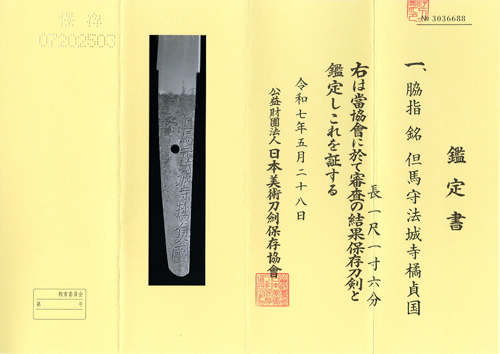
Certificate reading — 銘 但馬守法城寺橘貞国