Sengoku Seki was an industry: smiths organized under their tutelary Kasuga shrine, arming the war bands of central Japan. Magoroku Kanemoto’s sanbonsugi and the finest Kanesada work prove quality survived inside mass production.
 NihontoWatchNihontoWatch
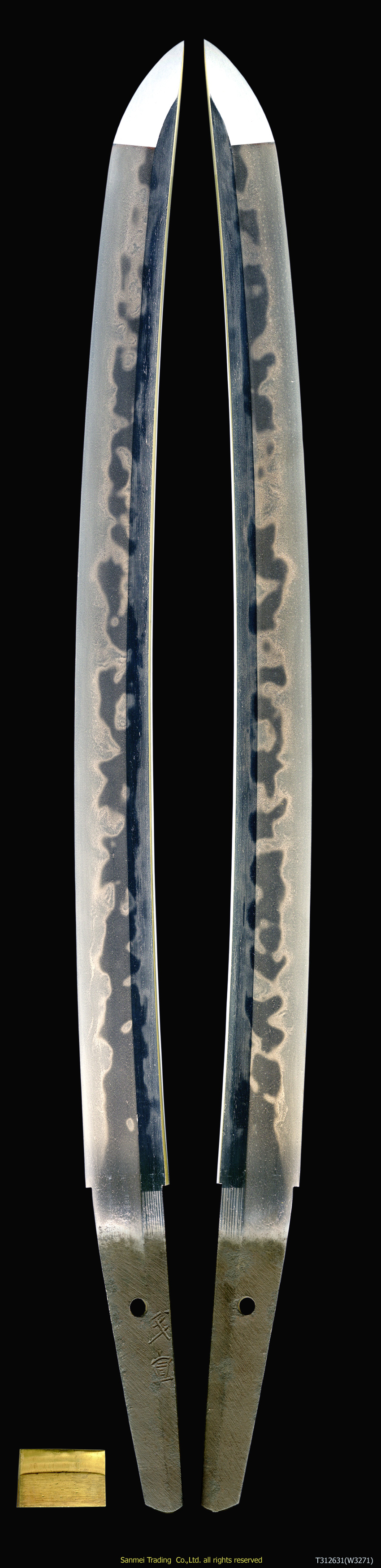
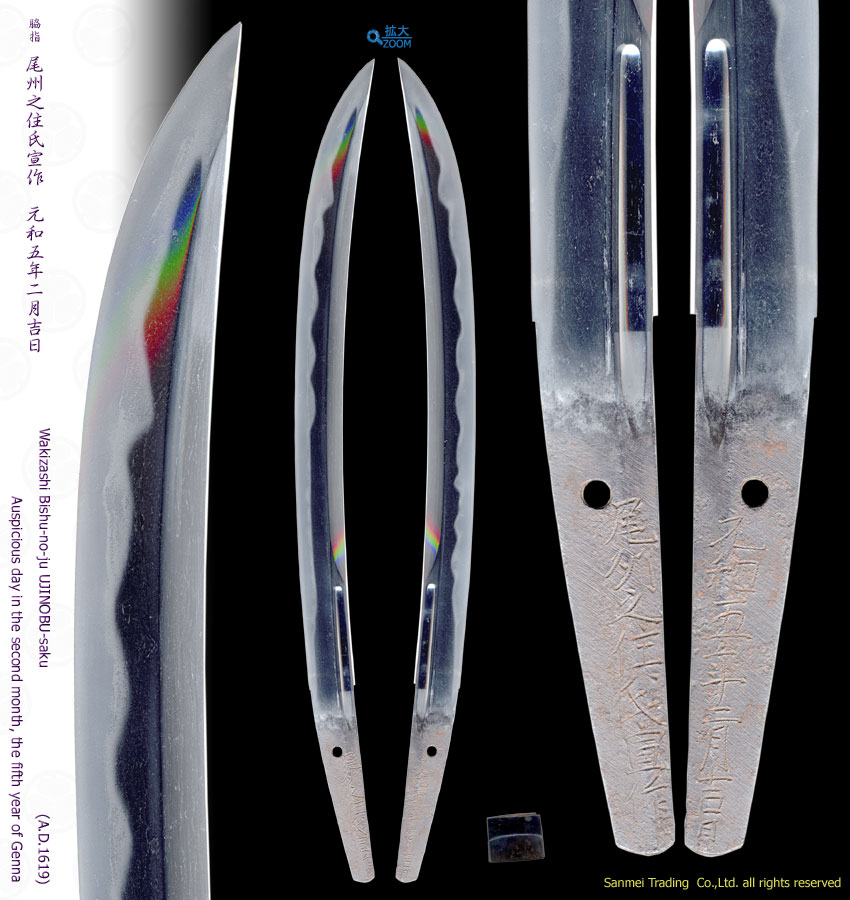
Blade construction : Shinogi-zukuri, Iori-mune. There is abundant thickness on base and swelling upper Fukura. The entire blade is heroically brave and heavy on hand. (blade weights 516grams including Habaki) Forging (Hada) : Jigane is Itame hada which is strongly vivid and lively active mixing in streaming Masame-hada on Shonigi-ji. Sparkling hard metal granules of Ji-nie appear over the surface. Temper line (Hamon) : Hamon starts with calm slant Yakidashi on base and then large Gunome mixing in with Togari and slanting Choji outline creating Ō-midare which is lively active and varies in shape and height. The entire temper works with thick, coarse Nie and deep Nioi with frequent Sunagashi, Kinsen activities. The Hamon generates isolated Tobiyaki and Yubashiri and some overflows to the Hiraji and Muneyaki that appears throughout the back ridge. The entire Hamon is splendidly active with broad-minded Nie so called "Hitatsura". Tang (Nakago) : Greatly slanting left Ō-sujikai file marks. One Mekugi-ana. The Kurijiri round heel-shape. There is thick chiselled character that reads UJINOBU 氏宣. Temper of tip (Boshi) : The temper of Boshi forms entirely quenching "Ichimai" then deeply turns back that generates "Muneyaki" temper marks throughout along the back ridge. The subject splended "Hitatsura" work is made by UJINOBU 氏宣, real name Kanshichiro 勘七郎. He had come from Seki-town, Mino province to Owari Nagoya and belonged to Bizen-no-kami UJIFUSA school 備前守氏房. He signed his works with chiselled inscriptions such as “Bishū-jū Ujinobu saku” 尾州住氏宣作 and “Bishū Nagoya-jū Ujinobu” 尾州名護屋住氏宣 and there are extant wakizashi dated "In the 2nd month of Genna 5 (1619)" and "In the 6th month of Genna 6 (1620)". In Owari Province during the early Edo period, a martial spirit prevailed, and many swords display a robust and powerful style. Such massive and fat shape blade is a good example that courageous Owari Samurai still mostly liked such heroic Wakizashi. This splendid Wakizashi has a wide Mihaba and a bold, imposing form, heavy on hand. The kitae shows a strong and well-refined Itame-hada with clear Ji-nie, containing Chikei. The magnificent "Hitatsura" hamon consists of large, Nie-based midare, with nie spilling into the Hira-ji to form Yubashiri, Tobiyaki, and Muneyaki - fully demonstrating the true merits of Owari Shintō. Its sound and healthy condition is also highly commendable. The smith UJIBOBU 氏宣 surely made this wakizashi to meet with courageous Owari Samurais' requirement. Copper base double layer gold foiled Owari-style Habaki collar, preserved in Shira-saya plain wood mounting. reference data: Owari Tōkōfu, Iwata Atou in 1985 Publisher : Nagoya city Board of Education
Offered by Sanmei

Mino-den · Owari
17 pieces on the market now
Rooted in Owari province at the boundary between the kotō and shintō eras, the Ujifusa line carried Mino-den forging into the late Momoyama and early Edo decades, working under the Tokugawa establishment of Owari at Nagoya. The setsumei here cover several hands of the group. Wakasa no Kami Ujifusa and Hida no Kami Ujifusa stand as the reference points against which the others are read. Echigo no Kami Fujiwara Ujitsune, recorded in the Meikan and the Mino-tō Taikan as the second son of Wakasa no Kami Ujifusa, first signed Ujishige, received the Echigo no Kami title in Genna 6 (1620), and died at Nagoya in Meireki 2 (1656). Ujisada, who took the court title Izumo no Kami and signed Sakon Shōshō and Sakon Gonshōshō, is transmitted as a son of the first-generation Ujifusa and younger brother of the second-generation Wakasa no Kami Ujifusa; one of his tantō carries a date of Tenshō 5 (1577). The shared hand begins in the kitae: a dense itame mixed with mokume and nagare-hada, carrying ji-nie and, in the fuller work, fine chikei. The temper draws on the Mino-den vocabulary, a notare mixed with gunome, ko-gunome in tsure, large gunome, and pointed togari-leaning forms, the notare often taking angular turns (kado-gakari).
Ko-ashi and yō enter; nie attaches, at times slightly coarse and unevenly applied, with kinsuji and sunagashi in the lower body and tobiyaki and muneyaki scattered through, so that some blades verge on hitatsura and minayaki. The nioiguchi can incline toward shizumi. The bōshi is tempered deeply and far down (yakisage) with hakikake, the point sometimes drawn into a sanpin-style sharpness on one face and an ō-maru on the other. Ujitsune's signed katana reads as a near-textbook gathering of these traits; Ujisada's tantō tightens the nioiguchi (shimarigokoro) toward his master's manner. For kantei, the angular notare, the patchy nie, the shizumi-inclined nioiguchi, and the sanpin-pointed bōshi with long yakisage mark the Wakasa no Kami group; the larger work adds broad mihaba, ō-kissaki, and thick kasane. Carving belongs to the record: a "grass" kurikara and gomabashi with rendai appear on Ujisada's tantō. The Ujitsune katana, by a smith the setsumei call a scant producer, is named his representative work, holding coherence across a great nagasa. Learn more →
| Smith | Era | Designated |
|---|---|---|
| Ujifusa氏房 | 1596-1615 | 16 |
| Ujifusa氏房 | 1571-1592 | 9 |
| Ujifusa氏房 | 1624-1644 | 0 |
| Ujitsune氏恒 | 1596-1615 | 1 |
| Ujisada氏貞 | 1558-1592 | 7 |
Mino in the Muromachi period
Sengoku Seki was an industry: smiths organized under their tutelary Kasuga shrine, arming the war bands of central Japan. Magoroku Kanemoto’s sanbonsugi and the finest Kanesada work prove quality survived inside mass production.
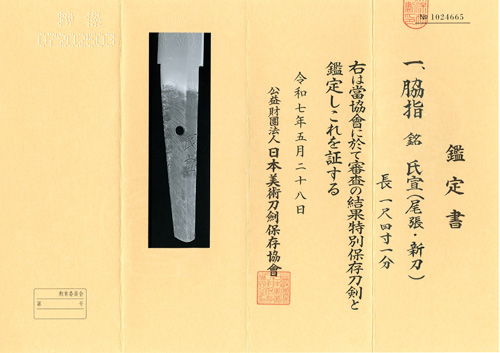
A Hozon-certified blade judged to show notably superior workmanship and a better state of preservation. The bar is higher: re-tempered blades and most unsigned Muromachi/Edo works are excluded.
The NBTHK (Nihon Bijutsu Tōken Hozon Kyōkai, the Society for the Preservation of Japanese Art Swords) is a public-interest incorporated foundation founded in 1948 and supervised by Japan’s Agency for Cultural Affairs (Bunkachō); it is based at the Japanese Sword Museum in Tokyo. Its expert panels physically examine each submitted work (shinsa) and issue a certificate (kanteishō) ranking it by artistic and historical merit. NBTHK papers are the most widely recognized standard of authentication for Japanese swords and fittings.
NBTHK official siteFor a return, please contact us within 7 days of the item's arrival. If specification changes such as dimensions were made at the customer's request, a return cannot be accepted. Shipping and transfer fees are the customer's responsibility.
Price on request
Certificate reading — 銘 氏宣