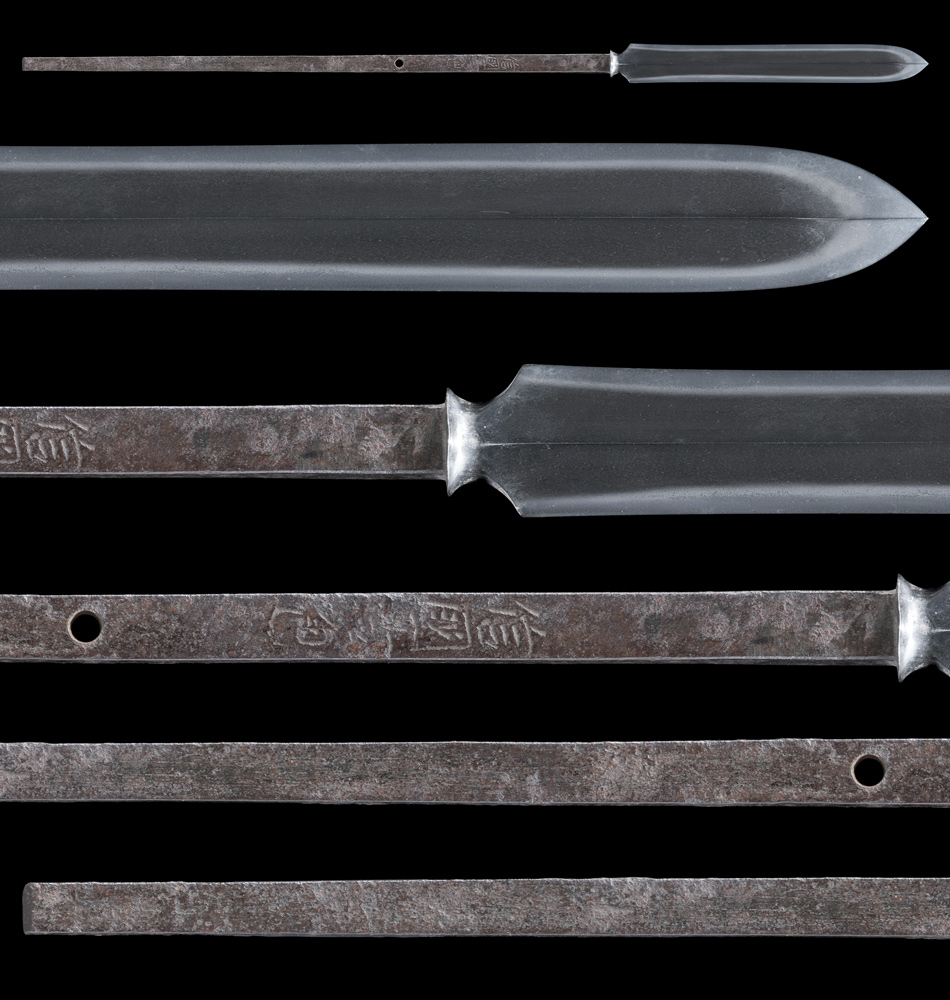
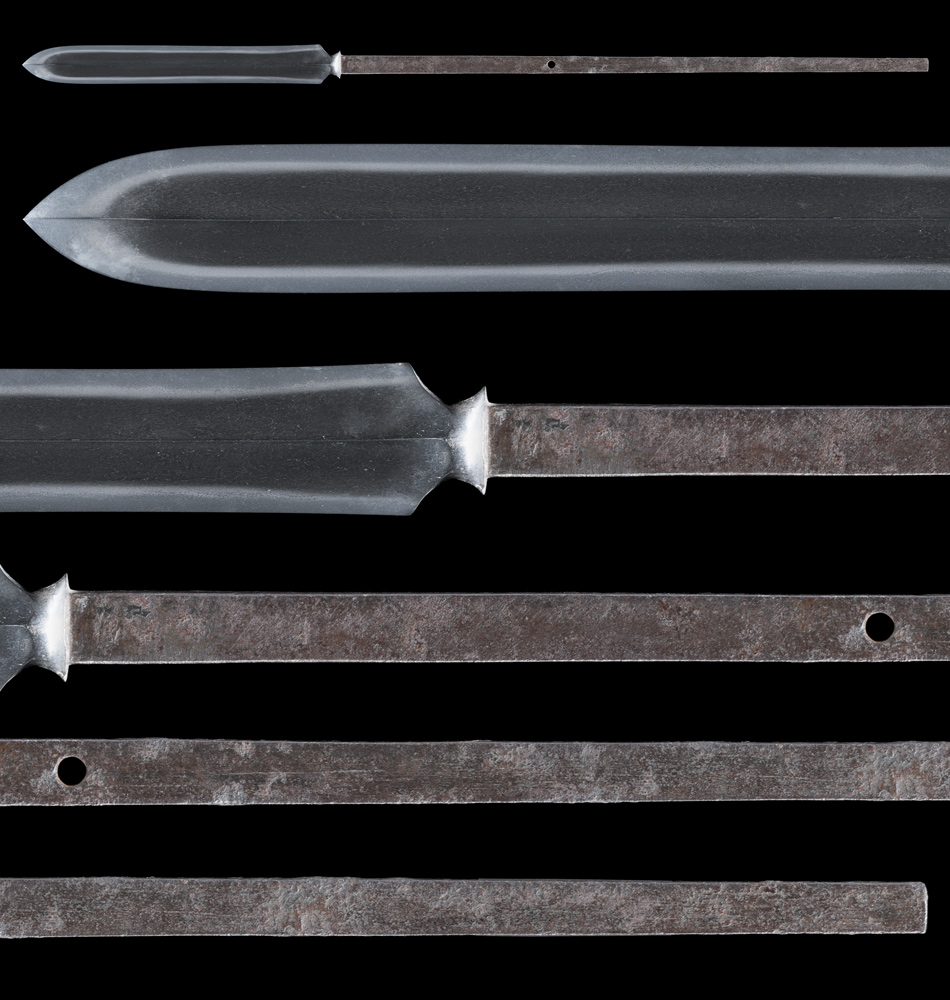
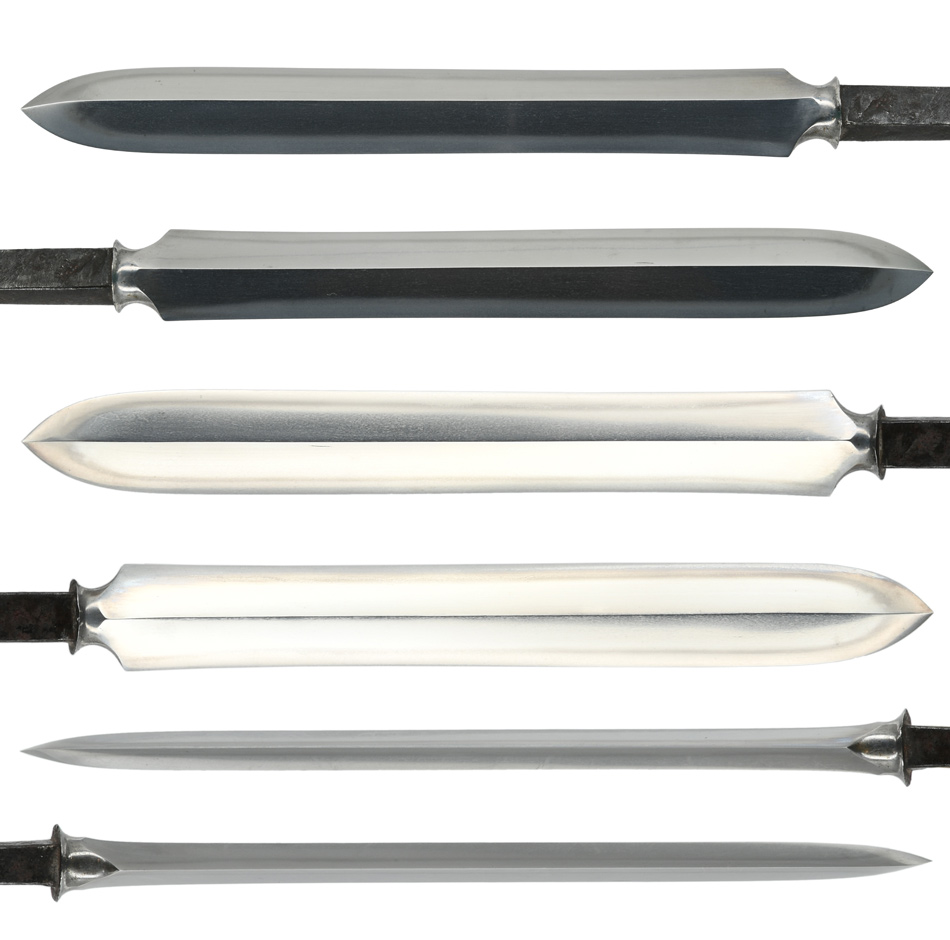
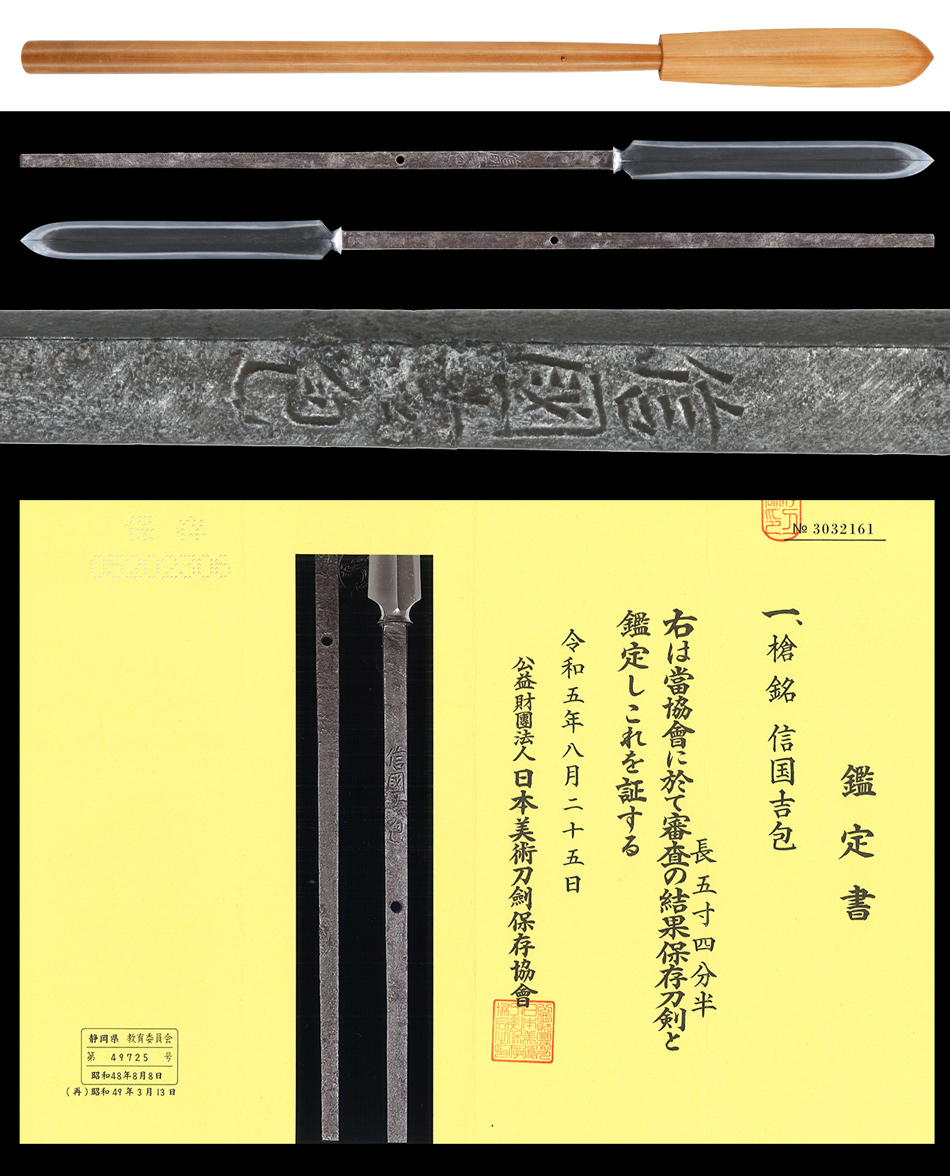
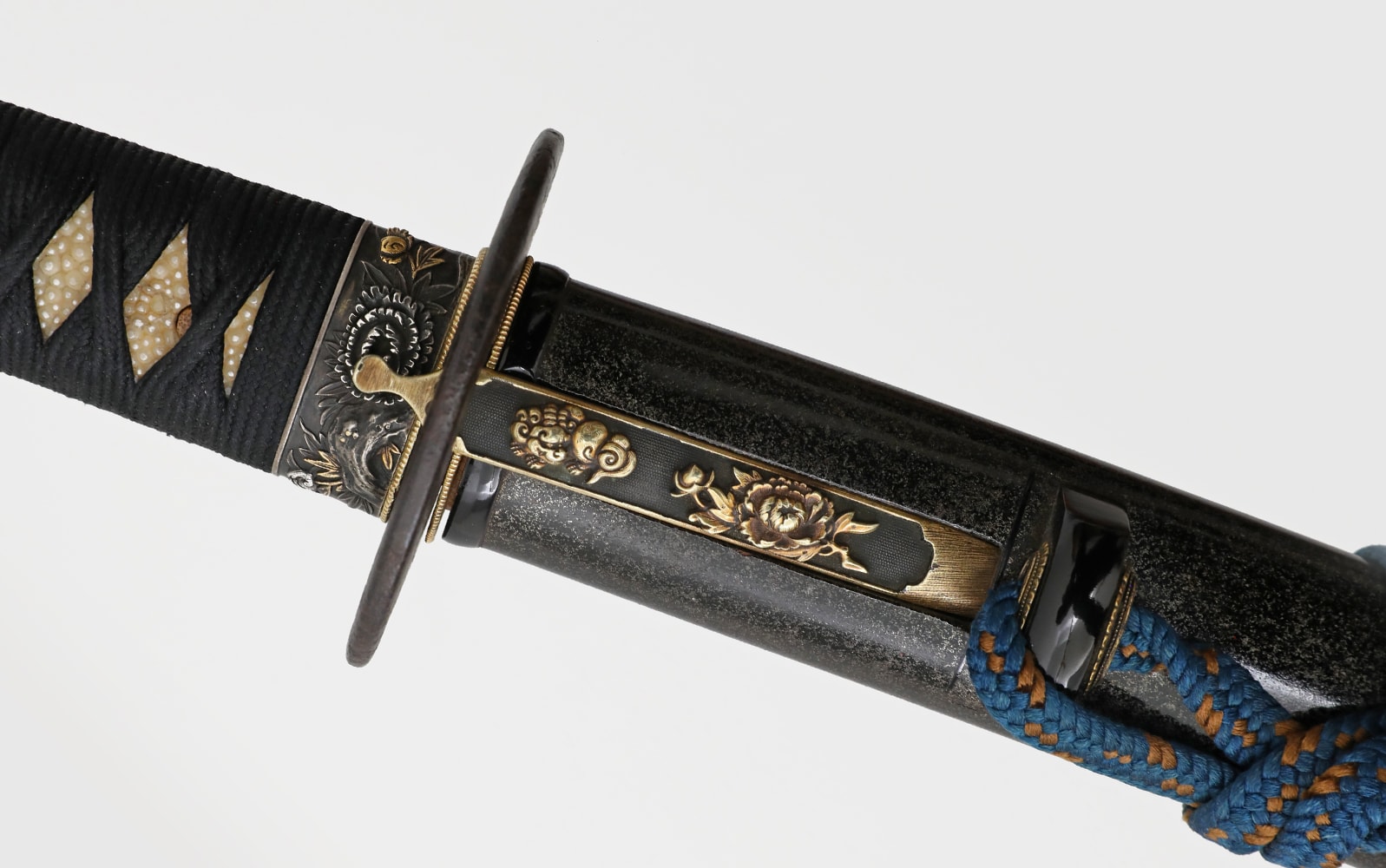
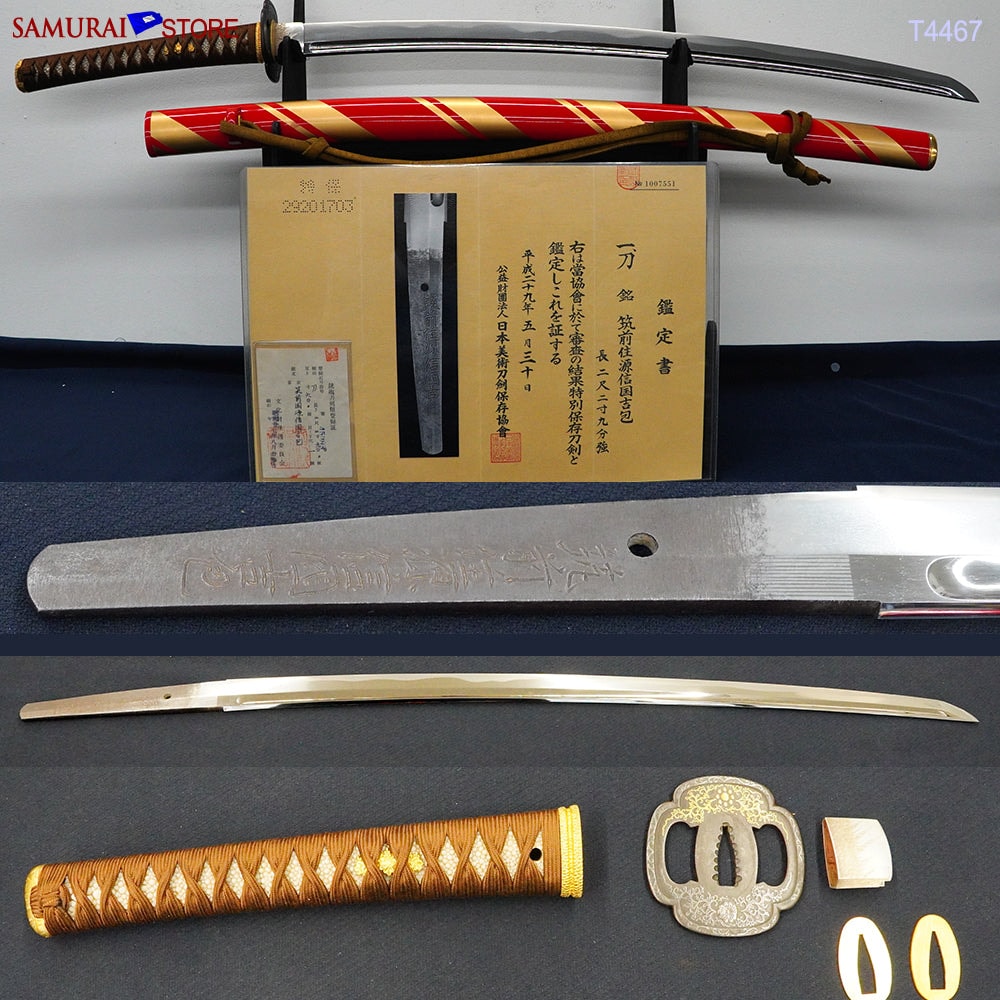
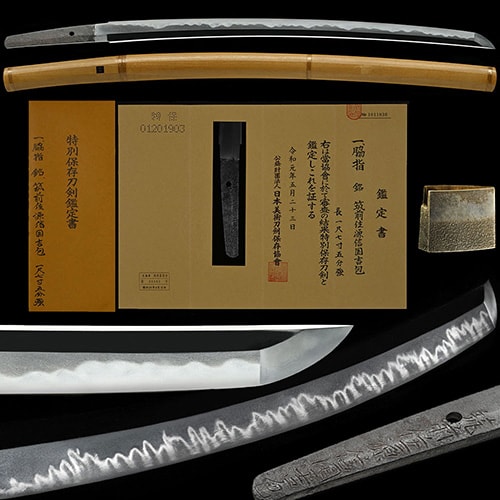
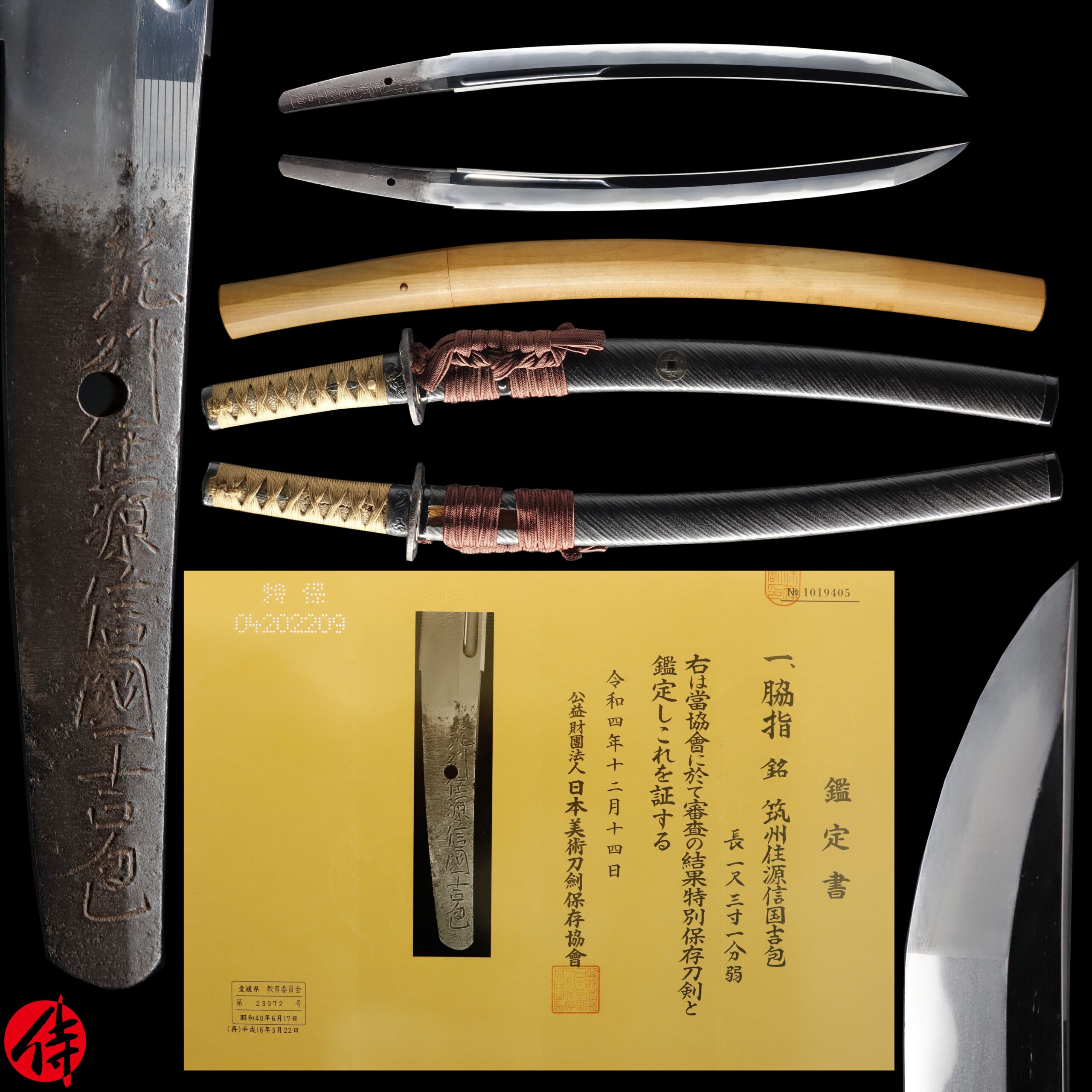
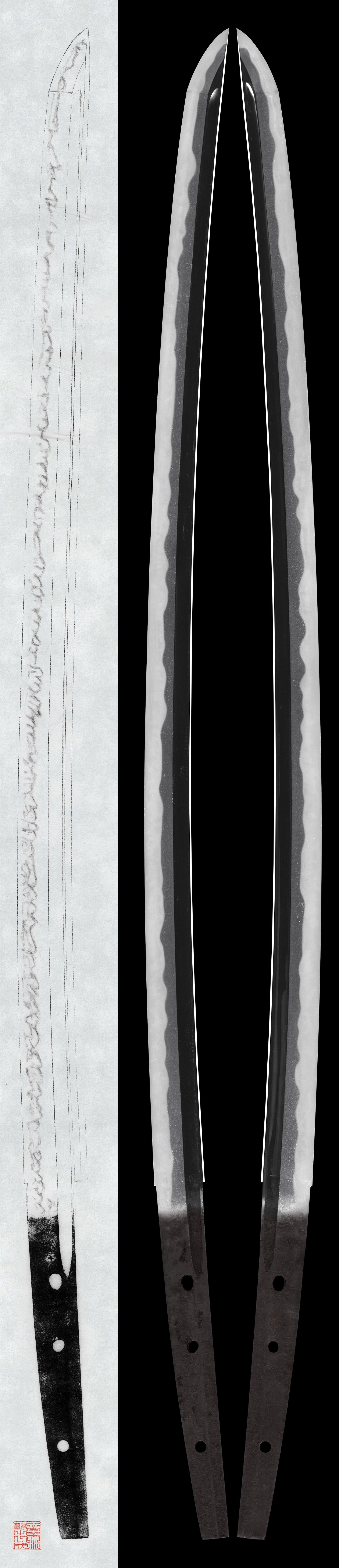
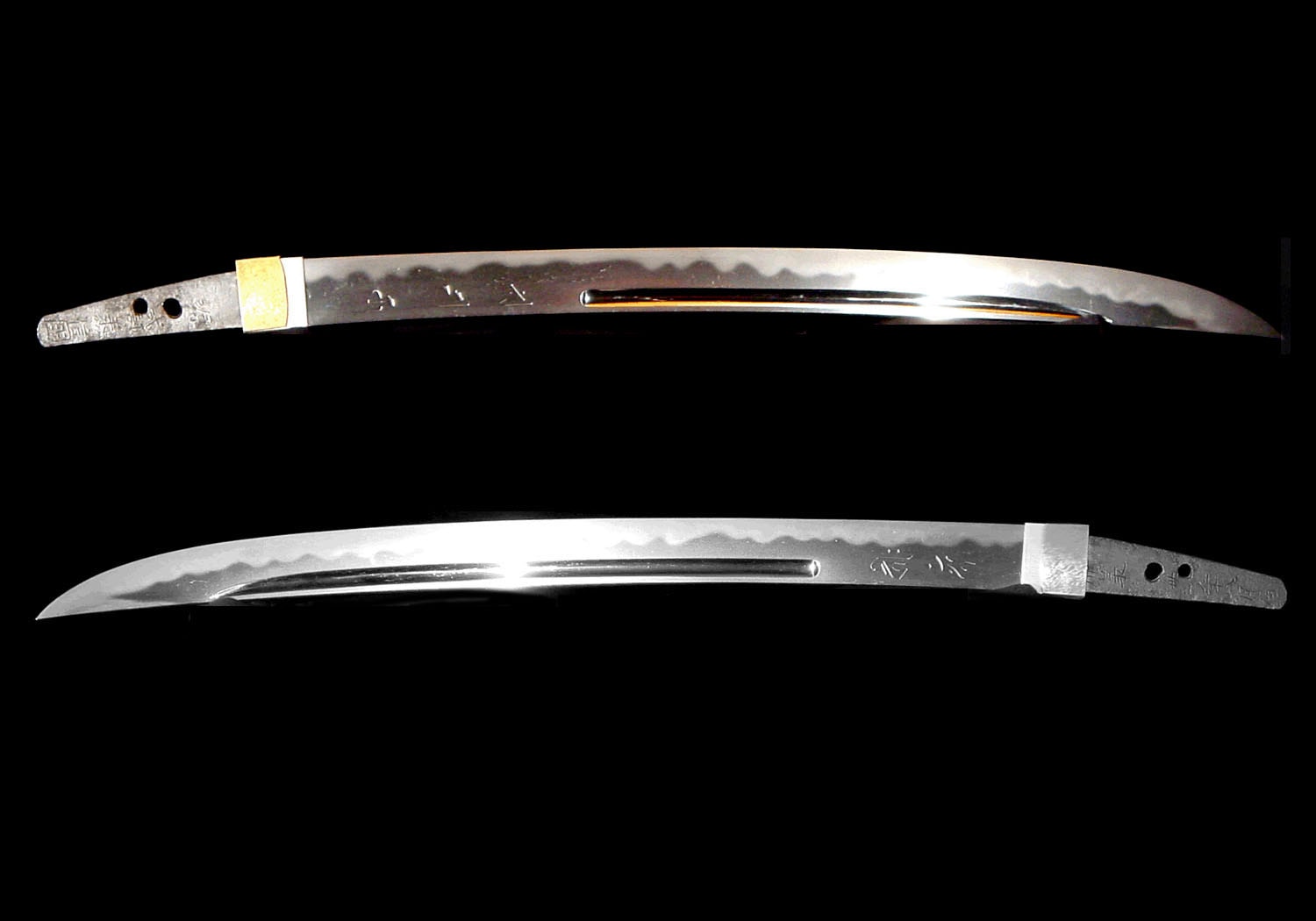
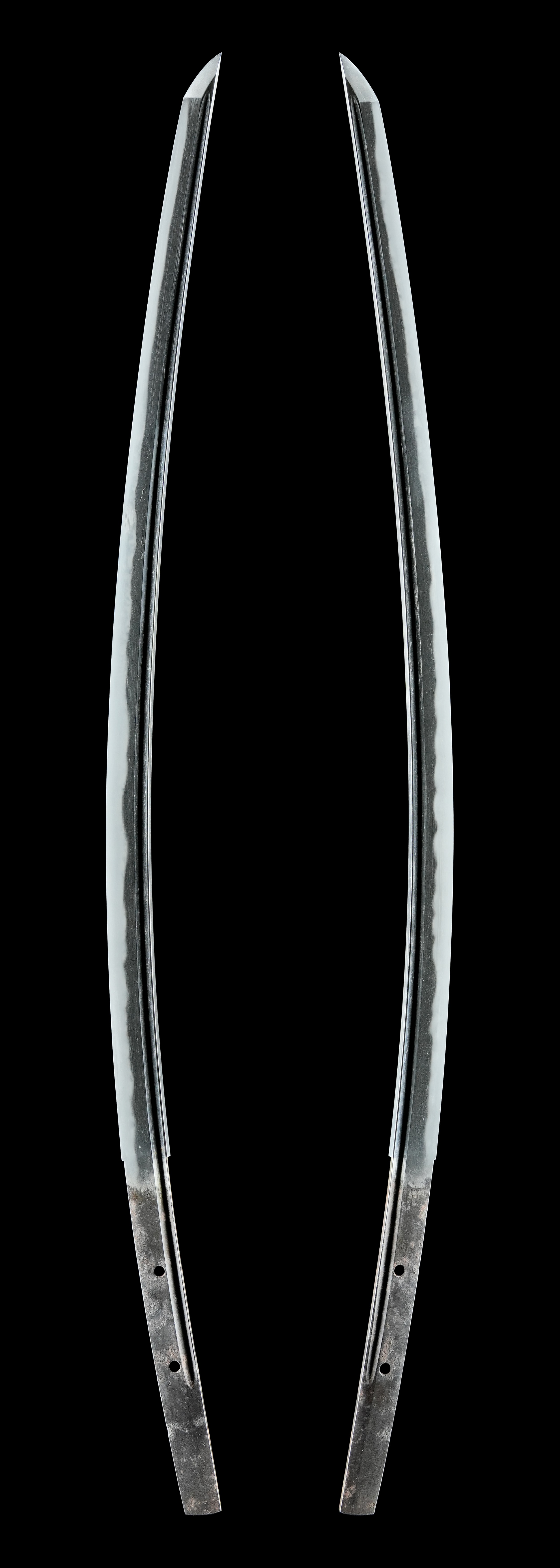
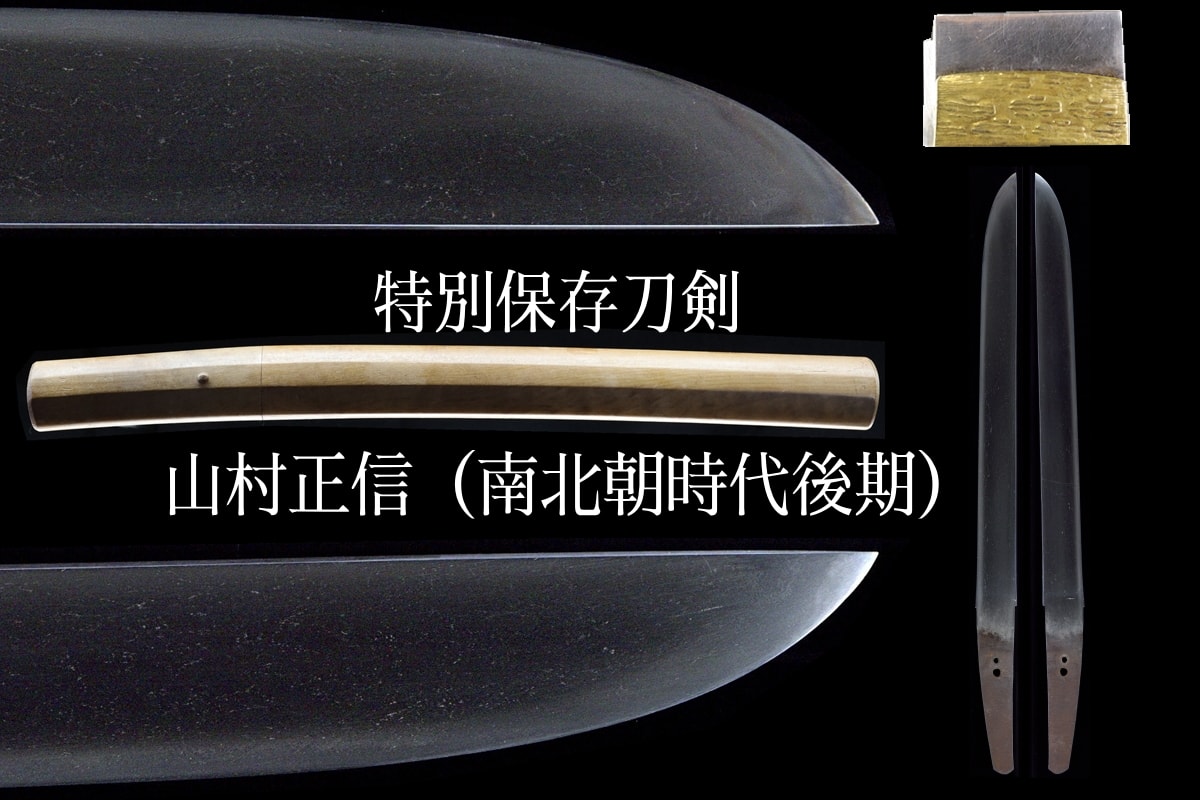
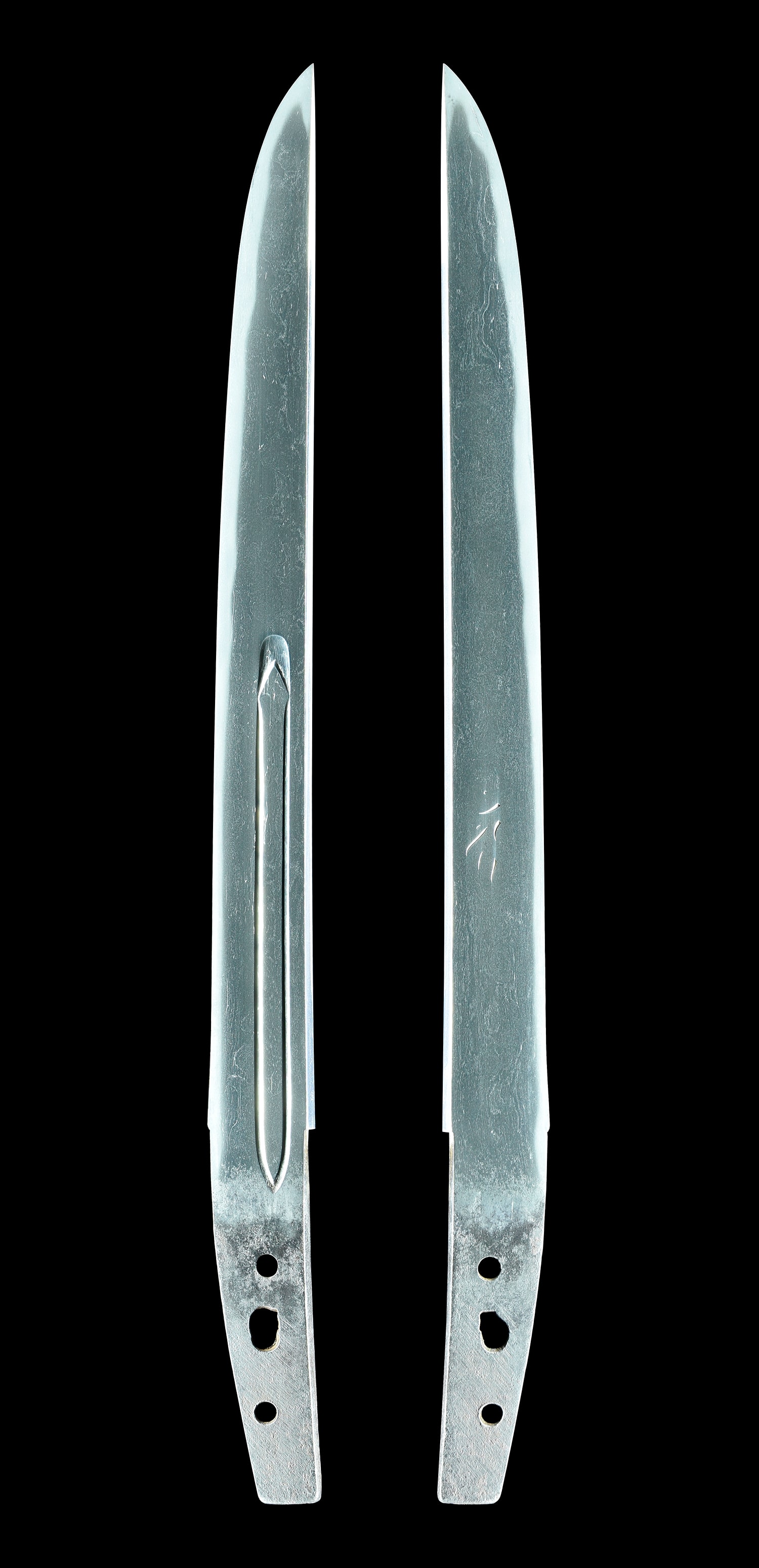
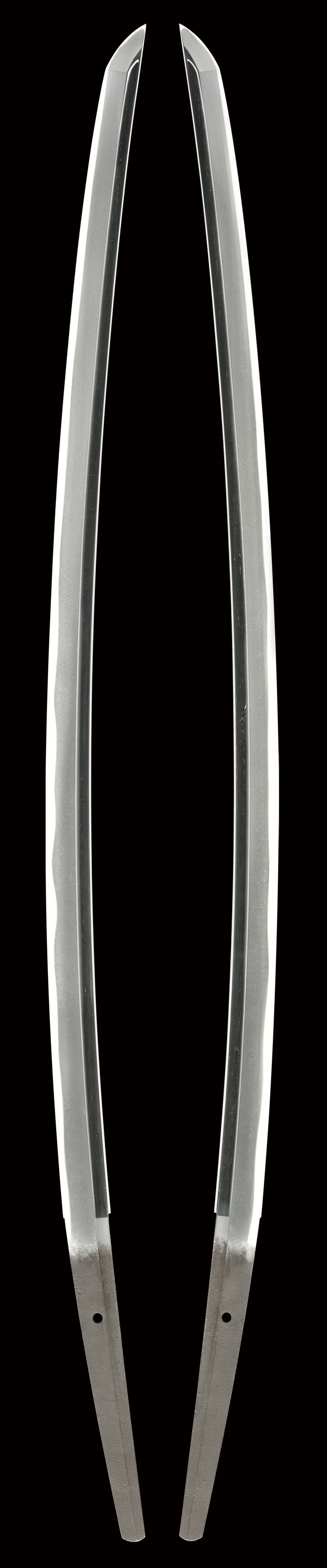
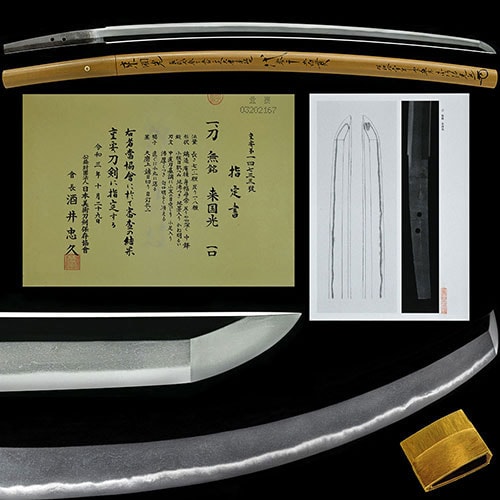
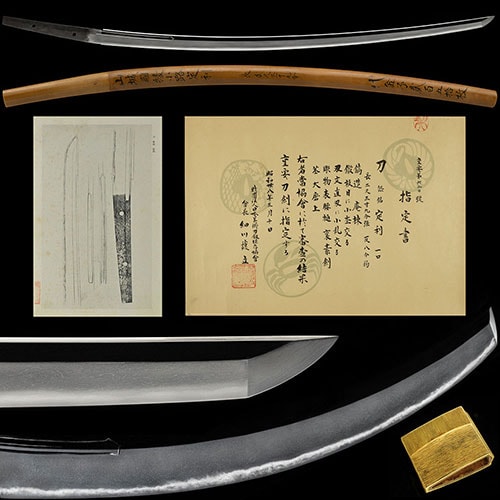
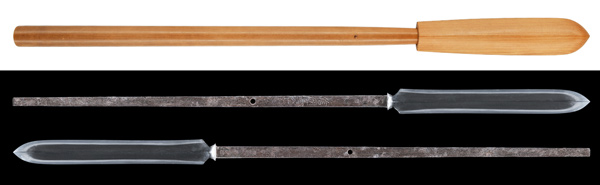
This is a yari (spear) made by Nobukuni Yoshikane. It is certified as Hozon Token by NBTHK. The yari was made in Chikuzen province during the middle Edo period, around 1681.
mei · Kanbun (1661-1673) · nagasa 16.3cm


Chikuzen Nobukuni (Shinto) · Chikuzen · around 1661-1686
Fujishiro Jo saku · Tōken Taikan top 39%
2 pieces on the market now
Yoshikane signed his blades Chikushu-ju Minamoto Nobukuni Yoshikane, used the common name Sukezaemon, and died in Genroku 6 (1693), the year his son Shigekane turned twenty-one. He worked in Hakata as one of the representative smiths of the Chikuzen Nobukuni group, the Shinto-period branch that the published sources trace back to the Kyoto Nobukuni line and that served the Kuroda house of Fukuoka as retained smiths (kakae-kaji) from the Keicho era down to the early Meiji years. The line is set out in the commentaries with a clear shape: its effective founder Yoshisada answered an invitation from Kuroda Nagamasa and moved from Buzen to Hakata, after which the headship passed generation to generation, and the representative makers are named as Yoshisada, Yoshimasa, Yoshitsugu, Yoshikane and Shigekane. Yoshikane was the son of Yoshitsugu, and from the Shinto period it had become customary for the group to take Nobukuni as a surname and style each member "Nobukuni so-and-so," which is why his five designated katana all carry the personal name within a boldly cut long signature.
Two deliberate manners run through that small body of work, and the more striking of them is a reach toward Soshu-den. Over an itame that flows and leans strongly toward masame, with ji-nie adhering and fine chikei entering, he forges a ko-notare mixed with gunome, angular elements among it, the nioi deep, the nie thick and well attached, with fine sunagashi running vigorously and kinsuji and a slight tobiyaki suggestive of yubashiri. The boshi follows the temper into a midare-komi that rises with tsukiage, comes to a sharp point with a deep return, and sweeps frequently with hakikake. Of the katana that shows this hand most fully the published sources write that "his aim lay clearly in Soshu-den"[[c:1]], calling it an ambitious work through which the high level of his ability can be understood. This is not the broad gunome-based midare that the commentaries give as the school's common range but a separate, intended idiom, and it is the gunome beneath the notare, present on every one of his designated blades, that ties the two manners together.
The jigane is the steady foundation on which both hands are laid. The forging is an itame, well knit and at times a tight ko-itame, that overall carries a nagare-hada and on the ura flows strongly into a masame-like state, with minute ji-nie adhering and delicate chikei entering. On the blades where he tempers the school's choji it throws up a clear midare-utsuri in a bright jigane, and the published sources note that this is the customary accompaniment of his choji manner, the flowing hada and the standing reflection arriving together. That flowing, masame-leaning itame, rather than a tight Bizen jigane, is the Yamashiro-descended surface that carries the Chikuzen line back to its Kyoto Nobukuni source, and it is the constant against which the variety of the ha is read.
His second documented manner is the choji-midare the commentaries name the salient point of the Chikuzen Nobukuni hand. It sits over the tight ko-itame and runs chiefly choji with togariba, gunome, ko-choji and ko-gunome mixed in, the yakigashira generally aligned in a small-pattern midare, a reverse-slanting tendency appearing in places, ashi and yo entering well, ko-nie adhering, fine sunagashi present, and the nioiguchi bright. One katana carries this further than any other on record: it shows differing manners on its two faces, a flamboyant choji-midare with marked rises and falls on the omote and a small-pattern, level-headed choji on the ura, the so-called kashiwade style[[c:2]]. The published sources call it the only known example of that approach within the smith's work and read in the flamboyant omote a resonance with the Fukuoka Ishido of the same province, a kinship they support by pointing to a documented Ishido carving on a blade of the second-generation Yoshimasa. Of this blade they conclude that it manifests the school's salient points[[c:3]].
What distinguishes Yoshikane is best drawn from his own grounded traits rather than by contrast with his neighbours. His is a smith of two intentions held at a high finish: the Soshu reach, with its deep nioi, thick nie, sunagashi and kinsuji over the flowing itame; and the school choji, with its aligned yakigashira and the midare-utsuri that the flowing hada throws up. The ura of the kashiwade katana, a small-pattern choji without rises and falls and with the heads of the midare aligned, the commentaries call a typical example of the distinctive Chikuzen Nobukuni choji, so that one blade holds both the school's textbook hand and its rarest variation. The mei is cut ubu on every designated piece, a long signature in bold, thick chisel strokes set below the mekugi-ana toward the mune, and on one blade an added inscription records that it was made of nanban-tetsu, the imported steel.
Yoshikane is rated Jo saku by Fujishiro, a sound standing for a provincial Shinto smith rather than a first rank, and his designated record is small and entirely signed. Five of his katana hold the Juyo rank, his record reaching no Important Cultural Property or National Treasure tier, so his blades are encountered as Juyo and lower-ranked pieces rather than as patrimony held permanently out of reach. One of his swords is recorded as having been held by the Imperial Family, the single notable provenance attached to his name in the corpus, and the remainder pass through private hands. The number of designated works on record is genuinely small, and the blade worth waiting for is the one in which both his intentions are fully realised, of the kind the published sources praise in their highest verdict on him: a work in which "the ji and the ha are both strikingly clear"[[c:4]], revealing, as they put it, Yoshikane's outstanding workmanship among the Shinto-period Nobukuni smiths. Such a blade comes to market only from time to time, and when one does it is a good representative of a respected provincial school whose finest hand looks back to both Soshu and the old Yamashiro line.
Where Yoshikane stands among comparable artisans: across all of nihontō, and within tradition, era, and period. The tiers (Foremost · Leading · Major · Notable) weigh official designations from the NBTHK and Japan's Agency for Cultural Affairs, together with historical honors of lasting repute such as the Sansaku and Meibutsu-chō.
Select a lens to see how it's measured.
Years he was demonstrably active, proven by signed-and-dated blades
Yamashiro-den · Yamashiro
28 pieces on the market now
Few Kyoto houses bridged two traditions as deliberately as Nobukuni (信国), the Yamashiro-den lineage whose work runs from the Nanbokucho period through Muromachi and on, in a western branch, into the shinto age. The first generation, the smith the NBTHK counts as shodai, is the master of the Enbun, Koan and Joji years; the older registers placed a founding Nobukuni back in the Kenmu era, but the published sources set that legend aside, since no work survives so early and the style of the oldest dated blades connects directly with that of Sadamune. Learn more →
| Smith | Era | Designated |
|---|---|---|
| Nobukuni信國 | 1356-1361 | 69 |
| Nobukuni信國 | 1383-1392 | 33 |
| Nobukuni信國 | 1394-1428 | 44 |
| Yoshikane吉包 | 1661-1686 | 7 |
| Masanobu正信 | 1356-1361 | 4 |
Certifies a genuine blade worth preserving: a signature confirmed correct, or, if unsigned, an era, province, and school that the NBTHK can reliably identify.
The NBTHK (Nihon Bijutsu Tōken Hozon Kyōkai, the Society for the Preservation of Japanese Art Swords) is a public-interest incorporated foundation founded in 1948 and supervised by Japan’s Agency for Cultural Affairs (Bunkachō); it is based at the Japanese Sword Museum in Tokyo. Its expert panels physically examine each submitted work (shinsa) and issue a certificate (kanteishō) ranking it by artistic and historical merit. NBTHK papers are the most widely recognized standard of authentication for Japanese swords and fittings.
NBTHK official siteNo cooling-off period or returns; refund only if the purchased sword is proven fake, capped at purchase price (excludes commission sales, accessories, auction items).
This is a yari (spear) made by Nobukuni Yoshikane. It is certified as Hozon Token by NBTHK. The yari was made in Chikuzen province during the middle Edo period, around 1681.
mei · Kanbun (1661-1673) · nagasa 16.3cm


Chikuzen Nobukuni (Shinto) · Chikuzen · around 1661-1686
Fujishiro Jo saku · Tōken Taikan top 39%
2 pieces on the market now
Yoshikane signed his blades Chikushu-ju Minamoto Nobukuni Yoshikane, used the common name Sukezaemon, and died in Genroku 6 (1693), the year his son Shigekane turned twenty-one. He worked in Hakata as one of the representative smiths of the Chikuzen Nobukuni group, the Shinto-period branch that the published sources trace back to the Kyoto Nobukuni line and that served the Kuroda house of Fukuoka as retained smiths (kakae-kaji) from the Keicho era down to the early Meiji years. The line is set out in the commentaries with a clear shape: its effective founder Yoshisada answered an invitation from Kuroda Nagamasa and moved from Buzen to Hakata, after which the headship passed generation to generation, and the representative makers are named as Yoshisada, Yoshimasa, Yoshitsugu, Yoshikane and Shigekane. Yoshikane was the son of Yoshitsugu, and from the Shinto period it had become customary for the group to take Nobukuni as a surname and style each member "Nobukuni so-and-so," which is why his five designated katana all carry the personal name within a boldly cut long signature.
Two deliberate manners run through that small body of work, and the more striking of them is a reach toward Soshu-den. Over an itame that flows and leans strongly toward masame, with ji-nie adhering and fine chikei entering, he forges a ko-notare mixed with gunome, angular elements among it, the nioi deep, the nie thick and well attached, with fine sunagashi running vigorously and kinsuji and a slight tobiyaki suggestive of yubashiri. The boshi follows the temper into a midare-komi that rises with tsukiage, comes to a sharp point with a deep return, and sweeps frequently with hakikake. Of the katana that shows this hand most fully the published sources write that "his aim lay clearly in Soshu-den"[[c:1]], calling it an ambitious work through which the high level of his ability can be understood. This is not the broad gunome-based midare that the commentaries give as the school's common range but a separate, intended idiom, and it is the gunome beneath the notare, present on every one of his designated blades, that ties the two manners together.
The jigane is the steady foundation on which both hands are laid. The forging is an itame, well knit and at times a tight ko-itame, that overall carries a nagare-hada and on the ura flows strongly into a masame-like state, with minute ji-nie adhering and delicate chikei entering. On the blades where he tempers the school's choji it throws up a clear midare-utsuri in a bright jigane, and the published sources note that this is the customary accompaniment of his choji manner, the flowing hada and the standing reflection arriving together. That flowing, masame-leaning itame, rather than a tight Bizen jigane, is the Yamashiro-descended surface that carries the Chikuzen line back to its Kyoto Nobukuni source, and it is the constant against which the variety of the ha is read.
His second documented manner is the choji-midare the commentaries name the salient point of the Chikuzen Nobukuni hand. It sits over the tight ko-itame and runs chiefly choji with togariba, gunome, ko-choji and ko-gunome mixed in, the yakigashira generally aligned in a small-pattern midare, a reverse-slanting tendency appearing in places, ashi and yo entering well, ko-nie adhering, fine sunagashi present, and the nioiguchi bright. One katana carries this further than any other on record: it shows differing manners on its two faces, a flamboyant choji-midare with marked rises and falls on the omote and a small-pattern, level-headed choji on the ura, the so-called kashiwade style[[c:2]]. The published sources call it the only known example of that approach within the smith's work and read in the flamboyant omote a resonance with the Fukuoka Ishido of the same province, a kinship they support by pointing to a documented Ishido carving on a blade of the second-generation Yoshimasa. Of this blade they conclude that it manifests the school's salient points[[c:3]].
What distinguishes Yoshikane is best drawn from his own grounded traits rather than by contrast with his neighbours. His is a smith of two intentions held at a high finish: the Soshu reach, with its deep nioi, thick nie, sunagashi and kinsuji over the flowing itame; and the school choji, with its aligned yakigashira and the midare-utsuri that the flowing hada throws up. The ura of the kashiwade katana, a small-pattern choji without rises and falls and with the heads of the midare aligned, the commentaries call a typical example of the distinctive Chikuzen Nobukuni choji, so that one blade holds both the school's textbook hand and its rarest variation. The mei is cut ubu on every designated piece, a long signature in bold, thick chisel strokes set below the mekugi-ana toward the mune, and on one blade an added inscription records that it was made of nanban-tetsu, the imported steel.
Yoshikane is rated Jo saku by Fujishiro, a sound standing for a provincial Shinto smith rather than a first rank, and his designated record is small and entirely signed. Five of his katana hold the Juyo rank, his record reaching no Important Cultural Property or National Treasure tier, so his blades are encountered as Juyo and lower-ranked pieces rather than as patrimony held permanently out of reach. One of his swords is recorded as having been held by the Imperial Family, the single notable provenance attached to his name in the corpus, and the remainder pass through private hands. The number of designated works on record is genuinely small, and the blade worth waiting for is the one in which both his intentions are fully realised, of the kind the published sources praise in their highest verdict on him: a work in which "the ji and the ha are both strikingly clear"[[c:4]], revealing, as they put it, Yoshikane's outstanding workmanship among the Shinto-period Nobukuni smiths. Such a blade comes to market only from time to time, and when one does it is a good representative of a respected provincial school whose finest hand looks back to both Soshu and the old Yamashiro line.
Where Yoshikane stands among comparable artisans: across all of nihontō, and within tradition, era, and period. The tiers (Foremost · Leading · Major · Notable) weigh official designations from the NBTHK and Japan's Agency for Cultural Affairs, together with historical honors of lasting repute such as the Sansaku and Meibutsu-chō.
Select a lens to see how it's measured.
Years he was demonstrably active, proven by signed-and-dated blades
Yamashiro-den · Yamashiro
28 pieces on the market now
Few Kyoto houses bridged two traditions as deliberately as Nobukuni (信国), the Yamashiro-den lineage whose work runs from the Nanbokucho period through Muromachi and on, in a western branch, into the shinto age. The first generation, the smith the NBTHK counts as shodai, is the master of the Enbun, Koan and Joji years; the older registers placed a founding Nobukuni back in the Kenmu era, but the published sources set that legend aside, since no work survives so early and the style of the oldest dated blades connects directly with that of Sadamune. Learn more →
| Smith | Era | Designated |
|---|---|---|
| Nobukuni信國 | 1356-1361 | 69 |
| Nobukuni信國 | 1383-1392 | 33 |
| Nobukuni信國 | 1394-1428 | 44 |
| Yoshikane吉包 | 1661-1686 | 7 |
| Masanobu正信 | 1356-1361 | 4 |
Certifies a genuine blade worth preserving: a signature confirmed correct, or, if unsigned, an era, province, and school that the NBTHK can reliably identify.
The NBTHK (Nihon Bijutsu Tōken Hozon Kyōkai, the Society for the Preservation of Japanese Art Swords) is a public-interest incorporated foundation founded in 1948 and supervised by Japan’s Agency for Cultural Affairs (Bunkachō); it is based at the Japanese Sword Museum in Tokyo. Its expert panels physically examine each submitted work (shinsa) and issue a certificate (kanteishō) ranking it by artistic and historical merit. NBTHK papers are the most widely recognized standard of authentication for Japanese swords and fittings.
NBTHK official siteNo cooling-off period or returns; refund only if the purchased sword is proven fake, capped at purchase price (excludes commission sales, accessories, auction items).