Gassan Sadakatsu was named Eitaro, born in Meiji 2 as the eldest son of the first generation Sadakazu, and in Sadakazu's later years he assisted his father and completed many substitute works. After his father's death, he succeeded the Gassan family and forged many swords for the Imperial Household, including the Daigensui sword for His Majesty the Emperor, and protective swords for His Imperial Highness the Crown Prince and His Imperial Highness the Imperial Grandson, as well as various swords bestowed by the Emperor such as the Gensui swords. At that time, only four people were ordered to produce Gensui swords: Gassan Sadakatsu, Morioka Masayoshi, Kasama Ikkansai Shigetsugu, and Horii Hideaki (Toshihide).
In Showa 10, he moved the forging workshop that had been in Yariyamachi, Osaka, to Yoshinoyama, Nara Prefecture. As the head of the Osaka Gassan family, he was active from the Taisho period through the early Showa period, and in addition to the family tradition of Gassan Ayasugi-den, he also skillfully forged the Gokaden. He died in Showa 18 at the age of 74.
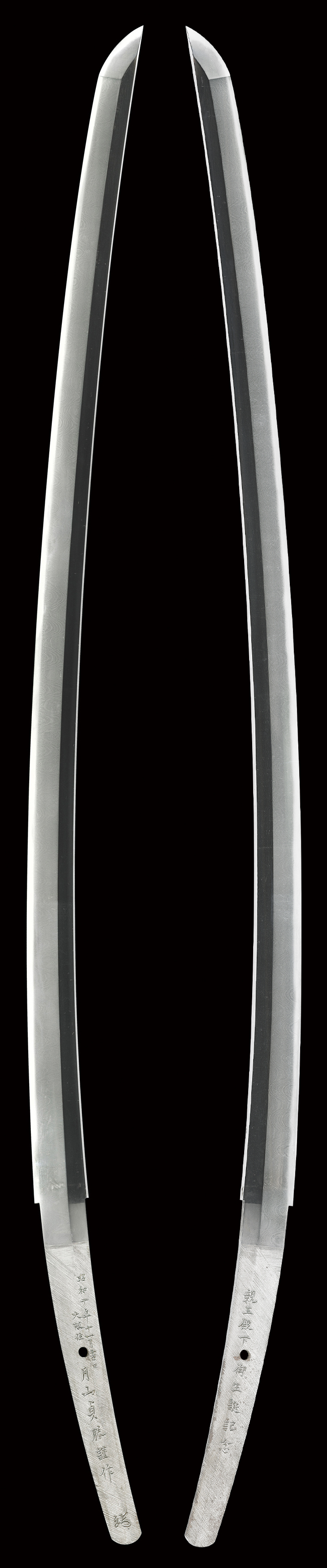
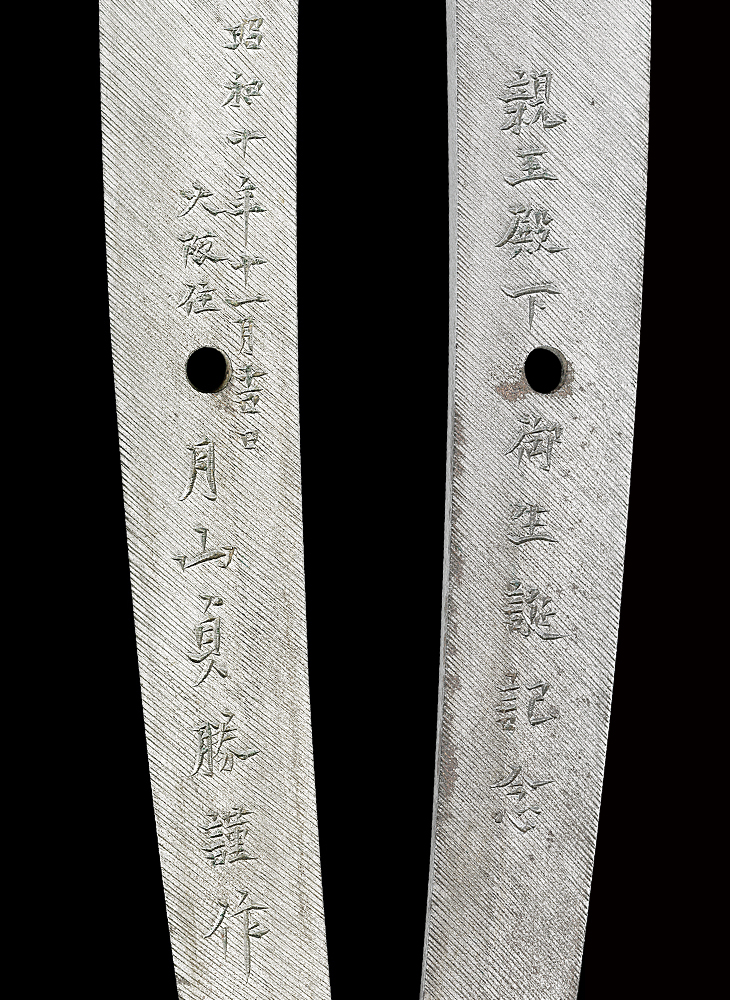
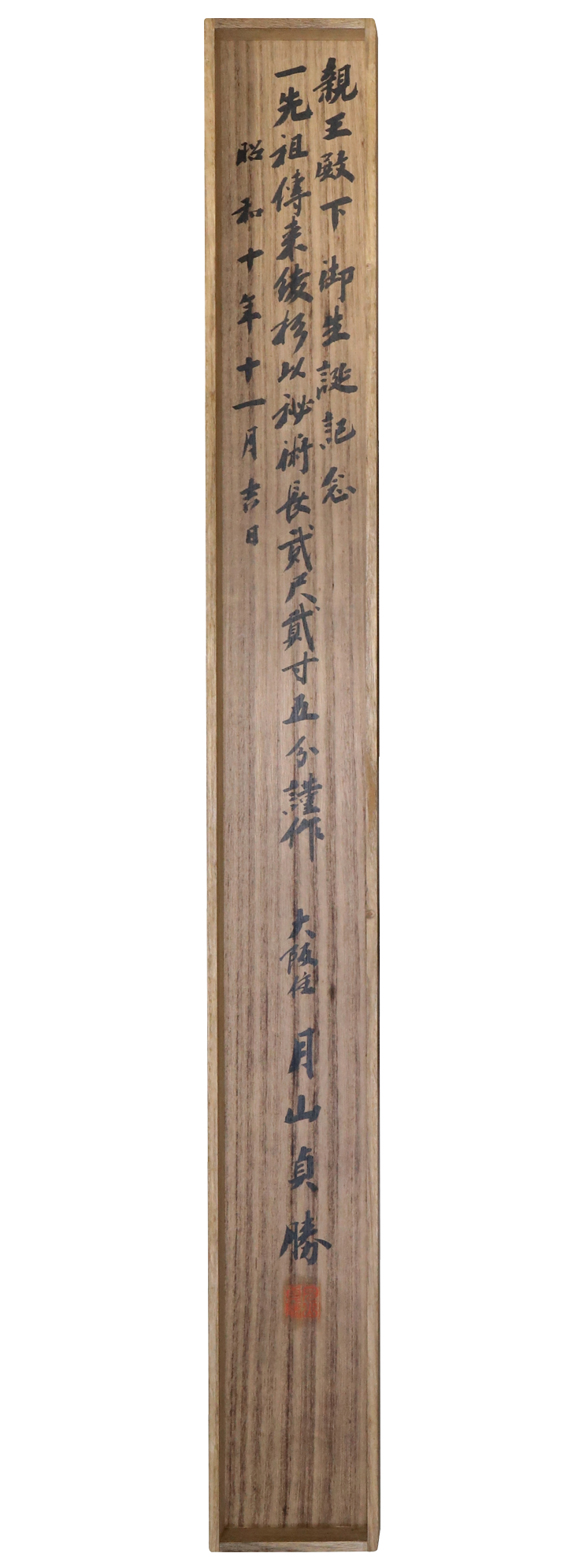
This work is a typical example of Gassan Ayasugi-den, forged around the time the smith was 66 years old in Showa 10, November, as stated in his own box inscription: "Using the secret technique of the ancestral Ayasugi."
The nakago bears the inscription "Commemorating the birth of His Imperial Highness the Prince," which refers to Prince Hitachi Masahito (younger brother of the Heisei Emperor) who was born in this month.
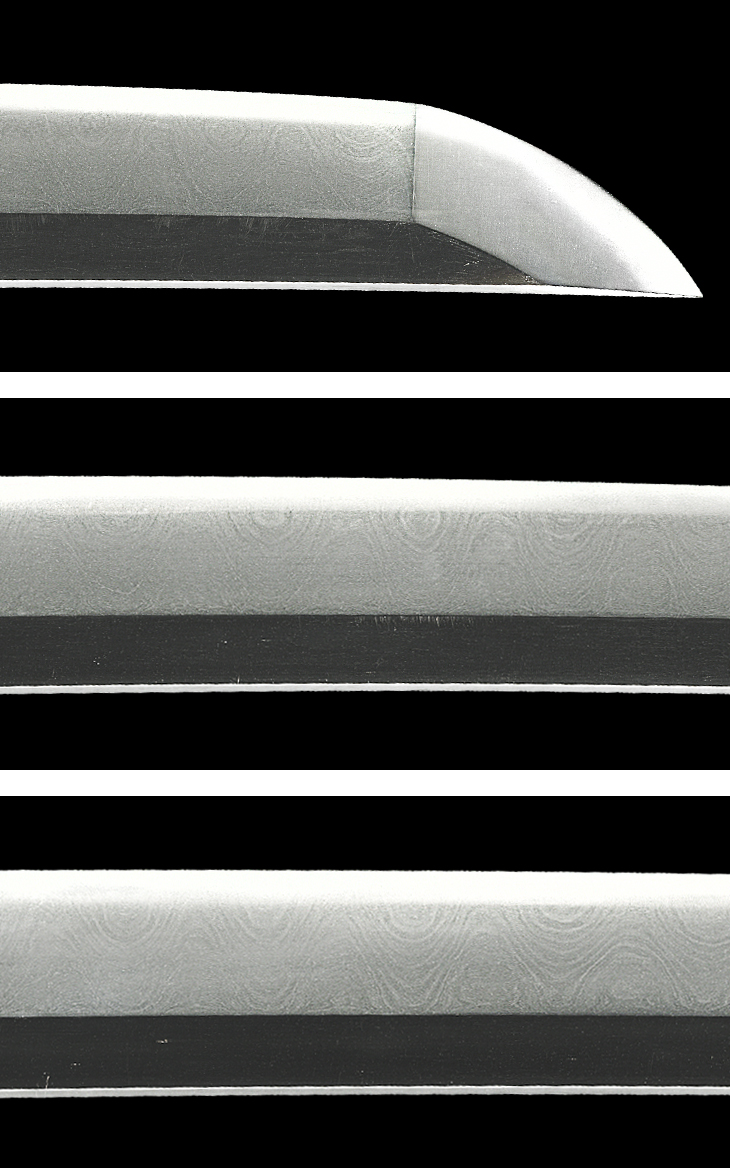
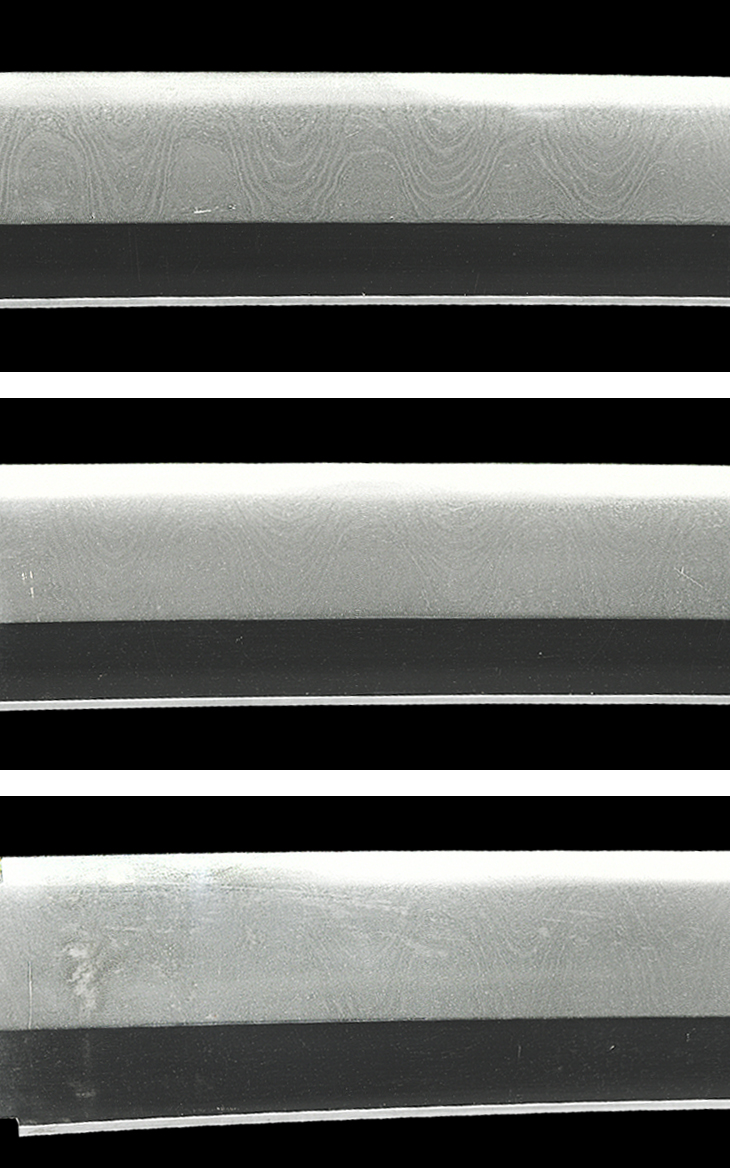
In the jitetsu, where the large, undulating Ayasugi-hada clearly appears, chikei enters densely along the hadame, and the yakiba, which is sugu-cho mixed with ko-gunome, is intertwined with the Ayasugi-kitae, with hotsure, uchinoke, and niju-ba at the ha-buchi, and within the ha, shimmering wavy kinsuji and sunagashi are intensely applied. The ji and ha are extremely healthy, making this a pleasant sword.
As a special custom-made piece commemorating the birth of a member of the Imperial family, it comes with a solid appraisal and is housed in a double box along with the box inscribed by the smith himself, so it is an essential piece for a Gassan school collection.
Machine translation from the shop's Japanese · may contain errors ·
Gassan Sadakatsu was named Eitaro, born in Meiji 2 as the eldest son of the first generation Sadakazu, and in Sadakazu's later years he assisted his father and completed many substitute works. After his father's death, he succeeded the Gassan family and forged many swords for the Imperial Household, including the Daigensui sword for His Majesty the Emperor, and protective swords for His Imperial Highness the Crown Prince and His Imperial Highness the Imperial Grandson, as well as various swords bestowed by the Emperor such as the Gensui swords. At that time, only four people were ordered to produce Gensui swords: Gassan Sadakatsu, Morioka Masayoshi, Kasama Ikkansai Shigetsugu, and Horii Hideaki (Toshihide).
In Showa 10, he moved the forging workshop that had been in Yariyamachi, Osaka, to Yoshinoyama, Nara Prefecture. As the head of the Osaka Gassan family, he was active from the Taisho period through the early Showa period, and in addition to the family tradition of Gassan Ayasugi-den, he also skillfully forged the Gokaden. He died in Showa 18 at the age of 74.
This work is a typical example of Gassan Ayasugi-den, forged around the time the smith was 66 years old in Showa 10, November, as stated in his own box inscription: "Using the secret technique of the ancestral Ayasugi."
The nakago bears the inscription "Commemorating the birth of His Imperial Highness the Prince," which refers to Prince Hitachi Masahito (younger brother of the Heisei Emperor) who was born in this month.
In the jitetsu, where the large, undulating Ayasugi-hada clearly appears, chikei enters densely along the hadame, and the yakiba, which is sugu-cho mixed with ko-gunome, is intertwined with the Ayasugi-kitae, with hotsure, uchinoke, and niju-ba at the ha-buchi, and within the ha, shimmering wavy kinsuji and sunagashi are intensely applied. The ji and ha are extremely healthy, making this a pleasant sword.
As a special custom-made piece commemorating the birth of a member of the Imperial family, it comes with a solid appraisal and is housed in a double box along with the box inscribed by the smith himself, so it is an essential piece for a Gassan school collection.
About the maker
Sadakatsu
貞勝
Shinshinto · Osaka · around 1926-1989
Fujishiro Jo saku · Tōken Taikan top 60%
6 pieces on the market now
›
Historical importance
Where Sadakatsu stands among comparable artisans: across all of nihontō, and within tradition, era, and period. The tiers (Foremost · Leading · Major · Notable) weigh official designations from the NBTHK and Japan's Agency for Cultural Affairs, together with historical honors of lasting repute such as the Sansaku and Meibutsu-chō.
The twentieth century nearly killed the craft twice: wartime distortion, then the occupation ban. The NBTHK’s founding in 1948 and licensed forging from 1953 rebuilt the sword as an art, crowned by Living National Treasures and the mukansa rank.
Certifies a genuine blade worth preserving: a signature confirmed correct, or, if unsigned, an era, province, and school that the NBTHK can reliably identify.
About the NBTHK›
The NBTHK (Nihon Bijutsu Tōken Hozon Kyōkai, the Society for the Preservation of Japanese Art Swords) is a public-interest incorporated foundation founded in 1948 and supervised by Japan’s Agency for Cultural Affairs (Bunkachō); it is based at the Japanese Sword Museum in Tokyo. Its expert panels physically examine each submitted work (shinsa) and issue a certificate (kanteishō) ranking it by artistic and historical merit. NBTHK papers are the most widely recognized standard of authentication for Japanese swords and fittings.
For one-of-a-kind items such as swords, sword fittings and antiques, other customers may be waiting for the item, so please contact us about a return within 3 days of its arrival and ship it back within 8 days. Refunds are made on the day the returned item arrives.

 NihontoWatch