<audio controls preload="auto"> <source src="clocktowerbell.mp3" type="audio/mpeg" /> </audio>
Signed. Nihon satetsu no seitan-ko wo motte
Moto-haba (Width at Ha-machi) : Approx. 2.03cm
Gassan Sadakatsu was born in Meiji 2 in Yariya-machi, Osaka. He inherited the superior skills of his father, Unryushi Sadakazu, who was highly praised as a master and served as an Imperial Court Artist, and performed daisaku for him. His attitude toward his work was extremely sincere and strict; it is said that when forging guardian swords for the Imperial Family or sacred swords for Ise Jingu and Meiji Jingu, he would surround the forge with bamboo fences, hang ceremonial curtains, spread pebbles to purify the area, and pray to the gods and Buddha (Note 1).
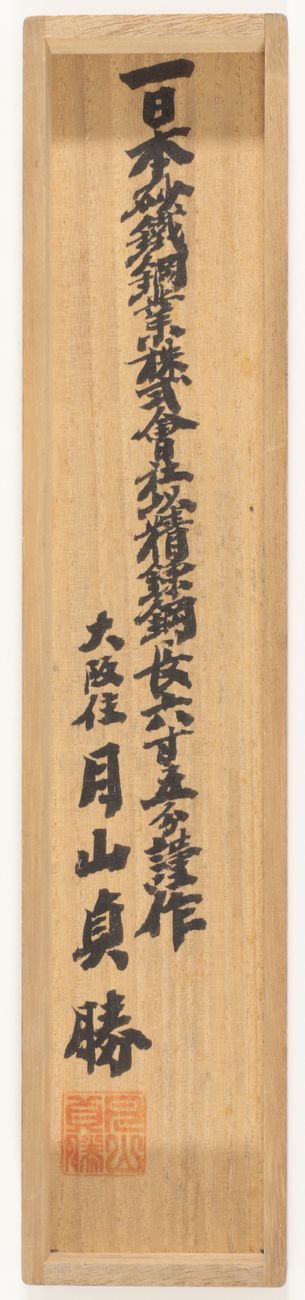
This tanto has a shape that, at first glance, is a reduced version of the Kogarasumaru-zukuri tachi, a treasure of the Heike clan, with the meat of the shinogi-ji shaved off for about two sun from the kissaki, and the shinogi-ji line running out to the kissaki (Note 2). The jigane is an incomparably tight ko-itame hada with dense chikei activity, covered in fine jinie, and is clear and bright. The hamon starts with a yakikomi at the machi where the ubu-ba remains, consisting of shallow notare mixed with gunome, with thick, bright nie like silver sand, yubashiri appearing along the habuchi, fine kinsuji sparkling near the monouchi, and thick nie-ashi entering the clear hachu. The boshi is nie-deki and returns long. The nakago, which features distinct sujikai yasurime stroke by stroke, still shines in a silver-white color, and the mei characters are carved with the same diligent chisel work as the guardian swords of the Imperial Family (Note 3), with the tagane-makura still standing out prominently. This is a mamori-katana forged from the refined steel of the Nihon Satetsu Kogyo Kabushiki Kaisha (Note 4), which was established in Takasago-cho, Hyogo Prefecture in Showa 9 to support the nation's mining and manufacturing industries.
Signed (100% of this smith's designated works are signed)
Measurements
Nagasa19.6cmMotohaba2.03cmKasane0.55cm
Description from Choshuya
Machine translation from the shop's Japanese · may contain errors ·
<audio controls preload="auto"> <source src="clocktowerbell.mp3" type="audio/mpeg" /> </audio>
Signed. Nihon satetsu no seitan-ko wo motte
Moto-haba (Width at Ha-machi) : Approx. 2.03cm
Gassan Sadakatsu was born in Meiji 2 in Yariya-machi, Osaka. He inherited the superior skills of his father, Unryushi Sadakazu, who was highly praised as a master and served as an Imperial Court Artist, and performed daisaku for him. His attitude toward his work was extremely sincere and strict; it is said that when forging guardian swords for the Imperial Family or sacred swords for Ise Jingu and Meiji Jingu, he would surround the forge with bamboo fences, hang ceremonial curtains, spread pebbles to purify the area, and pray to the gods and Buddha (Note 1).
This tanto has a shape that, at first glance, is a reduced version of the Kogarasumaru-zukuri tachi, a treasure of the Heike clan, with the meat of the shinogi-ji shaved off for about two sun from the kissaki, and the shinogi-ji line running out to the kissaki (Note 2). The jigane is an incomparably tight ko-itame hada with dense chikei activity, covered in fine jinie, and is clear and bright. The hamon starts with a yakikomi at the machi where the ubu-ba remains, consisting of shallow notare mixed with gunome, with thick, bright nie like silver sand, yubashiri appearing along the habuchi, fine kinsuji sparkling near the monouchi, and thick nie-ashi entering the clear hachu. The boshi is nie-deki and returns long. The nakago, which features distinct sujikai yasurime stroke by stroke, still shines in a silver-white color, and the mei characters are carved with the same diligent chisel work as the guardian swords of the Imperial Family (Note 3), with the tagane-makura still standing out prominently. This is a mamori-katana forged from the refined steel of the Nihon Satetsu Kogyo Kabushiki Kaisha (Note 4), which was established in Takasago-cho, Hyogo Prefecture in Showa 9 to support the nation's mining and manufacturing industries.
About the maker
Sadakatsu
貞勝
Shinshinto · Osaka · around 1926-1989
Fujishiro Jo saku · Tōken Taikan top 60%
6 pieces on the market now
›
Historical importance
Where Sadakatsu stands among comparable artisans: across all of nihontō, and within tradition, era, and period. The tiers (Foremost · Leading · Major · Notable) weigh official designations from the NBTHK and Japan's Agency for Cultural Affairs, together with historical honors of lasting repute such as the Sansaku and Meibutsu-chō.
The twentieth century nearly killed the craft twice: wartime distortion, then the occupation ban. The NBTHK’s founding in 1948 and licensed forging from 1953 rebuilt the sword as an art, crowned by Living National Treasures and the mukansa rank.
A Hozon-certified blade judged to show notably superior workmanship and a better state of preservation. The bar is higher: re-tempered blades and most unsigned Muromachi/Edo works are excluded.
About the NBTHK›
The NBTHK (Nihon Bijutsu Tōken Hozon Kyōkai, the Society for the Preservation of Japanese Art Swords) is a public-interest incorporated foundation founded in 1948 and supervised by Japan’s Agency for Cultural Affairs (Bunkachō); it is based at the Japanese Sword Museum in Tokyo. Its expert panels physically examine each submitted work (shinsa) and issue a certificate (kanteishō) ranking it by artistic and historical merit. NBTHK papers are the most widely recognized standard of authentication for Japanese swords and fittings.
If, due to our fault, the item differs significantly from its proper condition, the item may be returned. Cooling-off is within one week of the item's arrival.






 NihontoWatch