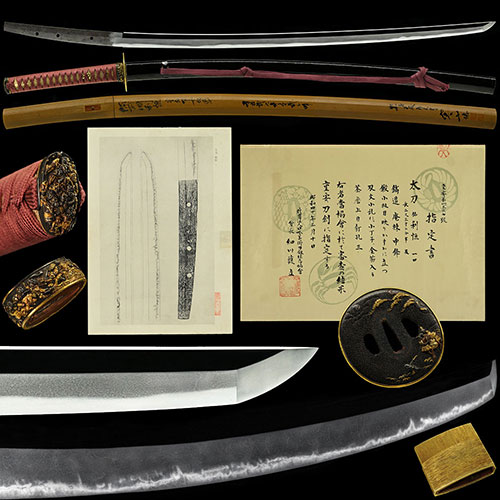
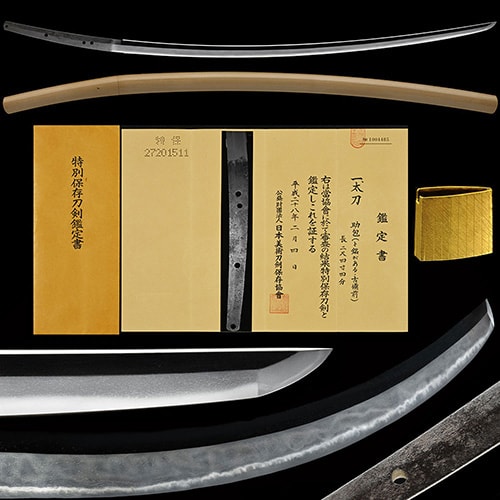
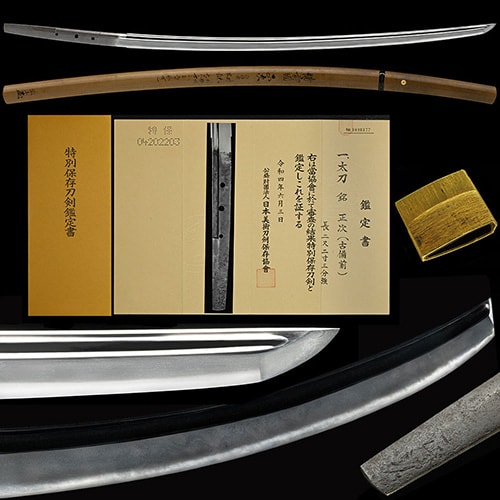
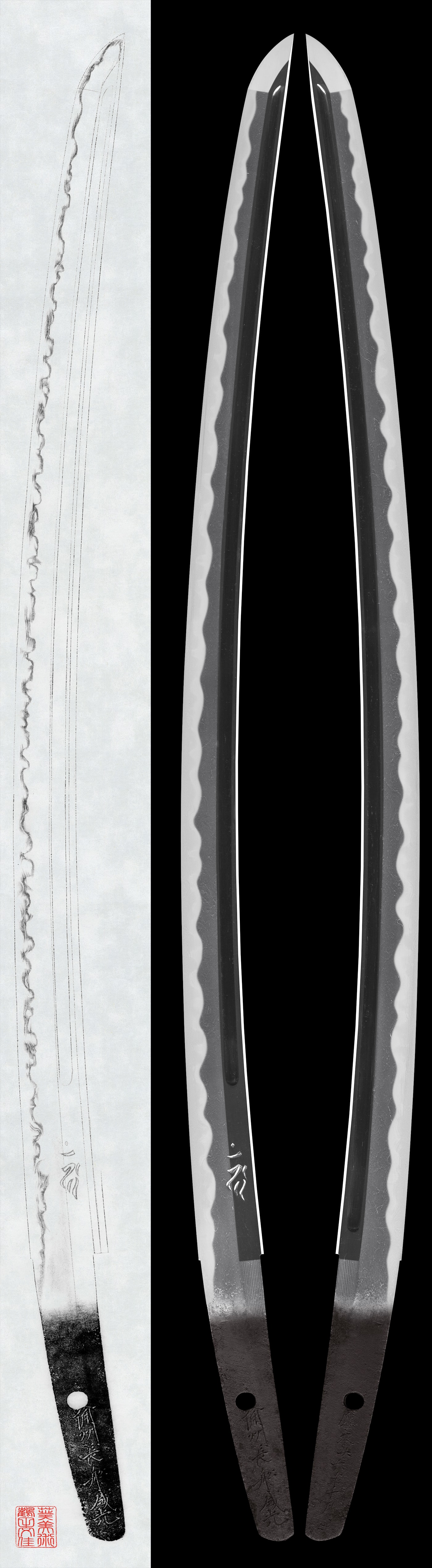
Toshitsune is a smith of the Ko-Bizen Masatsune line, working at the close of the Heian period and into the early Kamakura, and the published sources transmit him as a disciple of Masatsune, in one account a son of Mitsutsune. A signed tachi of his, designated an Important Cultural Property, survives at the Kyoto National Museum, and three more signed tachi were named Important Art Objects in the prewar designations. He is, for an old-Bizen name, comparatively well recorded: signed pieces survive in notable number alongside a body of shortened, unsigned blades attributed to him on workmanship, so that the Meikan in fact lists three smiths who carried the name across the Shogen, Bunryaku and Kencho eras. His standing is fixed by the lineage he extends. The judges write that both his signature and his work make the relationship with the school's founder readily plausible, finding his blades to 'support the relationship with Masatsune'[[c:1]].
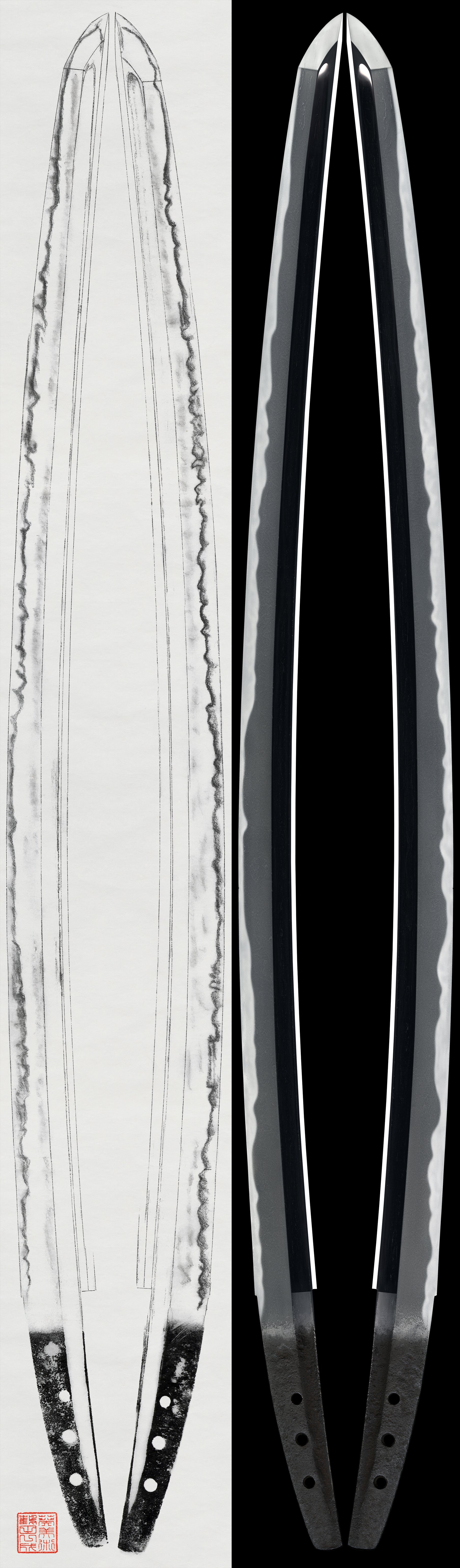
The core of his hand is a suguha-based ko-midare, the calm old-Bizen temper the published sources read as recalling Masatsune. Into a shallow, small irregular line he mixes ko-choji, ko-gunome and small midare, with ashi and yo entering well, ko-nie adhering, and frequent kinsuji and sunagashi running through the edge. On one of his finest signed tachi the published sources single out the kinsuji and sunagashi that entwine the small midare at the base as splendid. The boshi runs straight into a small round, at times finishing with a yakitsume tendency and hakikake. The shape beneath it is the old-Bizen bearing: at base slender, the koshizori high with funbari, the curve settling into a ko-kissaki.
The jigane is the constant. He forges an itame, in places a tighter ko-itame and in places standing a little, with ji-nie and frequent chikei; over it a midare-utsuri rises, clearing on his best pieces into a distinct jifu-utsuri, the speckled reflection of old Bizen steel. The published sources note that where the ji-nie gathers strongly the utsuri is the less conspicuous, so the reflection comes and goes with the steel rather than standing uniform. On the latest of his Juyo tachi the judges describe an itame mixed with mokume and tending to stand, thick ji-nie and frequent chikei, with the jifu-utsuri emerging clearly and the nioiguchi bright, and conclude that the blade 'fully manifests the distinctive qualities and virtues of Ko-Bizen'[[c:2]].
What the published sources name as Toshitsune's own tell, though, is sugata. Distinct from Masatsune, many of his blades, signed and shortened alike, are broad in mihaba and dignified in construction, the chu-kissaki at times compact toward ikubi, and over them the activity within the hamon is a step more florid: the small midare opens into ko-choji and a choji-midare, jifu enters the standing itame, and on one ubu tachi yubashiri gathers in the upper half into nijuba. The Jubun tachi at Kyoto and several signed examples carve bo-hi, while one tachi bears devotional horimono at the base, bonji with gomabashi and bonji with suken. The judges record three smiths of the name in the Meikan, which accounts for the variation in both signature and emphasis, and treat the spread as one tradition rather than two manners. The signed tachi, the published sources observe, include some whose edge is, like Masatsune, slightly subdued, and others somewhat more brilliant and florid, 'but in every case the boshi is rounded'[[c:3]].
That rounded boshi, with the well-ordered jigane, is exactly the thread by which the judges keep him within the line even on his broadest, most florid work. Reviewing his wide, dignified mumei katana, they grant that the construction is broader and the hataraki more flamboyant than Masatsune's, yet add that the refined jigane and the rounded boshi let one perceive the continuation of Masatsune's style. They affirm such blades from era and school, naming the imposing construction, 'a wide blade with a dignified presence'[[c:4]], as one of Toshitsune's distinctive traits. His work 'well displays the characteristic features of the Masatsune group'[[c:5]], the verdict that recurs across his entries. He stands among the old-Bizen hands at the threshold before the flowering of the Fukuoka Ichimonji, his most decorative pieces reaching a choji-midare but never the full clove-flower of the mid-Kamakura.
For the collector he is one of the more attainable of the old-Bizen names, which for a late-Heian to early-Kamakura Bizen smith is a relative thing. Fujishiro grades him Jo-jo saku, and his Toko Taikan valuation places him among the higher-ranked old-Bizen hands. He has no National Treasures; his record runs instead through a single Important Cultural Property, three prewar Important Art Objects, and seventeen blades in the Tokubetsu Juyo and Juyo tiers, of which only a part can ever change hands. The Important Cultural Property tachi is held at the Kyoto National Museum, and others are preserved in long-standing institutional collections, the Sano Art Museum and the Mori Shusui Museum of Art among them; among the recorded provenances are the Suwa family, whose tachi descends with a fine itomaki-tachi koshirae bearing the Suwa crest, and the prewar collectors Ide Tokuichi, Otomo Tsunetaro and Yamauchi Toyokage. One signed tachi crossed to the United States in the celebrated Compton collection. A signed, unshortened Toshitsune comes to light only from time to time, and a privately held example is a document of how Bizen forged at its beginnings, the calm root from which its most brilliant traditions would grow.