Muromachi turned sword making into an industry: the uchigatana rose with massed infantry warfare, Osafune and Seki produced bundle swords beside custom orders, and the Ming trade carried Japanese blades abroad by the tens of thousands.
 NihontoWatchNihontoWatch
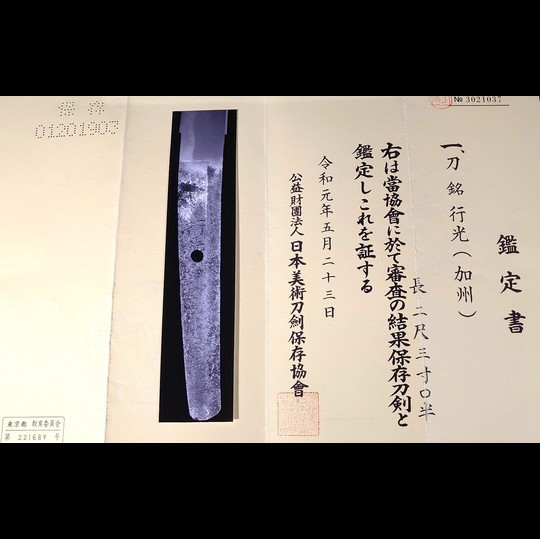
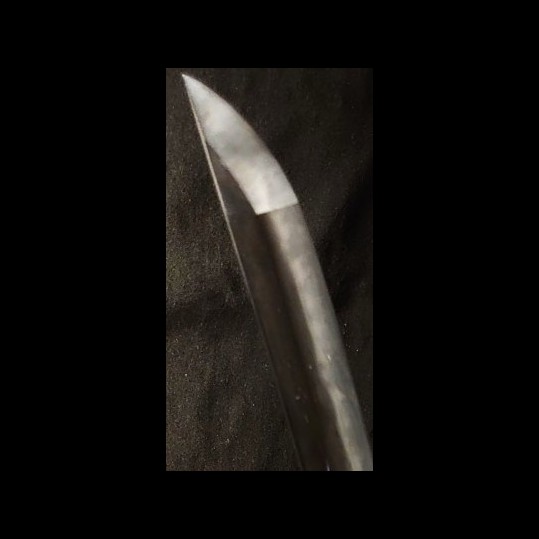
南北朝時代の加賀国には、山城国より『来国俊』の門人である『藤島友重』が来住し、また『則重』の高弟『真景』が隣国越中より加賀に来住すると活況を呈するようになったと言われております。 表題の『行光』は『藤島友重』の門人で初代は康正頃(1455~)作刀が見られます。 鞘書にはこの初代であろうと書かれていますが、鑑定書には何代とまでは判定しきれておりません。 行光は山城伝の京反りの太刀造りの体躯に相伝備前を加味した互の目丁子乱れの刃文を焼いて見応え十分にありと言われており、室町時代を通じて五代まで続くと言われております。銘鑑によれば業物に列せられています。 さて、本刀ですが京輪ゾリ深く付いた典型的な太刀姿。元幅は広めに先幅にやや開き付き、地は板目流れての刃紋は互ノ目交じりに丁子足入り、金線、砂流しも地に沿って入り、切先乱れ込み複雑に掃けて長く返っています。 刀身全体にわたって、表裏面白く見ごたえ十分にあります。 美術刀剣としても楽しく良い出来です。 武術武道的に見ていきますと、良い輪反り加減のお刀で抜刀納刀ともに丸く抜き差しできますので、気持ちよく稽古できます。古流居合の方には特におすすめです。 試斬稽古で考えますと、刀身体配は重ね薄目で身幅も有りますので時代刀の中では巻藁試斬には向いていると言えます。このような反りの強いお刀はどういう斬れ方をするのか興味が湧きます。 現代拵えは15万円~作れますので、柄、鞘、鍔等、お好みのバランスで作ってみては如何でしょうか。 お手持ちの金具持ち込みも歓迎いたします。ご相談ください。 皆様からのお問合せを、お待ちしております。
NihontoWatchOffered by Token Hasegawa
This piece has sold
17 on the market
Get an email when a new Fujishima Yukimitsu piece hits the market.
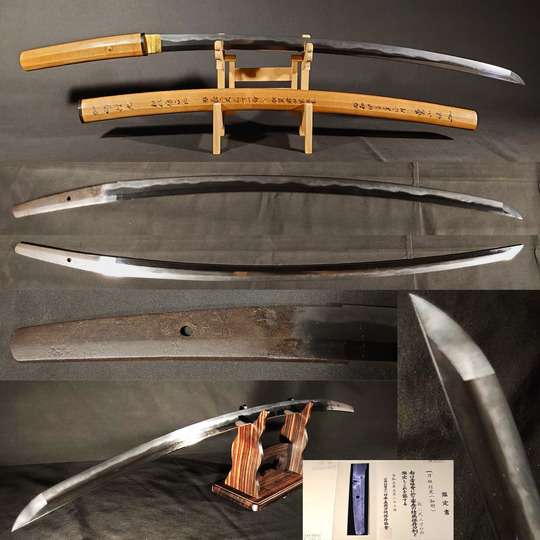
As written by the shop
Yamashiro-den · Kaga · around 1455-1457
Fujishiro Jo saku · Tōken Taikan top 49%
Yamashiro-den · Kaga
17 pieces on the market now
Among the provincial lineages of the Hokurikudo, the Fujishima school took its name and its base from the village of Fujishima in Kaga province, where Tomoshige stands as founder and the name he set down passed through several generations from the close of the Nanbokucho period across the Muromachi and on into the early-modern Shinto era. The members place the chronological anchor with care: the earliest firmly dated work is a tanto of Oei 2 (1395), and the NBTHK finds nothing among the surviving blades that goes back earlier than Nanbokucho. Old documentary tradition reads the first generation as a pupil of Rai Kunitoshi of Yamashiro, alternatively of Kashu Sanekage or Rai Toshimune, but the published sources doubt each reading in turn, finding no stylistic tie to Rai Kunitoshi and a chronological impossibility with Sanekage; judging from the make and the nakago finish, they settle by elimination toward the Yamato tradition, close to the Yamato Shikkake hand. A tachi held at Atsuta Shrine and a two-character ken read as the oldest surviving piece bracket the early end of the line. The recognition of the school lives in its jigane. The members agree on a board-grained itame that mixes in mokume and runs to nagare, standing somewhat open (hada-dachi), the surface gathering ji-nie and chikei, the steel carrying a distinct blackish cast named kan'a-iro and tied directly to the northern provinces as hokkoku-hada; a faint whitish shirake-utsuri rises quietly against this dark ground rather than a bright Bizen reflection. Over that ji the school tempers a gunome-midare into which box-shaped (hako-ba), pointed and angular (togariba) teeth enter together with notare and ko-notare, the ashi running rather long, the ha nie-laden with sunagashi sweeping it and kinsuji entering, small tobiyaki and muneyaki scattered here and there.
The NBTHK reads the feel of it as a make in which Bizen temperament and Mino flavor coexist, the boshi running straight or midare-komi into a ko-maru, often swept with hakikake or running to yakizume. The members also mark the short blades apart: on the tanto the hand can quiet to a ko-itame and a narrow hoso-suguha or low ko-gunome with ko-nie, the nioiguchi sometimes clouding to urumi, the boshi turning jizo-like or returning deep, this the simplest face of the Yamato base while the dark steel keeps its northern mark. To kantei a Fujishima blade the eye works the conjunction rather than any single trait: the standing dark ji read together with the box-and-pointed midare and the constant sunagashi names the school where a clean Bizen choji or a true Yamashiro ko-itame would not. The members note works read variously toward an Aoe air, toward Naoe Shizu and Sekishu Naotsuna, the Mino and northern lines the school sits between, kin in feel to the Etchu and Echizen smiths of the same region. Among the membership Tomoshige carries the name and the standing; Fujishiro rates the founder Chu-jo saku and places others among the middle ranks of the koto smiths, and the most highly regarded work falls in the Oei generation while the Muromachi work survives most often. The single finest piece is a great spear (o-mi-yari) signed Fujishima Tomoshige and carved with a sanko-ken and the deity-name Myoken Daibosatsu, which the published sources judge not merely the best spear of the school but one of the representative famous spears of its age; surviving naginata by the line are noted as rare, their ubu-nakago valued as dating evidence. Provenance gathers around named houses recorded in the blades themselves, an Oei katana descended in the Inaba daimyo house and a tanto recorded in Honma's inventory of the Imperial collection, heritage pieces in long-standing hands; yet the line is not among the unattainable names, and a Juyo Tomoshige remains a realistic if uncommon encounter for the patient collector, valued for the way a single dark-steeled blade carries the whole northern school in its ji. Learn more →
| Smith | Era | Designated |
|---|---|---|
| Tomoshige友重 | 1394-1428 | 15 |
| Tomoshige友重 | 1346-1370 | 5 |
| Tomoshige友重 | 1324-1326 | 5 |
| Fujishima藤島 | 1394-1428 | 4 |
| Yukimitsu行光 | 1340-1346 | 0 |
The Muromachi period (1392 to 1573)
Muromachi turned sword making into an industry: the uchigatana rose with massed infantry warfare, Osafune and Seki produced bundle swords beside custom orders, and the Ming trade carried Japanese blades abroad by the tens of thousands.
Certifies a genuine blade worth preserving: a signature confirmed correct, or, if unsigned, an era, province, and school that the NBTHK can reliably identify.
The NBTHK (Nihon Bijutsu Tōken Hozon Kyōkai, the Society for the Preservation of Japanese Art Swords) is a public-interest incorporated foundation founded in 1948 and supervised by Japan’s Agency for Cultural Affairs (Bunkachō); it is based at the Japanese Sword Museum in Tokyo. Its expert panels physically examine each submitted work (shinsa) and issue a certificate (kanteishō) ranking it by artistic and historical merit. NBTHK papers are the most widely recognized standard of authentication for Japanese swords and fittings.
NBTHK official site