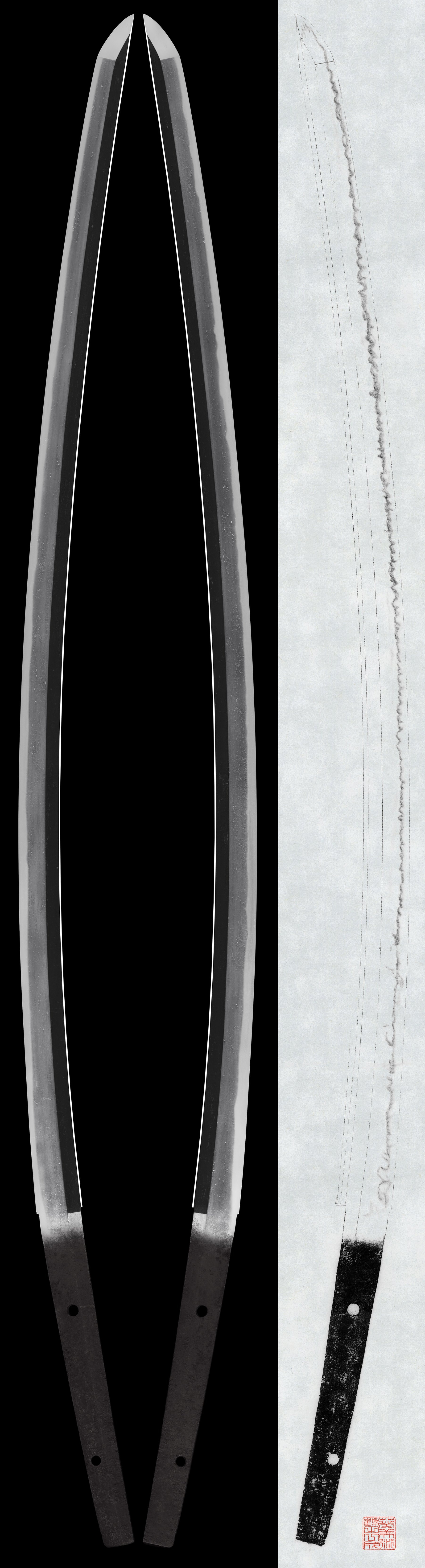
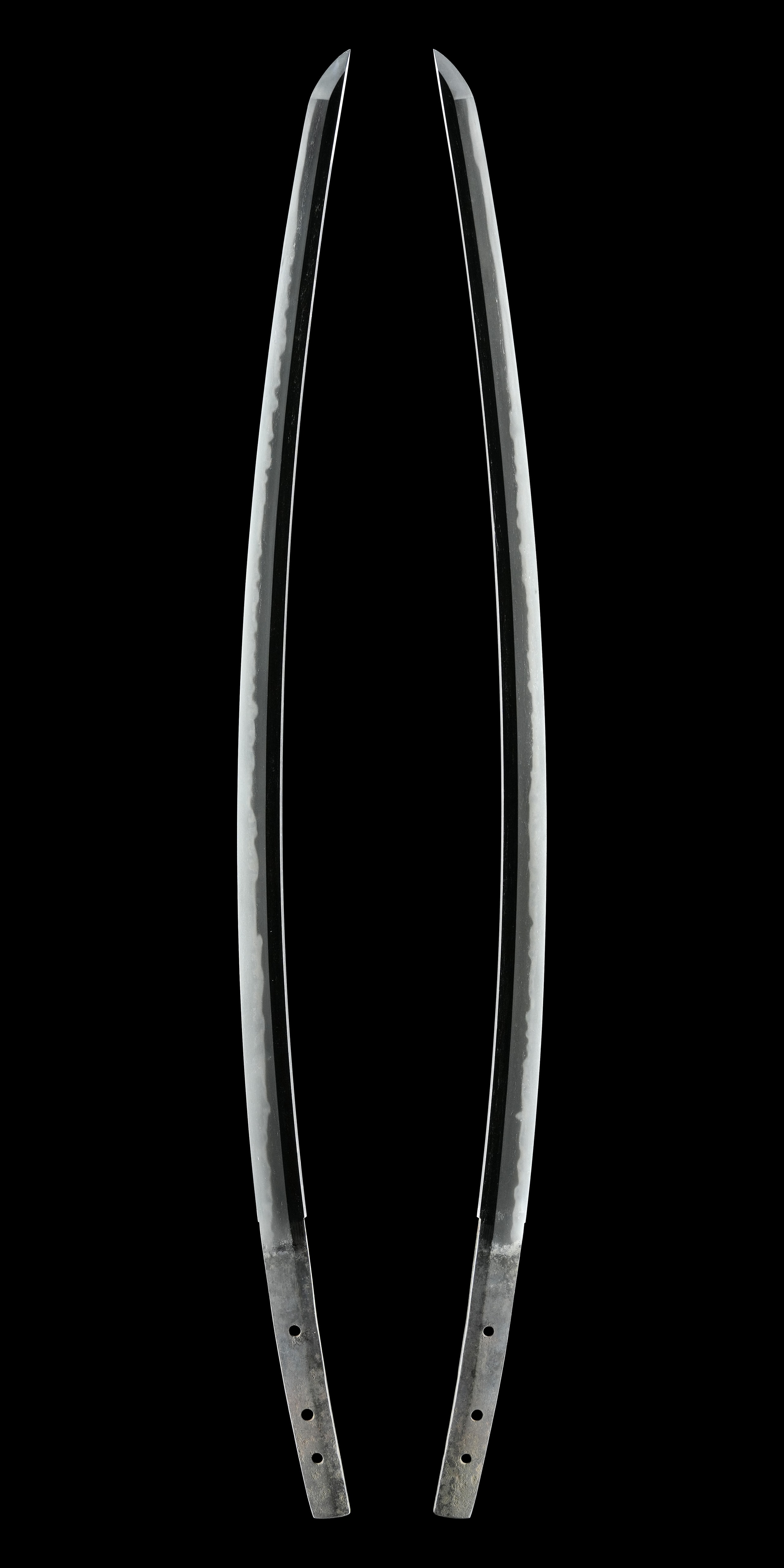
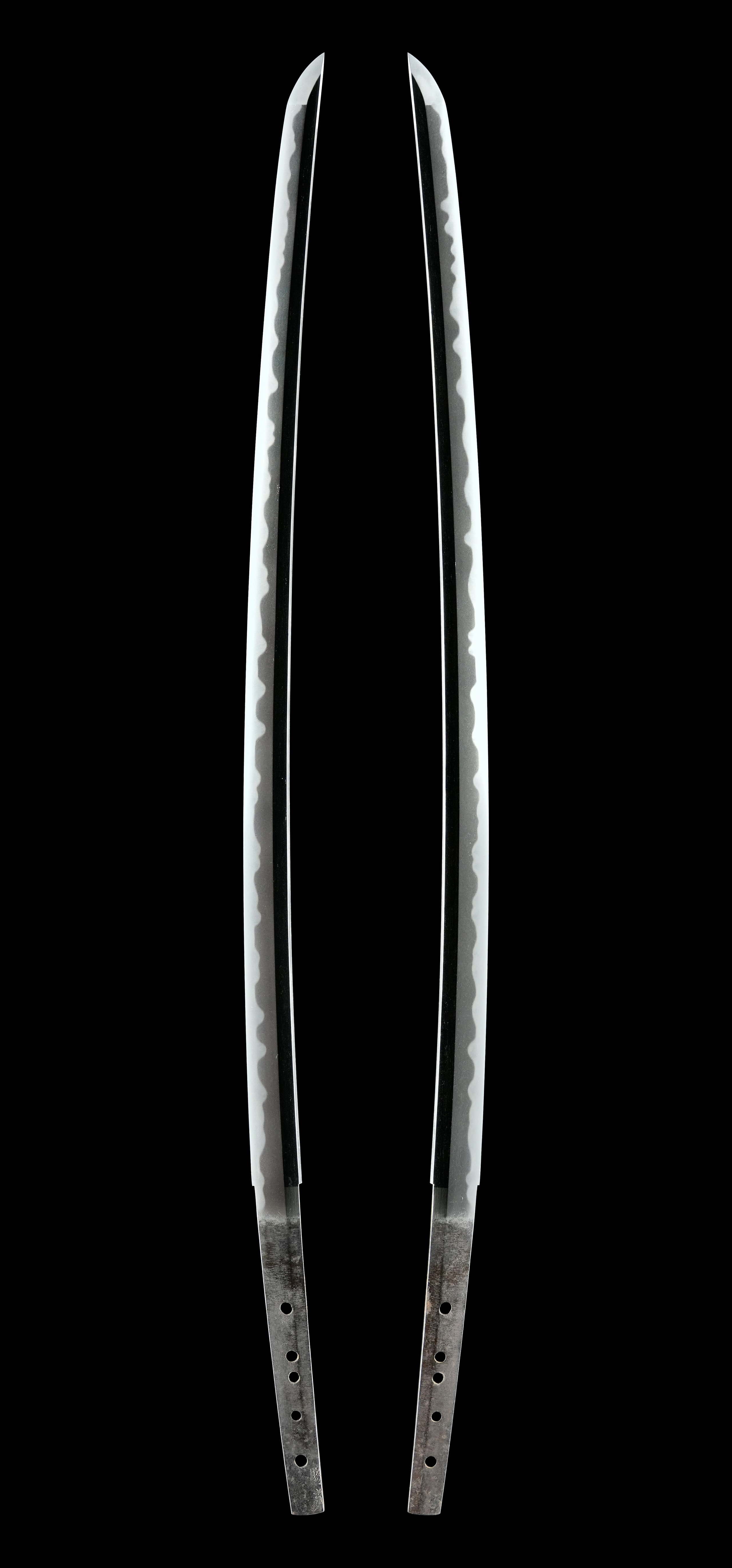
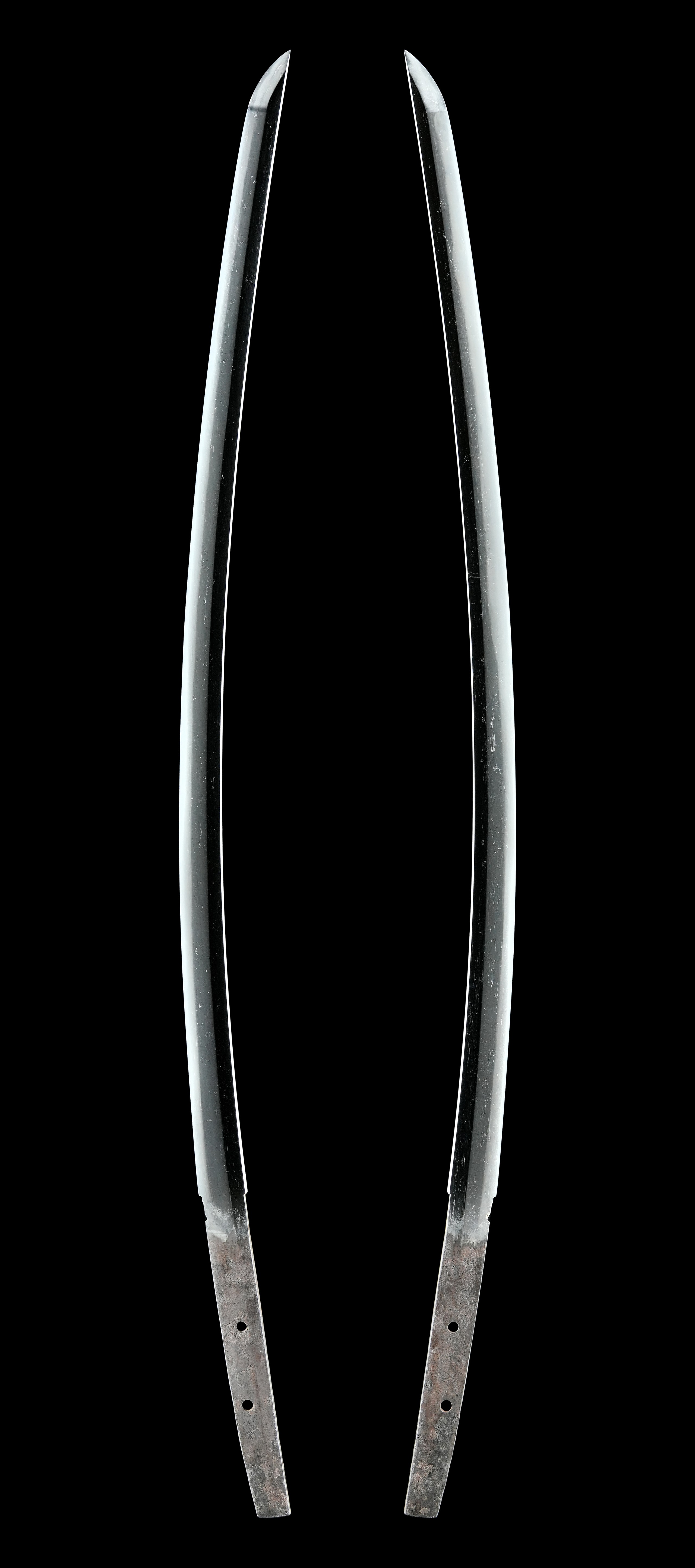
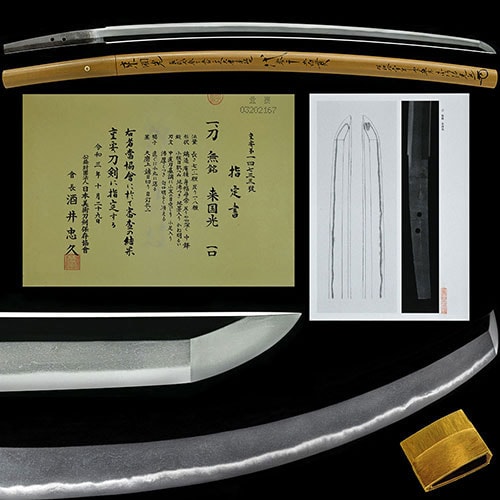
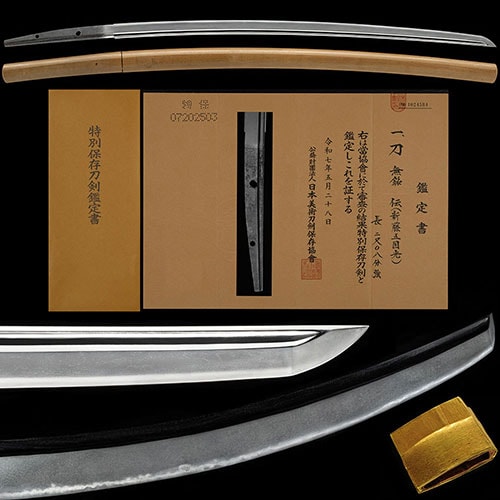
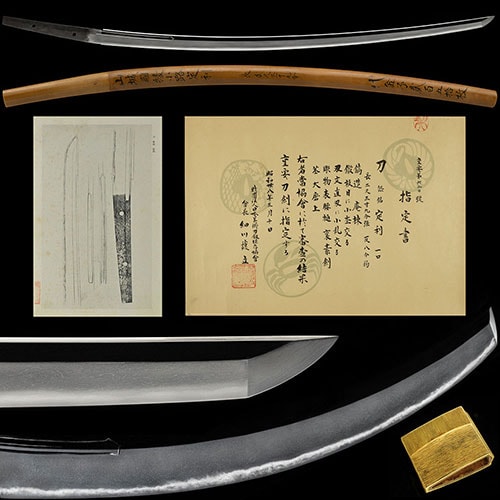
Fujishima Tomoshige is the founding smith of the Fujishima school, a lineage of swordsmiths resident at Fujishima in Province (Kashū). Documentary tradition holds that the first-generation Tomoshige was a disciple of Kunitoshi, though no extant work can be appraised as dating to the period, and the has observed that "there is no material that can be accepted as confirming this tradition." Alternative sources variously connect him to Kashū Sanekage or Toshimune, but these claims likewise "appear to leave room for further examination." Rather, judging from the workmanship and the manner of tang construction, the has concluded that he may be considered to have drawn upon a Yamato-derived lineage. Among dated works, the earliest known inscription is Ōei 2 (1395); however, undated pieces exist whose style "appears to go somewhat earlier," with the oldest works appraised as beginning in the period. A single bearing only the two-character signature "Tomoshige" is thought to be the earliest surviving work, not descending later than the end of the period. The Tomoshige name continued through the period and into the era, flourishing over a long span.
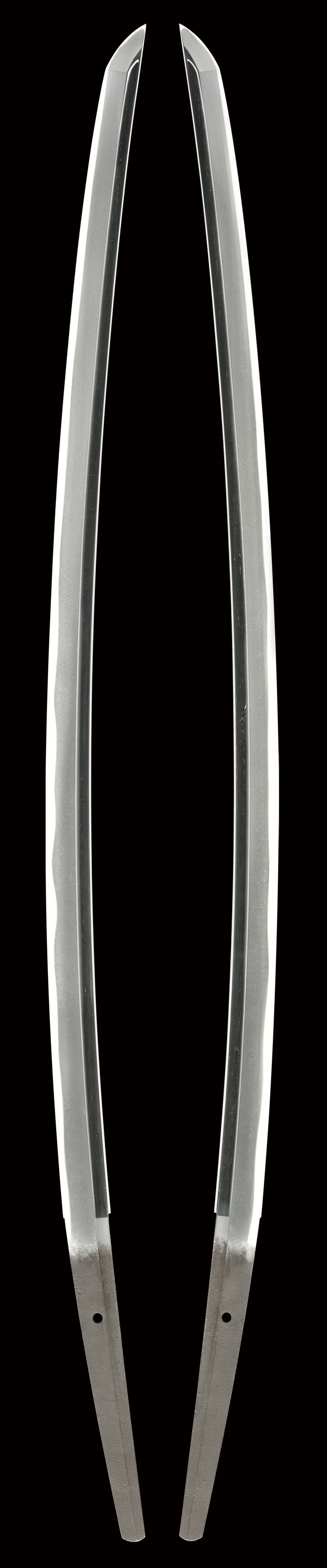
A key point of appreciation in the workmanship of this school is the character of the : it tends toward a slightly standing grain — — and takes on a darkened, blackish tone described as 'a-iro, presenting a distinctive quality of northern-province workmanship known as hokkoku-. Faint frequently stands out against this dark ground. The commonly forms a mixed in which , -ba, and appear together, producing what the characterizes as "an impression in which -like characteristics and -like tendencies coexist." In many works the enter somewhat long and the temper is -laden, with vigorous and running through the hardened edge; small and are also encountered. The frequently shows and tends toward . Conversely, among one also encounters works in a fine with — a mode in which the has noted points of resemblance to Naoe and Sekishū Naotsuna, or an -like manner. The presence of angular and pointed elements within the hardened edge, together with conspicuous , are consistently singled out as "points to be appreciated" and essential features of this smith.
Tomoshige is repeatedly designated "a representative smith of the Fujishima school," and his works are valued both as superior examples of craftsmanship and as reliable source material for understanding the scope of his oeuvre. The consistently notes that his finest pieces exhibit and that are — sound and well-preserved — and praises blades that "clearly demonstrate the distinctive features of this school and smith." Rare forms such as and large-bodied spears are singled out for exceptional praise; one is described as "not only a masterpiece among Fujishima-made spears, but one of the renowned spears representative of its age." Dated Ōei-era works are regarded as "particularly noteworthy" and "exceedingly precious" for establishing his chronology, while pieces appraised as pre-Ōei are valued for pushing the documented range of his career into the late period. Through his coexistence of temperament, inflection, and Yamato structural sensibility — all cast upon the dark, characteristically northern-province ground steel — Tomoshige occupies a singular position among provincial smiths of the transitional -to- era.