Hizen swords were a domain enterprise: the Nabeshima sent Tadayoshi to study under Umetada Myōju around 1596, then built a licensed school around him. Nine generations carried its famously consistent konuka-hada work into the Meiji era.
 NihontoWatchNihontoWatch
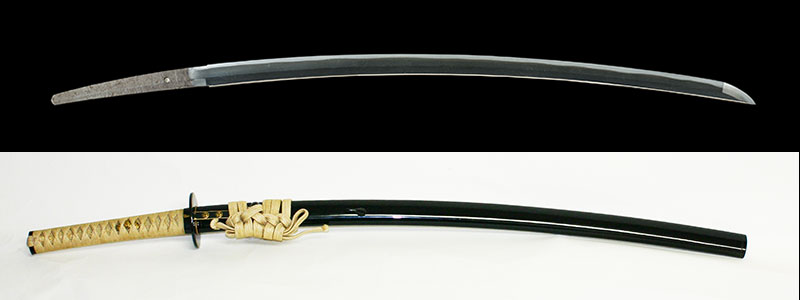
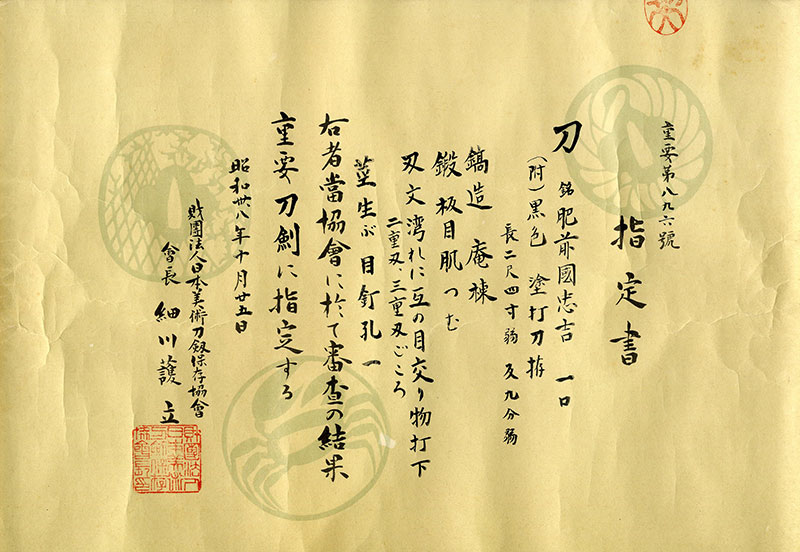
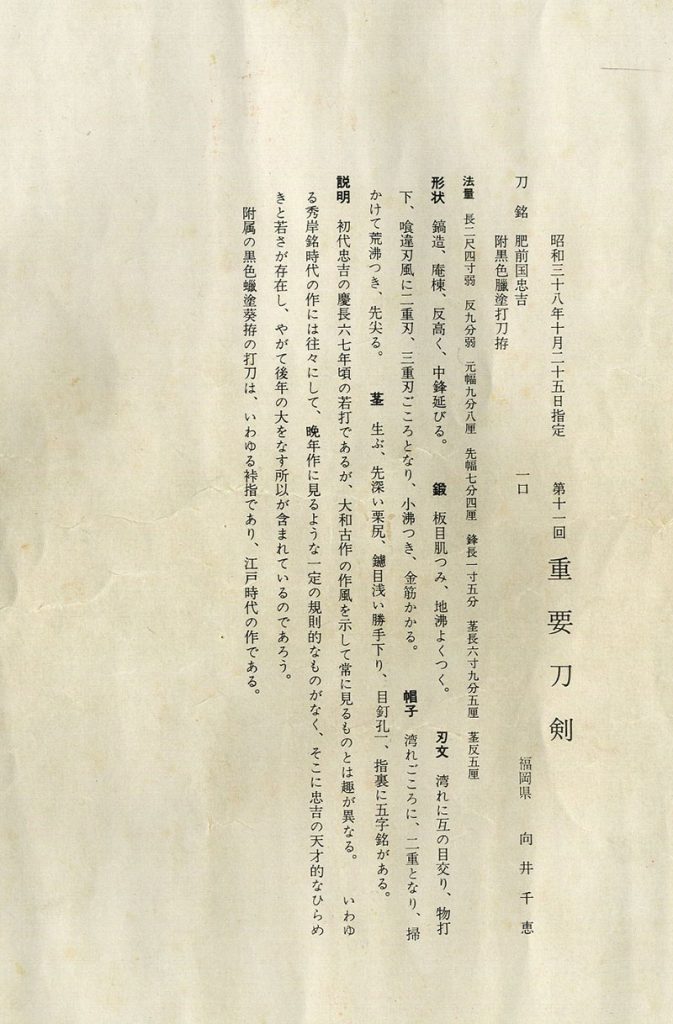
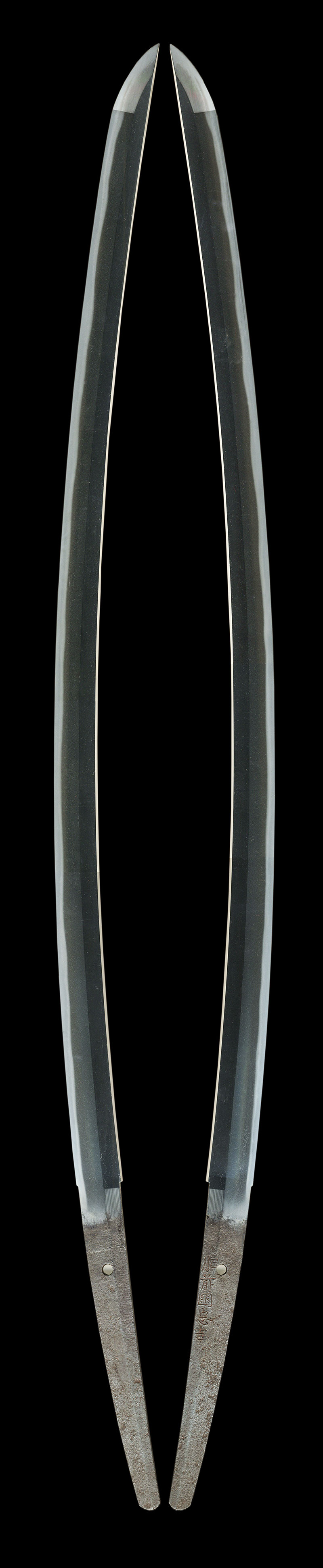
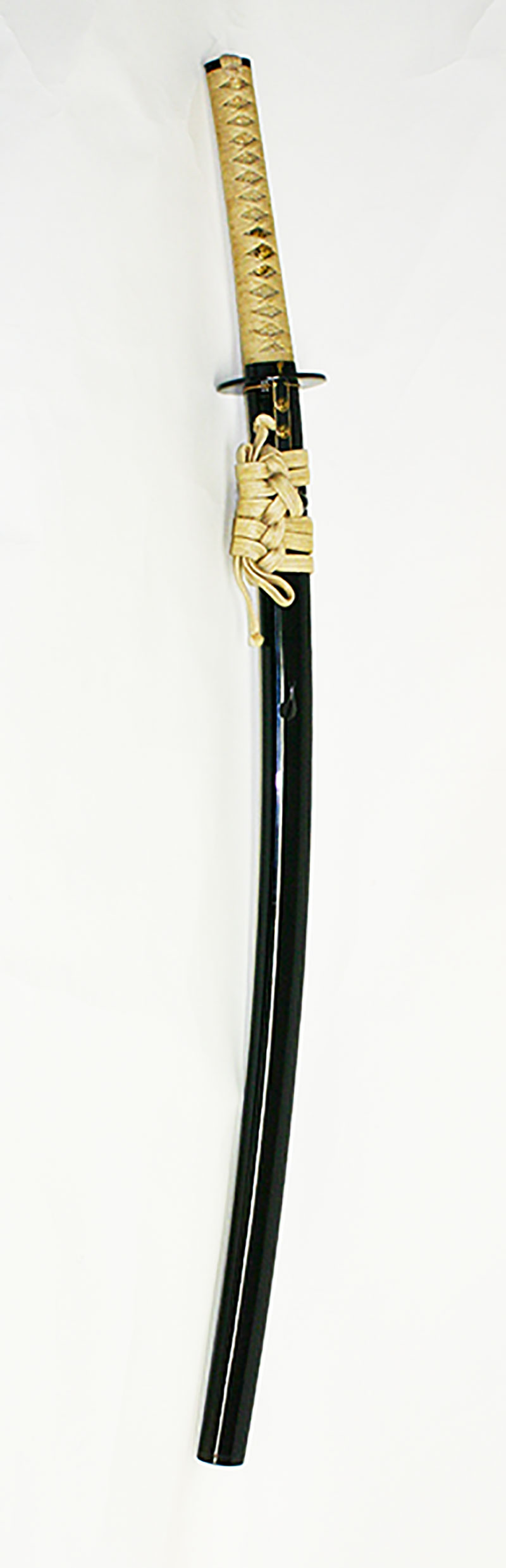
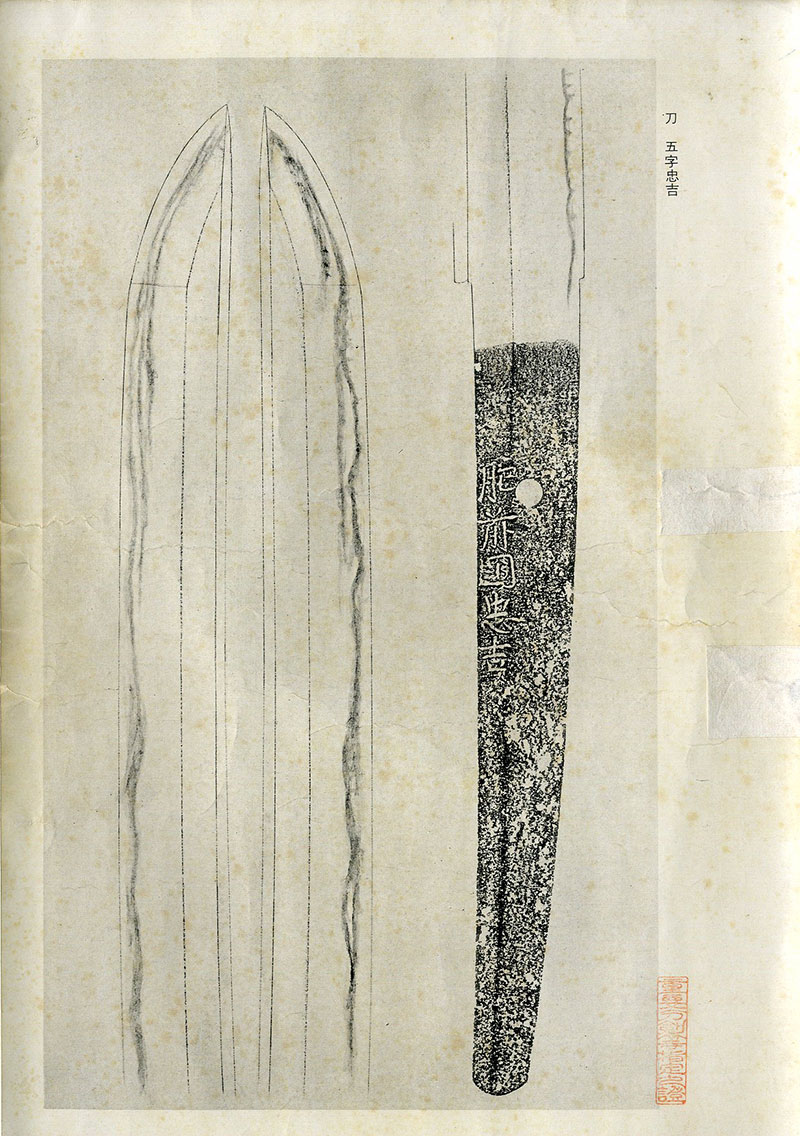
初代肥前国忠吉は橋本新左衛門と称し、佐賀藩主:鍋島家に抱えられた。慶長元年、藩命により一門の宗長とともに京に上り、埋忠明寿の門に入り、同三年帰国、佐賀城下に在住して活躍し、一門は同家の庇護のもと明治まで栄えて多くの優れた名品を生み出した。元和10年の再上京の際には「武蔵大掾」を受領し、名を忠広と改めている。寛永9年8月15日に逝去した。初代忠吉は、長義写し・志津写し・直江志津写し・来写し・大和物写し・青江写し景光写し等があって、様々な古作の作域に果敢に挑戦している。 本作は長寸で反り強くつき、中鋒が延びごころとなる体配をしめし、地鉄は、板目肌に、地沸が細かによくつき、地景しきりに入り、刃文は、ゆったりとしたのたれを基調に、互の目・小互の目を交え、足よく入り、少しく葉を交え、小沸よくつき、金筋・砂流しかかり、刃縁に喰違刃や打ちのけ・二重刃などさかんにかかり、変化に富み、匂口明るく冴える。重要刀剣の解説にあるとおり、鎬が高く、鎬幅を広く取った体配に、のたれ刃に小足、金筋・砂流しを交え、帽子も激しく沸づきなが焼詰風にみられるところから、まさに大和国当麻辺りを狙った作と思われる。拵は葵紋の三所を備えた江戸時代の打刀拵であるところから一時期徳川家ゆかりの武士の旧蔵品であったかと思われる。
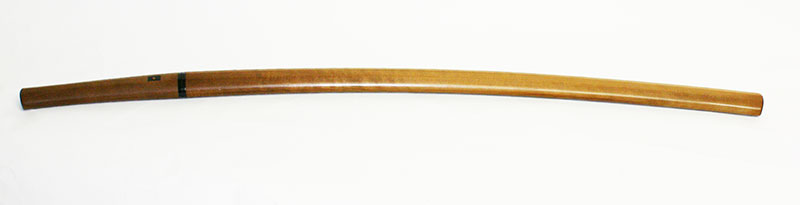
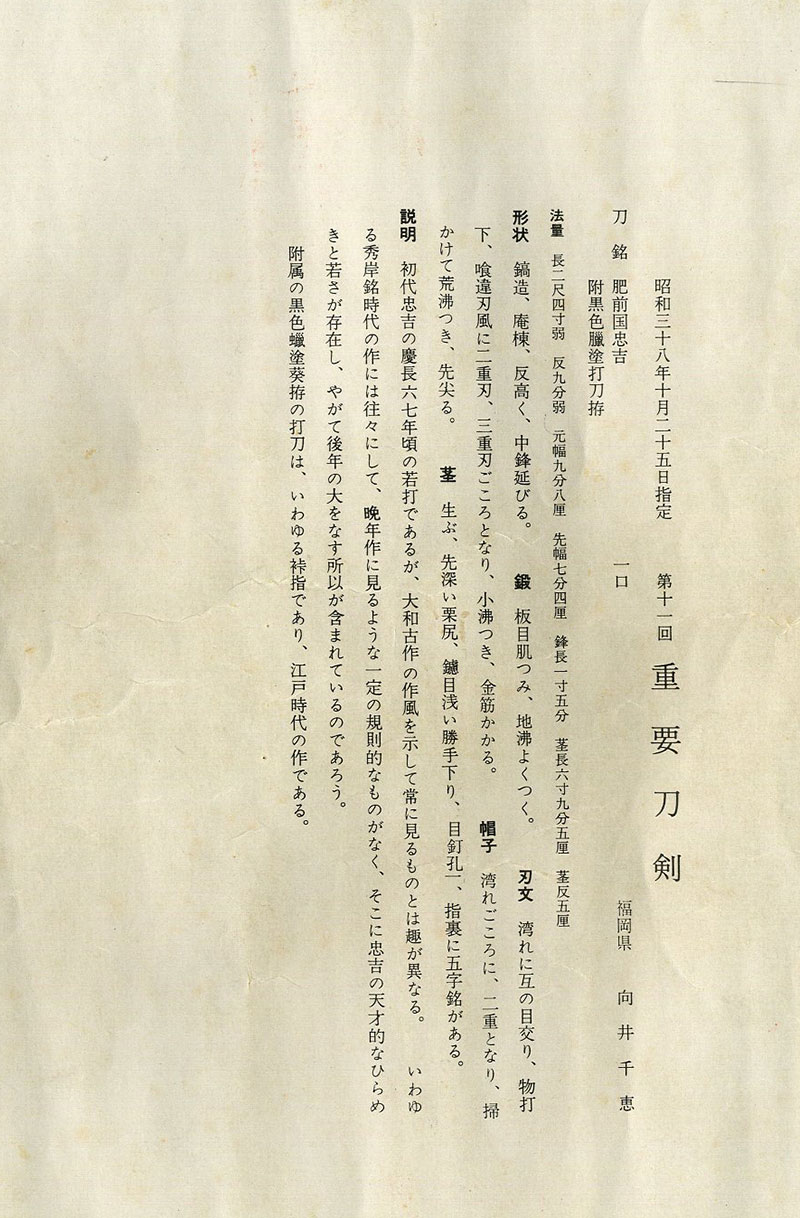
初代忠吉の慶長六七年頃の若打であるが、大和古作の作風を示して常に見るものとは趣が異なる。 秀岸銘時代の作には往々にして、晩年作に見るような一定の規則的なものがなく、そこに忠吉の天才的なひらめ きと若さが存在し、やがて後年の大をなす所以が含まれているのであろう。 附属の黒色蠟塗葵拵の打刀は、いわゆる裃指であり、江戸時代の作である。
NihontoWatchOffered by Iida Koendo
This piece has sold
Get an email when a new Hizen Tadayoshi piece hits the market.

As written by the shop
Hizen (Tadayoshi) · Hizen · around 1596-1632
Fujishiro Sai-jo saku · Tōken Taikan top 5%
10 pieces on the market now
The first-generation Tadayoshi of Hizen, the published sources record, styled himself Hashimoto Shinzaemon and served as a retained smith of the Nabeshima of Hizen. By domain order in Keicho 1 (1596) he went up to Kyoto together with the carver Munenaga and entered the school of Umetada Myoju, where he studied sword forging while Munenaga learned carving; they returned to their province in Keicho 3 (1598), and Tadayoshi settled in the castle town below Saga, where under the domain's patronage the line flourished greatly. His dated work begins from the eighth month of Keicho 5 (1600) and runs to the eighth month of Kan'ei 9 (1632), the year he died, a working career the published sources reckon at thirty-two years. In Genna 10 (1624) he went up to Kyoto a second time, received the court title Musashi Daijo, and changed his name from Tadayoshi to Tadahiro, altering his clan name from Minamoto to Fujiwara. He is the founder of Hizen-to, and the school he raised under Nabeshima patronage came to dominate the sword-making of Kyushu.
His mainstay is a bright, tight suguha tempered upon the fine jigane that is the signature of Hizen work. The published sources describe it plainly: "his favored suguha is tempered upon a well-knit ko-itame, the distinctive jigane commonly called kome-nuka-hada, and in it he aimed at the manner of the Rai school"[[c:1]]. The temper is a chu-suguha or hiro-suguha carrying only a shallow notare, at times mixed with ko-gunome, into which ko-ashi and yo enter; the nioiguchi is deep with finely clustered ko-nie, and it tightens to a bright clarity. Yet, the same sources note, the work departs from the Rai originals it looks to: the nioiguchi is tighter and brighter, fine chikei enter the ji abundantly, and the forging "has rather more vigor than the Rai pieces"[[c:2]]. The temper and the steel together carry the recognition.
That steel is the heart of the matter. The forging is a dense, well-knit ko-itame, at times with mokume mixed in, over which ji-nie gathers as the finest particles and lies thickly; fine chikei enter intricately and the steel is notably clear. The published sources give it its name as a feature peculiar to his hand, the surface taking on the "distinctive kome-nuka-hada"[[c:3]], the fine, bright, rice-bran texture the published sources name only for Hizen work. Upon it the boshi runs straight and turns back in a quiet ko-maru, the regular finish of a Hizen point. This combination, the clear konuka-hada beneath a tight bright suguha, is what the published record returns to again and again as the founder's proper manner, the work that places his suguha at the head of the tradition.
His early years are another matter, and the published sources read them as a period of copies. The constant formula is repeated almost verbatim from blade to blade: "his early manner comprises a wide range, full of utsushi-mono"[[c:4]], naming Naoe-Shizu, old Yamato work, and the Rai and Kamakura masters. In the Naoe-Shizu vein he forges a ko-notare mixed with ko-gunome, ko-ashi entering and sunagashi running, the nioiguchi slightly tightened, a manner the sources say inherits the ko-notare that was Myoju's particular forte and is "commonly called Naoe-Shizu utsushi"[[c:5]]. In the old-Yamato vein the itame grows larger and flows toward the edge, kuichigaiba and nijuba mix in with hotsure and frequent sunagashi, and even the boshi finishes with a touch of hakikake; of one such piece the sources say it shows "the most archaic manner among Tadayoshi's works, with deep, lingering appeal"[[c:6]], the hakikake boshi standing as the exception to the rule that the Hizen point turns back in a quiet ko-maru. He admired the Kamakura tanto masters as well, above all Rai Kunimitsu, and copied the Bizen Kagemitsu on occasion, one katakiriba tanto being an utsushi of a Kagemitsu transmitted in the Nabeshima house.
The through-line of his career is the signature itself, which the published sources divide into three forms by period. He cut "Hizen no Kuni Tadayoshi" in five characters, the so-called five-character Tadayoshi mei; he signed in eight characters as "Hizen no Kuni junin Tadayoshi saku," the junin mei; and after the Musashi Daijo title of Genna 10 (1624) he used the "Musashi Daijo Tadahiro" signature, the rename being a single hand's chronology and not a change of person. The presentation pieces signed "Hizen no Kuni ju Fujiwara Tadahiro" without the title are the kenjo-mei, ordered by the Nabeshima, who held the title-signature unnecessary on a blade made for the house. Because the second generation signed the same words before his own title, the published sources separate the two hands by the forms of the characters for Fuji and Hiro. The kiriba-zukuri pieces common in his Tadayoshi years, the sources note, become rare under the Tadahiro name. The mei is cut on the ura, the practice of Tadayoshi and his line; every one of his recorded works is signed, so the signature is itself part of the appraisal, though the five-character form, imitated by the later Tosa-no-kami and the third-generation Mutsu-no-kami, dates a piece only together with the rest of the workmanship.
The eight Musashi Daijo years, dated from Kan'ei 1 (1624) to the second month of Kan'ei 9 (1632), form a distinct chapter of the record. The published sources observe that after the title "his hamon divide broadly into suguha and midare, but compared with the Tadayoshi period the midare pieces are more numerous and the whole has a certain showiness"[[c:7]]. A wakizashi of Kan'ei 8 (1631), among the last of his life, carries a choji-midare that the same sources say displays his true ability, and the nioi of these years runs deeper than before. His suguha changes as well. Set against the later generations, the Musashi Daijo suguha "has variety, mixing kuichigai-like breaks and nie that spill from the edge into the ji, bold and full of vigor"[[c:8]]. A katana of Kan'ei 8, made at sixty, is read as the finished form of his chu-suguha[[c:9]]. The record is candid about the workshop behind these blades. The published sources hold that most work under the Musashi Daijo signature was made by pupils at his side, and they point to signatures running from fine to thick chisel, from which "the existence of substitute makers may be inferred"[[c:10]]. One blade forged by him was even signed with his name by his son after his death. The kenjo-mei pieces of these years include one made to a Nabeshima order for a fine suguha "with irregularities here and there in the likeness of Shizu", the commission itself preserved as a document.
From him descends the whole Hizen school. His son the second-generation Omi Daijo Tadahiro carried on the konuka-hada and the suguha to become the most prolific of the Hizen smiths, and the line continued through the third-generation Mutsu-no-kami Tadayoshi and the Tosa-no-kami branch, the published sources noting that the third generation in particular returned in style toward his grandfather the founder, especially accomplished in suguha and skilled also at choji-midare. Tadayoshi is Sai-jo saku in Fujishiro's grading. The weight of designation behind his name runs to one Important Cultural Property, nine Tokubetsu Juyo and a large body of Juyo, one hundred and forty-four blades in the Tokubetsu Juyo and Juyo tiers, with seven prewar Juyo Bijutsuhin pieces and no National Treasures; there are one hundred and fifty-five designated works on record. His blades carry a Nabeshima provenance and pass through notable hands, the recorded transmissions naming the Owari Tokugawa Family, the Satake Family and the Imperial Family among others, and one katana having been the sword of Nabeshima Naomoto, lord of the Ogi domain, with a kinzogan cutting-test inscription on one and a Myoju soemei on another that documents his discipleship. The bulk of what survives is held in long-standing collections and institutions such as the Takamatsu Historical Museum, and most are kept rather than traded; one comes to open hands only from time to time, and as the founder's own work it is a landmark of the Hizen tradition when it does.
Where Tadayoshi stands among comparable artisans: across all of nihontō, and within tradition, era, and period. The tiers (Foremost · Leading · Major · Notable) weigh official designations from the NBTHK and Japan's Agency for Cultural Affairs, together with historical honors of lasting repute such as the Sansaku and Meibutsu-chō.
Select a lens to see how it's measured.
Years he was demonstrably active, proven by signed-and-dated blades
Shinto · Hizen
107 pieces on the market now
The Hizen school began with a single domain commission. In Keicho 1 (1596) the Nabeshima of Hizen ordered Hashimoto Shinzaemon, the smith who would sign Tadayoshi, up to Kyoto with the carver Munenaga; there he entered the gate of Umetada Myoju and studied forging while Munenaga learned the chisel. The two returned to the province in Keicho 3 (1598), and Tadayoshi settled in the castle town below Saga, where under the domain's patronage the line grew into the dominant sword-making house of Kyushu. His own work runs from Keicho 5 (1600) to his death in Kan'ei 9 (1632); in Genna 10 (1624) he received the court title Musashi Daijo, changed his name to Tadahiro, and shifted his clan name from Minamoto to Fujiwara, so that the late Musashi Daijo blades are the founder under a second name. From him the house became a true generational institution: his son the second-generation Omi Daijo Tadahiro carried it forward as its most prolific hand, the third-generation Mutsu no Kami Tadayoshi returned its highest finish, and a Tosa no Kami branch took the founder's signature when he set it aside. Around this main line grew a circle of disciples and collateral hands, the waki-Hizen or Soba-Hizen smiths, several of them, like Yoshiie and Hironori, working as daisaku substitute makers whose own signed pieces are therefore scarce. The school's signature is its steel. Over a ko-itame forged so tightly it shows no slackness, fine ji-nie gathers in minute particles until the surface takes on the rice-bran konuka-hada (also written komenuka-hada) that no other school produces, fine chikei entering throughout and the ji notably clear and bright.
The orthodox temper laid upon it is a chu-suguha or hiro-suguha, sometimes tinged with a shallow notare and ko-gunome, the nioiguchi deep with finely clustered ko-nie and tightened to a bright clarity, the boshi running straight to a quiet ko-maru. The founder aimed this suguha toward the Rai school yet departed from it, his nioiguchi tighter and his forging carrying more vigor; the third generation refined it to what the published sources call the strongest and most precise hand of the first three generations. Against that calm register the house also worked a showier one, the Hizen choji-midare mixing gunome, long ashi, kinsuji and sunagashi, a manner the published sources already find more often in the founder's late Musashi Daijo work than in his Tadayoshi years, and one the second generation made his own. The branches pushed further from the suguha standard: Tadakuni of the Ogi domain ran sunagashi more conspicuously than any other Hizen hand and reached toward old Ichimonji in his o-choji; Masahiro and Yukihiro favored a flamboyant long-ashi choji over the calm main line; and the Iyo no Jo Munetsugu line worked apart in the Soshu-den, building a midareba on notare with a pointed togariba and a jihada that tends to stand and tone slightly blackish. A collector seeks Hizen-to first for that steel, and reads it the same way the appraiser does: a bright suguha lying over a clear, tight konuka-hada identifies the school before the signature is consulted, and the quiet ko-maru boshi on the ura-signed tang confirms the main-line practice. Generation and branch are then told within that frame, the third generation's powerful sugata recalling not his father but his grandfather, the waki-Hizen hands set apart by their irregular temper, their sujikai file marks and a sashi-ura signature, the Munetsugu line by its Soshu togari. The main line, made in real numbers across so long a span, reaches the market more readily than any Kamakura master, so a papered example is within reach of a patient collector, while the founder's own work and the finest konuka-suguha of the third generation come to open hands only from time to time. Provenance runs back through the house the school served, blades recorded to Nabeshima Katsushige and Nabeshima Naomoto and passing onward to the Owari Tokugawa, the Satake and the Imperial families; documentary inscriptions sharpen the picture further, a Myoju soemei attesting the founder's discipleship, Umetada carving adding flowers to brocade on his late blades, and the gold-inlaid cutting tests of Yamano Kanjuro and Yamano Ka'emon, rare on Hizen work, naming the edge as well as the hand. Learn more →
| Smith | Era | Designated |
|---|---|---|
| Tadayoshi忠吉 | 1596-1632 | 155 |
| Tadayoshi忠吉 | 1660-1686 | 61 |
| Tadahiro忠廣 | 1633-1693 | 133 |
| Tadakuni忠國 | 1648-1652 | 32 |
| Masahiro正廣 | 1624-1655 | 30 |
Hizen: a domain enterprise
Hizen swords were a domain enterprise: the Nabeshima sent Tadayoshi to study under Umetada Myōju around 1596, then built a licensed school around him. Nine generations carried its famously consistent konuka-hada work into the Meiji era.
A blade of top-grade workmanship and condition, formally judged to rank with a nationally recognized Important Art Object (Jūyō Bijutsuhin). Awarded only at the NBTHK’s competitive annual examination.
Of Japan’s roughly 2.5 million registered swords, only 12,348 (about 1 in 202) have ever attained Jūyō.
The NBTHK (Nihon Bijutsu Tōken Hozon Kyōkai, the Society for the Preservation of Japanese Art Swords) is a public-interest incorporated foundation founded in 1948 and supervised by Japan’s Agency for Cultural Affairs (Bunkachō); it is based at the Japanese Sword Museum in Tokyo. Its expert panels physically examine each submitted work (shinsa) and issue a certificate (kanteishō) ranking it by artistic and historical merit. NBTHK papers are the most widely recognized standard of authentication for Japanese swords and fittings.
NBTHK official siteFor returns at the customer's convenience, please notify us within two days of the item's arrival. Items that have been altered cannot be accepted. Return shipping is at the customer's expense. Costs other than the item price (bank transfer fees, cash-on-delivery fees, etc.) cannot be refunded. Items delivered overseas cannot be returned or refunded.