Under this name stands the second generation of the main line, Ōmi no Daijō Fujiwara Tadahiro, the most prolific master the Saga school produced. The published sources set out his life plainly: legitimate son of the first-generation , he was a youth of nineteen when his father died in 'ei 9 (1632), yet works by him are seen from that year, helped by the disciples who had served under the first Tadahiro. He received the court title Ōmi no Daijō in 'ei 18 (1641) and worked until his death at eighty-one in Genroku 6 (1693), a career of more than sixty years. Of that span the 's commentary writes that among smiths "he left the greatest number of works". Working under this code beside him is the founder's own last phase, for in Genna 10 (1624), at fifty-three, the first-generation received the title no Daijō and changed his name to Tadahiro, so that the late works signed no Daijō Fujiwara Tadahiro are the founder under his second name.
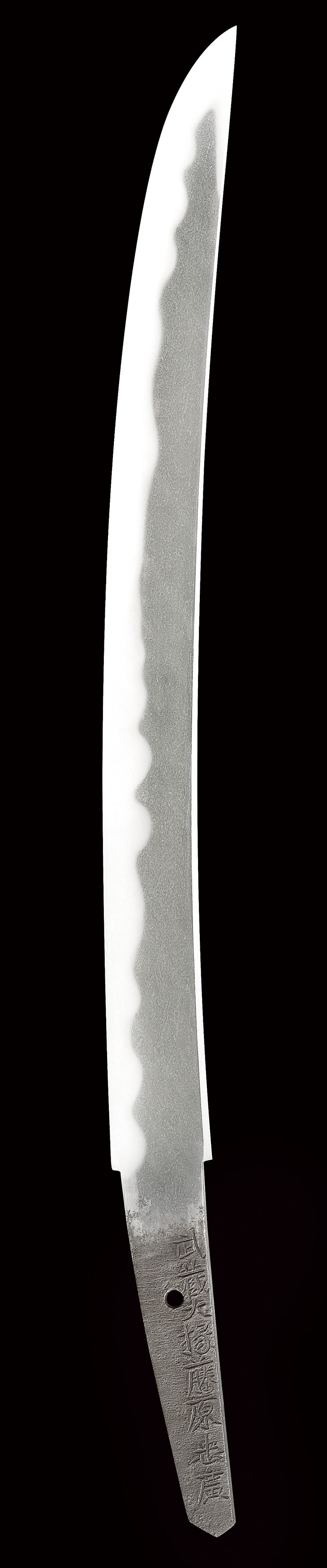
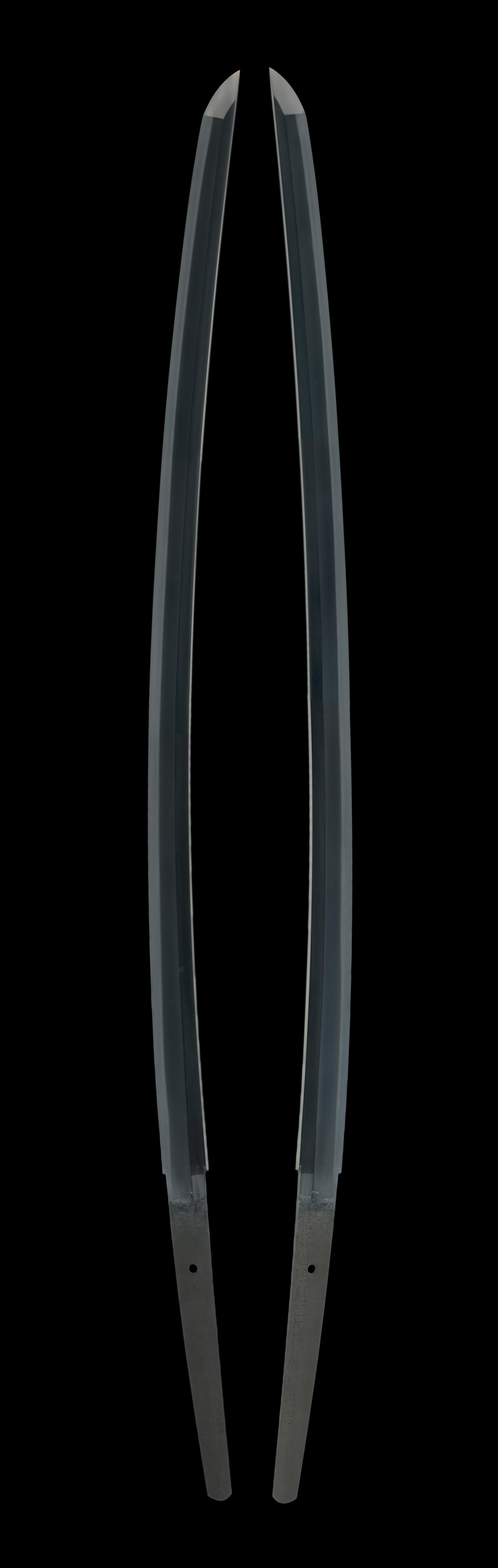
The second generation's hand is read in two manners, both of which the published sources call accomplished: on one they record that he made "both and , and in both he was highly proficient". The one he most excelled in is the . Over a tightly forged that becomes the , with laid in a dust-fine layer and fine , he tempers a medium straight line tinged with a shallow , mixing here and there a or a slightly pointed element. and enter well, the is deep and in places becomes band-like, adheres thickly, and fine and run through it with and an -like effect at the . The whole closes in a that is bright and clear, the straight to a .
The is the constant of his work. It is the school's rice-bran , a forged so tightly that the published sources describe one blade as without the least slackness, the densely and minutely covering it to give a moist, lustrous quality, the steel bright. Against that calm the temper stays composed, and where it rises it does so as the second register, the showier : a clove pattern mixed with , long and entering, deep and , and . On one the judges note that this clove pattern is the very thing his father had not done, the smith forging "an ordered -ba in that was not seen in his father ". The over both manners is the straight .
The two registers and the two generations give the corpus its shape. The second generation's is the body of it, his the brilliant exception; the published sources liken that to his father's clove pattern even as they observe how he made it his own. His dated pieces sharpen the picture. One carries the date of the very day in 'ei 18 on which he received the Ōmi no Daijō title, inferred to be a commemorative work and among the earliest to bear the received-title inscription, its temper read as "an archaic flavor that appears to have been modeled after works". The founder's late no Daijō phase forms the third face: a deep- over a that takes on a , several of these carrying carving by his Kyoto teacher's house, Myōju and Shichiza, with a or Fudō Myōō, of which the published commentary says the carving "adds flowers to brocade".
Within the line his place is exact. He is the prolific center between his father, the founder who carried the Kyoto training home to Saga, and his own eldest son, the third generation, who took the name back to the main house and whom the sources call the strongest forger of the first three generations. His own bright komenuka of deep is the standard against which later work is read. He is set apart from his father not by the they share but by the ordered the father did not attempt, and from the lesser hands by the clarity of his and the brightness of his . When his work reaches beyond his usual composure it is named for it: of one the published sources write that, compared with his customary work, it is "powerful in both and , a bold, forceful piece".
For the collector he is among the more attainable of the great names, the natural consequence of so long and productive a life. Fujishiro grades him Jō-jō . He has no National Treasures and no Important Cultural Properties; his record runs instead through one hundred and sixty-four blades in the and tiers, three of them , with a Jūyō Bijutsuhin among the founder's no Daijō works. His provenance reaches into the house he served: blades recorded to the Nabeshima , to Nabeshima Katsushige and Nabeshima Naomoto, and one transmitted in the Imperial Family, the published record noting that the Nabeshima house required the received-title signature on blades presented to it. Because he made so many, a signed Ōmi no Daijō Tadahiro is among the more findable works by a master of his rank, his appearing from time to time at the upper tiers; yet most designated blades are held rather than traded, and a example or one of the founder's -carved pieces remains an uncommon thing to encounter, a document of the school at the height of its production.