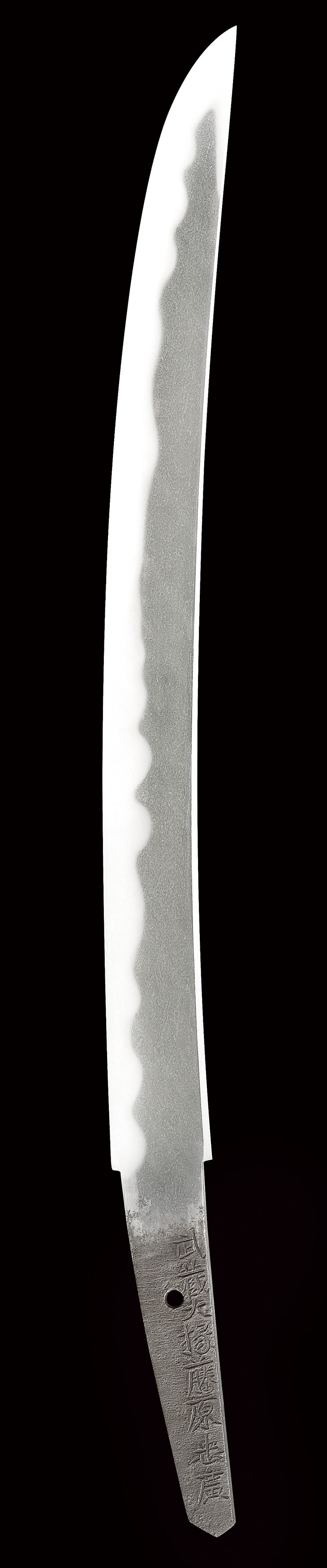
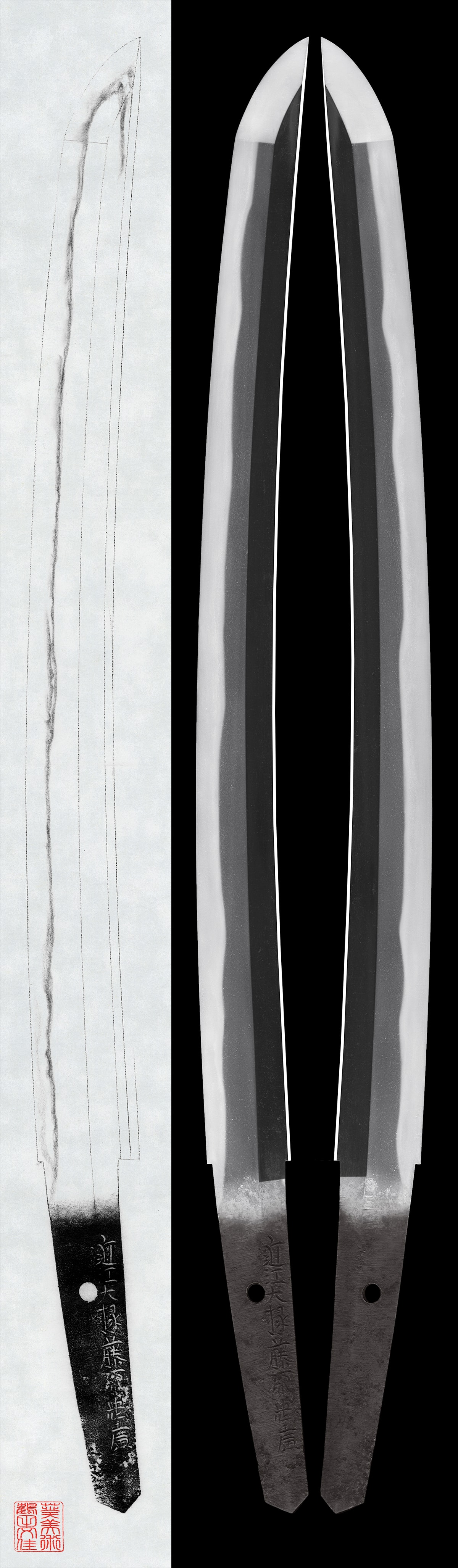
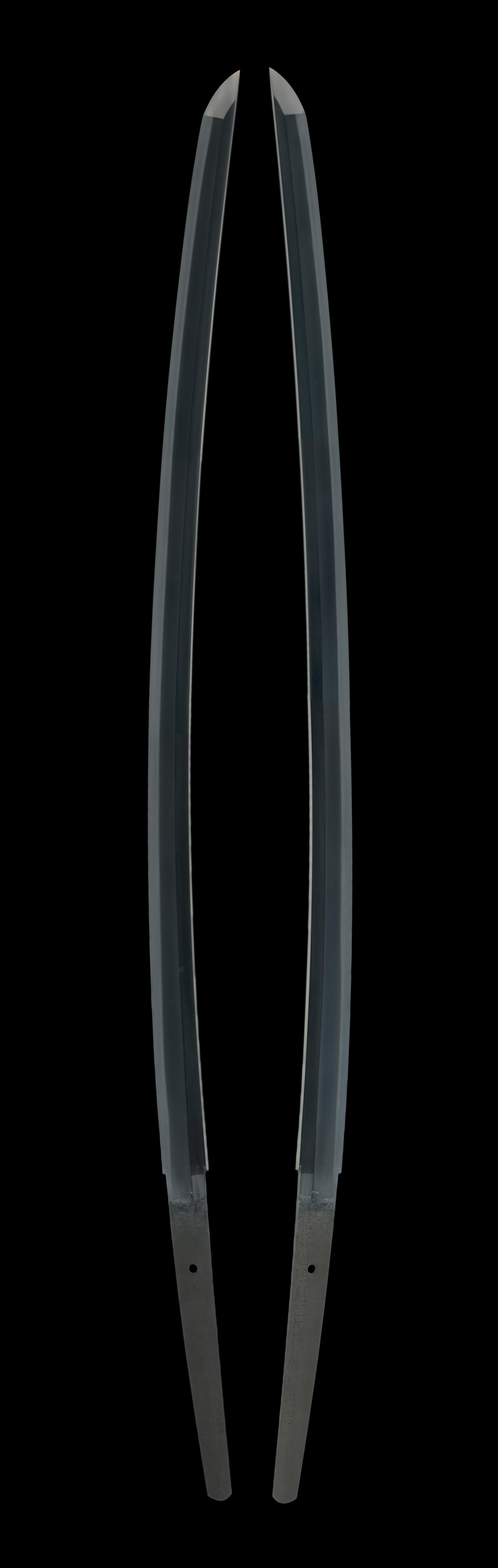
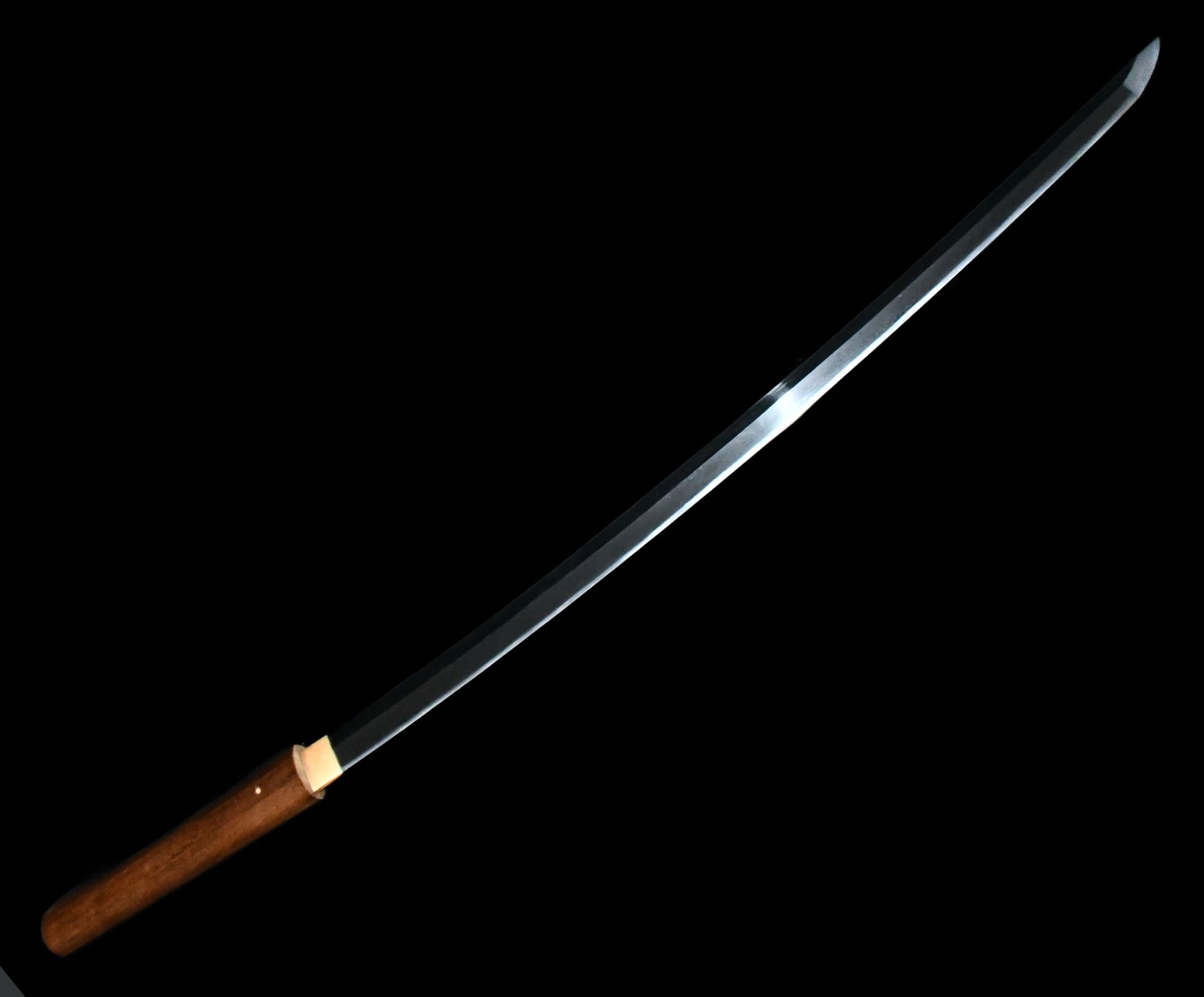
is the name carried by the main line of the school, the house smiths of the Nabeshima domain working at Saga from the Keichō era onward. The founder, Hashimoto Shinzaemon, was sent by domain order in Keichō 1 to study in Kyoto under Myōju (he "studied at the gate of Myōju in Kyoto," 京の埋忠明寿の門に学び), returned to Saga, and prospered under the domain's patronage before taking a second court title as no Daijō and changing his name to Tadahiro. The single five-character signed of his hand in the record shows the Keichō- manner: a body wide with little taper, shallow and an extended point, a -toned shallow over a with and fine . The corpus assembled under this code, however, is overwhelmingly the work of a later generation, and the smith it most fully portrays is the third, Mutsu no Kami , eldest son of the second-generation Ōmi no Daijō Tadahiro, who took the name back to the main house after the death of the Tosa no Kami line and who the published sources hold to be the finest forger of the school's first three generations.
His characteristic hand is a tempered restraint. Over a tightly packed he sets the the published sources name as the manner "he most excelled in", at times tinged with a shallow and the faintest suggestion of , with small and entering, the deep, well adhered, fine and running through, and the bright and clear. The is consistently a straight , sometimes turning back deeply with at the tip. His is broad, long and thick, weighty in the hand, and the judges read it as recalling not his father but his grandfather, the manner the commentary returns to again and again as "calling to mind not the father but rather the grandfather, the first-generation ".
The is where his reputation rests. Tightly forged takes on the , the rice-bran surface in which finely granular lies thickly and evenly, entering to give it depth, the steel itself clear. Among the first three generations of the main line the published sources call his forging the strongest and most refined, "the strongest and most refined of the upper three generations", and they name the quality of his forging his true forte, "the excellence of his forging is his true hallmark". Over that the temper stays comparatively calm, the activity carried in deep and , in fine and , and above all in the clarity of the rather than in towering clusters.
Alongside the runs a showier register, the -. Skilled in the clove pattern as well, he forged a mixing , with broad entering, and , deep and . On one the clove pattern is so close to his father's that the published sources call it a temper "to be mistaken for the of his father Ōmi", set apart from his usual Mutsu manner; this is the bright face held against the calm . A second matter occupies the commentary: the rarity of his five-character signatures. One " no " five-character is judged by the chisel-work of the signature, the position of the and the workmanship to be the third generation and not the founder, and the sources call such pieces by his hand "extremely rare", a valuable document for knowing him. The texts caution that the main line signs on the in the manner, so that "in the case of a " a blade signed on the warrants particular care over authenticity.
What sets the third generation apart within his own house is precisely what the judges name. His own works are comparatively few, both because his forging career was short and because he served as a substitute maker for his long-lived and prolific father; the second-generation Ōmi no Daijō Tadahiro is the broad open record of the school, the third its strongest and most refined hand. His bright komenuka- and his powerful become the standard against which later work is read, and the published sources distinguish him from his father by the strength of his forging and the clarity of both and , and from the founder by the tightness and refinement of the steel rather than by any departure of manner. The line he holds is the conservative one, the grandfather's carried forward at its highest finish.
For the collector he is a knowable and, by the standards of the great names, an attainable hand. Fujishiro grades him Jō-jō . He has no National Treasures and no Important Cultural Properties on record; his standing rests instead on nine works in the rank and a further forty-nine in the , fifty-eight blades across the two tiers, several of the called by the published sources his finest workmanship, one "transmitted in the Nabeshima family in the domain-administration era". Provenance, where recorded, runs through the Imperial Family and the Nabeshima house, the domain his line served. Signed of the main line survives in real numbers and reaches the market more readily than a master ever could, so a papered example in the tier is not beyond a patient collector, while the third generation's finest komenuka- , sound and dignified, comes to light only from time to time and is a landmark when it does.