NihontoWatch MonNihontoWatchBETA
MarketEncyclopedia
NihontoWatch Mon

NihontoWatchBETA

Market
Encyclopedia
Overview·Kantei·Designations·Blade Forms·Signatures·Lineage·School
OverviewKanteiDesignationsBlade FormsSignaturesLineageSchool
  1. Schools
  2. Hizen Tadayoshi
  3. Masahiro

Tadayoshi Masahiro

正廣

Jūyō
Vol. 25, No. 334 · Naginata

Tadayoshi Masahiro

正廣

32 ranked works

ProvinceHizenEraKanei (1624–1644)PeriodEdoSchoolHizen TadayoshiTraditionShintoGeneration1stTeacherYoshinobuFujishiroJo-jo sakuToko Taikan550(top 23%)TypeSwordsmithCodeMAS172
32Jūyō Tōken

Overview

Masahiro was the son of Yoshinobu, a smith of the collateral line who first signed Masanaga and took the name Masahiro in 'ei 2 (1625). He worked at Saga in the orbit of the school, served as a close attendant of the second-generation Omi no Daijo Tadahiro, and after the death of the first-generation assisted the second generation as, in the words of the published sources, a most able collaborator. Later he received the court title Kawachi Daijo, signing no Kawachi Daijo Fujiwara Masahiro. Of the date the published record is candid: although tradition gives 'ei 5, works dated as late as 'ei 16 still sign only no Saga-ju Masahiro, and the title first appears on blades dated the eighth month of 'ei 18, so the modern view places the appointment about that year. Among the waki-, the branch smiths working outside the main house, the holds him the most accomplished of all, 「傍肥前の中でも最も技量が優れており」.

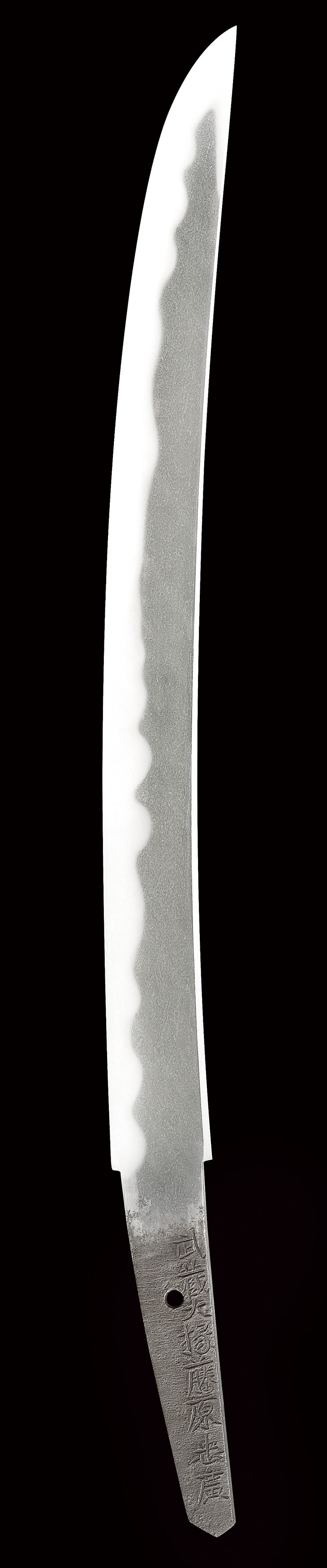
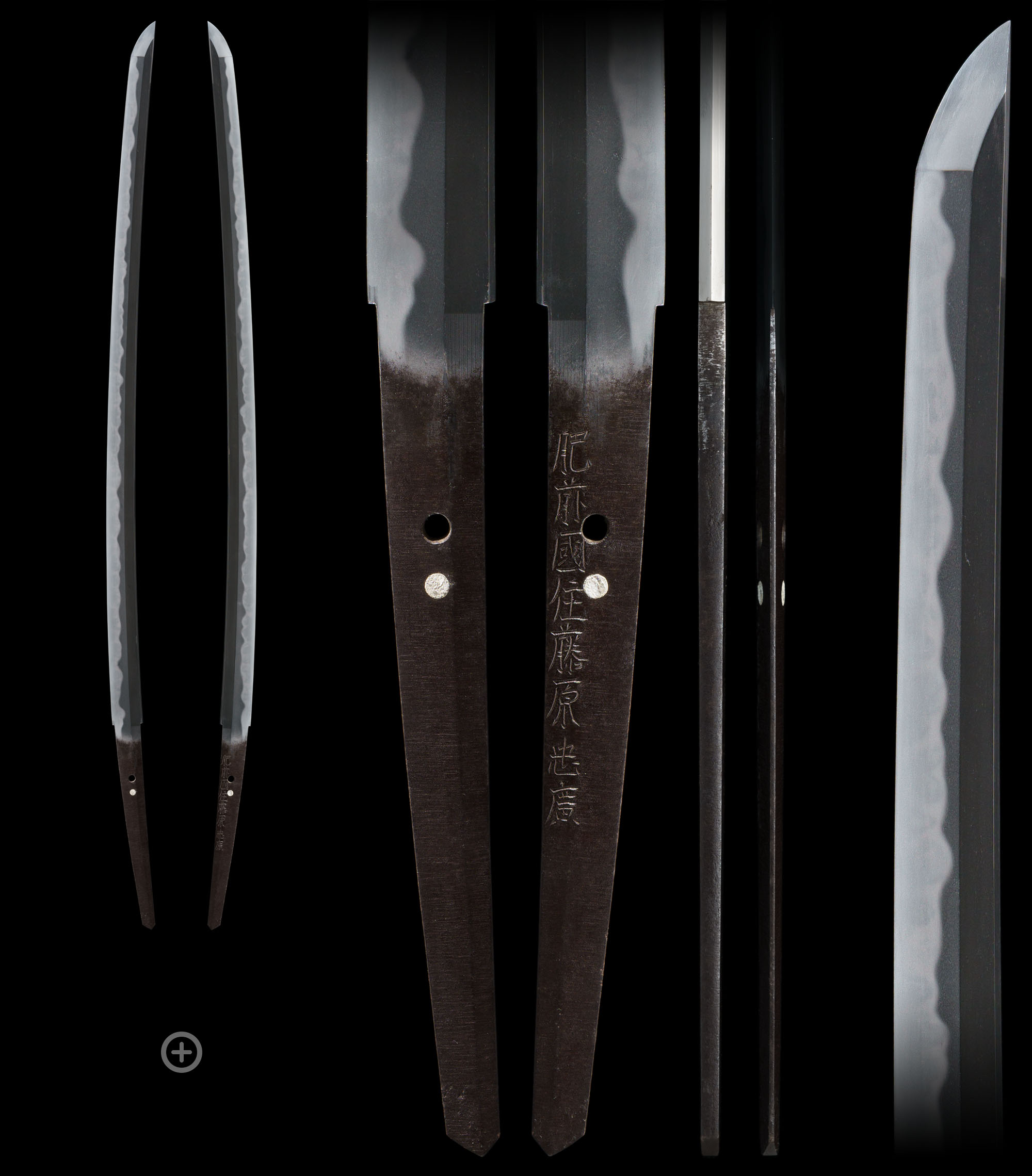
What distinguishes him is exactly what sets him against the main line. Where the house is read first in its calm, deep- , Masahiro favored the opposite, and the published sources state it plainly: 「作風は乱れた刃を好んで焼き」, his hand favored the irregular temper. His characteristic begins with a at the and rises into a -dominant , mixing , - and large with and at times a or angular flavor. The clove pattern the judges liken to that of no Daijo Tadahiro. The temper is set high and low, in places linking clusters of with a quieter -toned line, long and entering well; the is deep, with thick gathering in the valleys of the , a little and at times , running well and long appearing. On one such the published sources write that he forges the he excelled in and shows his true ability to full effect.

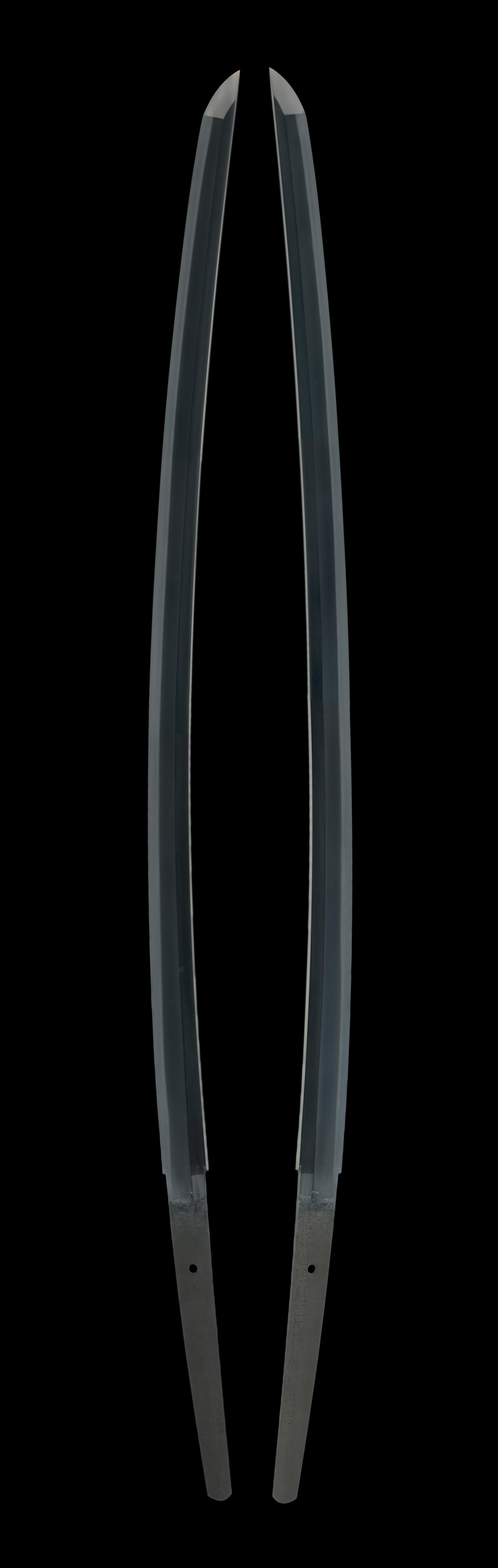
Beneath that flamboyant edge lies the refined steel he shares with the rest of the school. The is a tightly packed becoming the , the rice-bran skin: a dense with dust-fine laid thickly and fine entering well, bright and clear. The runs straight to a with and a long, deep turnback, at times opening into a small on the . The is the well-balanced shape, at times wide in body with an extended or large , powerful and forceful. The stays bright over both his showy and his quiet work, the constant of his and .

He was not, however, a smith of one manner only. A clear register of his record is the he also commanded, a quiet toned with a shallow and mixing , and entering, fine and naturally interwoven, the bright over the well-packed . One of 'ei 11, worked in this calmer manner, the published sources name his finest, 「この刀はその白眉である」. His dated works survive only in small number, running from 'ei into , and several pieces whose signatures blend his pre-title and post-title styles are valued for fixing the chronology of his career; he is said to have died at fifty-nine in 5 (1665).

His distinction from the main house is drawn by the judges themselves. He is set apart not only by his preference for over but by his , which differ from the main line's, and by his consistent practice of signing on the . The published sources read his blades as carrying a more natural vigor and driving spirit than the main house, 「本家忠吉家の作よりも自然、覇気のある作が多く」, and one entry says of a representative piece that he forges the at which he excelled and displays his true ability without reserve, 「彼が得意とした乱れ刃を焼いて、その本領を遺憾なく発揮している」. He stands, then, as the most gifted of the branch hands, the one among the waki- whose work most readily approaches the main line in quality while keeping a manner distinctly his own.

For the collector Masahiro is a desirable and attainable name. Fujishiro grades him Jo-jo . He has no National Treasures and no Important Cultural Properties; his record runs instead through the rank, where some thirty of his blades have been designated, the published sources calling his finest powerful and forceful in both and and richly animated. Documentary interest is high among them: one carries within a a relief of Shigetsu Hotei by the carver Yoshinaga, a design the published sources call extremely rare among blades and of notable value for the study of the province's carving. Provenance is only partly recorded, so it is best stated quietly: his blades are held in private collections of recorded whereabouts rather than in a roll of famous houses. A signed Masahiro is not beyond the reach of a serious collector as a top main-line blade can be, and from time to time, with patience, one of his works comes to light, a chance to hold the flamboyant of the most accomplished of the waki-.

Kantei

the waki-Hizen branch master read by register: his favored flamboyant midareba prime, a choji-dominant midare of gunome, gunome-choji and large gunome with a suguha yakidashi, over the Hizen komenuka ground, set against the calmer chu-suguha he also commanded

Masahiro is the most technically accomplished of the waki-, the collateral smiths working outside the main line at Saga: son of Yoshinobu, first signing Masanaga, he took the name Masahiro in 'ei 2, served as a close attendant and able collaborator of the second-generation Omi no Daijo Tadahiro, and after the death of the first-generation was the leading hand among the school's branch smiths. The published sources read his work as favored over , the clove pattern likened to that of no Daijo Tadahiro, and they hold his blades to carry more natural vigor and driving spirit than the main house. His prime is exactly that flamboyant : a at the base rising into a -dominant that mixes , -, large and , the temper set high and low, long and entering, the deep with thick gathering in the valleys of the , running well and long appearing, the bright, over the tightly packed komenuka ground with dust-fine and fine that is the school's signature steel, the a straight with and a long turnback. The other face of his record is the calmer he also commanded, a quiet toned with shallow and , the bright over the refined ground. The published sources note that his and his -signing habit differ from the main line, a caution against forgery.

Diagnostic discriminators

where the Hizen main line is read first in its deep-nioi chu-suguha, Masahiro's tell is the opposite: a gunome- and choji-dominant midareba, the clove pattern the published sources liken to Musashi no Daijo Tadahiro and call the splendid midare he excelled in

81% of his works

69% of his works

Observation by phase

His favored midareba (his recognized prime, the waki-Hizen choji-midare)

The corpus prime is the flamboyant the published sources say he favored above . The body is a at the rising into a -dominant , into which he mixes , -, large , and at times a or flavor, the clove pattern the sources liken to no Daijo Tadahiro. The temper is set high and low, in places linking clusters of with a more -toned line, long and entering well, the deep with thick gathering in the valleys of the , a little and at times , running well and long appearing, the bright and clear. The ground is a tightly packed becoming the , dust-fine laid thickly and fine entering. The runs straight to a with and a long, deep turnback, at times a small on the . The is the well-balanced shape, at times wide in body with an extended or , powerful and forceful, the published sources calling these the splendid in which Masahiro excelled and works of natural vigor surpassing the main house.

Sugata 姿
Jigane 地鉄
Hamon 刃文
Bōshi 帽子

The chu-suguha register (the calmer suguha he also commanded)

Although noted above all for the showy , Masahiro also commanded , and a clear register of his record is the . It is a calm toned with a shallow and mixing and at times small , and entering, the bright and clear, running and forming, over the well-packed ground with . The stays a straight with . The published sources call one such work, into which fine and are naturally interwoven, the finest example among his works. This is the quiet face set against the flamboyant he most favored.

Jigane 地鉄
Hamon 刃文
Bōshi 帽子
Scholarship

The published sources record that Masahiro, son of Yoshinobu, first signed Masanaga and changed his name to Masahiro in Kan'ei 2, that he is held the most technically accomplished of the waki-Hizen, that after the death of the first-generation Tadayoshi he assisted the second-generation Tadahiro as an able collaborator, and that he favored midareba over suguha, his clove pattern mixing gunome and ko-notare in a manner likened to Musashi no Daijo Tadahiro, his blades carrying more natural vigor than the main house.

On the question of his title, the published sources note the traditional account that he received Kawachi Daijo in Kan'ei 5, but observe that works dated as late as Kan'ei 16 still sign Hizen no Kuni Saga-ju Masahiro or Hizen no Kuni Masahiro, and that the title appears only from blades dated the eighth month of Kan'ei 18; the prevailing modern view therefore places the appointment about Kan'ei 18. They add that his yasurime differ from those of the main house and that, since he signs katana on the sashi-ura, a katana-mei piece warrants particular caution.

Designations

Kokuhō—
Jūyō Bunkazai—
Jūyō Bijutsuhin—
Gyobutsu—
Tokubetsu Jūyō—
Jūyō Tōken32

Elite Standing

0.15 across 32 designated works

Top 14% among smiths

Blade Forms

Distribution across 32 ranked works

Signatures

Signature types across 32 ranked works

Currently Available

Lineage

TeacherYoshinobu
Masahiro
Students (12)
  1. 1.Masahiro正廣4 for sale24designated
  2. 2.Hirotaka廣隆
  3. 3.Hirotsugu廣次
  4. 4.Masahiro正廣1 for sale
  5. 5.Masahiro正廣
  6. 6.Masahiro正廣
  7. 7.Masahiro正廣
  8. 8.Masahiro正廣
  9. 9.Masahiro正廣
  10. 10.Masahiro正廣
  11. 11.Masanaga正永
  12. 12.Masanaga正永1 for sale3designated

Hizen Tadayoshi School

Other artisans of the Hizen Tadayoshi school

  1. 1.Tadayoshi忠吉8 for sale125designated
  2. 2.Tadayoshi忠吉4 for sale60designated
  3. 3.Tadahiro忠廣7 for sale169designated
  4. 4.Tadakuni忠國1 for sale32designated
  5. 5.Masahiro正廣4 for sale24designated
  6. 6.Yukihiro行廣1 for sale16designated
  7. 7.Yoshiie吉家4designated
  8. 8.Muneyasu宗安4designated
  9. 9.Yoshinobu吉信4designated
  10. 10.Yoshifusa吉房3designated
  11. 11.Hironori廣則3designated
  12. 12.Tosa no Kami Tadayoshi忠吉3designated