NihontoWatch MonNihontoWatchBETA
MarketEncyclopedia
NihontoWatch Mon

NihontoWatchBETA

Market
Encyclopedia
Overview·Kantei·Designations·Provenance·Blade Forms·Signatures·Lineage·School
OverviewKanteiDesignationsProvenanceBlade FormsSignaturesLineageSchool
  1. Schools
  2. Hizen Tadayoshi
  3. Tadahiro

Hizen Tadahiro

忠廣

Tokujū
Vol. 14, No. 39 · Katana

Hizen Tadahiro

忠廣

169 ranked works

ProvinceHizenEraKanei (1624–1644)PeriodEdoSchoolHizen TadayoshiTraditionShintoGeneration2ndTeacherTadahiroFujishiroJo-jo sakuToko Taikan800(top 14%)TypeSwordsmithCodeTAD37
2Jūyō Bijutsuhin
3Gyobutsu
3Tokubetsu Jūyō161Jūyō Tōken

Overview

Under this name stands the second generation of the main line, Ōmi no Daijō Fujiwara Tadahiro, the most prolific master the Saga school produced. The published sources set out his life plainly: legitimate son of the first-generation , he was a youth of nineteen when his father died in 'ei 9 (1632), yet works by him are seen from that year, helped by the disciples who had served under the first Tadahiro. He received the court title Ōmi no Daijō in 'ei 18 (1641) and worked until his death at eighty-one in Genroku 6 (1693), a career of more than sixty years. Of that span the 's commentary writes that among smiths "he left the greatest number of works" (肥前刀工中でも最も多くの作品を遺している). Working under this code beside him is the founder's own last phase, for in Genna 10 (1624), at fifty-three, the first-generation received the title no Daijō and changed his name to Tadahiro, so that the late works signed no Daijō Fujiwara Tadahiro are the founder under his second name.

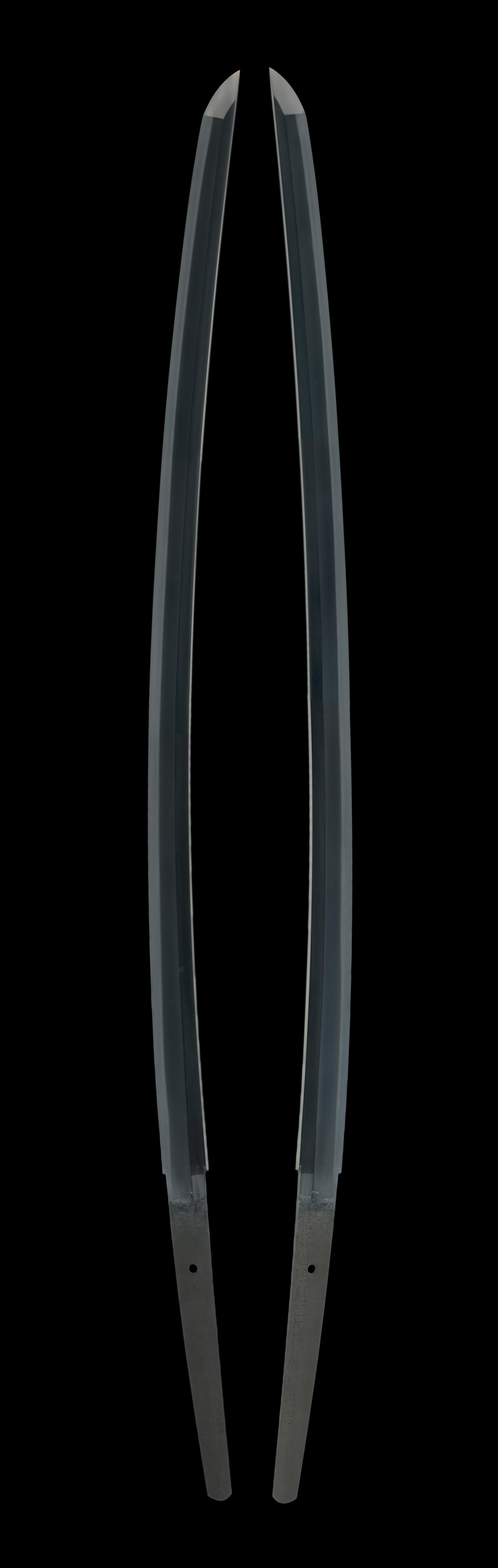
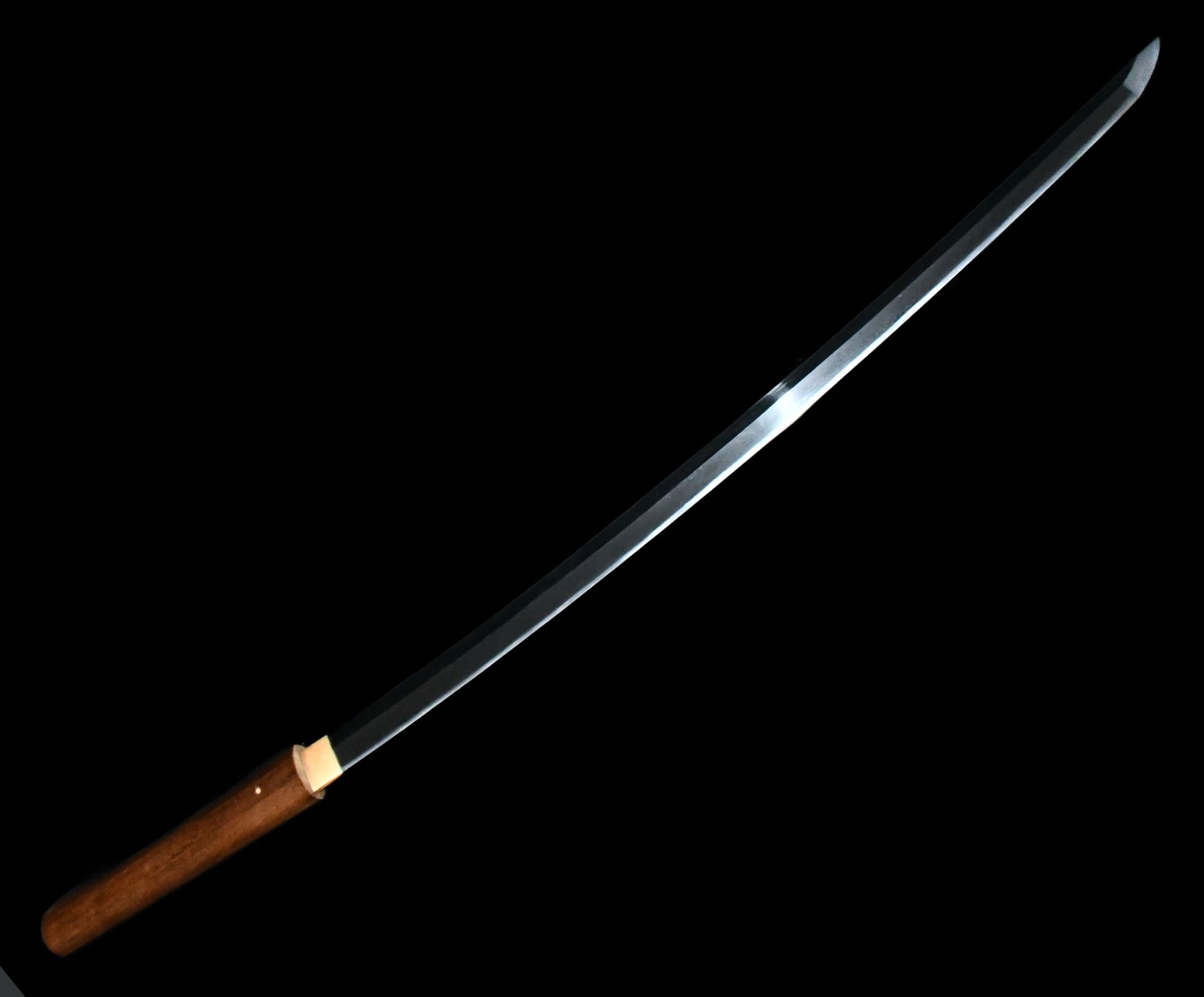
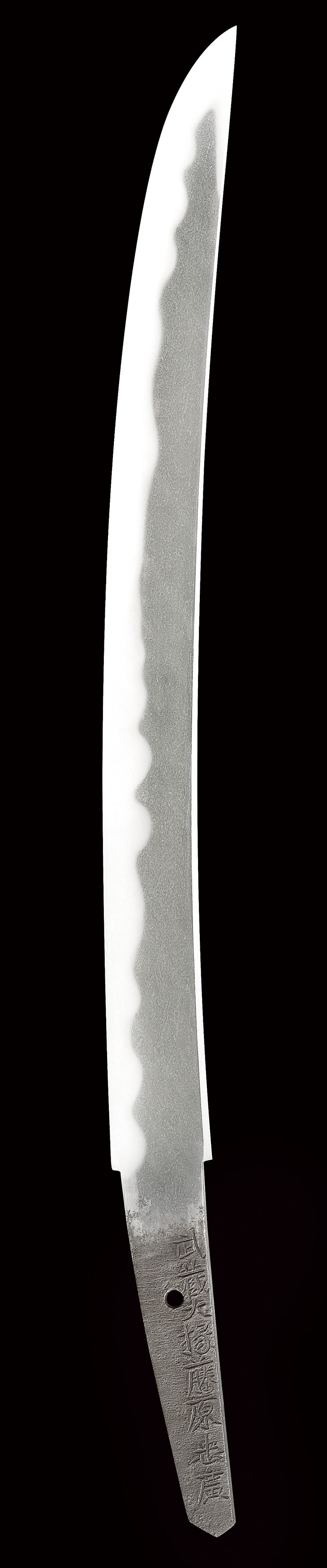
The second generation's hand is read in two manners, both of which the published sources call accomplished: on one they record that he made "both and , and in both he was highly proficient" (直刃と丁子乱れの両様があり、いずれも上手である). The one he most excelled in is the . Over a tightly forged that becomes the , with laid in a dust-fine layer and fine , he tempers a medium straight line tinged with a shallow , mixing here and there a or a slightly pointed element. and enter well, the is deep and in places becomes band-like, adheres thickly, and fine and run through it with and an -like effect at the . The whole closes in a that is bright and clear, the straight to a .

The is the constant of his work. It is the school's rice-bran , a forged so tightly that the published sources describe one blade as without the least slackness, the densely and minutely covering it to give a moist, lustrous quality, the steel bright. Against that calm the temper stays composed, and where it rises it does so as the second register, the showier : a clove pattern mixed with , long and entering, deep and , and . On one the judges note that this clove pattern is the very thing his father had not done, the smith forging "an ordered -ba in that was not seen in his father " (丁子乱は父忠吉にはない整った乱刃を焼いている). The over both manners is the straight .

The two registers and the two generations give the corpus its shape. The second generation's is the body of it, his the brilliant exception; the published sources liken that to his father's clove pattern even as they observe how he made it his own. His dated pieces sharpen the picture. One carries the date of the very day in 'ei 18 on which he received the Ōmi no Daijō title, inferred to be a commemorative work and among the earliest to bear the received-title inscription, its temper read as "an archaic flavor that appears to have been modeled after works" (来物を写したと思われる古調な出来口). The founder's late no Daijō phase forms the third face: a deep- over a that takes on a , several of these carrying carving by his Kyoto teacher's house, Myōju and Shichiza, with a or Fudō Myōō, of which the published commentary says the carving "adds flowers to brocade" (錦上花を添えている).

Within the line his place is exact. He is the prolific center between his father, the founder who carried the Kyoto training home to Saga, and his own eldest son, the third generation, who took the name back to the main house and whom the sources call the strongest forger of the first three generations. His own bright komenuka of deep is the standard against which later work is read. He is set apart from his father not by the they share but by the ordered the father did not attempt, and from the lesser hands by the clarity of his and the brightness of his . When his work reaches beyond his usual composure it is named for it: of one the published sources write that, compared with his customary work, it is "powerful in both and , a bold, forceful piece" (常々の同作に比して、地刃共に力強く、放胆で迫力のある一口である).

For the collector he is among the more attainable of the great names, the natural consequence of so long and productive a life. Fujishiro grades him Jō-jō . He has no National Treasures and no Important Cultural Properties; his record runs instead through one hundred and sixty-four blades in the and tiers, three of them , with a Jūyō Bijutsuhin among the founder's no Daijō works. His provenance reaches into the house he served: blades recorded to the Nabeshima , to Nabeshima Katsushige and Nabeshima Naomoto, and one transmitted in the Imperial Family, the published record noting that the Nabeshima house required the received-title signature on blades presented to it. Because he made so many, a signed Ōmi no Daijō Tadahiro is among the more findable works by a master of his rank, his appearing from time to time at the upper tiers; yet most designated blades are held rather than traded, and a example or one of the founder's -carved pieces remains an uncommon thing to encounter, a document of the school at the height of its production.

Kantei

the 忠廣 name read by register: the second-generation Omi no Daijo prime in his deep-nioi chu-suguha over the tightest komenuka-hada, the showier Hizen-choji that runs alongside the suguha, and the founder's late Musashi no Daijo phase with its Umetada-carved choji-midare

Tadahiro is the name carried under this code by the second generation of the main line, Omi no Daijo Fujiwara Tadahiro, the most prolific master produced, with the founder's late no Daijo Tadahiro phase running alongside as a second register. The corpus is overwhelmingly the second generation: legitimate son of the first-generation , nineteen when his father died in 'ei 9, he received the title Omi no Daijo in 'ei 18 and worked until his death at eighty-one in Genroku 6, a career of more than sixty years that left more works than any other smith. The published sources read his hand in two manners, both of which he commanded. The one he most excelled in is a of deep , thickly adhering , fine and and a bright clear , set over the tightly packed with dust-fine and fine that is the school's signature ground, the a straight . The other is the showier with and long , the clove pattern the sources liken to his father's. The founder's late phase, signing no Daijo Tadahiro after taking that title in Genna 10, is the other face of the corpus: a deep- over a -toned , frequently carrying Myoju and Shichiza carving, with or Fudo Myoo.

Diagnostic discriminators

22% of his works

the chu-suguha of deep nioi with thickly adhering ko-nie, fine kinsuji and sunagashi and a bright clear nioiguchi is the manner the published sources say the second generation most excelled in, the calm face against the showier choji

58% of his works

unique vs the second generation's typically unadorned blades

Observation by phase

The second generation (Omi no Daijo Tadahiro), his chu-suguha prime

The corpus prime is the second generation, Omi no Daijo Fujiwara Tadahiro, legitimate son of the first-generation . Nineteen when his father died in 'ei 9, he is seen forging from that year, supported by the disciples of the first Tadahiro; he received Omi no Daijo in 'ei 18 and died at eighty-one in Genroku 6, leaving more works than any other smith. The published sources hold his style to fall into two manners, and , both highly proficient, with his greatest specialty. The ground is a tightly forged with absolutely no looseness, becoming the with dust-fine laid thickly and fine entering, the steel bright and clear. Over it he sets a tinged with a shallow and at times or slightly pointed elements, and entering well, the deep and in places band-like, adhering thickly, fine and and an - or -like effect at the , the bright and clear. The runs straight to a , sometimes with and a deeper turnback. The is the well-balanced, elegant curvature, at times broad, long and powerful.

Sugata 姿
Jigane 地鉄
Hamon 刃文
Bōshi 帽子

The Hizen-choji register (the showier choji-midare alongside the suguha)

Although noted above all for , the second generation also commanded the clove pattern, and a clear register of his record is the -: a mixing with long and , deep and , fine and . The published sources liken this clove pattern to the -ba of his father, and on his finest examples the and are both clear and brilliant. The here is the well-packed with , and the stays a straight . This is the showier face set against the calm he most excelled in.

Jigane 地鉄
Hamon 刃文
Bōshi 帽子

The founder's late phase (Musashi no Daijo Tadahiro), Umetada-carved choji-midare

The other face of the corpus is the founder, Hashimoto Shinzaemon, in his late phase. Having signed for most of his career, in Genna 10, at fifty-three, he received the title no Daijo and changed his name to Tadahiro; this code's no Daijo Tadahiro pieces are his last works, from the late 'ei years. The ground is a dense that takes on a with and . Over it he tempers a deep in both and , with entering well, at times mixing the komenuka and the bright of the school. Several carry carving by Myoju or Shichiza, his teacher's house: with a or Fudo Myoo, the program the published sources call adding flowers to brocade. The runs to a .

Jigane 地鉄
Hamon 刃文
Bōshi 帽子
Scholarship

The published sources record that Omi no Daijo Tadahiro, legitimate son of the first-generation Tadayoshi, was nineteen when his father died in Kan'ei 9 yet is seen forging from that same year with the support of the founder's disciples, received the title Omi no Daijo in Kan'ei 18, and died at eighty-one in Genroku 6 after a career of more than sixty years, leaving more works than any other Hizen smith, his style falling into both suguha and choji-midare with suguha his greatest specialty.

On one Tokubetsu Juyo katana the published sources read a chu-suguha into which fine kinsuji, sunagashi, hotsure and an uchinoke-like effect are naturally interwoven, producing an archaic flavor that appears modeled after Rai works, and note that, dated the day he received the Omi no Daijo title in Kan'ei 18, it is inferred to be a commemorative piece and one of the earliest examples bearing the received-title inscription.

Designations

Kokuhō—
Jūyō Bunkazai—
Jūyō Bijutsuhin2
Gyobutsu3
Tokubetsu Jūyō3
Jūyō Tōken161

Elite Standing

0.23 across 169 designated works

Top 10% among smiths

Provenance

6 documented provenances across certified works by Tadahiro

Provenance Standing

5 works held in elite collections across 6 documented provenances

Top 15% among smiths

Raw score: 2.23 / 10

Blade Forms

Distribution across 169 ranked works

Signatures

Signature types across 169 ranked works

Currently Available

Lineage

Tadahiro
Students (3)
  1. 1.Tadayoshi忠吉4 for sale60designated
  2. 2.Tadahiro忠廣7 for sale169designated
  3. 3.Tadahiro忠廣

Hizen Tadayoshi School

Other artisans of the Hizen Tadayoshi school

  1. 1.Tadayoshi忠吉8 for sale125designated
  2. 2.Tadayoshi忠吉4 for sale60designated
  3. 3.Tadakuni忠國1 for sale32designated
  4. 4.Masahiro正廣3 for sale32designated
  5. 5.Masahiro正廣4 for sale24designated
  6. 6.Yukihiro行廣1 for sale16designated
  7. 7.Yoshiie吉家4designated
  8. 8.Muneyasu宗安4designated
  9. 9.Yoshinobu吉信4designated
  10. 10.Yoshifusa吉房3designated
  11. 11.Hironori廣則3designated
  12. 12.Tosa no Kami Tadayoshi忠吉3designated