The Shintō era was largely invented in Kyōto: Umetada Myōju’s workshop trained the movement, Horikawa Kunihiro raised a generation, and the Hon’ami appraisers, who held no forge, governed the meaning of famous blades.
 NihontoWatchNihontoWatch
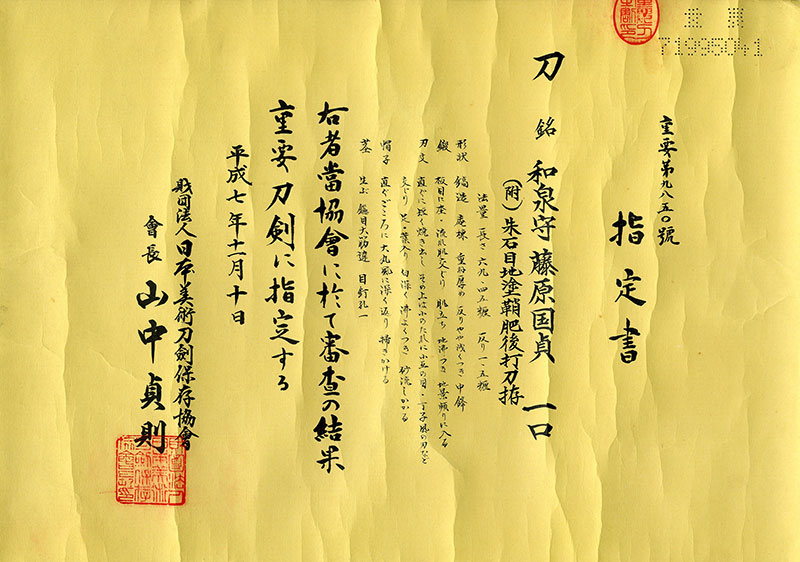
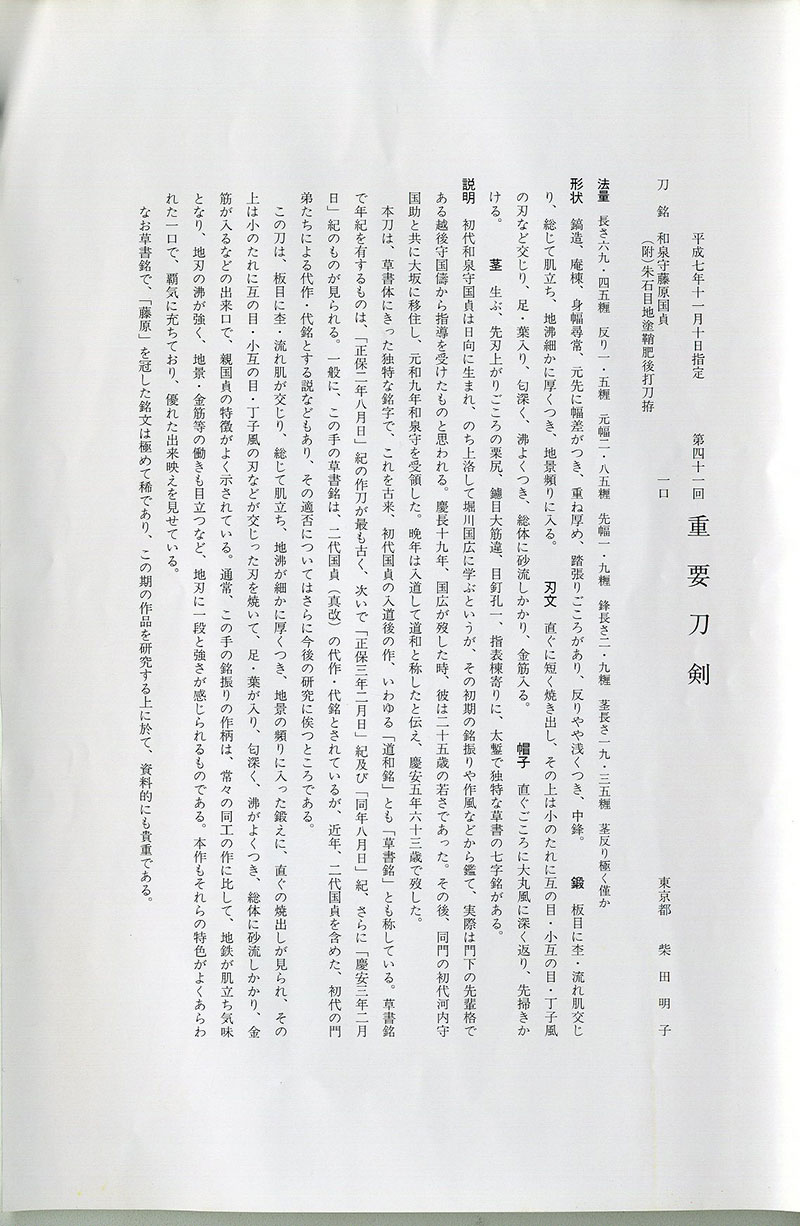
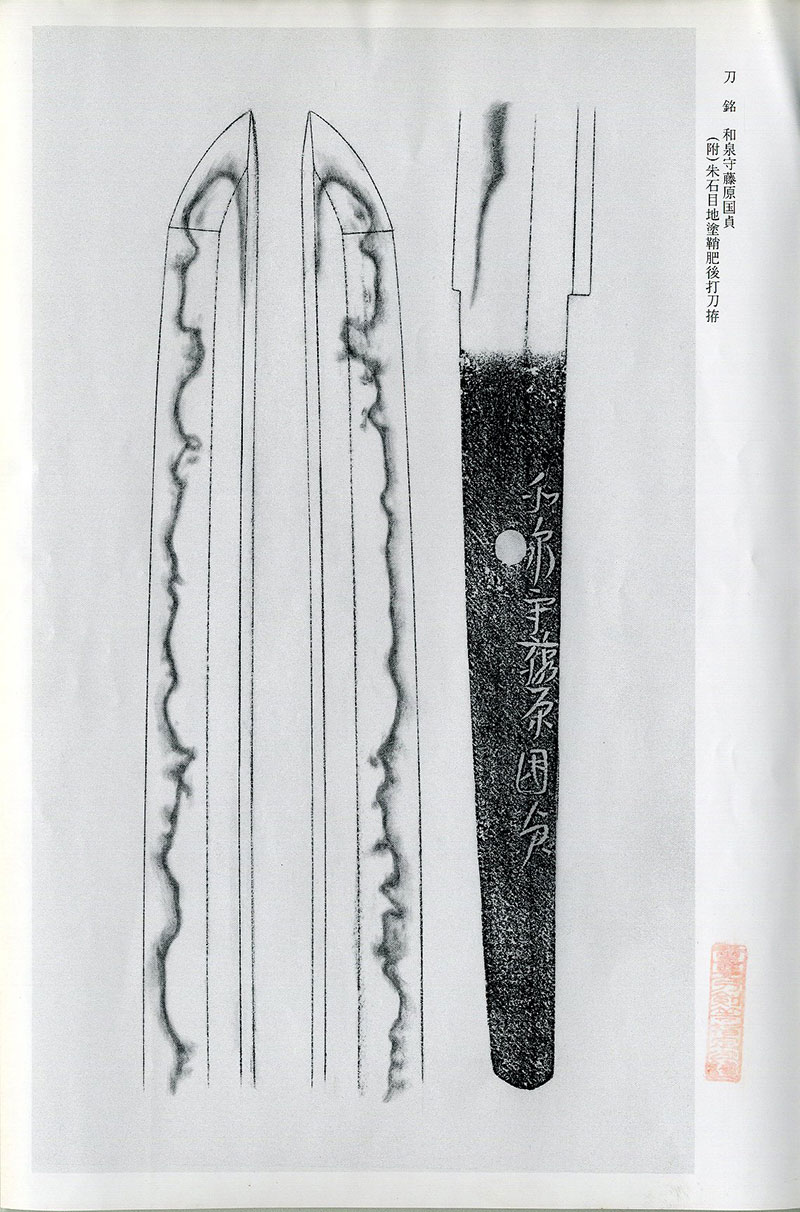
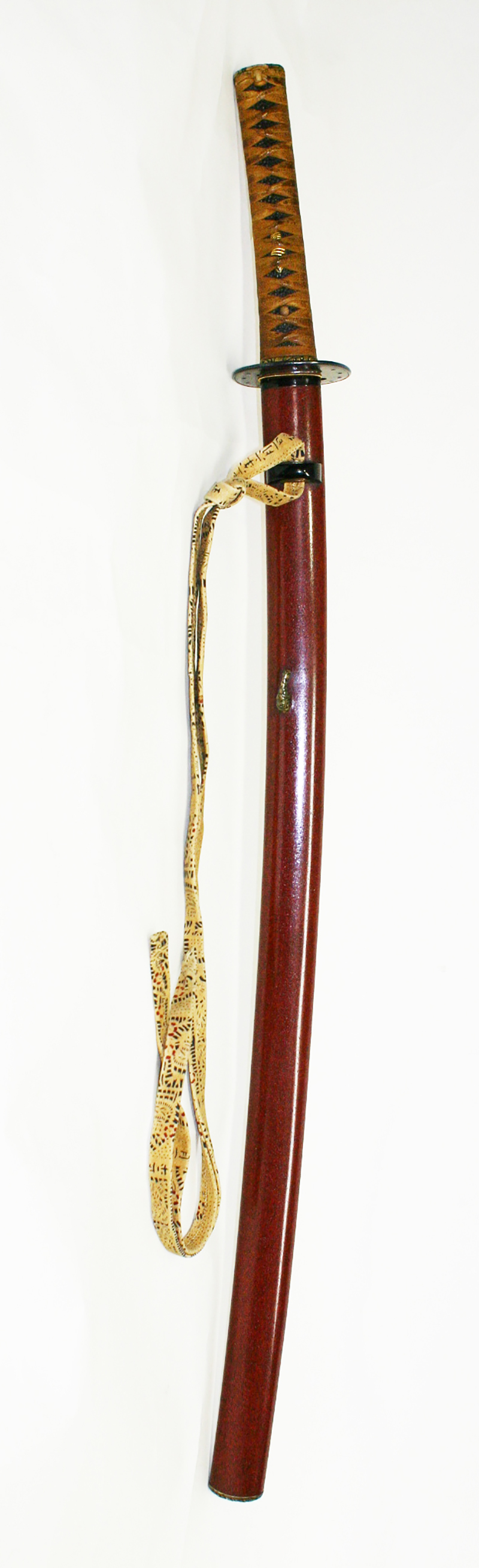
江戸時代前期、摂津国を代表する名工、和泉守国貞の作品。 和泉守国貞は京都の堀川国広門下であり、後に大阪に移住、河内守国助と共に大阪新刀の基礎を作った名工である。また堀川一門中、彫物の名手としても知られており、まま特徴的な彫物の添えられた作品が存在する。元和九年に和泉守を受領し、晩年入道して道和と称したと伝え、慶安五年に六十三歳で没した。 本作は彼が国許に隠居願いを出したのち入道し、息子の井上真改に代作代銘をさせていたと言われる時期の草書銘(道和銘とも)の作品である。元幅に比べて先幅狭まり、反りの浅くついた優美な体配を示し、地鉄、板目に流れ肌が交じり、地沸が細かに厚くつき、地景の頻りに入った美しい鍛えに、刃文は親国貞の得意とする沸出来の互の目乱れに、殊に横手下で激しく乱れ、直焼出しが見られるなど同作の典型的な作風を示した優品であり、地刃に一段と力強さが見られる。なお草書銘の作品に「藤原」を冠した物は特に少なく資料的にも貴重である。 附たりの拵は江戸時代後期の制作とみられる肥後拵で朱石目地塗りの鞘に真鍮金具で波濤を描いた上手の作品である。
NihontoWatchOffered by Iida Koendo
This piece has sold
Get an email when a new Horikawa Kunisada piece hits the market.

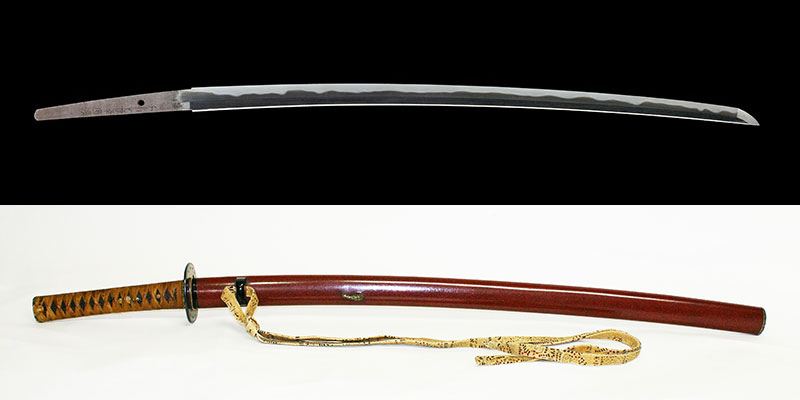

As written by the shop
Horikawa school, Osaka Shinto (Settsu) · Settsu · around 1624-1646
Fujishiro Jo-jo saku · Tōken Taikan top 14%
6 pieces on the market now
Izumi no Kami Kunisada signed himself, on a sword dated the eighth month of Genna 7, "Sesshu Osaka-ju Fujiwara Kunisada," and that one inscription fixes both the man and the moment: a Horikawa-trained smith already settled in Osaka, at the founding of what would become the city's own tradition of swordmaking. Collectors call him Oya Kunisada, "Kunisada the Elder," and the published sources are explicit that the name exists to separate him from his heir, written that he is so called "to distinguish him from his adopted son, Inoue Izumi no Kami Kunisada"[[c:1]], the man later known as Inoue Shinkai. He was born in Hyuga, went up to Kyoto, and is said to have entered the school of Horikawa Kunihiro; but Kunihiro died in Keicho 19 when Kunisada was only twenty-five, and the judges read his early style and signatures as in fact following his senior fellow-disciple, Echigo no Kami Kunitomo. He moved to Osaka with Kawachi no Kami Kunisuke, received the title Izumi no Kami in Genna 9, took the tonsure in old age under the name Dowa, and died in Keian 5 at the age of sixty-three, "one of the pioneers who opened the path for the Osaka smiths"[[c:2]].
His recognized hand is a broad, imposing katana in the Keicho-shinto taste, wide in body with little taper from base to tip, thick in kasane, and carried out to an extended chu-kissaki or o-kissaki. The forging is itame, frequently mixed with mokume and tending to stand a little, hada-dachi, with thick ji-nie and chikei entering freely; where the grain opens, the published sources name it the loose, vigorous zanguri texture of the Horikawa school, the steel of his teacher carried into Osaka. This is the jigane his work is read on. Over that jigane he tempers a notare base into which he sets gunome, ko-gunome and choji, the line opening from a short straight yakidashi in the Edo manner, deep in nioi with ko-nie well adhered, sunagashi and kinsuji running through it, often with muneyaki and drifting tobiyaki. The boshi runs straight into a ko-maru or enters in midare with hakikake, turning back rather long or deep. On his finest blades he adds carving: a relief shin-no-kurikara dragon set within the groove, with a bonji and paired goma-bashi, work the judges call distinctive and superb and count among his tells.
The jigane is the steady base beneath the temper. Itame with thick ji-nie and frequent chikei appears across his oeuvre, sometimes standing into that rustic zanguri surface, sometimes drawing tight; the deep, bright nioiguchi and the ko-nie along the edge are constants, and the activity is carried in ashi and yo, in sunagashi and kinsuji, rather than in towering clove heads. Where one Tokubetsu Juyo katana of the 27th session widens and turns vigorous, the published sources find it "rather than resembling Kunitomo, his de-facto teacher, closer to the calm, unforced character of Kunihiro himself," naming the ko-maru-sagari boshi and the frequent muneyaki as the elder Kunisada's own marks. The nioiguchi at times deepens, at times falls subdued, and that deliberate variation in how the nie gathers is itself part of his manner.
Three registers run through the work. The first is this prime notare-gunome katana over the bold Horikawa jigane. The second is a Soshu-leaning manner that looks back through his masters: the published sources read one Juyo katana as a Shizu-style piece made in emulation of his teacher, the choji not conspicuous yet the whole vigorous, and call a wakizashi an emulation of Soshu Sadamune, written "modelled on the manner of Soshu Sadamune, and well made"[[c:3]]. The third is a quiet, bright suguha of his late years, of which the judges note "the first generation's suguha work, though skillful"[[c:4]], survives in very few examples, and that such a blade "at a glance appears closer rather to that of the second-generation Shinkai"[[c:5]]. To these late years belong his cursive sosho signatures of the Dowa period, which the sources connect to his old age, when his second generation, Inoue Shinkai, is said to have served often as proxy in both forging and signing; whether a given cursive blade is the elder's own work or Shinkai's daimei, and whether such pieces should be read as a separate second-generation Shinkai Kunisada, remain matters the published record leaves open for further study. Where a paper does commit, naming a Kunisada-signed blade as Shinkai's substitute work and proxy signature, that blade belongs to Shinkai's record rather than to the elder's.
What sets him apart is named in his own designation papers. Against the tightly packed ko-itame of the old Bizen and Yamashiro lines, his standing zanguri jigane and his notare opening from a straight yakidashi are the Osaka-shinto signature, not a Bizen choji; against his own son Shinkai's brighter, more refined steel, the elder's hand reads as the rougher, more vigorous root from which the Osaka tradition grew. The judges place him with Kawachi no Kami Kunisuke at the head of that movement, his de-facto teacher Kunitomo behind him and his master Kunihiro behind that, and his heir Shinkai carrying the name forward into its most celebrated generation.
For the collector he is a major Osaka-shinto name held within reach but never common. Fujishiro grades him Jo-jo saku. He has no National Treasures and no Important Cultural Properties; his record runs instead through the Juyo rank in number, with three Tokubetsu Juyo and several prewar Juyo Bijutsuhin, eighty-two blades standing in the Tokubetsu Juyo and Juyo tiers. The provenance that survives is distinguished: blades that passed through the Imperial Family, the Sanada house, and the Ito family of his native Hyuga, with one Juyo Bijutsuhin now held at the Sano Art Museum. The published sources reserve their highest words for his signed katana, calling one "a quintessential work of the first-generation Kunisada, especially deep and splendid in nioiguchi, an outstanding example among his works"[[c:6]], and another, the Soshu-flavoured Tokubetsu Juyo, simply "a blade after the elder Kunisada's own heart"[[c:7]]. Most of these are held rather than traded, and only a handful of the Tokubetsu Juyo and Juyo blades change hands in any decade; a signed Oya Kunisada in good condition comes to a private collector from time to time, with patience, and is a substantial acquisition when it does, a document of the founding of Osaka steel.
Where Kunisada stands among comparable artisans: across all of nihontō, and within tradition, era, and period. The tiers (Foremost · Leading · Major · Notable) weigh official designations from the NBTHK and Japan's Agency for Cultural Affairs, together with historical honors of lasting repute such as the Sansaku and Meibutsu-chō.
Select a lens to see how it's measured.
Years he was demonstrably active, proven by signed-and-dated blades
Shinto · Yamashiro
64 pieces on the market now
At Ichijo Horikawa in Kyoto, from Keicho 4 (1599), Horikawa Kunihiro gathered the pupils whose work the published sources name with his own as the opening of the shinto age. Kunihiro himself reached forging late and by a roundabout road. Born Tanaka and serving as a warrior under the Ito of Obi castle in Hyuga, he wandered the provinces after that house fell, forging where he stopped, his earliest dated blade cut in Hyuga in Tensho 4 (1576); his itinerant Tensho-uchi looked to late Soshu and late Seki, often run toward a hitatsura-like effect over devotional carving. The settlement in Kyoto changed that. There his stated aim, the sources write, lay in the revival of the Soshu-den tradition, the leaning strongest toward Shizu, and around that ideal he trained the men who carried his manner forward: Dewa no Kami Kunimichi, Kuniyasu, Osumi no Jo Masahiro, Echigo no Kami Kunitomo, the elder Kunisada and Kunisuke, with later and minor hands reaching Settsu, Echizen and Edo. Many of them, born like the master at Obi, followed him from Hyuga to the capital. The shared vocabulary is read first in the steel. The school forges an itame mixed with mokume that stands up, the grain raised into the loose, granular surface the commentaries name outright, the zanguri hada particular to Horikawa work, with ji-nie lying thick and chikei entering; on many blades a mizukage rises obliquely from the machi. Over that ground the prime manner is the Keicho-shinto sugata, wide with little taper and an extended chu-kissaki or o-kissaki, the build likened to a Nanbokucho odachi cut down, tempered in a notare and gunome with thick nie, sunagashi and long kinsuji, the nioiguchi often sinking into shizumi. Within that frame the pupils diverge sharply.
Kunimichi runs the flamboyant Shizu copy fully out and turns his boshi pointed in the Mishina manner, the Sanpin boshi the school otherwise does not show. Masahiro keeps the same Soshu-den worked at lower temperature, his temper calm and his mokume conspicuous; Kuniyasu and Kunitsugu stand closest of all to the master and signed for him. Kunitomo turns alone toward late Seki, his gunome round-headed and his chisel the finest in the group, and the elder Kunisada and Kunisuke carry the zanguri steel south into Osaka, the latter keeping the Ishido clove he was born to. Hiroyuki holds suguha over a blackish steel that recalls old Yamato, and the two Echizen Kunikiyo forge a dark, dense hokkoku-gane under a calm chu-suguha. A collector seeks Horikawa because the school stands at a hinge: Kunihiro is read as the first hand of the new-sword age, and the line he taught runs forward into the Osaka tradition through Kunisada and Kunisuke and into Echizen through Kunikiyo. To kantei the work, read the steel first, the standing zanguri surface and the oblique mizukage, then the sinking nioiguchi and the Soshu-revival notare with its sunagashi and kinsuji; the individual hand declares itself in the departures, Kunimichi's pointed boshi, Kunitomo's Seki gunome and compact tang, Kuniyasu's reversed file marks and two-character mei, Hiroyuki's kiri-yasuri. The founder and his closest pupils sit at the top of the line, Kunihiro signing almost everything he made, the large kata-ochi two-character mei beside his long residence signatures; because Kuniyasu, Masahiro, Kunitsugu and Hiromi worked as his daisaku, a share of the blades signed Kunihiro are in fact theirs. Provenance runs through the houses of the founder's own story and of the country, the Hyuga Ito he had served, the Shimazu of Kagoshima, the Imperial Family and Toyotomi Hideyori, with the tachi Kunihiro dedicated to the Hataeda Hachimangu still in the shrine's keeping. A signed Horikawa blade reaches a private collection only from time to time, carrying on its nakago the hand with which the new sword begins. Learn more →
| Smith | Era | Designated |
|---|---|---|
| Kunihiro國廣 | 1573-1613 | 147 |
| Kunimichi國路 | 1615-1624 | 75 |
| Kunisada國貞 | 1624-1646 | 87 |
| Kunitomo國儔 | 1596-1615 | 27 |
| Masahiro正弘 | 1596-1615 | 16 |
Kyōto: the revival workshop
The Shintō era was largely invented in Kyōto: Umetada Myōju’s workshop trained the movement, Horikawa Kunihiro raised a generation, and the Hon’ami appraisers, who held no forge, governed the meaning of famous blades.
A blade of top-grade workmanship and condition, formally judged to rank with a nationally recognized Important Art Object (Jūyō Bijutsuhin). Awarded only at the NBTHK’s competitive annual examination.
Of Japan’s roughly 2.5 million registered swords, only 12,348 (about 1 in 202) have ever attained Jūyō.
The NBTHK (Nihon Bijutsu Tōken Hozon Kyōkai, the Society for the Preservation of Japanese Art Swords) is a public-interest incorporated foundation founded in 1948 and supervised by Japan’s Agency for Cultural Affairs (Bunkachō); it is based at the Japanese Sword Museum in Tokyo. Its expert panels physically examine each submitted work (shinsa) and issue a certificate (kanteishō) ranking it by artistic and historical merit. NBTHK papers are the most widely recognized standard of authentication for Japanese swords and fittings.
NBTHK official siteFor returns at the customer's convenience, please notify us within two days of the item's arrival. Items that have been altered cannot be accepted. Return shipping is at the customer's expense. Costs other than the item price (bank transfer fees, cash-on-delivery fees, etc.) cannot be refunded. Items delivered overseas cannot be returned or refunded.