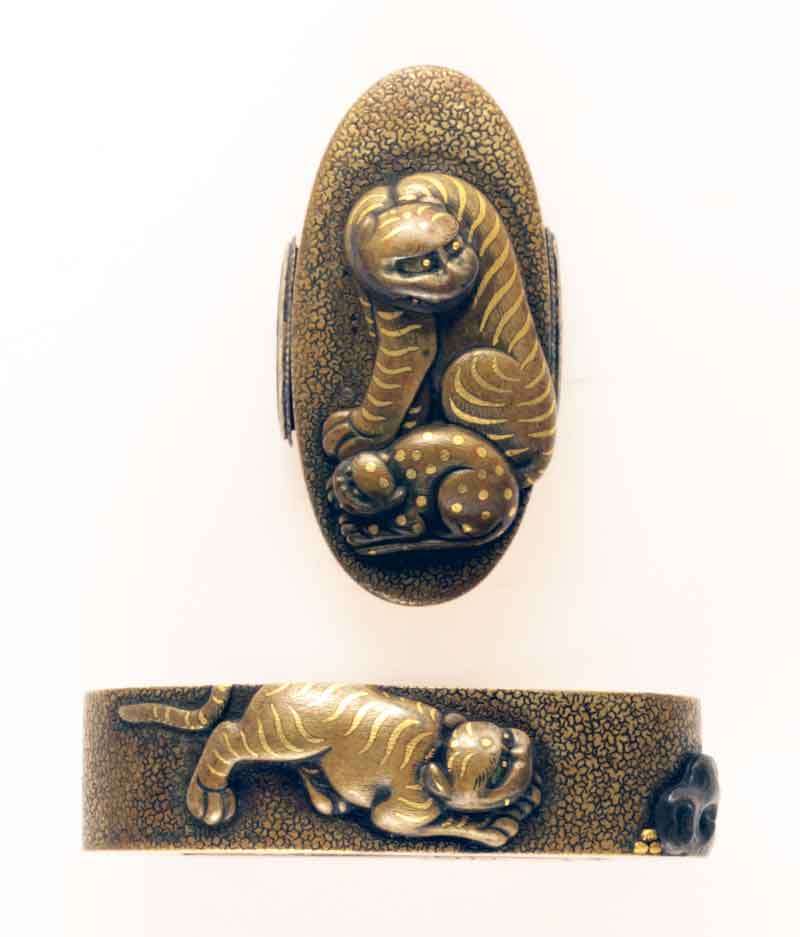
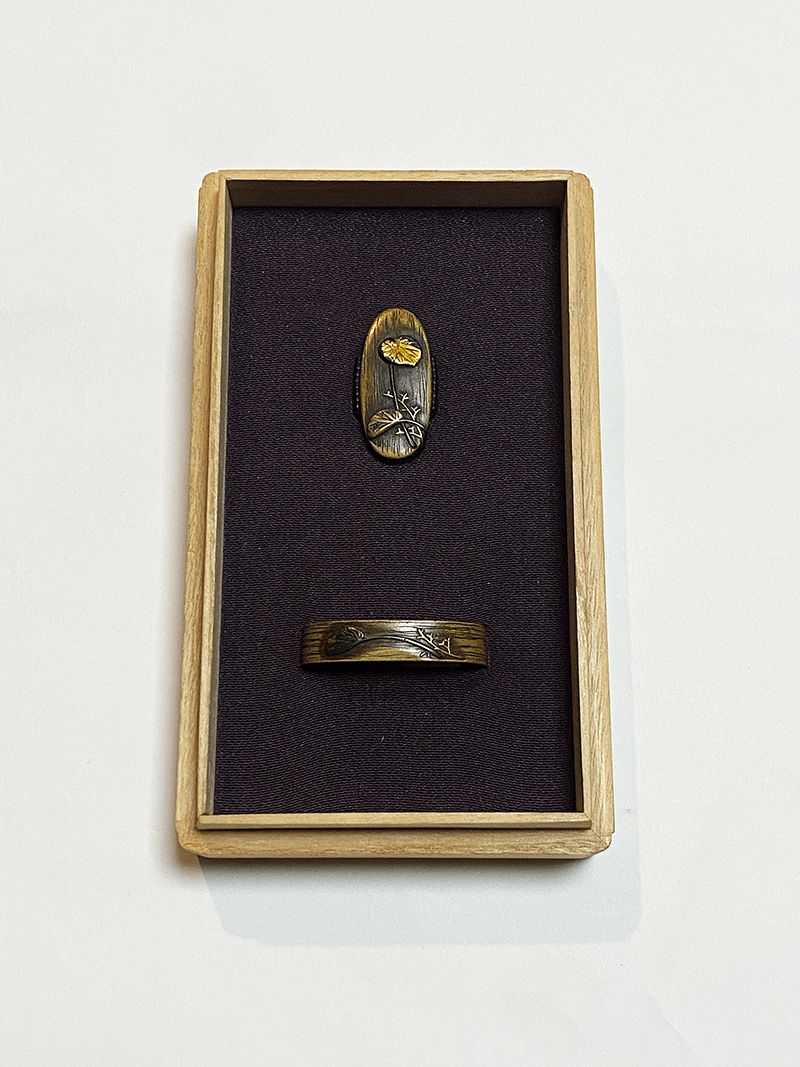
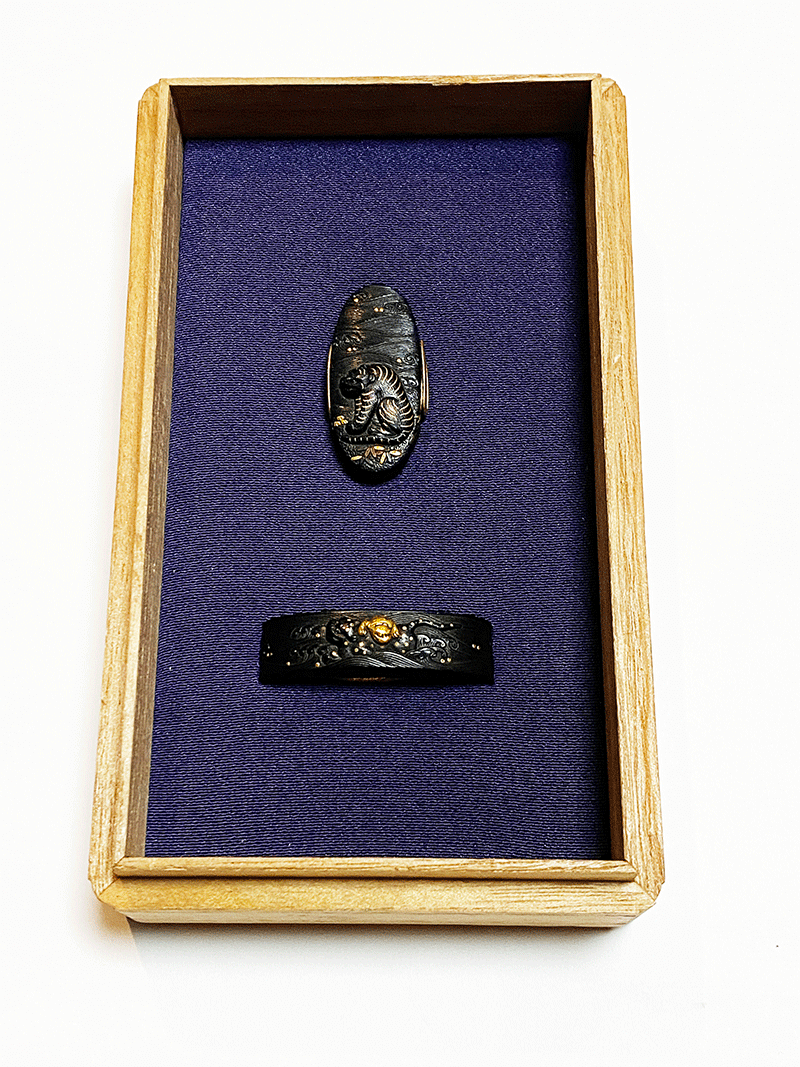
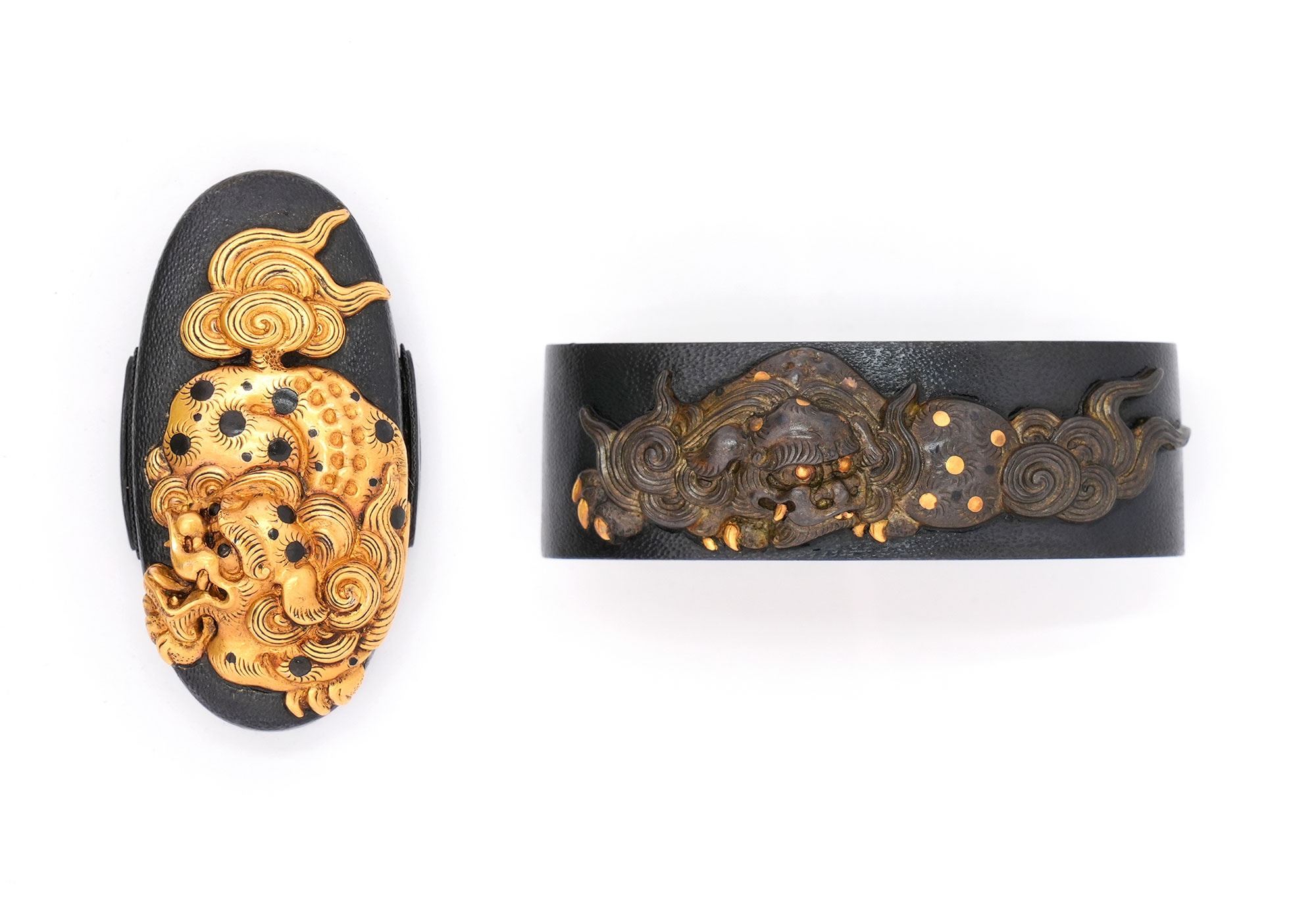
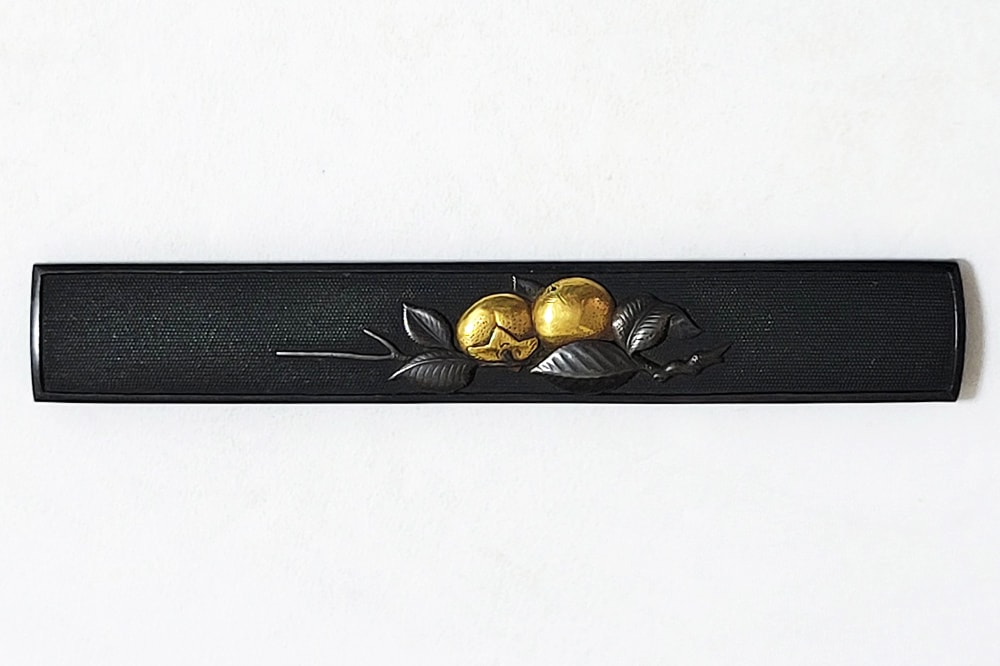
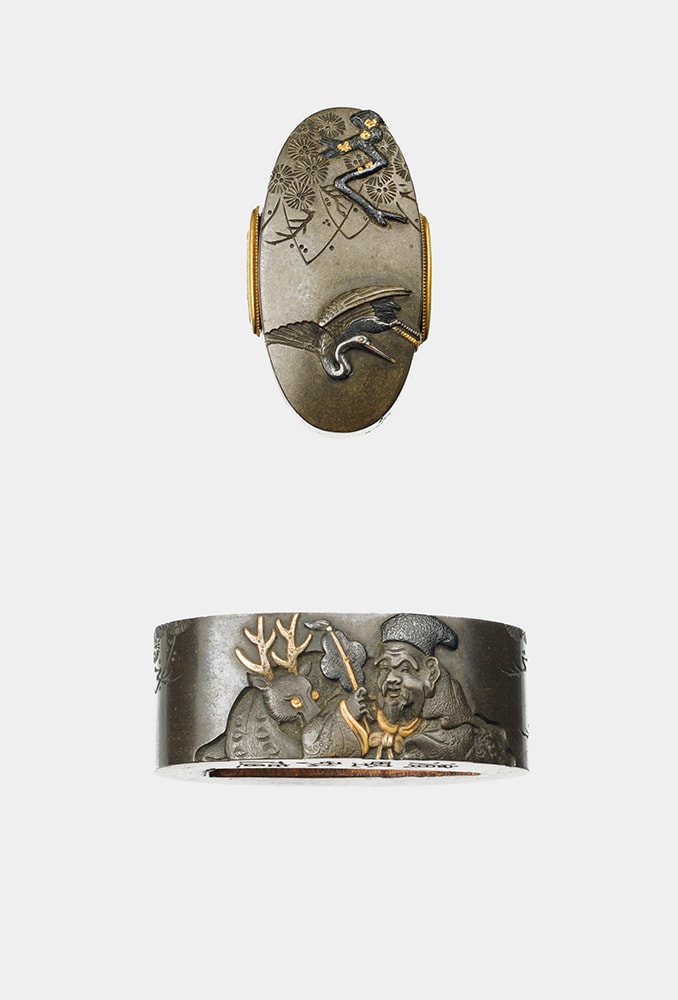
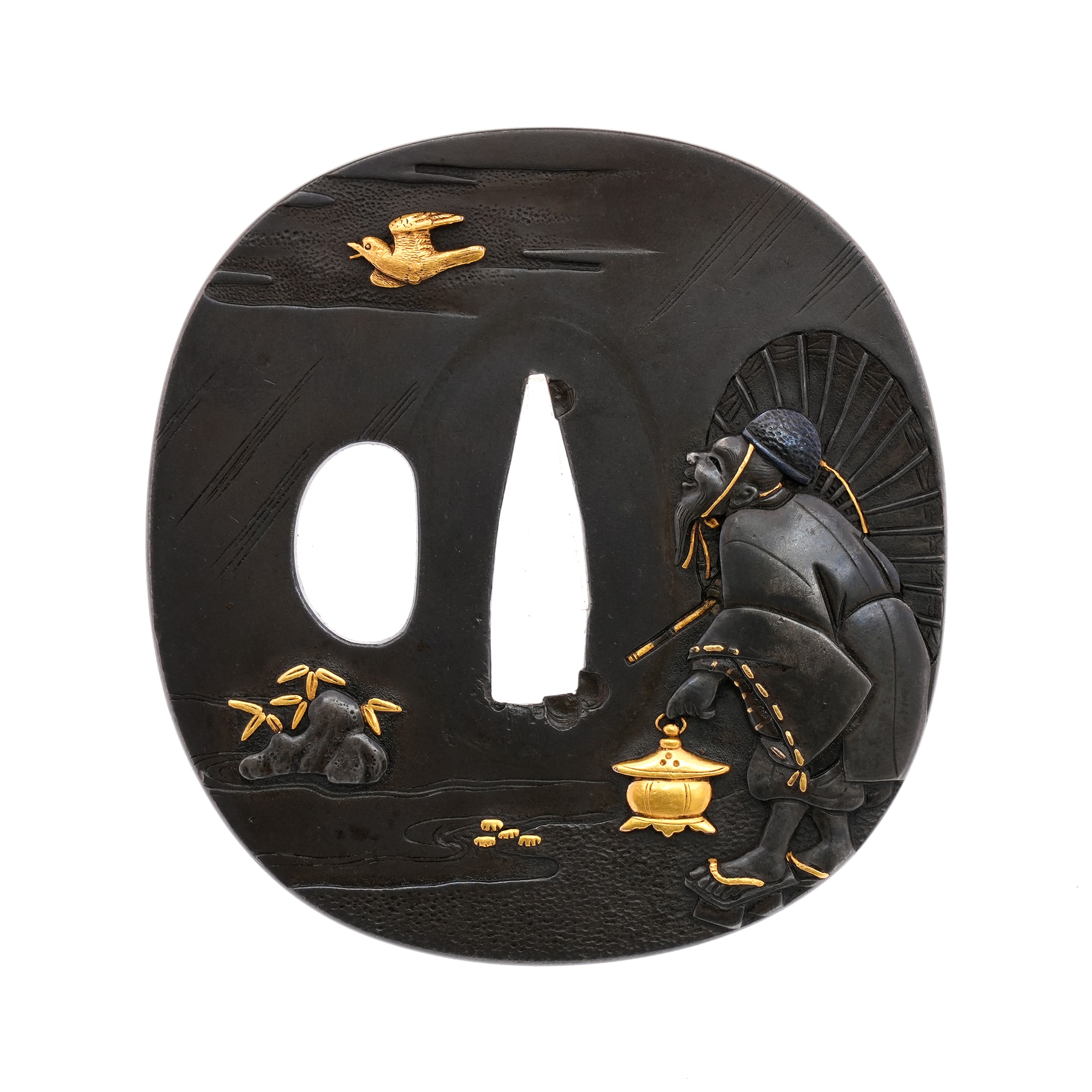
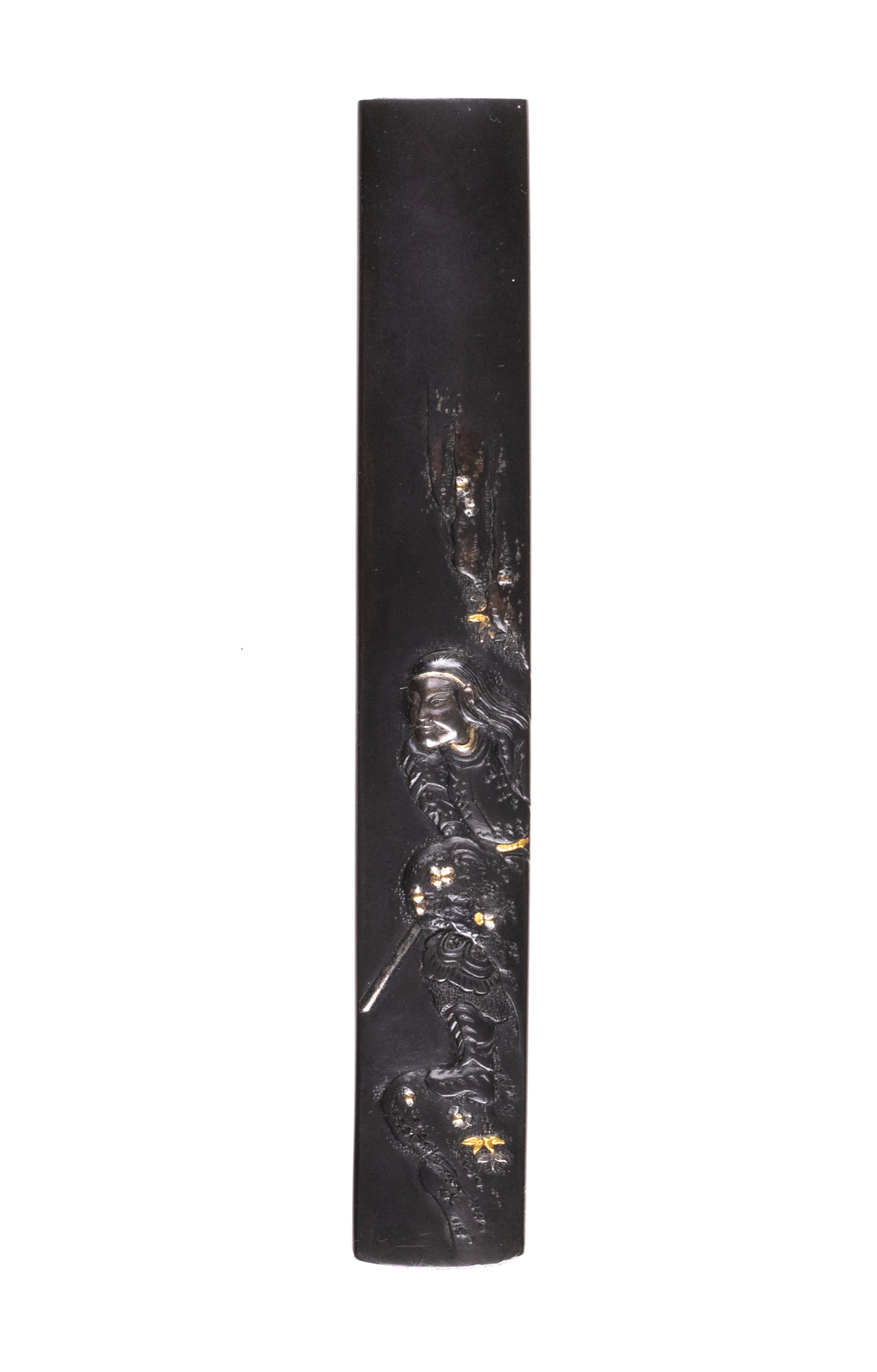
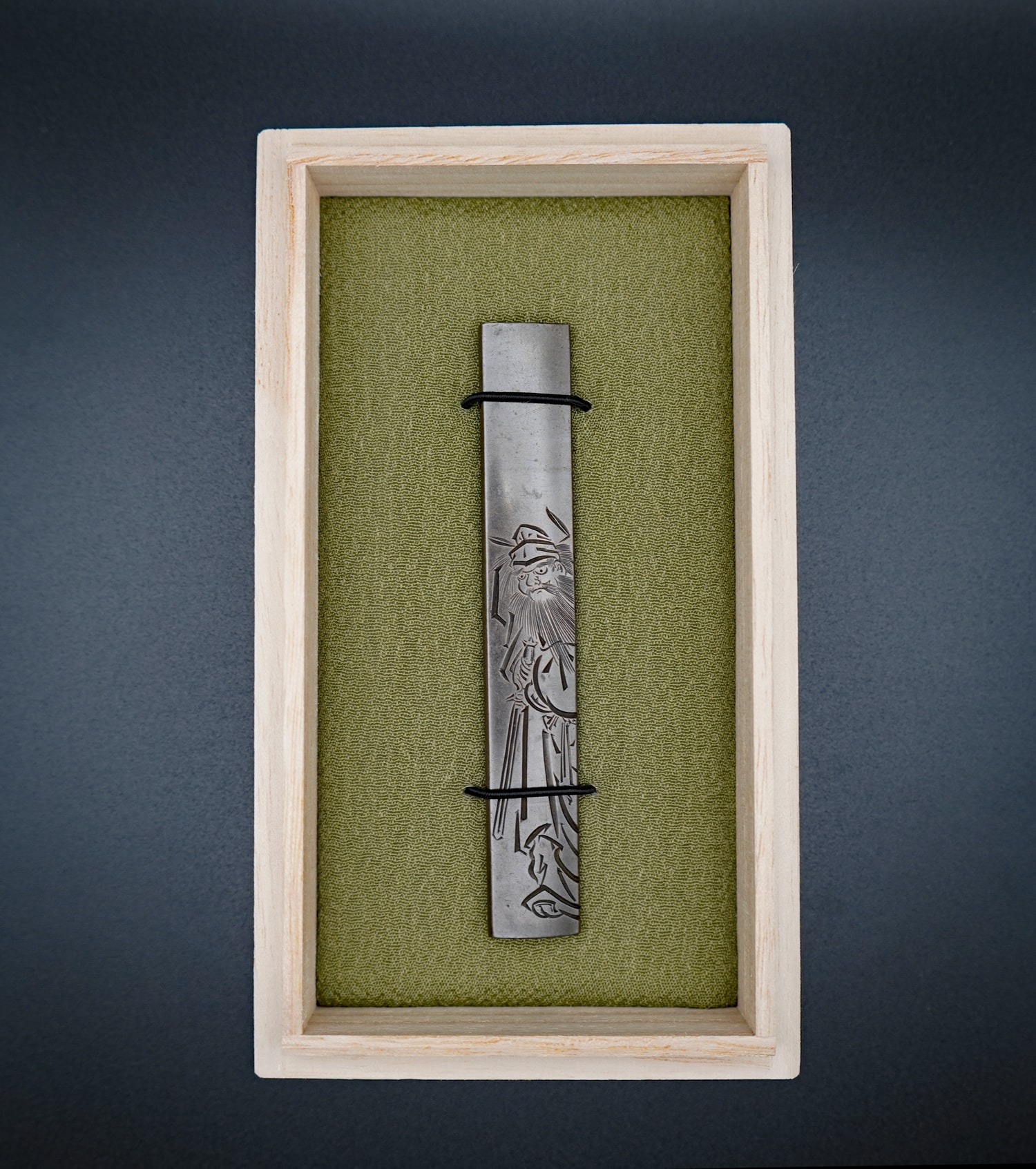
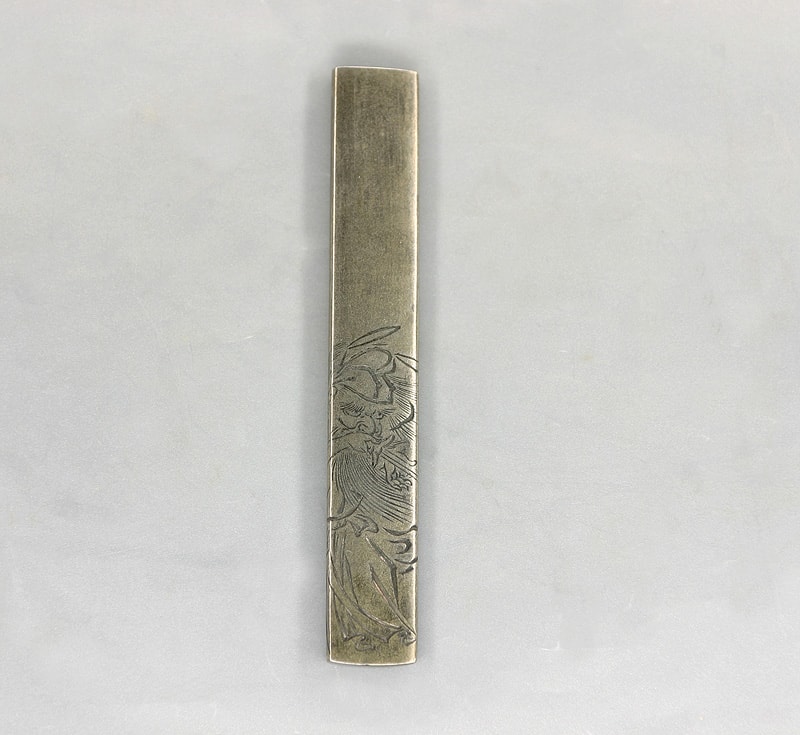
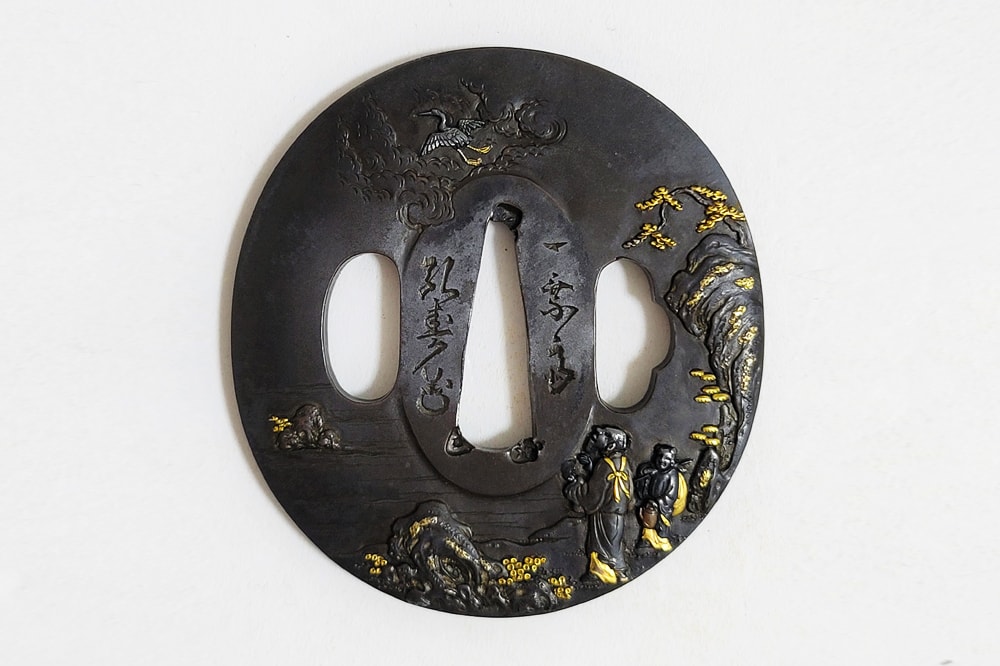
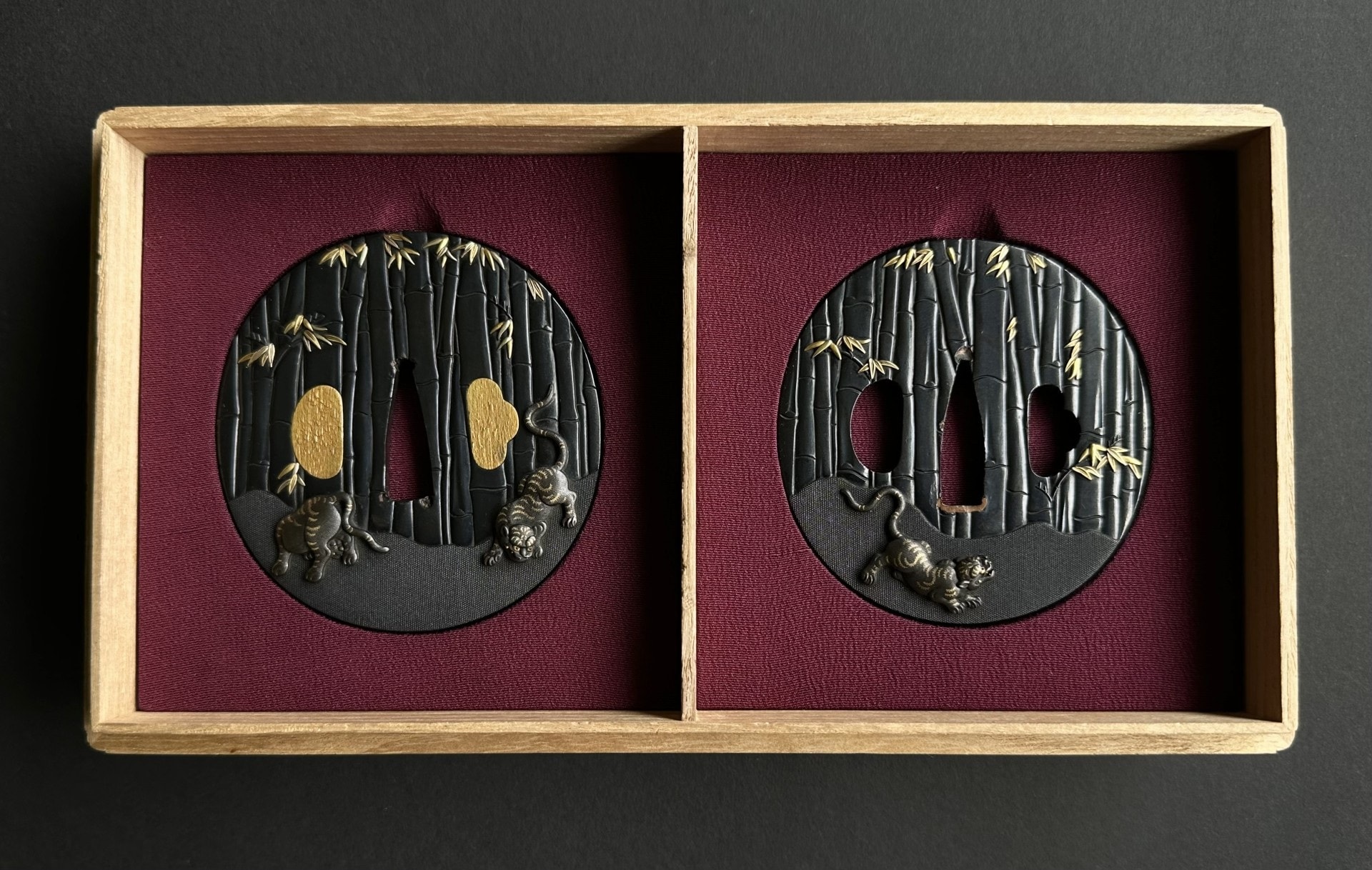
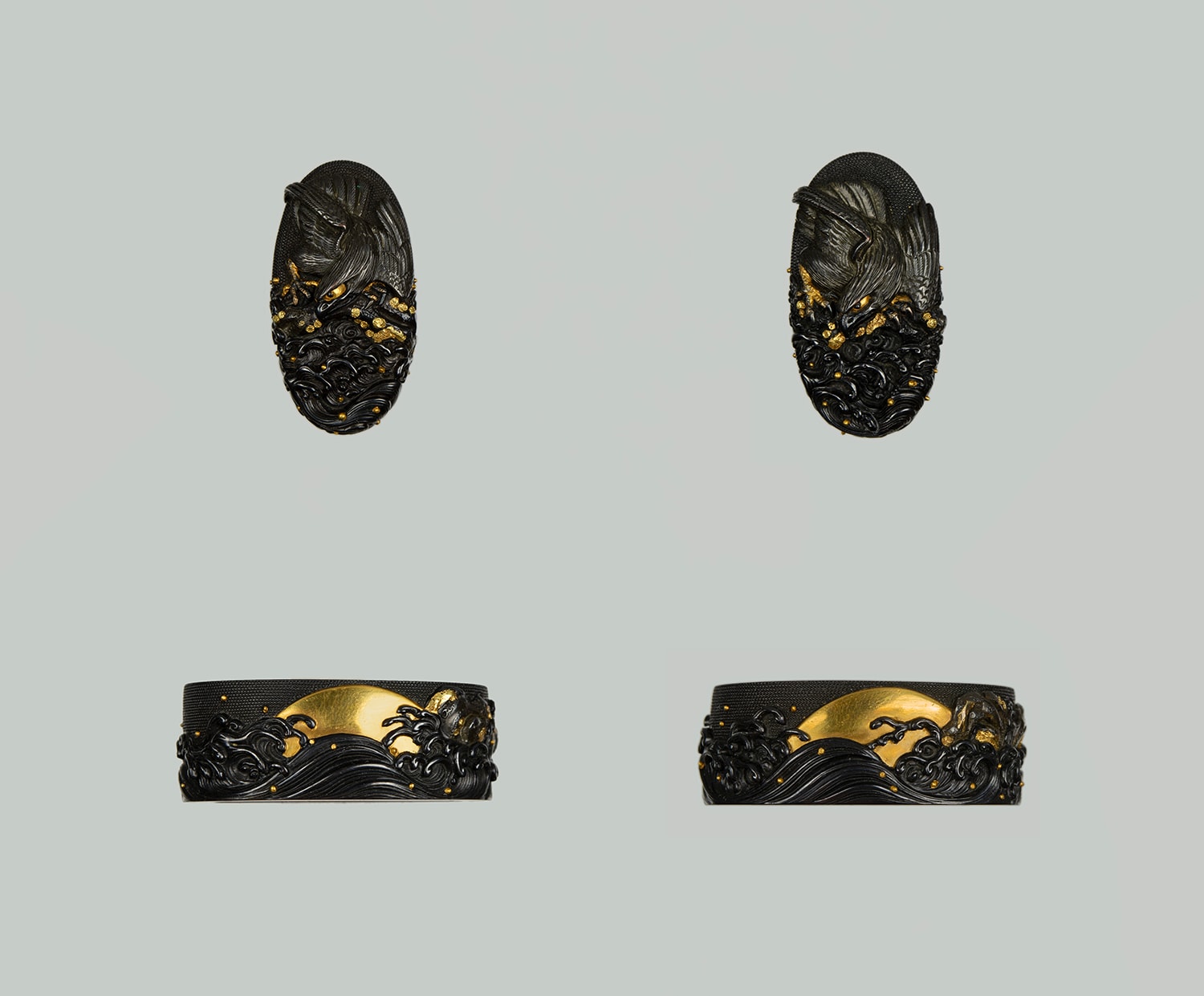
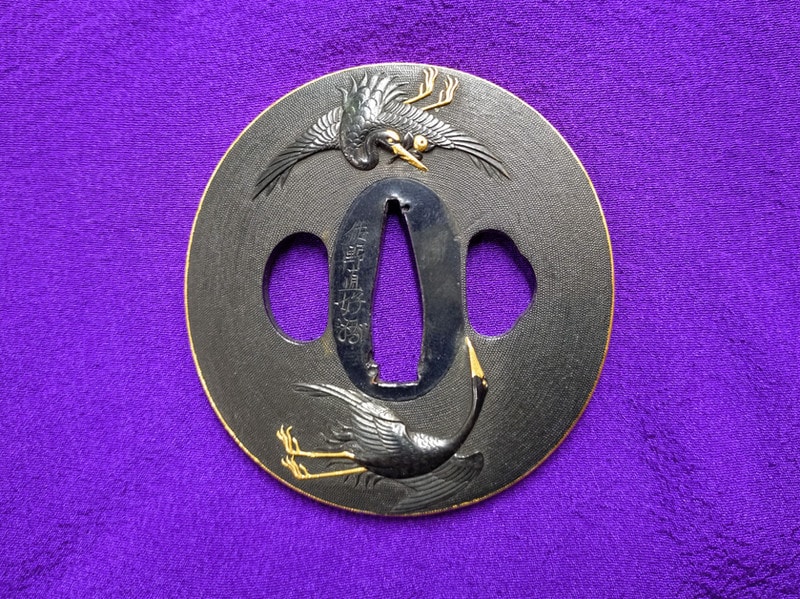
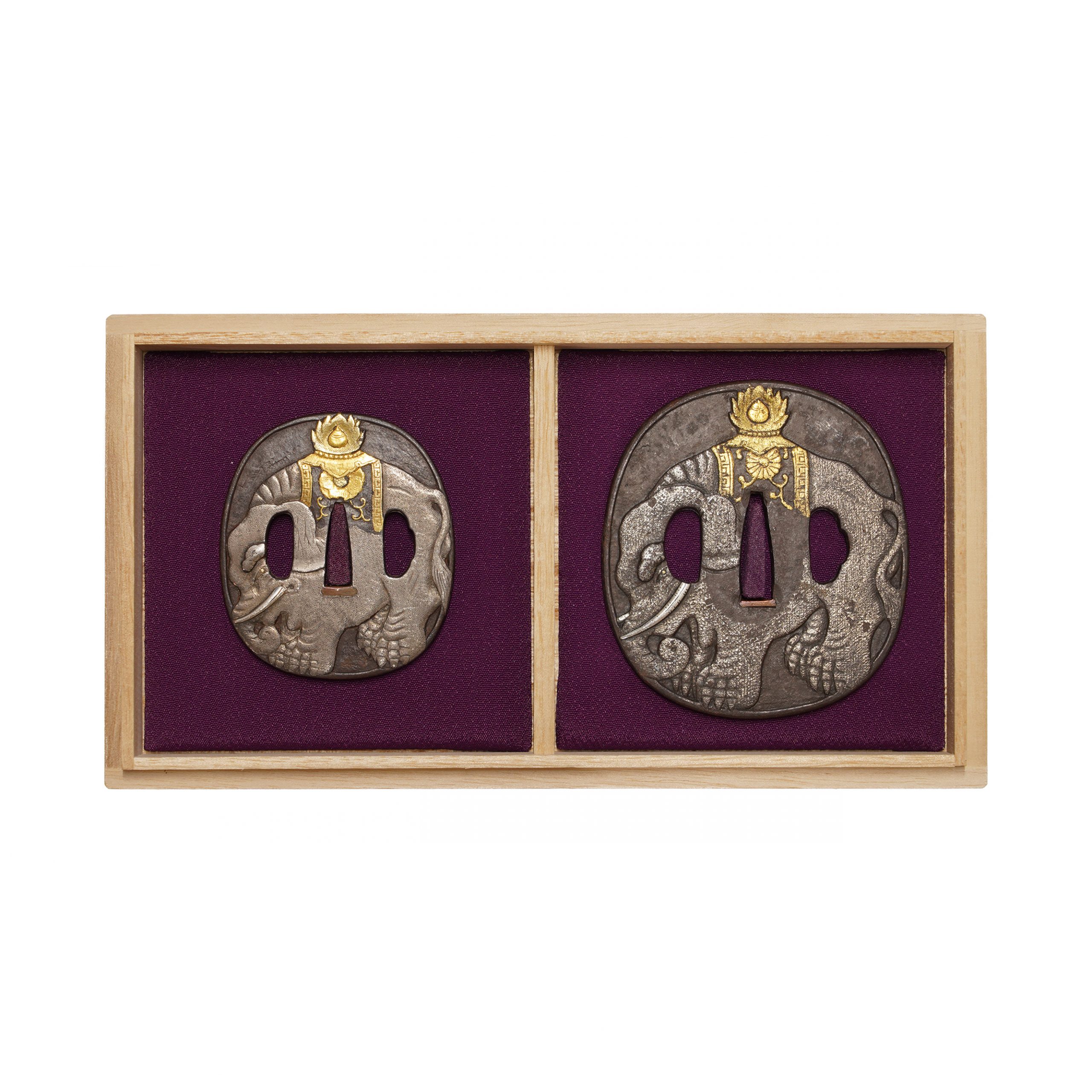
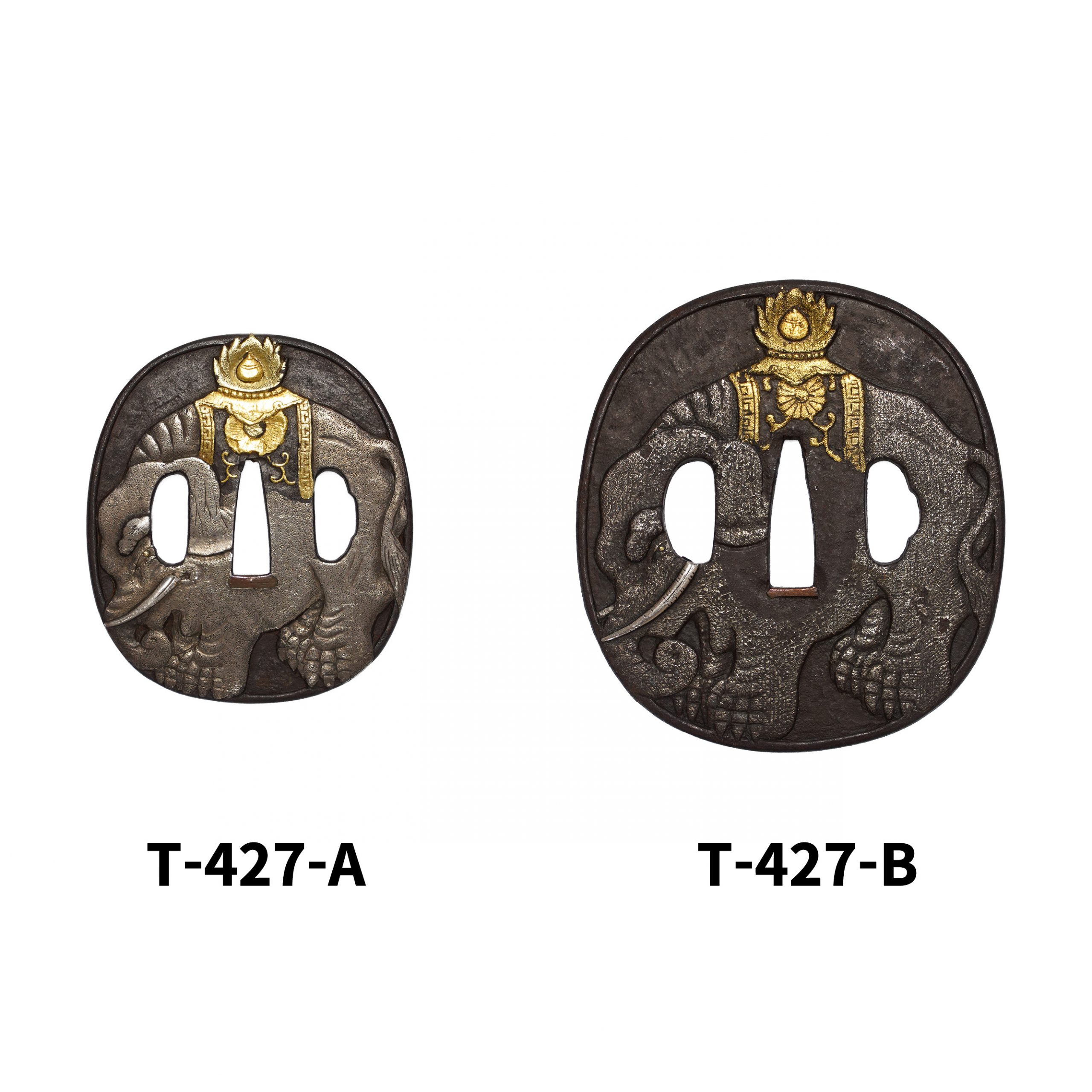
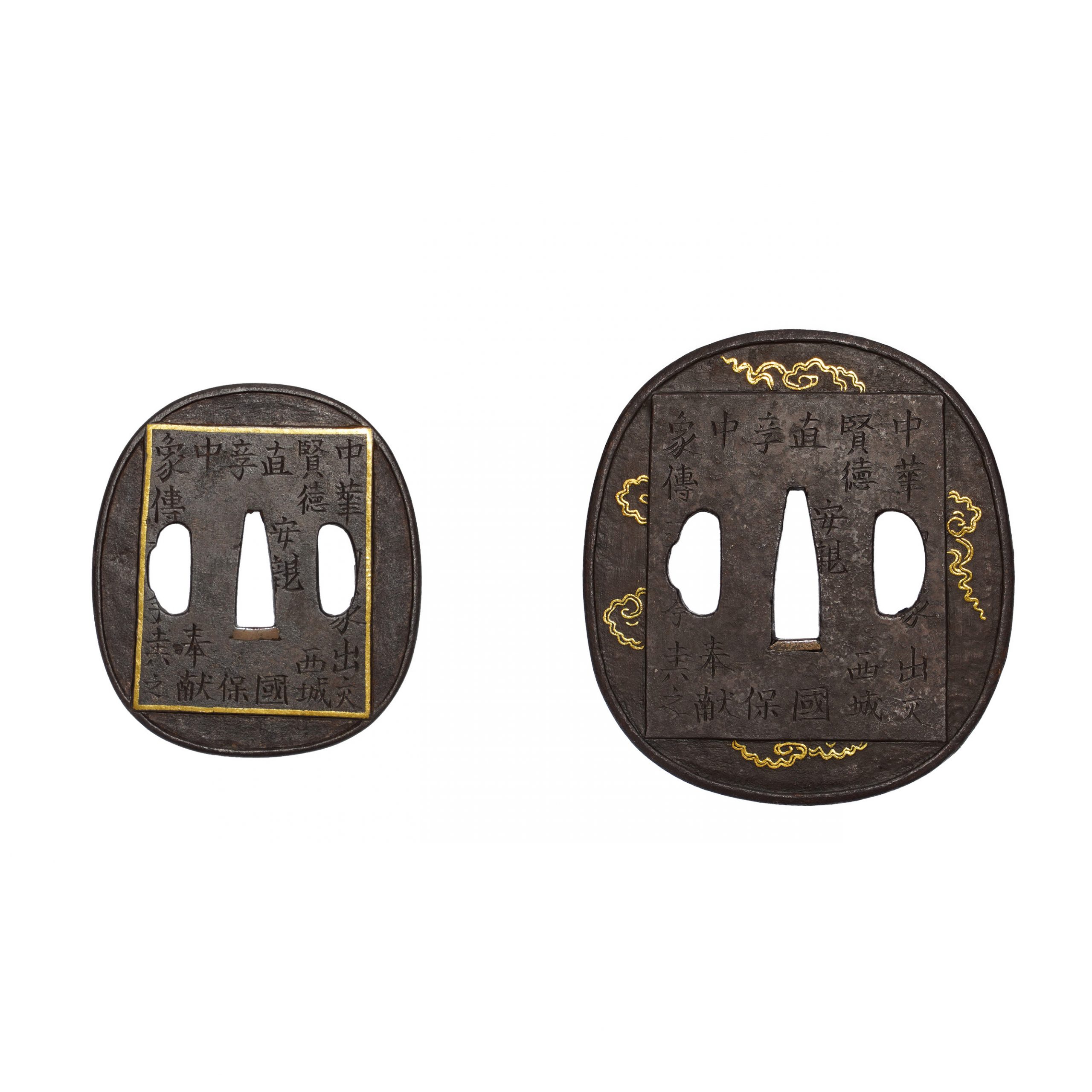
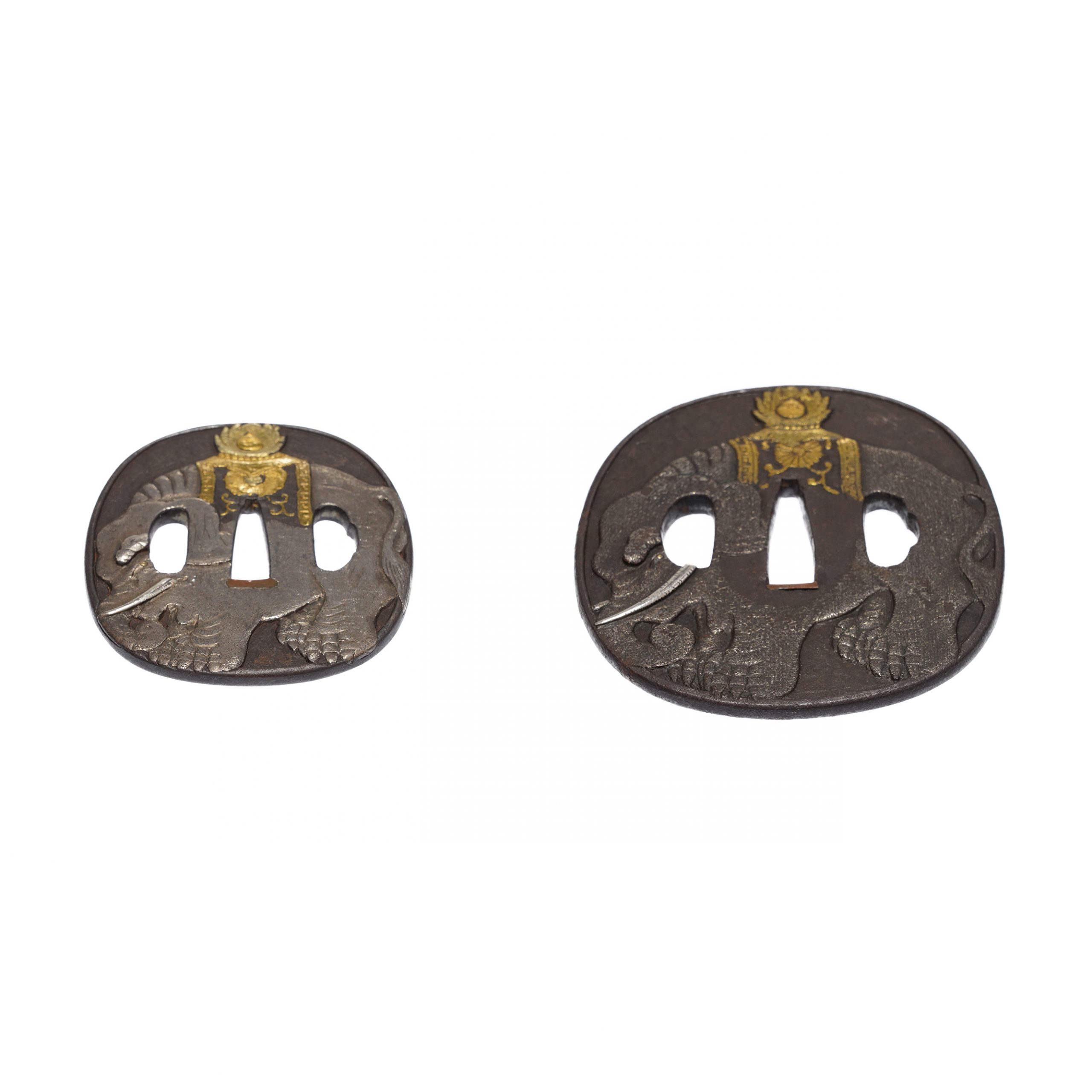
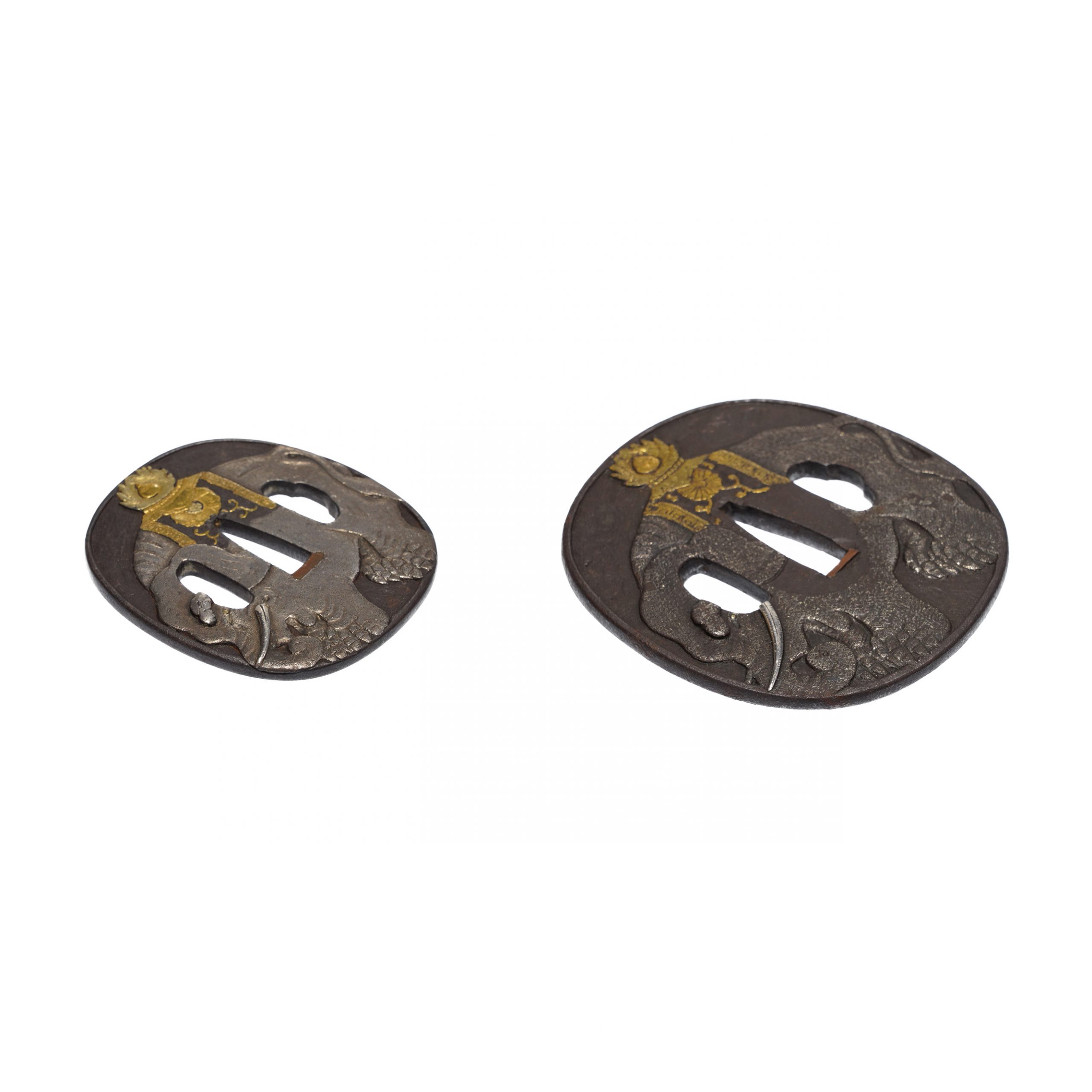
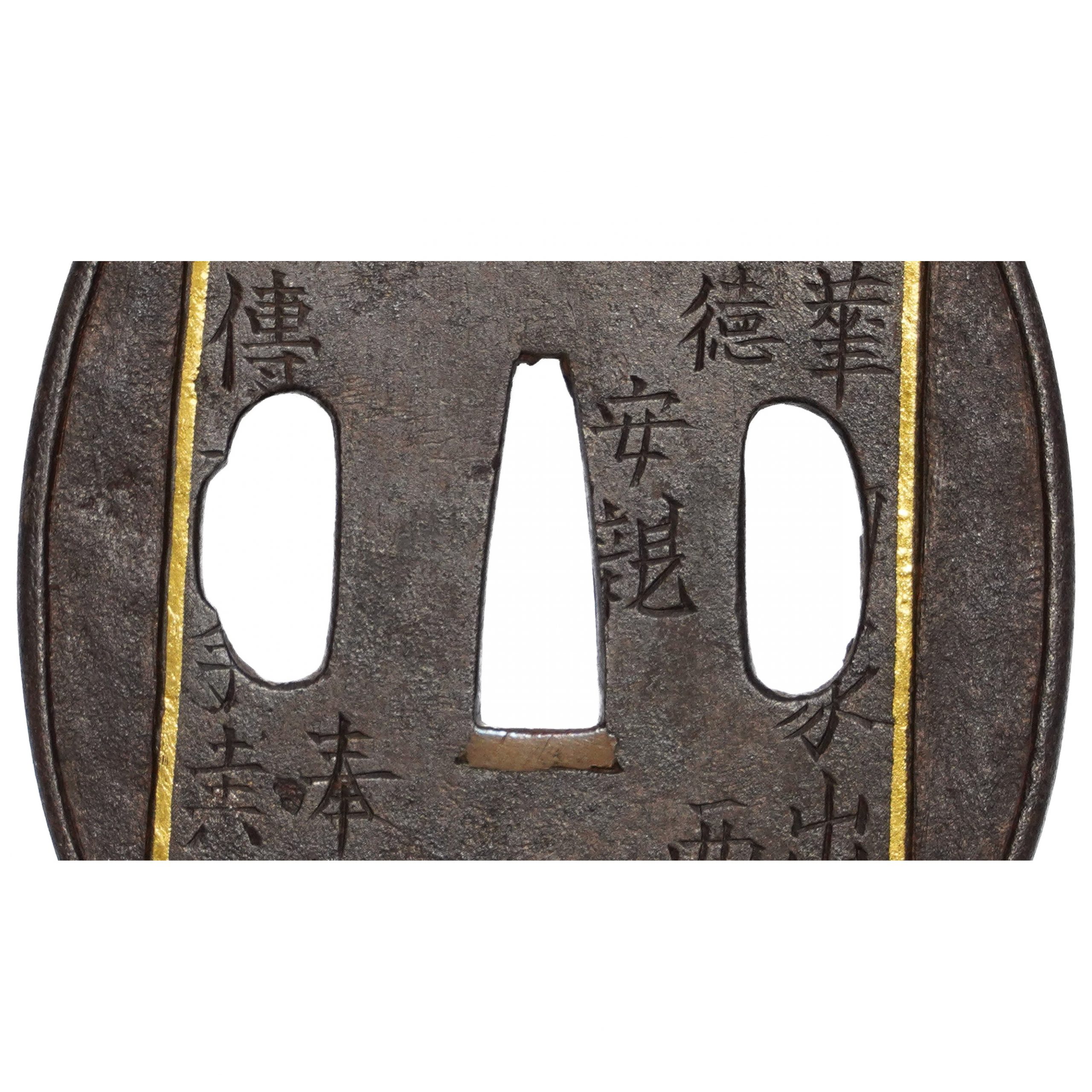
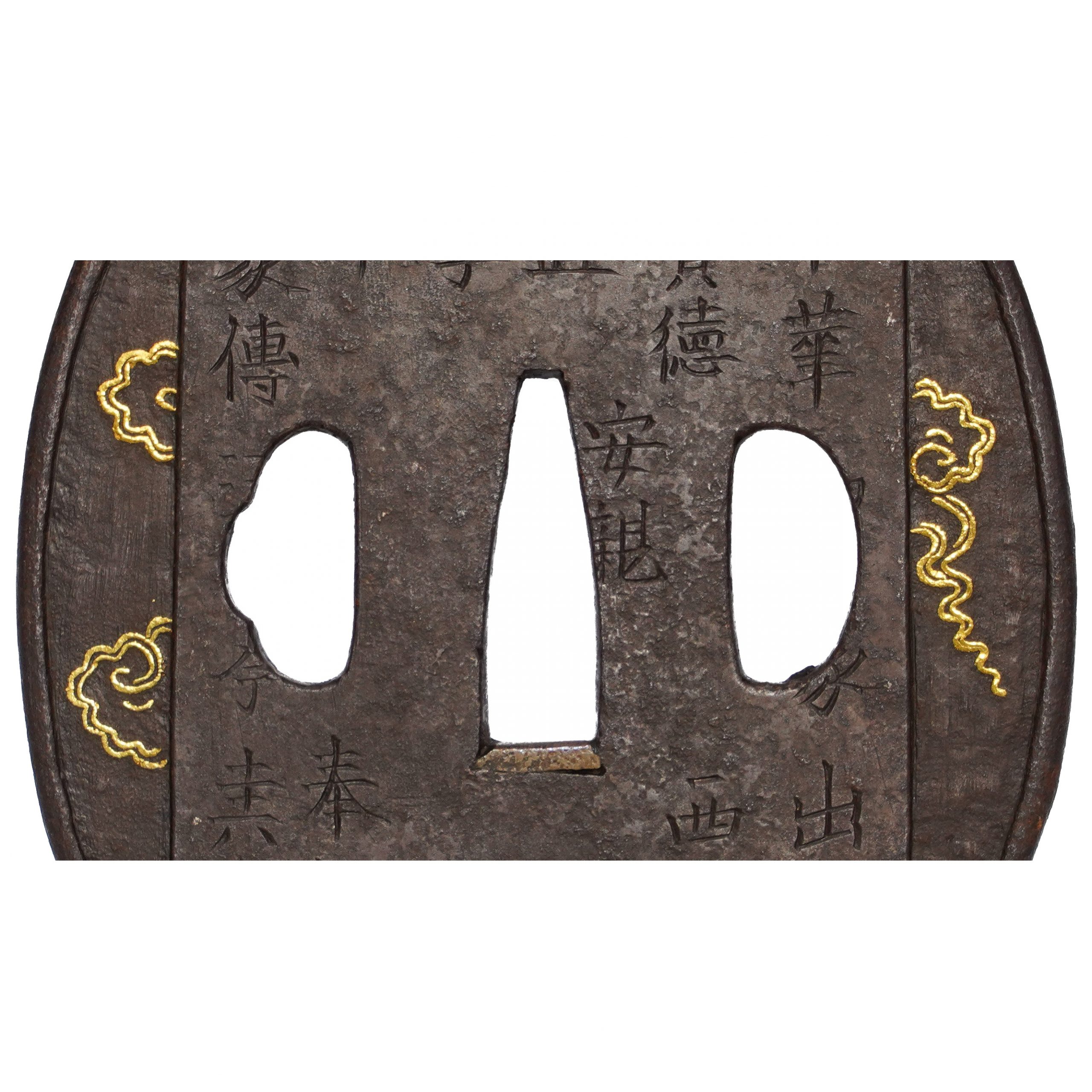
This is a set of two antique Tsuba (handguards) from the Edo period, signed by Yasuchika. The design, titled 'Hakuzou Zu,' features white elephants adorned with gorgeous decorations, engraved semi-three-dimensionally and colored with silvery metal. The white elephant is a sacred symbol in Buddhism, associated with Fugen Bosatsu and the birth of Buddha.
 NihontoWatch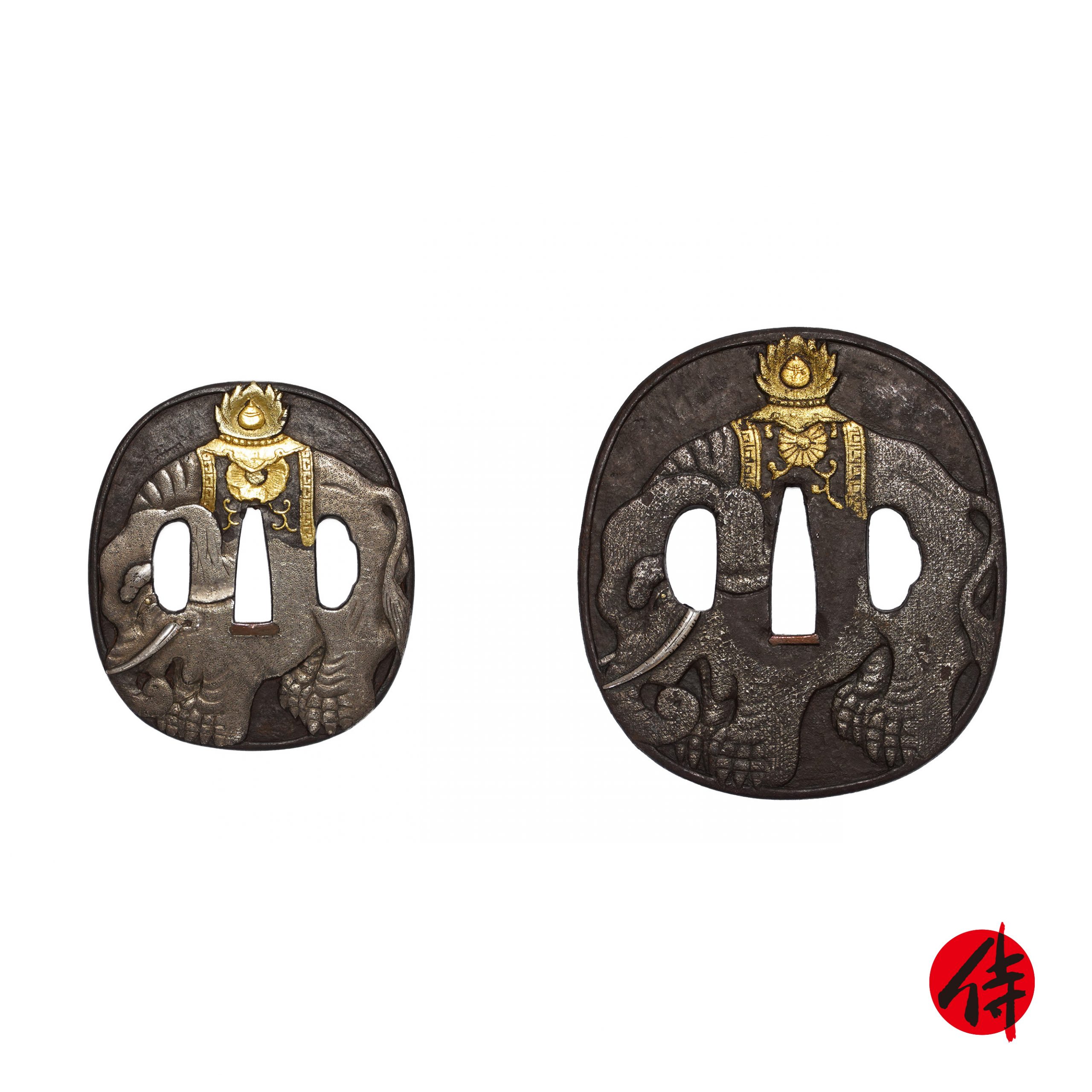
Machibori · Edo
1 piece on the market now
Tsuchiya Yasuchika (土屋安親), also known as Yagohachi, was born in Kanbun 10 (1670) as the son of Tsuchiya Chuzaemon, a retainer of the Shonai domain in Dewa Province. While still young he entered the school of Shoami Chinku, married his teacher's daughter, and in Genroku 16 (1703), at the age of thirty-four, went to Edo, where he undertook further training under Nara Tatsumasa — at which point, as the NBTHK setsumei consistently observe, "his innate talent fully blossomed." Around the Shotoku era he entered the service of Matsudaira Daigaku-no-kami, a nephew of Tokugawa Mitsukuni and lord of the twenty-thousand-koku Moriyama fief in Oshu. In Kyoho 16 (1731), at the age of sixty-one, he took the tonsure and adopted the art name Tou (東雨). He left numerous masterpieces to the world and was later celebrated — together with Nara Toshihisa and Sugiura Joi — as one of the "Three Masters of Nara" (Nara sansaku), recognized as an artist of the very highest ability.
Yasuchika's technical range is exceptional. His oeuvre encompasses work in iron, shakudo, shibuichi, brass (shinchu), and refined copper (suaka), with surfaces treated as polished grounds (migaki-ji), hammered textures (tsuchime-ji), and stone-grain finishes (ishime-ji). His signature carving methods include sukidashi-bori modeled relief, takabori high relief, the thread-fine line work of kebori, and — more rarely — the single-stroke katakiribori incision. Polychrome metal inlay (iroe) in gold, silver, shibuichi, and suaka is deployed with what the NBTHK describes as "an unrivaled equilibrium in compositional planning and in the exquisitely balanced placement of colored metals." His iron tsuba frequently employ the distinctive daigaku-gata form conceived for his patron, while his kozuka demonstrate the capacity to "draw forth a small universe" within a confined surface. In later works signed Tou, NBTHK examiners identify an austere, detached realm (kotan) — a shift from the vigorous pictorialism of his Edo-period maturity toward something "profoundly rich in nuance."
Across the designation records, certain evaluative themes recur with striking consistency. The NBTHK praises Yasuchika's "warm, humane sentiment" and "gentle humanism," visible in his treatment of figures such as Jurojin, Daruma, and the creatures that populate his compositions — faces rendered with "an unmistakable mildness," animals depicted so as to seem "almost alive." His narrative scenes are likened to hanging paintings (ichifuku no e), unfolding atmospheric effects "akin to watercolor." Whether rendering a carp amid turbulent waves, wild geese descending in rain, or Li Bai gazing at a waterfall, Yasuchika's compositions are praised for their "outstanding" interlinked design across front and back, their "free and untrammeled manner, calm and unforced," and a compositional intelligence in which "tension and relaxed release coexist." In subject, technique, and the sustained refinement of his carving, the setsumei affirm that his is an art in which, as one examiner concludes, "the sharpness of Yasuchika's skill is scattered throughout."[[c:2]]
Where Yasuchika stands among comparable artisans: across all of nihontō, and within tradition, era, and period. The tiers (Foremost · Leading · Major · Notable) weigh official designations from the NBTHK and Japan's Agency for Cultural Affairs, together with historical honors of lasting repute such as the Sansaku and Meibutsu-chō.
Select a lens to see how it's measured.
Machibori · Edo
82 pieces on the market now
The Nara school of kinko (metalwork) emerged in the mid-Edo period as one of the most celebrated independent traditions of sword-fitting craftsmanship, its masters working outside the patronage structures that governed the Goto house. The school coalesced around the figure of Nara Toshihisa (1667--1736), also known as Tahee, who as head master during its creative zenith defined the mature idiom of the lineage. Though the school's origins are often traced through the successive generations of the Nara family beginning with Toshiharu, its lasting fame rests upon the Nara sansaku — the Three Masters of Nara: Toshihisa, Tsuchiya Yasuchika, and Sugiura Joi. " Joi (1701--1761), trained under Juei in the lineage of Toshiharu, rose to become the third pillar of this triumvirate. Together, and joined by masters of allied lineages such as Hayashi Shigemitsu of the Higo kinko tradition, the Nara school and its circle represent the highest achievement of independent metalwork in the Edo period. The collective technical vocabulary of the Nara school encompasses an extraordinary breadth of materials and methods. Its masters worked in iron, shakudo, shibuichi, brass (shinchu), refined copper (suaka), and oborogin, treating surfaces as polished grounds (migaki-ji), hammered textures (tsuchime-ji), and stone-grain finishes (ishime-ji) — the latter developed by Toshihisa into a distinctive personal manner. The school's carving methods span the full spectrum: sukidashi-bori modeled relief, takabori high relief, the thread-fine line work of kebori, and the single-stroke katakiribori incision. " Yet individual specialties distinguish the masters within this shared vocabulary.
Toshihisa's art finds its fullest expression in sukidashi takabori — relief carving in which figures are raised with subtly graduated heights to produce an illusion of spatial depth — executed against his richly textured ishime-ji grounds. Joi developed nikuaibori, a modulated relief technique of unrivaled refinement, producing entire compositions through chisel work alone on polished oborogin grounds, dispensing with inlay and colored-metal accents. Yasuchika's range is perhaps the broadest, encompassing the distinctive daigaku-gata iron tsuba conceived for his patron and kozuka that "draw forth a small universe" within a confined surface, while his late works signed with the art name Tou achieve an austere, detached realm the NBTHK terms kotan. The legacy of the Nara school rests on the singular ability of its masters to transcend decorative function and achieve genuine artistic expression within the confines of sword fittings. Toshihisa, as the senior figure among the sansaku, established the standard of dignified, powerfully carved relief against richly textured grounds, and his figural subjects — gamecocks, tigers, Bishamonten — consistently achieve what NBTHK scholarship identifies as the philosophical duality of do (movement) and sei (stillness) within a single composition. " Joi, working primarily in the intimate format of the kozuka, achieved expressive authority through the sheer subtlety of his nikuaibori chisel work — his celebrated lion-and-cub compositions existing in closely related versions across multiple designations and published in the canonical reference Tagane no Hana. That the school also attracted masters of allied provincial traditions — Hayashi Shigemitsu of Higo, whose iron tsuba display the characteristic murasaki-sabi patina and "somewhat gentler feeling" that distinguishes the second generation from the founder Matahichi — attests to its gravitational influence on Edo-period metalwork as a whole. Across the school's production, the NBTHK's evaluative language converges on a consistent theme: compositional intelligence, technical command across the full range of materials and carving methods, and an expressive depth that elevates the finest works from accomplished craft to art of the highest order. Learn more →
| Smith | Era | Designated |
|---|---|---|
| Yasuchika安親 | — | 85 |
| Joi乗意 | — | 12 |
| Toshinaga利寿 | — | 28 |
| Nara奈良 | — | 2 |
| Toshiyoshi利善 | — | 0 |
We could not find an authenticity certificate on the seller’s listing. Japanese swords and fittings are normally papered by the NBTHK (or the NTHK). Without one, the attribution is the seller’s own assessment and has not been independently verified — treat it with caution and ask the dealer about certification before buying.
Returns/exchanges limited to defects caused by shipping (except willful misconduct or gross negligence by the company); customers must contact within 72 hours of receiving the product.
This is a set of two antique Tsuba (handguards) from the Edo period, signed by Yasuchika. The design, titled 'Hakuzou Zu,' features white elephants adorned with gorgeous decorations, engraved semi-three-dimensionally and colored with silvery metal. The white elephant is a sacred symbol in Buddhism, associated with Fugen Bosatsu and the birth of Buddha.
NihontoWatchMachibori · Edo
1 piece on the market now
Tsuchiya Yasuchika (土屋安親), also known as Yagohachi, was born in Kanbun 10 (1670) as the son of Tsuchiya Chuzaemon, a retainer of the Shonai domain in Dewa Province. While still young he entered the school of Shoami Chinku, married his teacher's daughter, and in Genroku 16 (1703), at the age of thirty-four, went to Edo, where he undertook further training under Nara Tatsumasa — at which point, as the NBTHK setsumei consistently observe, "his innate talent fully blossomed." Around the Shotoku era he entered the service of Matsudaira Daigaku-no-kami, a nephew of Tokugawa Mitsukuni and lord of the twenty-thousand-koku Moriyama fief in Oshu. In Kyoho 16 (1731), at the age of sixty-one, he took the tonsure and adopted the art name Tou (東雨). He left numerous masterpieces to the world and was later celebrated — together with Nara Toshihisa and Sugiura Joi — as one of the "Three Masters of Nara" (Nara sansaku), recognized as an artist of the very highest ability.
Yasuchika's technical range is exceptional. His oeuvre encompasses work in iron, shakudo, shibuichi, brass (shinchu), and refined copper (suaka), with surfaces treated as polished grounds (migaki-ji), hammered textures (tsuchime-ji), and stone-grain finishes (ishime-ji). His signature carving methods include sukidashi-bori modeled relief, takabori high relief, the thread-fine line work of kebori, and — more rarely — the single-stroke katakiribori incision. Polychrome metal inlay (iroe) in gold, silver, shibuichi, and suaka is deployed with what the NBTHK describes as "an unrivaled equilibrium in compositional planning and in the exquisitely balanced placement of colored metals." His iron tsuba frequently employ the distinctive daigaku-gata form conceived for his patron, while his kozuka demonstrate the capacity to "draw forth a small universe" within a confined surface. In later works signed Tou, NBTHK examiners identify an austere, detached realm (kotan) — a shift from the vigorous pictorialism of his Edo-period maturity toward something "profoundly rich in nuance."
Across the designation records, certain evaluative themes recur with striking consistency. The NBTHK praises Yasuchika's "warm, humane sentiment" and "gentle humanism," visible in his treatment of figures such as Jurojin, Daruma, and the creatures that populate his compositions — faces rendered with "an unmistakable mildness," animals depicted so as to seem "almost alive." His narrative scenes are likened to hanging paintings (ichifuku no e), unfolding atmospheric effects "akin to watercolor." Whether rendering a carp amid turbulent waves, wild geese descending in rain, or Li Bai gazing at a waterfall, Yasuchika's compositions are praised for their "outstanding" interlinked design across front and back, their "free and untrammeled manner, calm and unforced," and a compositional intelligence in which "tension and relaxed release coexist." In subject, technique, and the sustained refinement of his carving, the setsumei affirm that his is an art in which, as one examiner concludes, "the sharpness of Yasuchika's skill is scattered throughout."[[c:2]]
Where Yasuchika stands among comparable artisans: across all of nihontō, and within tradition, era, and period. The tiers (Foremost · Leading · Major · Notable) weigh official designations from the NBTHK and Japan's Agency for Cultural Affairs, together with historical honors of lasting repute such as the Sansaku and Meibutsu-chō.
Select a lens to see how it's measured.
Machibori · Edo
82 pieces on the market now
The Nara school of kinko (metalwork) emerged in the mid-Edo period as one of the most celebrated independent traditions of sword-fitting craftsmanship, its masters working outside the patronage structures that governed the Goto house. The school coalesced around the figure of Nara Toshihisa (1667--1736), also known as Tahee, who as head master during its creative zenith defined the mature idiom of the lineage. Though the school's origins are often traced through the successive generations of the Nara family beginning with Toshiharu, its lasting fame rests upon the Nara sansaku — the Three Masters of Nara: Toshihisa, Tsuchiya Yasuchika, and Sugiura Joi. " Joi (1701--1761), trained under Juei in the lineage of Toshiharu, rose to become the third pillar of this triumvirate. Together, and joined by masters of allied lineages such as Hayashi Shigemitsu of the Higo kinko tradition, the Nara school and its circle represent the highest achievement of independent metalwork in the Edo period. The collective technical vocabulary of the Nara school encompasses an extraordinary breadth of materials and methods. Its masters worked in iron, shakudo, shibuichi, brass (shinchu), refined copper (suaka), and oborogin, treating surfaces as polished grounds (migaki-ji), hammered textures (tsuchime-ji), and stone-grain finishes (ishime-ji) — the latter developed by Toshihisa into a distinctive personal manner. The school's carving methods span the full spectrum: sukidashi-bori modeled relief, takabori high relief, the thread-fine line work of kebori, and the single-stroke katakiribori incision. " Yet individual specialties distinguish the masters within this shared vocabulary.
Toshihisa's art finds its fullest expression in sukidashi takabori — relief carving in which figures are raised with subtly graduated heights to produce an illusion of spatial depth — executed against his richly textured ishime-ji grounds. Joi developed nikuaibori, a modulated relief technique of unrivaled refinement, producing entire compositions through chisel work alone on polished oborogin grounds, dispensing with inlay and colored-metal accents. Yasuchika's range is perhaps the broadest, encompassing the distinctive daigaku-gata iron tsuba conceived for his patron and kozuka that "draw forth a small universe" within a confined surface, while his late works signed with the art name Tou achieve an austere, detached realm the NBTHK terms kotan. The legacy of the Nara school rests on the singular ability of its masters to transcend decorative function and achieve genuine artistic expression within the confines of sword fittings. Toshihisa, as the senior figure among the sansaku, established the standard of dignified, powerfully carved relief against richly textured grounds, and his figural subjects — gamecocks, tigers, Bishamonten — consistently achieve what NBTHK scholarship identifies as the philosophical duality of do (movement) and sei (stillness) within a single composition. " Joi, working primarily in the intimate format of the kozuka, achieved expressive authority through the sheer subtlety of his nikuaibori chisel work — his celebrated lion-and-cub compositions existing in closely related versions across multiple designations and published in the canonical reference Tagane no Hana. That the school also attracted masters of allied provincial traditions — Hayashi Shigemitsu of Higo, whose iron tsuba display the characteristic murasaki-sabi patina and "somewhat gentler feeling" that distinguishes the second generation from the founder Matahichi — attests to its gravitational influence on Edo-period metalwork as a whole. Across the school's production, the NBTHK's evaluative language converges on a consistent theme: compositional intelligence, technical command across the full range of materials and carving methods, and an expressive depth that elevates the finest works from accomplished craft to art of the highest order. Learn more →
| Smith | Era | Designated |
|---|---|---|
| Yasuchika安親 | — | 85 |
| Joi乗意 | — | 12 |
| Toshinaga利寿 | — | 28 |
| Nara奈良 | — | 2 |
| Toshiyoshi利善 | — | 0 |
We could not find an authenticity certificate on the seller’s listing. Japanese swords and fittings are normally papered by the NBTHK (or the NTHK). Without one, the attribution is the seller’s own assessment and has not been independently verified — treat it with caution and ask the dealer about certification before buying.
Returns/exchanges limited to defects caused by shipping (except willful misconduct or gross negligence by the company); customers must contact within 72 hours of receiving the product.