NihontoWatch Mon

NihontoWatch

MarketAuctions
Encyclopedia
NihontoWatch Mon

NihontoWatch

MarketAuctions
Encyclopedia

Description

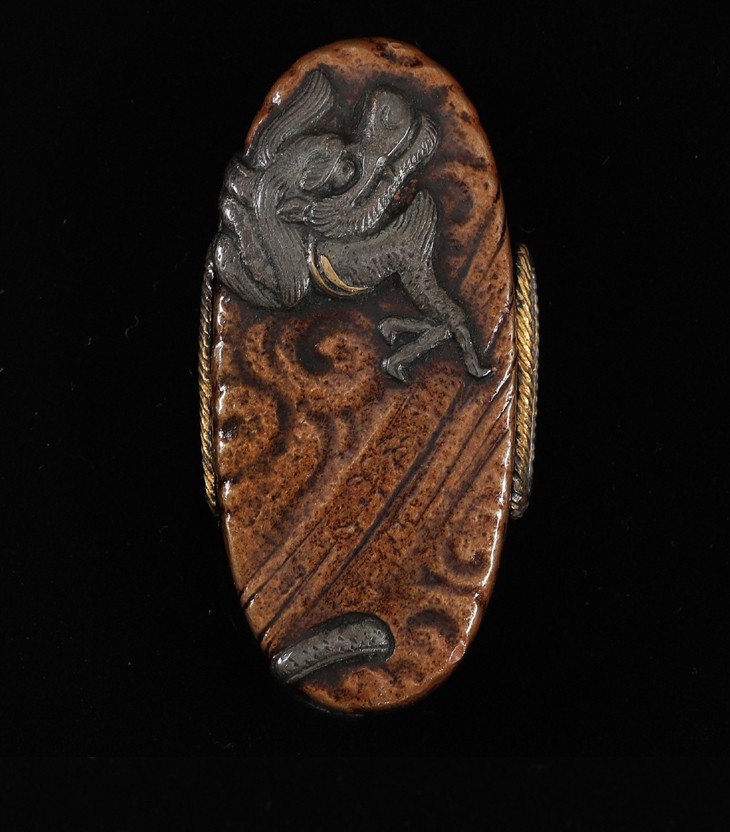
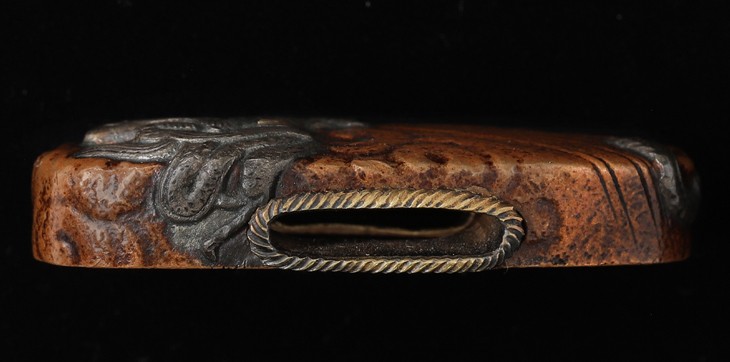
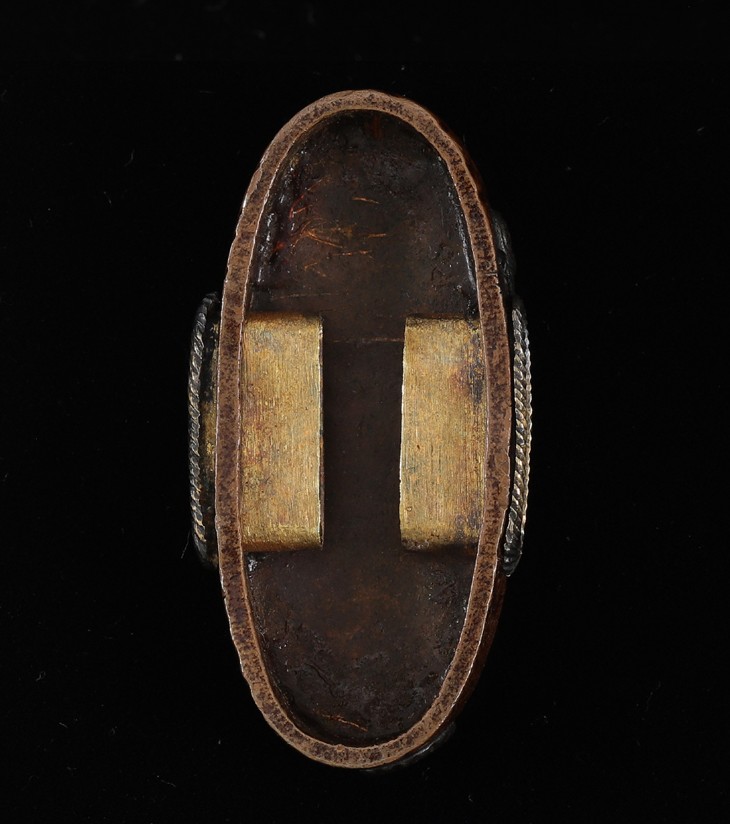
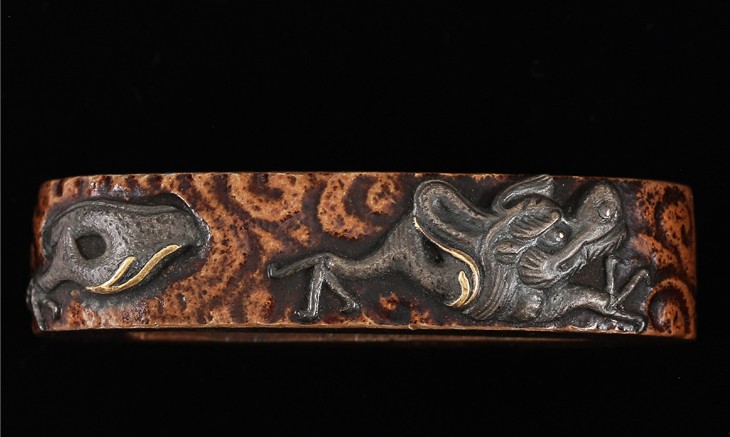
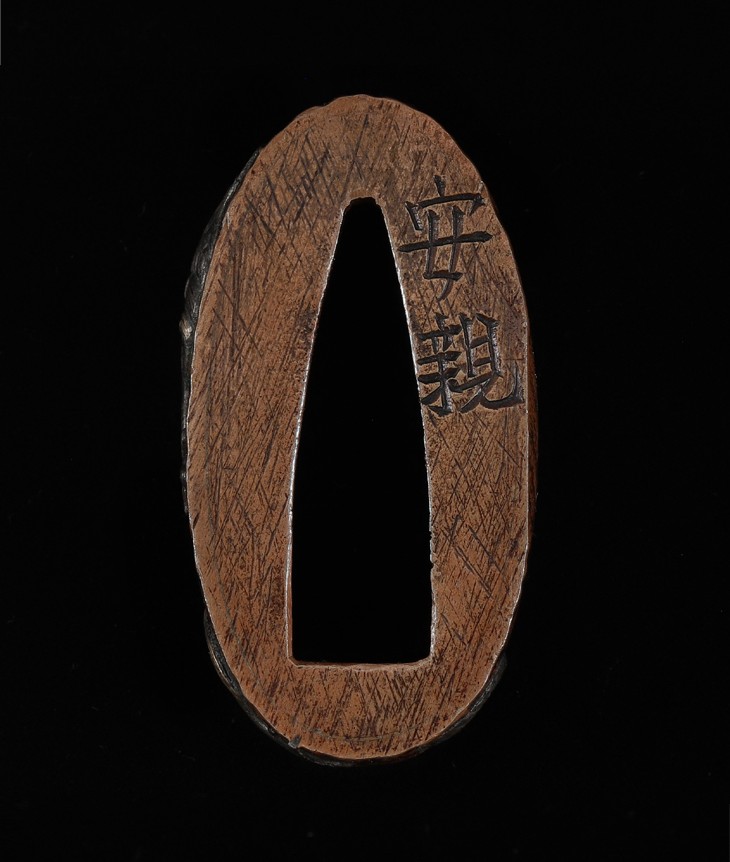
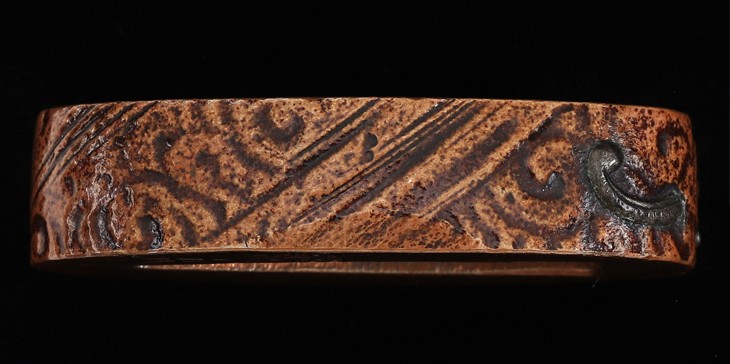
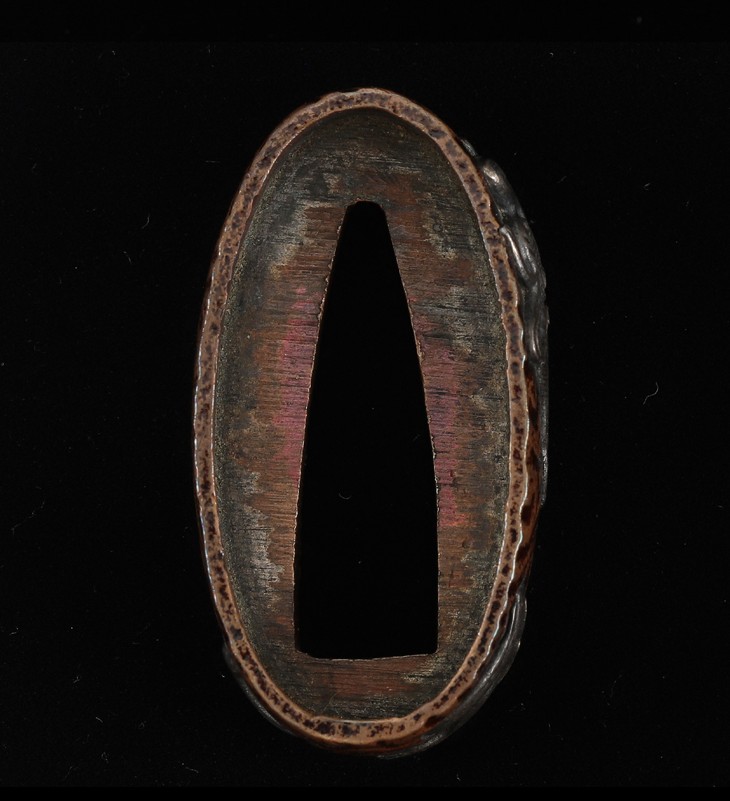
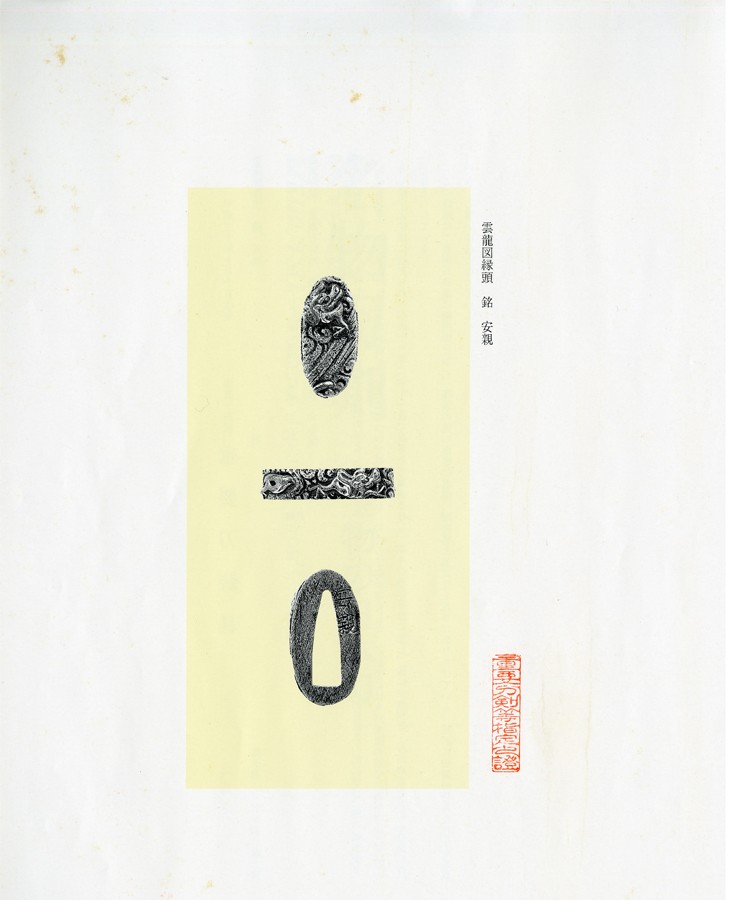
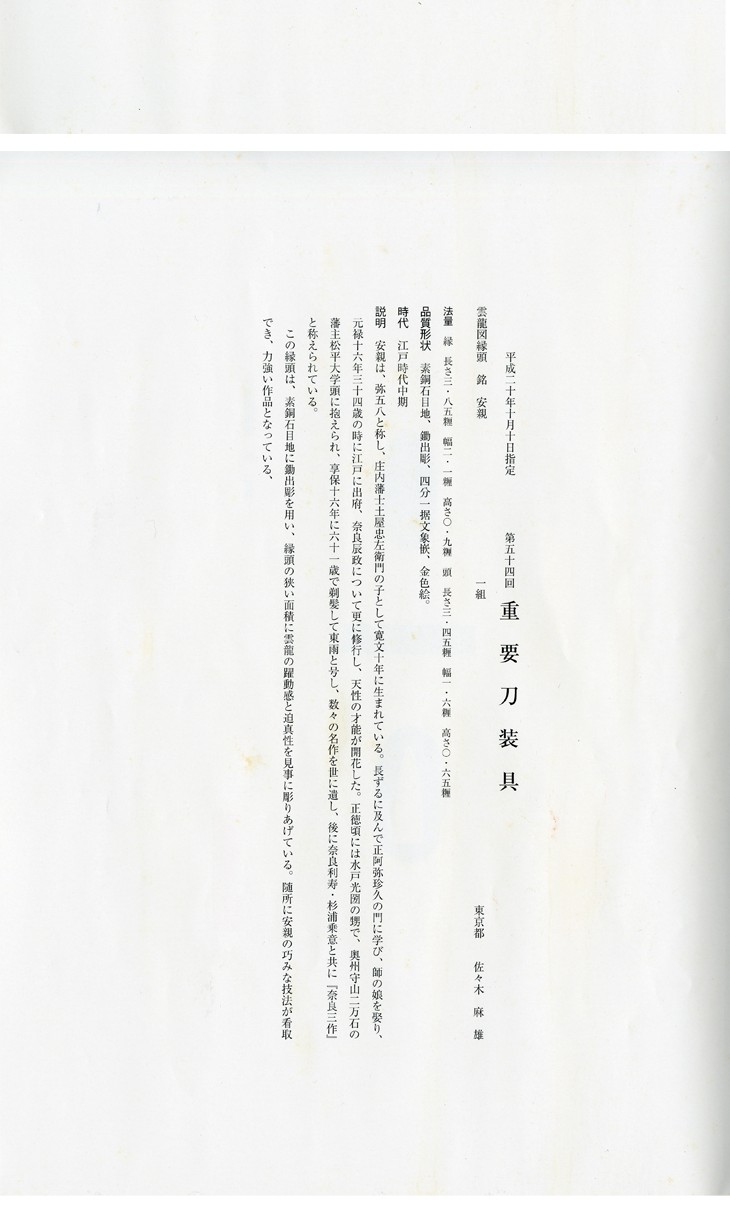
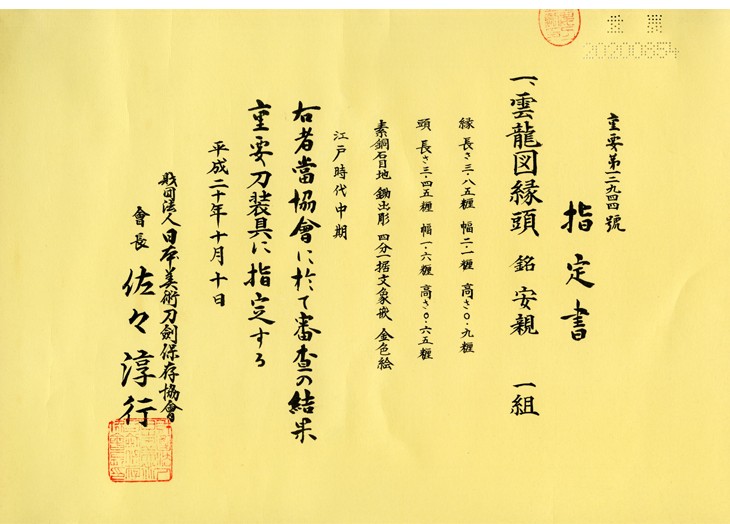
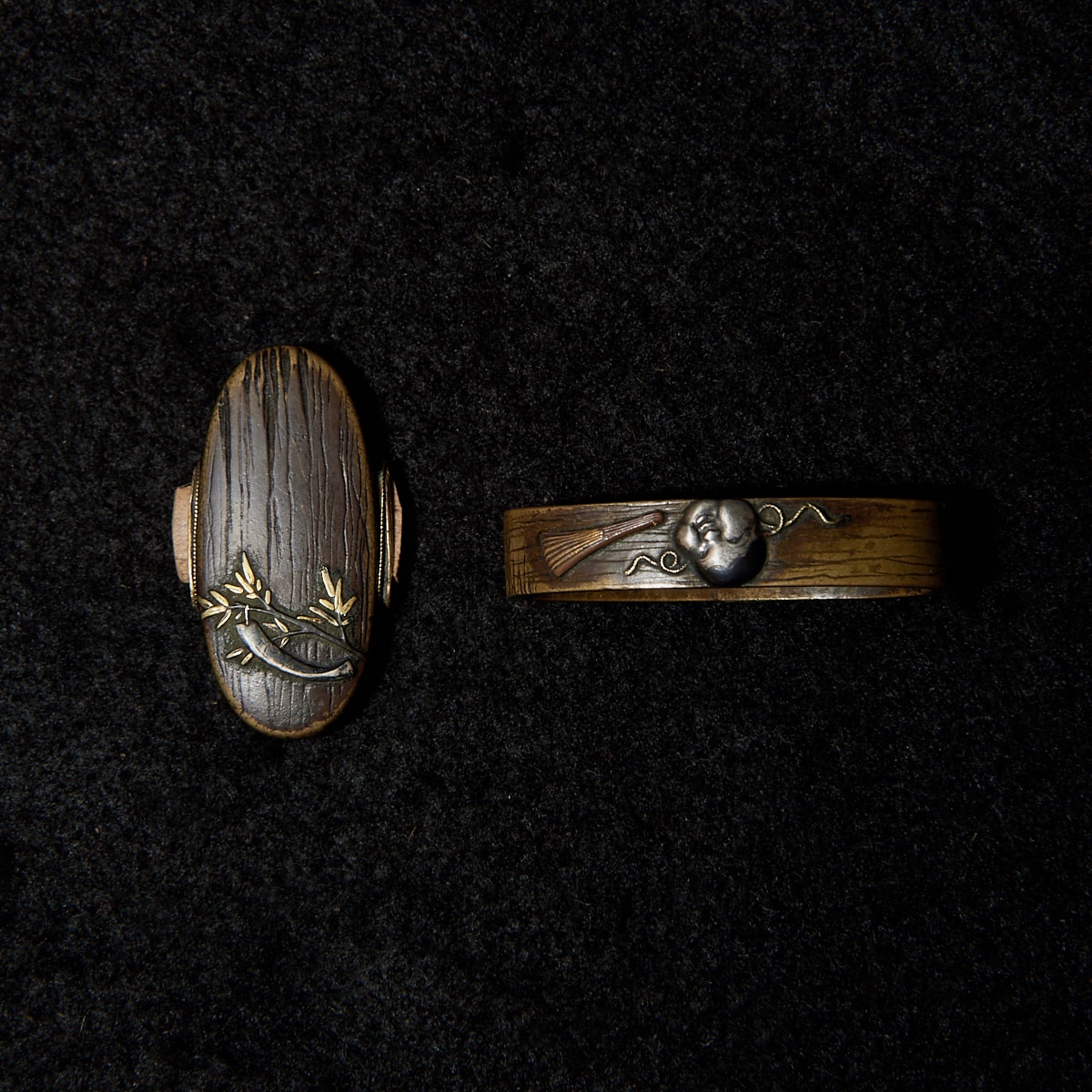
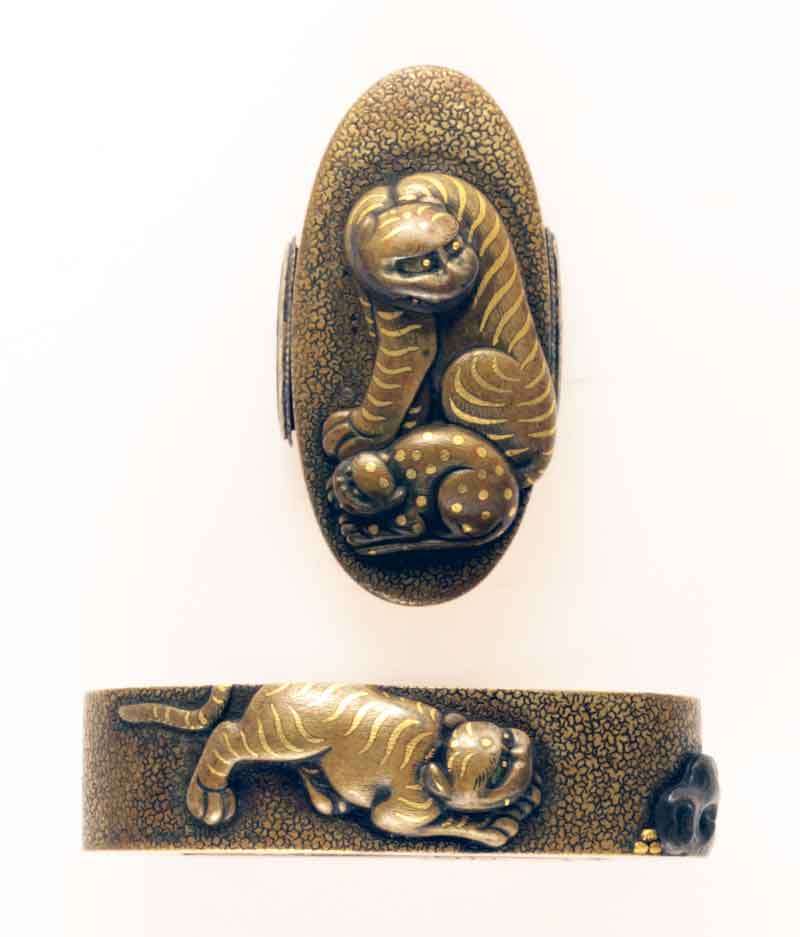
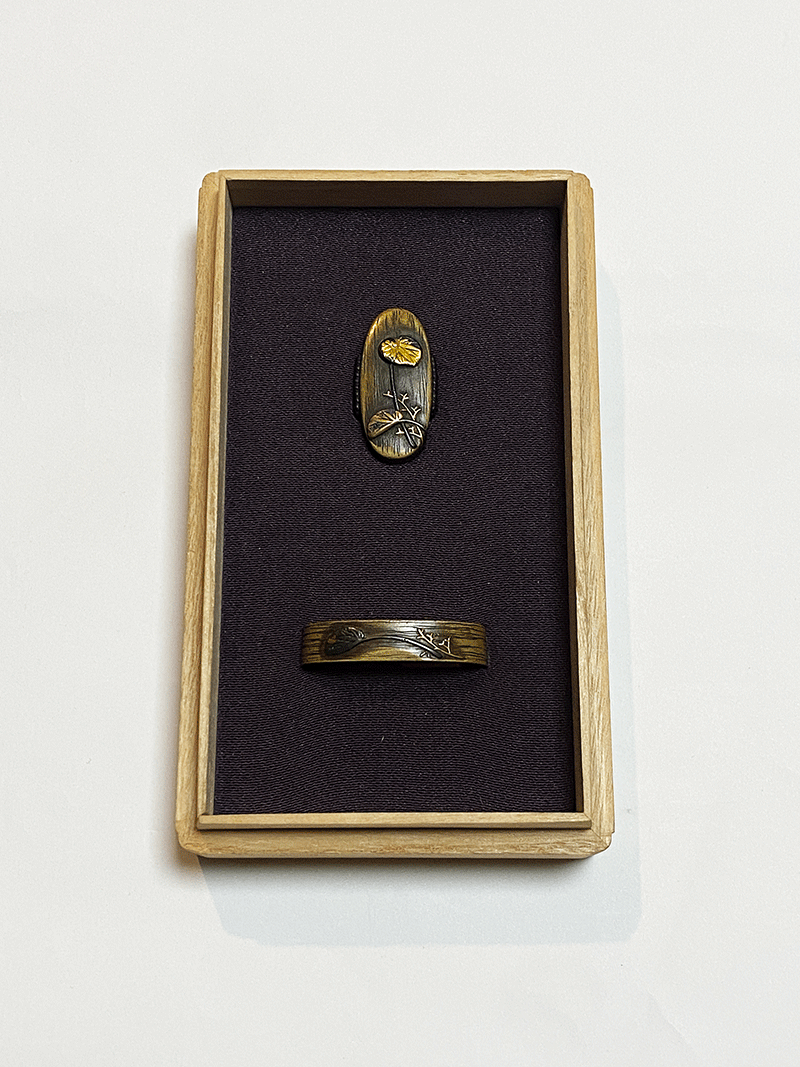
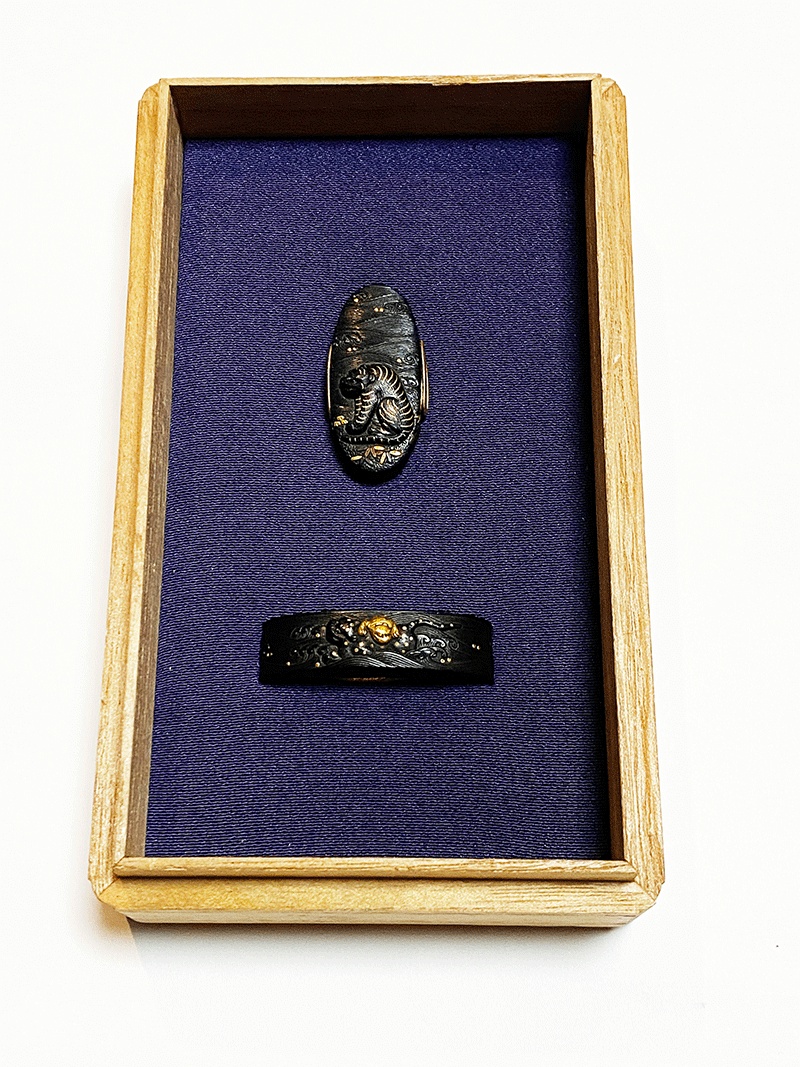
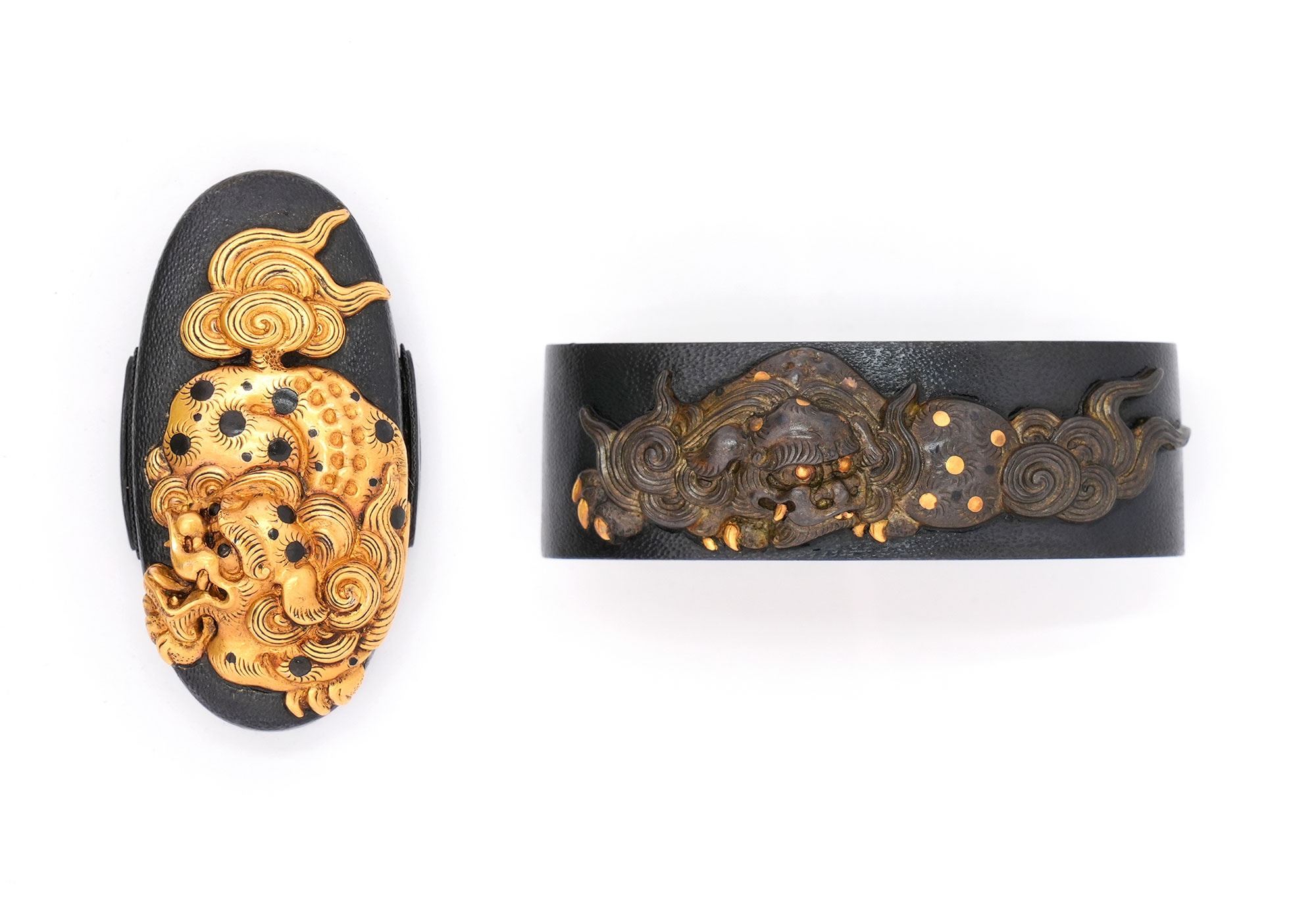
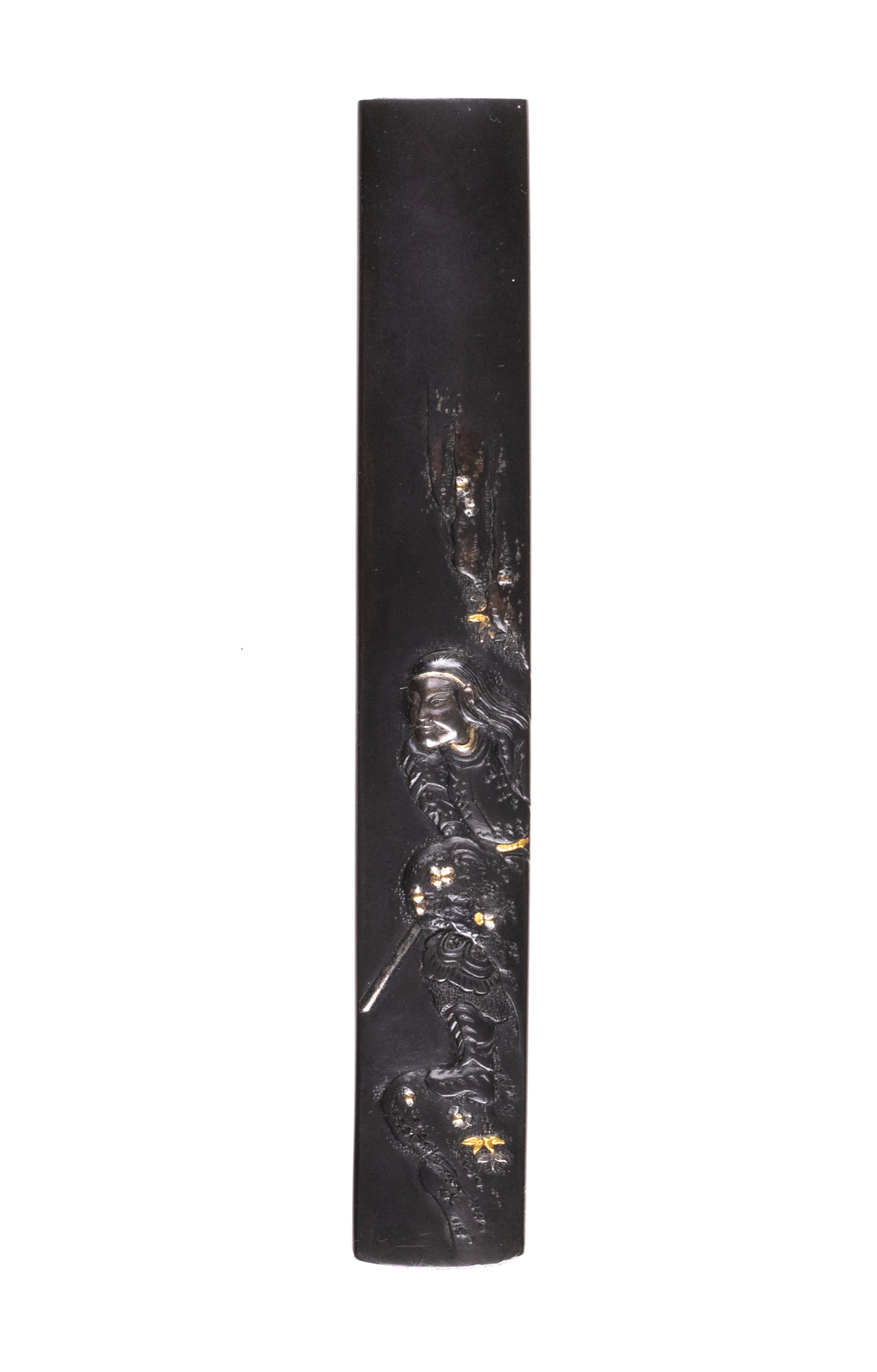
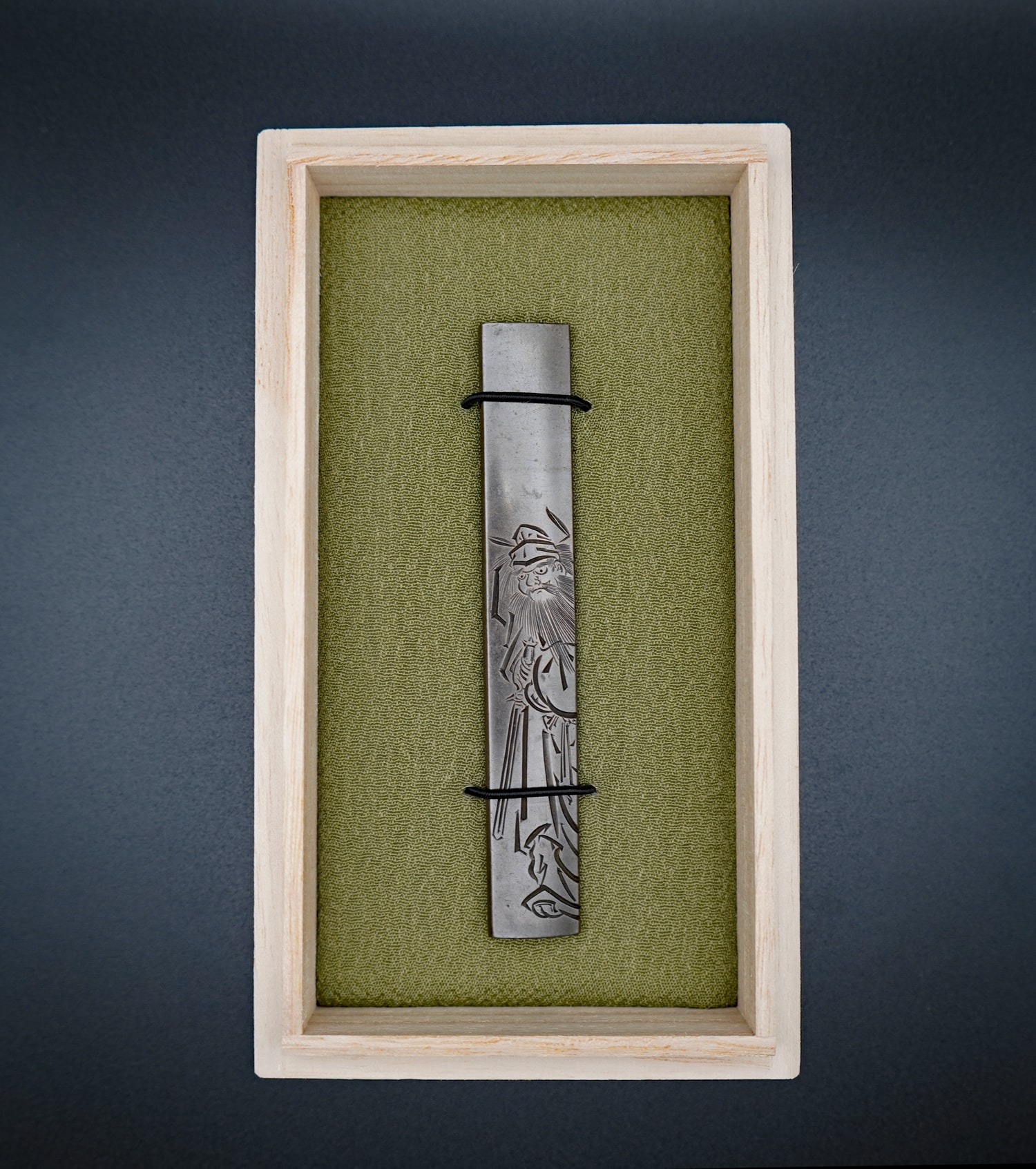
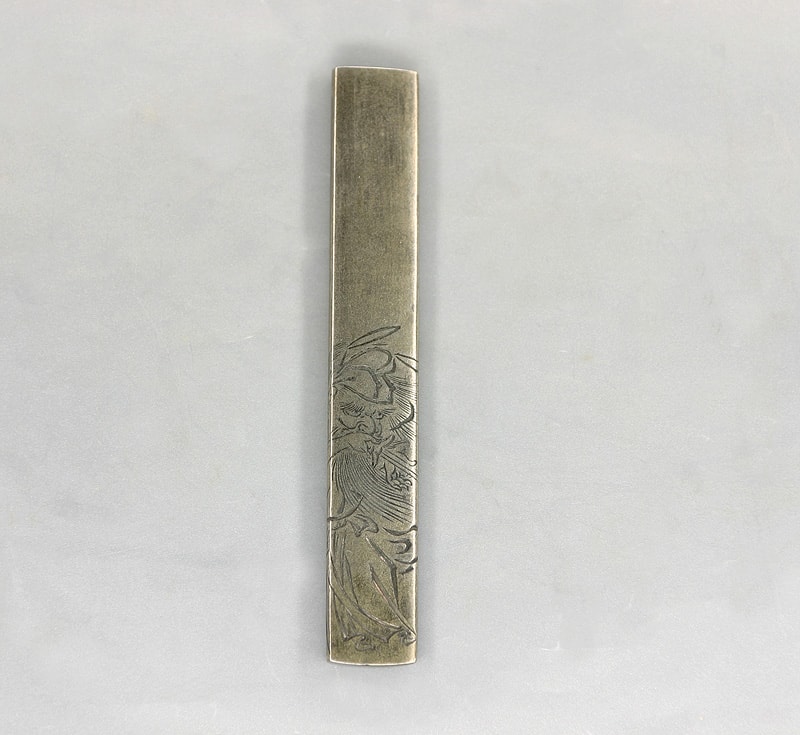
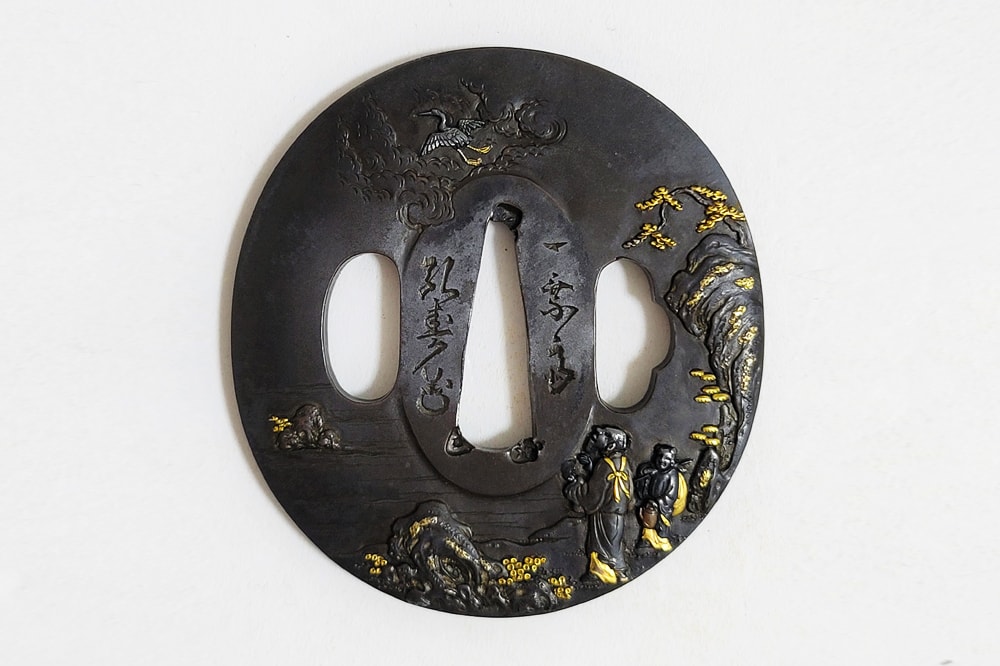
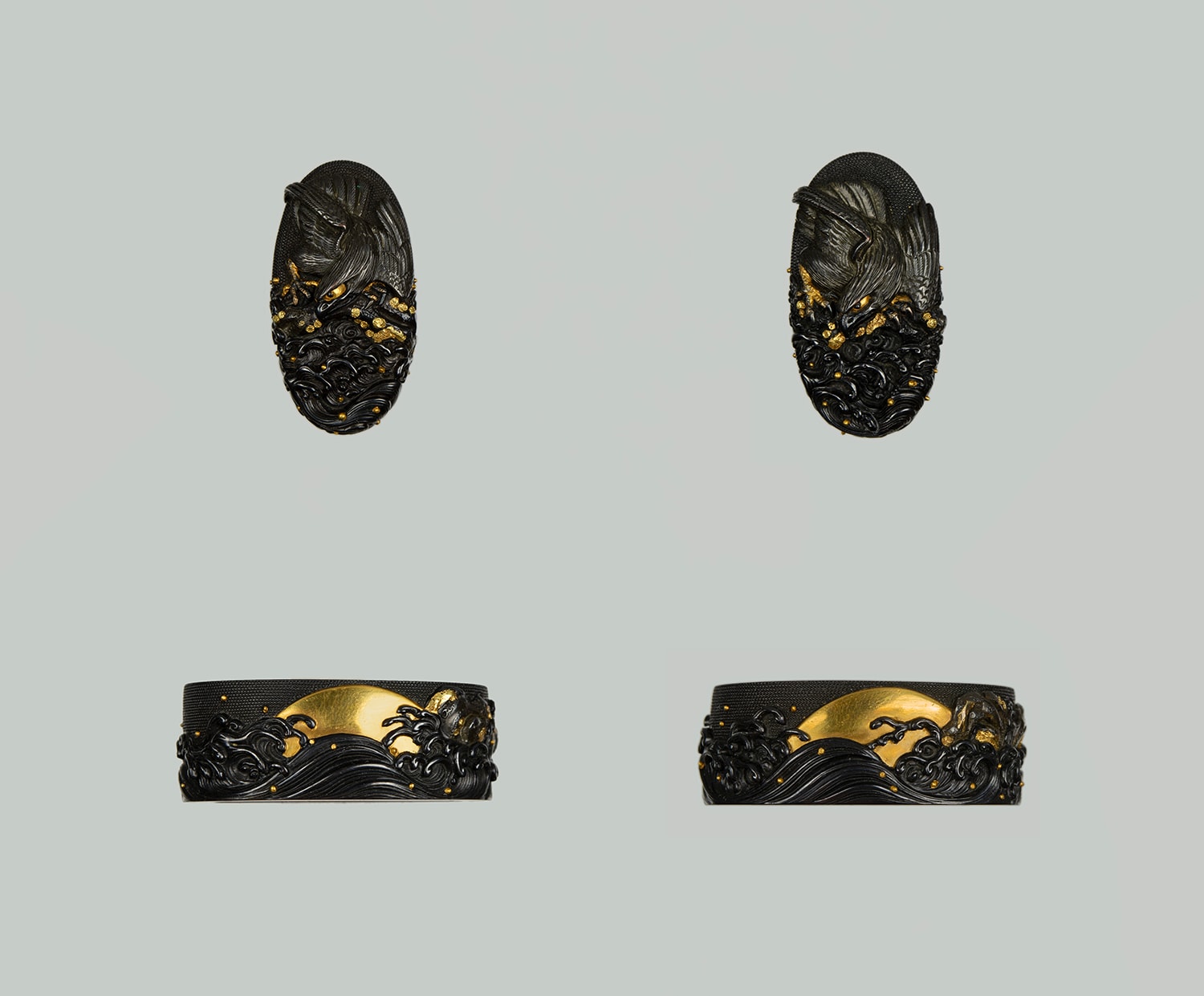
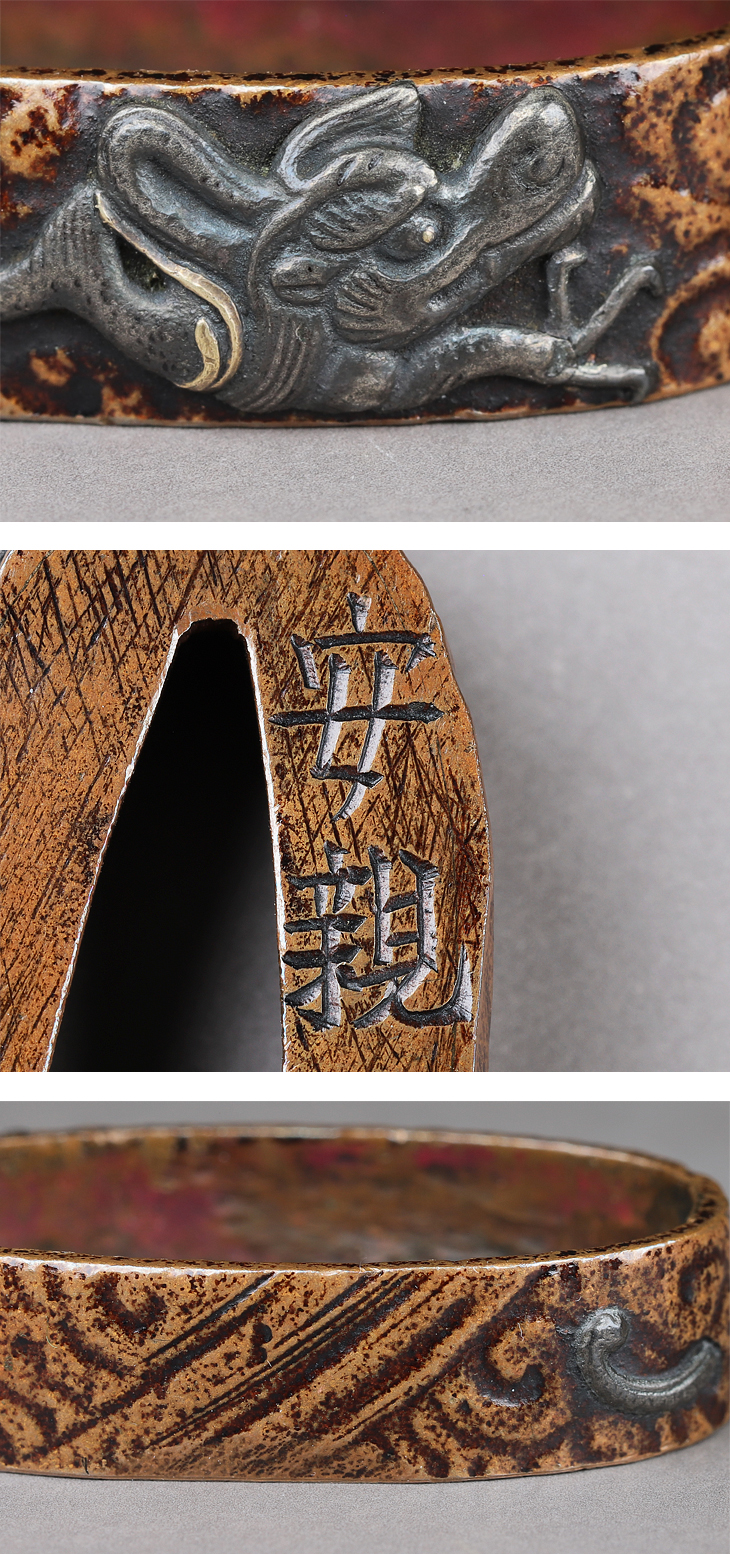
This is a Fuchigashira (collar and buttcap set) featuring a dynamic cloud dragon design (Unryu Zu) by the renowned Nara school master, Yasuchika. Crafted in the mid-Edo period, it is designated as a 54th session Juyo Tosogu. The piece showcases Yasuchika's skillful sukidashi-bori (relief carving) on a suaka-ishimeji (copper ground with stone-like texture) with shibuichi-sue-mon-zogan (inlaid crests in shibuichi) and kin-iroe (gold coloring).

NBTHK Setsumei

Jūyō-Koshirae, 54th Session — Designated October 10, 2008 Fuchi-kashira set, “Clouds and Dragon” design (雲龍図縁頭), signed Yasuchika (安親), one set Overall Description A vigorously carved fuchi-kashira set depicting a dragon amid swirling clouds, compact in scale yet imparting strong movement and immediacy. Components Fuchi-kashira: Suaka (so-dō) with ishime-ji ground; carved in sukidashi-bori; inlaid shibuichi details by suemon-zogan; with kin-iroe. Artisan/Origin Signed work of Nara Yasuchika (安親). Era Mid-Edo period. Explanation Yasuchika—also known as Yago-hachi—was born in Kanbun 10 (1670) as the son of Tsuchiya Chūzaemon, a retainer of the Shōnai domain. As he came of age, he studied under Shōami Chinku and married his master’s daughter. In Genroku 16 (1703), at the age of thirty-four, he went up to Edo. There he undertook further training under Nara Tatsumasa, at which point his innate talent fully blossomed. Around the Shōtoku era (1711–1716), he entered the service of Matsudaira Daigaku-no-kami, a nephew of Mito Mitsukuni and lord of a 20,000-koku fief at Moriyama in Ōshū. In Kyōhō 16 (1731), aged sixty-one, he took the tonsure and adopted the art name Tōu. He left numerous celebrated works to the world, and later—together with Nara Toshihisa and Sugiura Jōi—he was acclaimed as one of the “Three Great Masters of Nara” (Nara Sansaku). This fuchi-kashira employs sukidashi-bori on a suaka ishime-ji ground, and within the limited surface area of the fittings it superbly renders both the dynamic energy and the lifelike presence of a cloud-dragon. Throughout, one can discern Yasuchika’s deft command of technique, resulting in a forceful work.

NihontoWatch MonNihontoWatch
MarketAuctionsEncyclopedia
Fittings›Machibori›Nara›Yasuchika›Fuchigashira: Unryu Zu (Cloud Dragon Design)
fuchi-kashiraJūyō
Nara Yasuchika

Fuchigashira: Unryu Zu (Cloud Dragon Design)

mei · Nara · Edo

SOLD
Nara Yasuchika — 1 of 5
Nara Yasuchika — 2 of 5
Nara Yasuchika — 3 of 5
Nara Yasuchika — 4 of 5
Nara Yasuchika — 5 of 5
1 / 5
1 / 5
Nara Yasuchika — 1 of 5Nara Yasuchika — 2 of 5Nara Yasuchika — 3 of 5Nara Yasuchika — 4 of 5Nara Yasuchika — 5 of 5
Measurements & details
Smith

Nara

Era

Edo

Signature

Signed

Papers

Jūyō #54

Description

This is a Fuchigashira (collar and buttcap set) featuring a dynamic cloud dragon design (Unryu Zu) by the renowned Nara school master, Yasuchika. Crafted in the mid-Edo period, it is designated as a 54th session Juyo Tosogu. The piece showcases Yasuchika's skillful sukidashi-bori (relief carving) on a suaka-ishimeji (copper ground with stone-like texture) with shibuichi-sue-mon-zogan (inlaid crests in shibuichi) and kin-iroe (gold coloring).

NBTHK Zufu Commentary

Juyo #54

AI translation — may contain errors

-, 54th Session — Designated October 10, 2008

set, “Clouds and Dragon” design (雲龍図縁頭), signed Yasuchika (安親), one set

Overall Description A vigorously carved set depicting a dragon amid swirling clouds, compact in scale yet imparting strong movement and immediacy.

Components : (so-dō) with ground; carved in ; inlaid details by -; with .

Artisan/Origin Signed work of Nara Yasuchika (安親).

Era Mid- period.

Explanation Yasuchika—also known as —was born in 10 (1670) as the son of Tsuchiya Chūzaemon, a retainer of the Shōnai domain. As he came of age, he studied under Shōami Chinku and married his master’s daughter. In Genroku 16 (1703), at the age of thirty-four, he went up to . There he undertook further training under Nara Tatsumasa, at which point his innate talent fully blossomed.

Around the Shōtoku era (1711–1716), he entered the service of Matsudaira Daigaku-no-kami, a nephew of Mito Mitsukuni and lord of a 20,000- fief at Moriyama in Ōshū. In Kyōhō 16 (1731), aged sixty-one, he took the tonsure and adopted the art name Tōu. He left numerous celebrated works to the world, and later—together with Nara Toshihisa and Sugiura Jōi—he was acclaimed as one of the “Three Great Masters of Nara” (Nara Sansaku).

This employs on a ground, and within the limited surface area of the fittings it superbly renders both the dynamic energy and the lifelike presence of a cloud-dragon. Throughout, one can discern Yasuchika’s deft command of technique, resulting in a forceful work.

About the maker

Yasuchika

安親

Machibori · Edo

›

Tsuchiya Yasuchika (土屋安親), also known as Yagohachi, was born in Kanbun 10 (1670) as the son of Tsuchiya Chuzaemon, a retainer of the Shonai domain in Dewa Province. While still young he entered the school of Shoami Chinku, married his teacher's daughter, and in Genroku 16 (1703), at the age of thirty-four, went to Edo, where he undertook further training under Nara Tatsumasa — at which point, as the NBTHK setsumei consistently observe, "his innate talent fully blossomed." Around the Shotoku era he entered the service of Matsudaira Daigaku-no-kami, a nephew of Tokugawa Mitsukuni and lord of the twenty-thousand-koku Moriyama fief in Oshu. In Kyoho 16 (1731), at the age of sixty-one, he took the tonsure and adopted the art name Tou (東雨). He left numerous masterpieces to the world and was later celebrated — together with Nara Toshihisa and Sugiura Joi — as one of the "Three Masters of Nara" (Nara sansaku), recognized as an artist of the very highest ability.

Yasuchika's technical range is exceptional. His oeuvre encompasses work in iron, shakudo, shibuichi, brass (shinchu), and refined copper (suaka), with surfaces treated as polished grounds (migaki-ji), hammered textures (tsuchime-ji), and stone-grain finishes (ishime-ji). His signature carving methods include sukidashi-bori modeled relief, takabori high relief, the thread-fine line work of kebori, and — more rarely — the single-stroke katakiribori incision. Polychrome metal inlay (iroe) in gold, silver, shibuichi, and suaka is deployed with what the NBTHK describes as "an unrivaled equilibrium in compositional planning and in the exquisitely balanced placement of colored metals." His iron tsuba frequently employ the distinctive daigaku-gata form conceived for his patron, while his kozuka demonstrate the capacity to "draw forth a small universe" within a confined surface. In later works signed Tou, NBTHK examiners identify an austere, detached realm (kotan) — a shift from the vigorous pictorialism of his Edo-period maturity toward something "profoundly rich in nuance."

Across the designation records, certain evaluative themes recur with striking consistency. The NBTHK praises Yasuchika's "warm, humane sentiment" and "gentle humanism," visible in his treatment of figures such as Jurojin, Daruma, and the creatures that populate his compositions — faces rendered with "an unmistakable mildness," animals depicted so as to seem "almost alive." His narrative scenes are likened to hanging paintings (ichifuku no e), unfolding atmospheric effects "akin to watercolor." Whether rendering a carp amid turbulent waves, wild geese descending in rain, or Li Bai gazing at a waterfall, Yasuchika's compositions are praised for their "outstanding" interlinked design across front and back, their "free and untrammeled manner, calm and unforced," and a compositional intelligence in which "tension and relaxed release coexist." In subject, technique, and the sustained refinement of his carving, the setsumei affirm that his is an art in which, as one examiner concludes, "the sharpness of Yasuchika's skill is scattered throughout."[[c:2]]

Historical importance

Where Yasuchika stands among comparable artisans: across all of nihontō, and within tradition, era, and period. The tiers (Foremost · Leading · Major · Notable) weigh official designations from the NBTHK and Japan's Agency for Cultural Affairs, together with historical honors of lasting repute such as the Sansaku and Meibutsu-chō.

随一
Foremost
屈指
Leading
有数
Major
著名
Notable

Select a lens to see how it's measured.

Designation record
85 designated works
Jūyō Bunkazai
5
Jūyō Bijutsuhin
14
Tokubetsu Jūyō
9
Jūyō
57
Yasuchika — full profileMachibori school
About the school

Nara

奈良

Machibori · Edo

79 pieces on the market now

›

The Nara school of kinko (metalwork) emerged in the mid-Edo period as one of the most celebrated independent traditions of sword-fitting craftsmanship, its masters working outside the patronage structures that governed the Goto house. The school coalesced around the figure of Nara Toshihisa (1667--1736), also known as Tahee, who as head master during its creative zenith defined the mature idiom of the lineage. Learn more →

23 recorded smiths181 designated works
Leading smiths
SmithEraDesignated
Yasuchika安親—85
Joi乗意—12
Toshinaga利寿—28
Toshiyoshi利善—0
Shigechika重親—0
Explore the Nara school →
NBTHK Certificate
Jūyō Tōsōgu重要刀装具
Important Fitting
›

Exceptional craft of very high artistic value, judged to rank with a nationally recognized Important Art Object (Jūyō Bijutsuhin).

About the NBTHK›

The NBTHK (Nihon Bijutsu Tōken Hozon Kyōkai, the Society for the Preservation of Japanese Art Swords) is a public-interest incorporated foundation founded in 1948 and supervised by Japan’s Agency for Cultural Affairs (Bunkachō); it is based at the Japanese Sword Museum in Tokyo. Its expert panels physically examine each submitted work (shinsa) and issue a certificate (kanteishō) ranking it by artistic and historical merit. NBTHK papers are the most widely recognized standard of authentication for Japanese swords and fittings.

NBTHK official site→
Seller
S
Samurai Nippon
Established 1977 · 49 yrs on the market
🇯🇵Ships from Japan
›
✓Verified dealersamurai-nippon.net
✓Ships worldwide✓English supportWire transferPayPalCredit card
Return policy

For one-of-a-kind items such as swords, sword fittings, and antiques, please contact us about a return within 3 days of the item's arrival and ship it back within 8 days. Refunds are issued the same day the returned item arrives.

View all of Samurai Nippon’s listings→View this item on the dealer’s site→

Previously sold by Nara Yasuchika

Tsuruginoya
Tokuho
Fuchi-Kashira - Tokuho - by Nara Yasuchika - Fuchi-Kashira: YasuchikaFuchi-Kashira - Tokuho - by Nara Yasuchika - Fuchi-Kashira: Yasuchika
Sold

Fuchi-Kashira

ByNara Yasuchika
SOLD
Samurai Museum
Tsuba - by Nara Yasuchika - Edo period antique Daisho Tsuba Set for Samurai SwordTsuba - by Nara Yasuchika - Edo period antique Daisho Tsuba Set for Samurai Sword
Sold

Tsuba

ByNara Yasuchika
SOLD
Iida Koendo
Tokuho
Fuchi-Kashira - Tokuho - by Nara Yasuchika - Tokubetsu Hozon Tosogu: YasuchikaFuchi-Kashira - Tokuho - by Nara Yasuchika - Tokubetsu Hozon Tosogu: Yasuchika
Sold

Fuchi-Kashira

ByNara Yasuchika
SOLD
Iida Koendo
Tokuho
Fuchi-Kashira - Tokuho - by Nara Yasuchika - Fuchi-Kashira: Yasuchika - Tokubetsu Hozon TosoguFuchi-Kashira - Tokuho - by Nara Yasuchika - Fuchi-Kashira: Yasuchika - Tokubetsu Hozon Tosogu
Sold

Fuchi-Kashira

ByNara Yasuchika
SOLD

More from the Nara school

View all →
Choshuya
Tokuho
Fuchi-Kashira - Tokuho - by Hamano Shozui - Fuchi-Kashira: Ebisu & Daikoku Rusumoyo-zu, Signed ShozuiFuchi-Kashira - Tokuho - by Hamano Shozui - Fuchi-Kashira: Ebisu & Daikoku Rusumoyo-zu, Signed Shozui

Fuchi-Kashira

ByHamano Shozui
Ask
Connoisseur Arms
Jūyō
Tsuba - Jūyō - by Hamano Sekibun - Masterpiece Tsuba by Yurakusai SekibunTsuba - Jūyō - by Hamano Sekibun - Masterpiece Tsuba by Yurakusai Sekibun

Tsuba

ByHamano Sekibun
Ask
Samurai Nippon
Tokuho
Tsuba - Tokuho - by Hamano School - Kashorin ZuTsuba - Tokuho - by Hamano School - Kashorin Zu

Tsuba

ByHamano School
¥820,000
Toushin
Tokuho
Tsuba - Tokuho - by Nara Tsuneshige - Antoogu-zu Tsuba by Takeya TsuneshigeTsuba - Tokuho - by Nara Tsuneshige - Antoogu-zu Tsuba by Takeya Tsuneshige

Tsuba

ByNara Tsuneshige
¥660,000
Toushin
Tokuho
Kozuka - Tokuho - by Hamano Chikayuki - Fugen Bosatsu Design by ChikayukiKozuka - Tokuho - by Hamano Chikayuki - Fugen Bosatsu Design by Chikayuki

Kozuka

ByHamano Chikayuki
¥800,000
Nihontocraft
Tokuho
Fuchi-Kashira - Tokuho - by Hamano Hiroyuki - Fuchi Kashira: Hamano YasuyukiFuchi-Kashira - Tokuho - by Hamano Hiroyuki - Fuchi Kashira: Hamano Yasuyuki

Fuchi-Kashira

ByHamano Hiroyuki
¥2,900
Choshuya
Tokuho
Kozuka - Tokuho - by Hamano Sekibun - Kozuka with Hagoromo Design, Signed Yurakusai Sekibun (with Kao)Kozuka - Tokuho - by Hamano Sekibun - Kozuka with Hagoromo Design, Signed Yurakusai Sekibun (with Kao)

Kozuka

ByHamano Sekibun
Ask
Aoi Art
Hozon
Kozuka - Hozon - by Hamano Naoyasu - Shugodo NaoyasuKozuka - Hozon - by Hamano Naoyasu - Shugodo Naoyasu

Kozuka

ByHamano Naoyasu
¥85,000

More from the Machibori tradition

View all →
Nihontocraft
Jūyō
Fuchi-Kashira - Jūyō - by Omori Teruhide - Omori Eishu (Teruhide)Fuchi-Kashira - Jūyō - by Omori Teruhide - Omori Eishu (Teruhide)

Fuchi-Kashira

ByOmori Teruhide
¥55,000
Wakeidou
Tokuho
Tsuba - Tokuho - by Otsuki Tokuoki - Tokuoki (Shinoyama Tokuoki)Tsuba - Tokuho - by Otsuki Tokuoki - Tokuoki (Shinoyama Tokuoki)

Tsuba

ByOtsuki Tokuoki
¥700,000
Ginza Seikodo
Tokuho
Kozuka - Tokuho - by Yokoya Somin - Somin - Depiction of Shoki (Zhong Kui)Kozuka - Tokuho - by Yokoya Somin - Somin - Depiction of Shoki (Zhong Kui)

Kozuka

ByYokoya Somin
¥1,500,000
Wakeidou
Hozon
Fuchi-Kashira - Hozon - by Omori Hidetomo - Fuchi-Kashira: Hidetoshi (Kao) - Sunrise Sailboat DesignFuchi-Kashira - Hozon - by Omori Hidetomo - Fuchi-Kashira: Hidetoshi (Kao) - Sunrise Sailboat Design

Fuchi-Kashira

ByOmori Hidetomo
¥480,000
Choshuya
Hozon
Kozuka - Hozon - by Yokoya School - Kozuka with Kinuta (Fulling Block) Design, Signed Riuzai Minkoku (Kao)Kozuka - Hozon - by Yokoya School - Kozuka with Kinuta (Fulling Block) Design, Signed Riuzai Minkoku (Kao)

Kozuka

ByYokoya School
¥300,000
Ginza Seikodo
Jūyō
Menuki - Jūyō - by Omori Chizuka Hisanori - Split Tanzaku Signature Hisanori (kao) Hen and Chicks MotifMenuki - Jūyō - by Omori Chizuka Hisanori - Split Tanzaku Signature Hisanori (kao) Hen and Chicks Motif

Menuki

ByOmori Chizuka Hisanori
Ask
Choshuya
Tokuho
Tsuba - Tokuho - by Otsuki School - Big Dipper Design, Signed Shokatei Mototsune (Kao)Tsuba - Tokuho - by Otsuki School - Big Dipper Design, Signed Shokatei Mototsune (Kao)

Tsuba

ByOtsuki School
¥450,000
Samurai Nippon
Tokubetsu Kichō
Kozuka - Tokubetsu Kichō - by Otsuki Mitsuhiro - Wave and Plover DesignKozuka - Tokubetsu Kichō - by Otsuki Mitsuhiro - Wave and Plover Design

Kozuka

ByOtsuki Mitsuhiro
¥85,000

Swords

  • Katana
  • Wakizashi
  • Tantō
  • Tachi
  • Naginata
  • Yari

Fittings

  • Tsuba
  • Fuchi-Kashira
  • Kozuka
  • Menuki

By Certification

  • Tokujū
  • Jūyō
  • Tokuho
  • Hozon

Resources

  • Dealer Directory
  • Artist Directory
  • Glossary
  • Browse All
Nihontowatch© 2026
TermsPrivacyCookiesAbout

Description

This is a Fuchigashira (collar and buttcap set) featuring a dynamic cloud dragon design (Unryu Zu) by the renowned Nara school master, Yasuchika. Crafted in the mid-Edo period, it is designated as a 54th session Juyo Tosogu. The piece showcases Yasuchika's skillful sukidashi-bori (relief carving) on a suaka-ishimeji (copper ground with stone-like texture) with shibuichi-sue-mon-zogan (inlaid crests in shibuichi) and kin-iroe (gold coloring).

NBTHK Setsumei

Jūyō-Koshirae, 54th Session — Designated October 10, 2008 Fuchi-kashira set, “Clouds and Dragon” design (雲龍図縁頭), signed Yasuchika (安親), one set Overall Description A vigorously carved fuchi-kashira set depicting a dragon amid swirling clouds, compact in scale yet imparting strong movement and immediacy. Components Fuchi-kashira: Suaka (so-dō) with ishime-ji ground; carved in sukidashi-bori; inlaid shibuichi details by suemon-zogan; with kin-iroe. Artisan/Origin Signed work of Nara Yasuchika (安親). Era Mid-Edo period. Explanation Yasuchika—also known as Yago-hachi—was born in Kanbun 10 (1670) as the son of Tsuchiya Chūzaemon, a retainer of the Shōnai domain. As he came of age, he studied under Shōami Chinku and married his master’s daughter. In Genroku 16 (1703), at the age of thirty-four, he went up to Edo. There he undertook further training under Nara Tatsumasa, at which point his innate talent fully blossomed. Around the Shōtoku era (1711–1716), he entered the service of Matsudaira Daigaku-no-kami, a nephew of Mito Mitsukuni and lord of a 20,000-koku fief at Moriyama in Ōshū. In Kyōhō 16 (1731), aged sixty-one, he took the tonsure and adopted the art name Tōu. He left numerous celebrated works to the world, and later—together with Nara Toshihisa and Sugiura Jōi—he was acclaimed as one of the “Three Great Masters of Nara” (Nara Sansaku). This fuchi-kashira employs sukidashi-bori on a suaka ishime-ji ground, and within the limited surface area of the fittings it superbly renders both the dynamic energy and the lifelike presence of a cloud-dragon. Throughout, one can discern Yasuchika’s deft command of technique, resulting in a forceful work.

NihontoWatch MonNihontoWatch
MarketAuctionsEncyclopedia
Fittings›Machibori›Nara›Yasuchika›Fuchigashira: Unryu Zu (Cloud Dragon Design)
fuchi-kashiraJūyō
Nara Yasuchika

Fuchigashira: Unryu Zu (Cloud Dragon Design)

mei · Nara · Edo

SOLD
Nara Yasuchika — 1 of 5
Nara Yasuchika — 2 of 5
Nara Yasuchika — 3 of 5
Nara Yasuchika — 4 of 5
Nara Yasuchika — 5 of 5
1 / 5
1 / 5
Nara Yasuchika — 1 of 5Nara Yasuchika — 2 of 5Nara Yasuchika — 3 of 5Nara Yasuchika — 4 of 5Nara Yasuchika — 5 of 5
Measurements & details
Smith

Nara

Era

Edo

Signature

Signed

Papers

Jūyō #54

Description

This is a Fuchigashira (collar and buttcap set) featuring a dynamic cloud dragon design (Unryu Zu) by the renowned Nara school master, Yasuchika. Crafted in the mid-Edo period, it is designated as a 54th session Juyo Tosogu. The piece showcases Yasuchika's skillful sukidashi-bori (relief carving) on a suaka-ishimeji (copper ground with stone-like texture) with shibuichi-sue-mon-zogan (inlaid crests in shibuichi) and kin-iroe (gold coloring).

NBTHK Zufu Commentary

Juyo #54

AI translation — may contain errors

-, 54th Session — Designated October 10, 2008

set, “Clouds and Dragon” design (雲龍図縁頭), signed Yasuchika (安親), one set

Overall Description A vigorously carved set depicting a dragon amid swirling clouds, compact in scale yet imparting strong movement and immediacy.

Components : (so-dō) with ground; carved in ; inlaid details by -; with .

Artisan/Origin Signed work of Nara Yasuchika (安親).

Era Mid- period.

Explanation Yasuchika—also known as —was born in 10 (1670) as the son of Tsuchiya Chūzaemon, a retainer of the Shōnai domain. As he came of age, he studied under Shōami Chinku and married his master’s daughter. In Genroku 16 (1703), at the age of thirty-four, he went up to . There he undertook further training under Nara Tatsumasa, at which point his innate talent fully blossomed.

Around the Shōtoku era (1711–1716), he entered the service of Matsudaira Daigaku-no-kami, a nephew of Mito Mitsukuni and lord of a 20,000- fief at Moriyama in Ōshū. In Kyōhō 16 (1731), aged sixty-one, he took the tonsure and adopted the art name Tōu. He left numerous celebrated works to the world, and later—together with Nara Toshihisa and Sugiura Jōi—he was acclaimed as one of the “Three Great Masters of Nara” (Nara Sansaku).

This employs on a ground, and within the limited surface area of the fittings it superbly renders both the dynamic energy and the lifelike presence of a cloud-dragon. Throughout, one can discern Yasuchika’s deft command of technique, resulting in a forceful work.

About the maker

Yasuchika

安親

Machibori · Edo

›

Tsuchiya Yasuchika (土屋安親), also known as Yagohachi, was born in Kanbun 10 (1670) as the son of Tsuchiya Chuzaemon, a retainer of the Shonai domain in Dewa Province. While still young he entered the school of Shoami Chinku, married his teacher's daughter, and in Genroku 16 (1703), at the age of thirty-four, went to Edo, where he undertook further training under Nara Tatsumasa — at which point, as the NBTHK setsumei consistently observe, "his innate talent fully blossomed." Around the Shotoku era he entered the service of Matsudaira Daigaku-no-kami, a nephew of Tokugawa Mitsukuni and lord of the twenty-thousand-koku Moriyama fief in Oshu. In Kyoho 16 (1731), at the age of sixty-one, he took the tonsure and adopted the art name Tou (東雨). He left numerous masterpieces to the world and was later celebrated — together with Nara Toshihisa and Sugiura Joi — as one of the "Three Masters of Nara" (Nara sansaku), recognized as an artist of the very highest ability.

Yasuchika's technical range is exceptional. His oeuvre encompasses work in iron, shakudo, shibuichi, brass (shinchu), and refined copper (suaka), with surfaces treated as polished grounds (migaki-ji), hammered textures (tsuchime-ji), and stone-grain finishes (ishime-ji). His signature carving methods include sukidashi-bori modeled relief, takabori high relief, the thread-fine line work of kebori, and — more rarely — the single-stroke katakiribori incision. Polychrome metal inlay (iroe) in gold, silver, shibuichi, and suaka is deployed with what the NBTHK describes as "an unrivaled equilibrium in compositional planning and in the exquisitely balanced placement of colored metals." His iron tsuba frequently employ the distinctive daigaku-gata form conceived for his patron, while his kozuka demonstrate the capacity to "draw forth a small universe" within a confined surface. In later works signed Tou, NBTHK examiners identify an austere, detached realm (kotan) — a shift from the vigorous pictorialism of his Edo-period maturity toward something "profoundly rich in nuance."

Across the designation records, certain evaluative themes recur with striking consistency. The NBTHK praises Yasuchika's "warm, humane sentiment" and "gentle humanism," visible in his treatment of figures such as Jurojin, Daruma, and the creatures that populate his compositions — faces rendered with "an unmistakable mildness," animals depicted so as to seem "almost alive." His narrative scenes are likened to hanging paintings (ichifuku no e), unfolding atmospheric effects "akin to watercolor." Whether rendering a carp amid turbulent waves, wild geese descending in rain, or Li Bai gazing at a waterfall, Yasuchika's compositions are praised for their "outstanding" interlinked design across front and back, their "free and untrammeled manner, calm and unforced," and a compositional intelligence in which "tension and relaxed release coexist." In subject, technique, and the sustained refinement of his carving, the setsumei affirm that his is an art in which, as one examiner concludes, "the sharpness of Yasuchika's skill is scattered throughout."[[c:2]]
Historical importance

Where Yasuchika stands among comparable artisans: across all of nihontō, and within tradition, era, and period. The tiers (Foremost · Leading · Major · Notable) weigh official designations from the NBTHK and Japan's Agency for Cultural Affairs, together with historical honors of lasting repute such as the Sansaku and Meibutsu-chō.

随一
Foremost
屈指
Leading
有数
Major
著名
Notable

Select a lens to see how it's measured.

Designation record
85 designated works
Jūyō Bunkazai
5
Jūyō Bijutsuhin
14
Tokubetsu Jūyō
9
Jūyō
57
Yasuchika — full profileMachibori school
About the school

Nara

奈良

Machibori · Edo

79 pieces on the market now

›

The Nara school of kinko (metalwork) emerged in the mid-Edo period as one of the most celebrated independent traditions of sword-fitting craftsmanship, its masters working outside the patronage structures that governed the Goto house. The school coalesced around the figure of Nara Toshihisa (1667--1736), also known as Tahee, who as head master during its creative zenith defined the mature idiom of the lineage. Learn more →

23 recorded smiths181 designated works
Leading smiths
SmithEraDesignated
Yasuchika安親—85
Joi乗意—12
Toshinaga利寿—28
Toshiyoshi利善—0
Shigechika重親—0
Explore the Nara school →
NBTHK Certificate
Jūyō Tōsōgu重要刀装具
Important Fitting
›

Exceptional craft of very high artistic value, judged to rank with a nationally recognized Important Art Object (Jūyō Bijutsuhin).

About the NBTHK›

The NBTHK (Nihon Bijutsu Tōken Hozon Kyōkai, the Society for the Preservation of Japanese Art Swords) is a public-interest incorporated foundation founded in 1948 and supervised by Japan’s Agency for Cultural Affairs (Bunkachō); it is based at the Japanese Sword Museum in Tokyo. Its expert panels physically examine each submitted work (shinsa) and issue a certificate (kanteishō) ranking it by artistic and historical merit. NBTHK papers are the most widely recognized standard of authentication for Japanese swords and fittings.

NBTHK official site→
Seller
S
Samurai Nippon
Established 1977 · 49 yrs on the market
🇯🇵Ships from Japan
›
✓Verified dealersamurai-nippon.net
✓Ships worldwide✓English supportWire transferPayPalCredit card
Return policy

For one-of-a-kind items such as swords, sword fittings, and antiques, please contact us about a return within 3 days of the item's arrival and ship it back within 8 days. Refunds are issued the same day the returned item arrives.

View all of Samurai Nippon’s listings→View this item on the dealer’s site→

Previously sold by Nara Yasuchika

Tsuruginoya
Tokuho
Fuchi-Kashira - Tokuho - by Nara Yasuchika - Fuchi-Kashira: YasuchikaFuchi-Kashira - Tokuho - by Nara Yasuchika - Fuchi-Kashira: Yasuchika
Sold

Fuchi-Kashira

ByNara Yasuchika
SOLD
Samurai Museum
Tsuba - by Nara Yasuchika - Edo period antique Daisho Tsuba Set for Samurai SwordTsuba - by Nara Yasuchika - Edo period antique Daisho Tsuba Set for Samurai Sword
Sold

Tsuba

ByNara Yasuchika
SOLD
Iida Koendo
Tokuho
Fuchi-Kashira - Tokuho - by Nara Yasuchika - Tokubetsu Hozon Tosogu: YasuchikaFuchi-Kashira - Tokuho - by Nara Yasuchika - Tokubetsu Hozon Tosogu: Yasuchika
Sold

Fuchi-Kashira

ByNara Yasuchika
SOLD
Iida Koendo
Tokuho
Fuchi-Kashira - Tokuho - by Nara Yasuchika - Fuchi-Kashira: Yasuchika - Tokubetsu Hozon TosoguFuchi-Kashira - Tokuho - by Nara Yasuchika - Fuchi-Kashira: Yasuchika - Tokubetsu Hozon Tosogu
Sold

Fuchi-Kashira

ByNara Yasuchika
SOLD

More from the Nara school

View all →
Choshuya
Tokuho
Fuchi-Kashira - Tokuho - by Hamano Shozui - Fuchi-Kashira: Ebisu & Daikoku Rusumoyo-zu, Signed ShozuiFuchi-Kashira - Tokuho - by Hamano Shozui - Fuchi-Kashira: Ebisu & Daikoku Rusumoyo-zu, Signed Shozui

Fuchi-Kashira

ByHamano Shozui
Ask
Connoisseur Arms
Jūyō
Tsuba - Jūyō - by Hamano Sekibun - Masterpiece Tsuba by Yurakusai SekibunTsuba - Jūyō - by Hamano Sekibun - Masterpiece Tsuba by Yurakusai Sekibun

Tsuba

ByHamano Sekibun
Ask
Samurai Nippon
Tokuho
Tsuba - Tokuho - by Hamano School - Kashorin ZuTsuba - Tokuho - by Hamano School - Kashorin Zu

Tsuba

ByHamano School
¥820,000
Toushin
Tokuho
Tsuba - Tokuho - by Nara Tsuneshige - Antoogu-zu Tsuba by Takeya TsuneshigeTsuba - Tokuho - by Nara Tsuneshige - Antoogu-zu Tsuba by Takeya Tsuneshige

Tsuba

ByNara Tsuneshige
¥660,000
Toushin
Tokuho
Kozuka - Tokuho - by Hamano Chikayuki - Fugen Bosatsu Design by ChikayukiKozuka - Tokuho - by Hamano Chikayuki - Fugen Bosatsu Design by Chikayuki

Kozuka

ByHamano Chikayuki
¥800,000
Nihontocraft
Tokuho
Fuchi-Kashira - Tokuho - by Hamano Hiroyuki - Fuchi Kashira: Hamano YasuyukiFuchi-Kashira - Tokuho - by Hamano Hiroyuki - Fuchi Kashira: Hamano Yasuyuki

Fuchi-Kashira

ByHamano Hiroyuki
¥2,900
Choshuya
Tokuho
Kozuka - Tokuho - by Hamano Sekibun - Kozuka with Hagoromo Design, Signed Yurakusai Sekibun (with Kao)Kozuka - Tokuho - by Hamano Sekibun - Kozuka with Hagoromo Design, Signed Yurakusai Sekibun (with Kao)

Kozuka

ByHamano Sekibun
Ask
Aoi Art
Hozon
Kozuka - Hozon - by Hamano Naoyasu - Shugodo NaoyasuKozuka - Hozon - by Hamano Naoyasu - Shugodo Naoyasu

Kozuka

ByHamano Naoyasu
¥85,000

More from the Machibori tradition

View all →
Nihontocraft
Jūyō
Fuchi-Kashira - Jūyō - by Omori Teruhide - Omori Eishu (Teruhide)Fuchi-Kashira - Jūyō - by Omori Teruhide - Omori Eishu (Teruhide)

Fuchi-Kashira

ByOmori Teruhide
¥55,000
Wakeidou
Tokuho
Tsuba - Tokuho - by Otsuki Tokuoki - Tokuoki (Shinoyama Tokuoki)Tsuba - Tokuho - by Otsuki Tokuoki - Tokuoki (Shinoyama Tokuoki)

Tsuba

ByOtsuki Tokuoki
¥700,000
Ginza Seikodo
Tokuho
Kozuka - Tokuho - by Yokoya Somin - Somin - Depiction of Shoki (Zhong Kui)Kozuka - Tokuho - by Yokoya Somin - Somin - Depiction of Shoki (Zhong Kui)

Kozuka

ByYokoya Somin
¥1,500,000
Wakeidou
Hozon
Fuchi-Kashira - Hozon - by Omori Hidetomo - Fuchi-Kashira: Hidetoshi (Kao) - Sunrise Sailboat DesignFuchi-Kashira - Hozon - by Omori Hidetomo - Fuchi-Kashira: Hidetoshi (Kao) - Sunrise Sailboat Design

Fuchi-Kashira

ByOmori Hidetomo
¥480,000
Choshuya
Hozon
Kozuka - Hozon - by Yokoya School - Kozuka with Kinuta (Fulling Block) Design, Signed Riuzai Minkoku (Kao)Kozuka - Hozon - by Yokoya School - Kozuka with Kinuta (Fulling Block) Design, Signed Riuzai Minkoku (Kao)

Kozuka

ByYokoya School
¥300,000
Ginza Seikodo
Jūyō
Menuki - Jūyō - by Omori Chizuka Hisanori - Split Tanzaku Signature Hisanori (kao) Hen and Chicks MotifMenuki - Jūyō - by Omori Chizuka Hisanori - Split Tanzaku Signature Hisanori (kao) Hen and Chicks Motif

Menuki

ByOmori Chizuka Hisanori
Ask
Choshuya
Tokuho
Tsuba - Tokuho - by Otsuki School - Big Dipper Design, Signed Shokatei Mototsune (Kao)Tsuba - Tokuho - by Otsuki School - Big Dipper Design, Signed Shokatei Mototsune (Kao)

Tsuba

ByOtsuki School
¥450,000
Samurai Nippon
Tokubetsu Kichō
Kozuka - Tokubetsu Kichō - by Otsuki Mitsuhiro - Wave and Plover DesignKozuka - Tokubetsu Kichō - by Otsuki Mitsuhiro - Wave and Plover Design

Kozuka

ByOtsuki Mitsuhiro
¥85,000

Swords

  • Katana
  • Wakizashi
  • Tantō
  • Tachi
  • Naginata
  • Yari

Fittings

  • Tsuba
  • Fuchi-Kashira
  • Kozuka
  • Menuki

By Certification

  • Tokujū
  • Jūyō
  • Tokuho
  • Hozon

Resources

  • Dealer Directory
  • Artist Directory
  • Glossary
  • Browse All
Nihontowatch© 2026
TermsPrivacyCookiesAbout
NihontoWatch Mon

NihontoWatch

MarketAuctions
Encyclopedia
NihontoWatch Mon

NihontoWatch

MarketAuctions
Encyclopedia