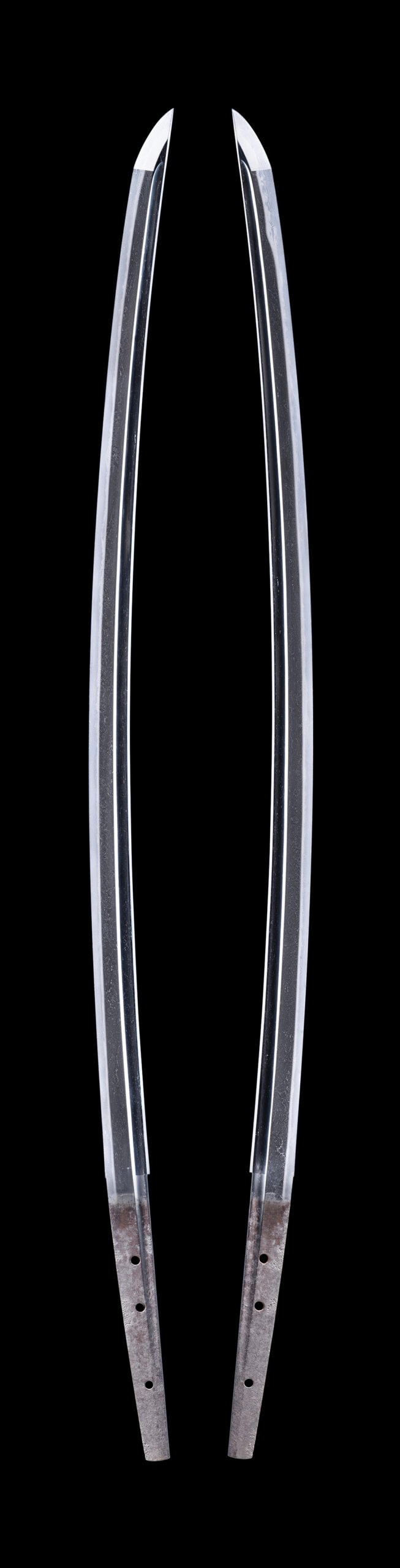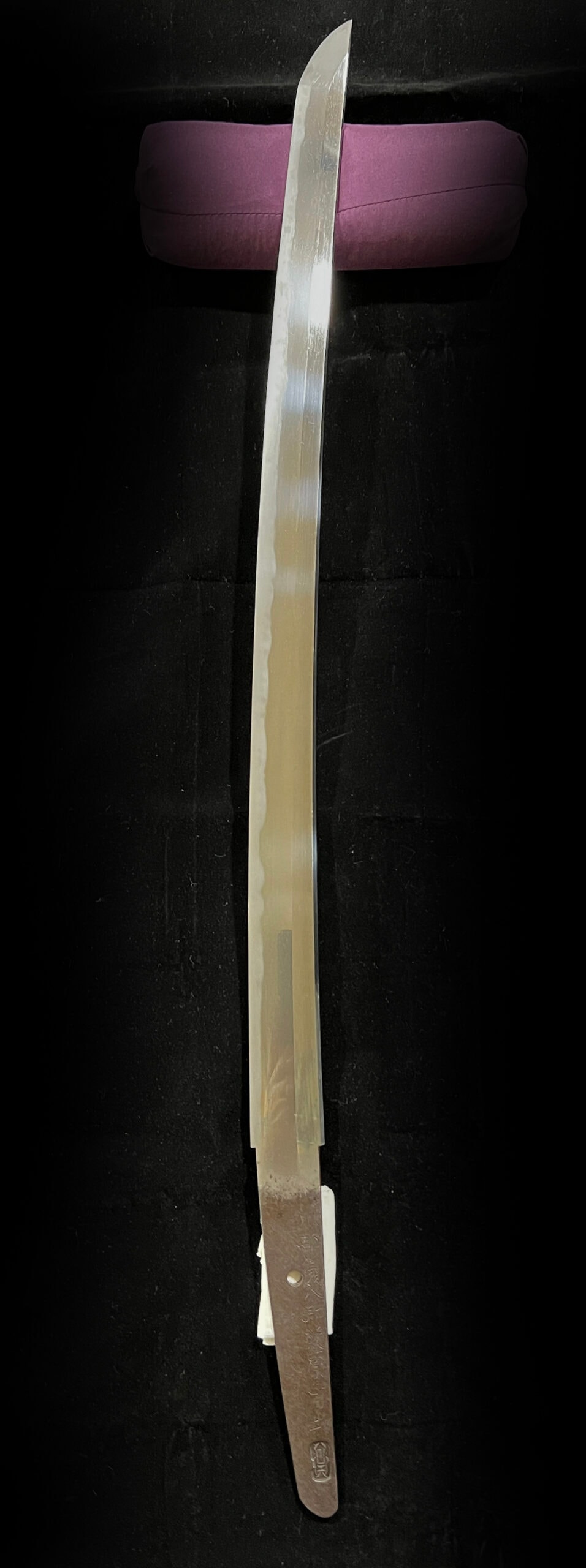
-, 46th Session — Designated October 5, 2000
, : school (延寿)
Measurements 69.85 cm, 1.8 cm, 3.05 cm, 1.95 cm, 3.25 cm, 18.4 cm
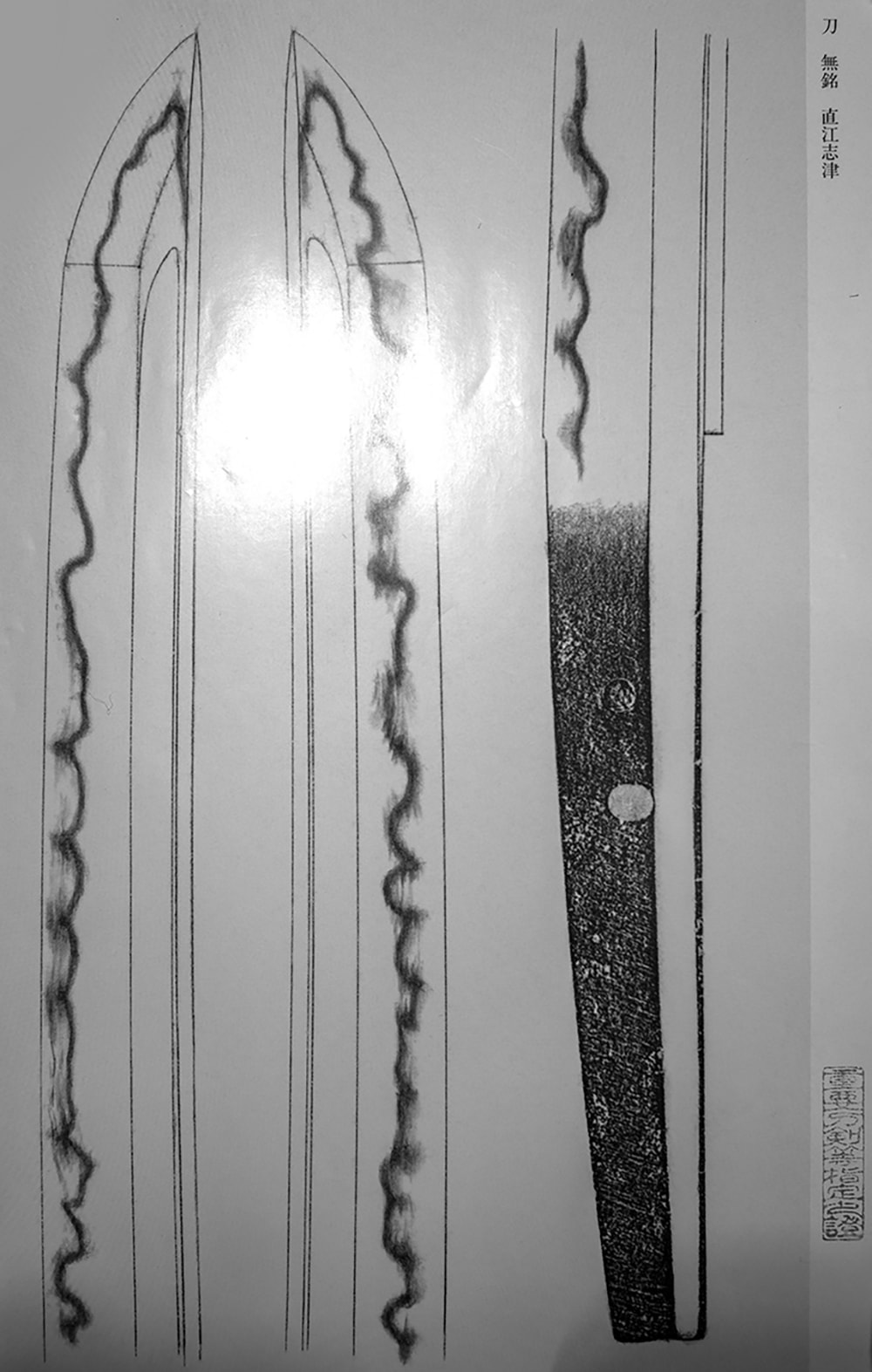
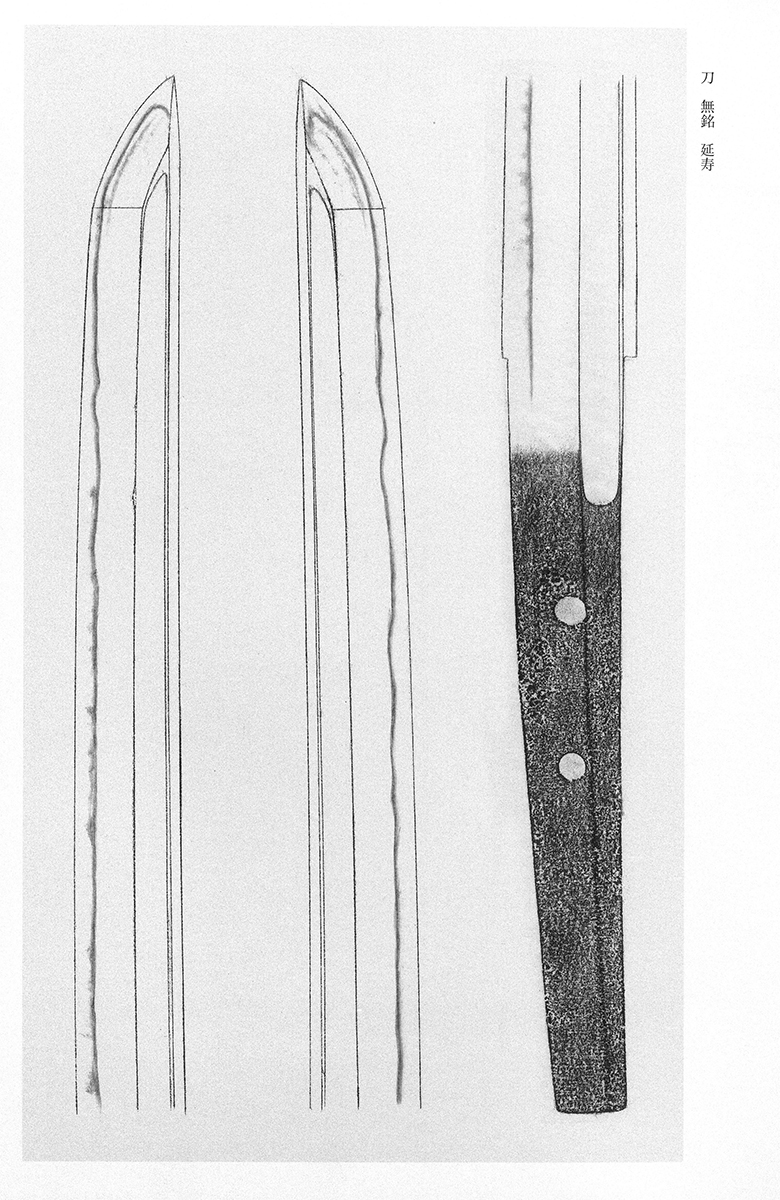
Description Keijō: , ; standard; somewhat pronounced difference between base and tip widths; high; somewhat deep with a -like tendency; with an extended impression. : tightly forged; thickly applied; fine ; a faint, whitish appears. : Based on with a shallow -tinge; slightly mixed with a -like flavor; the becomes somewhat narrower in the upper half; enter; the tends toward tightness and is well covered with ; with a slight tendency to , mixed with uchi-noke; on the around the a faint appears. : Straight, forming a rounded tip with a shallow return; shows a -like effect, and the point becomes . : On both sides, with . : ; tip an extremely shallow ; ; two ; .
Artisan school
Era Late period to period ( Province)
Explanation The group of Province is said to have originated with Tarō Kunimura, traditionally regarded as a grandson in the line of Kuniyuki of Yamashiro. Many capable smiths emerged within the group—Kuniyoshi, Kunitoki, Kunitai, Kunitomo, Kunisuke, Kuninobu, Kunitsuna, and others—and from the end of the period through the period they flourished greatly in Kumafu (Kikuchi District) in that province.
In style, the individual personalities of their works are not strongly differentiated; broadly speaking they resemble the Yamashiro school. Nevertheless, certain points of distinction are observed: the forging often incorporates flowing among the grain and shows conspicuous whitish ; the in the tends somewhat toward (subdued) and the internal activities within the hardened area are calmer; and in the the rounded portion at the tip is slightly larger, while the return is tempered shallow—features regarded as key points for recognizing this school.
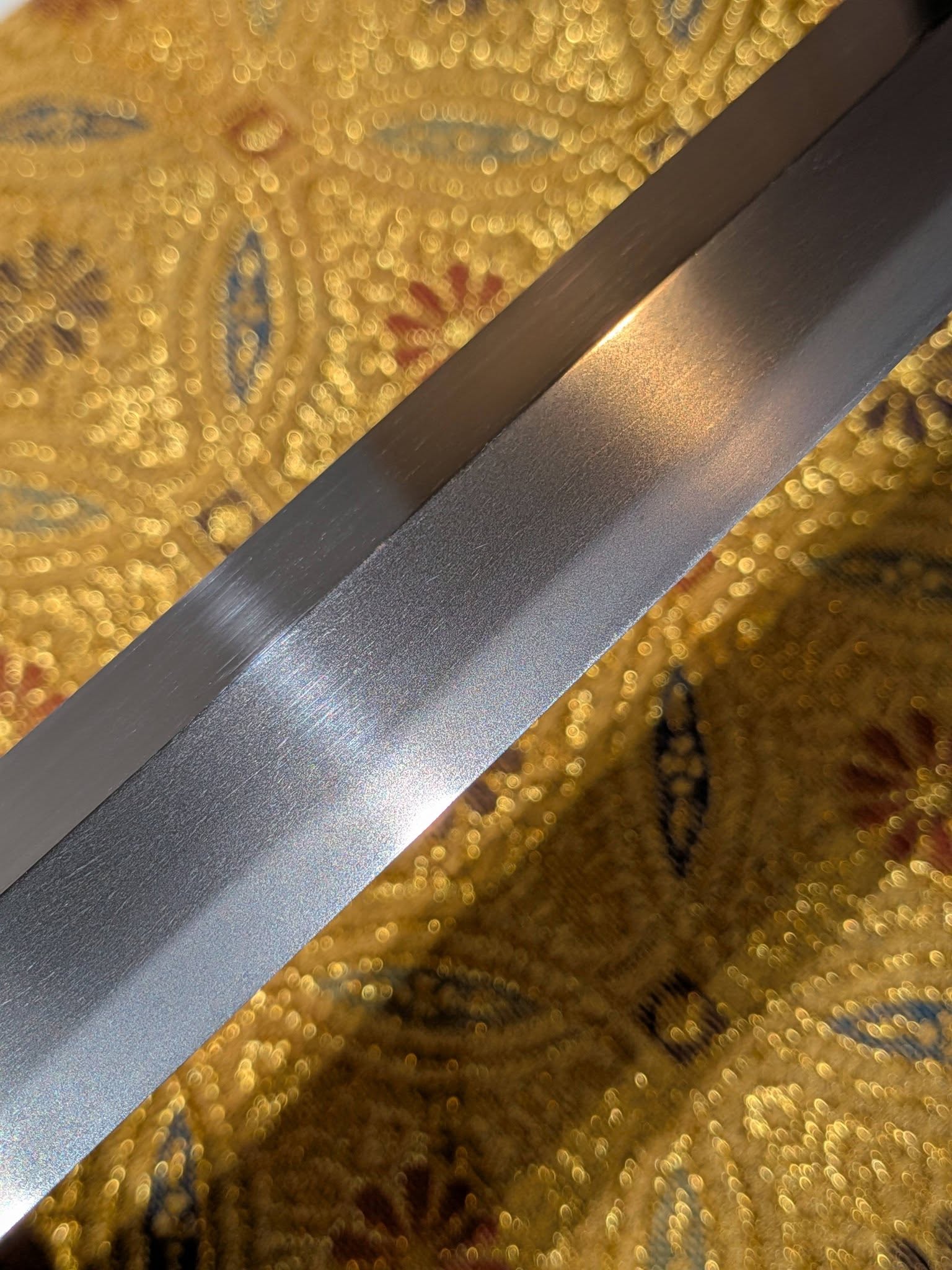
This shows a tightly forged with thickly applied , together with a faint whitish . The is based on with a shallow flavor, slightly mixed with a -like element and containing ; the has a tight tendency with well-adhering . Furthermore, along the edge and in the one can discern the -like effect often seen in this group. Accordingly, it clearly demonstrates the characteristic features of the school, and the traditional attribution is fully acceptable.
This is a well-made blade representing an attribution, and it is particularly noteworthy for the exceptional quality of its forging, which is superior by an additional degree.