The curved, ridged tachi took its classic form in the Heian provinces while the court refined its culture in the capital. Its patrons were the military nobility whose feuds ended in the Genpei War, and whose blades became heirlooms almost at once.
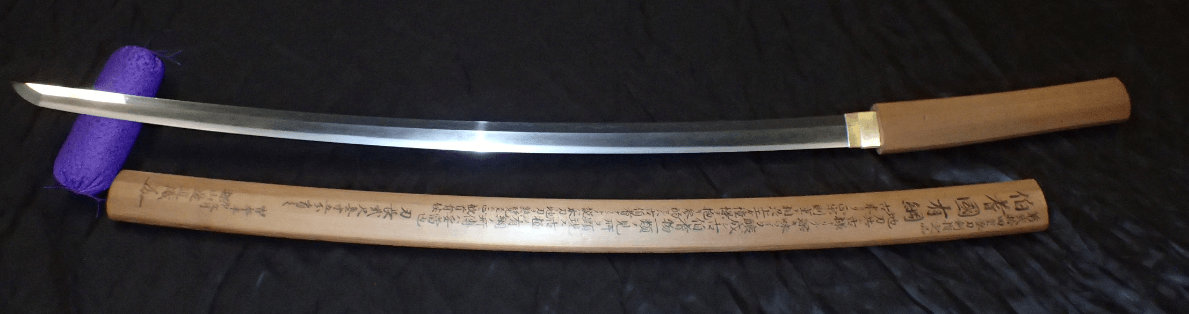
This is a masterpiece katana by Kohouki Sadatsuna, grandson of Yasutsuna, from the late Heian period (around Genryaku era). It features an Ayasugi-style jigane with frequent chikei and midare-utsuri, a suguha-style hamon with small midare and gunome, and abundant nie and kinsuji. The blade is a kuge-tachi style with a slightly narrow mihaba, koshizori, and small kissaki.
 NihontoWatch
mumei · Kohouki · Heian · nagasa 66.6cm · sori 1.6cm
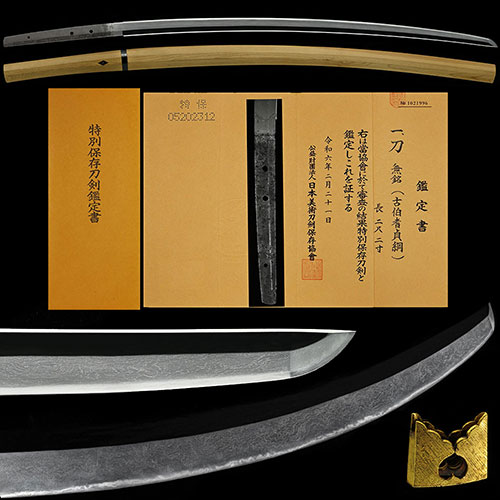

Ko-Hoki (Yasutsuna lineage, Hoki province) · Hoki · around 1184-1185
Tōken Taikan top 3%
Sadatsuna worked in Hōki province in the late Heian and early Kamakura periods, one of the small group of smiths the published sources gather around Yasutsuna and call Ko-Hōki. The same commentary that names that circle, listing Yasutsuna with Sanemori, traditionally his son, and the related smiths Aritsuna, Sadatsuna, Yasuie and Sanekage, also records, on the authority of the Meikan, that Sadatsuna himself was a son of Ōhara Sanemori. What it does not give him is quantity. Signed work by his hand is, in the recurring phrase of the designation papers, exceedingly few, so that his record reaches us in two distinct registers: a body of unsigned blades judged to be his in the mainstream Ko-Hōki manner, and a handful of signed tachi the judges hold apart as something finer.
The larger register, the one the unsigned attributions carry, is the rustic Ko-Hōki hand the published sources describe whenever they place a blade with this group. The forging is itame in a large pattern, frequently mixed with ō-itame and mokume, the grain standing open; thick ji-nie gathers in it, chikei enter, jifu and a faint patchy utsuri drift across the steel, and the kane itself takes a dark, iron-grey cast. Over that jigane the temper rests on a suguha base broken into ko-midare and small ko-gunome, with ashi and yō entering, the nie thick and locally strong, the habuchi frayed into hotsure, and bright kinsuji, nie-suji and sunagashi running insistently through the edge. The defining quality is not the pattern but its mood: the nioiguchi is clouded and sunken, urumi and shizumi-gokoro, never the clear bright line of Bizen. Several blades drop their temper above the machi in a yaki-otoshi, and the bōshi runs straight to a small ko-maru or sweeps with hakikake.
The jigane and the clouded edge together are the tell, and the judges return to them precisely because the work is so easily confused with something else. Their manner, the published sources note, tempers a small irregular line that resembles the contemporary Ko-Bizen of the same years, a temper they describe with the phrase "resembling the small-midare style of the Ko-Bizen works"[[c:1]]. Looked at closely, the resemblance breaks: where the Ko-Bizen steel is bright and tight, Sadatsuna's stands open and dark, his itame large-patterned and conspicuous, his edge soft and subdued with kinsuji and sunagashi working through it. From this the group is read as something rougher and more provincial, what the commentary calls a more rustic, untrammeled character. His own bright jifu-utsuri and the dark, standing jigane set him apart, not by any single signature flourish but by the whole temper of the steel.
The second register is the small set of signed tachi the judges single out, and it inverts the picture. Here the forging tightens, the itame packing closer with its mokume, and instead of a faint patchy reflection a vivid midare-utsuri or jifu-utsuri stands clearly in the ji. The temper brightens and leans toward Bizen, a suguha-toned line opening into ko-chōji, small chōji and ko-midare with ko-gunome, ashi and yō entering frequently, slight tobiyaki and shimaba in the upper half, and the nioiguchi turning tight and clear rather than clouded. Of the Tokubetsu Jūyō tachi the judges write that it shows "a refined manner exceptional not only for Sadatsuna himself but within the whole group"[[c:2]]; of another, that it is "an outstanding piece not only among Sadatsuna's works but within the school"[[c:3]]. These are the same hand caught at its most controlled, and they are what make the unsigned attributions legible, the bright, varied edge and the somewhat wide, powerful shape recurring on signed and mumei work alike.
What ties the registers together, and what has unsettled his place in the schools, is the tang. On blade after blade the yasurime are ō-sujikai, the steeply slanted file marks, and the two-character signature is cut bold and archaic with a thick chisel. Those file marks, the published sources observe, are not found on Yasutsuna or Sanemori but do appear on Aritsuna of the same line, so they read as a thread binding Sadatsuna into the lineage. The same feature is a characteristic of the Aoe school, and on its strength the commentary records a standing view that he should be placed with Aoe; one early Jūyō paper, judging from the sugata, the fine jigane and the florid temper, wondered whether the blade might belong to the Ko-Aoe group and left the question to later research. The settled judgment weighs that possibility but does not accept it, concluding that, taking the workmanship and the signature characters together, "it is appropriate to regard the work as Ko-Hōki"[[c:4]].
For a collector Sadatsuna is, before anything else, a rare early name. He has no National Treasures and no Important Cultural Properties; his record runs entirely through the modern designations, two tachi at the Tokubetsu Jūyō rank and seventeen blades at Jūyō, nineteen in those two tiers in all. Of the signed tachi the published commentary calls one "an outstanding piece among the same maker's works, transmitted in the Tokugawa shogunal house"[[c:5]], and a long unsigned tachi bears a later dedicatory inscription to the Konpira shrine in Sanuki; of one of the finest mumei katana the judges write that it shows "a particularly outstanding level of workmanship even among attributions to Sadatsuna"[[c:6]]. The Tōkō Taikan values him at a high level among recorded smiths. Almost nothing of his trades: the designated blades are held in shrines, museums and long-private collections, and because signed examples are so few, a signed Ko-Hōki Sadatsuna comes to light only seldom and a privately held one is a rare thing to encounter, a document of how the Hōki tradition forged its dark, rustic steel at the very dawn of the Japanese sword.
Where Sadatsuna stands among comparable artisans: across all of nihontō, and within tradition, era, and period. The tiers (Foremost · Leading · Major · Notable) weigh official designations from the NBTHK and Japan's Agency for Cultural Affairs, together with historical honors of lasting repute such as the Sansaku and Meibutsu-chō.
Select a lens to see how it's measured.
Wakimono · Hoki
Phase: Ko-Hoki古伯耆· 966–1334
4 pieces on the market now
Ko-Hoki occupies the deepest stratum of the school, the chapter in which the Hoki name first enters the record at all. The published commentary places Yasutsuna roughly contemporary with Sanjo Munechika in the late Heian period, correcting the older reference-book dating that pushed him back to the Daido era (806 to 810), and the gap between that legend and the inferred reality is itself a measure of how far back this phase reaches. Gathered around Yasutsuna is the Ohara group: Masamori (read also as Sanemori), transmitted as his son, with Aritsuna, Sadatsuna, Yasuie and Masakage (Sanekage) named beside him, a circle the setsumei describes as flourishing from the late Heian into the early Kamakura period. Hoki Kunimune extends the manner toward the Kamakura age, his work judged to stand apart from Bizen Saburo Kunimune and possibly to predate him. Signed survivals at this antiquity are thin, more frequent under Yasutsuna than any other hand, and the meibutsu Dojigiri Yasutsuna fixes the period's highest reference. The style of this phase is read first in the steel. The setsumei return blade after blade to itame with standing grain, mixed with o-itame and mokume in large pattern, thick ji-nie, entering chikei and patchy jifu that rises into jifu-utsuri or midare-utsuri across a ground of darkish, blackish (kanai-iro) tone. The temper rests on a suguha base broken into ko-midare, with ko-choji, ko-gunome and shallow ko-notare mingled small in scale, the nie lying thick and the nioiguchi tending to urumi or shizumi; kinsuji and sunagashi run insistently, and many blades drop the edge above the machi in yakiotoshi.
The sugata keeps an archaic koshizori tachi form with funbari and a small kissaki, the boshi running straight to ko-maru or yakizume. Against the later Sue-Hoki the contrast is one of vigor and individuality: where the late phase settles this rustic register into something tamer and more regular, Ko-Hoki stands open, dark and forceful, each hand still distinct, Yasutsuna's midare running larger while Sadatsuna's finest signed work brightens unusually toward Bizen. For kantei the recurring task is to separate Hoki from Ko-Bizen, whose contemporaneous ko-midare it superficially resembles. The setsumei draw the line on close view: Ko-Bizen steel is bright and tight, while the Hoki ji stands open and dark with conspicuous large itame, a clouded nioiguchi, and kinsuji and sunagashi working through a softer provincial edge that carries an ancient fragrance (koko). A thread of Yamato spirit is read in certain pieces, such as the unsigned Yasutsuna long held in the Maeda house, and Sadatsuna's o-sujikai yasurime point toward Aoe even as judgment keeps him in Ko-Hoki. Yasutsuna and Masamori head the phase, and the signature habit of cutting tsuna (綱) larger than yasu (安) and shifted to the right is a noted diagnostic. The Dojigiri stands above the named works, with the Imperial Yasunori tachi and Sadatsuna and Kunimune blades transmitted through the Tokugawa, the Satake of Dewa, and the Hisamatsu-Matsudaira, the provenance running through the houses that held the country. Learn more →
| Smith | Era | Designated |
|---|---|---|
| Yasutsuna安綱 | 987-1150 | 35 |
| Ohara大原 | 987-1596 | 16 |
| Sadatsuna貞綱 | 1184-1185 | 19 |
| Hiroyoshi廣賀 | 1532-1565 | 6 |
| Aritsuna有綱 | 1181-1182 | 5 |
The Heian period (794 to 1185)
The curved, ridged tachi took its classic form in the Heian provinces while the court refined its culture in the capital. Its patrons were the military nobility whose feuds ended in the Genpei War, and whose blades became heirlooms almost at once.
A Hozon-certified blade judged to show notably superior workmanship and a better state of preservation. The bar is higher: re-tempered blades and most unsigned Muromachi/Edo works are excluded.
The NBTHK (Nihon Bijutsu Tōken Hozon Kyōkai, the Society for the Preservation of Japanese Art Swords) is a public-interest incorporated foundation founded in 1948 and supervised by Japan’s Agency for Cultural Affairs (Bunkachō); it is based at the Japanese Sword Museum in Tokyo. Its expert panels physically examine each submitted work (shinsa) and issue a certificate (kanteishō) ranking it by artistic and historical merit. NBTHK papers are the most widely recognized standard of authentication for Japanese swords and fittings.
NBTHK official siteReturns/exchanges/cancellations not accepted after shipment except for significant defects; if defective, return/exchange possible within 3 days of arrival (return shipping paid by customer).
This is a masterpiece katana by Kohouki Sadatsuna, grandson of Yasutsuna, from the late Heian period (around Genryaku era). It features an Ayasugi-style jigane with frequent chikei and midare-utsuri, a suguha-style hamon with small midare and gunome, and abundant nie and kinsuji. The blade is a kuge-tachi style with a slightly narrow mihaba, koshizori, and small kissaki.
NihontoWatchmumei · Kohouki · Heian · nagasa 66.6cm · sori 1.6cm
Ko-Hoki (Yasutsuna lineage, Hoki province) · Hoki · around 1184-1185
Tōken Taikan top 3%
Sadatsuna worked in Hōki province in the late Heian and early Kamakura periods, one of the small group of smiths the published sources gather around Yasutsuna and call Ko-Hōki. The same commentary that names that circle, listing Yasutsuna with Sanemori, traditionally his son, and the related smiths Aritsuna, Sadatsuna, Yasuie and Sanekage, also records, on the authority of the Meikan, that Sadatsuna himself was a son of Ōhara Sanemori. What it does not give him is quantity. Signed work by his hand is, in the recurring phrase of the designation papers, exceedingly few, so that his record reaches us in two distinct registers: a body of unsigned blades judged to be his in the mainstream Ko-Hōki manner, and a handful of signed tachi the judges hold apart as something finer.
The larger register, the one the unsigned attributions carry, is the rustic Ko-Hōki hand the published sources describe whenever they place a blade with this group. The forging is itame in a large pattern, frequently mixed with ō-itame and mokume, the grain standing open; thick ji-nie gathers in it, chikei enter, jifu and a faint patchy utsuri drift across the steel, and the kane itself takes a dark, iron-grey cast. Over that jigane the temper rests on a suguha base broken into ko-midare and small ko-gunome, with ashi and yō entering, the nie thick and locally strong, the habuchi frayed into hotsure, and bright kinsuji, nie-suji and sunagashi running insistently through the edge. The defining quality is not the pattern but its mood: the nioiguchi is clouded and sunken, urumi and shizumi-gokoro, never the clear bright line of Bizen. Several blades drop their temper above the machi in a yaki-otoshi, and the bōshi runs straight to a small ko-maru or sweeps with hakikake.
The jigane and the clouded edge together are the tell, and the judges return to them precisely because the work is so easily confused with something else. Their manner, the published sources note, tempers a small irregular line that resembles the contemporary Ko-Bizen of the same years, a temper they describe with the phrase "resembling the small-midare style of the Ko-Bizen works"[[c:1]]. Looked at closely, the resemblance breaks: where the Ko-Bizen steel is bright and tight, Sadatsuna's stands open and dark, his itame large-patterned and conspicuous, his edge soft and subdued with kinsuji and sunagashi working through it. From this the group is read as something rougher and more provincial, what the commentary calls a more rustic, untrammeled character. His own bright jifu-utsuri and the dark, standing jigane set him apart, not by any single signature flourish but by the whole temper of the steel.
The second register is the small set of signed tachi the judges single out, and it inverts the picture. Here the forging tightens, the itame packing closer with its mokume, and instead of a faint patchy reflection a vivid midare-utsuri or jifu-utsuri stands clearly in the ji. The temper brightens and leans toward Bizen, a suguha-toned line opening into ko-chōji, small chōji and ko-midare with ko-gunome, ashi and yō entering frequently, slight tobiyaki and shimaba in the upper half, and the nioiguchi turning tight and clear rather than clouded. Of the Tokubetsu Jūyō tachi the judges write that it shows "a refined manner exceptional not only for Sadatsuna himself but within the whole group"[[c:2]]; of another, that it is "an outstanding piece not only among Sadatsuna's works but within the school"[[c:3]]. These are the same hand caught at its most controlled, and they are what make the unsigned attributions legible, the bright, varied edge and the somewhat wide, powerful shape recurring on signed and mumei work alike.
What ties the registers together, and what has unsettled his place in the schools, is the tang. On blade after blade the yasurime are ō-sujikai, the steeply slanted file marks, and the two-character signature is cut bold and archaic with a thick chisel. Those file marks, the published sources observe, are not found on Yasutsuna or Sanemori but do appear on Aritsuna of the same line, so they read as a thread binding Sadatsuna into the lineage. The same feature is a characteristic of the Aoe school, and on its strength the commentary records a standing view that he should be placed with Aoe; one early Jūyō paper, judging from the sugata, the fine jigane and the florid temper, wondered whether the blade might belong to the Ko-Aoe group and left the question to later research. The settled judgment weighs that possibility but does not accept it, concluding that, taking the workmanship and the signature characters together, "it is appropriate to regard the work as Ko-Hōki"[[c:4]].
For a collector Sadatsuna is, before anything else, a rare early name. He has no National Treasures and no Important Cultural Properties; his record runs entirely through the modern designations, two tachi at the Tokubetsu Jūyō rank and seventeen blades at Jūyō, nineteen in those two tiers in all. Of the signed tachi the published commentary calls one "an outstanding piece among the same maker's works, transmitted in the Tokugawa shogunal house"[[c:5]], and a long unsigned tachi bears a later dedicatory inscription to the Konpira shrine in Sanuki; of one of the finest mumei katana the judges write that it shows "a particularly outstanding level of workmanship even among attributions to Sadatsuna"[[c:6]]. The Tōkō Taikan values him at a high level among recorded smiths. Almost nothing of his trades: the designated blades are held in shrines, museums and long-private collections, and because signed examples are so few, a signed Ko-Hōki Sadatsuna comes to light only seldom and a privately held one is a rare thing to encounter, a document of how the Hōki tradition forged its dark, rustic steel at the very dawn of the Japanese sword.
Where Sadatsuna stands among comparable artisans: across all of nihontō, and within tradition, era, and period. The tiers (Foremost · Leading · Major · Notable) weigh official designations from the NBTHK and Japan's Agency for Cultural Affairs, together with historical honors of lasting repute such as the Sansaku and Meibutsu-chō.
Select a lens to see how it's measured.
Wakimono · Hoki
Phase: Ko-Hoki古伯耆· 966–1334
4 pieces on the market now
Ko-Hoki occupies the deepest stratum of the school, the chapter in which the Hoki name first enters the record at all. The published commentary places Yasutsuna roughly contemporary with Sanjo Munechika in the late Heian period, correcting the older reference-book dating that pushed him back to the Daido era (806 to 810), and the gap between that legend and the inferred reality is itself a measure of how far back this phase reaches. Gathered around Yasutsuna is the Ohara group: Masamori (read also as Sanemori), transmitted as his son, with Aritsuna, Sadatsuna, Yasuie and Masakage (Sanekage) named beside him, a circle the setsumei describes as flourishing from the late Heian into the early Kamakura period. Hoki Kunimune extends the manner toward the Kamakura age, his work judged to stand apart from Bizen Saburo Kunimune and possibly to predate him. Signed survivals at this antiquity are thin, more frequent under Yasutsuna than any other hand, and the meibutsu Dojigiri Yasutsuna fixes the period's highest reference. The style of this phase is read first in the steel. The setsumei return blade after blade to itame with standing grain, mixed with o-itame and mokume in large pattern, thick ji-nie, entering chikei and patchy jifu that rises into jifu-utsuri or midare-utsuri across a ground of darkish, blackish (kanai-iro) tone. The temper rests on a suguha base broken into ko-midare, with ko-choji, ko-gunome and shallow ko-notare mingled small in scale, the nie lying thick and the nioiguchi tending to urumi or shizumi; kinsuji and sunagashi run insistently, and many blades drop the edge above the machi in yakiotoshi.
The sugata keeps an archaic koshizori tachi form with funbari and a small kissaki, the boshi running straight to ko-maru or yakizume. Against the later Sue-Hoki the contrast is one of vigor and individuality: where the late phase settles this rustic register into something tamer and more regular, Ko-Hoki stands open, dark and forceful, each hand still distinct, Yasutsuna's midare running larger while Sadatsuna's finest signed work brightens unusually toward Bizen. For kantei the recurring task is to separate Hoki from Ko-Bizen, whose contemporaneous ko-midare it superficially resembles. The setsumei draw the line on close view: Ko-Bizen steel is bright and tight, while the Hoki ji stands open and dark with conspicuous large itame, a clouded nioiguchi, and kinsuji and sunagashi working through a softer provincial edge that carries an ancient fragrance (koko). A thread of Yamato spirit is read in certain pieces, such as the unsigned Yasutsuna long held in the Maeda house, and Sadatsuna's o-sujikai yasurime point toward Aoe even as judgment keeps him in Ko-Hoki. Yasutsuna and Masamori head the phase, and the signature habit of cutting tsuna (綱) larger than yasu (安) and shifted to the right is a noted diagnostic. The Dojigiri stands above the named works, with the Imperial Yasunori tachi and Sadatsuna and Kunimune blades transmitted through the Tokugawa, the Satake of Dewa, and the Hisamatsu-Matsudaira, the provenance running through the houses that held the country. Learn more →
| Smith | Era | Designated |
|---|---|---|
| Yasutsuna安綱 | 987-1150 | 35 |
| Ohara大原 | 987-1596 | 16 |
| Sadatsuna貞綱 | 1184-1185 | 19 |
| Hiroyoshi廣賀 | 1532-1565 | 6 |
| Aritsuna有綱 | 1181-1182 | 5 |
The Heian period (794 to 1185)
The curved, ridged tachi took its classic form in the Heian provinces while the court refined its culture in the capital. Its patrons were the military nobility whose feuds ended in the Genpei War, and whose blades became heirlooms almost at once.
A Hozon-certified blade judged to show notably superior workmanship and a better state of preservation. The bar is higher: re-tempered blades and most unsigned Muromachi/Edo works are excluded.
The NBTHK (Nihon Bijutsu Tōken Hozon Kyōkai, the Society for the Preservation of Japanese Art Swords) is a public-interest incorporated foundation founded in 1948 and supervised by Japan’s Agency for Cultural Affairs (Bunkachō); it is based at the Japanese Sword Museum in Tokyo. Its expert panels physically examine each submitted work (shinsa) and issue a certificate (kanteishō) ranking it by artistic and historical merit. NBTHK papers are the most widely recognized standard of authentication for Japanese swords and fittings.
NBTHK official siteReturns/exchanges/cancellations not accepted after shipment except for significant defects; if defective, return/exchange possible within 3 days of arrival (return shipping paid by customer).