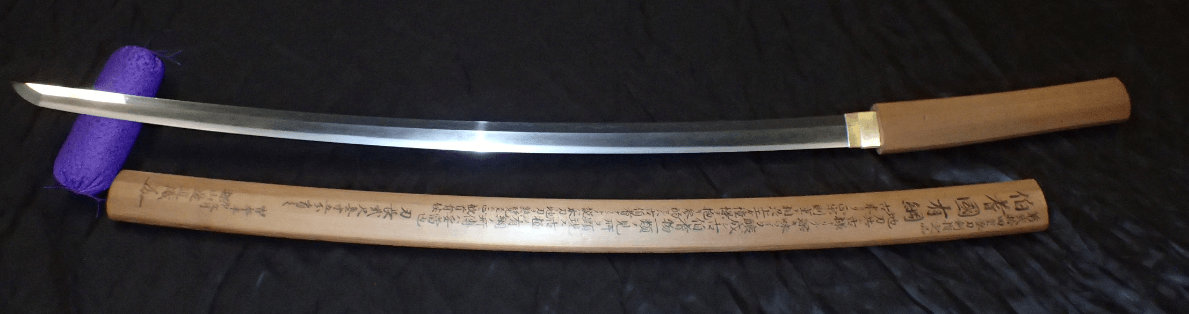
Nearly every entry the has published on Yasutsuna of Hoki returns to the anchor: the existence of the Dojigiri Yasutsuna, the sources write, "has further elevated his renown," and within his oeuvre that sword remains the most celebrated of his name. Yasutsuna is the representative smith of Ko-Hoki, the old school of Hoki province, and he stands in the oldest stratum of the curved Japanese sword. The sword registries transmit an active period around the Daido era (806 to 810), but the published record consistently lowers the dating: judging from the surviving work, he reads as a smith of the late period, roughly contemporary with Munechika, and one earlier designation places him around the Eien era (987 to 989). A entry of 1962 fixes his historical position exactly, calling his age the time when the sword was passing from the straight chokuto to the curved , and when that new form had, for the time being, settled into a standard shape. Other entries call him "a renowned master from the earliest phase of true curved swords" and a celebrated master representing the very beginnings of the Japanese sword. Among the Ko-Hoki smiths his signed works survive in comparatively large numbers, so that, almost alone at this depth of antiquity, his hand can be studied from the inscription as well as from the steel.
His keep the classical silhouette of the period. The blade is typically slender, the high with pronounced , and the width narrows toward a small . The sources single out one point of the form again and again: compared with work, the tendency of his blades to incline downward toward the tip is not especially conspicuous, and this restraint of the upper curve is named a distinctive trait of his shaping. A few works run larger, and the of the Satake line is noted as being of bigger, more robust construction than what is commonly encountered from him.
The carries the deepest part of his identity. He forges mixed with and , and the stands out. Thick covers it, and enter, and the steel itself shows a darkish color (黒み) out of which a rises. Over that dark steel he tempers a -laden on a base of shallow and . Within it , and mingle conspicuously, and weave through the , and on many blades the temper is dropped above the in (焼落し). It is this combination that the published sources contrast with old , writing that his workmanship "differs somewhat in feeling from groups such as ." The runs to a small or to , often swept with . Within the school the published record also isolates a personal tell: in the upper half of the the and mix in a somewhat independent form, a point one entry names as the place where Yasutsuna is distinguished even among Ko-Hoki.
The signature is its own field of study. He cut a large two-character on the toward the , and the habit of his chisel is recorded in entry after entry: the character is larger than the character and is set slightly to the right, his signing habit (手癖), one seen in other Ko-Hoki works as well. The benchmark is the Dojigiri itself; of one the sources state that the manner of the signature is "exactly like that of the Dojigiri Yasutsuna," and a Bijutsuhin entry judges another similar to the Dojigiri. surviving with the unaltered are extremely few, and an signed Yasutsuna is counted exceedingly precious in the published record. Beside the prime manner the documents a quieter register. One signed , in which the and recede, is read as an appearance rather close to work and expressly called one style register of the smith; another, in a more subdued dressing, is still betrayed by the abundant vertical workings along the . The unsigned remainder, blades, are accepted on the archaic elegance (古雅) of their and : one carries the of Koon dated 4 (1664), another the of Koyu dated Kanpo 3 (1743), and the handed down in the Maeda house, carrying a thread of Yamato spirit, has its tradition affirmed.
His manner is, in effect, the definition of Ko-Hoki. The school is read through him: the standing dark , the and the -charged small with its form the axis along which the published sources set Hoki apart from old , and unsigned blades of sufficient age and flavor gather to his name as Yasutsuna. Even the signing habit extends beyond him, since the rightward-set recurs elsewhere in the school. The published record treats him as a single late master, with no division into generations, and so presents him plainly as the first fully formed personality of the curved sword, working at the moment the itself was being settled.
Fujishiro grades him Sai-jo . Thirty-five designated works stand on record. Two are National Treasures and five are Important Cultural Properties, patrimony preserved beyond any market, and six more were certified Bijutsuhin between 1933 and 1941, then in the hands of the Satake, Sakai, Matsudaira and Ikeda houses, of the shrine Tsuboi Hachimangu, and of the Maeda; the Ikeda blade had been shortened in the Bakumatsu period by Sukehira, probably for the wear of the himself. Thirteen of his blades carry recorded provenance, and the roll runs through the men and houses that held the country: Toyotomi Hideyoshi, Tokugawa Ieyasu and Tokugawa Hidetada, the Matsudaira line, the Shimazu, the Imperial Family, and the Satake of Kubota in Dewa, who handed down two of his signed . Of recorded whereabouts today, his blades rest with the Tokyo National Museum, the Sano Art Museum and Ogamiyama Jinja, and one has crossed the sea to the Boston Museum of Fine Arts. For the private collector the realistic horizon is the and tiers, twenty-one blades in all, most of them long held; a Yasutsuna of any kind comes to the market only rarely, and a signed example, let alone an one, is among the rarest encounters the field can offer.