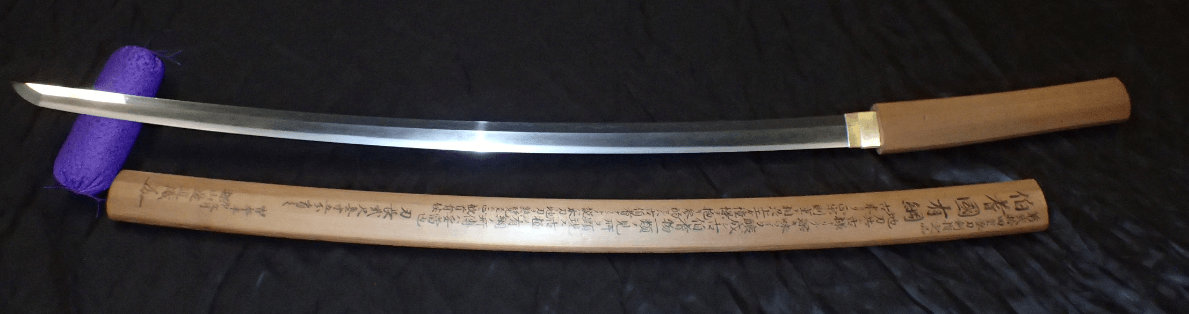
Hiroyoshi of Hoki Province, who signed himself Mita Gorozaemon no Jo, worked at Tsuwara through the Tenbun and Eiroku eras of the late period, and the dated of Tenbun 2 (1533), cut on the with an age inscription reading that it was made at sixty-one years, is regarded as the earliest dated work of his hand. The name Hiroyoshi, read Hiroga, first appears in Hoki around the Bunmei era and runs over several generations of the signature down into the period, the line dividing into a Doso-o house that forged at the Kajimachi district of Kurayoshi and the Mita house of this smith, who resided at Tsuwara and later worked between Tsuwara and Kurayoshi. The published sources transmit him as a pupil of the smith Tsunahiro, 「相州綱広の門人と伝え」, so that what reaches this corner of the San'in coast with him is the late manner of the age, carried into a province better known for Mount Daisen than for its forges. Among the several smiths who signed Hoshu Hiroga, the published sources judge those signing Mita Gorozaemon no Jo to be the most skillful, 「見田五郎左衛門尉と銘するものが特に上手である」, and they place him with Wakasa Fuyuhiro as a representative maker of the San'in region in the late period.
The feature that most distinguishes his work is that it is two hands rather than one, a duality the published sources state outright. His blades, they write, divide into those of a -influenced character and those showing a -like style, 「相州風のものと、備前風のものと」, and certain pieces incorporate aspects of both the late and late lineages, 「末相州と末備前両派のおもむきが加味されたもの」. The side is the fuller register, a large , at times a koshi-hiraki or an base showing a compound, double-structured feeling. - and enter thickly, frequent builds into , and the temper is well filled with , threaded with and a little . The -toned side is the calmer one, a broad into which are mixed, carrying and with adhering and touched in. The follows the temper beneath it, running over the irregular work and turning back deeply, an -like feeling continuing down the into , while over the straighter temper it goes straight to a rounded turnback with a long .
Under both manners lies one , a tightly forged with fine densely adhering, mixed in places with and crossed by , and on the largest of the a faint whitish rises in the . On the Eiroku 8 the carries intermingled , the patchy steel that gives the late San'in work its particular look, and in the the opens conspicuously into on both faces. The published sources draw attention to this directly, observing that within his steel there is a rustic flavor and a darkened, bronzy tone, 「かな色に黒味あるものがあってそこがこの派の見どころともなっている」, and they make this character of and one of the chief attractions of the group rather than a defect of provincial forging. The over it is rich in on the pieces and bright with and over the , and on the the base carries a shallow with about the waist, the hardened width broadening above the with a suggestion of .
The is as legible as the temper. His are with and an extended , one a high- blade with deep , another with at the base, the form the published sources call a quintessential . The is , wide of and thick of with a receding , the yoroi-doshi shape made for piercing armor, and it carries a on the and on the . Every recorded blade is and every one is long-signed toward the , most often the full Mita Gorozaemon no Jo Hiroga title with an Eiroku or Tenbun date, and at times a patron's name or, on the Tenbun , an age inscription, so that his record is unusually precise in its dating. Those dated works span from Tenbun 5 (1536) through Genki 3 (1572), and the present blades carry Tenbun 2, Eiroku 1, Eiroku 4 and Eiroku 8 dates, fixing his activity firmly across the middle and third quarter of the sixteenth century.
Within the broader Hiroga name his place is that of the prized Mita branch, the hand the published commentary singles out for skill while the Doso-o house and the later -name generations stand around it. The comparisons the sources draw are to his contemporaries rather than to his teacher. His Eiroku is judged in no way inferior to the works of the contemporaneous group, 「末備前派の作などに比して遜色がな」い, and his style is set close to Kiyomitsu, Wakasa Fuyuhiro and Bungo Munekage, the working smiths of the decade across the San'in and Sanyo provinces. What sets his own blades apart within that company is grounded in their own description, the passing into on the side and the broad over a darkened, -flecked on the -toned side, not in any borrowed resemblance. The manner he descends from Tsunahiro he carries as a provincial idiom, harder and more rustic than the metropolitan work, and it is that rustic note, named in the sources, that identifies the group.
The connoisseurship around Hiroyoshi is that of a skilled provincial master rather than a celebrated name. The reference texts place him at Jo- in Fujishiro's ranking and at four hundred points in the Toko Taikan, the assessment of a competent and collectible smith well below the first rank of the age. He holds no National Treasures and no Important Cultural Properties, and his designated record stands at five blades, all at the level, none yet risen to . Provenance, where it survives, is real and worth naming. A of his came down from Ukita Hideie into the Maeda family, the Eiroku 8 was long dedicated to Hiroto Shrine in Banshu, for which it was made to a patron's order, and a Mita Gorozaemon is recorded in the Imperial collection. The remaining holders on record are private. For a collector this places him within reach in a way the great and names are not. A signed, Hiroga of the wide with its and , or one of the broad of the calmer manner, is the kind of dated, legible late- work that comes to market from time to time and rewards a patient eye, a sound blade by the most skilled hand of the Hoki Hiroga line.