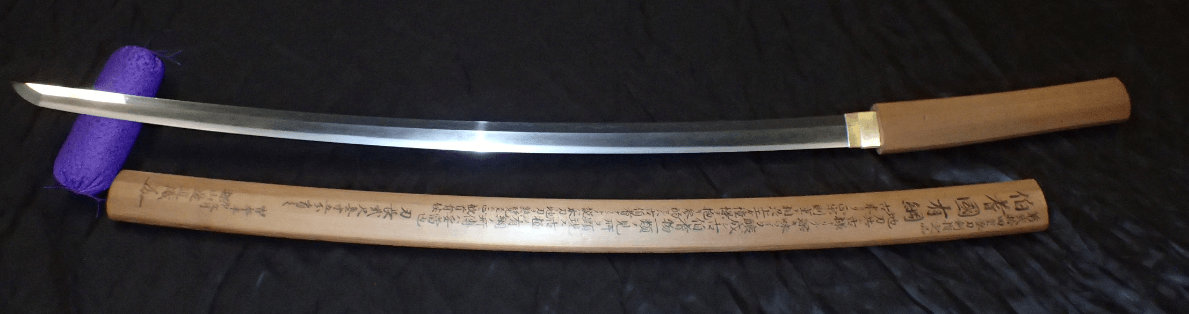
Sadatsuna worked in Hōki province in the late and early periods, one of the small group of smiths the published sources gather around Yasutsuna and call Ko-Hōki. The commentary that names that circle, listing Yasutsuna with Sanemori, traditionally his son, and the related smiths Aritsuna, Sadatsuna, Yasuie and Sanekage, also records, on the authority of the , that Sadatsuna himself was a son of Ōhara Sanemori. What it does not give him is quantity. Signed work by his hand is, in the recurring phrase of the designation papers, exceedingly few, so that his record reaches us in two distinct registers: a body of unsigned blades judged to be his in the mainstream Ko-Hōki manner, and a handful of signed the judges hold apart as something finer.
The larger register, the one the unsigned attributions carry, is the rustic Ko-Hōki hand the published sources describe whenever they place a blade with this group. The forging is in a large pattern, frequently mixed with and , the grain standing open; thick gathers in it, enter, and a faint patchy drift across the steel, and the itself takes a dark, iron-grey cast. Over that the temper rests on a base broken into and small , with and entering, the thick and locally strong, the frayed into , and bright , and running insistently through the edge. The defining quality is not the pattern but its mood: the is clouded and sunken, and , never the clear bright line of . Several blades drop their temper above the in a -otoshi, and the runs straight to a small or sweeps with .
The and the clouded edge together are the tell, and the judges return to them precisely because the work is so easily confused with something else. Their manner, the published sources note, tempers a small irregular line that resembles the contemporary of the years, a temper they describe with the phrase "resembling the small- style of the works". Looked at closely, the resemblance breaks: where the steel is bright and tight, Sadatsuna's stands open and dark, his large-patterned and conspicuous, his edge soft and subdued with and working through it. From this the group is read as something rougher and more provincial, what the commentary calls a more rustic, untrammeled character. His own bright and the dark, standing set him apart, not by any single signature flourish but by the whole temper of the steel.
The second register is the small set of signed the judges single out, and it inverts the picture. Here the forging tightens, the packing closer with its , and instead of a faint patchy reflection a vivid or stands clearly in the . The temper brightens and leans toward , a -toned line opening into , small and with , and entering frequently, slight and in the upper half, and the turning tight and clear rather than clouded. Of the the judges write that it shows "a refined manner exceptional not only for Sadatsuna himself but within the whole group"; of another, that it is "an outstanding piece not only among Sadatsuna's works but within the school". These are the hand caught at its most controlled, and they are what make the unsigned attributions legible, the bright, varied edge and the somewhat wide, powerful shape recurring on signed and work alike.
What ties the registers together, and what has unsettled his place in the schools, is the tang. On blade after blade the are , the steeply slanted file marks, and the two-character signature is cut bold and archaic with a thick chisel. Those file marks, the published sources observe, are not found on Yasutsuna or Sanemori but do appear on Aritsuna of the line, so they read as a thread binding Sadatsuna into the lineage. The feature is a characteristic of the school, and on its strength the commentary records a standing view that he should be placed with ; one early paper, judging from the , the fine and the florid temper, wondered whether the blade might belong to the group and left the question to later research. The settled judgment weighs that possibility but does not accept it, concluding that, taking the workmanship and the signature characters together, "it is appropriate to regard the work as Ko-Hōki".
For a collector Sadatsuna is, before anything else, a rare early name. He has no National Treasures and no Important Cultural Properties; his record runs entirely through the modern designations, two at the rank and seventeen blades at , nineteen in those two tiers in all. Of the signed the published commentary calls one "an outstanding piece among the maker's works, transmitted in the Tokugawa shogunal house", and a long unsigned bears a later dedicatory inscription to the Konpira shrine in Sanuki; of one of the finest the judges write that it shows "a particularly outstanding level of workmanship even among attributions to Sadatsuna". The Tōkō Taikan values him at a high level among recorded smiths. Almost nothing of his trades: the designated blades are held in shrines, museums and long-private collections, and because signed examples are so few, a signed Ko-Hōki Sadatsuna comes to light only seldom and a privately held one is a rare thing to encounter, a document of how the Hōki tradition forged its dark, rustic steel at the very dawn of the Japanese sword.