NihontoWatch MonNihontoWatchBETA
MarketEncyclopedia
NihontoWatch Mon

NihontoWatchBETA

Market
Encyclopedia
Overview·Kantei·Designations·Provenance·Blade Forms·Signatures·Lineage·School
OverviewKanteiDesignationsProvenanceBlade FormsSignaturesLineageSchool
  1. Schools
  2. Hoki
  3. Ko-Hoki
  4. Sadatsuna

Hoki Sadatsuna

貞綱

Tokujū
Vol. 8, No. 29 · Tachi

Hoki Sadatsuna

貞綱

19 ranked works

ProvinceHokiEraGenryaku (1184–1185)PeriodKamakuraSchoolHokiTraditionWakimonoToko Taikan1,800(top 3%)TypeSwordsmithCodeSAD793
2Tokubetsu Jūyō17Jūyō Tōken

Overview

Sadatsuna worked in Hōki province in the late and early periods, one of the small group of smiths the published sources gather around Yasutsuna and call Ko-Hōki. The commentary that names that circle, listing Yasutsuna with Sanemori, traditionally his son, and the related smiths Aritsuna, Sadatsuna, Yasuie and Sanekage, also records, on the authority of the , that Sadatsuna himself was a son of Ōhara Sanemori. What it does not give him is quantity. Signed work by his hand is, in the recurring phrase of the designation papers, exceedingly few, so that his record reaches us in two distinct registers: a body of unsigned blades judged to be his in the mainstream Ko-Hōki manner, and a handful of signed the judges hold apart as something finer.

The larger register, the one the unsigned attributions carry, is the rustic Ko-Hōki hand the published sources describe whenever they place a blade with this group. The forging is in a large pattern, frequently mixed with and , the grain standing open; thick gathers in it, enter, and a faint patchy drift across the steel, and the itself takes a dark, iron-grey cast. Over that the temper rests on a base broken into and small , with and entering, the thick and locally strong, the frayed into , and bright , and running insistently through the edge. The defining quality is not the pattern but its mood: the is clouded and sunken, and , never the clear bright line of . Several blades drop their temper above the in a -otoshi, and the runs straight to a small or sweeps with .

The and the clouded edge together are the tell, and the judges return to them precisely because the work is so easily confused with something else. Their manner, the published sources note, tempers a small irregular line that resembles the contemporary of the years, a temper they describe with the phrase "resembling the small- style of the works" (古備前物に類似した小乱れ調). Looked at closely, the resemblance breaks: where the steel is bright and tight, Sadatsuna's stands open and dark, his large-patterned and conspicuous, his edge soft and subdued with and working through it. From this the group is read as something rougher and more provincial, what the commentary calls a more rustic, untrammeled character. His own bright and the dark, standing set him apart, not by any single signature flourish but by the whole temper of the steel.

The second register is the small set of signed the judges single out, and it inverts the picture. Here the forging tightens, the packing closer with its , and instead of a faint patchy reflection a vivid or stands clearly in the . The temper brightens and leans toward , a -toned line opening into , small and with , and entering frequently, slight and in the upper half, and the turning tight and clear rather than clouded. Of the the judges write that it shows "a refined manner exceptional not only for Sadatsuna himself but within the whole group" (同工のみならず同派の中でも異例の垢抜けた作風を示しており); of another, that it is "an outstanding piece not only among Sadatsuna's works but within the school" (貞綱のみならず同派の出色の一口である). These are the hand caught at its most controlled, and they are what make the unsigned attributions legible, the bright, varied edge and the somewhat wide, powerful shape recurring on signed and work alike.

What ties the registers together, and what has unsettled his place in the schools, is the tang. On blade after blade the are , the steeply slanted file marks, and the two-character signature is cut bold and archaic with a thick chisel. Those file marks, the published sources observe, are not found on Yasutsuna or Sanemori but do appear on Aritsuna of the line, so they read as a thread binding Sadatsuna into the lineage. The feature is a characteristic of the school, and on its strength the commentary records a standing view that he should be placed with ; one early paper, judging from the , the fine and the florid temper, wondered whether the blade might belong to the group and left the question to later research. The settled judgment weighs that possibility but does not accept it, concluding that, taking the workmanship and the signature characters together, "it is appropriate to regard the work as Ko-Hōki" (古伯耆物と捉えるのが妥当であろう).

For a collector Sadatsuna is, before anything else, a rare early name. He has no National Treasures and no Important Cultural Properties; his record runs entirely through the modern designations, two at the rank and seventeen blades at , nineteen in those two tiers in all. Of the signed the published commentary calls one "an outstanding piece among the maker's works, transmitted in the Tokugawa shogunal house" (同作中傑出の一口であり、徳川将軍家伝来である), and a long unsigned bears a later dedicatory inscription to the Konpira shrine in Sanuki; of one of the finest the judges write that it shows "a particularly outstanding level of workmanship even among attributions to Sadatsuna" (貞綱極めの中でも特に傑出した出来映えをあらわしている). The Tōkō Taikan values him at a high level among recorded smiths. Almost nothing of his trades: the designated blades are held in shrines, museums and long-private collections, and because signed examples are so few, a signed Ko-Hōki Sadatsuna comes to light only seldom and a privately held one is a rare thing to encounter, a document of how the Hōki tradition forged its dark, rustic steel at the very dawn of the Japanese sword.
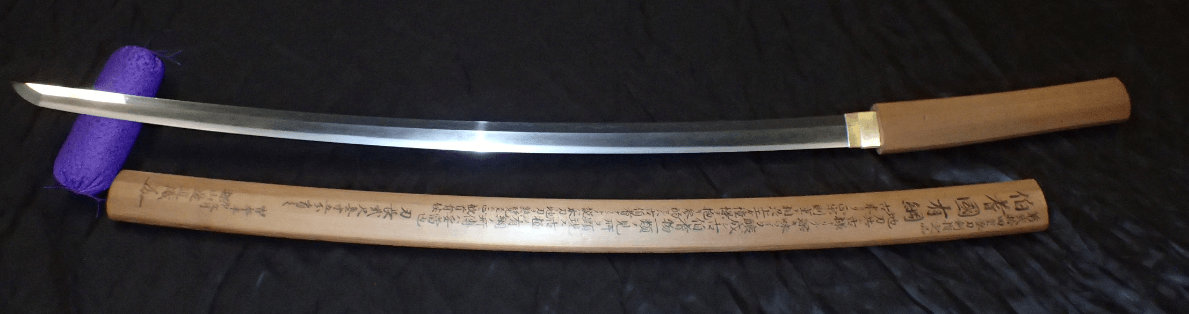
Kantei

two registers of one Ko-Hoki hand: the mainstream rustic manner of standing large itame, darkish steel and a clouded, subdued suguha-based ko-midare carrying frequent kinsuji and sunagashi, set against a small group of exceptional signed tachi where the forging tightens, the utsuri stands clear and a brighter ko-choji temper turns tight and bright

Sadatsuna is a Ko-Hoki smith of the late Heian to early Kamakura period, counted within the Yasutsuna lineage of Hoki and traditionally recorded in the Meikan as the son of Ohara Sanemori. His extant signed work is exceedingly rare, so his record is read in two registers. The mainstream Ko-Hoki manner, carried on most of the mumei katana attributed to him, forges a standing large itame with mokume, ji-nie thick and chikei entering, jifu and a faint jifu-utsuri, the steel darkish in tone, over which he tempers a suguha-based ko-midare with ashi and yo, the nioiguchi clouded and subdued, with kinsuji, nie-suji and sunagashi running insistently and the habuchi frayed, the boshi straight to a small round or swept. The other register is his small group of exceptional signed tachi, several at the Tokubetsu Juyo rank, where the forging tightens and a clear midare-utsuri or jifu-utsuri rises, the temper turns to a brighter ko-choji and ko-midare with the nioiguchi tight and clear, and the work is judged unusually refined and polished not only for Sadatsuna but for the whole group. Across both he carves a bold, archaic two-character signature with steeply slanted o-sujikai file marks, a feature the published sources also find on Aritsuna of this line and which has fed a standing debate over whether he should be placed with Aoe.

Diagnostic discriminators

unique vs his own mainstream rustic mumei (faint jifu-utsuri at most)

Observation by phase

The mainstream Ko-Hoki manner (the rustic mumei attributions)

Most of the work attributed to Sadatsuna is mumei katana judged Ko-Hoki, and on them the published sources draw the school's defining picture. The forging is itame in a large pattern, often mixed with o-itame and mokume, the grain standing, ji-nie thick and minute, chikei entering well, jifu and a faint jifu-utsuri intermingled, the steel taking a darkish, iron-like tone. Over it the temper rests on a suguha base with ko-midare and ko-gunome, ashi and yo entering, the nie thick and locally strong, the habuchi frayed and the ha-hada standing, with kinsuji, nie-suji and sunagashi running insistently and the nioiguchi clouded and subdued; several show a yaki-otoshi above the machi. The boshi runs straight to a small round, sometimes swept or flame-toned. The sources caution that this manner can be mistaken for contemporaneous Ko-Bizen, but is told apart by its standing large itame, its blackish steel and its softly clouded, sunken nioiguchi, a more rustic character. Within the group these are assigned specifically to Sadatsuna by the brighter, more varied temper and the somewhat wide, powerful shape his signed work also shows.

Sugata 姿
Jigane 地鉄
Hamon 刃文
Bōshi 帽子

The exceptional signed tachi (the tightened, brighter register)

A small number of signed tachi, several papered to the Tokubetsu Juyo and Juyo ranks, form his exceptional register, and the published sources hold them up as unusually refined for the group. Here the forging tightens, the itame mixed with mokume packing closer, and a vivid midare-utsuri or jifu-utsuri stands clear, ji-nie fine and dense. The temper turns brighter and more Bizen-leaning, a suguha-toned line opening into ko-choji, small choji and ko-midare with ko-gunome, ashi and yo entering frequently, slight tobiyaki and shimaba in the upper half, ko-nie laid in deep nioi, and the nioiguchi tight and clear rather than clouded. The boshi enters midare with a hint of nijuba, turning back shallowly. The sources call these works tighter in forging, with the utsuri standing vividly and the temper bright and polished, an outstanding manner not only for Sadatsuna but across the whole Yasutsuna group, and they note the two-character signature is cut bold and archaic with a thick chisel.

Sugata 姿
Jigane 地鉄
Hamon 刃文
Bōshi 帽子
Scholarship

The published sources record that the steeply slanted o-sujikai file marks of Sadatsuna are a feature of the Aoe school, and that on this ground there is a view placing him within the Aoe lineage; while granting the possibility cannot be wholly dismissed, they hold that, taking the workmanship and the signature characters together, it is appropriate to regard his work as Ko-Hoki.

On one early signed tachi the published sources, judging from the tachi shape, the fine jigane and the florid hamon, noted that it might instead belong to the Ko-Aoe group and left the question to future research, a measure of how few signed Sadatsuna survive and how unsettled the early reading of his hand was.

Designations

Kokuhō—
Jūyō Bunkazai—
Jūyō Bijutsuhin—
Gyobutsu—
Tokubetsu Jūyō2
Jūyō Tōken17

Elite Standing

0.12 across 19 designated works

Top 16% among smiths

Provenance

2 documented provenances across certified works by Sadatsuna

Provenance Standing

1 works held in elite collections across 2 documented provenances

Top 86% among smiths

Raw score: 1.81 / 10

Blade Forms

Distribution across 19 ranked works

Signatures

Signature types across 19 ranked works

Currently Available

Lineage

Sadatsuna
Students (2)
  1. 1.Sanemune眞宗
  2. 2.Yoshimori吉守

Hoki School

Other artisans of the Hoki school

  1. 1.Yasutsuna安綱35designated
  2. 2.Ohara大原16designated
  3. 3.Kunimune國宗6designated
  4. 4.Hiroyoshi廣賀1 for sale6designated
  5. 5.Aritsuna有綱1 for sale5designated
  6. 6.Sanekage眞景4designated
  7. 7.Yasuie安家1designated
  8. 8.Sadanawa貞繩1designated
  9. 9.Sukenaga助長1designated
  10. 10.Tomoyasu友安1designated
  11. 11.Narichika成近1designated
  12. 12.Morihiro守廣1designated